I recently talked with a friend who’s planning to schedule a screening of Blade Runner at her film festival. We discussed the important decision that anyone who wants to show Ridley Scott’s Philip K. Dick-adapting masterpiece faces: which Blade Runner? Seven different official cuts exist: many would instinctively choose the 2007 “final cut,” some might prefer the 1992 “director’s cut,” and a curious minority might even like to see the cut originally released in U.S. theaters in 1982, featuring the Harrison Ford voiceover and happy ending that fans now consider ruinous.
But now we have yet another cut of Blade Runner, perhaps the most unusual of them all: a “new” version made out of shots that, even if you’ve seen every official cut of the film, you may never have seen before. “Some enterprising souls have compiled a B‑roll cut of the film, using all of the excised footage that was not incorporated in the previous cuts,” writes Nerdist’s Joseph McCabe. “There’s so much here that most Blade Runner fans have not seen before that it’s absolutely required viewing. I found it worth watching all forty-five minutes just to hear Edward James Olmos’ gruff Gaff hilariously exclaim, ‘I spit on metaphysics!’ ” Not to mention all the new views of the picture’s still-striking production design.
That running time, over an hour shorter than every other cut, effectively condenses Blade Runner into a short film. It doesn’t play quite like any of the widely seen versions of the film, even though it retains the hated narration and incongruous Hollywood ending of the American theatrical cut. But the elements that feel clunky, over-explanatory, and audience-distrusting in a two-hour Blade Runner somehow work better in this briefer rendition. (Certainly Ford’s voiceover, awkward though it always sounds, helps this trimmed-down story cohere.) You haven’t really seen Blade Runner, so many who love the movie feel,until you’ve seen every Blade Runner — but even now, I don’t think we’ve seen the last of them.
Isaac Asimov, one of the most prolific creators in science-fiction history, wrote or edited more than 500 books in his lifetime, including the high-profile ones we all recognize like I, Robot and the Foundation series (hear a version dramatized here). But which piece of this massive body of work did Asimov himself consider his favorite? Always a fan of clarity, the man didn’t leave that issue shrouded in mystery: the honor belongs to “The Last Question,” which first appeared in the November 1956 issue of Science Fiction Quarterly. It’s now available inIsaac Asimov: The Complete Stories, Vol. 1.
“Why is it my favorite?” Asimov later wrote. “For one thing I got the idea all at once and didn’t have to fiddle with it; and I wrote it in white-heat and scarcely had to change a word. This sort of thing endears any story to any writer.” But it also had, and continues to have, “the strangest effect on my readers. Frequently someone writes to ask me if I can give them the name of a story, which they ‘think’ I may have written, and tell them where to find it. They don’t remember the title but when they describe the story it is invariably ‘The Last Question.’ ”
You certainly won’t forget who wrote the story if you can hear it read by Leonard Nimoy, surely the most distinctive sci-fi narrator of our time, in the video just above. Nimoy first read “The Last Question” aloud for an adaptation staged at Michigan State University’s Abrams Planetarium in 1966, a production that first moved Asimov himself to consider ranking its source material among his best works. Of course, the story would have received none of this retrospective attention, from its author or others, if not for its intellectual content, which comes through vividly no matter how you take it in.
Look past the more entertainingly dated elements — expressions like “for Pete’s sake,” enormous central computers that print all their output on paper slips, an early reference to “highballs” — and you find plenty of elements that qualify as eternal: the ever more rapid expansion of humanity, the ever more rapid progress of technology, and the seemingly ever-faltering ability of the former to maintain dominance over the latter. Within the story’s nine pages, Asimov even digs into scientific concepts like entropy and the heat death of the universe as well as philosophical concepts like the true nature of “forever” and the origin of life, the universe, and everything. If you read only one of Asimov’s stories, he’d surely approve if you made it “The Last Question.” (And if you read two, why not “The Last Answer”?). Find these readings added to our collection, 1,000 Free Audio Books: Download Great Books for Free.
Looking for free, professionally-read audio books from Audible.com, including ones written by Isaac Asimov? Here’s a great, no-strings-attached deal. If you start a 30 day free trial with Audible.com, you can download two free audio books of your choice. Get more details on the offer here.
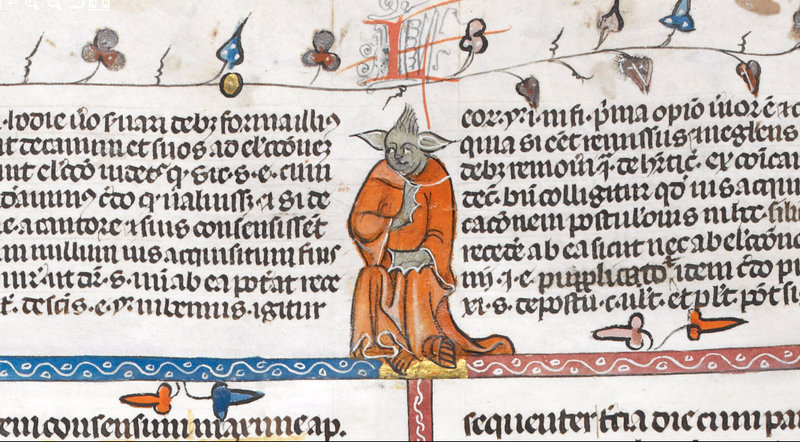
In a new picture book called Medieval Monsters, published by the British Library, historian Damien Kempf and art historian Maria L. Gilbert have gathered together illustrations that highlight the great monsters of the medieval world. Monsters were everywhere, including “on the edges of manuscript pages” and on “the fringes of maps.” The successor to Medieval Cats and Medieval Dogs, Medieval Monsterscontains no shortage of fascinating illustrations, including the one above. It looks remarkably like Yoda, doesn’t it?
A British Library curator told NPR, “The Yoda image comes from a 14th-century manuscript known as the Smithfield Decretals.” “I’d love to say that it really was Yoda, or was drawn by a medieval time traveler.” But “it’s actually an illustration to the biblical story of Samson — the artist clearly had a vivid imagination!”
The Earth, it seems, has only one truly unlimited resource: enthusiasm for Star Wars. Not even The Phantom Menace, the derision magnet that opened the film series’ newer trilogy, made a serious dent in our reserves. But did everyone who got together in the 1970s to make the very first Star Wars movie, from George Lucas on down the chain of command, understand how deep a vein of fandom they had drilled into? The Making of Star Wars, a 1977 documentary on that beloved space opera-turned-cultural phenomenon, will give you some idea.
Now that Star Wars has generated such a universe, if you like, of supplementary content, one more 50-minute behind-the-scenes special might strike you as no great shakes. But when The Making of Star Wars appeared in ’77, it appeared as the first documentary about Star Wars ever. And it has much higher ambitions than the average promotional short of the day, featuring not only cast and crew interviews but segments on the (decidedly pre-CGI) effects technology employed in the production.
Even the most dedicated Star Wars buffs will still find material of interest here, including footage that never made it into the picture’s theatrical cut, and footage reintroduced into 1997’s revamped “Special Edition” of the original trilogy but altered with CGI (another drain on several generation’s Star Wars love). But many of us will watch The Making of Star Wars on one of its strengths alone: C‑3PO and R2-D2 host the whole thing. Could even those precision-engineered droids have foreseen the thunderous reception that has met this year’s brand new teasers for Star Wars: The Force Awakens?
Whether they consider it one of her most or least important works, fans of science-fiction writer Ursula K. Le Guin usually have a great deal to say about her best-known novel, 1969’s The Left Hand of Darkness. But it doesn’t matter to me whether a book has won a Hugo or a Nebula — and The Left Hand of Darkness has won both — or how many readers — and The Left Hand of Darkness has many — have slapped on it the label of “masterpiece.” No, I only get intrigued by descriptions like the one Wikipedia puts in its opening paragraph on the novel, which calls it “the most famous examination of sexless androgyny in science fiction.”
Among its many other fascinating qualities, The Left Hand of Darkness takes place on an alien world with no fixed sexes, performing a narrative “thought experiment” about what kind of society you might get when, depending on the circumstances, anyone might reproduce with anyone else. This unusual concept has drawn the attention of not only generations of readers but several different adaptors, most recently the BBC. They’ve always done a redoubtable job converting imaginative literature into radio drama — take their recent version of Neil Gaiman’s Neverwhere, or their classic one of Douglas Adams’ The Hitchhiker’s Guide to the Galaxy, considered by many fans better than the book. Now they’ve set their sights on Le Guin’s award-winner.
The first episode of the BBC’s Left Hand of Darkness has already aired, and you can hear it free online for about a month at the show’s site. (It runs almost an hour.) Episode two is now online here. You can get a taste of the production from the promotional video at the top of the post; the one just above gives a scrap of insight as to how Le Guin came to envision the novel’s world. Personally, I need no further incentive to tune in than that the series features Toby Jones, whose presence (usually in film) reliably indicates a just-askew-enough cultural experience. And if you still feel wary about engaging with any kind of science fiction, know that even Harold Bloom really, really liked the book.
It didn’t take long for Star Wars (1977) to start spinning off fan films. Just a year after the space opera hit American cinemas, Jonathan Crow tells us, “San Francisco filmmaker Ernie Fosselius had the brainwave to make a spoof.” And, as it turns out, the 13-minute film, made for $8,000, “became a pre-internet viral hit and a staple on the festival circuit, ultimately earning over $1,000,000 – an unheard of haul for a short film.” It’s called Hardware Wars, and you can find it in our archive.
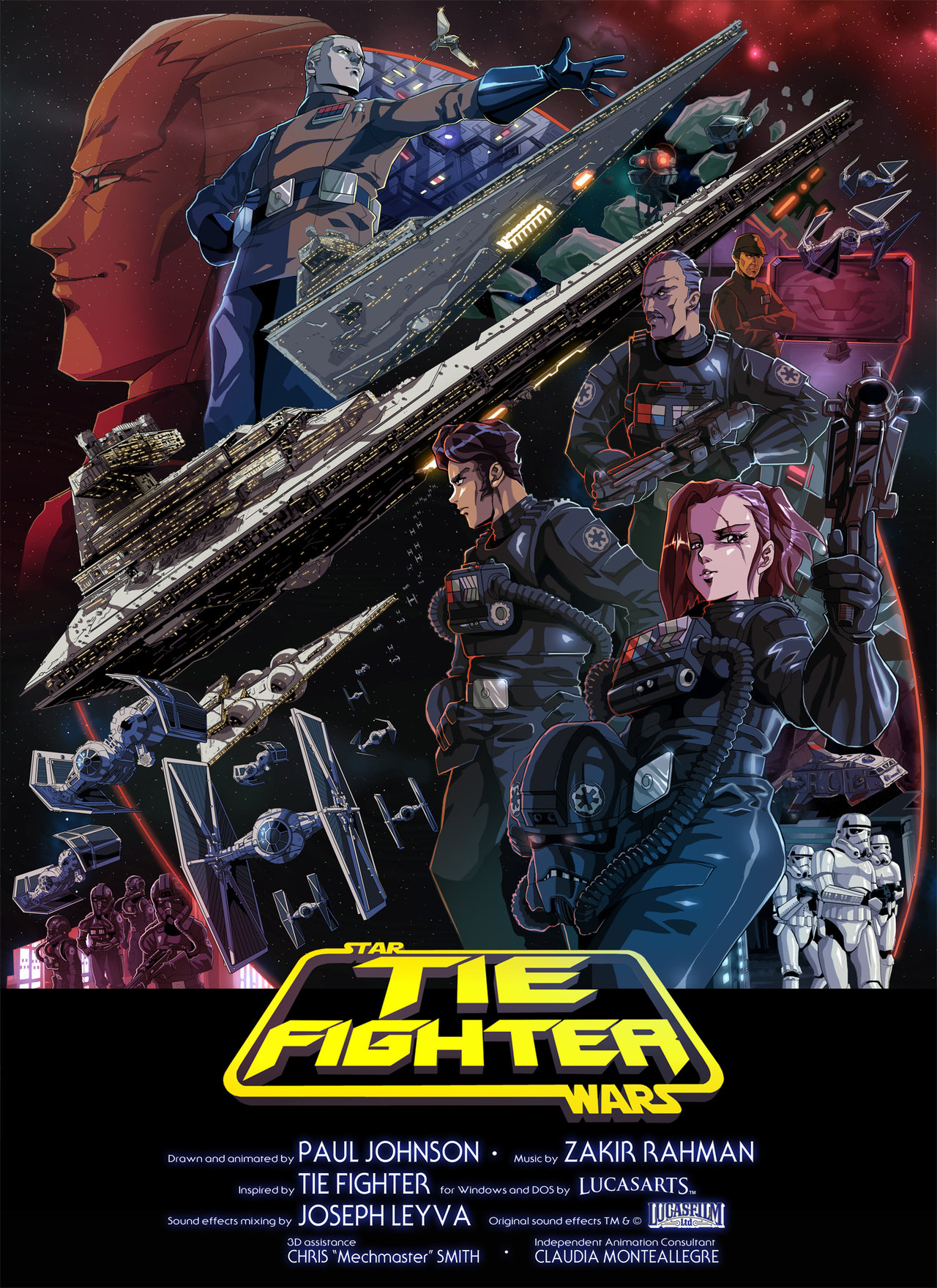
Star Wars fan films have kept coming ever since. Right through today. The latest is TIE Fighter (above). Drawn by Paul Johnson over a four-year period, the video adopts an anime style, made famous by the Japanese during the 1980s, and it tells the Star Wars story (or at least part of it), from the perspective of the Empire. A PDF of the story can be read online here. Find the official poster here.
Philip K. Dick died in 1982, but readers — more readers than ever, in all probability — still thrill to his daring, unconventional imagination, and how tightly he could weave the inventions of that imagination into mundane reality. (Sometimes they wonder, as in his meeting with God, to what extent he himself could tell the two apart.) And like many strong-visioned writers of what roughly fell into the category of science fiction, Dick got consulted now and again as something of a futurist.
In 1980, David Wallechinsky, Amy Wallace, and Irving Wallace (the Book of Lists people) rounded up visions of the future from all manner of sages past and present, prescient and incompetent, in order to create The Book of Predictions. Dick’s contributions, republished in the September 2003 issue of fanzine PKD Otaku, go like this.
1983: The Soviet Union will develop an operational particle-beam accelerator, making missile attack against that country impossible. At the same time the U.S.S.R. will deploy this weapon as a satellite killer. The U.S. will turn, then, to nerve gas.
1984: The U.S. will perfect a system by which hydrogen, stored in metal hydrides, will serve as a fuel source, eliminating a need for oil.
1985: By or before this date there will be a titanic nuclear accident either in the U.S.S.R. or in the U.S., resulting in shutting down all nuclear power plants.
1986: Such satellites as HEAO‑2 will uncover vast, unsuspected high energy phenomenon in the universe, indicating that there is sufficient mass to collapse the universe back when it has reached its expansion limit.
1989: The U.S. and the Soviet Union will agree to set up one vast metacomputer as a central source for information available to the entire world; this will be essential due to the huge amount of information coming into existence.
1993: An artificial life form will be created in a lab, probably in the U.S.S.R., thus reducing our interest in locating life forms on other planets.
1995: Computer use by ordinary citizens (already available in 1980) will transform the public from passive viewers of TV into mentally alert, highly trained, information-processing experts.
1997: The first closed-dome colonies will be successfully established on Luna and Mars. Through DNA modification, quasi-mutant humans will be created who can survive under non-Terran conditions, i.e., alien environments.
1998: The Soviet Union will test a propulsion drive that moves a starship at the velocity of light; a pilot ship will set out for Proxima Centaurus, soon to be followed by an American ship.
2000: An alien virus, brought back by an interplanetary ship, will decimate the population of Earth, but leave the colonies on Luna and Mars intact.
2012: Using tachyons (particles that move backward in time) as a carrier, the Soviet Union will attempt to alter the past with scientific information.
Cherry-pickers among us will fixate on Dick’s near-hits: the development of DNA modification, a 1985 nuclear accident in the U.S.S.R. (Chernobyl happened in 1986), and computer use by ordinary citizens (though our status as “mentally alert, highly trained, information-processing experts” admittedly remains questionable). Others might prefer to highlight the most improbable, such as the eliminated need for oil, the creation of artificial life, and not just the 21st-century existence but eventual time-traveling capabilities of the Soviet Union.
Still, even in his fiction, Dick does have his moments of prophecy, especially for those who share his paranoia that we’ve unwittingly let ourselves slip into surveillance-state conditions. But I’ve always found him best, especially in the what-if-Japan-won-the-war story The Man in the High Castle, as a teller of alternate histories, whether of the past, present, or future. These predictions, stretching from just after the writer’s death to just before our time, strike me as nothing so much as the premises for the best novel Philip K. Dick never wrote.
We're hoping to rely on loyal readers, rather than erratic ads. Please click the Donate button and support Open Culture. You can use Paypal, Venmo, Patreon, even Crypto! We thank you!
Open Culture scours the web for the best educational media. We find the free courses and audio books you need, the language lessons & educational videos you want, and plenty of enlightenment in between.