Here’s a zinger to mull over: The BBC has posted an article about a theory advanced by Oliver Curry, an “evolutionary theorist” working out of The London School of Economics, who suggests that humanity may split into two sub-species about 100,000 years down the road. And what we’d be left with is “a genetic upper class” ruling over “a dim-witted underclass.” This is a scenario, of course, that HG Wells laid out in his 1895 classic, The Time Machine (listen to free audiobook on iTunes here). And, if Curry’s theory holds water, Welles may offer the most extreme example of science fiction anticipating the shape of the future. Does Curry’s theory have anything to it? We haven’t the foggiest. But does it make for strangely compelling yet disturbing reading? It sure does.
Today, Elizabeth Green Musselman has penned a guest blog post that you’re bound to enjoy. Elizabeth is a professor and historian who works on the history of science, and she has recently launched a thoughtful podcast on the history of science, medicine, and technology. It’s called “The Missing Link” (iTunes — Feed — Web Site). Below, she highlights for us a range of podcasts that will appeal to everyday science enthusiasts. (If you’re interested in doing some guest blogging, drop us a line.) Thanks Elizabeth and take it away:
These can seem like dark days for those people who love science but who neither specialize in the field nor can quite stomach the gee-whiz factor that plagues so much popular science writing and broadcasting. Now that Stephen Jay Gould is cavorting somewhere in the Beyond with Charles Darwin, and ever since the New York Academy of Sciences put the ax to its inspired magazine The Sciences, where is a levelheaded lover of the sciences to turn?
The podcast world has begun to develop a niche market for just such listeners, that is, listeners who like their science relatively non-technical but still high-minded – listeners who think of science as a part of human culture, rather than an arcane temple. Not surprisingly, some of the best content comes from radio programs that have been re-released as podcasts. These include WNYC’s RadioLab, an hour-long show whose serious investigations on a theme (such as sleep or mortality) take on an intriguingly funhouse quality through the program’s inventive use of sound and the humorous interaction between co-hosts Jad Abumrad and Robert Krulwich. NPR has also released Krulwich’s solo reports in podcast form as Hmmm… Krulwich on Science.
Another longstanding NPR favorite, The Engines of Our Ingenuity, began broadcasting brief, thoughtful reflections on technology and culture in 1988. Written and hosted by John Lienhard, a retired professor of mechanical engineering and history at the University of Houston, the show now airs five days a week on 30 NPR affiliates in the U.S. The brief programs are also available in podcast form.
On the other side of the pond, the BBC 4’s long-running, popular show, In Our Time, frequently considers scientific topics and can also be heard in podcast form. Most recently, the program explored antimatter. On each hour-long program the host, Melvyn Bragg, keeps a panel of three scholars moving at a pace that skirts neatly between brisk and contemplative.
Finally, several podcasts produced by individuals have begun to appear, each of which considers science in context. Exploring Environmental History features Jan Oosthoek’s smart interviews with his fellow environmental historians and scientists, often focusing on how historical study can point us toward stronger environmental policy solutions. The most recent episode considers Arctic climate conditions both today and in the Little Ice Age. My own monthly podcast, The Missing Link, considers those fascinating moments in the history of science, medicine, and technology, when our intellectual and technical prowess rubs up against our very human dreams and failings. The most recent episode visits Berlin, Germany, where the gruesomeness of a pathology museum’s collection masks a centuries-long history of both inequitable medical care and brilliant microbiological research. The program also discusses the Berlin Phonogram Archive, one of the first attempts to record the world’s music for posterity, designed originally to demonstrate the evolutionary scale of primitive to civilized humanity.
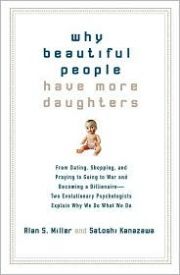
Human behavior is notoriously complex, and there’s been no shortage of psychologists and psychological theories venturing to explain what makes us tick. Why do we get irrationally jealous? Or have midlife crises? Why do we overeat to our own detriment? Why do we find ourselves often strongly attracted to certain physical traits? Numerous theories abound, but few are perhaps as novel and thought-provoking as those suggested by a new book with a long title: Why Beautiful People Have More Daughters: From Dating, Shopping, and Praying to Going to War and Becoming a Billionaire — Two Evolutionary Psychologists Explain Why We Do What We Do. Written by Satoshi Kanazawa and Alan S. Miller, the book finds answers not in ids, egos and superegos, but in the evolution of the human brain. Written in snappy prose, their argument is essentially that our behavior — our wants, desires and impulses — are overwhelmingly shaped by the way our brain evolved 10,000+ years ago, and one consequence is that our ancestral brain is often responding to a world long ago disappeared, not the modern, fast-changing world in which we live. This disconnect can lead us to be out of sync, to act in ways that seem inexplicable or counter-productive, even to ourselves. These arguments belong to new field called “evolutionary psychology,” and we were fortunate to interview Satoshi Kanazawa (London School of Economics) and delve further into evolutionary psychology and the (sometimes dispiriting) issues it raises. Have a read, check out the book, and also see the related piece that the Freakonomics folks recently did on this book. Please note that the full interview continues after the jump.
DC: In a nutshell, what is “evolutionary psychology”? (e.g. when did the field emerge? what are the basic tenets/principles of this school of thinking?)
SK: Evolutionary psychology is the application of evolutionary biology to human cognition and behavior. For more than a century, zoologists have successfully used the unifying principles of evolution to explain the body and behavior of all animal species in nature, except for humans. Scientists held a special place for humans and made an exception for them.
In 1992, a group of psychologists and anthropologists simply asked, “Why not? Why can’t we use the principles of evolution to explain human behavior as well?” And the new science of evolutionary psychology was born. It is premised on two grand generalizations. First, all the laws of evolution by natural and sexual selection hold for humans as much as they do for all species in nature. Second, the contents of the human brain have been shaped by the forces of evolution just as much as every other part of human body. In other words, humans are animals, and as such they have been shaped by evolutionary forces just as other animals have been.
DC: Evolutionary psychology portrays us as having impulses that took form long ago, in a very pre-modern context (say, 10,000 years ago), and now these impulses are sometimes rather ill-adapted to our contemporary world. For example, in a food-scarce environment, we became programmed to eat whenever we can; now, with food abounding in many parts of the world, this impulse creates the conditions for an obesity epidemic. Given that our world will likely continue changing at a rapid pace, are we doomed to have our impulses constantly playing catch up with our environment, and does that potentially doom us as a species?
SK: In fact, we’re not playing catch up; we’re stuck. For any evolutionary change to take place, the environment has to remain more or less constant for many generations, so that evolution can select the traits that are adaptive and eliminate those that are not. When the environment undergoes rapid change within the space of a generation or two, as it has been for the last couple of millennia, if not more, then evolution can’t happen because nature can’t determine which traits to select and which to eliminate. So they remain at a standstill. Our brain (and the rest of our body) are essentially frozen in time — stuck in the Stone Age.
One example of this is that when we watch a scary movie, we get scared, and when we watch porn we get turned on. We cry when someone dies in a movie. Our brain cannot tell the difference between what’s simulated and what’s real, because this distinction didn’t exist in the Stone Age.
DC: One conclusion from your book is that we’re something of a prisoner to our hard-wiring. Yes, there is some room for us to maneuver. But, in the end, our evolved nature takes over. If all of this holds true, is there room in our world for utopian (or even mildly optimistic) political movements that look to refashion how humans behave and interact with one another? Or does this science suggest that Edmund Burke was on to something?
SK: Steven Pinker, in his 2002 book The Blank Slate, makes a very convincing argument that all Utopian visions, whether they be motivated by left-wing ideology or right-wing ideology, are doomed to failure, because they all assume that human nature is malleable. Evolutionary psychologists have discovered that the human mind is not a blank slate, a tabula rasa; humans have innate biological nature as much as any other species does, and it is not malleable. Paul H. Rubin’s 2002 book Darwinian Politics: The Evolutionary Origin of Freedom gives an evolutionary psychological account of why Burke and classical liberals (who are today called libertarians) may have been right.
As a scientist, I am not interested in Utopian visions (or any other visions for society). But it seems to me that, if you want to change the world successfully, you cannot start from false premises. Any such attempt is bound to fail. If you build a house on top of a lake on the assumption that water is solid, it will inevitably collapse and sink to the bottom of the lake, but if you recognize the fluid nature of water, you can build a successful houseboat. A houseboat may not be as good as a genuine house built on ground, but it’s better than a collapsed house on the bottom of the lake. A vision for society based on an evolutionary psychological understanding of human nature at least has a fighting chance, which is a much better than any Utopian vision based on the assumption that human nature is infinitely malleable.
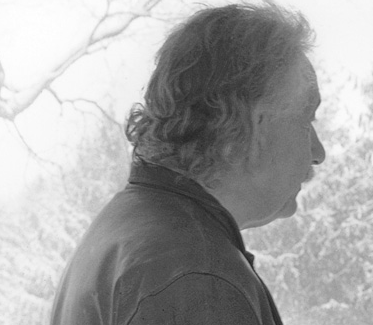
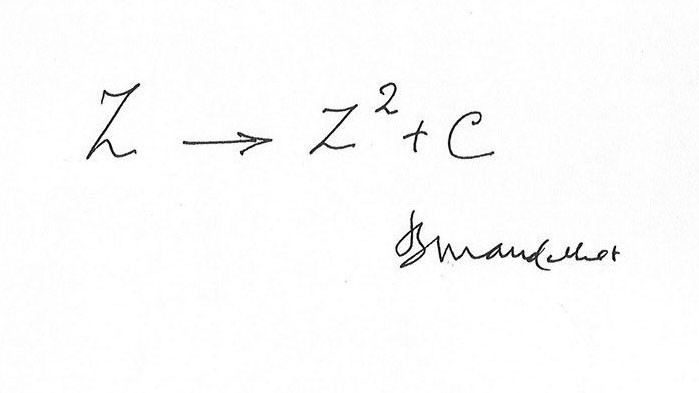
Speaking of Einstein–have you ever wanted to explain the world on a napkin? The Edge, self-described as “an online collective of deep thinkers,” has teamed up with the Serpentine Gallery in London to participate in a month-long Experiment Marathon. The Serpentine has been asking leading scientists and thinkers “What Is Your Formula?” and the Edge is now hosting the fascinating answers on their site. Rickard Dawkins, Brian Eno and Benoit Mandelbrot are just a few of the contributors.
Speaking at a conference on science, religion and philosophy in 1941, Albert Einstein famously said that “science without religion is lame; religion without science is blind.” Einstein, a German-born Jew, considered himself religious. But what he meant by religion was not straightforward. The first episode of a two-part podcast called Einstein and the Mind of God (iTunes — MP3 — Web Site) tries to sort out Einstein’s religious sensibility and how it squares with his scientific thinking. For Einstein, religion consisted of a belief, not in a personal God, but a universal spirit that manifests itself in nature. And it was the task of physics to make sense of nature, of God’s universe. Or, so that is how it’s explained by Freeman Dyson, a famed theoretical physicist who appears on the show. In the second part, the podcast turns to look at Einstein’s ethics (iTunes — MP3 — Web Site). Although not without personal flaws (he often fell short in his personal/domestic life), Einstein had a strong moral sense informed by his Jewish upbringing. He saw scientists having a deep moral obligation to society; he took strong positions against war (except when Hitler came along); he opposed racial discrimination and lamented the plight of African-Americans well before the civil rights movement; and he lauded religious leaders’ efforts to use non-violent action to oppose immoral conditions. Each of these podcasts runs around 53 minutes in length, and they form part of a larger radio/podcast series called Speaking of Faith (iTunes — Feed — Web Site), which is issued by American Public Media.
Earlier this week I spoke on the phone with Alan Weisman, the author of The World Without Us. (See our initial piece on his book.) Alan was gracious enough to take some time out of his publicity schedule to share his thoughts on the book, the world, his writing process, and more. What follows is an edited transcript of our conversation.
Ed: This book addresses what on the surface seems to be a pretty far-fetched hypothetical: that humanity might suddenly disappear. What drew you to this premise in the first place?
Alan: Well, precisely that. Most great environmental writing does not get read by a lot of the people who ought to be learning about it because the nearer-term possibilities just seem sometimes so frightening, or so depressing, that nobody really wants to pick up a book to read it.
By structuring the book the way that I did, I disarm the automatic fear that repels a lot of people from reading about the environment. People don’t want to read something that seems too threatening. On a subconscious or even a conscious level, they don’t want to be worried we’re all going to die. In my book, killing us off in the first couple of pages means people don’t have to worry about dying because we’re already dead, and that’s a relief in a sense. The idea of glimpsing the future is irresistible to all of us and I establish pretty quickly that is not going to just be me speculating, it’s going to be some hard science writing based on a lot of reporting, of talking to experts or eyewitnesses whose guesses will be far more interesting than most peoples’.
The fact that it is far-fetched is really useful because on the one hand really it’s a remote possibility that we would leave, that we would disappear tomorrow. So people don’t go into a panic over this book, and it really gives people enough time to think about these things without panicking about it. So that’s how this device works, and I think it’s been proven to be very effective. I’m getting a lot more people to read it than just people who are hung up on the environment.
PBS’s NOVA recently aired a three-hour mini-series, The Elegant Universe, that introduced TV viewers to string theory — a radical “theory of everything” that unites major laws of physics and offers a unified explanation for everything that happens in the universe. The program was hosted by Brian Green, a string theorist who wrote a runaway bestselling book also called The Elegant Universe (you can read an excerpt here). The program makes difficult concepts quite graspable, partly with the help of dynamic computer animation. And the best part is that you can now watch the mini-series any time you want online (just click here to get the videos). You can also access the complete description of the show here.
PS: Here is a great heads up from a reader. “A great complement to the Elegant Universe is the Origins series on NOVA, part of which is also available online. It details the creation of life on earth.” The complete collection of NOVA episodes can be found here. Thanks Allen for the good info.
We're hoping to rely on loyal readers, rather than erratic ads. Please click the Donate button and support Open Culture. You can use Paypal, Venmo, Patreon, even Crypto! We thank you!
Open Culture scours the web for the best educational media. We find the free courses and audio books you need, the language lessons & educational videos you want, and plenty of enlightenment in between.
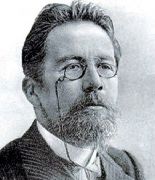 Among Russia’s greatest writers, Anton Chekhov revolutionized Russian drama and short-story writing. In this collection, you’ll find 201 translated stories presented in the order of their publication. If you’re new to Chekhov, it’s recommended by the web site that you begin (and I’m quoting verbatim) “with a few humorous stories, such as Oh! the Public!, The Orator, and A Transgression. Next try one of Chekhov’s most moving stories, Misery. Among the longer stories, I suggest beginning with Ward No. 6, The Duel, and The Steppe, which contains the most famous thunderstorm in literature. Finally, be sure to read the famous trilogy made of The Man in a Case, Gooseberries, and About Love.” (Source: Metafilter)