Millions of kids grew up with the groovy yet educational cartoon comedy of Fat Albert, and millions of adults may find it difficult or impossible now to watch the show without thinking of the crimes of its creator. Such is life in the 21st century, but so it was too at the end of the 1960s when the first iteration of Fat Albert debuted. There were plenty of reasons to feel terrible about the culture. Yet the music that came out of the various jazz/funk/fusion/soul scenes seemed like it couldn’t let anyone feel too bad for long.
In 1969, Herbie Hancock had just been let go from the Miles Davis quintet and left historic Blue Note. During this pivotal time, he signed on to compose the soundtrack for the TV special Hey, Hey, Hey, It’s Fat Albert, the precursor to the episodic cartoon Fat Albert and the Cosby Kids, which ran from 1972 to 1985 and taught serious ethical lessons about such subjects as kindness, respect, stealing, drugs, scams, kidnapping, smoking, racism, and more with original songs.
The later show’s unforgettable theme song (“na, na, na, gonna have a good time!”) was not penned by Hancock, nor were any of its other tunes. Only the original special used his music, which is maybe why the soundtrack is not better known, as well it should be. “It’s a deeply soulful affair,” writes Boing Boing, “that presaged Hancock’s 1973 jazz-funk classic Head Hunters.” The album, Fat Album Rotunda, had gone out of print, but has now been reissued on the label Antarctica Starts Here.
After listening to the tracks (hear samples above and below), you might find it difficult to resist buying a copy. Whether or not you still enjoy the cartoon, the incredible grooves here evoke much more than its adolescent characters and their junkyard mishaps. This is such an expansive, joyous album, one “in which Hancock,” Superior Viaduct writes, “clearly had a great time.” So too did the rest of the band, “which by the time of recording in late 1969 was both razor-sharp and confidently loose from rehearsing and touring.”
The band included three horn players, “Joe Henderson on sax and flute, Garnett Brown on trombone and Johnny Coles on trumpet and flugelhorn.” Hancock’s solos run fluidly through each song, held in place by the rock-solid swing of Albert Heath’s drums. The compositions are complex and catchy, with lilting melodies, mean hooks, and big refrains.
The album is instantly classic, whether you heard it fifty years ago or just now for the first time. Warner Brothers agreed, and gave Hancock and his band a deal on the strength of the album. So did Quincy Jones, who recorded his own version of the track “Tell Me a Bedtime Story,” a mellow, dynamic slow burn that builds to some of the finest Fender Rhodes playing Hancock put to tape. Fat Albert Rotunda was hardly his first or his last soundtrack album, but while it has fallen into obscurity, it should rank as one of his best.
Critics describe David Lynch’s most memorable imagery as not just deeply troubling but deeply American. Despite that — or maybe because of it — his films have found enthusiastic audiences all over the world. But does Lynch command quite as fervent a fan base in any country as he does in Japan? Unlikely though the cultural match of creator and viewer may seem, Lynch’s work tends to make big splashes in the Land of the Rising Sun, and Twin Peaks, the groundbreakingly strange television drama Lynch co-created with Mark Frost, made an especially big one. Standing as evidence is the Twin Peaks material made for the Japanese and no one else: the Lynch-directed Twin Peaks Georgia Coffee commercials, for instance, or the Twin Peaks Visual Soundtrack on Laserdisc.
“What must the thirty-five million people who tuned in to the pilot episode of Twin Peaks in April 1990 have thought when they first witnessed the show’s opening credits?” writes musician Claire Nina Norelli in her book on Twin Peaks’ soundtrack. “This haunting music, coupled with images of rural terrain and industrialization, must have belied audiences’ expectations.”
That holds as true for audiences outside America as inside it: Norelli, who first saw the show in her “small, isolated hometown” of Perth, Australia, writes that “what really captured my attention during what would be the first of many forays into the world of Twin Peaks was its soundtrack, composed by Angelo Badalamenti.”
The Twin Peaks Visual Soundtrack, which you can watch on Youtube, takes Badalamenti’s soundtrack (which Norelli credits with “strengthening the visual language” of the show, no mean feat given the innate strength of Lynch’s visions) and accompanies it with footage of the small town of Twin Peaks and its environs — or rather, footage of the locations around Washington state that Lynch and company used to craft the small town of Twin Peaks and its environs. Matt Humphrey of the Twin Peaks Podcast highlights the track “Laura Palmer’s Theme,” whose video “explores the train graveyard where they filmed the exteriors of Laura’s death location. Now, in the series, the interiors of the train were built on sets. In this video you can see the actual interior of the old trains. It’s pretty cool/gross.”
“From what I can tell,” Humphrey writes, “these Visual Soundtrack videos were taken in maybe 1992 by a Japanese film crew.” In some shots, he adds, “you can see the townsfolk staring.” Other shots bear traces of Twin Peaks’ popularity: “The Double R diner is already sporting the ‘Twin Peaks Cherry Pie’ sign, so I think it’s after the series’ run. However the town of North Bend is still in full Twin Peaks promotional mode as you can see some gift shops in the videos selling all sorts of memorabilia.” But Twin Peaks fans will especially enjoy the opening of the Visual Soundtrack, a CGI fly-through of the eponymous town complete with the aforementioned diner (coffee and cherry pie not included in the rendering), the Twin Peaks Sheriff’s Department, and a logging truck. Seeing how it all compares to Lynch’s hand-drawn map from when he first pitched the show to ABC will be left as an exercise for the true fan.
Based in Seoul, Colin Marshall writes and broadcasts on cities, language, and culture. His projects include the book The Stateless City: a Walk through 21st-Century Los Angeles and the video series The City in Cinema. Follow him on Twitter at @colinmarshall or on Facebook.
“I’m a friend first and a boss second,” says David Brent, middle manager at the Slough branch of paper company Wernham-Hogg. “Probably an entertainer third.” Those of us who’ve watched the original British run of The Office — and especially those of us who still watch it regularly — will remember that and many other of Brent’s pitiable declarations besides. As portrayed by the show’s co-creator Ricky Gervais, Brent constitutes both The Office’s comedic and emotional core, at once a fully realized character and someone we’ve all known in real life. His distinctive combination of social incompetence and an aggressive desperation to be liked provokes in us not just laughter but a more complex set of emotions as well, resulting in one expression above all others: the cringe.
The elaborate friend-boss-entertainer song-and-dance Brent constantly puts on for his co-workers so occupies him that he lacks the ability or even the inclination to have any sense of what they’re thinking. “The irony is that Brent can’t see that a weak theory of mind always makes for a weak self-performance. You can’t brute force your preferred personality onto another’s consciousness: it takes two to build an identity.”
Central though Brent is to The Office, we laugh not just at what he says and does, but how the other characters (which Puschak places across a spectrum of ability to understand the minds of others) react — or fail to react — to what he says and does, how he reacts to their reactions, and so on. Mastery of the comedic effects of all this has kept the original Office effective more than fifteen years later, though its effect may not be entirely pleasurable: “A lot of people say that cringe humor like this is hard to watch,” says Puschak, “but in the same way that under our confidence, in theory of mind, lies an anxiety, I think that under our cringing there’s actually a deep feeling of relief.” When Brent and others fail to connect, their “body language speaks in a way that is totally transparent: in that moment the embarrassment is not only palpable, it’s palpably honest.” And it reminds us that — if we’re being honest — none of us are exactly mind-readers ourselves.
Based in Seoul, Colin Marshall writes and broadcasts on cities, language, and culture. His projects include the book The Stateless City: a Walk through 21st-Century Los Angeles and the video series The City in Cinema. Follow him on Twitter at @colinmarshall or on Facebook.
One of the most striking anecdotes in the doc concerns a 1969 episode in which Mister Rogers, who was white, invited Officer Clemmons, who is black, to join him in soaking his bare feet in a backyard baby pool on a hot summer’s day.
It was one of those giant leaps for mankind moments that passes itself off as a homey, fairly unremarkable step, though as Clemmons told his friend Karl Lindholm in a StoryCorps interview, Rogers understood the powerful message this gesture would send.
Likewise, his choice of Clemmons to embody a friendly cop for his television neighborhood, a part Clemmons, who played the role for 30 years, was initially hesitant to accept:
Fred came to me and said, “I have this idea, you could be a police officer.” That kind of stopped me in my tracks. I grew up in the ghetto. I did not have a positive opinion of police officers. Policemen were sicking police dogs and water hoses on people. And I really had a hard time putting myself in that role. So I was not excited about being Officer Clemmons at all.
Rogers, who had met Clemmons in a Pittsburgh area church where the trained opera singer was performing, prevailed, stressing the impact such a positive portrayal of a black authority figure could have on the community.
Officer Clemmons, the first recurring black character on a children’s series, paved the way for the multiracial casts of Sesame Street and The Electric Company, also on PBS.
If a picture is worth a thousand words, a song can also pack quite a wallop. It’s hard not to get choked up hearing Clemmons sing “There Are Many Ways to Say I Love You,” above, a tune he reprised in 1993, for his final appearance on the show.
Such sentiments are a natural fit in programs aimed at the preschool crowd, whose love of their families is reinforced at every turn, but it’s still unusual to see these feelings articulated so purely when the only people in sight are grown men.
Clemmons learned not to doubt Roger’s sincerity when he said, “I like you just the way you are.”
And Rogers grew to accept his friend’s sexual orientation, though this embrace came a bit less naturally. In an interview with Vanity Fair’s Chris Azzopardi, Clemmons was philosophical, recalling his “surrogate father’s” request to steer clear of gay clubs so as not to endanger the show’s wholesome image:
Sacrifice was a part of my destiny. In other words, I did not want to be a shame to my race. I didn’t want to be a scandal to the show. I didn’t want to hurt the man who was giving me so much, and I also knew the value as a black performer of having this show, this platform. Black actors and actresses—SAG and Equity—90 percent of them are not working. If you know that and here you are, on a national platform you’re gonna sabotage yourself?
I weighed this thing, the pros and the cons. And I thought, I not only have a national platform, I’m getting paid. I was also getting a promotion that I simply could not have afforded to pay for. Every time I did the show, and every time Fred took us across the country to do three, four, five personal appearances, my name was being written into somebody’s heart—some little kid who would grow up and say, “Oh, I remember him, I remember that he could sing, I remember that he was on Mister Rogers’ Neighborhood.” I didn’t have the money to pay for that, but I was getting it free. There were so many things that I got back for that sacrifice that I kept my big mouth shut, kept my head down, kept my shoulder to the plough.
Clemmons has added color and soul to the Middlebury College scene for nearly 25 years. As Alexander Twilight Artist in Residence and director of the Martin Luther King Spiritual Choir, he is known by many names: the divo, the maestro, the reverend, doctor-madam-honey-man, sportin’ life, and even black magic. He has played the role of professor, choirmaster, resident vocal soloist, advisor, confidant, and community cheerleader. Yet his purpose is singular: to share hope through song.
Listen to StoryCorps podcast episode #462 about Mister Rogers’ and Francois Clemmons’ famous foot bath, as well as an incident that took place five years prior where protesters staged a “wade in” at the “Whites Only” pool at St. Augustine, Florida’s Monson Motor Lodge.
For decades, fans of J.R.R. Tolkien’s The Lord of the Rings wondered if the books could ever become a film. The Beatles and John Boorman both tried to get adaptations off the ground in the 1960s and 70s, and animator Ralph Bakshi came up with his own cinematic interpretation, if only a partial one, in 1978. But now we live in a world rich with Lord of the Rings and Lord of the Rings-related material on film, thanks to the efforts of director Peter Jackson and his collaborators on not just the adaptations of The Fellowship of the Ring, The Two Towers, and The Return of the King, but three whole feature films bringing the relatively brief tale The Hobbit to the screen.
What remains for the Tolkien-inspired filmmaker today? None, so far, have proven brave enough to take on the likes of The Silmarillion, the forbiddingly mythopoeic work published a few years after the writer’s death. But the Finnish director Dome Karukoski, whose last picture told the story of male-erotica illustrator Tom of Finland, has found material in the writer’s life.
Going by the trailer above, Tolkiendeals not just with the writing of The Lord of the Rings, described by star Nicholas Hoult as “a story about journeys, the journeys we take to prove ourselves,” about “adventures” and “potent magic, magic beyond anything anyone has ever felt before.”
It’s also, says Hoult-as-Tolkien, a story about “what it means to love, and to be loved.” That fits with another apparent storyline of Tolkien itself, that of the man who dreamed up Middle-Earth’s relationship with Edith Bratt, the girl he met as a teenager who would become his wife — not long after which he received the letter summoning him to France to fight in the First World War, where he managed to survive the Battle of the Somme. An equally skilled writer of another temperament might have produced an enduring novel of the war, but Tolkien, as his generations of readers know, went in another direction entirely. A generation later, Joseph Heller proved to be that skilled writer of a different temperament, and sixteen years after coming back from the Second World War, he produced Catch-22.
Heller’s novel has also made it to the screen a few times: Mike Nichols directed a feature-film adaptation in 1970, the pilot for a television series aired three years later, and now we await a Catch-22 miniseries that will air on Hulu this May. Christopher Abbott stars as Captain John Yossarian, the hapless bombardier with no aim in the war but to stay out of harm’s way, and George Clooney (also one of the series’ directors) as Lieutenant Scheisskopf, one of the book’s cast of highly memorable minor characters. The series’ six episodes should accommodate more of that cast — and more of the forms Heller’s elaborate satire takes in the novel — than a movie can. If, as a result, you need to consult Heller’s large-format handwritten outline for the book, by all means do — and have a look at Tolkien’s annotated map of Middle-Earth while you’re at it.
Based in Seoul, Colin Marshall writes and broadcasts on cities, language, and culture. His projects include the book The Stateless City: a Walk through 21st-Century Los Angeles and the video series The City in Cinema. Follow him on Twitter at @colinmarshall or on Facebook.
Established in 1933, Turkish Airlines celebrated its 85th anniversary last year with a higher profile than ever before. Born in 1937, Ridley Scott turned 81 last year and has shown no decline whatsoever in his enthusiasm for filmmaking. This year found those two institutions brought together by another, the Super Bowl, which offered the occasion to air a thirty-second teaser for The Journey, a six-minute film commissioned by Turkish Airlines and directed by Scott. (The same game also, Open Culture readers will have noticed, featured a Burger King commercial with Andy Warhol eating a Whopper.) The visually rich story of one woman pursuing another to and through Istanbul, the short marks the first commercial the Alien, Blade Runner, and Gladiator director has made in well over a decade.
“I decided to go back and click into advertising,” Scott says in the behind-the-scenes video below. “I love the chase and the speed of the job.” And in this case the job was to show off the luxury of Turkish Airlines’ first-class cabins and also the city of Istanbul itself, which Scott had never visited before.
But on his first trip there, Istanbul impressed him with its harbor, its mosques, and surely many other of the elements of which The Journey makes use, including the airport. “The Istanbul airport was modern and efficient, European, and what first struck me is how foreign it did not feel,” writes American reporter Suzy Hansen in Notes on a Foreign Country of her own first visit to Istanbul, drawing a stark contrast with “the decrepit airport in New York I had just left.”
And Hansen had flown into Istanbul’s old airport, not the new one opened just last year and designed as the largest in the world. Whether The Journey will bring more business to Turkish Airlines’ flights into and out of it (the final shot finds our heroine en route to Bali) remains to be seen, especially since the Super Bowl teaser seemed to cause confusion about what was being sold. It nevertheless fits nicely into Scott’s acclaimed body of advertising work. In its early period came a 1974 bread commercial voted England’s favorite advertisement of all time; in its middle period, of course, came the 1984 Super Bowl spot that introduced the Apple Macintosh to the world. Given the energy Scott’s work in commercials and features still exudes, it feels somehow unsuitable to use the term “late period” at all.
Based in Seoul, Colin Marshall writes and broadcasts on cities, language, and culture. His projects include the book The Stateless City: a Walk through 21st-Century Los Angeles and the video series The City in Cinema. Follow him on Twitter at @colinmarshall or on Facebook.
A quick fyi: This month, Twitch is presenting a marathon streaming of classic Doctor Who episodes. Continuing through January 25th, they plan to broadcast “11 to 12 hours of new episodes per day (~27 episodes), repeating once so you can catch Doctor Who nearly 24 hours a day, every day…” Stream the episodes right above, or here on Twitch.
If you would like to support the mission of Open Culture, consider making a donation to our site. It’s hard to rely 100% on ads, and your contributions will help us continue providing the best free cultural and educational materials to learners everywhere. You can contribute through PayPal, Patreon, and Venmo (@openculture). Thanks!
While life lasts, let us live it, not pass through as zombies, and let us find in art a glorious passageway to a deeper understanding of our essential humanity.
- Sister Wendy Beckett (1930–2018)
Sister Wendy, a cloistered nun whose passion for art led her to wander out into the world, where she became a star of global proportions, entertained the television masses with her frank humanist assessments.
Unfazed by nudity, carnality, and other sensual excesses, she initially came across as a funny-looking, grandma-aged virgin in an old-fashioned habit, lisping rhapsodically about appendages and entanglements we expect most Brides of Christ to shy away from.
Having beaten the jokers to the punch, she took her rapt audience along for the ride, barnstorming across the continent, eager to encounter works she knew only from the reproductions Church higher ups gave her permission to study in the 1980s.
She was grateful to the artists—1000s of them—for providing her such an excellent lens with which to contemplate God’s creations. Eroticism, greed, physical love, horrific violence—Sister Wendy never flinched.
“Great art offers more than pleasure; it offers the pain of spiritual growth, drawing us into areas of ourselves that we may not wish to encounter. It will not leave us in our mental or moral laziness,” she wrote in the foreword to Sister Wendy’s 1000 Masterpieces, her handpicked selection of the greatest paintings of Western art. (“A thousand sounded like so many until we got down to it and then began the anguish of choice,” she later opined.)
A lover of color and texture, she was unique in her ability to appreciate shades of grey, delving deeply into the psychological motivations of both the subjects and the artists themselves.
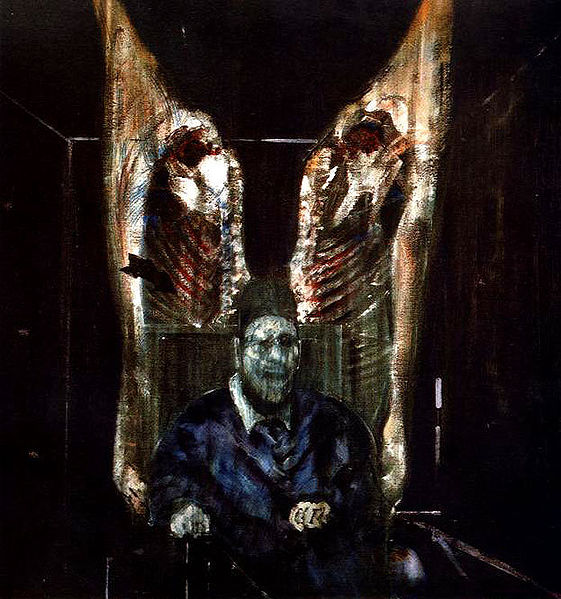
Here, he shows the pope, father of the Catholic Church, both enthroned and imprisoned by his position. Bacon’s relationship with his own father was a very stormy one, and perhaps he has used some of that fear and hatred to conjure up this ghostly vision of a screaming pope, his face frozen in a rictus of anguish.
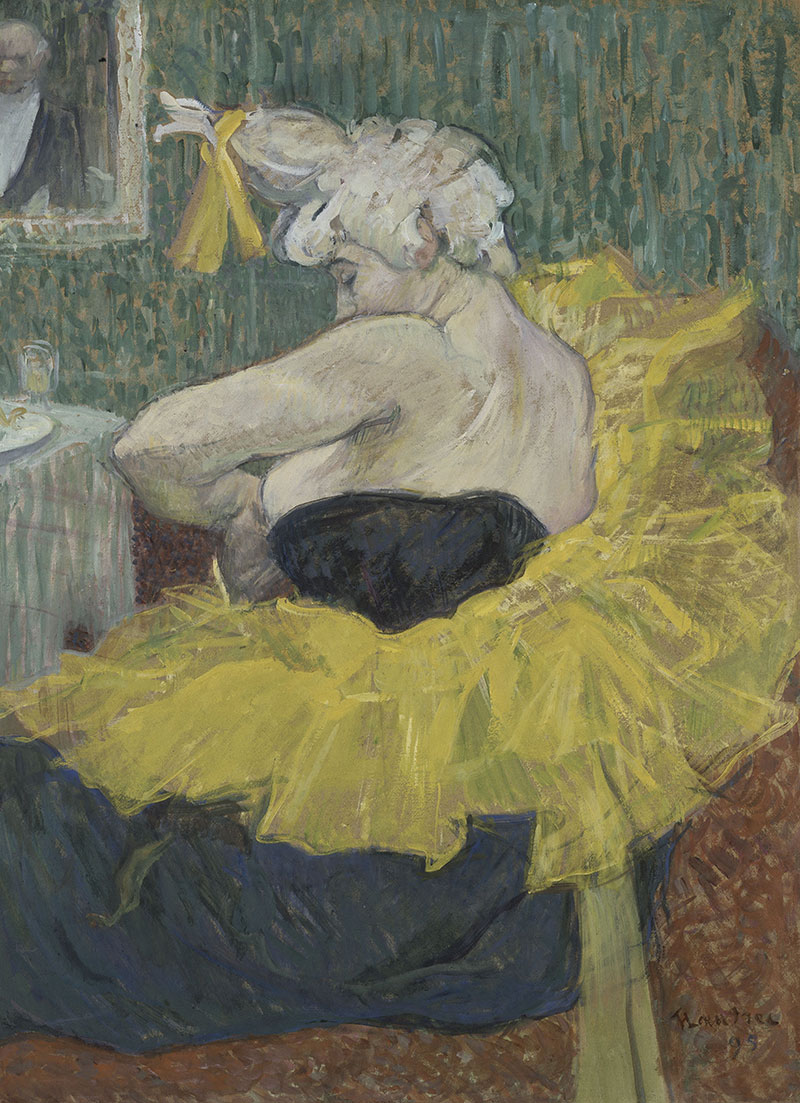
On Henri De Toulouse-Lautrec’s The Clown Chau-u-Kao (1895):
Toulouse-Lautrec, as the last descendant of an ancient French family, must have been bitterly conscious of his own physical deformities and to many people he, too, was a figure of fun…He shows us Chau-U-Kao preparing for her act with dignity and serenity, the great swirl of her frill seems to bracket the clown so that we can truly look at her, see the pathos of that blowzy and sagging flesh, and move on to the nobility of the nose and the intense eyes. This is a degradation, but one that has been chosen by the performer and redeemed by intelligence and will power.
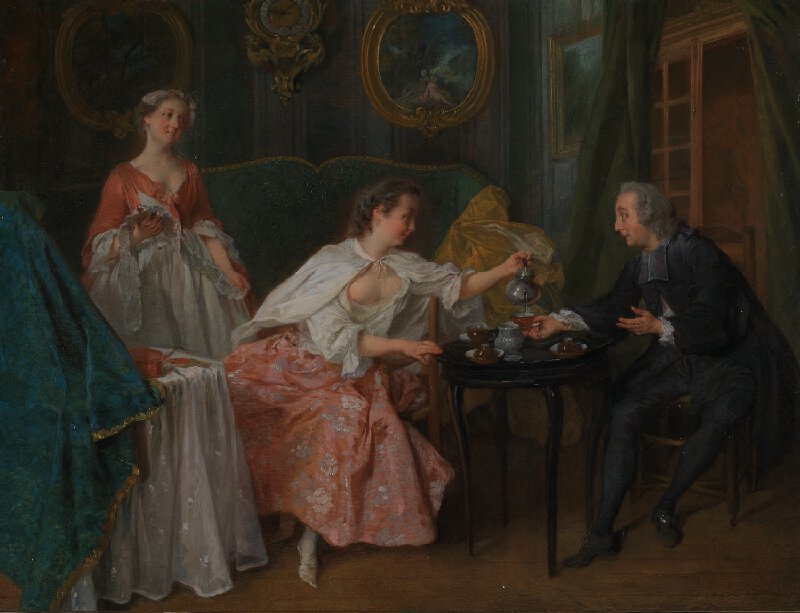
On Nicolas Lancret’s The Four Times of the Day: Morning (1739):
Morning is filled with witty observation — a delightful young woman (who is clearly no better than she should be) is entertaining a young cleric, seemingly unaware of the temptation offered by that casually exposed bosom. He holds out his cup, but his eyes are fied, alas, on that region of the feminine anatomy that his profession forbids him.
On François Clouet’s Diane De Poitiers (c. 1571)
The implication would seem to be that this shameless beauty with her prominent nipples and overflowing bowl of ripe fruit, is a woman of dubious morals. Yet one cannot but feel that the artist admires the natural freedom of his subject. Her children and her grinning wet-nurse are at her side, and, in the background, the maid prepares hot water. /surely this domestic scene is no more than a simple and endearing vignette.
Her generous takes on these and other artworks are irresistible. How wonderful it would be to approach every piece of art with such thought and compassion.
Fortunately, Sister Wendy, who passed away last week at the age of 88, left behind a how-to of sorts in the form of her 2005 essay, “The Art of Looking at Art,” from which we have extracted the following 10 rules.
Sister Wendy Beckett’s 10 Rules for Engaging with Art
Visit museums
They are the prime locus where the uniqueness of an artist’s work can be encountered.
Prioritize quality time over quantity of works viewed
Sociologists, lurking inconspicuously with stopwatches, have discovered the average time museum visitors spend looking at a work of art: it is roughly two seconds. We walk all too casually through museums, passing objects that will yield up their meaning and exert their power only if they are seriously contemplated in solitude.
Fly solo
If Sister Wendy could spend over four decades sequestered in a small mobile home on the grounds of Carmelite monastery in Norfolk, surely you can go alone. Do not complicate your contemplation by tethering yourself to a friend who cannot wait to exit through the gift shop.
Buy a postcard
…take it home for prolonged and (more or less) distractionless contemplation. If we do not have access to a museum, we can still experience reproductions—books, postcards, posters, television, film—in solitude, though the work lacks immediacy. We must, therefore, make an imaginative leap (visualizing texture and dimension) if reproduction is our only possible access to art. Whatever the way in which we come into contact with art, the crux, as in all serious matters, is how much we want the experience. The encounter with art is precious, and so it costs us in terms of time, effort, and focus.
Pull up a chair, whenever possible
It has been well said that the basic condition for art appreciation is a chair.
Don’t hate on yourself for being a philistine.
However inviolate our self-esteem, most of us have felt a sinking of the spirit before a work of art that, while highly praised by critics, to us seems meaningless. It is all too easy to conclude, perhaps subconsciously, that others have a necessary knowledge or acumen that we lack.
Take responsibility for educating yourself…
Art is created by specific artists living in and fashioned by a specific culture, and it helps to understand this culture if we are to understand and appreciate the totality of the work. This involves some preparation. Whether we choose to “see” a totem pole, a ceramic bowl, a painting, or a mask, we should come to it with an understanding of its iconography. We should know, for example, that a bat in Chinese art is a symbol for happiness and a jaguar in Mesoamerican art is an image of the supernatural. If need be, we should have read the artist’s biography: the ready response to the painting of Vincent van Gogh or Rembrandt, or of Caravaggio or Michelangelo, comes partly from viewers’ sympathy with the conditions, both historical and temperamental, from which these paintings came.
…but don’t be a prisoner to facts and expert opinions
A paradox: we need to do some research, and then we need to forget it…We have delimited a work if we judge it in advance. Faced with the work, we must try to dispel all the busy suggestions of the mind and simply contemplate the object in front of us. The mind and its facts come in later, but the first, though prepared, experience should be as undefended, as innocent, and as humble as we can make it.
Celebrate our common humanity
Art is our legacy, our means of sharing in the spiritual greatness of other men and women—those who are known, as with most of the great European painters and sculptors, and those who are unknown, as with many of the great carvers, potters, sculptors, and painters from Africa, Asia, the Middle East, and Latin America. Art represents a continuum of human experience across all parts of the world and all periods of history.
Listen to others but see with your own eyes
We should listen to the appreciations of others, but then we should put them aside and advance toward a work of art in the loneliness of our own truth.
Sister Wendy’s television shows can be found on PBS, the BBC, and as DVDs. Her books are well represented in libraries and from booksellerslike Amazon. (We have learned so much in the year her dictionary-sized 1000 Paintings has been parked next to our commode…)
We're hoping to rely on loyal readers, rather than erratic ads. Please click the Donate button and support Open Culture. You can use Paypal, Venmo, Patreon, even Crypto! We thank you!
Open Culture scours the web for the best educational media. We find the free courses and audio books you need, the language lessons & educational videos you want, and plenty of enlightenment in between.