“Some think that so much of today’s art mirrors and thus criticizes decadence,” Robert Hughes once said; “not so. It’s just decadent, full stop. It serves no critical function. It is part of the problem.”
Hughes died Monday at the age of 74. One of the towering figures of late 20th century art criticism, the Australian writer is best known for The Shock of the New, his 1980 television series on the rise and fall of modernism, and the bestselling book of the same name. He wrote at least 15 other wide-ranging books on art and history. He was an eloquent writer and a tough critic. “It was decidedly not Mr. Hughes’s method to take prisoners,” writes Randy Kennedy in the New York Times obituary. “He was as damning about artists who fell short of his expectations as he was ecstatic about those who met them, and his prose seemed to reach only loftier heights when he was angry.”
Perhaps nothing made Hughes more angry than the pernicious influence of money on art in the past few decades. In the scene above from the 2008 BBC documentary The Mona Lisa Curse, Hughes pays a visit to Alberto Mugrabi, whose wealthy family makes no secret of its efforts to manipulate the art market by buying up large numbers of works by certain artists (often those whom Hughes despised, like Andy Warhol and Damien Hirst) and storing them in warehouses. What follows is less of an interview than a browbeating. When it’s over and Hughes has left the room, Mugrabi says, “He’s a tough cookie.”
The Royal Institution Christmas Lectures for Children — it’s a tradition that began back in 1825 when the inventor Michael Faraday organized an annual lecture series for kids, hoping to instill in a younger generation a love for science. Almost two centuries later, the tradition continues. Eminent figures like Sir David Attenborough and Richard Dawkins (watch here) presented lectures to youngsters in 1973 and 1991 (respectively). And the great astronomer Carl Sagan took his turn in 1977, offering six lectures on our solar system. The first two talks offer a broad overview of the planetary system, setting the stage for three presentations (see below) dedicated to Mars, a topic that holds special interest this week. With NASA just having landed its rover Curiosity on the surface of Mars, it’s particularly interesting to watch Sagan talk about the knowledge gained from early NASA orbiters, particularly the Mariner and Viking missions. In a rather timely way, Sagan’s lectures put the Curiosity mission in a grander historical context, a deeper history of space exploration.
Sagan’s talks assume no specialized knowledge and run roughly 60 minutes each. You can find more Christmas lectures on the RI website here.
The Mars rover Curiosity carried a Descent Imager (essentially a glorified HD color camera), and according to Planetary.org, it started shooting images at a rate of 4.5 frames per second upon its descent. We’ll eventually get access to high-res images (1600 by 1200 pixels). But, in the meantime, Curiosity has already beamed back 297 thumbnail images that have been stitched into a stop animation video, giving you another look at the dramatic landing. The action starts with Curiosity losing its heat shield and ends with it touching down on Mars. How cool is that?
When we hear the word “camera” we tend to think of a little device that fits in the hand. Actually, the word is Latin for “vaulted chamber,” or room. The first cameras were rooms.
Long before the invention of photographic film, it was discovered that if you have a darkened room with a small hole in it, the light passing through will project an upside-down image of the surrounding scenery onto the opposite wall. The Chinese philosopher Mo Tzu, who died in the early 4th century BCE, called it the “locked treasure room.” In 1604 the German mathematician and astronomer Johannes Kepler coined the term “camera obscura,” or darkened room.
Kepler and other astronomers used the camera obscura to observe the sun. The problem with viewing dimmer objects, though, is that the tiny aperture lets in very little light. You can widen the hole to let in more light, but as you do so the image gets blurrier. Eventually it was discovered that you can have a wide aperture if you place a glass lens over it to focus the light.
With advances in optics, artists made more use of the device. The painter David Hockney and physicist Charles M. Falco have theorized that as early as the 15th century, Renaissance painters were using the camera obscura and other optical devices to project images onto their canvases as an aid to composition. By the time the chemical process of photography was invented in the 1820s, the camera was old hat.
In the scene above from the 2007 BBC series The Genius of Photography, photographer Abelardo Morell returns to the camera’s roots to create a striking image of the Basilica di Santa Maria della Salute in Venice projected onto an interior wall of a palazzo on the other side of the Grand Canal. To capture the strange interior-exterior scene on film, he uses a camera-within-a-camera.
Morell has been combining modern photography with the ancient camera obscura technique for over 20 years. He first tried it in the living room of his home in Quincy, Massachusetts. He sealed off all the windows, cut a dime-sized hole in the covering and set up a view camera. His first exposures lasted five to 10 hours. Since then, Morrell has traveled the globe to capture exotic exteriors projected onto interior walls. He now uses high-speed digital cameras to cut the exposure time down to minutes. “One of the satisfactions I get from making this imagery,” he says on his Web site, “comes from my seeing the weird and yet natural marriage of the inside and the outside.”
You can view a selection of Morell’s camera obscura photographs at AbelardoMorell.net. And if you’d like to try it yourself, watch the video below from National Geographic, “Making Your Own Room With a View.”
George Orwell published his satirical allegory Animal Farmin 1945 at the tail end of World War II. While Orwell claimed his inspiration for the farm setting was a bucolic village scene, it’s tempting to imagine that he also drew some of his ideas from American propaganda cartoons made during WWII by Disney (see below) and Warner Brothers. One particularly striking example from 1942 is Loony Tunes’ “The Ducktators,” set on a farm that becomes Europe under a newly-hatched Adolf Hitler duckling, sporting the forelock and mustache and shouting “sieg heil” as soon as he emerges from his jet-black egg. Hitler-duck’s posturing appeals to a strutting, broadly stereotypical Italian goose (Mussolini), and many of the ducks and geese on the farm, who line to up salute and, um… goosestep. There are plenty of little gags thrown in—it’s all played for comedy—but of course, there is a message (or two) here.
First, cut to the simpering “Dove of Peace,” an androgynous creature who wrings its hands and says, “Have they forgot? ‘Tis love that’s right, and naught is gained by show of might.” This is clearly a caricature of Neville Chamberlain, whose ineffectual policies enabled and emboldened Hitler.
Chamberlain is remembered for prematurely declaring that his appeasement of Hitler in the 1938 Munich Pact (here represented by a barnyard “Peace Conference”) had secured “peace for our time.” The reference is an interesting example of a wartime dig at the U.S.’s British allies.
Hitler-duck tears up the “Peace Conference” treaty and beats up the British and French ducks. Then a (painfully racist) Japanese duck rows ashore singing “I’m a Japanese Sandman”—a stand in for Tojo Hideki or Emperor Hirohito. The three “Ducktators” rule the roost and trample the Dove of Peace underfoot. Historical allegory gives way to slapstick, and the wimpy Dove morphs into a pudgy, victorious Churchill with the Ducktators’ heads mounted on his wall. Then, message number two appears with fanfare: “If you’d like to make this true, here’s all you have to do: For Victory Buy United States Savings Bonds and Stamps.” Overall, The Ducktators is a fascinating example of wartime advertising, and of contemporary U.S. feelings towards its European allies. You can download The Ducktatorshere.
The past decade has seen filmmaker Werner Herzog rise up on a new, seemingly sudden burst of international fame. Cinephiles have paid great respect to his work, or at least felt great admiration toward his work’s audacity, since the seventies. But Herzog himself has been at his craft since the sixties, and you can see photographic evidence of it in the autobiographical documentary above, Portrait Werner Herzog. In it, he reveals that he turned to filmmaking after a friend’s serious injury convinced him to abandon his previous dream of becoming a champion ski jumper. But Herzog’s fans know he didn’t stop feeling the visceral impact of the sport, since he went on to make 1974’s The Great Ecstasy of Woodcarver Steiner, perhaps the definitive visual study of that particular thrill. We hear him say this over clips from that film, as we hear him recount other formative moments over images from other Herzog favorites, including Fata Morgana, Heart of Glass, and Fitzcarraldo.
A 1986 German production directed by Herzog himself, Portrait Werner Herzog shows him at a time and from a cultural angle that countless more recent interviews and profiles don’t. We see his footage of Munich’s elaborately boisterous Oktoberfest; we see him in the green Bavarian valley of his youth. “I’m the kind of person who travels on foot,” he explains, “even for long distances.” This leads to the story of his walk from Munich to Paris to visit the ailing film critic Lotte Eisner (whom Herzog calls “the consciousness of the new German cinema”), which became his book Of Walking In Ice. He speaks of hypnotizing an entire cast for Heart of Glass, of fighting the aggressively filmmaking-unfriendly Peruvian jungle to shoot Fitzcarraldo, and of planning a never-realized Himalayan film starring frequent (and frequently volatile) collaborator Klaus Kinski. “Here we can truly see how hard it is to make a film,” so Herzog sums up his struggle, “but this is my life, and I don’t want to live it in any other way.” In that respect, nothing has changed in 25 years.
Portrait Werner Herzog will be added to our list of 500 Free Movies.
NASA’s Mars rover, Curiosity, landed just minutes ago. If you didn’t catch the action live online, you can watch a screen capture of the moments before and after the landing. The landing itself takes place around the 5:40 mark, but the tension in the mission control room begins in the minutes before that, when the rover passed through The Seven Minutes of Terror. The joy, the tears, the great sense of accomplishment, the first images from Mars (around 7:30 mark) — they all follow. A job well done. A great pleasure to watch.
If you want to focus on the pride in the mission control room, you can simply watch the video below.
Some years ago, a writer for Publisher’s Weekly said, “Salvador Dalí’s swan-dive from Surrealist visionary to pathetic self-parody surely constitutes one of this century’s great case studies in career suicide.”
Fair enough. But Salvador Dalí doing a swan dive is a fun thing to watch, as these three television commercials from his later years demonstrate. The artist appeared in TV ads for a number of clients, including Lanvin Chocolates, Alka-Seltzer and Veterano brandy.
In the 1968 Lanvin commercial, the wild-eyed artist takes a bite of chocolate and it curls his mustache. He looks at the camera and says, “I’m crazy about Lanvin Chocolates,” with the emphasis on “crazy.”
Of course, there was method in Dalí’s madness. According to his biographer Meryle Secrest, Dalí’s minimum price for a minute of film was $10,000. The artist’s love of money is legendary. In 1939 André Breton, founder of the Surrealist movement, gave Dalí the nickname “Avida Dollars,” an anagram for “Salvador Dali” based on the French avide à dollars. It means“eager for dollars.”
If you would like to support the mission of Open Culture, consider making a donation to our site. It’s hard to rely 100% on ads, and your contributions will help us continue providing the best free cultural and educational materials to learners everywhere. You can contribute through PayPal, Patreon, and Venmo (@openculture). Thanks!
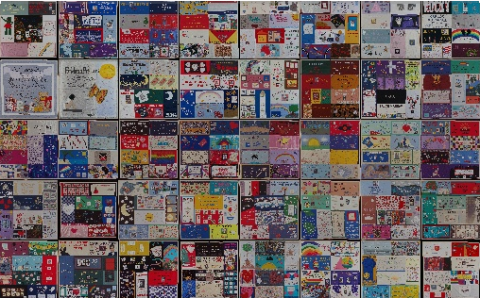
Twenty-five years ago a group of friends gathered in a San Francisco apartment to memorialize companions who had died of AIDS. They used one of the oldest techniques around to honor their loved ones: they made a quilt, the now-famous AIDS Memorial Quilt, with unique panels for each person felled by the disease. Now including some 48,000 panels, the quilt has grown into a massive, public expression of grief. Its panels come from around the world. It was even nominated for the Nobel Peace Prize in 1989. (Find more on the history of the quilt here.)
Like any good archive—and the quilt is an archive of life and loss—the AIDS Memorial Quilt serves as a historical repository, a storehouse of sentimental information for scores of people. But beyond that the quilt is a piece of political folk art. AIDS, after all, is a uniquely political disease, at least in the United States. The idea for the quilt was conceived during a candlelight march for assassinated San Francisco Mayor George Moscone and Supervisor Harvey Milk. Efforts to lift the stigma of AIDS are closely linked to gay rights activism.
While the quilt is on view in Washington, D.C. this summer, Microsoft offers the world up close and personal access. Even if the Mall is too small to hold the entire quilt, the Internet isn’t. All 48,000 panels are newly digitized through a collaboration between Microsoft and the University of Iowa, the University of Southern California and the Names Quilt Foundation.
You can fly like a bird over the whole, beautiful piece. You can zoom in to read the thousands of names—some in block letters, others stitched in cursive. You can count the rainbows, too.
You can also search the quilt by name or, if you know it, by the block number of a particular panel through the AIDS Quilt Touch interface. The site allows unique searches for each time the quilt has been displayed. This is important because the quilt is so massive that the Mall in Washington can’t hold it all. It’s always displayed in sections, so if you want to know where a special panel has been on view, recently, it’s now possible to find out.
Kate Rix is a freelance writer based in Oakland. See more of her work at .
After seeing it mentioned in Monday’s post on the “Strawberry Fields Forever” demos, any curious aficionado of Beatles-related ephemera will want to know more about Richard Lester’s How I Won the War, in which John Lennon made his only non-musical acting appearance. The trailer above gives you an idea of the sensibility of the film, whose desert shoot in Spain allowed Lennon the time and got him into the headspace to conceive of that beloved song. Ever shifting between tones, genres, and looks, the movie follows the attempt of the British Army’s “3rd Troop, the 4th Musketeers” to build a cricket pitch behind enemy lines in WW II Tunisia. In the small part of Musketeer Gripweed, Lester cast the 26-year-old, bespectacled Lennon. The two had already established a working relationship, with Lester having directed all of the Fab Four in their musical films A Hard Day’s Night and Help!
An enterprising fan assembled the video just above by stringing together all of Lennon’s scenes, which come to just under eight minutes out of the full film’s 109. Watching all these gags decontextualized adds a layer of absurdity, and How I Won the War’s humor is pretty absurd to begin with. You’d perhaps do best to approach the movie as an absurdist black comedy that both uses and parodies countless traditions in British film.
Not that it worked for a 25-year-old Roger Ebert, who waxed sarcastic at the time about the ballyhooing of Lennon’s eight minutes: “By now we have seen John Lennon’s bloody picture on the cover of Ramparts, and read the advertisements in which critics are pounded over the head with each other’s reviews, and we know this a film the old fogeys and fascist baby-eaters will hate and the young, pure, enlightened liberals will find Truth in.” Brave and hilarious anti-war statement featuring a colossal cultural figure, or nonsensical piece of slapstick that happens to include a Beatle? Copies of How I Won the War can be purchased on DVD.
Next to “celebrated” (or “celebrity”) the description I’ve most seen applied to the late Gore Vidal is “acerbic,” or some such synonym—“scathing,” “disdainful”… I’m sure he would relish the compliment. One of the most fitting adjectives, perhaps, is “Wilde-like” (as in Oscar Wilde), deployed by Hilton Als in the New Yorker. The adjective fits especially well considering one of Vidal’s most-tweeted quotes from his treasury of Wilde-like aphorisms: “Write something, even if it’s just a suicide note.” It’s clever and morbid and naughty and devil-may-care, and almost entirely fatuous. Unlike several writers recently featured here—Margaret Atwood, Ray Bradbury, Henry Miller, George Orwell, et al.—who helpfully compiled numbered lists of writing advice, Vidal’s pronouncements on his craft were rather unsystematic. But, like many of those named above, what Vidal did leave in the form of advice was sometimes facetious, and sometimes profound. Despite his evident contempt for neat little lists, one writer in the UK has helpfully compiled one anyway. The “suicide note” quote above is number 4:
Each writer is born with a repertory company in his head.
Write what you know will always be excellent advice for those who ought not to write at all. Write what you think, what you imagine, what you suspect!
I sometimes think it is because they are so bad at expressing themselves verbally that writers take to pen and paper in the first place.
Write something, even if it’s just a suicide note.
How marvelous books are, crossing worlds and centuries, defeating ignorance and, finally, cruel time itself.
Southerners make good novelists: they have so many stories because they have so much family.
You can’t really succeed with a novel anyway; they’re too big. It’s like city planning. You can’t plan a perfect city because there’s too much going on that you can’t take into account. You can, however, write a perfect sentence now and then. I have.
Today’s public figures can no longer write their own speeches or books, and there is some evidence that they can’t read them either.
I suspect that one of the reasons we create fiction is to make sex exciting.
Writer’s Digest gives us ten additional quotes of Gore Vidal on writing (unnumbered this time):
“You can improve your talent, but your talent is a given, a mysterious constant. You must make it the best of its kind.”
“I’ve always said, ‘I have nothing to say, only to add.’ And it’s with each addition that the writing gets done. The first draft of anything is really just a track.”
“The reason my early books are so bad is because I never had the time or the money to afford constant revisions.”
“That famous writer’s block is a myth as far as I’m concerned. I think bad writers must have a great difficulty writing. They don’t want to do it. They have become writers out of reasons of ambition. It must be a great strain to them to make marks on a page when they really have nothing much to say, and don’t enjoy doing it. I’m not so sure what I have to say but I certainly enjoy making sentences.”
“Constant work, constant writing and constant revision. The real writer learns nothing from life. He is more like an oyster or a sponge. What he takes in he takes in normally the way any person takes in experience. But it is what is done with it in his mind, if he is a real writer, that makes his art.”
“I’ll tell you exactly what I would do if I were 20 and wanted to be a good writer. I would study maintenance, preferably plumbing. … So that I could command my own hours and make a good living on my own time.”
“If a writer has any sense of what journalism is all about he does not get into the minds of the characters he is writing about. That is something, shall we say, Capote-esque—who thought he had discovered a new art form but, as I pointed out, all he had discovered was lying.”
“A book exists on many different levels. Half the work of a book is done by the reader—the more he can bring to it the better the book will be for him, the better it will be in its own terms.”
[When asked which genre he enjoys the most, and which genre comes easiest:]
“Are you happier eating a potato than a bowl of rice? I don’t know. It’s all the same. … Writing is writing. Writing is order in sentences and order in sentences is always the same in that it is always different, which is why it is so interesting to do it. I never get bored with writing sentences, and you never master it and it is always a surprise—you never know what’s going to come next.”
[When asked how he would like to be remembered:]
“I suppose as the person who wrote the best sentences in his time.”
A series of snippets of Gore Vidal’s wit from Esquire provides the biting (for its non-sequitur jab at rival Norman Mailer): “For a writer, memory is everything. But then you have to test it; how good is it, really? Whether it’s wrong or not, I’m beyond caring. It is what it is. As Norman Mailer would say, “It’s existential.” He went to his grave without knowing what that word meant.”
Vidal returns to the theme of memory in a 1974 interview with The Paris Review, in which he admits to placing the ultimate faith in his memory: “I am not a camera… I don’t consciously watch anything and I don’t take notes, though I briefly kept a diary. What I remember I remember—by no means the same thing as remembering what you would like to.”
While Vidal is memorialized this week as a celebrity and Wilde-like provocateur, it’s also worth noting that he had quite a lot to say about the work of writing itself, some of it witty but useless, some of it well worth remembering.
We're hoping to rely on loyal readers, rather than erratic ads. Please click the Donate button and support Open Culture. You can use Paypal, Venmo, Patreon, even Crypto! We thank you!
Open Culture scours the web for the best educational media. We find the free courses and audio books you need, the language lessons & educational videos you want, and plenty of enlightenment in between.