If you want to see rough-and-ready experiments in residential architecture and neighborhood construction, look no further than the world’s largest slums. Every day, straitened conditions and high density force the millions upon millions who live in them to improvise creative solutions to the challenges of urban survival using whatever materials and power — both terms broadly defined — happen to lay at hand. In his short New Mumbai, filmmaker Tobias Revell turns his lens toward India, host to some of the most vast and complex slums around, and discovers a highly unconventional material, a sort of organic infrastructure, in use in the knocked-together neighborhoods of Dharavi: giant mushrooms.
Actually, Revell doesn’t discover the mushrooms; he invents them, telling a science-fiction story, if not a terribly far-fetched one, in the plainspoken, street-level style of a developing-world documentary. He even comes up with a semi-plausible explanation for how each of these miracle mushrooms generates enough power to run an entire building: biological samples leak from Amsterdam into the Mumbai gangland, and a few shadowy types struggle to engineer them into a new kind of narcotic. When that doesn’t work, Dharavi’s science-savvy residents — refugees from a religious war — get to work on adapting them to a variety of life-improving uses. Revell, no stranger to speculative projects that tap into modern currents of thought, has taken the zeitgeist’s notions of a new partnership between the city and nature, but run them to an intriguing extreme. And you can’t deny how cool those mushrooms look sprouting from the rooftops.
During his time on the International Space Station (ISS), astronaut Don Pettit endeared himself to me in two ways. First, he invented a handy-dandy “zero‑g coffee cup” that lets you drink coffee in space without using a straw — something we’ll all hopefully use one day. Next, between 2002 and 2008, he took some striking images of great cities and their lights shining at night. The opening minutes explain how the shots were actually taken. Then, at the 1:45 mark, the tour begins. Zurich, Milan, Madrid, Athens, London, Cairo (including the Pyramids), Jerusalem, Mecca, Tokyo, Sao Paulo, San Francisco, Las Vegas (the brightest spot on earth) — they’re all included on the tour.
Pettit narrates the entire video. And, along the way, he takes care to underscore an interesting point — each culture creates its cities in its own way, using differently geographic layouts and technologies. Those differences we can see on the ground from one perspective, and from outer space from yet another vantage point.
For all the recent scandal and the trauma of past Games, the Olympics remain a pageant of grandeur and glory, and there is no greater symbol of its ideals than the Olympic Flame. The video above, from the Ontario Science Centre, explains the evolving technology that keeps the flame burning from its lighting to the closing ceremonies. It’s a pretty cool story, set to a bombastic soundtrack worthy of its subject and carried by an animated runner who just peeled himself off of an ancient Athenian vase.
Introduced in the 1928 Summer Olympics in Amsterdam, the flame revives a symbol from antiquity, commemorating Prometheus’s audacity and reminding warring city states to put aside hostilities for as long as it burned. In the modern Olympics, between the lighting and the opening ceremonies, the flame, in its stylized torch, makes a pilgrimage to the host city via relay, a practice that began with the 1936 games in Berlin. This year’s relay started on May 19th in Land’s End in Cornwall and ends this Friday, the 27th at the opening ceremony in London. The torch will have traveled through 1,000 places in the UK, covered a total of 8,000 miles (and passing through 8,000 hands), moving over land, air, and water, without once having to be relit.
Follow us on Facebook, Twitter and now Google Plus and share intelligent media with your friends! We’ll thank you for it.
Just yesterday, I sat across from a fellow wearing a t‑shirt emblazoned with the image of a gun-wielding Jesus blowing away Charles Darwin above the words “EVOLVE THIS!” At first I assumed he wore it to emphatically signal his belief that religion, specifically Christianity, refutes science, specifically biological evolution. Then, remembering that Jesus probably wouldn’t have used a handgun even had they been available in his day, I took the shirt as a mockery of the blunter varieties of creationist rhetoric. Looking it up later, I found out that the shirt comes from the movie Paul, so the wearer probably meant nothing more than to express his appreciation for what I understand to be one of 2011’s most underrated comedies. Yet the question lingers: has science refuted religion, or is it the other way around? The internet age provides us access to a virtually unlimited number of these debates, although you’ll often search in vain for matches of cogent, well-articulated arguments. Just take a look at the science-religion squabbles currently roiling in YouTube comment sections. Keep out of the comments, then, and stick to the videos, such as the debate above. In two hours comprising short segments of argument, rebuttal, cross-examination, and audience questions, the program pits Skeptic magazine publisher Michael Shermer and Caltech cosmologist Sean Carroll against MIT physicist Ian Hutchinson and King’s College president Dinesh D’Souza. In an unusually orderly, well-disciplined debate of this type, all four weigh in on one central proposition: “Has science refuted religion?” Carroll says that science, a “reality check” on human biases, offers the only explanations that work. Hutchinson blames not science but something he calls “scientism,” a belief in the absolute supremacy of scientific knowledge, for a variety of social and intellectual ills. Shermer describes religious belief as an evolutionarily determined characteristic of human beings, and an increasingly useless one at that. D’Souza upbraids science for failing not only to find answers to questions about human purpose and life’s meaning, but for throwing up its hands when presented them. All this offers a good bit of human drama as well, but in good fun; when I interviewed Shermer, a habitué of such debates, he mentioned often enjoying taking his ostensibly sworn intellectual enemies to beers and pizza afterward. Related Content:Richard Dawkins & John Lennox Debate Science & AtheismDoes God Exist? Christopher Hitchens Debates Christian Philosopher William Lane CraigAnimated: Stephen Fry & Ann Widdecombe Debate the Catholic ChurchColin Marshall hosts and produces Notebook on Cities and Culture. Follow him on Twitter at @colinmarshall.
In 1976, Martin Scorsese made a chilling cameo appearance in his thriller, Taxi Driver. Perhaps you remember the scene: Playing a bearded, nameless character, Scorsese enters a cab, bosses the driver around for a while, then proceeds to explain, in an uncomfortably matter of fact way, how he plans to kill his wife. It’ll make your hair stand on end. In a new commercial for Apple, Scorsese plays a bossy back-seat rider again. But this time, there’s no killing involved, just shilling. It’s an ad for Apple’s iPhone, and it’s the latest in a new series of ads featuring celebs like Zooey Deschannel, Samuel Jackson and John Malkovich.
Of course, the parallel between the Siri ad and the 1976 film was spotted by Roger Ebert. All props to him.
P.S.: In case you think we’re seeing a parallel that doesn’t actually exist, it’s worth noting that both cabs have the same number. Great spot by @sinyc.
“We who use words enjoy a peculiar privilege over our fellows,” says Rudyard Kipling in this rare filmed speech. “We cannot tell a lie. However much we may wish to do so, we only of educated men and women cannot tell a lie–in our working hours. The more subtly we attempt it, the more certainly do we betray some aspect of truth concerning the life of our age.”
The speech was given on July 12, 1933 at Claridge’s Hotel in London, during a luncheon of the Royal Society of Literature for visiting members of the Canadian Authors’ Association. Kipling was 67 years old at the time. The text of the speech (which you can open and read in a new window) was published in a posthumous edition of A Book of Words.
Rudyard Kipling was one of the most celebrated English writers of the late Victorian era. Henry James once said, “Kipling strikes me personally as the most complete man of genius (as distinct from fine intelligence) that I have ever known.” In 1907 he was awarded the Nobel Prize in Literature. As a prolific author of short stories, poetry, and novels, Kipling was the foremost chronicler of the British colonial experience.
But as the British Empire faded in the 20th century, so too did Kipling’s literary standing. His works for children, including The Jungle Book and Just So Stories (see below), are still widely enjoyed, but much of his other writing–even the classic novel Kim–is viewed with ambivalence. The literary genius praised by James is often overshadowed by our contemporary views on the cruelty and exploitation of colonialism.
“Mercifully,” says Kipling later in his speech to the Canadian authors, “it is not permitted to any one to foresee his or her literary election or reprobation, any more than it was permitted to our ancestors to foresee the just stature of their contemporaries…”
As everyone surely knows by now, Sally Ride died this past Monday at age 61 from pancreatic cancer. An astronaut, physics professor at the University of California, and benefactor of young students, Ride dedicated her life to science education. In the video above, from NASA’s Jet Propulsion Laboratory, she describes how the shuttle program she was so much a part of helped provide evidence for what scientists now describe as climate change.
Ride entered the space program in 1978 and made her first space flight in 1983 and her second in 1984, becoming the first woman to do a spacewalk. As the Smithsonian’s tribute to Sally Ride points out, what made her flight different from that of the first Soviet woman in orbit twenty years earlier is that she was the first in “a steady queue of women going to work in space.” She did not take the honor of being a “first” lightly: after her retirement from NASA in 1987, she founded her own company, Sally Ride Science, to motivate young people, especially young girls, to pursue careers in math, science, and technology.
In the video, Ride’s quiet optimism shines through her discussion of a phenomenon that can seem dire. While she faults our technology for causing global climate shifts, she was optimistic that similar applications of technology can help us, as she puts it above, “solve the problem we created for ourselves.”
NASA’s website has a detailed tribute to Sally Ride, including a short video in which she discusses both of her shuttle missions.
We all know John Cleese can be funny, but watch his discussion of the human brain above and witness how adroitly he can rise to the occasion when it comes to a serious subject. The clip comes from a video podcast in which he starred from 2006 to 2009, and which dealt with the big topics: science, God, the monarchy, and airline service, to name but four. (He followed it up with the Headcast.) Here, Cleese dons a lab coat to solemnly explain, in an erudite and highly technical manner, the workings of our gray matter. I mean, I assume that’s what he’s explaining; being untrained in neuroscience, I suppose there’s a chance I can’t tell whether he might simply be engaging in that rich British satirical tradition of appearing to say a great deal of the utmost importance while actually saying nothing at all, in language barely even recognizable as made up of words.
You can see Cleese in a different mode in another vanishingly short-form video, the new DirecTV commercial. Speaking with blunt simplicity, he pitches the satellite television provider’s service package in the character of a wealthy Englishman engaged in a variety of increasingly absurd wealthy-Englishman activities: sitting fireside in a voluminous smoking jacket, receiving a massage on the hood of his Bentley, practicing indoor archery, dining upon a lobster the size of the table. As an examination of the aristocracy, Grand Illusion it ain’t; it does, however, shed some light on Cleese’s distinctive comedic skills. In both of these videos, Cleese uses a serious demeanor to his advantage, but his decades of experience allow him to use different nuances of seriousness appropriate to each performative occasion. He has his funniest moments when he assumes the characteristics of the perfectly humorless, having mastered and long resided in that liminal state between laughter and stultification, irony and straightforwardness, that the most respected British comedians have made their own.
In 1959, Bertrand Russell, the Nobel Prize-winning philosopher, mathematician and peace activist was just short of his 87th birthday, when he gave wide-ranging interviews to the BBC and the CBC. Age hadn’t diminished Russell in the slightest. Quite the contrary, he remained witty and wise in equal parts. Today, we’re highlighting key moments from those interviews. They’ve been individually featured here before, but never brought together in such a way that you can appreciate the personality that was Russell’s.
We start above with Russell giving life lessons — lessons about critical thinking, love and tolerance — to a generation living 1,000 years in the future. Then we segue to Russell contemplating God and the afterlife, something that might well preoccupy a man approaching life’s end. (He died another 11 years later, it’s worth noting.) Finally, we arrive at Russell’s great anecdote where he explains how smoking saved his life on one ill-fated day in 1948. It’s quite the tale.
By day, Bob Egan is a mild-mannered commercial real estate agent in New York City. By night, and on weekends, he transforms himself into something of a pop culture detective, searching out the locations of famous record album covers and other famous pop images. About a year ago he started a Web site, PopSpotsNYC, to share his findings, and the site has been growing in popularity ever since.
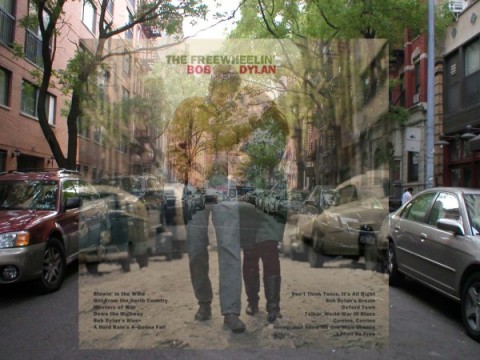
Egan’s fascination with album cover locations began in 1977, when he moved to his first apartment in Greenwich Village and discovered he was only a block away from the place on Jones Street where The Freewheelin’ Bob Dylan cover photograph was shot in 1963, which showed Dylan walking arm-in-arm with his girlfriend, Suze Rotolo, on a cold February day.
“Living in Greenwich Village in the late 70s,” Egan told Open Culture, “I was surrounded by sites I had read about in college: Bleecker and Macdougal, The Bottom Line, the Mudd Club, CBGB’s, etc. I was soaking up information for years later, I guess, because it wasn’t until the mid 90s that I first went into Bleecker Bob’s and asked if they knew where the cover of Blonde on Blonde was shot. When they didn’t know, I said, Well why not find out myself?”
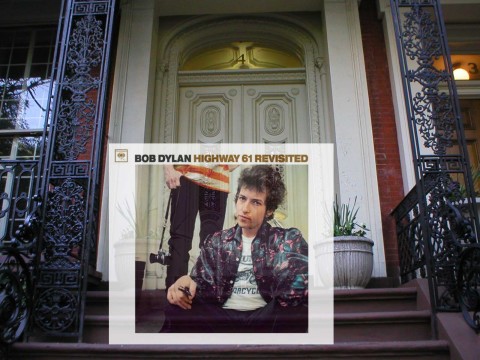
The Blonde on Blonde location remains a mystery, but Egan has tracked down a number of other Dylan cover locations, including Highway 61 Revisited (the front steps of a town house on Gramercy Park West), Another Side of Bob Dylan (the corner of 52nd Street and Broadway), and the single “I Want You” (a warehouse district on Jacob Street that was torn down long ago).
The Jacob Street location, also the site of a July 30, 1966 Saturday Evening Post cover of Dylan, was one of the hardest to find. “I searched through every curved street in New York and finally found it online in an old photo from the library,” Egan said. “The entire street, which was next to the Brooklyn Bridge, had been demolished 50 years ago, but I finally clicked on a library image and found myself staring straight into the exact spot Dylan was in the photo. I let out a whoop!”
Egan has found the exact locations of record albums and other famous images of a number of artists, including Bruce Springsteen, Neil Young, The Who, and Simon & Garfunkel. The choices reflect his taste in music. “I grew up during the classic rock era,” Egan said. “My ‘musical comfort food’ is Dylan, Van Morrison, Lou Reed, and The Grateful Dead.”
Even though the Grateful Dead was a West Coast group, Egan makes use of online tools like Google Street View and Bing Bird’s Eye to explore locations from his New York home. The 1970 album “Workingman’s Dead” is one of Egan’s current projects. “The Dead photo was supposedly taken next to a bus stop in the Mission District of San Francisco,” said Egan. “I bought a vintage map of the bus route from 1969 from the San Francisco transit museum and searched all the bus routes through the Mission with Street View, but still haven’t found it.”
When we asked Egan what drives his obsession, he said, “I think of it like this: If I went to England and someone asked me if I wanted to see Westminster Abbey or Abbey Road, I’d take Abbey Road.”
Below are several examples of Egan’s detective work. To see more, and to read the story behind each location, visit PopSpotsNYC.com.
The album cover that started it all for Egan was The Freewheelin’ Bob Dylan, featuring Don Hunstein’s photo of Dylan and his girlfriend Suze Rotolo walking through snow at the north end of Jones Street, in Greenwich Village.
The location of the cover photo of Dylan’s 1965 album Highway 61 Revisited posed a challenge. Egan always assumed that Daniel Kramer’s photo of Dylan was taken indoors, but he eventually tracked it down to the front steps of a town house on Gramercy Park West that was the home of Dylan’s manager, Albert Grossman. The person standing behind Dylan in the photo, holding a camera by its strap, is the singer’s friend Bob Neuwirth.
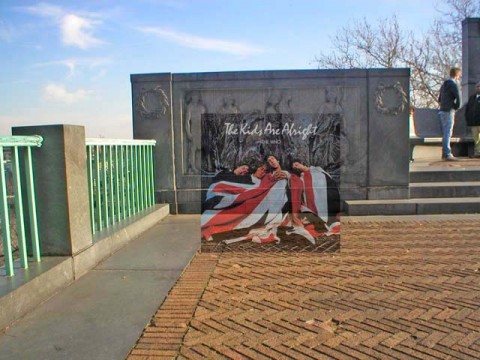
What could be more British than the 1979 cover of The Kids Are Alright, by The Who? Actually, Art Kane’s photo was taken in America, at the little-known Carl Schurz Monument in the Morningside Heights area of New York City. Egan gives directions on how to find the place at his Web site.
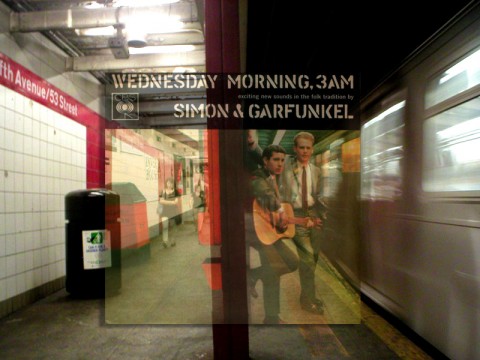
Egan found the precise location of Henry Parker’s cover photo for Simon & Garfunkel’s 1965 debut album, Wednesday Mourning 3 A.M.: the lower subway platform at Fifth Avenue and 53rd Street, for the outbound E and F lines.
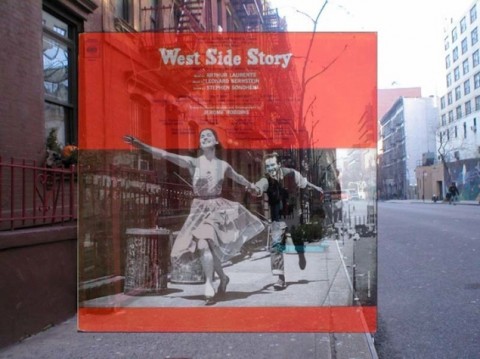
Leo Friedman’s cover photograph from the original 1957 cast recording of West Side Story shows characters Maria (Carol Lawrence) and Tony (Larry Kent) running through the Hell’s Kitchen neighborhood of New York. The location was actually one of Egan’s easier discoveries. “How did I find it,” he says on his Web site? “Pretty simple. If you look closely at the garbage can to the left of Maria–the address is right on it! 418 West 56th Street.” (All images courtesy Bob Egan/PopSpotsNYC.com)
This short internet documentary from Etsy profiles Jim Power, a.k.a. “Mosaic Man,” an artist and local historian of sorts on Manhattan’s Lower East Side who creates tile portraits of the city’s most significant people and places. Power embodies all of the qualities that attracted me to the neighborhood in the early 2000’s—a hard-bitten do-it-yourself ethos and a dedication to communal values. And he has withstood the forces that drove me out: the often harsh impact of so-called “quality of life” laws passed by Mayors Giuliani and Bloomberg and the soaring rents occasioned by encroaching new developments and ever-increasing demand for real-estate on the island. During Giuliani’s tenure in the 90s much of the arts community in lower Manhattan was swept away, including fifty light posts bearing Jim Power’s now-classic mosaics.
But Power is undaunted and is working to rebuild the “Mosaic Trail,” tile mosaics on a series of light poles and other fixtures representing several eras of Lower East Side history and culture. Power’s mosaics have been a stalwart feature of the neighborhood’s idiosyncratic landscape, as has the artist himself. Homeless for nearly thirty years, he is sustained by the generosity of his neighbors, who have donated studio space and helping hands. But he contends with the harsh conditions—whether on the streets or in the city shelters—that all New York’s homeless must, as you can read on his website. Nonetheless, Power thrives, in part, because as the documentary’s director Tara Young writes on her Etsy blog, “Jim’s not out for fame. He makes his art for the community that he loves and that loves him so dearly in return.”
We're hoping to rely on loyal readers, rather than erratic ads. Please click the Donate button and support Open Culture. You can use Paypal, Venmo, Patreon, even Crypto! We thank you!
Open Culture scours the web for the best educational media. We find the free courses and audio books you need, the language lessons & educational videos you want, and plenty of enlightenment in between.