In 1937, Walt Disney Studios shot Snow White and the Seven Dwarfs with a new-fangled camera, the multiplane camera, which allowed cartoon animation to take a quantum leap forward. Thanks to this new “super cartoon camera,” animated scenes suddenly looked more realistic and three-dimensional. You only need to watch this presentation by Walt Disney himself (recorded in 1957) and you’ll see what I mean. Disney shot many of its classic feature films – Pinocchio, Fantasia, Bambi, and Peter Pan – with the multiplane camera, and it remained in production right through The Little Mermaid, filmed in 1989. Today, only three original Disney multiplane cameras survive.
A big thanks to Sergey for sending this vintage clip our way. If you see a good piece of open culture, don’t hesitate to send it our way…
Google celebrated Les Pauls’ 96th birthday today with a playable electric guitar doodle. And, naturally, some tried to make it sing. Above, we have a version of Led Zeppelin’s Stairway to Heaven, while others strummed out versions of The Beatles’ Ob-la-di Ob-la-da, Michael Jackson’s Billie Jean, and Lady Gaga’s Paparazzi. By popular demand, the doodle will stay live on Google’s homepage for an extra day.
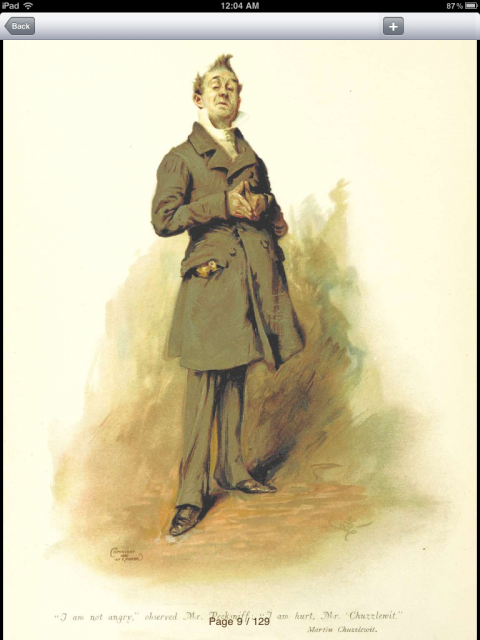
We told you this was coming, and now it’s here. The British Library has started to release 60,000+ texts from the 19th century in digital format. And they’re getting rolled out with the release of a new iPad app. (If you have any problems downloading the app, try doing it directly from the app store on your iPad.)
The upside: The new app currently features 1,000 works, including Mary Shelley’s Frankenstein, Charles Dickens’ Oliver Twist and other British classics. The collection gives you scans of the original editions. So you can read the works as they originally appeared.
The downside: The app won’t be free for long. Eventually, you’ll have to pay. So get in while you can, or just skim through our collection of Free eBooks and Audio Books. All classics, all the time…
Samuel Beckett’s haunting short story “The Lost Ones,” which tells of a group of people doomed to wander forever inside a narrow cylindrical prison, makes Waiting for Godot seem like Little Miss Sunshine. It is also nearly unadaptable since a story driven by the certainty of damnation leaves little room for dramatic tension … until now, perhaps.
This month’s New Scientist has a nice piece up about Unmakeablelove, a 3‑D interactive simulation based on “The Lost Ones” in which virtual bodies (created with motion capture, the same technique James Cameron used in Avatar) beat themselves, collide into each other, and slouch eternally towards nowhere, all driven by a force even more implacable than fate: the computer algorithms with which the piece was programmed.
And as with any good work of Existentialist Despair That Dooms All of Humanity to A Future Without Meaning or Hope, this one implicates the audience — spectators can only see inside the exhibit if they station themselves by one of six torches surrounding the 30-foot space. And when they do so, infrared video cameras project their own likenesses into the cylinder. There are no spectators.
Sheerly Avni is a San Francisco-based arts and culture writer. Her work has appeared in Salon, LA Weekly, Mother Jones, and many other publications. You can follow her on twitter at @sheerly.
One of the most unique concerts from the British blues revival of the 1960s was the “Blues and Gospel Train,” filmed May 7, 1964 by Granada TV for the BBC. Fans who were lucky enough to get tickets–some 200 of them–were instructed to gather at Manchester’s Central Station by 7:30 that evening for a short train ride to the abandoned Wilbraham Road Station. When the train pulled in at Wilbraham Road, the audience poured out and found seats on one platform. The opposite side, decorated to look like an old railway station in the American South, served as a stage for Muddy Waters, Otis Spann, Sister Rosetta Tharpe, Sonny Terry, Brownie McGhee, Cousin Joe and Reverend Gary Davis. The performances are available on DVD as part of American Folk-Blues Festival: The British Tours 1963–1966. In the scene above, Muddy Waters sings, “You Can’t Lose What You Ain’t Never Had.”
If you would like to support the mission of Open Culture, consider making a donation to our site. It’s hard to rely 100% on ads, and your contributions will help us continue providing the best free cultural and educational materials to learners everywhere. You can contribute through PayPal, Patreon, and Venmo (@openculture). Thanks!
This week, U2’s 360° Tour hit the west coast of the US, stopping first in Seattle, then Oakland and next Anaheim. Though critics have offered mixed reviews (this v. that), we had ourselves a ball, horrendous traffic jams aside. And we were particularly touched by one moment with a poignant backstory.
During the show, the audience gets beamed up to Mark Kelly, an astronaut on the space shuttle Endeavour, who happens to be married to Gabby Giffords, the US representative shot this past January in Arizona. To the 70,000 onlookers, Kelly says “Tell my wife I love her very much she knows” – the same lines delivered by Major Tom, the fictional astronaut, made famous by David Bowie’s Space Oddity: And, with that, U2 breaks into “Beautiful Day,” the song that served as a wake-up call for the Endeavour crew, at Gabby Giffords’ personal request. How’s that for a nice touch?
P.S. Yes we know that Endeavour returned to earth last week. But we have nothing against the willing suspension of disbelief.
Sheerly Avni is a San Francisco-based arts and culture writer. Her work has appeared in Salon, LA Weekly, Mother Jones, and many other publications. You can follow her on twitter at @sheerly.
How do you adequately portray life in a high-rise building? London filmmaker Marc Isaacs found a rather unconventional answer to this question. He installed himself inside the lift/elevator of a high rise on the East End of London. And for ten hours a day, over two months, he would ride up and down with the residents, with his camera pointing at them. It is fascinating to see how the residents react to him being there — some are suspicious or even hostile at the beginning. Others open up about their personal lives and their daily life in the building. And then others bring him something to eat, a chair to sit down on, or even little presents. The result is a moving and “quietly fascinating meditation on the mundanities of London life.” Writing about the film, the Times Online put it best: “Isaacs has an astounding gift for getting people to open up to him and he uses film the way a skilled artist uses paint. The result is beautiful, heartbreaking and profoundly humane.”
Here’s some bonus material: a review of “Lift” and Isaacs’ two other short documentaries “Calais” and “Travellers,” a Sunday Times article entitled “Marc Isaacs on his documentary art,” and an interview with Mark by The Documentary Filmmakers Group dfg.
By profession, Matthias Rascher teaches English and History at a High School in northern Bavaria, Germany. In his free time he scours the web for good links and posts the best finds on Twitter.
At first we thought it was either an Onion story or a joke: Multi-talented author, actor, sports enthusiast and Paris Revieweditor George Plimpton (1927–2003) also achieved considerable success in another medium: video games.
The Millions points us to George Plimpton’s video “Falconry,” the game Plimpton helped develop for ColecoVision in the early 80’s. You can play it here, but first be sure to catch up on the backstory (click “Backstory” button below the “Play” button), which may or may not involve high stakes double-crosses, hardcore sleuthings, and the childhood obsessions of frequent Daily Show guest John Hodgman. Maximum Fun has also posted an old commercial for the game, which we’ve reposted above. (Our apologies for the poor quality. It was apparently ripped from an old VHS tape).
If it turns out that we’ve been punked, it was worth it, if only for the joys of typing the words “Plimpton,” “Falconry” and “ColecoVision” all in one sentence. The game isn’t bad either.
Sheerly Avni is a San Francisco-based arts and culture writer. Her work has appeared in Salon, LA Weekly, Mother Jones, and many other publications. You can follow her on twitter at @sheerly.
Andrés Segovia first visited the Alhambra, the storied 14th Century Moorish palace in Granada, Spain, when he was ten years old. “It was here,” he said, “that I opened my eyes to the beauty of nature and art. To be here is to feel oneself to be near, very near, paradise.”
Segovia is often called the father of classical guitar. As a young boy he learned to play flamenco, the traditional music of his native Andalusia, but by the time he was a teenager he was transcribing Bach and other composers, adapting music originally intended for different instruments. Over the course of his lifetime, Segovia transcribed much of the classical repertoire, refined the standard technique, and established the guitar as a serious instrument, bringing it out of the parlors and into the concert halls.
In 1976, at the age of 84, Segovia returned to the Alhambra to perform for the documentary, Andrés Segovia: The Song of the Guitar. In the excerpt above, Segovia plays one of his favorite pieces, “The Legend of Asturias,” by Isaac Albéniz, who composed it for the piano as a prelude to his “Cantos de España.” The complete documentary is available on a two-film DVD, Andrés Segovia: In Portrait.
Thirty-five years ago today, New York magazine published “Tribal Rights of Saturday Night,” a beautifully-written paean to the dancing teens of the city’s boroughs. And the story focused on a working-class disco dancer named Vincent:
Vincent was the very best dancer in Bay Ridge—the ultimate Face. He owned fourteen floral shirts, five suits, eight pairs of shoes, three overcoats, and had appeared on American Bandstand. Sometimes music people came out from Manhattan to watch him, and one man who owned a club on the East Side had even offered him a contract. A hundred dollars a week. Just to dance.
“Vincent” become the model for Tony Manero, the hero of John Badham’s 1977 disco-ganza Saturday Night Fever, a hit film which launched the 70’s hottest dance craze and the career of young John Travolta. Plus it gave us the best-selling soundtrack album of all time and introduced the line dance, an exercise in inebriated communal humiliation that would dominate the dance floors of American wedding receptions for decades to come.
With all this to its credit, perhaps it shouldn’t matter that Nik Kohn’s article was more fiction than non-fiction, and that “Vincent” was, in Kohn’s own words, “completely made up, a total fabrication.” The ostensibly conscience-stricken journalist came clean in the Guardian in 1994:
My story was a fraud, I’d only recently arrived in New York. Far from being steeped in Brooklyn street life, I hardly knew the place. As for Vincent, my story’s hero, he was largely inspired by a Shepherd’s Bush mod whom I’d known in the Sixties, a one-time king of Goldhawk Road.” [Ed. Note: The Guardian piece is not available online, but it was quoted extensively in Charlie LeDuff’s 1996 article, “Saturday Night Fever: The Life”]
Sheerly Avni is a San Francisco-based arts and culture writer. Her work has appeared in Salon, LA Weekly, Mother Jones, and many other publications. You can follow her on twitter at @sheerly.
We're hoping to rely on loyal readers, rather than erratic ads. Please click the Donate button and support Open Culture. You can use Paypal, Venmo, Patreon, even Crypto! We thank you!
Open Culture scours the web for the best educational media. We find the free courses and audio books you need, the language lessons & educational videos you want, and plenty of enlightenment in between.