Last month, two award-winning writers and Vietnam veterans – Tim O’Brien and Tobias Wolff – met at Stanford University to talk about war and literature, a tradition that has given us Tolstoy’s War and Peace, Remarque’s All Quiet on the Western Front, Hemingway’s A Farewell to Arms, and Mailer’s The Naked and the Dead. O’Brien has confronted war in two previous works, If I Die in a Combat Zone and Going After Cacciato. But he’s best known for The Things They Carried, a collection of short stories that gives literary expression to the Vietnam experience, and that’s now a staple of high school and college literature courses. As for Tobias Wolff, his memoir recounting his disillusioning experience as a soldier in Vietnam – In Pharaoh’s Army – was a National Book Award finalist, ranking up there with This Boy’s Life and Old School. Their wide-ranging conversation runs 80 minutes…
Sub Zero: Winter Time-Lapse in South Dakota
Earlier this month, Randy Halverson braved the cold South Dakota nights (where temperatures often drop to ‑25 below wind chill), to create this nighttime time-lapse film. Using a Canon 60D and T2i, Halverson gave each shot a 20 second exposure, with a one second interval placed between shots. The result is pretty jaw-dropping. H/T @matthiasrascher.
The Great Train Robbery: Where Westerns Began
A great film tradition – the Western – started with The Great Train Robbery in 1903. Edwin S. Porter’s 10 minute film combined western themes with innovative cinematic techniques (narrative storytelling, parallel editing, minor camera movement, location shooting, etc.). And the film took its inspiration from an event that became the stuff of legend: Butch Cassidy’s 1900 train heist, which ended with Cassidy blowing open a safe and escaping with $5,000 in cash.
Porter’s landmark film helped spark America’s love affair with Western films. Thousands of Westerns flooded cinemas throughout the silent era — films like Broncho Billy and The Greaser (1914), Sky High (1922), and West of Hot Dog (1924). And though the Western faded briefly with the advent of sound film (circa 1927), the genre staged a major comeback with the release of Stagecoach (1939), a John Ford film that turned John Wayne into one of Hollywood’s enduring stars. And yes, we have catalogued 25 free John Wayne Films right here. To find other free Westerns, visit this YouTube channel.
Related Content:
A Trip to the Moon: Where Sci Fi Movies Began
The Amazing Adventures of Kavalier and Clay: Animation Concepts
Michael Chabon published The Amazing Adventures of Kavalier & Clay in 2000, and the next year it won the Pulitzer Prize for Fiction. The film version of the novel has been locked in “development hell” for a good decade now. (The producer Scott Rudin has a reputation for optioning high-profile novels and sitting on them for a long time; he also holds the film rights to Jonathan Franzen’s The Corrections.) Anyway, somewhere in the development process, the director Jamie Caliri was asked to explore animation concepts, and here’s what he came up with: a fun intertwining of live action and animation.
If you would like to support the mission of Open Culture, consider making a donation to our site. It’s hard to rely 100% on ads, and your contributions will help us continue providing the best free cultural and educational materials to learners everywhere. You can contribute through PayPal, Patreon, and Venmo (@openculture). Thanks!
The Ice Book, a Beautiful Pop-Up Book
The Ice Book, seen above, is a paper theatre brought to life with light. Watch as sheets of paper are illuminated in a dazzling animation display. According to the artists, Davy and Kristin McGuire, The Ice Book tells the story of a mysterious princess who lures a boy into her magical world to warm her heart of ice. It was shot with the Canon 5D Mark II, with the actors superimposed onto the montages using a makeshift green screen, and projections created in Adobe After Effects. A simple yet remarkable achievement. You can learn more about the project here. Don’t miss the page describing the behind the scenes work, or this other primo video that savors books in stop motion film.
Eugene Buchko is a blogger and photographer living in Atlanta, GA. He maintains a photoblog, Erudite Expressions, and writes about what he reads on his reading blog.
“From Dictatorship to Democracy.” Open Text Changes Face of Egypt.
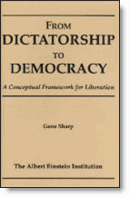 There’s something wonderful about this .… unless you’re a dictator. Today, The New York Times shines a good light on Gene Sharp, a shy American intellectual who has spent decades writing on the art of non-violent revolution. Back in 2002, Sharp published “From Dictatorship to Democracy: A Conceptual Framework for Liberation,” a 93-page guide to upending autocrats. Then, he had the text translated into 24 languages and made freely available online, with all copyright restrictions removed. The manual has since inspired dissidents in Burma, Bosnia and Estonia, while giving strategic direction to the protests in Egypt and Tunisia. Ideas have power. But good ideas have more power when they’re open. You can download Sharp’s manual here (PDF), and learn more about his mission through his nonprofit, The Albert Einstein Institution.
Speaking of good ideas that are open, feel free to download 35o free online courses and teach yourself anything and everything.
via @philosophybites
NASA Zooms into Spiral Galaxy
Courtesy of NASA’s Hubble Space Telescope, we’re zooming into a “majestic disk of stars and dust lanes” and getting a stunning view of the spiral galaxy NGC 2841, which lies 46 million light-years away in the constellation of Ursa Major (The Great Bear). But wait, it gets even better. This high resolution still photo shows the spiral galaxy in all its beauty and splendor…
Christopher Hitchens Answers Reddit User Questions
A little ways back, Christopher Hitchens fielded questions for 30 minutes from Reddit.com users, answering any and every question they threw his way. What historical figures, events or books have been underemphasized in American public education? Has the Iraq War (something Hitchens supported) had a positive or negative impact on Islamic extremism? What do socialism and libertarianism have in common intellectually, if anything? Other figures interviewed by Reddit users include Richard Dawkins, Noam Chomsky, and Ron Paul.
Evolution Made Us All
File under Everything is a Remix. Ben Hillman offers a creative little riff on “All Things Bright and Beautiful” (listen here), an Anglican hymn inspired by William Paley’s 1802 treatise, Natural Theology, which positions God as the designer of the natural world … in an Enlightenment kind of way. You can catch more Hillman videos on Vimeo here.
A Rare Look Inside Pixar Studios
Since 1995, Pixar has released a steady stream of award-winning animated films. First came Toy Story, then Finding Nemo, Monsters, Inc., The Incredibles, and most recently Toy Story 3. (You can revisit Pixar’s classics in this wonderful little tribute video.) Getting inside Pixar Studios has never been easy. But last week The New York Times pulled it off, producing a six minute video that takes you through the studios designed by Steve Jobs himself, and inside Pixar’s patented animation process – a process that combines more traditional and cutting-edge elements.
Note: This video tour also appears on Vimeo and YouTube.
H/T @matthiasrascher
The First Talk Radio Show on the Net (1993)
Back in the early 1990s, while most of us were still trying to wrap our heads around this new thing called the internet (don’t miss this amusing bit), NPR’s Science Friday started pushing the envelope and hosting the first internet-based radio talk show. This marked the first time that listeners could “phone into” a program via the web and talk together – in this case about the creative uses of this emerging technology. The broadcast, which singlehandedly brought the internet to a crawl, has now resurfaced online. You can listen below (or here).
via @Alyssa_Milano and ExtremeTech
Support Us
We're hoping to rely on loyal readers, rather than erratic ads. Please click the Donate button and support Open Culture. You can use Paypal, Venmo, Patreon, even Crypto! We thank you!

Great Lectures
About Us

Open Culture scours the web for the best educational media. We find the free courses and audio books you need, the language lessons & educational videos you want, and plenty of enlightenment in between.
Advertise With Us
Archives
- October 2026
- September 2026
- August 2026
- July 2026
- June 2026
- May 2026
- April 2026
- March 2026
- February 2026
- January 2026
- December 2025
- November 2025
- October 2025
- September 2025
- August 2025
- July 2025
- June 2025
- May 2025
- April 2025
- March 2025
- February 2025
- January 2025
- December 2024
- November 2024
- October 2024
- September 2024
- August 2024
- July 2024
- June 2024
- May 2024
- April 2024
- March 2024
- February 2024
- January 2024
- December 2023
- November 2023
- October 2023
- September 2023
- August 2023
- July 2023
- June 2023
- May 2023
- April 2023
- March 2023
- February 2023
- January 2023
- December 2022
- November 2022
- October 2022
- September 2022
- August 2022
- July 2022
- June 2022
- May 2022
- April 2022
- March 2022
- February 2022
- January 2022
- December 2021
- November 2021
- October 2021
- September 2021
- August 2021
- July 2021
- June 2021
- May 2021
- April 2021
- March 2021
- February 2021
- January 2021
- December 2020
- November 2020
- October 2020
- September 2020
- August 2020
- July 2020
- June 2020
- May 2020
- April 2020
- March 2020
- February 2020
- January 2020
- December 2019
- November 2019
- October 2019
- September 2019
- August 2019
- July 2019
- June 2019
- May 2019
- April 2019
- March 2019
- February 2019
- January 2019
- December 2018
- November 2018
- October 2018
- September 2018
- August 2018
- July 2018
- June 2018
- May 2018
- April 2018
- March 2018
- February 2018
- January 2018
- December 2017
- November 2017
- October 2017
- September 2017
- August 2017
- July 2017
- June 2017
- May 2017
- April 2017
- March 2017
- February 2017
- January 2017
- December 2016
- November 2016
- October 2016
- September 2016
- August 2016
- July 2016
- June 2016
- May 2016
- April 2016
- March 2016
- February 2016
- January 2016
- December 2015
- November 2015
- October 2015
- September 2015
- August 2015
- July 2015
- June 2015
- May 2015
- April 2015
- March 2015
- February 2015
- January 2015
- December 2014
- November 2014
- October 2014
- September 2014
- August 2014
- July 2014
- June 2014
- May 2014
- April 2014
- March 2014
- February 2014
- January 2014
- December 2013
- November 2013
- October 2013
- September 2013
- August 2013
- July 2013
- June 2013
- May 2013
- April 2013
- March 2013
- February 2013
- January 2013
- December 2012
- November 2012
- October 2012
- September 2012
- August 2012
- July 2012
- June 2012
- May 2012
- April 2012
- March 2012
- February 2012
- January 2012
- December 2011
- November 2011
- October 2011
- September 2011
- August 2011
- July 2011
- June 2011
- May 2011
- April 2011
- March 2011
- February 2011
- January 2011
- December 2010
- November 2010
- October 2010
- September 2010
- August 2010
- July 2010
- June 2010
- May 2010
- April 2010
- March 2010
- February 2010
- January 2010
- December 2009
- November 2009
- October 2009
- September 2009
- August 2009
- July 2009
- June 2009
- May 2009
- April 2009
- March 2009
- February 2009
- January 2009
- December 2008
- November 2008
- October 2008
- September 2008
- August 2008
- July 2008
- June 2008
- May 2008
- April 2008
- March 2008
- February 2008
- January 2008
- December 2007
- November 2007
- October 2007
- September 2007
- August 2007
- July 2007
- June 2007
- May 2007
- April 2007
- March 2007
- February 2007
- January 2007
- December 2006
- November 2006
- October 2006
- September 2006

