If you would like to support the mission of Open Culture, consider making a donation to our site. It’s hard to rely 100% on ads, and your contributions will help us continue providing the best free cultural and educational materials to learners everywhere. You can contribute through PayPal, Patreon, and Venmo (@openculture). Thanks!
The story has, over time, solidified into one of the columns of Steve Jobs lore: in the early 1970s, the man who would found Apple left for Reed College. But before long, not wanting to spend any more of his parents’ money on tuition (and perhaps not temperamentally compatible with the structure of higher education anyway), he officially dropped out, couch-surfed through friends’ pads, lived on free meals ladled out by Hare Krishnas, continued to audit a variety of classes, and generally lived the prototype techno-neo-hippie lifestyle Silicon Valley has continued relentlessly to refine.
Perhaps the least likely of those classes was one on calligraphy, taught by Trappist monk and calligrapher Robert Palladino. More than thirty years later, delivering a now-famous Stanford commencement speech, Jobs recalled his time in the calligraphy class: “None of this had even a hope of any practical application in my life. But 10 years later, when we were designing the first Macintosh computer, it all came back to me. And we designed it all into the Mac. It was the first computer with beautiful typography.”
And what of the calligraphy teacher who made that possible? “Palladino, who died in late February at 83, joined the Trappist order of monks in New Mexico in 1950, according to a 2003 profile in Reed Magazine,” writes the Washington Post’s Niraj Chokshi. “Just 17 at the time, his handwriting attracted the attention of the monastery scribe, who worked with him on his art. Five years later, Palladino moved to Lafayette, Ore., where local artists brought news of a skilled amateur to Lloyd Reynolds, an icon in the field and the creator of Reed’s calligraphy program.”
Now you, too, can receive instruction from Reynolds, who in 1968 starred in a series on the Oregon Education Television Service’s program Men Who Teach, shooting twenty half-hour broadcasts on italic calligraphy and handwriting. Eight years later — about the time Jobs co-founded Apple with Steve Wozniak — he re-shot the series in color, and you can watch that version almost in its entirety with the playlist at the top of the post. (Reed has also made some related instructional materials available.) You may feel the temptation to turn all of Reynolds’ lessons on the art of writing toward your goal of becoming the next Steve Jobs. But try to resist that impulse and appreciate it for its own nature, which Jobs himself described as “beautiful, historical, artistically subtle in a way that science can’t capture.”
On the 750th birthday of Dante Alighieri—composer of the dizzyingly epic medieval poem the Divine Comedy—English professor John Kleiner pointed to one way of helping undergraduate students understand the Italian poet’s importance: an “obvious comparison” with Shakespeare. They both occupy singularly definitive places in their respective languages and literatures as well as in world literature, Kleiner suggested, and indeed no less a critical personage than T.S. Eliot once wrote, “Dante and Shakespeare divide the world between them. There is no third.”
And yet, those who know the epic English poems Paradise Lost and Paradise Regained—heavily influenced by Dante’s work—may find John Milton a more apt comparison. Milton also made complex uses of theology as political allegory, and wrote political tracts as passionate and resolute as his poetry. Both Milton and Dante were intensely partisan writers who expanded their worldly conflicts into the eternal realms of heaven and hell.
Like Milton, Dante’s formative political experience involved a civil war—in his case between two factions known as the Guelphs and the Ghibellines (then further between the “White Guelphs” and the “Black Guelphs.”) And like Milton, Dante had special access to the powerful of his day. Unlike the English poet and defender of regicide, however, Dante was a strict monarchist who even went so far as to propose a global monarchy under Holy Roman Emperor Henry VII. And while Milton veiled his political references in allegorical symbolism, Dante boldly named his adversaries in his poem, and subjected them to grisly, inventive tortures in his vivid depiction of hell.
Indeed, Dante’s literary persecution of his opponents presents one of the foremost difficulties for modern readers of the Inferno. In addition to cataloguing the number of classical and mythological characters Dante encounters in his infernal sojourn, we must wade through pages of contextual notes to find out who various contemporary characters were, and why they have been condemned to their respective levels and torments. Most of his named historical sufferers—including Pope Boniface VII—had died by the time of his writing, but some still lived. Of two such cases, one online guide notes humorously, “Dante explains their presence in Hell by saying that they were so sinful that the devil did not wait for them to die before snatching their souls…. Obviously libel laws were not that strict in Medieval Italy.”
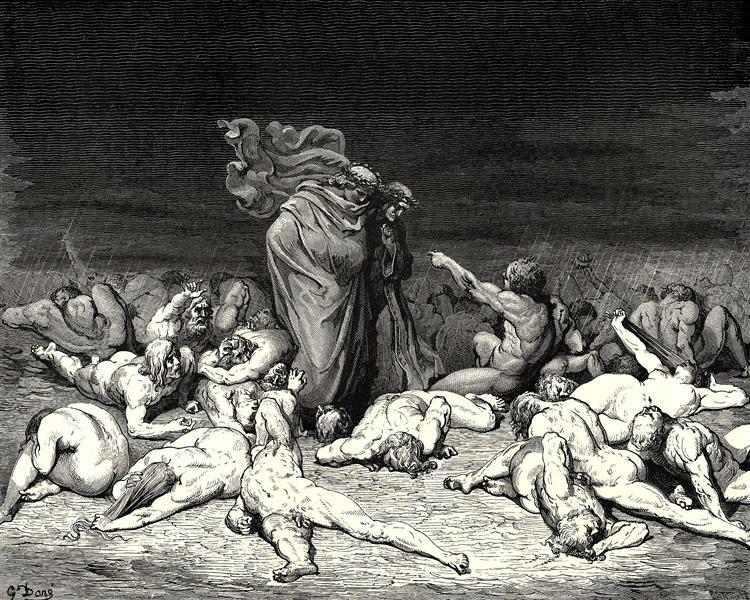
The Inferno treats the existence of hell and the grievous sins that consign its inhabitants there with the utmost seriousness. And yet, the presence of Dante’s many personal and political enemies injects no small amount of dark humor into the poem, such that one can read it as political satire as well as an ingenious marriage of medieval Catholic theology and philosophy with the poetry of courtly love. The richness of the Divine Comedy’s rhetorical world invites a great many interpretations, but it also demands much of its reader. To meet its challenge, we might lean on excellent reference guides like the online World of Dante, which offers a fully annotated text in English and Italian, as well as maps, charts, and diagrams of the hellish world, and visual interpretations like Gustave Doré’s illustration from Canto 6 at the top.
And we might listen to the poem read aloud. Here, we have one reading of Cantos I‑VIII of the Inferno by poet John Ciardi, from his translation of the poem for a Signet Classics Edition. Ciardi (known as “Mr. Poet” during his day) made his recording in 1954 for Smithsonian Folkways records, and the liner notes of the LP, which you can download here, contain the excerpted “verse rendering for the modern reader.” The translation preserves Dante’s terza rima in very eloquent, yet accessible language, fitting given Dante’s own use and defense of the vernacular. You can hear the complete reading on Spotify (download the software here) or on Youtube just above.
For his new album, Electronica Volume II: The Heart Of Noise, Jean-Michel Jarre, a pioneer in electronic and ambient music, collaborated on a recording with Edward Snowden, the former CIA computer analyst-turned-whistleblower. Cue up their song, “Exit,” above.
At first glance, it perhaps seems like an unlikely pairing. But if you give Jarre, the son of a French resistance fighter, a chance to explain, it all makes perfect sense. Recently, he told The Guardian:
The whole Electronica project is about the ambiguous relationship we have with technology: on the one side we have the world in our pocket, on on the other, we are spied on constantly. There are tracks about the erotic relationship we have with technology, the way we touch our smartphones more than our partners, about CCTV surveillance, about love in the age of Tindr. It seemed quite appropriate to collaborate not with a musician but someone who literally symbolises this crazy relationship we have with technology.
A lot of what Jarre and Snowden were trying to accomplish with the song–musically, conceptually, ideologically, etc.–gets explained in the video below. Listening to Snowden talk about the meaning of the song’s title (“Exit” means “things have to change,” “it’s time to leave, it’s time to do something else, it’s time to find a better way”), you’ll get the sense that “Exit” is an electronic protest song befitting our digital age. Out with the folk music, in with the techno.
Since 1997, Paul Thomas Anderson (There Will Be Blood, Boogie Nights, and Magnolia) has directed 11 music videos (watch them here)–five alone for Fiona Apple, and now the first of hopefully many for Radiohead. Above, watch the cinematic touch Anderson puts on the new Radiohead single “Daydreaming.” And, if you want, download Radiohead’s new album, AMoon Shaped Pool, which just became available minutes ago on digital platforms (Amazon, iTunes, the band’s website, etc). A release in vinyl/CD is scheduled for June 17th.
If you would like to support the mission of Open Culture, consider making a donation to our site. It’s hard to rely 100% on ads, and your contributions will help us continue providing the best free cultural and educational materials to learners everywhere. You can contribute through PayPal, Patreon, and Venmo (@openculture). Thanks!
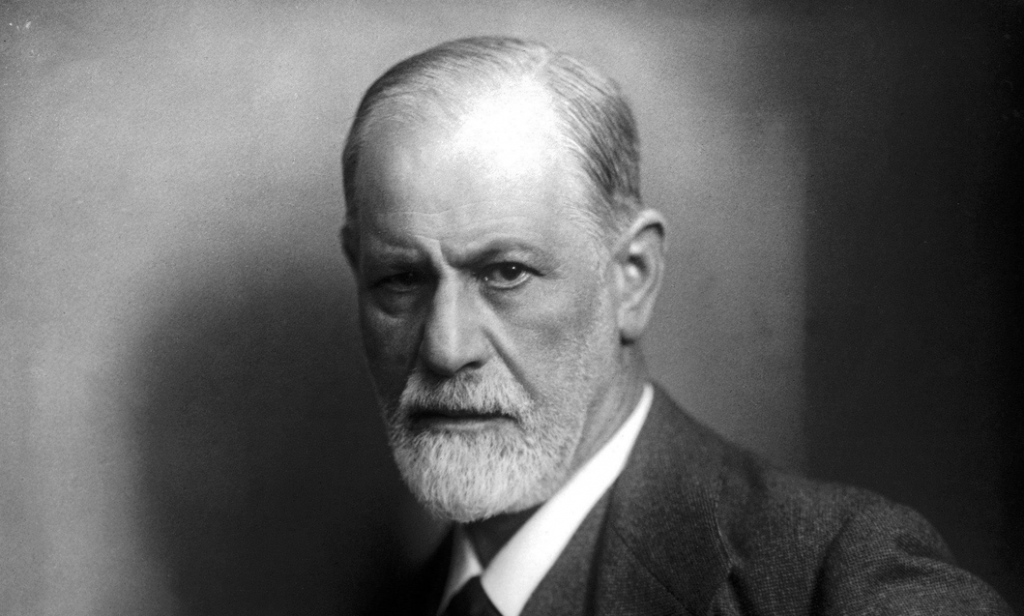
Anyone with a passing familiarity with the work of Sigmund Freud—which is just about everyone—knows at least a handful of things about his famous psychoanalytic theory: Ego, Super-ego, and Id, sex and death drives, Oedipal complex, “Freudian slip,” “sometimes a cigar is just a cigar”… (a quote that didn’t come from Freud). Most of these terms, except that cigar thing, originate from Freud’s later period—from about 1920 to his death in 1939—perhaps his most productive from a literary standpoint, starting with Beyond the Pleasure Principle, in which he began to develop his well-known structural model of the mind.
During these later years Freud built on ideas from 1913’s Totem and Taboo and fully expanded his psychological analysis into a philosophical and cultural theory in books like The Future of an Illusion, Civilization and its Discontents, and Moses and Monotheism. For those who have primarily encountered Freud in intro to psych classes, these works can seem strange indeed, given the sweeping speculative claims the Viennese doctor makes about religion, war, ancient history, and even prehistory. Though peppered with terminology from psychoanalysis, Freud’s more philosophical works roam far afield of his medical specializations and direct observations.
When and how did Freud’s psychiatry become philosophy, and what possessed him to apply his psychological theories to analyses of broad social and historical dynamics? We see hints of Freud the philosopher throughout his career, but it’s during his middle period—when his tripartite model of the psyche still consisted of the conscious, preconscious, and unconscious—that he began to move more fully from case studies of individual psychosexual development and interpretations of dreams to studies of human development writ large. These books are almost Darwinian expansions of what Freud called “metapsychology”—which included his theories of Oedipal neuroses, narcissism, and sadomasochism.
From 1914 to 1915, after his break with Jung, Freud worked on a series of papers on “metapsychology,” intended, he wrote “to clarify and carry deeper the theoretical assumptions on which a psycho-analytic system could be founded.” Seven of the manuscripts from this period vanished, seemingly lost forever. In 1983, psychoanalyst Ilse Grubich-Simitis discovered one of these essays in an old trunk belonging to a friend and colleague of Freud. Published as A Phylogenetic Fantasy, this fascinating, unfinished work points the way forward for Freud, providing some connective tissue between his “ontogeny,” the development of the individual, and “phylogeny,” the development of the species.
It is here, his translators write in their introduction to this rare work, that Freud “concludes that each individual contains somewhere within himself or herself the history of all mankind; further, that mental illness can usefully be understood as a vestige of responses once necessary and highly adaptive to the exigencies of each era. Accordingly, mental illness can be understood as a set of formerly adaptive responses that have become maladaptive as the climatic and sociological threats to the survival of mankind have changed.”
These basic, yet radical, ideas may be said to form a backdrop against which we might read so much of Freud’s mature work as a means for decoding what seems puzzling, irrational, and downright maddening about human behavior. Freud’s scientific work has long been superseded, and many of the specifics of his psychoanalytic theory deemed unworkable, irrelevant, or even damaging. But there are very good reasons why his work has thrived in literary theory and philosophy. There is even a case to be made the Freud was the first evolutionary psychologist, roughly bringing Darwinian concepts of adaptation to bear on the development of the human psyche from prehistory to modernity.
For all the negative criticism his work has endured, Freud dared to explain us to ourselves, drawing on every resource at his disposal—including our most foundational narratives in mythology and ancient poetry. For that reason, his relevance, writes Jane Ciabattari, as a “theoretical catalyst” in the 21st century remains potent, and his work remains well worth reading and pondering, for any student of human behavior.
Today, on the 160th birthday of the father of psychoanalysis, we bring you a collection of Freud’s major works available free to read online or download as ebooks in the links below. Further down, find a list of Freud audiobooks to download as mp3s or stream.
Whether rooted in clinical study and research, detective-like case studies, philosophical speculations, or poetic flights of fancy, Freud’s writing draws us deeper into strange, obsessive, profound, and disturbing ways of thinking about our uneasy relationships with ourselves, our families, and our unstable social order.
Charles Bukowski could really write. Charles Bukowski could really drink. These two facts, surely the best-known ones about the “lowlife laureate” of a poet and author of such novels as Post Office and Ham on Rye(as well as what we might call his lifestyle column, “Notes of a Dirty Old Man”), go together. Drinking provided enough of the subject matter of his prose and verse — and, in life, enough of the fuel for the existence he observed on the page with such rough-edged evocative artistry — that we can hardly imagine Bukowski’s writing without his drinking, or his drinking without his writing.
We would naturally expect him, then, to have written an ode to beer, one of his drinks of choice. “Beer,” which appeared in Bukowski’s 1971 poetry collection Love Is a Dog from Hell, pays tribute to the countless bottles the man drank “while waiting for things to get better,” “after splits with women,” “waiting for the phone to ring,” “waiting for the sounds of footsteps.”
The female, he writes, knows not to consume beer to excess in the male manner, as “she knows its bad for the figure.” But Bukowski, figure be damned, finds in this most working-class of all drinks a kind of solace.
“Beer” comes to life in the animation above by NERDO. “The composition is a manifesto of the author’s way of life, this is why we decided to go inside the author’s mind, and it is not a safe journey,” say the accompanying notes. “A brain solo without filter, a tale of ordinary madness, showing how much loneliness and decadence can be hidden inside a genius mind.” This wild ride passes what we now recognize as many visual signifiers of the Bukowskian experience: neon signs, cigarettes, decaying city blocks, tawdry Polaroids — and, of course, beer, literally “rivers and seas of beer,” which no less a fellow animated enthusiast of the beverage than Homer Simpson once, just as eloquently, pronounced “the cause of, and solution to, all of life’s problems.”
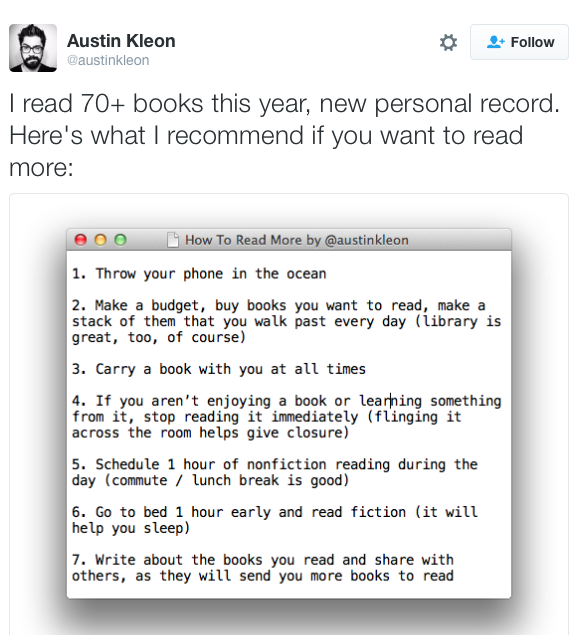
On Twitter, Austin Kleon, author of Steal Like an Artist: 10 Things Nobody Told You About Being Creativehas served up 7 tips for achieving the seemingly impossible–getting more books read in this age of constant distraction. The tips are simple and effective–effective enough to help Austin read 70+ books during a year, a new personal record.
No doubt, you have your own strategies for spending more time with books (and not just watching them pile up, unread, on your shelves. There’s a word for that in Japanese folks. It’s called “Tsundoku.”) If you care to share them, please put your best tips in the comments section below. We, and your fellow readers, thank you in advance.
Looking for free, professionally-read audio books from Audible.com? (Speaking of an easy way to spend more time with books.) Here’s a great, no-strings-attached deal. If you start a 30 day free trial with Audible.com, you can download two free audio books of your choice. Get more details on the offer here. Also note that Audibooks.com has a very similar offer that you can explore here.
It is the end of term this week and my film production students asked me to name my favorite part of filmmaking. I told them it’s directing, as it’s something I so rarely get to do (compared to writing) yet so involving that an entire day goes by in a flash. Regardless, I always pop out the other side knowing I was at my absolute creative best. I was in the “zone” or as Mihaly Csikszentmihalyi called it in 1990, “the flow state.” And in a wonderful bit of synchronicity, not a little while later, I have been charged with presenting to you this example of artificial intelligence (AI) creativity. It similarly uses this understanding of the flow state to create.
In the above video, the Flow Machine developed by François Pachet at Sony CSL-Paris has been fed Beethoven’s “Ode to Joy”, and then asked to orchestrate “cover versions” following the rules set down by a genre–say bossa nova or electronic chill music–or a song itself, in this case being the Beatles’ “Penny Lane.”
Previous attempts to create random computer music have resulted in exactly that–random notes, drawn from a selection determined by a programmer. But that isn’t how creativity works. When we create, we understand our parameters already, subconsciously, and not only that, we know what we and others have done before, what “pushes the envelope” compared to using a completely wrong element, and what makes our own creativity unique. (If we discover it and emphasize the latter over and over, it’s called style.)
The Flow Machine project aims to understand style and treat it as a computational object through which other information can pass. That’s what we’re seeing in the above video. For a more thorough explanation of Flow Machine, watch this video.
Supposedly, this will help us poor human beings in the end, as it might (it’s never explained how) help us get into our own flow state more readily.
But really, that’s not what I’m thinking about. I’m more imagining a night club sometime in the future where Beatles androids play not just their hits, but the hits of others as if John, Paul, George and Ringo wrote them instead. (Yes, I know that has already been done. By humans.) And your local used record shop will have a lot of LPs full of classical versions of Beatles hits.
It’s an interesting video, but I wouldn’t pack up your guitars yet folks!
Ted Mills is a freelance writer on the arts who currently hosts the artist interview-based FunkZone Podcast. You can also follow him on Twitter at @tedmills, read his other arts writing at tedmills.com and/or watch his films here.
The Japanese term kaizen, which just means something like “good change,” has come to signify in global management culture a process of continuous small-scale improvement — an element of the “Japanese business philosophy” so enviously scrutinized during that country’s postwar economic boom. Toyota has done the most to associate themselves with the idea of kaizen-as-continuous-improvement, but it has made its way to countless other businesses, including foreign ones selling completely different products; even the American grocery store Trader Joe’s has worked the word into their internal customer-service lexicon.
These mini-documentaries take in-depth looks at the nuts and bolts (sometimes literally) of production systems that have evolved, small improvement after small improvement, over decades or indeed centuries. You can see in action every stage of these hybrid processes of advanced and highly specialized technology with skilled and sometimes even artisanal human labor, somehow at once elaborate and elegant. This goes for every product featured, no matter how important or trivial it may seem. (I got hooked myself after watching one on chicken-shaped sweets.)
Even non-Japanese-speakers can enjoy all of The Making’s clear and almost completely visual-driven episodes, but the JST has also made select ones available with English subtitles (see top playlist) in order to tell the world all about what it takes to make what it has come to see as quintessentially Japanese, like urban railroad cars, steel balls (of many uses, including but not limited to pachinko machines), and Hina dolls.
Any American old-timer will tell you that, back in their day — a time when the United States’ former enemy had yet to fully rebuild its economy, let alone to become a technological leader — the “made in Japan” stamp signified a piece of junk. These videos show us, in detail, what it took to refute that notion for good.
The broadcast features Amy Berg’s never-before-seen extended film cut with additional archival performance footage and new interviews with Janice Joplin’s sister Laura Joplin and musicians influenced by Janis: Alecia Moore (a.k.a. Pink), Juliette Lewis, Melissa Etheridge and the film’s narrator, Chan Marshall, who is best known as indie rock star Cat Power.
The doc runs 102 minutes, and just started airing on television on PBS this week. Enjoy.
h/t goes to Elana and Robin.
If you would like to support the mission of Open Culture, consider making a donation to our site. It’s hard to rely 100% on ads, and your contributions will help us continue providing the best free cultural and educational materials to learners everywhere. You can contribute through PayPal, Patreon, and Venmo (@openculture). Thanks!
We're hoping to rely on loyal readers, rather than erratic ads. Please click the Donate button and support Open Culture. You can use Paypal, Venmo, Patreon, even Crypto! We thank you!
Open Culture scours the web for the best educational media. We find the free courses and audio books you need, the language lessons & educational videos you want, and plenty of enlightenment in between.