I’ll admit it. I have a thing for listening to rock biographies and autobiographies on Audible, particularly memoirs narrated by the author him or herself. Look in my personal Audible library and you’ll find Patti Smith reading Just Kids. Keith Richards reading sections of his bestseller Life. And Pete Townshend narrating his 18-hour tome Who Am I. That’s just naming a few.
Right now, I’m getting started with Girl in a Band, the new memoir released by Kim Gordon, the co-founder of the influential indie rock band, Sonic Youth. And it looks like you can do the same with me. Rough Trade has made available online five audio clips, starting with Gordon reading from Chapter 1. Together, they amount to almost an hour of free audio. Find them all below.
Meanwhile, if you want to download the entire memoir for free, you can go here, and then click on the “Try Audible Free” button in the upper right corner. Just realize that you’re signing up for Audible’s 30-Day Free Trial program, which lets you download two free audiobooks and try out the service for 30 days. If you so choose, you can cancel before a fee kicks in. Please make sure you read all of the fine print before you sign up.
People can, and do, spend lifetimes tracking down and cataloguing all of the various releases of their favorite bands—studio, stage, bootleg, and otherwise. Certain groups—the Grateful Dead, naturally (hear 9,000 Dead shows here)—encourage this more than others. And if a rock band can send completists on lifelong scavenger hunts, how much more so a prolific jazz artist such as, say, Miles Davis? Like the musical form itself, jazz artists are mercurial by nature, spending years as journeymen for any number of other bandleaders before breaking off to form their own quartets, quintets, sextets, etc. Add to the profusion of different groups the tendency of jazz players to record the same songs—but never in the same way—dozens, hundreds, of times, and you’ve got discographies that number well into double-digit page lengths.
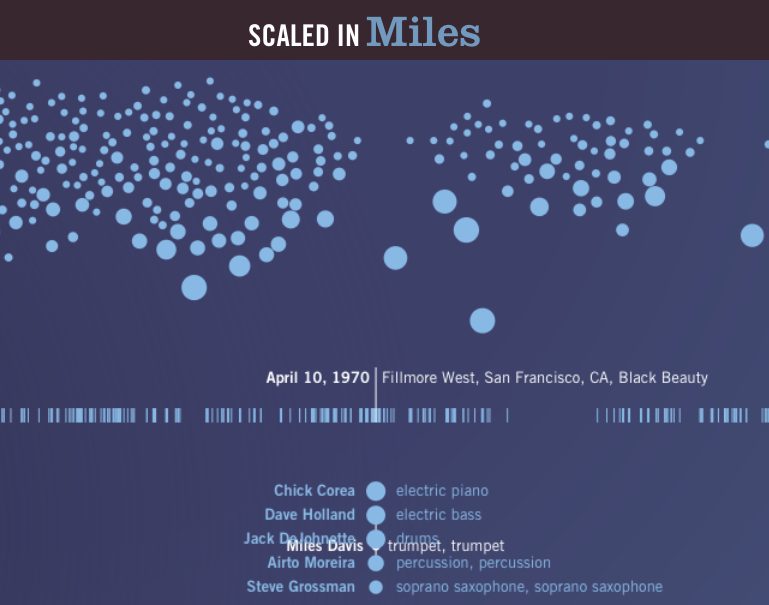
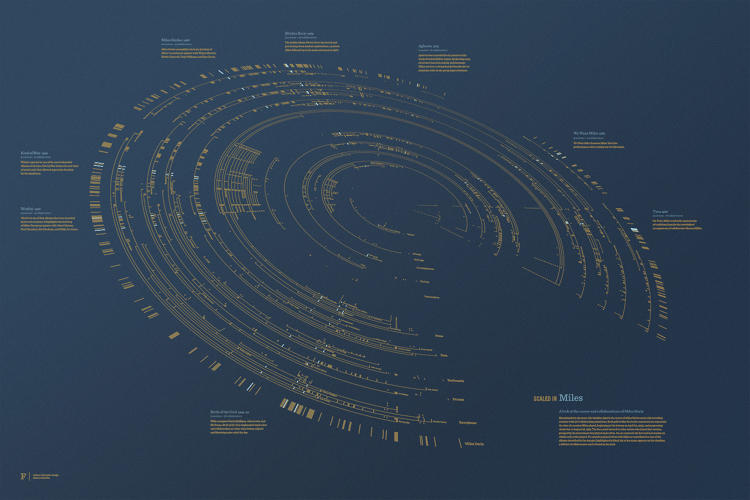
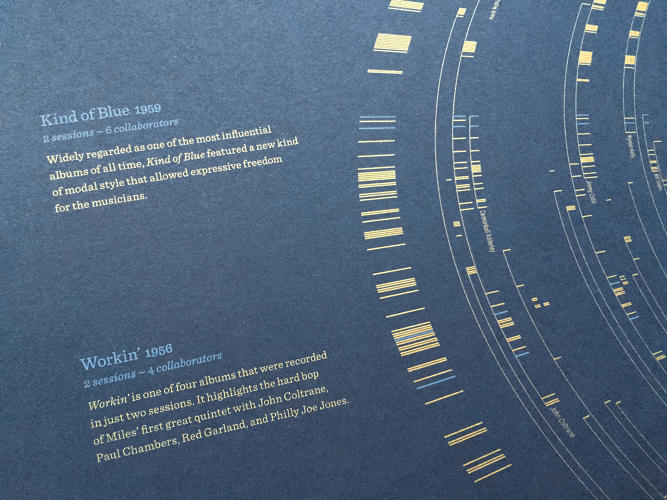
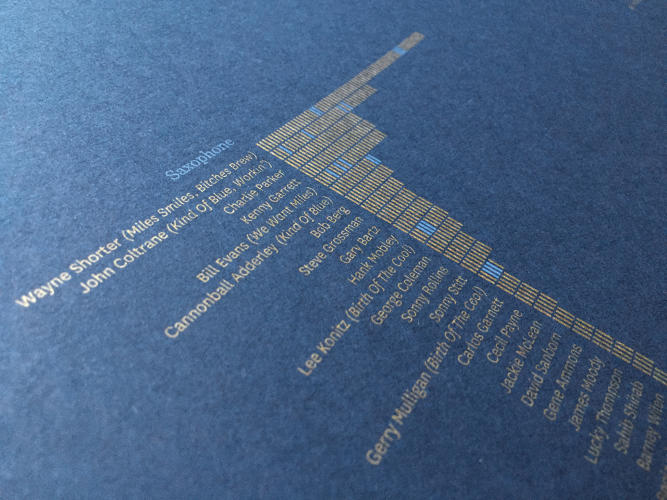
That’s the situation with Miles, for sure—even the most studied of his collectors couldn’t possibly call to mind all of his immense catalog without some handy reference guide. Perhaps “Scaled in Miles” can help. Condensing an incredible amount of musical history into a very concise and attractive form, “Scaled in Miles,” as it’s called—a huge online interactive discography—“tries to make sense of Davis’s storied career by visualizing each of the 577 artists he collaborated with over 405 recording sessions.” That description comes from Fast Company, who feature a few close-ups of the related “Scaled in Miles” poster, which they describe as resembling NASA’s “Golden Record.” The interactive visualization allows you to listen to the tunes as you learn the musicians who created them and the wheres and whens of their recordings.
Something about Miles’ music lends itself particularly well, I have to say, to the very streamlined, clean design of this impressive catalog’s online interface. Were someone enterprising enough to make one for the Grateful Dead, I’m guessing it would look less like a golden record in space and more like another, messier kind of spaced-out voyage. That’s not to suggest that Davis and the Dead have little in common but their vast recorded output. They did, after all, once share a stage at the Fillmore West in 1970. No need to go digging in the vaults to find that one; see the personnel from that night at the top of the post and stream the whole thing right here.
Like myself, Adam Savage went to the traveling Stanley Kubrick exhibition at LACMA last year and stayed several hours, just absorbing all the genius, from the scripts to the slates to the blueprints and the costumes to the props. Unlike myself, he went back two more times, that lucky man! Because the Mythbuster noticed that the Hedge Maze prop in The Shining section did not look like the one in the film in any way. In fact, it looked kinda cheap. So, being Adam Savage, a man for whom prop-making is one of a series of childhood obsessions turned jobs, he set out to accurately recreate the maze model from the film.
In this fascinating video (top) from his YouTube series Tested, we get a step-by-step walkthrough of the process. The LACMA model used plastic foam; Savage goes for a sturdy particle board, made to look like hedges through spray paint and flocking. His attention to detail goes down to the crowns at the tops of the outer maze wall, a newspaper kiosk and miniature map of the maze. He even geeks out (in the best way, of course!) about the scale model figures (at $4 a pop) he buys to populate the maze. (Strangely, there’s no representation of Jack, Wendy, Danny or even Halloran to be seen.)
Savage’s energy is infectious and if some of us had the time (55 hours total) and income to do this–and an understanding spouse–wouldn’t a lot of us love to travel down this rabbit hole?
The film ends with a nice surprise that I won’t spoil, but let’s just say the universe gets set right for once.
Ted Mills is a freelance writer on the arts who currently hosts the FunkZone Podcast. You can also follow him on Twitter at @tedmills and/or watch his films here.
Let’s take Kevin Spacey’s southern accent on the Netflix series House of Cards, and use it as a springboard for exploring the linguistics of that often times charming regional accent, shall we? In the video above, created by Vox, we learn all about “ay-unglidding.” And “r‑dropping,” that ever distinctive feature of the Southern accent that originated in England.
The clip was made with the help of university linguists — Dennis Preston at Oklahoma State University; Robin Dodsworth at North Carolina State University; and Kirk Hazen at West Virginia University. To learn more about how well Kevin Spacey masters the accent (and where he falls short), head over to Vox.
Leonard Nimoy’s death yesteday at the age of 83 is an enormous loss to fans across the world who loved and respected the actor. Nimoy may have never transcended his Star Trek character Spock, though he tried, but he seemed to have made his peace with that, signing his many wise tweets in the last few months of his life with the acronym “LLAP,” or “live long and prosper,” the Vulcan farewell. The actor and his most famous character were very familiar to even non-fans of the show; Spock has come to represent an archetype of the dispassionate and rational, and Nimoy eventually immersed himself in the Star Trek universe, penning Star Trek novels and continuing to star in the franchise’s many films (and in good natured car ads with his replacement). He was an ambassador for science fiction, and an ambassador for science fact, as a major donor to NASA and narrator of several films about astronomy.
Nimoy also had several other non- Trek endeavors of note, including his work as a photographer and narrator of audiobooks about, for example, whales. And while Spock fans watched the actor inhabit the half-Vulcan, half-human character’s existential struggles with his identity, Nimoy the actor had his own distinctive background as the son of Ukrainian Jewish immigrants. His parents escaped the town of Zaslav in what was then Soviet Russia and emigrated to Boston’s West End, a neighborhood roughly 60 percent Italian and 25–30 percent Jewish. It was a place—Nimoy says in the engaging 10 minute excerpt above from an interview with Christa Whitney—where the Italians spoke Yiddish and the Jews spoke Italian (Nimoy speaks some Yiddish, some famous lines from Hamlet!, above).
Nimoy remembers his personal history, his parents’ bemusement with Spock, and his own identification with the famous character: “Spock is an alien wherever he is,” says Nimoy, “not totally at home in the Vulcan culture… not totally at home in the human culture. And that alienation is something that I had learned in Boston… so I understood that aspect of the character.” The interview was taped in October of 2013 as part of the Yiddish Book Center’s Wexler Oral History Project. As we grieve the loss of Nimoy-as-Spock, it’s a fitting way to get to know much more about the man himself. Hear much more of Nimoy’s Yiddish and much more about his life in the full, two-hour interview below. You can find basic Yiddish lessons in our collection, Learn 45+ Languages Online for Free: Spanish, Chinese, English & More.
In Brian Eno’s A Year with Swollen Appendices, one of my very favorite books, the well-known rock producer, visual artist, and “non-musician” musician writes out all the things he is, including “mammal,” “celebrity,” “wine-lover,” “non-driver,” “pragmatist,” and “drifting clarifier.” The list gives us a kind of overview of the man’s many facets, as well as of the many facets we all have, but it doesn’t mention one of his most important roles: that of a singer.
Even within the realm of music, you might not immediately associate Eno (who there made his name spouting synthesized sounds into Roxy Music’s early records, creatively shaking up big acts like David Bowie and U2, and pretty much inventing the wordless ambient genre) with singing. But of course he’s done it since his earliest solo albums and continues to do it on relatively recent ones, and you can hear samples of both here in this post.
“I believe in singing,” says Eno. “I believe in singing together.” He expounds upon this belief in an NPR segment called “Singing: The Key to a Long Life.” He also credits the practice with the ability to ensure “a good figure, a stable temperament, increased intelligence, new friends, super self-confidence, heightened sexual attractiveness and a better sense of humor.” It offers the chance to “use your lungs in a way that you probably don’t for the rest of your day, breathing deeply and openly,” to experience “a sense of levity and contentedness,” and to “learn how to subsume yourself into a group consciousness.”
Beyond simply, er, singing the praises of singing, Eno also explains just how he goes about his own practice, regularly bringing together not just friends willing to sing, but “some drinks, some snacks, some sheets of lyrics and a strict starting time” — all centered around a carefully curated selection of songs. Years of this have convinced Eno of singing’s importance to our very civilization, to the point that, as he says, “if I were asked to redesign the British educational system, I would start by insisting that group singing become a central part of the daily routine. I believe it builds character and, more than anything else, encourages a taste for co-operation with others.” And it would certainly encourage whichever student turns out to be the next, well, Brian Eno.
P.S. Here’s Eno’s Group-Sing Song List:
Can’t Help Falling In Love
Love Me Tender
Keep On the Sunny Side
Sixteen Tons
Will the Circle Be Unbroken
Dream
If I Had a Hammer
Love Hurts
I’ll Fly Away
Down By the Riverside
Chapel of Love
Wild Mountain Thyme
Que Sera, Sera
Cotton Fields
Ray Bradbury, author of The Martian Chronicles and Fahrenheit 451, contributed to science fiction a highly distinctive voice; the now departed Leonard Nimoy, Star Trek’s Mr. Spock, also contributed to science fiction a highly distinctive voice. In the mid-seventies, a pair of record albums came out that together offered a truly singular listening experience: the voice of Bradbury in the voice of Nimoy.
1975’s The Martian Chronicles and 1976’s The Illustrated Man contain Nimoy’s renditions of two well-known stories, one per side, from each of Bradbury’s eponymous books. At the top of the post, you can hear The Martian Chronicles’ “There Will Come Soft Rains” and “Usher II.” At the bottom of the post, we have The Illustrated Man’s “The Veldt” and “Marionettes Inc.”
In our internet age, with its abundance of downloadable audio and mobile media delivery systems, we’ve grown thoroughly accustomed to the idea of the audio book. But 40 years ago, in the age of twelve-inch vinyl discs that could barely hold 45 minutes of content, the fully realized concept must have seemed more like something we would thrill to Bradbury himself writing about, or Nimoy himself using on television. But the visionaries in this case worked at the record label Caedmon, “a pioneer in the audiobook business,” according to the Internet Archive, “the first company to sell spoken word recordings to the public,” and “the ‘seed’ of the audiobook industry.” They grew famous putting out recordings of literary luminaries reading their own work: Dylan Thomas reading Dylan Thomas, T.S. Eliot reading T.S. Eliot, Gertrude Stein reading Gertrude Stein. But to my mind — or to my ear, anyway — the best of it happened at the intersections, like this one, of an era-defining author, and a different era-defining reader.
There’s a polite turn of phrase I’ve always found amusing, if a little sad; when someone has too much to drink at a social function and embarrasses him or herself, we say the person has been “overserved.” This euphemism graciously lays the blame at the host’s feet rather than the sometimes shamefaced imbiber’s, suggesting that a good host cares enough about his or her guests—whether they be lightweights or binge-drinking alcoholics—to monitor their intake and keep things on an even keel. In the case of one notoriously hard-drinking guest, novelist William Faulkner, this responsibility became much more than the tactful burden of a few friends. Keeping an eye on the writer’s drinking became a mandate of State Department officers at the U.S. Information Agency during Faulkner’s official trips abroad.
Since his 1950 Nobel win—writes Greg Barnhisel at Slate—Faulkner was in high demand as a Cold War goodwill ambassador for American culture, along with Martha Graham, John Updike, and Louis Armstrong, all “living proof that America wasn’t just Mickey Mouse and chewing gum.” Unfortunately, as most everyone knows, “the author had a bit of a drinking problem.” During a 1955 visit to Japan, for example, he got so drunk at the welcome reception “that the U.S. ambassador ordered he be put on the next plane back to the states.” U.S. officials may have been embarrassed, but the Japanese, it seems, did not feel that Faulkner’s drinking was a hindrance. According to Dr. Leon Picon, books officer at the Tokyo embassy, the writer’s hosts “didn’t see anything wrong with the amount of drink that he had, and they understood when he went off completely, and was not communicable again….” Rather than send Faulkner home, Picon found ways to make sure his guest was never overserved.
Picon—whom Faulkner called his “wet nurse”—composed and discreetly circulated a document called “Guidelines for Handling Mr. William Faulkner on His Trips Abroad.” These instructions came from Picon’s observations that Faulkner “fared better… when there was little time for concerted drinking.” Of the Japanese visit Faulkner biographer David Mintner writes:
Given shrewdly arranged schedules and carefully arranged audiences, Faulkner talked easily about books, war, and race, hunting, farming, and sailing. Although his manners remained formal and his replies formulaic, he seemed poised and responsive.
Barnhisel quotes among Picon’s guidelines for assuring a smooth visit the following:
“Keep several pretty young girls in the front two rows of any public appearance to keep his attention up”
“Put someone in charge of his liquor at all times so that he doesn’t drink too quickly”
“Do not allow him to venture out on his own without an escort”
As the declassified memoranda above testify (click once, and then again, to view them in a larger format), the instructions helped other foreign service officers to successfully navigate the writer’s habits. In the memo near the top of the post with the oddly-worded subject “Exploitation of Faulkner Visit,” Dr. Picon is lauded for “humoring and handling Mr. Faulkner,” and his guidelines credited with being “effective and vital to the success of the whole tour.” The memo just above—written in needlessly wordy bureaucratese, apparently by none other than J. Edgar Hoover—commends Picon in more detail:
The Department wishes to commend Mr. Leon Picon for the superb job he did in describing a procedure for developing a program for Mr. Faulkner in other countries.
In his book Cold War Modernists, Barnhisel, a professor at Duquesne University, notes that Faulkner continued to represent the U.S. abroad, in trips to Greece and Venezuela, and though his drinking remained a challenge for his government handlers, the trips were deemed unqualified successes.
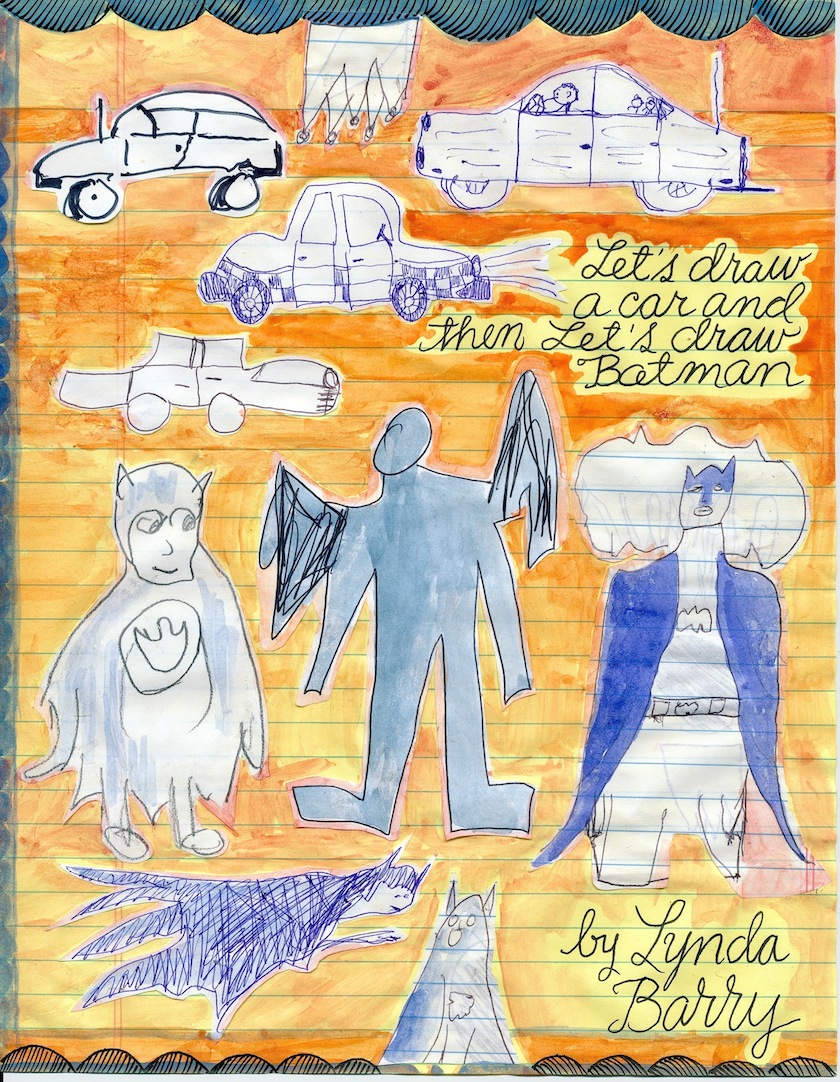
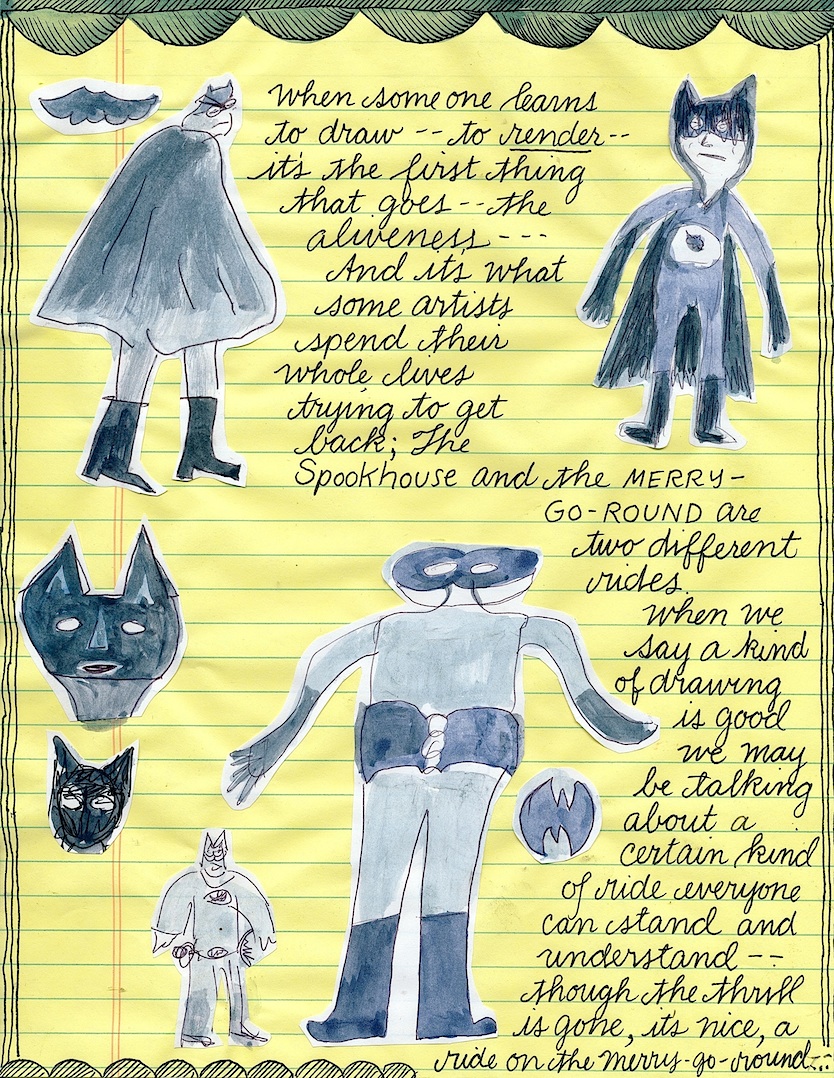
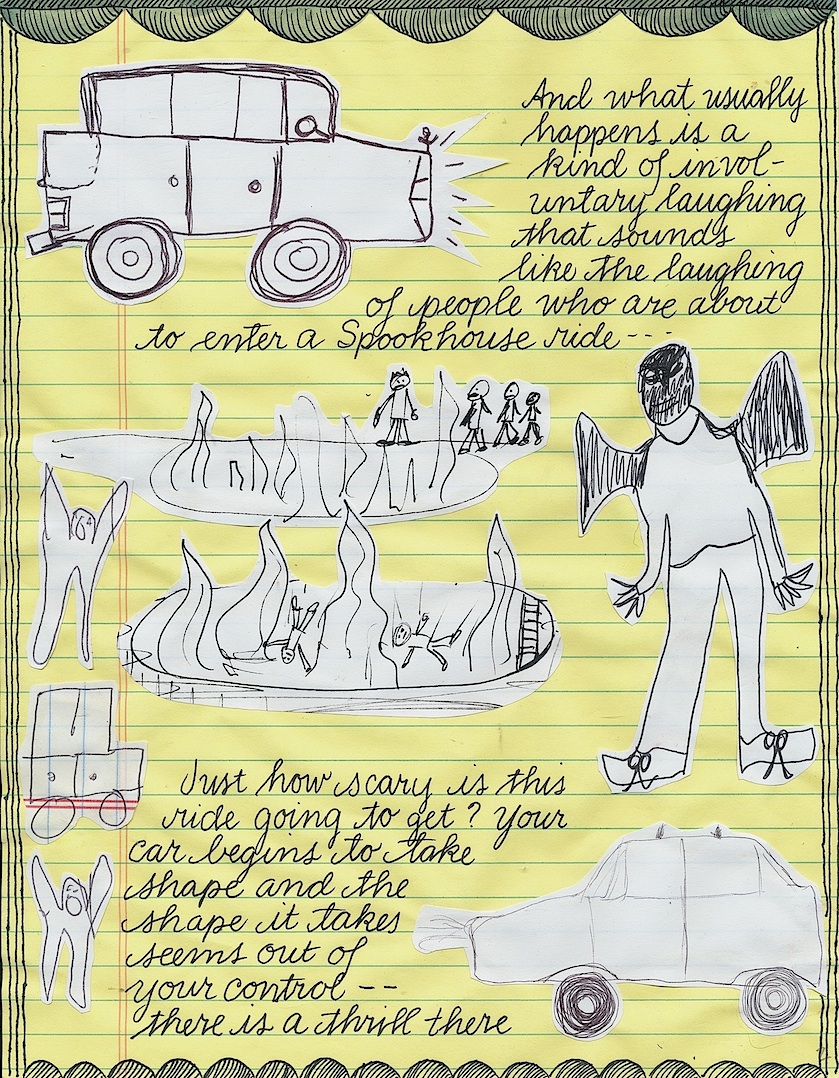
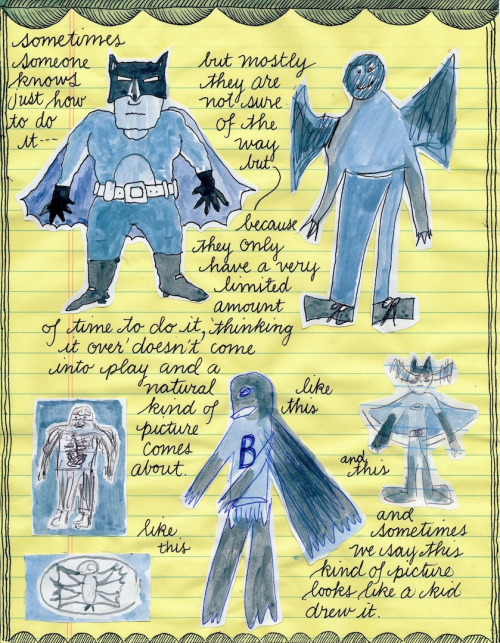
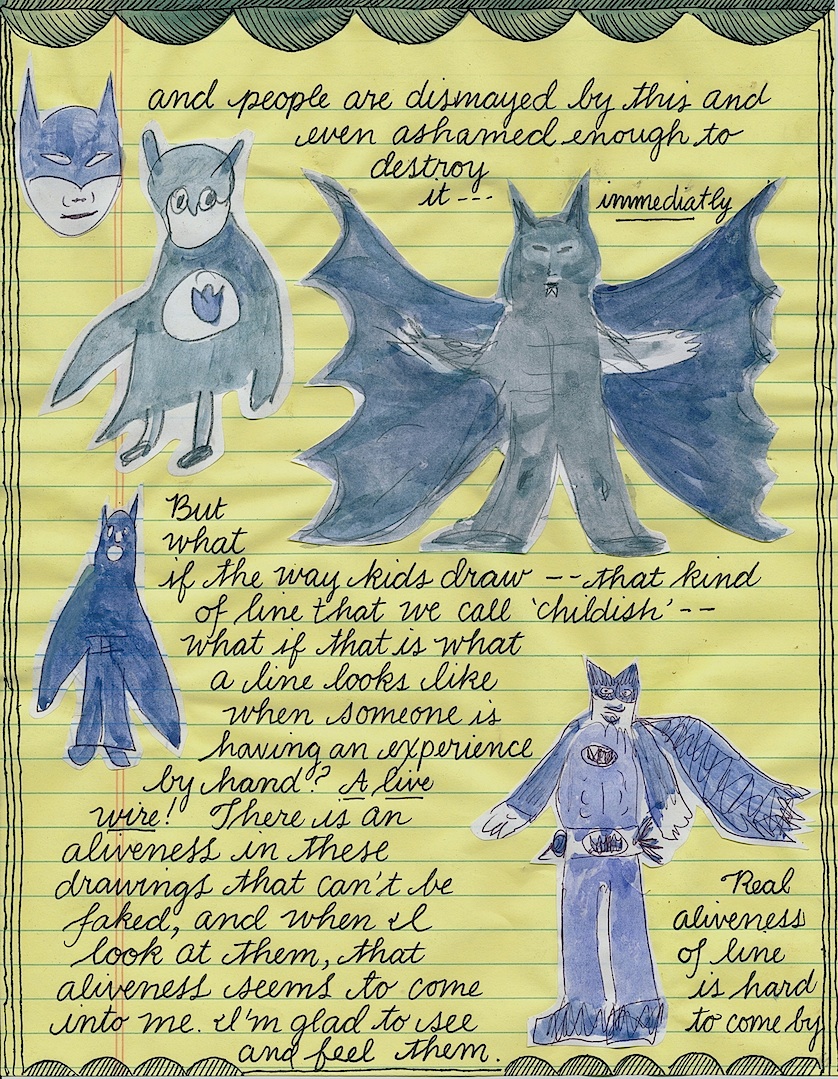
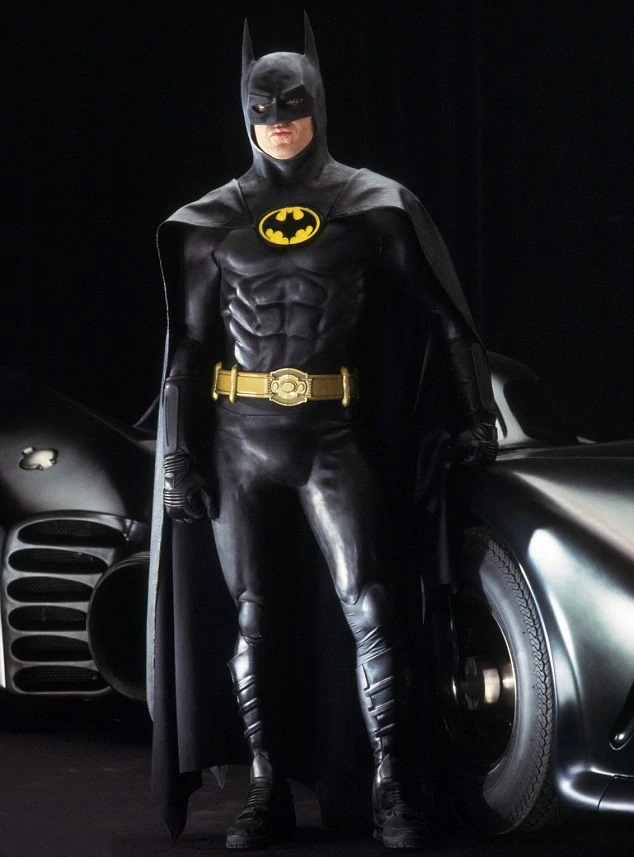
Don’t say you don’t, or that you can’t. According to cartoonist and educator Lynda Barry, we’re all capable of getting Batman down on paper in one form or another.
You have the ability to create a recognizable Batman because Batman’s basic shape is universally agreed upon, much like that of a car or a cat. Whether you know it or not, you have internalized that basic shape. This alone confers a degree of proficiency.
As proof of that, Barry would ask you to draw him in 15 seconds. A time constraint of that order has no room for fretting and self doubt. Only frenzied scribbling.
It also levels the playing field a bit. At 15 seconds, a novice’s Batman can hold his own against that of a skilled draftsperson.
Try it. Did you get pointy ears? A cape? A mask of some sort? Legs?
I’ll bet you did.
Once you’ve proved to yourself that you can draw Batman, you’re ready to tackle a more complex assignment: perhaps a four panel strip in which Batman throws up and screams.
This is probably a lot easier than drawing him scaling the side of a building or battling the Joker. Why? Personal experience. Anybody who’s ever lost his or her lunch can draw on the cellular memory of that event.
Fold a piece of paper into quarters and give it a whirl.
Then reward yourself with the video up top, a collection of student-created work from the Making Comics class Barry taught last fall at the great University of Wisconsin.
With everyone’s Batman rocking a Charlie Brown-sized noggin and simple rubber hose style limbs, there’s less temptation to get bogged down in comparisons.
Okay, so maybe some people are better than others when it comes to drawing toilets. No biggie. Keep at it. We improve through practice, and you can’t practice if you don’t start.
Once you’ve drawn Batman throwing up and screaming, there’s no end to the possibilities. Barry has an even bigger collection of student work (second video above), in which you’ll find the Caped Crusader doing laundry, using a laptop, calling in sick to work, reading Understanding Comics, eating Saltines… all the stuff one would expect given that part of the original assignment was to envision oneself as Batman.
More of Lynda Barry’s Batman-related drawing philosophy from Syllabus can be found above and down below:
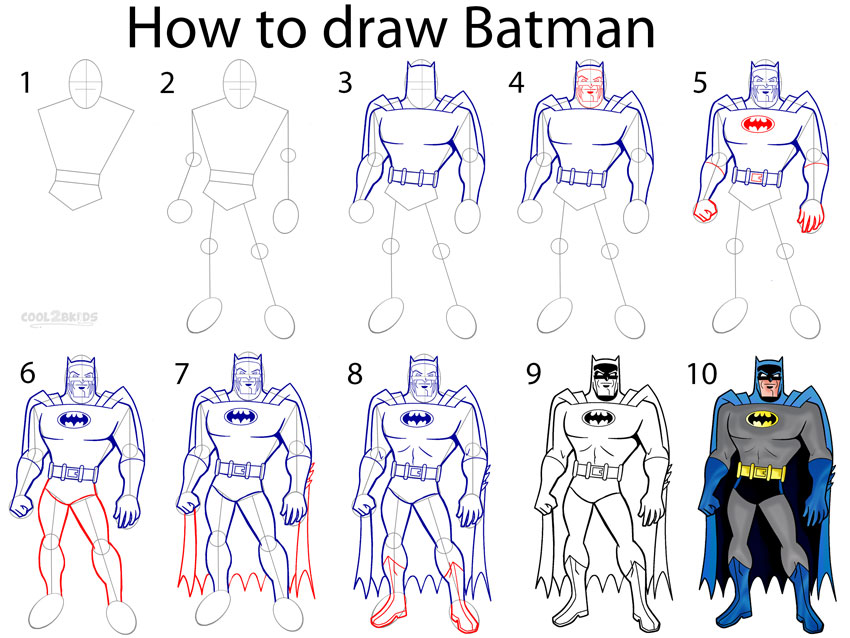
No matter what anyone tells you (see below), there’s no right way to draw Batman!
We all know the reputation of 19th-century Russian novels: long, dense bricks of pure prose, freighted with deep moral concerns and, to the uninitiated, enlivened only by a confusing farrago of patronymics. And sure, while they may have a bit of a learning curve to them, these classic works of literature also, so their advocates assure us, boast plenty to keep them relevant today — just the quality, of course, that makes them classic works of literature in the first place.
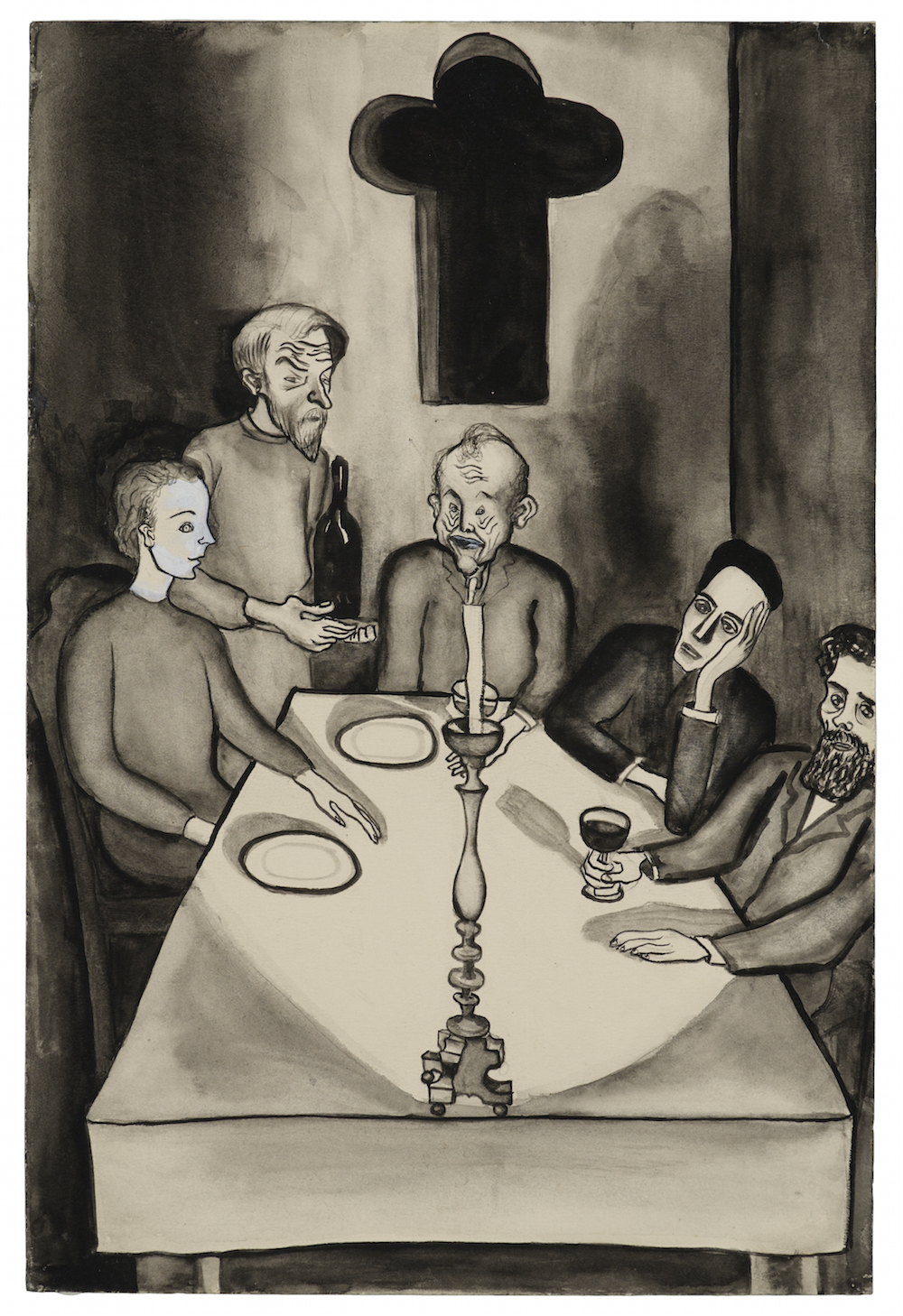
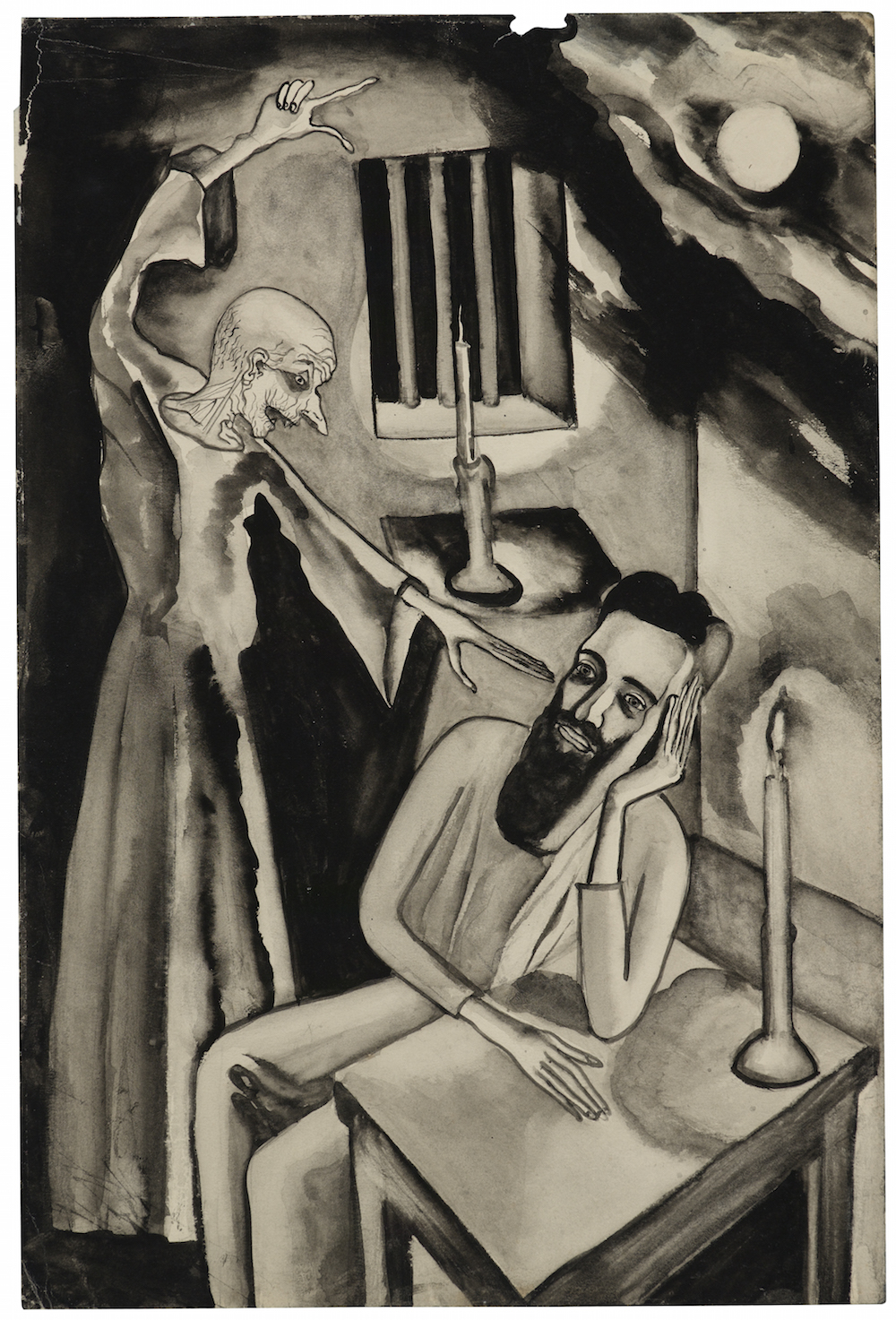
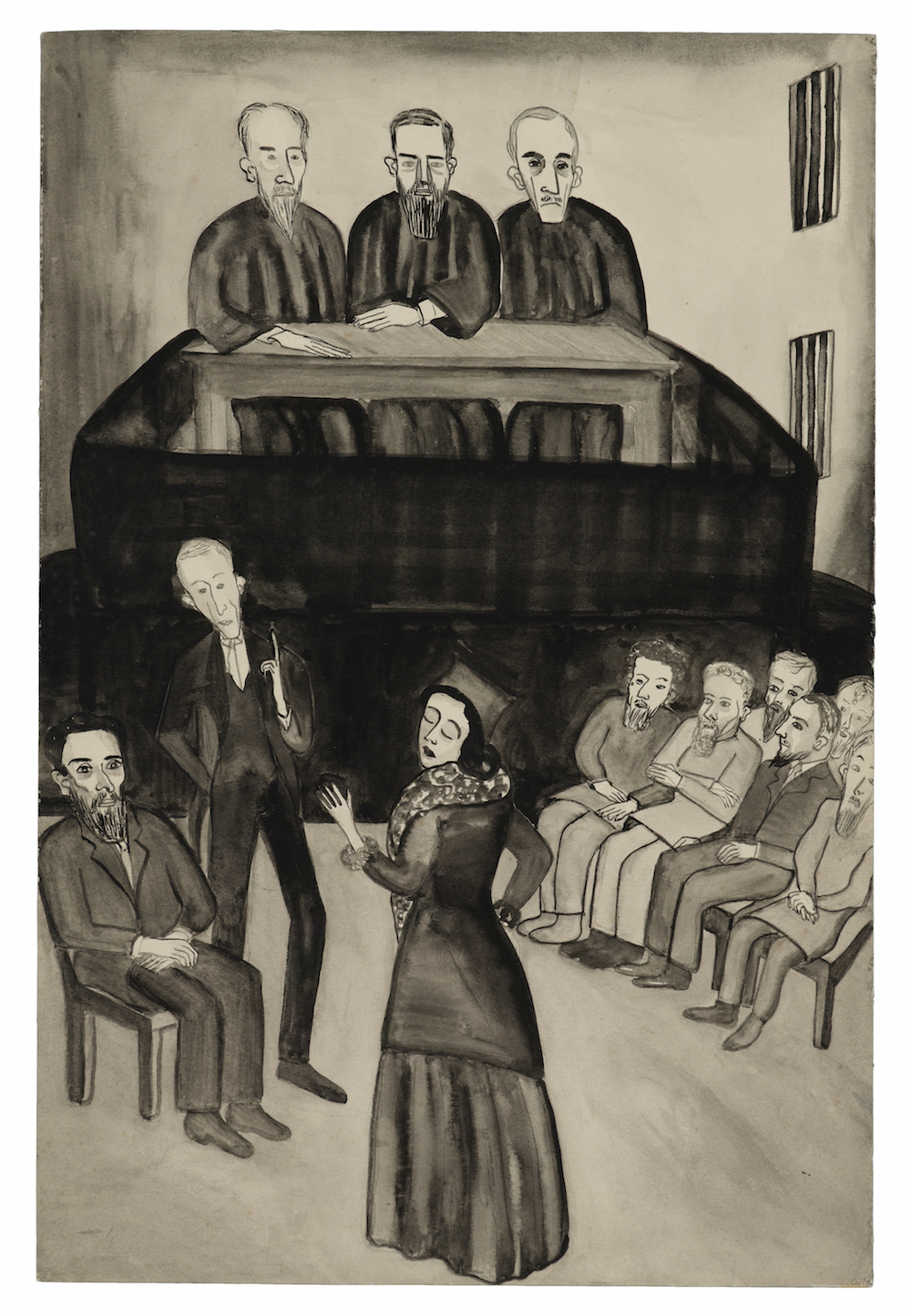
While we should by all means read them, that doesn’t mean we can’t get a taste of these much-discussed books before we heft them and turn to page one by, for example, checking out their illustrations. These vary in quality with the editions, of course, but how much of the art that has ever accompanied, say, Fyodor Dostoyevsky’s The Brothers Karamazov has looked quite as evocative as the never-published illustrations here? They come from the hand of the Pennsylvania-born artist Alice Neel, commissioned in the 1930s for an edition of the novel that never saw the printing press.
The Paris Review’s Dan Piepenberg, posting eight of Neel’s illustrations, highlights “how attuned these two sensibilities are: it’s the marriage of one kind of darkness to another”; “the black storm cloud of Neel’s pen is well suited to Dostoyevsky’s questions of God, reason, and doubt.” And yet Neel also manages to express the novel’s “madness and comedy,” bringing “a manic bathos to these scenes that lends them both gravity and levity; in every wide, glassy pair of eyes, grave questions of moral certitude are undercut by the absurd.”
You can see all of eight of Neel’s Karamazov illustrations at The Paris Review, not that they provide a substitute for reading the novel itself (which you can find in our collection of Free eBooks). After all, that’s the only way to find out what exactly happens at that bacchanal just above.
Now closing in on 50 episodes, David Dutton’s 8‑Bit Cinema series for CineFlix celebrates and critiques the increasing video game qualities of action films. Or maybe it’s a nostalgic do-over of a childhood spent watching great films turned into terrible games and your favorite games turned into terrible films. 8‑Bit Cinema imagines popular and classic movies turned into NES-era console games, with the movie’s plot imagined as a “perfect run,” as gamers call it.
Their version of Guardians of the Galaxy (watch it here) quotes Megaman, Capcom’s 1987 hit game that is still spawning sequels, and confines its action to a platform shooter, which, in a way, describes James Gunn’s film. (But dig that 8‑bit version of “The Pina Colada Song,” man!). The film adapts too well to a video game, and that may be its problem.
Things get more interesting when Dutton’s creative team tackles films in the cult canon. One of their favorites, Pulp Fiction combines several game genres: Dance Dance Revolution for the Jack Rabbit Slim sequence, side scrollers for the gun (and samurai sword)-heavy action, and more. But what 8‑Bit Cinema had to do was straighten out Tarantino’s non-linear narrative, allowing the “player” to change characters from Vince to Butch after their unfortunate meeting, and ditch all that wonderful dialog. This 2 1/2 minute version quotes plenty of rare video games, just like Tarantino quotes movies.
The Shining is one of two Kubrick films the team has attempted, the other one being A Clockwork Orange. The Shining one works better as Kubrick’s examinations of domestic violence are rendered even icier (no pun intended) through typical violent gameplay, and tense confrontations between Jack and Wendy are reduced to emotionless exchanges. The video references 1987’s Maniac Mansion, appropriately enough, which itself was a tribute to horror movie cliches.
Wes Anderson’s ship set from The Life Aquatic with Steve Zissou was designed much like a platform game, so the 8‑Bit Cinema team had an easier job with this one, and threw in references to Metal Gear Solid to boot. Judging from the comments, the 8‑Bit death of Ned still manages to pull the ol’ heartstrings, but the narrative remains just as inscrutable.
The takeaway here might be this: The better the film, the less it can conform to the simplistic plots, puzzle play, and point-scoring violence that make video games fun to play. And while video games are undoubtedly a form of art, there’s a large gulf between them and cinema.
Currently Dutton’s crew manages one 8‑Bit Cinema short a month. For a behind-the-scenes look at what it takes to put three minutes of nostalgic bliss together, check this out:
Ted Mills is a freelance writer on the arts who currently hosts the FunkZone Podcast. You can also follow him on Twitter at @tedmills and/or watch his films here.
We're hoping to rely on loyal readers, rather than erratic ads. Please click the Donate button and support Open Culture. You can use Paypal, Venmo, Patreon, even Crypto! We thank you!
Open Culture scours the web for the best educational media. We find the free courses and audio books you need, the language lessons & educational videos you want, and plenty of enlightenment in between.