Quick fyi: A couple weeks ago, the literary world gasped when a lost Sherlock Holmes story was apparently discovered in an attic in Scotland. Read it online here. It hasn’t been completely confirmed that the story came from the pen of Arthur Conan Doyle. Some experts still have their doubts. But even so, the fine folks at Audible have produced an audio recording of the story, narrated by the award-winning narrator/actor Simon Vance. You can download it for free at Audible (on the condition that you create a username and password).
It’s also worth noting that if you start a 30-day free trial with Audible, you can download two free audio books, including many contemporary bestsellers. At the end of the 30 days, you can join Audible’s subscription service, or you can cancel. Either way, you can keep the two free audio books. Get more details here.
If you would like to support the mission of Open Culture, consider making a donation to our site. It’s hard to rely 100% on ads, and your contributions will help us continue providing the best free cultural and educational materials to learners everywhere. You can contribute through PayPal, Patreon, and Venmo (@openculture). Thanks!
“Jorge Luis Borges 1951, by Grete Stern” by Grete Stern (1904–1999). Licensed under Public Domain via Wikimedia Commons.
Jorge Luis Borges’ terse, mind-expanding stories reshaped modern fiction. He was one of the first authors to mix high culture with low, merging such popular genres as science fiction and the detective story with heady philosophical discourses on authorship, reality and existence. His story “The Garden of the Forking Paths,” which describes a novel that is also a labyrinth, presaged the hypertextuality of the internet age. His tone of ironic detachment influenced generations of Latin American authors. The BBC argued that Borges was the most important writer of the 20th century.
Of course, Borges wasn’t just an author. When not writing fiction, Borges worked as a literary critic, occasional film critic, a librarian, and, for a spell, as the director of the Biblioteca Nacional in Buenos Aires. His tastes were famously eclectic. He did not think of much of canonical writers like Goethe, Jane Austen, James Joyce and Gabriel Garcia Marquez. He favored the 19th storytellers like Edgar Allan Poe and Rudyard Kipling.
In 1985, Argentine publisher Hyspamerica asked Borges to create A Personal Library — which involved curating 100 great works of literature and writing introductions for each volume. Though he only got through 74 books before he died of liver cancer in 1988, Borges’s selections are fascinating and deeply idiosyncratic. He listed adventure tales by Robert Louis Stevenson and H.G. Wells alongside exotic holy books, 8th century Japanese poetry and the musing of Kierkegaard. You can see the full list below. A number of the selected works can be found in our Free eBooks and Free Audio Books collections.
1. Stories by Julio Cortázar (not sure if this refers to Hopscotch, Blow-Up and Other Stories, or neither)
2. & 3. The Apocryphal Gospels
4. Amerika and The Complete Stories by Franz Kafka
5. The Blue Cross: A Father Brown Mystery by G.K. Chesterton
6. & 7. The Moonstone by Wilkie Collins
8. The Intelligence of Flowers by Maurice Maeterlinck
9. The Desert of the Tartars by Dino Buzzati
10. Peer Gynt and Hedda Gabler by Henrik Ibsen
11. The Mandarin: And Other Stories by Eça de Queirós
12. The Jesuit Empire by Leopoldo Lugones
13. The Counterfeiters by André Gide
14. The Time Machine and The Invisible Man by H.G. Wells
15. The Greek Myths by Robert Graves
16. & 17. Demons by Fyodor Dostoyevsky
18. Mathematics and the Imagination by Edward Kasner
19. The Great God Brown and Other Plays, Strange Interlude, and Mourning Becomes Electra by Eugene O’Neill
20. Tales of Ise by Ariwara no Narihara
21. Benito Cereno, Billy Budd, and Bartleby, the Scrivener by Herman Melville
22. The Tragic Everyday, The Blind Pilot, and Words and Blood by Giovanni Papini
23. The Three Impostors
24. Songs of Songs tr. by Fray Luis de León
25. An Explanation of the Book of Job tr. by Fray Luis de León
26. The End of the Tether and Heart of Darkness by Joseph Conrad
27. The Decline and Fall of the Roman Empire by Edward Gibbon
28. Essays & Dialogues by Oscar Wilde
29. Barbarian in Asia by Henri Michaux
30. The Glass Bead Game by Hermann Hesse
31. Buried Alive by Arnold Bennett
32. On the Nature of Animals by Claudius Elianus
33. The Theory of the Leisure Class by Thorstein Veblen
34. The Temptation of St. Antony by Gustave Flaubert
35. Travels by Marco Polo
36. Imaginary lives by Marcel Schwob
37. Caesar and Cleopatra, Major Barbara, and Candide by George Bernard Shaw
38. Macus Brutus and The Hour of All by Francisco de Quevedo
39. The Red Redmaynes by Eden Phillpotts
40. Fear and Trembling by Søren Kierkegaard
41. The Golem by Gustav Meyrink
42. The Lesson of the Master, The Figure in the Carpet, and The Private Life by Henry James
43. & 44. The Nine Books of the History of Herodotus by Herdotus
45. Pedro Páramo by Juan Rulfo
46. Tales by Rudyard Kipling
47. Vathek by William Beckford
48. Moll Flanders by Daniel Defoe
49. The Professional Secret & Other Texts by Jean Cocteau
50. The Last Days of Emmanuel Kant and Other Stories by Thomas de Quincey
51. Prologue to the Work of Silverio Lanza by Ramon Gomez de la Serna
52. The Thousand and One Nights
53. New Arabian Nights and Markheim by Robert Louis Stevenson
54. Salvation of the Jews, The Blood of the Poor, and In the Darkness by Léon Bloy
55. The Bhagavad Gita and The Epic of Gilgamesh
56. Fantastic Stories by Juan José Arreola
57. Lady into Fox, A Man in the Zoo, and The Sailor’s Return by David Garnett
58. Gulliver’s Travels by Jonathan Swift
59. Literary Criticism by Paul Groussac
60. The Idols by Manuel Mujica Láinez
61. The Book of Good Love by Juan Ruiz
62. Complete Poetry by William Blake
63. Above the Dark Circus by Hugh Walpole
64. Poetical Works by Ezequiel Martinez Estrada
65. Tales by Edgar Allan Poe
66. The Aeneid by Virgil
67. Stories by Voltaire
68. An Experiment with Time by J.W. Dunne
69. An Essay on Orlando Furioso by Atilio Momigliano
70. & 71. The Varieties of Religious Experience and The Study of Human Nature by William James
72. Egil’s Saga by Snorri Sturluson
73. The Book of the Dead
74. & 75. The Problem of Time by J. Alexander Gunn
Jonathan Crow is a Los Angeles-based writer and filmmaker whose work has appeared in Yahoo!, The Hollywood Reporter, and other publications. You can follow him at @jonccrow. And check out his blog Veeptopus, featuring lots of pictures of badgers and even more pictures of vice presidents with octopuses on their heads. The Veeptopus store is here.
As an artist, William S. Burroughs was undoubtedly his own man, beholden to no particular aesthetic, movement, or school, always independent even as a frequent collaborator with many other notable writers and artists. It didn’t hurt that he came from money—Burroughs’ grandfather invented the adding machine, and the writer’s inheritance, writes the Daily Beast, “left the young scion free to pursue education and drugs at his leisure.” Yet, although he pursued the latter without reservation, he also worked harder than most of his contemporaries, constantly innovating and pursuing new paths. Burroughs’ “entire creative project,” writes blogger Dan Shelalevy, “encompassed art, graphics, calligraphy, type, photography, film, assemblage, poetry, spoken word, and music…. Culture itself was his medium.”
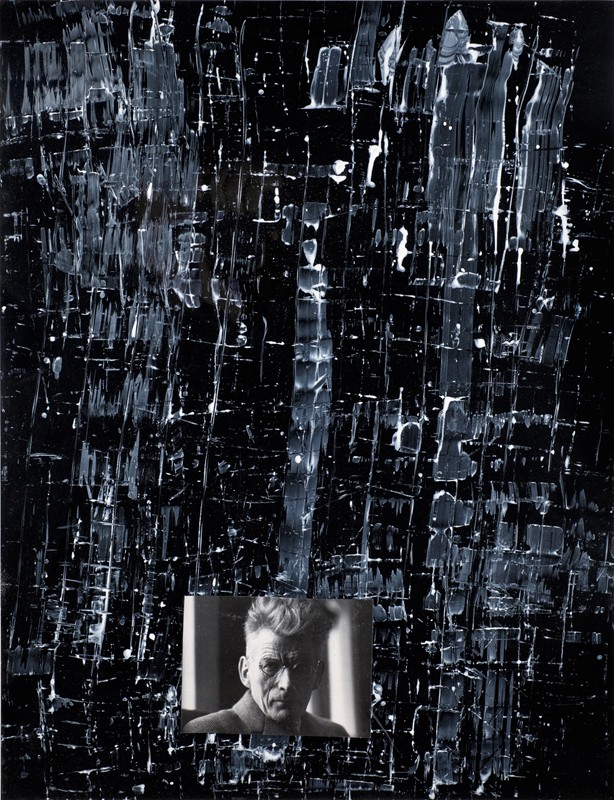
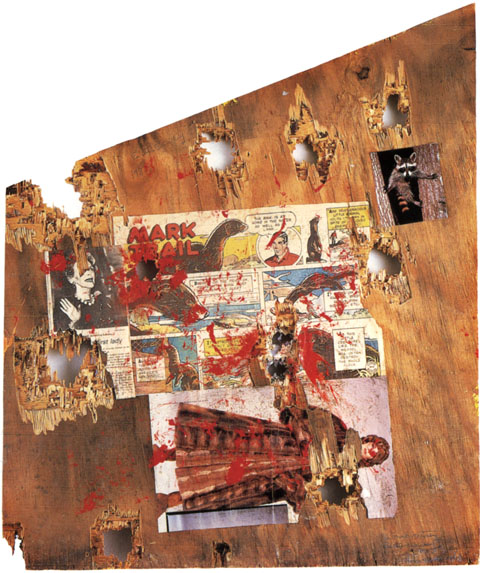
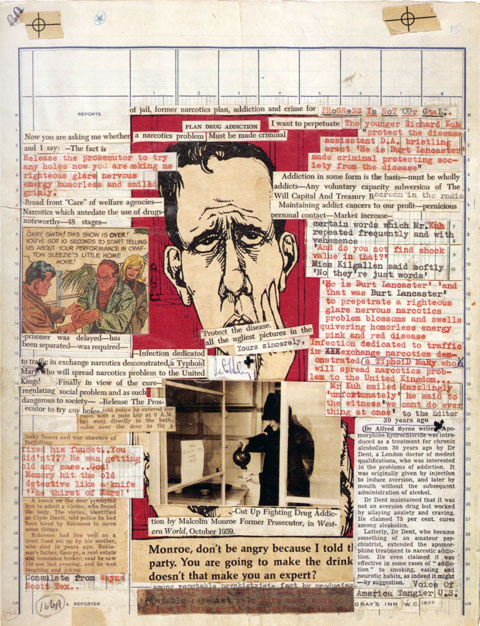
He may be associated primarily with the Beats, but Burroughs himself rejected the label, saying, “We’re not doing at all the same thing, either in writing or in outlook.” As a visual artist, London’s October Gallery informs us, he “collaborated with Keith Haring, George Condo, Robert Rauschenberg, and others.” As in his writing, Burroughs experimented throughout his art career with collage, incorporating photographs and pop culture ephemera like comic strips and advertising into paintings richly textured—as in the thick impasto surrounding the portrait of Samuel Beckett above—and often violent, as below.
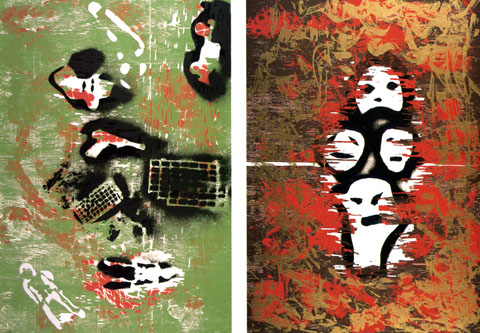
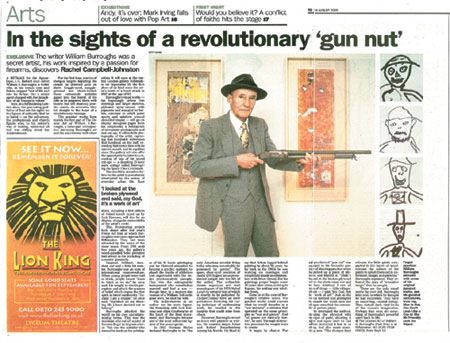
The notorious gun enthusiast often blasted holes through his canvasses and even experimented with shotgun painting. (See him with his shotgun below, on the front page of a Times article covering a 2005 exhibit of his work.) Burroughs also incorporated gun imagery into his paintings—often made on slabs of plywood—and used pop art techniques like stencils and spray paint, as below.
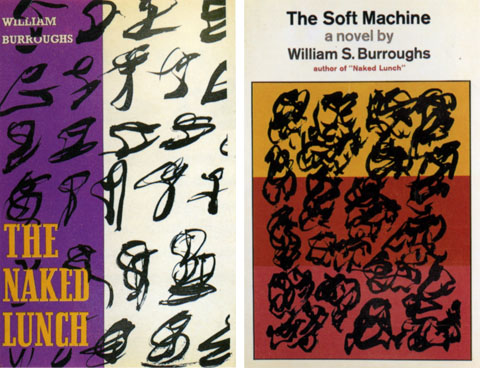
Burroughs even designed his own book covers, as you can see at the top of the post in the relatively austere paperback covers for Naked Lunch and The Soft Machine, both featuring repeating patterns of symbols. His visual art reflects the same obsessions we find in all of his work. These recurring motifs are what Paul Pieroni, co-organizer of the 2005 gallery show at The Riflemaker gallery in London, describes as a “hetero-ontology of forces at work,” including the “central themes” of “vice, violence and passion.”
The same imagery that recurs in hallucinatory novels like Junky, Naked Lunch, and The Western Lands appears in the writer’s artwork: “thus, as in his literature,” says Pieroni, “we find war, cocks, violence, dirt, parasites, guns—junk.” In Burroughs’ hands the detritus of American culture—the contents of advertisements, foreign policy briefs, and seedy motel rooms—takes on an ominous, mythic significance that shows us as much about ourselves as it does about the artist.
These days, would we expect to find a profile of a homosexual radical-left philosopher specializing in discipline and punishment in the pages of Time magazine? Maybe, maybe not—and few of us would find out if there were one, given that the magazine seems to have long since ceded its centrality in American culture, falling back on a subscriber base of retirees and dentist offices. But in November 1981, when Time was definitely still TIME, it did indeed run such a profile, and now you can read it in full in PDF form.
“Watching French Marxists grapple with the radical theories of Michel Foucault, says the philosopher’s translator Alan Sheridan, is like watching ‘a policeman attempting to arrest a particularly outrageous drag queen.’ ” So reports journalist and cultural historian Otto Friedrich in the piece’s opening. “The solemn specialists who patrol the American university have their own difficulties with Foucault. Leo Bersani of the French department at Berkeley eulogizes him as ‘our most brilliant philosopher of power,’ but Yale Historian Peter Gay dismisses him: ‘He doesn’t do any research, he just goes on instinct.’ ”
Other sources offering accolade, condemnation, and a mixture of both for the author of The Archaeology of Knowledgeand The History of Sexuality, include (broadly speaking) colleagues like literary theorist Edward Said, who complains that Foucault “has never been able to explain historical change,” and philosopher Richard Rorty, who suggests Foucault “join the bourgeois liberals he despises.” When Foucault himself speaks, he exhibits the expected tendency toward intellectual defiance and rug-pulling redefinition of terms, though the article also gathers several moments of surprising frankness about his own life. (“I cannot experience pleasure,” he claims.)
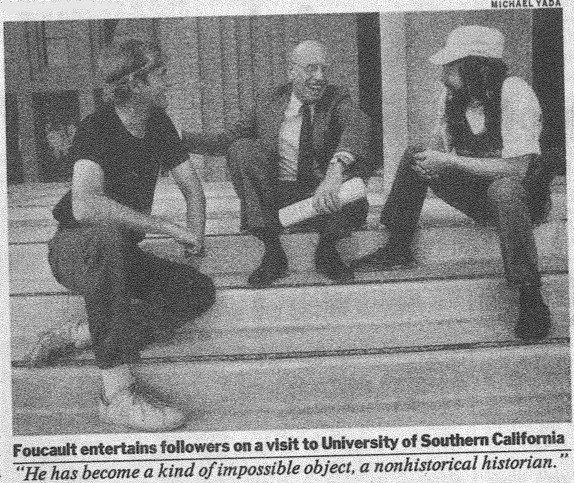
Of course, not every American of the day got to know Foucault through Time. Rather than in that most mainstream of all magazines, they may have discovered him through one of the least: Chez Foucault, the low budget fanzine we featured last week. And the connection goes deeper: “In 1981, when Time magazine published an article on Foucault,” writes James Miller in his biography The Passion of Michel Foucault, “the photograph accompanying the piece [above] showed Foucault sitting with Simeon Wade”—publisher of Chez Foucault. Wade put the ‘zine together with other University of California students, a group whom the philosopher’s ideas would continue to influence until his death, as evidenced by his final UC Berkeley lectures in 1983, and beyond—as collegians currently working under the system of control known as the cultural theory department can attest.
He has a wild look in his eyes, but a beautiful idea in his mind. Meet Raul Lemesoff, an eccentric character from Buenos Aires, who takes old cars and turns them into “militaristic bibliothecas” that drive the streets of Argentina, giving free books to those who want them. This is an ongoing project for Lemesoff, but the weaponized 1979 Ford Falcon you see above was specially created to celebrate World Book Day on March 5th. You can thank 7UP for commissioning that project.
Follow us on Facebook, Twitter and Google Plus and share intelligent media with your friends. And if you see any great items we should feature on our site, send them our way. We’d love to get your ideas.
Ludwig Wittgenstein’sTractatus Logico-Philosophicus (available in our collection of 130 Free Philosophy eBooks has surely set a fair few of its readers on the path to philosophy. But how much music has it inspired? Improbable as it may sound, the German-Austrian philosopher of mathematics, language, and mind’s ultra-terse 1922 masterpiece has brought about at least two pieces. We’ve previously featured Finnish composer M.A. Numminen adapting the Tractatus into an avant-garde comic opera. Today, we have Tibor Szemző’s Tractatus.
You can download the whole piece as a single MP3 on Ubuweb, or hear it above. According to UBU’s page about it, the work, first composed for Szemző and Péter Forgács’ video Wittgenstein Tractatus, “took six months of hard work in the studio to produce, yet it is only 30 minutes and 30 seconds long.”
And not only has Szemző set to music Wittgenstein’s statement after statement on the relationship of language to reality, he’s done so in seven different languages, combining readings recorded in English, Spanish, and Hungarian in Budapest, Japanese in Tokyo, Czech in Prague, the original German in Vienna, and Slovak in Bratislava.
Though I can only really follow three of those (assuming I really grasp Wittgenstein in the first place), Szemző’s Tractatus makes me appreciate how well Wittgenstein’s Tractatus — with its simple yet complex lines like “Everything we see could also be otherwise” and “The light that work sheds is a beautiful light, which, however, only shines with real beauty if it is illuminated by yet another light” — functions not just as a set of lyrics, but as an exercise in foreign-language comprehension. And didn’t Wittgenstein want to get us thinking about language in the first place?
In 1931, Caltech invited Albert Einstein to spend some time on their campus, with the hopes that he might eventually join their faculty. While in Southern California, he met Charlie Chaplin, took a photo with an Einstein puppet, enjoyed the mild winter, ruffled a few conservative feathers, then eventually left town. On the train ride back across the country, he visited the Hopi House, near the Grand Canyon, where he posed for a picture with members of the Hopi tribe. The website Hanksville.org revisits the classic photograph (apparently taken by Eugene O. Goldbeck) that documented his short visit:
There are several striking things about this photograph that deserve mention. It is clear that the headdress that has been placed on Professor Einstein’s head and the pipe he has been given to hold have no relationship to the Indians in this photograph. These Indians are Hopis from the relatively nearby Hopi pueblos while the headdress and pipe belong to the Plains Indian culture.… The Hopis in this picture were employees of the Fred Harvey Company who demonstrated their arts there and, no doubt, posed for many other pictures with tourists.
Besides Albert Einstein and his wife, there are 3 adult Hopis and one Hopi child in the photograph. Einstein is holding the hand of a young Hopi girl in a very natural manner; she is clutching something tightly in her other hand and is quite intent upon something outside the frame. Prof. Einstein’s attraction to children is seen in several other unofficial photographs. He loved children and felt quite comfortable with them. The two men on the left side of the photograph were there to facilitate the Einsteins’ trip. The man on the left is J. B. Duffy, General Passenger Agent of the ATSF (the famous Atichson, Tokepa and Santa Fe Railroad); the other man is Herman Schweizer, Head of Fred Harvey Curio, normally stationed in Albuquerque. He may have spoken German and was therefore present because Prof. Einstein was not completely comfortable yet with English.
According to the Einstein Almanac, the Hopi “gave Einstein a peace pipe, recognizing his pacifism, and dubbed him the ‘Great Relative.’ ” You can see the pipe on display in the photo.
As one website observed, what’s perhaps most notable about the historic image is this: It captures layers of commodification/fetishization. Here stands the most fetishized intellectual of the 20th century posing with one of the most fetishized peoples. Or maybe that’s just overthinking things.
Google the keywords “art” and “limits” (or “boundaries”) and you will find thousands of results with titles like “art without limits” or “art without boundaries.” Without dissecting any of them in particular, the general idea strikes me as a fantasy. Art cannot exist without limits: the limitations of particular media, the limitations of the artist’s vision, the limitations of space and time. We always work within limits, and often those creators who are most deliberate about setting limitations for themselves produce some of the most profound and unusual works. One could name minimalists like Samuel Beckett, or Lars Van Trier, or Erik Satie. Or Chuck Jones, American animator of such classic Warner Brother’s characters as Bugs Bunny, Daffy Duck, Porky Pig, and, of course, the Road Runner and Wile E. Coyote. Hey, why not? He’s a genius.
Jones had a keen ear for wisecracks, a satirical bent, and perfect comic timing; his verbal humor is as deft as his slapstick; and perhaps most importantly, he recognized the importance of setting strict limits on his cartoon universe, so as to make its rapid-fire jokes physically intelligible and wring from them the maximum amount of tension and irony. Take the list of rules above for the Road Runner/Wile E. Coyote cartoons. These have been circulating widely on the internet, and I’d guess people find them intriguing not only because they pull back the curtain on the inner workings of a fictive world as familiar as the back of our hands, but also because they reveal how Jones’ cartoon series functions as a minimalist thought experiment. What happens when you restrict two cartoon characters to the barest of expressions, movements, and setting, and to the oddball consumer products of one megacorporation?
We all know the answer: A perpetual motion machine of physical comedy, with loads of near-mythic subtext underlying Wile E.‘s tragicomic folly. The list of rules is on display at New York’s Museum of the Moving Image in an exhibit called What’s Up Doc? The Animation Art of Chuck Jones. The story has a twist. Apparently, writes Kottke—who shared a slightly different version of the rules—“long-time Jones collaborator Michael Maltese said he’d never heard of the rules.” Whether this means that Jones kept them secret and never shared them with his team, or whether he formulated them after the fact, we may never know. In any case, I imagine that if we sat down and watched all of the Road Runner cartoons with a copy of the rules in front of us, we’d find that they apply in almost every case.
Are you one of the millions of sighted visitors who’ll visit a world class institution this year only to find yourself suffering from museum fatigue a couple of hours in? You know, that moment when all the paintings start to look alike, still lifes, crucifixions, and teenage noblewomen swimming before your eyes?
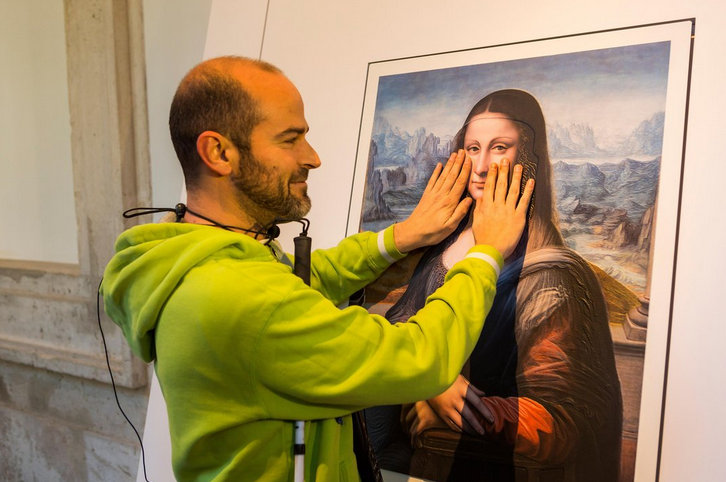
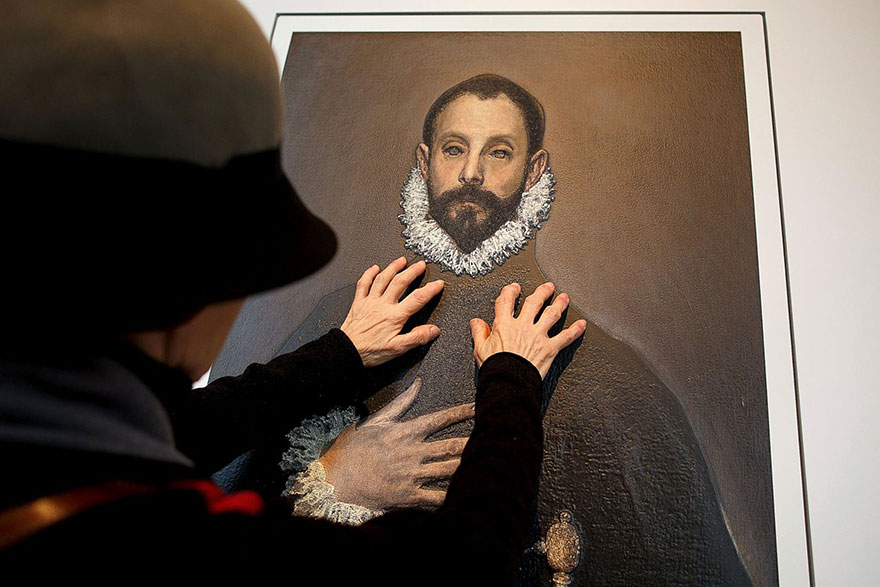
If so, may we recommend closing your eyes and limiting yourself to an in-depth study of a half dozen paintings? That’s the number of works on display in Hoy toca el Prado, Madrid’s Museo del Prado’s landmark exhibition aimed at people with visual disabilities.
The Louvre, New York’s Metropolitan Museum of Art, and London’s National Gallery all have touch-friendly programming that allows blind visitors to experience sculptural works with their hands. The Prado’s initiative is unique in that it applies 3D printing techniques to reproductions of painted—i.e. flat—work.
Certain aspects of each painting, including textures, were selected for showcasing in the 3D reproductions. A chemical process involving ultraviolet light and special ink resulted in a few millimeters of added volume. The reproductions retained the originals’ color, for visually impaired visitors with the ability to perceive it.
Image courtesy of The Prado
Sighted patrons can try their hands at experiencing such works as The Parasol by Goya and Velazquez’s Vulcan’s Forge in a non-visual way by donning opaque glasses. Texts are in braille. Audioguides are accessible to all.
According to the original’s record in the museum’s catalog, El Greco’s The Nobleman with His Hand on His Chestis notable for the “expressive gaze its sitter directs at the viewer.” The exhibit’s curator reported that one of the first blind visitors to come through wanted to know the subject’s eye color. He found that he could not confidently respond without double checking.
Some YouTuber posted online a pretty nice clip of an espresso shot being pulled from a La Marzocco FB80 espresso machine at 120 frames per second. They recommend muting the sound, then putting on your own music. I gave it a quick shot with the famous soundtrack for Kubrick’s 2001: A Space Odyssey. And I’ll be damned, it syncs up pretty well. Have a better soundtrack to recommend? Feel free to let us know in the comments section below.
In 2001 or 2002, guitarist and singer David Gilmour of Pink Floyd recorded a musical interpretation of William Shakespeare’s “Sonnet 18” at his home studio aboard the historic, 90-foot houseboat the Astoria. This video of Gilmour singing the sonnet was released as an extra on the 2002 DVD David Gilmour in Concert, but the song itself is connected with When Love Speaks, a 2002 benefit album for London’s Royal Academy for the Dramatic Arts.
The project was organized by the composer and conductor Michael Kamen, who died a little more than a year after the album was released. When Love Speaks features a mixture of dramatic and musical performances of Shakespeare’s Sonnets and other works, with artists ranging from John Gielgud to Ladysmith Black Mambazo.
Kamen wrote much of the music for the project, including the arrangement for Sonnet 18, which is sung on the album by Bryan Ferry. A special benefit concert to celebrate the release of the album was held on February 10, 2002 at the Old Vic Theatre in London, but Ferry did not attend. Gilmour appeared and sang the sonnet in his place. It was apparently around that time that Gilmour recorded his own vocal track for Kamen’s song.
“Sonnet 18” is perhaps the most famous of Shakespeare’s 154 sonnets. It was written in about 1595, and most scholars now agree the poem is addressed to a man. The sonnet is composed in iambic pentameter, with three rhymed quatrains followed by a concluding couplet:
Shall I compare thee to a summer’s day? Thou art more lovely and more temperate: Rough winds do shake the darling buds of May, And summer’s lease hath all too short a date; Sometime too hot the eye of heaven shines, And often is his gold complexion dimm’d; And every fair from fair sometime declines, By chance or nature’s changing course untrimm’d But thy eternal summer shall not fade, Nor lose possession of that fair thou ow’st; Nor shall death brag thou wander’st in his shade, When in eternal lines to time thou grow’st: So long as men can breathe or eyes can see, So long lives this, and this gives life to thee.
This post was originally published on Open Culture on April 5, 2013. We’re bringing it back today for Gilmour’s 69th birthday.
We're hoping to rely on loyal readers, rather than erratic ads. Please click the Donate button and support Open Culture. You can use Paypal, Venmo, Patreon, even Crypto! We thank you!
Open Culture scours the web for the best educational media. We find the free courses and audio books you need, the language lessons & educational videos you want, and plenty of enlightenment in between.