Some YouTuber posted online a pretty nice clip of an espresso shot being pulled from a La Marzocco FB80 espresso machine at 120 frames per second. They recommend muting the sound, then putting on your own music. I gave it a quick shot with the famous soundtrack for Kubrick’s 2001: A Space Odyssey. And I’ll be damned, it syncs up pretty well. Have a better soundtrack to recommend? Feel free to let us know in the comments section below.
In 2001 or 2002, guitarist and singer David Gilmour of Pink Floyd recorded a musical interpretation of William Shakespeare’s “Sonnet 18” at his home studio aboard the historic, 90-foot houseboat the Astoria. This video of Gilmour singing the sonnet was released as an extra on the 2002 DVD David Gilmour in Concert, but the song itself is connected with When Love Speaks, a 2002 benefit album for London’s Royal Academy for the Dramatic Arts.
The project was organized by the composer and conductor Michael Kamen, who died a little more than a year after the album was released. When Love Speaks features a mixture of dramatic and musical performances of Shakespeare’s Sonnets and other works, with artists ranging from John Gielgud to Ladysmith Black Mambazo.
Kamen wrote much of the music for the project, including the arrangement for Sonnet 18, which is sung on the album by Bryan Ferry. A special benefit concert to celebrate the release of the album was held on February 10, 2002 at the Old Vic Theatre in London, but Ferry did not attend. Gilmour appeared and sang the sonnet in his place. It was apparently around that time that Gilmour recorded his own vocal track for Kamen’s song.
“Sonnet 18” is perhaps the most famous of Shakespeare’s 154 sonnets. It was written in about 1595, and most scholars now agree the poem is addressed to a man. The sonnet is composed in iambic pentameter, with three rhymed quatrains followed by a concluding couplet:
Shall I compare thee to a summer’s day? Thou art more lovely and more temperate: Rough winds do shake the darling buds of May, And summer’s lease hath all too short a date; Sometime too hot the eye of heaven shines, And often is his gold complexion dimm’d; And every fair from fair sometime declines, By chance or nature’s changing course untrimm’d But thy eternal summer shall not fade, Nor lose possession of that fair thou ow’st; Nor shall death brag thou wander’st in his shade, When in eternal lines to time thou grow’st: So long as men can breathe or eyes can see, So long lives this, and this gives life to thee.
This post was originally published on Open Culture on April 5, 2013. We’re bringing it back today for Gilmour’s 69th birthday.
I think I speak for many of us when I say that coffee fuels our greatest intellectual efforts. And even as we get the jitters and leave brown rings on our desks, we can take comfort in the fact that so it also went with some of the most notable philosophers in the history of the discipline. As far back as the 18th century, no less a writer, thinker, and agitator than François-Marie Arouet, better known as Voltaire, “reportedly consumed somewhere between 40 and 50 cups of joe a day, apparently of a chocolate-coffee mixture. He lived into his eighties, though his doctor warned him that his beloved coffee would kill him.”
That comes from Amanda Scherker at The Huffington Post writing up “9 Famous Geniuses Who Were Also Huge Coffee Addicts.” Voltaire’s java habit also comes up on “10 Odd Obsessions of Famous Philosophers” by Virginia Muir at Listverse, who names his drinking venue of choice (the Café Procope in Paris) and indicates the extent of his enthusiasm by noting that “he even regularly paid exorbitant fees to have luxury coffee imported for his personal use” — which certainly doesn’t seem so eccentric today.
Later that century, Immanuel Kant took up coffee in his last days. Writing first-hand on the subject in the aptly titled The Last Days of Immanuel Kant, Thomas De Quincey (no stranger to life-changing habits himself) describes the philosopher’s “custom of taking, immediately after dinner, a cup of coffee,” a ritual he so came to relish that, whenever he sensed he may not get his new favorite beverage, there “commenced a scene of some interest. Coffee must be brought ‘upon the spot’ (a word he had constantly on his mouth during his latter days) ‘in a moment.’ ” Knowing this would happen, De Quincey made sure “the coffee was ground; the water was boiling; and the very moment the word was given, [Kant’s] servant shot in like an arrow and plunged the coffee into the water.… But this trifling delay seemed unendurable to Kant.”
In the 19th century, Søren Kierkegaard would also get into a coffee ritual. He “had his own quite peculiar way of having coffee,” writes biographer Joakim Garff. “Delightedly he seized hold of the bag containing the sugar and poured sugar into the coffee cup until it was piled up above the rim. Next came the incredibly strong, black coffee, which slowly dissolved the white pyramid.” I always drink it black myself, but who among us dares think ourselves too good for the teeth-aching preferred by the author of Fear and Trembling?
We must always bear in mind, too, that while coffee may constitute a necessary condition for our intellectual achievements, it never constitutes a sufficient one. Before pouring your next cup, whether your first of the day or your fiftieth, whether before or after dinner, and whether into a pyramid of sugar or not, ask yourself how much progress you’ve made on your own Candideor Critique of Pure Reason. A sobering question, to be sure — but after enough caffeine, you feel pretty sober anyway.
I’ve lived all of my life in various cities on the East Coast, north and south. Various cultural and geographic features of the mid-Atlantic have shaped me in ways I’m probably only partially aware of. But this past summer I spent more time on the West Coast—L.A. to be precise—than I ever have before, and I found it completely refreshing. Of course, mass commerce being what it is, no matter where you go in the U.S., you run smack into a Target, usually flanked by strips of other tediously familiar chains. But instead of the towering pines of my current locale, I gazed up at languid palm fronds, and instead of the typical East Coast swelter, I relished the arid heat and the faint ocean tang in the air. A change in climate changes one’s perceptions of the world, and that’s not even to mention my—admittedly superficial—tourist’s appreciation of myriad architectural, culinary, and other SoCal eccentricities.
On returning and settling back into the grind, I still felt the pull westward, toward L.A.’s weirdness. This is unsurprising—it’s a city, and a state, that have always symbolized escapism, as well as disappointment, whether that of the Joads, Norma Desmond, or countless real anonymous hopefuls. The story of moving west in pursuit of some American Dream is as old as Lewis and Clark and as new as Devo, one of whose founding members, native Californian Mark Mothersbaugh, narrates above his journey to Hollywood with his bandmates after college at Kent State (at the top of the post). He begins with some formative childhood experiences—getting his first pair of glasses in 2nd grade (Mothersbaugh is legally blind), seeing the Beatles on Ed Sullivan. He then tells, in brief, the story of Devo vs. the record company, or how a quirky art-rock band co-opted Madison Avenue strategies to “tell the good news of de-evolution,” only to themselves become a commodity after scoring a hit with “Whip It.”
The video is part of a series called “California Inspires Me,” a collaboration between Google Play and California Sunday magazine. Beneath Mothersbaugh’s animated story, see one from filmmaker and artist Mike Mills, who talks about skateboarding and punk rock in his L.A. youth. In the video above, singer/songwriter Thao Nguyen shares her “really deep appreciation for the history of San Francisco in music.” And below, Jack Black relates his experiences growing up in the “deep, deep South” of Southern California, specifically Hermosa Beach, with its surf culture, and “free-wheeling hippie love.” If there’s one thing that ties all four videos together—besides the music by Shannon Ferguson—it’s the mellow personalities of the four Californian artists. Watching the series from my currently blustery winter climate gave me the East Coast jitters, firing up that urge again to hit the dusty trail and revisit, or maybe relocate to the Sunshine State.
In 2006, Oxford biologist and new atheist Richard Dawkins made an appearance at the evangelical Liberty University and fielded questions from the audience. One student, Amber Moore, asked Dawkins why he was more inclined to believe in extraterrestrials with advanced intelligence than God? When Dawkins gave his answer, explaining that he could only believe in biological beings, Amber asked the follow up question, “What if you’re wrong?” Dawkins’ responsewent viral on Youtube, tallying almost 4 millions views. So did the South Park-style animation that appeared several years later. The animation (above) came not from the creators of South Park, Trey Parker and Matt Stone, but rather from some YouTuber called TubeLooB.
Parker and Stone did separately lampoon Dawkins, however, in a 2006 episode of the show. Dawkins didn’t like it very much. If you watch this raunchy, very Not-Safe-for-Work clip, you’ll see why.
Akira Kurosawa, “the Emperor” of Japanese film, made movies — and in some sense, he never wasn’t making movies. Even when he lacked the resources to actually shoot them, he prepared to make movies in the future, thinking through their every detail. Critic and historian of Japanese cinema Donald Richie’s remembrance of the director who did more than anyone to define the Japanese film emphasizes Kurosawa’s “concern for perfecting the product” — to put it mildly. “Though many film companies would have been delighted by such directorial devotion,” Richie writes, “Japanese studios are commonly more impressed by cooperation than by innovation.”
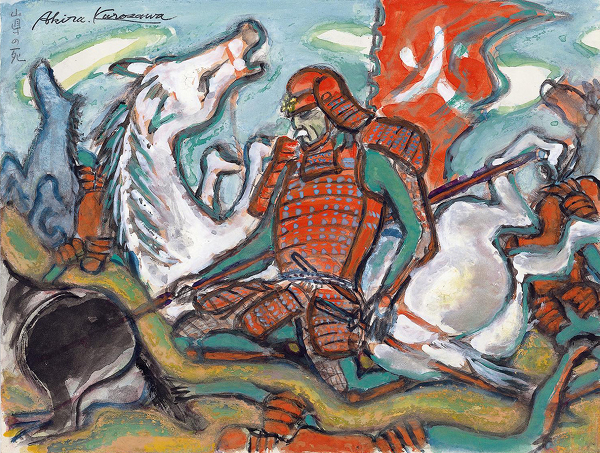
Kurosawa thus found it more and more difficult, as his career went on, to raise money for his ambitious projects. Richie recalls a time in the 1970s when, “convinced that Kagemusha would never get made, Kurosawa spent his time painting pictures of every scene — this collection would have to take the place of the unrealized film. He had, like many other directors, long used storyboards. These now blossomed into whole galleries — screening rooms for unmade masterpieces.” When he couldn’t shoot movies, he wrote them. If he’d written all he could, he painted them.
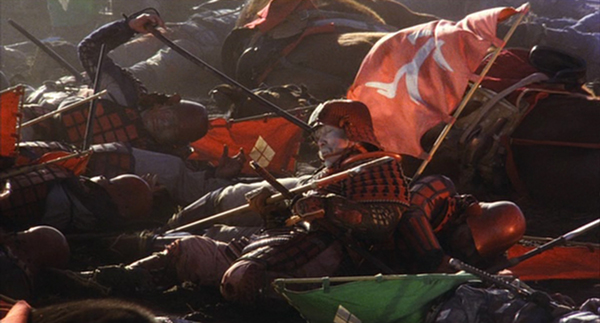
At Flavorwire, you can see a comparison between Kurosawa’s paintings and the frames of his movies. “He hand-crafted these images in order to convey his enthusiasm for the project,” writes Alison Nastasi, going on to quote the director’s own autobiography: “My purpose was not to paint well. I made free use of various materials that happened to be at hand.”
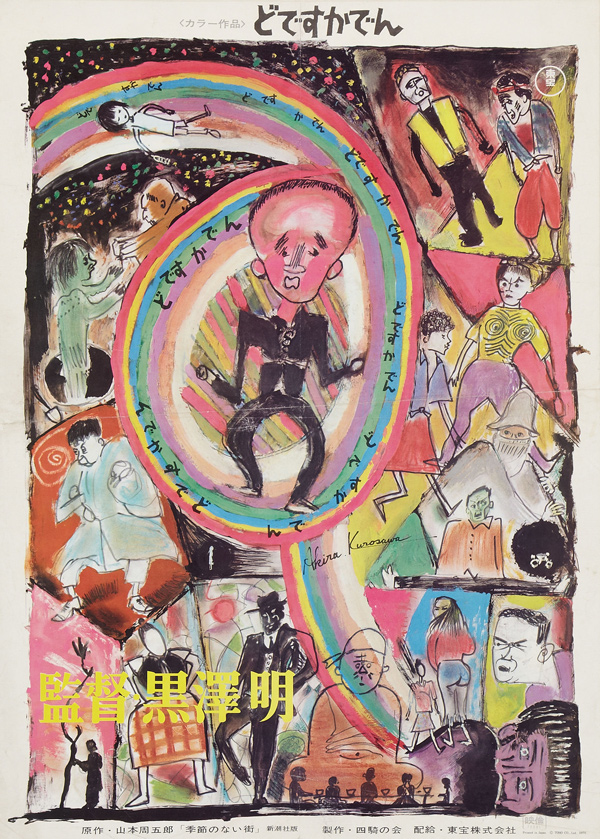
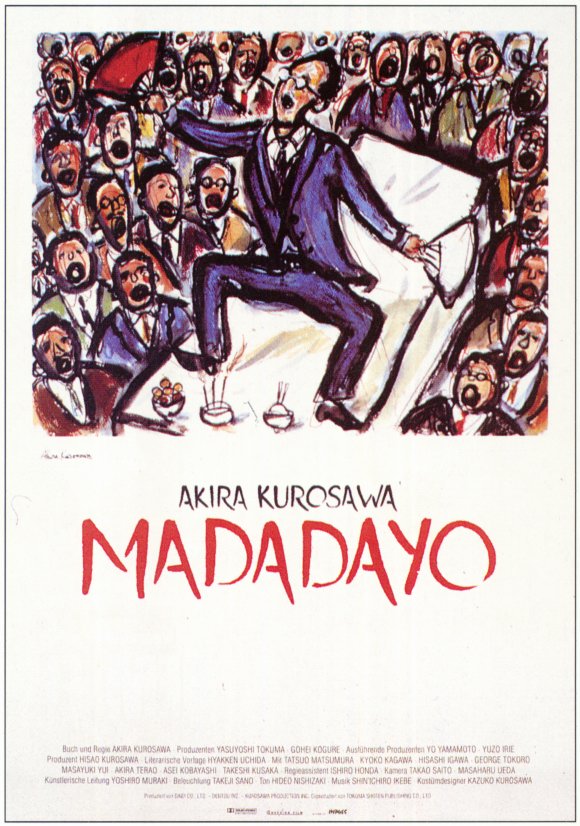
But as you can see, the Emperor knew what he wanted; the actual shots clearly represent a realization of what he’d devoted so much time and energy to visualizing beforehand. Occasionally, Kurosawa’s own artwork even made it to his movies’ official posters, especially lesser-known (whatever “lesser-known” means in the context of the Kurosawa canon) personal works like 1970’s Dodes’ka-den and 1993’s Madadayo.
We might chalk up the filmmaker’s interest in painting — and perhaps in filmmaking — in large part to his older brother Heigo, with whom he gazed upon the aftermath of Tokyo’s 1923 Kantō earthquake. A live silent film narrator and aspiring painter in the Proletarian Artists’ League, Heigo committed suicide in 1933 after his political disillusionment and the career-killing introduction of sound film. Young Akira would make his directorial debut a decade later and, in the 55 years that followed, presumably do Heigo proud on every possible level.
New York-based artist Brian Dettmer cuts into old books with X‑ACTO knives and turns them into remixed works of art. Speaking at TED Youth last November, he told the audience, “I think of my work as sort of a remix .… because I’m working with somebody else’s material in the same way that a D.J. might be working with somebody else’s music.” “I carve into the surface of the book,and I’m not moving or adding anything.I’m just carving around whatever I find interesting.So everything you see within the finished pieceis exactly where it was in the book before I began.”
Dettmer puts on display his pretty fantastic creations, all while explaining how he sees the book — as a body, a technology, a tool, a machine, a landscape, a case study in archaeology. The talk runs six minutes and delivers more than the average TED Talk does in 17.
The recent “adjunct walk out day” has reminded people outside academia—at least those who paid any attention—of the decaying state of American higher education, a condition driven in part by a searing undercurrent of anti-intellectualism in U.S. political culture. It’s a trend historian Richard Hofstadter identified last century in his Pulitzer Prize-winning 1963 study Anti-Intellectualism in American Life. But not long after Hofstadter’s book appeared, another, more vital current took hold in the 60s and 70s, one brought on by the broadening possibilities for those previously denied access to elite universities, and by reciprocal relationships between radicals and scholars. Academics like Timothy Leary became figureheads of the counterculture, revolutionaries like Huey Newton earned Ph.D.s, and activist professors like Angela Davis held the line between the worlds of higher ed and popular dissent. The universities became not only sites of student protest, but also matrices of revolutionary theory.
Into this fomenting intellectual culture stepped French theorist Michel Foucault, who first lectured in the U.S. in 1975 after the publication of his History of Sexuality. Foucault was a true product of the French university system and an academic superstar of sorts, as well as a gadfly of revolutionary movements from Paris in ’68, to Iran in ’79, to Berkeley in the 80s. His work as a philosopher and political dissident prompted one biographer to refer to him as a “militant intellectual,” though his politics could sometimes be as obscure as his prose. By 1981, he had risen to such cultural prominence in the States that Time magazine published a profile of him and his “growing cult.” One of Foucault’s American acolytes, Simeon Wade, befriended the philosopher in the mid-seventies and wrote an unpublished, 121-page account of Foucault’s alleged 1975 LSD trip in Death Valley (referred to in James Miller’s The Passion of Michel Foucault). Wade, along with a number of other University of California students, also interviewed Foucault the following year.
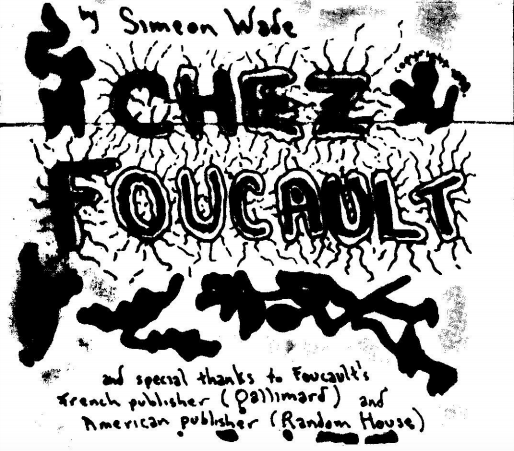
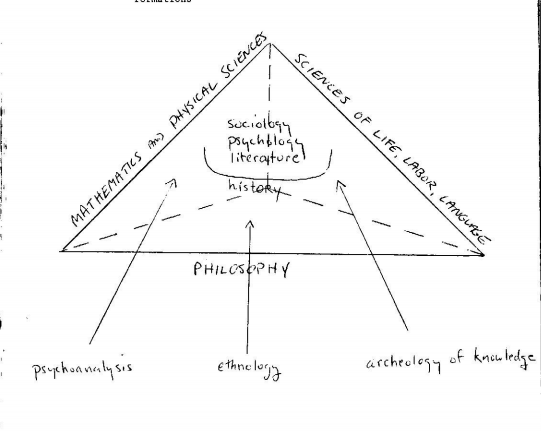
In 1978, Wade published the interview in what may be the most populist of mediums—the fanzine. Titled Chez Foucault, with a dedication “for Michael Stoneman,” the mimeographed document looks on its face like a typical handmade self-publication from the period, with its murky lettering and generally haphazard design. But inside, Chez Foucault is far denser than any chapbook or rock ‘zine. In his preface, Wade describes Chez Foucault as “a workbook I tinkered together for teachers and students in the humanities, social sciences and natural sciences.” Accordingly, in addition to the interview, he includes a synopsis of Foucault’s Discourse on Language, a “transcription” of his Discipline and Punish, a sketch of “The Early Foucault,” and a bibliography, glossary, reading and film list, and veritable course outline. It’s a very rich text that provides a thorough introduction to many of Foucault’s major works. Of principle interest, however, is the interview, seemingly unpublished anywhere else. In it, Foucault elaborates on several of his key concepts, such as the relationship between discourse and power:
I do not want to try to find behind the discourse something which would be the power and which would be the source of the discourse […]. We start from the discourse as it is! […] The kind of analysis I make does not deal with the problem of the speaking subject, but looks at the ways in which the discourse plays a role inside the strategical system in which the power is involved, for which power is working. So power won’t be something outside the discourse. Power won’t be something like a source or the origin of discourse. Power will be something which is working through the discourse.
This concise explanation offers a key to Foucault’s method. Disavowing the labels of both philosopher and historian (he calls himself a “journalist”), Foucault defines his program as “an analysis of discourse, but not with the perspective of ‘point of view.’” (If the distinction is confusing, a reading of his essay “What is an Author?” may help clarify things.) Foucault discusses the biopolitics of power, calling the human body “a productive force,” which “exists in and through a political system.” He also talks about the “political use” of a critical theory such as his, and the possibility of revolutionary philosophy:
I do not think there is such a thing as a conservative philosophy or a revolutionary philosophy. Revolution is a political process; it is an economic process. Revolution is not a philosophical ideology. And that’s important. That’s the reason why something like Hegelian philosophy has been both a revolutionary ideology, a revolutionary method, a revolutionary tool, but also a conservative one. Look at Nietzsche. Nietzsche brought forth wonderful ideas, or tools if you like. He was used by the Nazi Party. Now a lot of Leftist thinkers use him. So we cannot be sure if what we are saying is revolutionary or not.
In honor of Errol Morris’ 67th birthday, which just passed on February 9, Grantland.com is celebrating with a full week of new documentaries shot for ESPN by the filmmaker. Frequently named one of the most important documentary filmmakers of our times, he rose to fame with 1978’s pet cemetery doc Gates of Heaven, then cemented it with The Thin Blue Line, which helped save a man from the electric chair. (It also started his long collaboration with composer Philip Glass.) Morris has been a private investigator, a journalist, and a maker of commercials, all of which provide the mental fuel (and funding) for his filmmaking. He invented the “Interrotron” a variation on the teleprompter, which allowed his subjects to talk straight into the camera while he interviewed them. It added an unsettling jolt to his two conversations with the men voted most likely to be war criminals, Robert McNamara and Donald Rumsfeld. But as Morris says in a Grantland interview, he is not here to accuse or prosecute.
When I was interviewing killers years ago, I enjoyed talking to them. I enjoyed being with them. I wasn’t there to moralize with them or temporize with them, I was there to talk to them. And I think that’s still true. Rumsfeld pushed it, I have to say.
It’s been two years since his last film, the Rumsfeld interview The Unknown Known, and, while we wait for his next feature and possibly a third book, Morris has given us six short docs that range between 10 and 20 minutes. The Subterranean Stadium (at the top of this post) delves into the sub-culture of tabletop electronic football games that have been around since the 1940s, and the grown-ups who still play them.
The Heist examines, with diagrams and suspenseful music, the four college students who stole Michael Jordan’s jersey from the vaulted heights of a stadium.
The Streaker profiles Mark Roberts, the affable Liverpudlian who has streaked at “every major sporting event in the world.”
There are three more videos waiting to be doled out. (Find them here.) One is on A.J. Mass, a writer for ESPN; another about sports collectibles; and the other about horse racing. The constant theme is the particular madness of sports fans, obsession being a major theme of Morris’ work.
The other link in all these films is the sound of Morris, who chooses not to edit out his offscreen voice. It’s the sound of a man clearly having a good time. However:
“I’m sick of interviewing,” he says. “I am really sick of it. I’m not gonna say I do it better than anybody else, but I do it differently than anybody else. I am good at it, for whatever reason. There are a lot of different reasons, but if that’s all I’m going to do for the rest of my life is stick a camera in front of people and say to them, “I don’t have a first question, what’s your first answer?” I think I would be very sad.”
So let’s celebrate Morris before he changes his mind.
Ted Mills is a freelance writer on the arts who currently hosts the FunkZone Podcast. You can also follow him on Twitter at @tedmills and/or watch his films here.
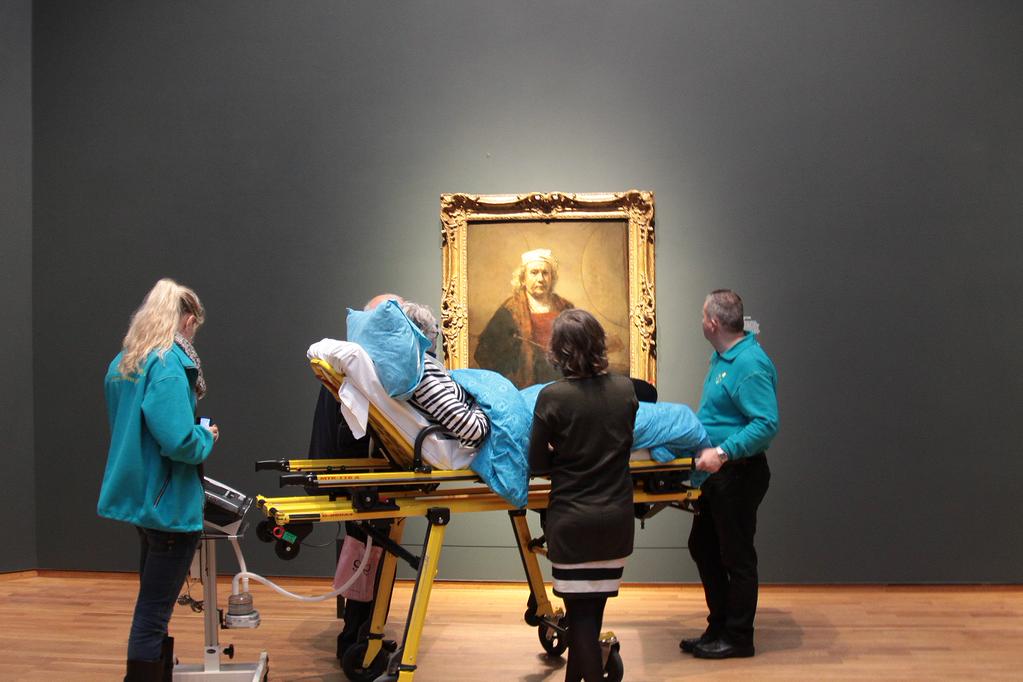
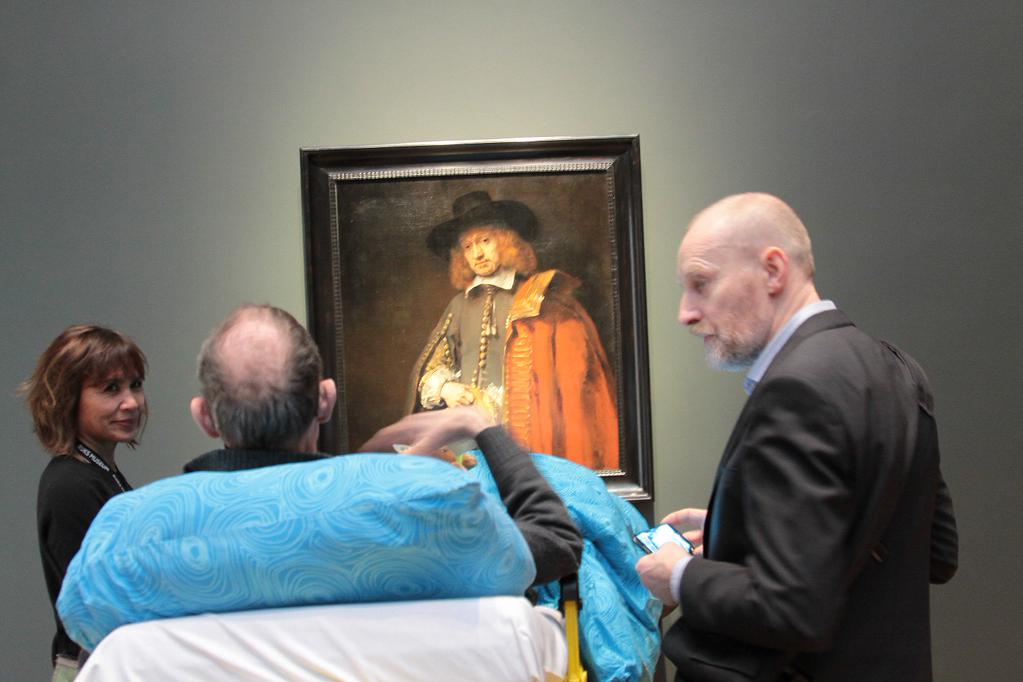
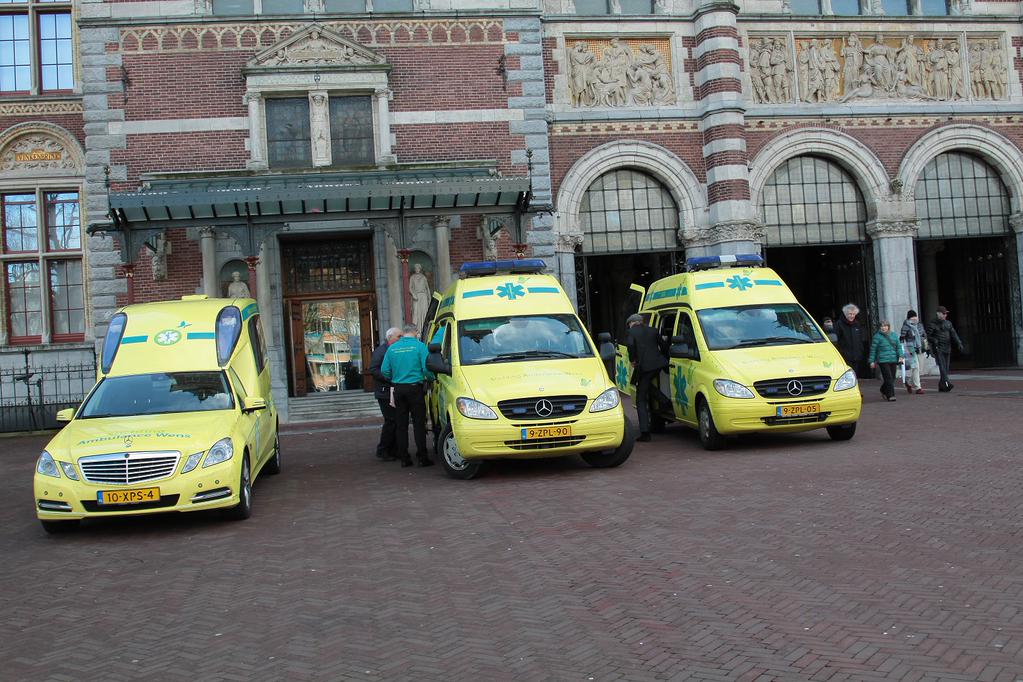
On Monday, the Dutch volunteer organization called Stichting Ambulance Wens Nederland (roughly translated as Ambulance Wish Foundation Netherlands) took three terminally ill patients to see The Late Rembrandt Exhibition currently being held at the Rijksmuseum in Amsterdam. The exhibit features over 100 paintings, drawings and prints that Rembrandt produced during the final phase of his life. And the patients, nearing the end of their lives, wanted to see the exhibit and experience the artistry of the great Dutch painter one last time.
Staffed by 200 medically-trained volunteers, the organization has fulfilled thousands of wishes since its creation in 2007, and they didn’t disappoint this time. As visually documented on its Twitter account, the nonprofit took the guests to the exhibit, each in an ambulance. The museum-goers were then treated to a one-hour private tour of the collection. Some poignant pictures capture the bittersweet moment.
If you would like to support the mission of Open Culture, consider making a donation to our site. It’s hard to rely 100% on ads, and your contributions will help us continue providing the best free cultural and educational materials to learners everywhere. You can contribute through PayPal, Patreon, and Venmo (@openculture). Thanks!
Kagonada, the video-essayist behind the cinematic supercuts of Kubrick’s “One-Point Perspective” and Ozu’s “Passageways” returns with a look at mirrors in the films of Ingmar Bergman, set to a plaintive Vivaldi work for two mandolins, and a reading of Sylvia Plath’s “Mirror.”
Mirrors and reflections turn up right in the beginning of Bergman’s films as a motif, when Jenny, the middle-aged protagonist of Crisis exclaims to her image, “You can’t see from the outside, but beneath this face … oh, my God!” Mirrors show their viewers a true face behind the mask in his films, mortality, failure, duplicity–everything fake stripped away. It’s a time to take stock and a time to break down.
It’s quite lovely, this cut, with Plath’s description of her wall “pink, with speckles” matching the color shot from Fanny & Alexander; or “Faces and darkness separate us over and over” as Nine-Christine Jönsson draws a frowny face and writes “lonely” on her reflection from Port of Call. The video is also a tribute to Bergman’s favorite actresses, from Harriet Andersson to Liv Ullmann.
Incidentally, Sylvia Plath was not just a fan of the filmmaker, she based her poem “Three Women” on Bergman’s film So Close to Life (aka Brink of Life) which she had seen in a London cinema in either 1961 or 1962.
If you would like to support the mission of Open Culture, consider making a donation to our site. It’s hard to rely 100% on ads, and your contributions will help us continue providing the best free cultural and educational materials to learners everywhere. You can contribute through PayPal, Patreon, and Venmo (@openculture). Thanks!
Ted Mills is a freelance writer on the arts who currently hosts the FunkZone Podcast. You can also follow him on Twitter at @tedmills and/or watch his films here.
We're hoping to rely on loyal readers, rather than erratic ads. Please click the Donate button and support Open Culture. You can use Paypal, Venmo, Patreon, even Crypto! We thank you!
Open Culture scours the web for the best educational media. We find the free courses and audio books you need, the language lessons & educational videos you want, and plenty of enlightenment in between.