Patti Smith, The Godmother of Punk, Is Now Putting Her Pictures on Instagram
As evidenced by her Instagram feed the Godmother is just like you and me. She posts pictures of her kids.
She gives her mom a Mothers Day shout out…
She celebrates her friends’ birthdays, posts selfies, travel shots, and pet pics…
She’s not above self-promotion if the situation warrants.
But the accompanying captions set punk’s poet laureate apart. No LOLs here. It’s clear that the award-winning author of Just Kids and M Train thinks about her content, carefully crafting each post before she publishes. Each is a bite-sized reflection, a page-a-day meditation on what it means to be alive:
This is day two of my Venice report.
I bummed around thinking of
Venice in the seventies. It had
a strong Rasta vibe with Reggae
music drifting from the head shops
and boom boxes on the beach.
Burning Spear and Jimmy Cliff
and Bob Marley. Venice has an
ever changing atmosphere but
I always like walking around,
anonymous, just another freak.
On Pacific next to the Cafe Collage
I had steamed dumplings and
ginger tea at Mao’s Kitchen.
The food is great and reasonable.
Because it was early it was
nearly empty. Since I was awake
since 4am i was nearly hypnotized
by the turning of their overhead
fan. Before I left they gave me a
fortune cookie. It was a true one.
Reflecting my past and certainly
my future. A very good day.
Follow Patti Smith on Instagram here.
Related Content:
Patti Smith’s 40 Favorite Books
Ayun Halliday is an author, illustrator, theater maker and Chief Primatologist of the East Village Inky zine. Her solo show Nurse!, in which one of Shakespeare’s best loved female characters hits the lecture circuit to set the record straight premieres in June at The Tank in New York City. Follow her @AyunHalliday.
Read More...The First 100 Years of the Bicycle: A 1915 Documentary Shows How the Bike Went from Its Clunky Birth in 1818, to Its Enduring Design in 1890
Back in 1915, French filmmakers decided to revisit the evolution of the bicycle during the 19th century, moving from the invention of the bicycle in 1818, to the bikes that emerged during the 1890s. As the resulting film above shows, the bike went from being clunky, cumbersome and seemingly perilous to ride, to taking on the tried and true shape that we still recognize today.
This film was preserved by the Netherlands’ EYE Film Institute. Hence the subtitles are in Dutch. But thanks to Aeon Magazine, you can read English translations below:
1. The draisine was invented only a century ago, in 1818 by Baron Drais de Sauerbrun.
2. [This subtitle never appears in the film.
3. The vehicle that lies between the draisine and the 1850 bicycle has an improved steering wheel and a fitted brake.
4. In 1863, Pierre Lallement invented pedals that worked on the front wheel.
5. Around 1868, a third wheel was added. Although these tricycles were heavier than the two-wheelers, they were safer.
6. Between 1867 and 1870, various improvements were made, including the increased use of rubber tyres.
7. In 1875, following an invention by the engineer Trieffault, the frame was made of hollow pipes.
8. Following the fashion of the day, the front wheel was made as large as possible.
9. In 1878, Renard created a bicycle with a wheel circumference of more than 7 feet. Just sitting down on one of these was an athletic feat!
11. At the beginning of 1879, Rousseau replaced the large front wheel with a smaller one, and the chain was introduced on the front wheel for driving power.
12. The bicycle of today.
For another look at the Birth of the Bike, you can watch a 1937 newsreel that gives its own narrative account. It comes the from British Pathé film archives.
If you would like to support the mission of Open Culture, consider making a donation to our site. It’s hard to rely 100% on ads, and your contributions will help us continue providing the best free cultural and educational materials to learners everywhere. You can contribute through PayPal, Patreon, and Venmo (@openculture). Thanks!
Related Content:
Young Frank Zappa Plays the Bicycle on The Steven Allen Show (1963)
Watch Boy and Bicycle: Ridley Scott’s Very First Film (1965)
Read More...The Diderot Effect: Enlightenment Philosopher Denis Diderot Explains the Psychology of Consumerism & Our Wasteful Spending

In pointing out the clear and present dangers posed by out-of-control consumerism, there is no need for Marxism 101 terms like “commodity fetishism.” Simply state in plain terms that we revere cheaply-mass-produced goods, made for the sake of endless growth and consumption, for no particular reason other than perpetual novelty and the creation of wealth for a few. Everyone nods in agreement, then gets back to scrolling through their social media feeds and inboxes, convincing themselves, as I convince myself, that targeted advertising in digital networks—what Jaron Lanier calls “mass behavior-modification regimes”—could not possibly have any effect on me!
While 18th-century French philosophe Denis Diderot in no way predicted (as Lanier largely did) the mass behavior-modification schemes of the internet, he understood something critically important about human behavior and the nascent commodity culture taking shape around him, a culture of anxious disquiet and games of one-upmanship, played, if not with others, then with oneself. Renowned, among other things, for co-founding the Encyclopédie (the first Wikipedia!), Diderot has also acquired a reputation for the insights in his essay “Regrets on Parting with My Old Dressing Gown,” which inspired the concept of the “Diderot Effect.”
This principle states that modern consumption requires us to “identify ourselves using our possessions,” as Esther Inglis-Arkell writes at io9. Thus, when persuaded by naked lust or the enticements of advertising to purchase something new and shiny, we immediately notice how out of place it looks amongst our old things. “Once we own one thing that stands out, that doesn’t fit our current sense of unity, we go on a rampage trying to reconstruct ourselves” by upgrading things that worked perfectly well, in order to maintain a coherent sense of who we are in relation to the first new purchase.
The phenomenon, “part psychological, and part deliberate manipulation,” drives heedless shopping and creates needless waste. Diderot describes the effect in terms consistent with the tastes and prejudices of an educated gentleman of his time. He does so with perspicacious self-awareness. The essay is worth a read for the rich hyperbole of its rhetoric. Beginning with a comparison between his old bathrobe, which “molded all the folds of my body” and his new one (“stiff, and starchy, makes me look stodgy”), Diderot builds to a near-apocalyptic scenario illustrating the “ravages of luxury.”
The purchase of a new dressing gown spoiled his sense of himself as “the writer, the man who works.” The new robe strikes a jarring, dissociative note. “I now have the air of a rich good for nothing. No one knows who I am…. All now is discordant,” he writes, “No more coordination, no more unity, no more beauty.” Rather than get rid of the new purchase, he feels compelled to become the kind of person who wears such a thing, by means of further purchases which he could only newly afford, after receiving an endowment from Catherine the Great. Before this windfall, points out James Clear, he had “lived nearly his entire life in poverty.”
Clear gives several examples of the Diderot effect that take it out of the realm of 18th century aesthetics and into our modern big-box/Amazon reality. “We are rarely looking to downgrade, to simplify,” he writes, “Our natural inclination is always to accumulate.” To counter the tendency, he recommends corrective behaviors such as making sure new purchases fit in with our current possessions; setting self-imposed limits on spending; and reducing exposure to “habit triggers.” This may require admitting that we are susceptible to the ads that clutter both our physical and digital environments, and that limiting time spent on ad-driven platforms may be an act not only of self-care, but of social and environmental care as well. Algorithms now perform Diderot effects for us constantly.
Is the Diderot effect universally bad? Inglis-Arkell argues that “it’s not pure evil… there’s a difference between an Enlightenment screed and real life.” So-called green consumerism—“replacing existing wasteful goods with more durable, cleaner, more responsibly-made goods”—might be a healthy use of Diderot-like avarice. Besides, she says, “there’s nothing wrong with wanting to communicate one’s sense of self through aesthetic choices” or craving a unified look for our physical spaces. Maybe, maybe not, but we can take responsibility for how we direct our desires. In any case, Diderot’s essay is hardly a “screed,” but a light-hearted, yet candid self examination. He is not yet so far gone, he writes: “I have not been corrupted…. But who knows what will happen with time?”
Related Content:
Bertrand Russell & Buckminster Fuller on Why We Should Work Less, and Live & Learn More
How Information Overload Robs Us of Our Creativity: What the Scientific Research Shows
Josh Jones is a writer and musician based in Durham, NC. Follow him at @jdmagness
Read More...Braille Neue: A New Version of Braille That Can Be Simultaneously Read by the Sighted and the Blind
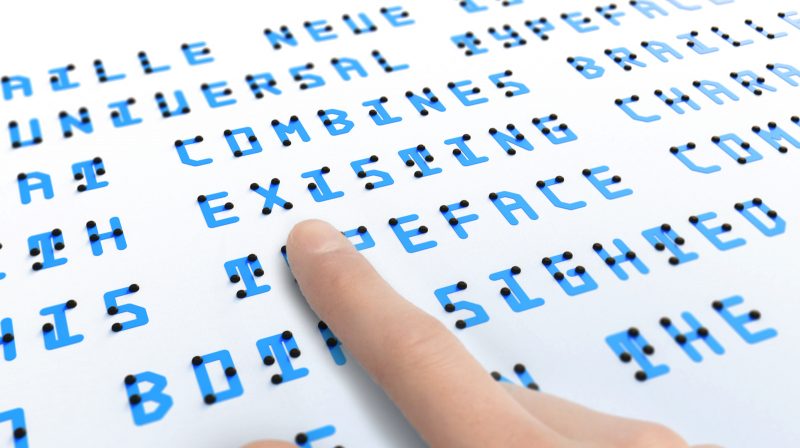
Photo via Kosuke Takahashi
To those of us who’ve never had reason to learn it, the Braille alphabet can have an appealingly retro-futuristic look, not least because Braille signage in America seems most often installed in pre-2000s public buildings. But it must smack of the past to many of the visually impaired as well, who these days have a host of ever higher-tech reading devices available to them (thanks to which, of course, they can read sites like this one). And though public support for producing materials in Braille exists, the educational programs needed to spread Braille literacy in the first place have fewer champions. Braille itself, perhaps, needs an upgrade for the 21st century.
Kosuke Takahashi may be just the graphic designer to provide that upgrade. He’s come up with Braille Neue, “a universal typeface that combines braille with existing characters. This typeface communicates to both the sighted and blind people in the same space.” He has, in other words, designed a readable alphabet that allows for the overlaying of English with the corresponding raised Braille dots, keeping both legible at a glance — or at a touch, as the case may be. Other designers have tried their hand at the same project, but unlike Takahashi, none of their alphabets support phonetic Japanese characters as well. “Our aim is to use this universal typeset for [the] Tokyo Olympics and Paralympics 2020 to create a truly universal space where anyone can access information,” says Takahashi’s Braille Neue page.
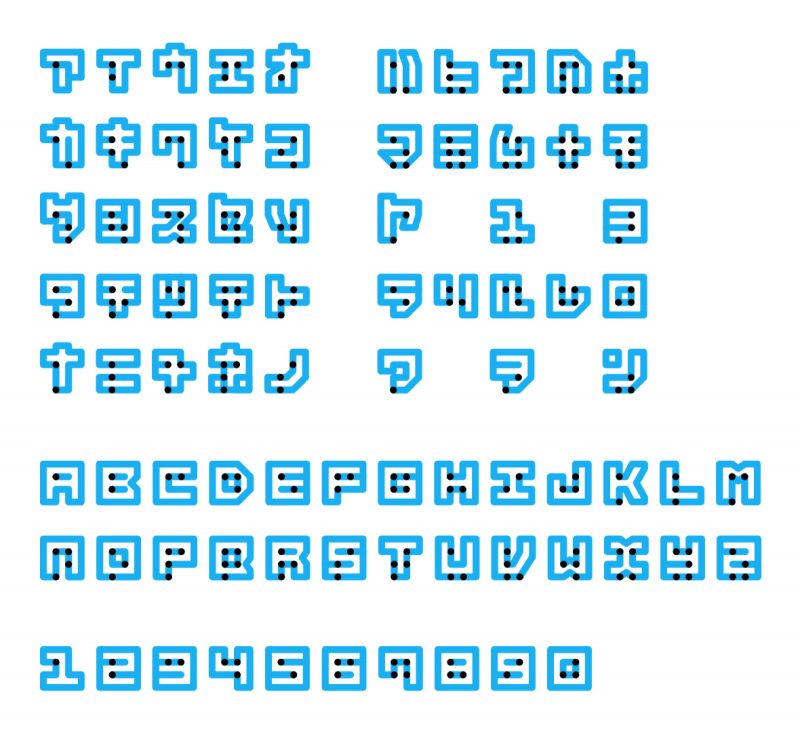
Photo via Kosuke Takahashi
Based on the existing Helvetica Neue font, Braille Neue — whose designer, according to My Modern Met, “is still experimenting with cost-effective printing and is refining the font prior to final release” — has the potential to spread not just awareness but literacy of Braille, given that it essentially shows sighted non-Braille readers a key every time they read it. As any non-Japanese person who has lived in Takahashi’s native land knows, even if you start with no idea of how to read a character in an unknown writing system, you’ll start to get a sense of it almost automatically if you see it often enough in context with your own. They’ll also know that if any country can implement retrofuturistic design in a way that fascinates the world, it’s Japan.
Related Content:
Helen Keller Had Impeccable Handwriting: See a Collection of Her Childhood Letters
How to Write Like an Architect: Short Primers on Writing with the Neat, Clean Lines of a Designer
Jorge Luis Borges, After Going Blind, Draws a Self-Portrait
Based in Seoul, Colin Marshall writes and broadcasts on cities and culture. His projects include the book The Stateless City: a Walk through 21st-Century Los Angeles and the video series The City in Cinema. Follow him on Twitter at @colinmarshall or on Facebook.
Read More...Radiooooo: Discover the Musical Time Machine That Lets You Hear What Played on the Radio in Different Times & Places

Radio has always been a fairly transportive medium.
During the Great Depression, entire families clustered round the electronic hearth to enjoy a variety of entertainments, including live remote broadcasts from the glamorous nightclubs and hotels where celebrity bandleaders like Count Basie and Duke Ellington held sway.
1950s teens’ transistors took them to a head space less square than the white bread suburbs their parents inhabited.
During the Vietnam War, South Vietnamese stations played homegrown renditions of the rock and soul sounds dominating American airwaves.
The Radiooooo.com site (there’s also a version available for the iPhone and Android) allows modern listeners to experience a bit of that magical time traveling sensation, via an interactive map that allows you to tune in to specific countries and decades.
The content here is user-generated. Register for a free account, and you too can begin sharing eccentric faves.
Find a user whose tastes mirror your own? Click their profile for a stat card of tracks they’ve favorited and uploaded, as well as any other sundry details they may feel like sharing, such as country of origin and age.
There are fun awards to be earned here, with the most sought after pelts going to the first to upload a song to an empty country, or upload a track from 1910–1920. (Cameroon, 1940 … go!)
As with an actual radio, you are not selecting the actual playlist, though you can nudge the needle a bit by toggling to your desired mood—slow, fast and/or weird.
And you need not limit yourself to a single destination. Embark on a strange musical trip by using Radiooooo’s taxi function to carry you to multiple countries and decades. (I closed my eyes and wound up shuttling between Ukraine and Mauritania in the 60s and 80s.)
Dotted around the map are island icons, where the ever-growing collection is sorted according to themes like Hawaii, Neverland (“for children big and small”), and 8‑Bit video game music. Le Club, floating midway between Europe and North America, contains brand new releases from contemporary labels.
The Now Playing window includes an option to buy, when possible, as well as the artist’s name and album artwork. Share, like, get your groove on…
And stay tuned for Radiooooo’s latest baby, Le Globe, an interactive 3‑D map of the world and a decade selector dial mounted on a “beautiful connected object.”
The boundaries are extremely permeable here.
Have a browse through Radiooooo’s Instagram feed for a feast of cover art or head to France for one of their in-person listening parties. (There’s one next week in the secret listening room of Paris’ Grand Hotel Amour.)
Readers, if your explorations unearth an exceptional track, please share it in the comments, below.
Download the Radioooo app for Mac or Android here, or listen on the website. (You may need to fool around with various browsers to find the one that works best for you.)
Related Content:
Hear 1,500+ Genres of Music, All Mapped Out on an Insanely Thorough Interactive Graph
Google’s Music Timeline: A Visualization of 60 Years of Changing Musical Tastes
Ayun Halliday is an author, illustrator, theater maker and Chief Primatologist of the East Village Inky zine. Her radio dial is set to Romania 1910 in anticipation of the third installment of her literary-themed variety show, Necromancers of the Public Domain , Monday, April 23 at the New York Society Library. Follow her @AyunHalliday.
Read More...Stream 47 Hours of Classic Sci-Fi Novels & Stories: Asimov, Wells, Orwell, Verne, Lovecraft & More
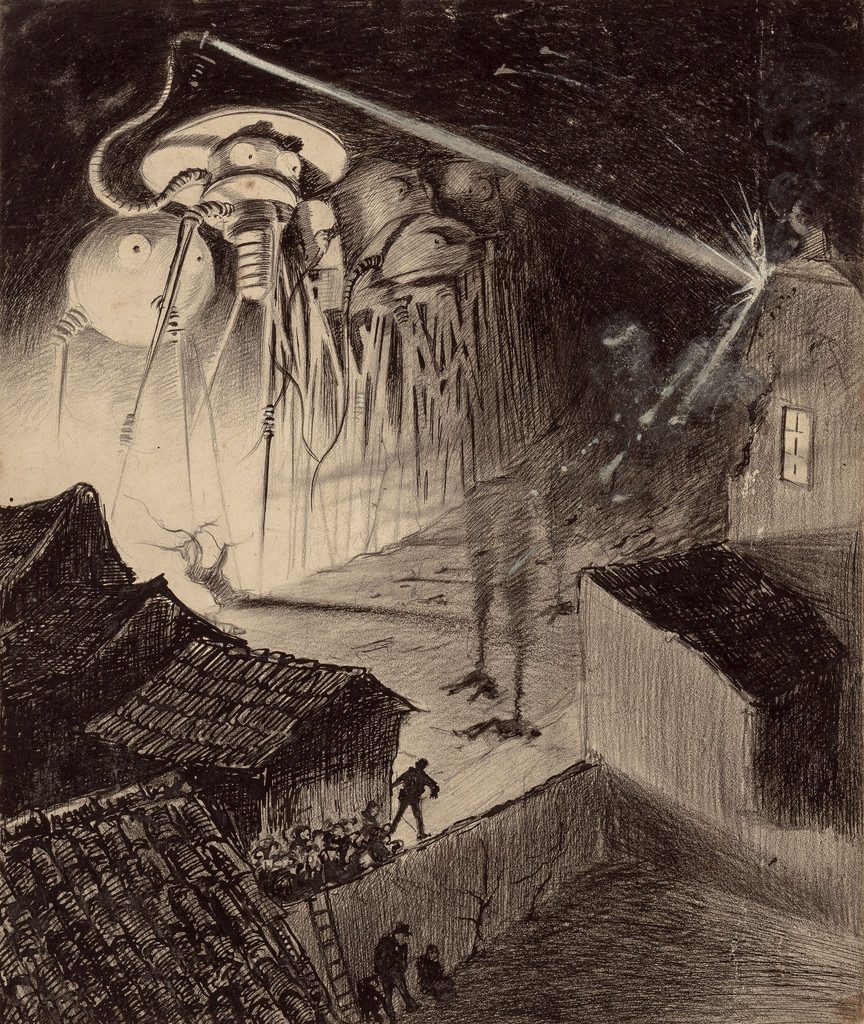
The pronouncements of French theorist Jean Baudrillard could sound a bit silly in the early 1990s, when the internet was still in its infancy, a slow, clunky technology whose promises far exceeded what it could deliver. We hoped for the cyberpunk spaces of William Gibson, and got the beep-boop tedium of dial-up. Even so, in his 1991 essay “Simulacra and Science Fiction,” Baudrillard contended that the real and the imaginary were no longer distinguishable, and that the collapse of the distance between them meant that “there is no more fiction.” Or, conversely, he suggested, that there is no more reality.
What seemed a far-fetched claim about the totality of “cybernetics and hyperreality” in the age of AOL and Netscape now sounds far more plausible. After all, it will soon be possible, if it is not so already, to convincingly simulate events that never occurred, and to make millions of people believe they had, not only through fake tweets, “fake news,” and age-old propaganda, but through sophisticated manipulation of video and audio, through augmented reality and the onset of “reality apathy,” a psychological fatigue that overwhelms our abilities to distinguish true and false when everything appears as a cartoonish parody of itself.
Technologist Aviv Ovadya has tried since 2016 to warn anyone who would listen that such a collapse of reality was fast upon us—an “Infocalypse,” he calls it. If this is so, according to Baudrillard, “both traditional SF and theory are destined to the same fate: flux and imprecision are putting an end to them as specific genres.” In an apocalyptic prediction, he declaimed, “fiction will never again be a mirror held to the future, but rather a desperate rehallucinating of the past.” The “collective marketplace” of globalization and the Borgesian condition in which “the map covers all the territory” have left “no room any more for the imaginary.” Companies set up shop expressly to simulate and falsify reality. Pained irony, pastiche, and cheap nostalgia are all that remain.
It’s a bleak scenario, but perhaps he was right after all, though it may not yet be time to despair—to give up on reality or the role of imagination. After all, sci-fi writers like Gibson, Philip K. Dick, and J.G. Ballard grasped long before most of us the condition Baudrillard described. The subject proved for them and many other late-20th century sci-fi authors a rich vein for fiction. And perhaps, rather than a great disruption—to use the language of a start-up culture intent on breaking things—there remains some continuity with the naïve confidence of past paradigms, just as Newtonian physics still holds true, only in a far more limited way than once believed.
Isaac Asimov’s short essay “The Relativity of Wrong” is instructive on this last point. Maybe the theory of “hyperreality” is right, in some fashion, but also incomplete: a future remains for the most visionary creative minds to discover, as it did for Asimov’s “psychohistorian” Hari Seldon in The Foundation Trilogy. You can hear a BBC dramatization of that groundbreaking fifties masterwork in the 47-hour science fiction playlist above, along with readings of classic stories—like Orson Welles’ infamous radio broadcast of H.G. Wells’ War of the Worlds (and an audiobook of the same read by English actor Maxwell Caulfield). From Jules Verne to H.P. Lovecraft to George Orwell; from the mid-fifties time travel fiction of Andre Norton to the 21st-century time-travel fiction of Ruth Boswell….
We’ve even got a late entry from theatrical prog rock mastermind Rick Wakeman, who followed up his musical adaptation of Journey to the Centre of the Earth with a sequel he penned himself, recorded in 1974, and released in 1999, called Return to the Centre of the Earth, with narration by Patrick Stewart and guest appearances by Ozzy Osbourne, Bonnie Tyler, and the Moody Blues’ Justin Hayward. Does revisiting sci-fi, “weird fiction,” and operatic concept albums of the past constitute a “desperate rehallucinating” of a bygone “lost object,” as Baudrillard believed? Or does it provide the raw material for today’s psychohistorians? I suppose it remains to be seen; the future—and the future of science fiction—may be wide open.
The 47-hour science fiction playlist above will be added to our collection of 900 Free Audio Books.
Related Content:
Free: Isaac Asimov’s Epic Foundation Trilogy Dramatized in Classic Audio
Free: 355 Issues of Galaxy, the Groundbreaking 1950s Science Fiction Magazine
Josh Jones is a writer and musician based in Durham, NC. Follow him at @jdmagness
Read More...A Shazam for Nature: A New Free App Helps You Identify Plants, Animals & Other Denizens of the Natural World

Do you ever long for those not-so-long-ago days when you skipped through the world, breathless with the anticipation of catching Pokémon on your phone screen?
If so, you might enjoy bagging some of the Pokeverse’s real world counterparts using Seek, iNaturalist’s new photo-identification app. It does for the natural world what Shazam does for music.
Aim your phone’s camera at a nondescript leaf or the grasshopper-ish-looking creature who’s camped on your porch light. With a bit of luck, Seek will pull up the relevant Wikipedia entry to help the two of you get better acquainted.
Registered users can pin their finds to their personal collections, provided the app’s recognition technology produces a match.
(Several early adopters suggest it’s still a few houseplants shy of true functionality…)
Seek’s protective stance with regard to privacy settings is well suited to junior specimen collectors, as are the virtual badges with which it rewards energetic uploaders.

While it doesn’t hang onto user data, Seek is building a photo library, composed in part of user submissions.
(Your cat is ready for her close up, Mr. DeMille…)
(Ditto your Portobello Mushroom burger…)
Download Seek for free on iTunes or Google Play.
Related Content:
Two Million Wondrous Nature Illustrations Put Online by The Biodiversity Heritage Library
Ayun Halliday is an author, illustrator, theater maker and Chief Primatologist of the East Village Inky zine. Follow her @AyunHalliday.
Read More...Watch Ta-Nehisi Coates Speak French Before & After Attending Middlebury’s Immersion Program
The many fans of Ta-Nehisi Coates, longtime Atlantic correspondent and author of books like The Beautiful Struggle and Between the World and Me (not to mention his more recent role as a writer of Black Panther comics), know a thing or two about the trials and tribulations he went through to become one of America’s best-known public intellectuals, but fewer of them know how intense a battle he’s waged, over the past few years, on the side: that of mastering the French language in his 30s and 40s.
“I’m taking an hour a week to try to teach myself French,” Coates wrote on his blog at The Atlantic in the summer of 2011, explaining that his wife “went to Paris five years ago and loved it. She wants me to go back with her, and I want to go. But I refuse to do so until I have a rudimentary understanding of the language. This isn’t about impressing the French — I expect my accent to mocked — it’s about how I interpret the world. Language is a big part of it.” After starting to dig into the Foreign Service Institute’s French materials (available free in our language-learning collection), he crossed out the word week in “an hour a week” to replace it with day, already sensing, no doubt, the unexpected demands this particular language would make on him.
“ ‘Et alors’ is similar to our ‘So what?’ But ‘Et Alors’ doesn’t simply sound different, it feels different, it carries another connotation, another music,” he wrote in an early 2012 follow-up. “I don’t know if that means anything to people who don’t write professionally, but for me it means a ton.” It seems only right, he concluded, “that a writer should explore languages and try to spend time with as many as he or she can. That I should arrive at such an obvious conclusion at this late date is humbling.” And so he pressed steadfastly on, memorizing French vocabulary words and grammatical structures, taking classes, meeting with a tutor, and after receiving his first passport at the age of 37, studying and practicing in real Francophone places like Paris and Switzerland.
Coates stepped up to a higher level of French skill — and a much higher level of French challenge — when he signed up for Middlebury College’s seven-week French immersion program, throwing himself into an environment of much younger and “fiercer” classmates without the possibility of leaning on his native language. When he sat down for the four-minute video interview at the top of the post before shipping out to Middlebury, he later revealed, “there were several moments when I didn’t even understand the question.” No such problems when he sat for another short conversation after the seven weeks, captured in the video just above: “What changed most at Middlebury, for me, was not in how I talked, but how I heard.”
Though Middlebury clearly helped push him forward, Coates doesn’t seem to consider participation in such a program a requirement for even the ambitious French learner. Maintaining the right attitude, however, is non-negotiable: “I expect to suck for awhile. Then I expect to slowly get better. The point is neither mastery, nor fluency. The point is hard study — the repeated application of a principle until the eyes and ears bleed a little.” Grappling with French has taught him, among other life lessons he’s written about, “that it is much better to focus on process, than outcomes. The question isn’t ‘When will I master the subjunctive?’ It’s ‘Did I put in my hour of study today?’ ”
How you feel about your process of study, Coates emphasizes, “it is as important as any objective reality. Hopelessness feeds the fatigue that leads the student to quit. It is not the study of language that is hard, so much as the ‘feeling’ that your present level is who you are and who you will always be. I remember returning from France at the end of the summer of 2013, and being convinced that I had some kind of brain injury which prevented me from hearing French vowel sounds. But the real enemy was not any injury so much as the ‘feeling’ of despair. That is why I ignore all the research about children and their language advantage. I don’t want to hear it. I just don’t care.”
After less than a year of studying French, Coates found, his brain had begun to “hunger for that feeling of stupidity” that comes from less-than-satisfactory comprehension. “There is absolutely nothing in this world like the feeling of sucking at something and then improving at it,” he wrote in a more recent reflection on his ongoing (and now surely lifelong) engagement with French. “Everyone should do it every ten years or so.”
Related Content:
French in Action: Cult Classic French Lessons from Yale (52 Episodes) Available Online
A Map Showing How Much Time It Takes to Learn Foreign Languages: From Easiest to Hardest
Learn 48 Languages Online for Free: Spanish, Chinese, English & More
Based in Seoul, Colin Marshall writes and broadcasts on cities and culture. His projects include the book The Stateless City: a Walk through 21st-Century Los Angeles and the video series The City in Cinema. Follow him on Twitter at @colinmarshall or on Facebook.
Read More...How Much Money Do You Need to Be Happy? A New Study Gives Us Some Exact Figures
“If I gave you a million dollars, would you…?” (insert possibly life-altering risk, humiliation, or soul-selling crime here). What about ten million? 100 million? One BILLION dollars? Put another way, in the terms social scientists use these days, how much money is enough to make you happy?
If you’re Montgomery Burns, it’s at least a billion dollars, lest you be forced to suffer the torments of the Millionaire’s Camp. (“Just kill me now!”) As it tends to do, The Simpsons’ dark humor nails the insatiable greed that seems the scourge of our time, when the richest 1 percent take 82 percent of the world’s wealth, and the poorest 50 percent get nothing at all.
Hypothetical windfalls aside, the question of how much is enough is an urgent one for many people: as in, how much to feed a family, supply life’s necessities, purchase just enough leisure for some small degree of personal fulfilment?
As the misery of Monty Burns demonstrates, we have a sense of the 1% as eternally unfulfilled. He’s the wicked heir to more serious tragic figures like Charles Foster Kane and Jay Gatsby. But satire is one thing, and desire, that linchpin of the economy, is another.
“What we see on TV and what advertisers tell us we need would indicate there is no ceiling when it comes to how much money is needed for happiness,” says Purdue University psychologist Andrew T. Jebb, “but we now see there are some thresholds.” In short: money is a good thing, but there is such a thing as too much of it.
Jebb and his colleagues from Purdue and the University of Virginia addressed questions in their study “Happiness, income satiation and turning points around the world” like, “Does happiness rise indefinitely with income, or is there a point at which higher incomes no longer lead to greater wellbeing?” What they found in data from an international Gallup World Poll survey of over 1.7 million people in 164 countries varies widely across the world.
People in wealthier areas seem to require more income for happiness (or “Subjective Well Being” in the social science terminology). In many parts of the world, higher incomes, “beyond satiation”—a metric that measures how much is enough—“are associated with lower life evaluations.” The authors also note that “a recent study at the country level found a slight but significant decline in life evaluation” among very high earners “in the richest countries.”
You can see the wide variance in happiness worldwide in the “Happiness” study. As Dan Kopf notes at Quartz, these research findings are consistent with those of other researchers of happiness and income, though they go into much more detail. Problems with the methodology of these studies—primarily their reliance on self-reported data—make them vulnerable to several critiques.
But, assuming they demonstrate real quantities, what, on average, do they tell us? “We found that the ideal income point,” averaged out in U.S. dollars, “is $95,000 for [overall life satisfaction],” says Jebb, “and $60,000 to $75,000 for emotional well-being,” a measure of day-to-day happiness. These are, mind you, individual incomes and “would likely be higher for families,” he says.
Peter Dockrill at Science Alert summarizes some other interesting findings: “Globally, it’s cheaper for men to be satisfied with their lives ($90,000) than women ($100,000), and for people of low ($70,000) or moderate education ($85,000) than people with higher education ($115,000).”
Yes, the study, like those before it, shows that after the “satiation point,” happiness decreases, though perhaps not to Monty Burns levels of dissatisfaction. But where does this leave most of us in the new Gilded Age? Given that “satiation” in the U.S. is around $105K, with day-to-day happiness around $85K, the majority of Americans fall well below the happiness line. The median salary for U.S. workers at the end of 2017 was $44, 564, according to the Bureau of Labor Statistics. Managers and professionals averaged $64,220 and service workers around $28,000. (As you might imagine, income inequality diverged sharply along racial lines.)
And while the middle class saw a slight bump in income in the last couple years, median household income was still only $59,039 in 2016. However, we measure it the “middle class… has been declining for four decades,” admits Business Insider—“identifying with the middle class is, in part, a state of mind” rather than a state of debt-to-income ratios. (One study shows that Millennials make 20% less than Baby Boomers did at the same age.) Meanwhile, as wealth increases at the top, “the country’s bottom 20% of earners became worse off.”
This may all sound like bad news for the happiness quotient of the majority, if happiness (or Subjective Well Being) requires a certain amount of material security. Maybe one positive takeaway is that it doesn’t require nearly the amount of vast private wealth that has accumulated in the hands of a very few people. According to this research, significantly redistributing that wealth might actually make the wealthy a little happier, and less Mr. Burns-like, even as it raised happiness standards a great deal for millions of others.
Not only are higher incomes “usually accompanied by higher demands,” as Jebb and his colleagues conclude—on one’s time, and perhaps on one’s conscience—but “additional factors” may also play a role in decreasing happiness as incomes rise, including “an increase in materialistic values, additional material aspirations that may go unfulfilled, increased social comparisons,” etc. The longstanding truism about money not buying love—or fulfillment, meaning, peace of mind, what-have-you—may well just be true.
You can dig further into Andrew T. Jebb’s study here: “Happiness, income satiation and turning points around the world.”
Related Content:
Josh Jones is a writer and musician based in Durham, NC. Follow him at @jdmagness
Read More...Tattoos Can Now Start Monitoring Your Medical Conditions: Harvard and MIT Researchers Innovate at the Intersection of Art & Medicine
Once reserved for rebels and outliers, tattoos have gone mainstream in the United States. According to recent surveys, 21% of all Americans now have at least one tattoo. And, among the 18–29 demographic, the number rises to 40%. If that number sounds high, just wait until tattoos go from being aesthetic statements to biomedical devices.
At Harvard and MIT, researchers have developed “smart tattoo ink” that can monitor changes in biological and health conditions, measuring, for example, when the blood sugar of a diabetic rises too high, or the hydration of an athlete falls too low. Pairing biosensitive inks with traditional tattoo designs, these smart tattoos could conceivably provide real-time feedback on a range of medical conditions. And also raise a number of ethical questions: what happens when your health information gets essentially worn on your sleeve, available for all to see?
To learn more about smart tattoos, watch the Harvard video above, and read the corresponding article in the Harvard Gazette.
If you would like to support the mission of Open Culture, consider making a donation to our site. It’s hard to rely 100% on ads, and your contributions will help us continue providing the best free cultural and educational materials to learners everywhere. You can contribute through PayPal, Patreon, and Venmo (@openculture). Thanks!
Related Content:
A Dazzling Gallery of Clockwork Orange Tattoos
Free Online Biology Courses
Read More...Support Us
We're hoping to rely on loyal readers, rather than erratic ads. Please click the Donate button and support Open Culture. You can use Paypal, Venmo, Patreon, even Crypto! We thank you!

About Us

Open Culture scours the web for the best educational media. We find the free courses and audio books you need, the language lessons & educational videos you want, and plenty of enlightenment in between.
Advertise With Us
FREE UPDATES!
GET OUR DAILY EMAIL
Get the best cultural and educational resources on the web curated for you in a daily email. We never spam. Unsubscribe at any time.
FOLLOW ON SOCIAL MEDIA
Open Culture editor Dan Colman scours the web for the best educational media. He finds the free courses and audio books you need, the language lessons & movies you want, and plenty of enlightenment in between.
Advertise With Us

