175+ College Admissions Offices Promise Not to Penalize High School Students Who Get Suspended for Protesting Peacefully Against Gun Violence

Image by Lorie Shaull, via Flickr Commons
“Will my admission get rescinded if I get suspended for engaging in a school walk-out meant to bring attention to the school shooting issue?” That’s a question many high school students have posed to college admissions offices around the country, especially after some high school officials threatened to suspend students taking part in anti-gun demonstrations.
Many leading universities have since issued policy statements and given these students their blessing and support. In a post called “In Support of Student Protests,” Hannah Mendlowitz, from Yale’s Admissions Office, writes:
[W]e continue to get the question: will Yale look unfavorably upon discipline resulting from peaceful demonstrations?
The answer is simple: Of course not.
To the students who have reached out to us with these concerns, we have made clear that they should feel free to participate in walk-out events to bring attention to this issue without fear of repercussion. Yale will NOT be rescinding anyone’s admission decision for participating in peaceful walkouts for this or other causes, regardless of any high school’s disciplinary policy. I, for one, will be cheering these students on from New Haven.
And on the official Twitter feed for the Brown University, a tweet reads:
Applicants to Brown: Expect a socially conscious, intellectually independent campus where freedom of expression is fundamentally important. You can be assured that peaceful, responsible protests against gun violence will not negatively impact decisions on admission to Brown.
And that’s just the tip of the iceberg. Below, find a list of 175+ universities that have granted similar assurances, along with links to their statements. The list comes from Alex Garcia, who is maintaining a regularly-updated Google Doc. Access it online here.
- Agnes Scott
- Alfred University
- American
- Amherst
- Baldwin Wallace
- Bard
- Bates
- Bellarmine
- Bennington
- Berkeley
- Berkshire CC
- Binghamton
- Boston College
- Bowdoin
- Brandeis
- Bridgewater State
- Brown
- Bryn Mawr
- BU
- Bucknell
- Cal State U System
- CalTech
- Case Western
- Catholic
- Chapman
- Clark
- CMU
- Colby
- Colgate
- Coll. of the Atlantic
- College of NJ
- College of Wooster
- Colorado College
- Colorado State
- Columbia U.
- Conn. College
- Cornell University
- CU Boulder
- CU Denver
- Dartmouth
- Davidson
- Denison
- DePaul
- Dickinson
- Dominican U of Cal
- Drew
- Duke
- Eastern CT State
- Elmira
- Emerson
- Emory
- Florida
- Fordham
- Georgetown
- Gettysburg
- GMU
- Gonzaga
- Goucher
- Grinnell
- Guilford
- GW
- Hamilton College
- Hamline
- Hampshire
- Hanover
- Harvard
- Harvey Mudd
- Haverford
- Hofstra
- Holy Cross
- Illinois State
- Indiana University
- Johns Hopkins
- Juniata
- Kalamazoo
- Kenyon College
- Knox
- Lafayette
- LawrenceU
- Lebanon Valley College
- Lehigh
- Lewis & Clark
- Lindenwood
- Loyola Marymount
- Macalester
- Manchester
- Miami of Ohio
- Middlebury
- MIT
- Mt Holyoke
- Muhlenberg College
- NCSU
- New School
- Northeastern
- Northwestern
- NYU
- Oberlin
- Occidental
- Ohio Wesleyan
- Pace
- Pacific Lutheran
- Penn
- Penn State
- Pitzer College
- Plymouth State
- Pomona
- Providence College
- Randolph
- Reed
- Rhodes College
- Rice
- RIT
- Saint Mary’s
- Salve Regina
- Sarah Lawrence
- Seattle University
- Simon’s Rock
- Skidmore
- Smith
- St. Johns
- St. Lawrence
- Stanford
- Stetson
- Stevens
- Suffolk
- Swarthmore
- Sweet Briar
- Syracuse
- Temple
- Transylvania
- Trinity College
- Trinity Washington
- Tufts
- Tulane
- U. Dayton
- U. Maryland
- U. New England
- U. Puget Sound
- U. Richmond
- U. South Carolina
- U. Southern California
- UCDavis
- UCLA
- UConn
- UIUC
- UMass-Amherst
- UMass Lowell
- UMBC
- UNH
- UPitt
- UVA
- UVM
- UWashington
- Vassar
- Villanova
- Virginia Tech
- W&M
- Wake Forest
- Wellesley
- Wesleyan
- Western Mich. U.
- Western Washington
- Wheaton
- Whitman college
- Widener
- Willamette
- Williams
- Winthrop University
- Wisconsin
- Wittenberg
- Worcester State
- WPI
- WUSTL
- WVU
- Yale
Again, you can refer to this Google Doc for more updates.
If you would like to support the mission of Open Culture, consider making a donation to our site. It’s hard to rely 100% on ads, and your contributions will help us continue providing the best free cultural and educational materials to learners everywhere. You can contribute through PayPal, Patreon, and Venmo (@openculture). Thanks!
Read More...What Made John Entwistle One of the Great Rock Bassists? Hear Isolated Tracks from “Won’t Get Fooled Again,” “Baba O’Riley” & “Pinball Wizard”
Drummer Keith Moon was surely the most kinetic member of The Who—which is really saying a lot—but he was not the band’s best musician, even if he is routinely named one of the best drummers of all time. Moon knew the appeal of his playing often lay in the fact that it was like no one else’s: he described himself as the “greatest Keith Moon-type drummer in the world.” Nothing in rock approached his untamed excess, modeled after the far more disciplined flights of his hero, Gene Krupa.
But if the band “can be said to have an instrumental virtuoso,” writes Chris Jisi at Drum! magazine, “it is John Alec Entwistle,” their true solid center (they called him “The Ox”) and the perfect rhythmic foil to Moon, who “could sound like a drum kit falling downstairs,” Entwistle says. The bass player not only kept time, he tells Jisi, since Moon didn’t, and followed Moon’s “mess of cymbals” and “all over the place” snare drum, but he also filled in for a rhythm guitarist as Pete Townshend slashed away.
He kept his bass riffs relatively simple, he had to, and he “added top end or treble… to cut through the rest of the noise.” It works, for sure. He is rightfully singled out as one of the greatest rock bass players ever for his phenomenal skill and poise.
A lesser player trying to compete with Moon’s wall of drums and Townshend’s massive power chords might disappear entirely. Entwistle always stands out. His comments about Moon’s playing might sound disparaging, but they come off in context as honest and accurate, as do his descriptions of his own playing.
Entwistle suggests he wouldn’t be the player he became without Moon and the rest of the band. “We constructed our music to fit ‘round each other,” he says. “It was something very peculiar that none of us played the same way as other people.” In their best moments, some parts “slid together by magic and were gone forever.” This is the essence, really, of rock and roll, the serendipitous transcendence that arises from wildly colliding waves of sound.
But such controlled chaos can require, especially in a band like The Who, one cool, well-trained virtuoso who cannot be ruffled, no matter what, whose perfection looks effortless and who never breaks a sweat. The eternal archetype of that player is John Entwistle. At the top, hear Entwistle’s isolated bass in a live take of “Won’t Get Fooled Again.” (He comes in at 1:45, after a much-extended intro). Below it, you’ll easily pick out his every note in the studio version. And further up, after another extended synthesizer intro, hear him solo at 1:25 on “Baba O’Riley,” also live at Shepperton Studios in 1978. (The studio recording is above).
And just above, in one of his most energetic performances, hear him play a live version of “Pinball Wizard” (starting at 0:36). And then catch one more jaw-dropping solo, just for good measure, recorded live at Royal Albert Hall.
Entwistle is sometimes compared to Jimi Hendrix, but in some ways, The Ox came first with his fuzzed-out sound. The mild-mannered player “pioneered the use of feedback in music and smashing his instrument,” writes Ultimate Classic Rock, “with Jimi Hendrix following suit after seeing Entwistle do it.” For all his reserved English coolness, Entwistle first pushed the boundaries of loudness, “using 200 watts of power when most bands used 50,” just one of the reasons, as you’ll hear in these tracks, for his other nickname: “Thunderfingers.”
Related Content:
What Makes Flea Such an Amazing Bass Player? A Video Essay Breaks Down His Style
The Genius of Paul McCartney’s Bass Playing in 7 Isolated Tracks
The Jimi Hendrix of the Bass: Watch a Busker Shred the Bass on the Streets of Newcastle
Josh Jones is a writer and musician based in Durham, NC. Follow him at @jdmagness
Read More...Noam Chomsky Explains What’s Wrong with Postmodern Philosophy & French Intellectuals, and How They End Up Supporting Oppressive Power Structures
Noam Chomsky has always had irascible tendencies—when he doesn’t like something, he lets us know it, without ever raising his voice and usually with plenty of footnotes. It’s a quality that has made the emeritus MIT professor and famed linguist such a potent critic of U.S. empire for half a century, vigorously denouncing the Vietnam War, the Iraq War(s), and the possibility of a catastrophic war with North Korea. Chomsky isn’t a professional historian or political philosopher; these are avocations he has taken on to bolster his arguments. But those arguments are strengthened by his willingness to engage with primary sources and take them seriously.
When it comes, however, to his much-publicized feud with “Postmodernism,” a term he uses liberally at times to describe almost all post-war French intellectual culture, Chomsky rarely confronts his opponents in their own terms. That’s largely because, as he’s said on many occasions, he can’t make any sense of them. It’s not exactly an original critique. Mandarins of French thought like Jean-Francois Lyotard, Jacques Lacan, and Jean Baudrillard have been accused for decades, and not without merit, of knowingly peddling bullshit to a French readership that expects, as Michel Foucault once admitted, a mandatory “ten percent incomprehensible.” (Sociologist Pierre Bourdieu asserts that the number is much higher.)
But Chomsky’s critique goes further, in a direction that doesn’t get nearly as much press as his charges of obscurantism and overuse of insular jargon. Chomsky claims that far from offering radical new ways of conceiving the world, Postmodern thought serves as an instrument of oppressive power structures. It’s an interesting assertion given some recent arguments that “post-truth” postmodernism is responsible for the rise of the self-described “alt-right” and the rapid spread of fake information as a tool for the current U.S. ruling party seizing power.
Not only is there “a lot of material reward,” Chomsky says, that comes from the academic superstardom many high-profile French philosophers achieved, but their position—or lack of a clear position—“allows people to take a very radical stance… but to be completely dissociated from everything that’s happening.” Chomsky gives an example above of an anonymous postmodernist critic branding a talk he gave as “naïve” for its discussion of such outmoded “Enlightenment stuff” as making moral decisions and referring to such a thing as “truth.” In his brief discussion of “the strange bubble of French intellectuals” at the top of the post, Chomsky gets more specific.
Most post-war French philosophers, he alleges, have been Stalinists or Maoists (he uses the example of Julia Kristeva), and have uncritically embraced authoritarian state communism despite its documented crimes and abuses, while rejecting other modes of philosophical thought like logical positivism that accept the validity of the scientific method. This may or may not be a fair critique: political orientations shift and change (and at times we accept a thinker’s work while fully rejecting their personal politics). And the postmodern critique of scientific discourse as form of oppressive power is a serious one that needn’t entail a wholesale rejection of science.
Are there any post-structuralist thinkers Chomsky admires? Though he takes a little dig at Michel Foucault in the clip above, he and the French theorist have had some fruitful debates, “on real issues,” Chomsky says, “and using language that was perfectly comprehensible—he speaking French, me English.” That’s not a surprise. The two thinkers, despite the immense difference in their styles and frames of reference, both engage heavily with primary historical sources and both consistently write histories of ideology.
It is partly through the interplay between Foucault and Chomsky’s ideas that we might find a synthesis of French Marxist post-structuralist thought and American anarchist political philosophy. Rather than seeing them as professional wrestlers in the ring, with the postmodernist as the heel and headlines like “Chomsky DESTROYS Postmodernism,” we could look for complementarity and points of agreement, and genuinely read, as difficult as that can be, as many of the arguments of postmodern French philosophers as we can (and perhaps this defense of obscurantism) before deciding with a sweeping gesture that none of them make any sense.
Related Content:
Free Online Philosophy Courses
Noam Chomsky Calls Postmodern Critiques of Science Over-Inflated “Polysyllabic Truisms”
Noam Chomsky Slams Žižek and Lacan: Empty ‘Posturing’
Clash of the Titans: Noam Chomsky & Michel Foucault Debate Human Nature & Power on Dutch TV, 1971
Josh Jones is a writer and musician based in Durham, NC. Follow him at @jdmagness
Read More...A Map Shows What Happens When Our World Gets Four Degrees Warmer: The Colorado River Dries Up, Antarctica Urbanizes, Polynesia Vanishes
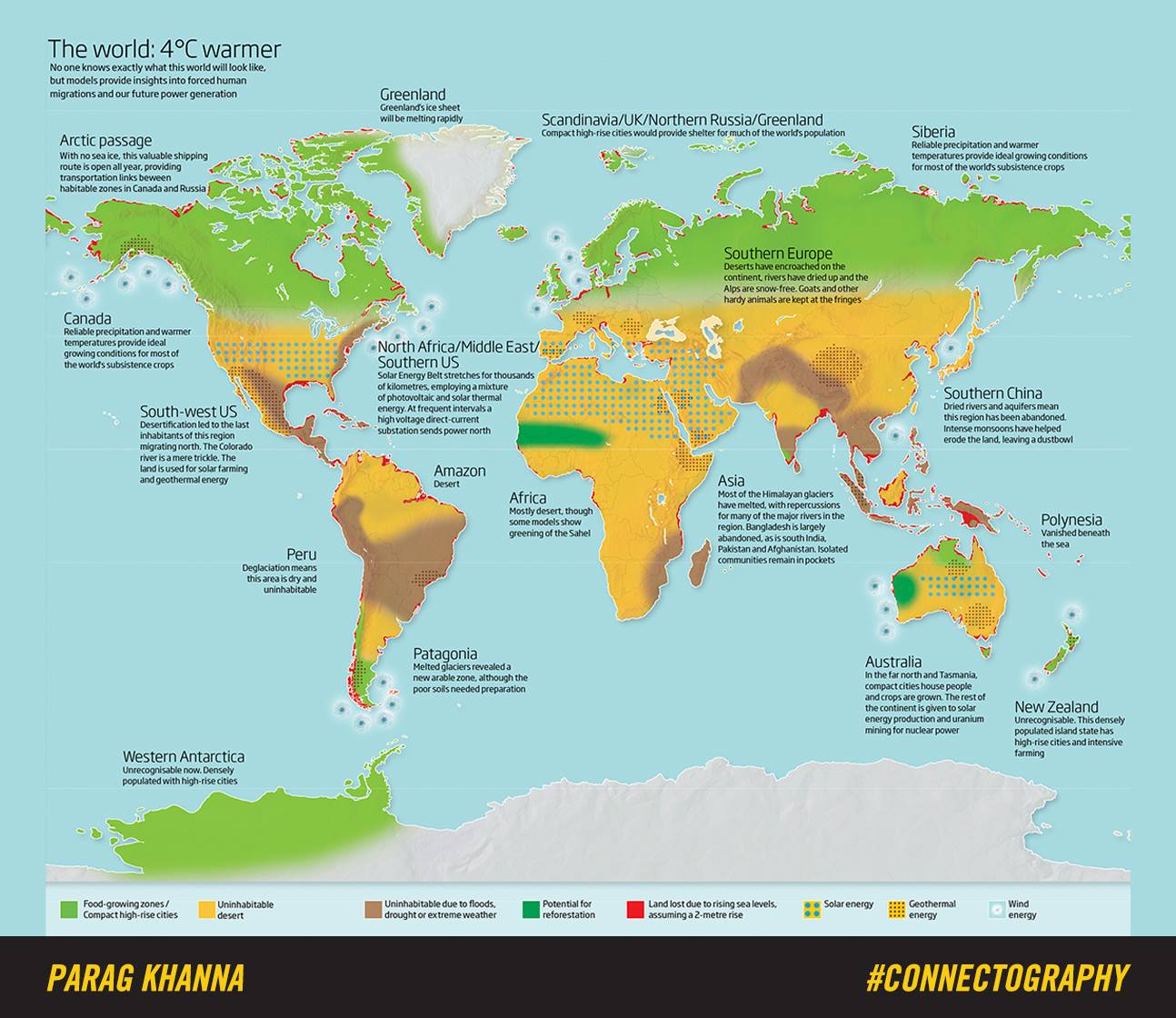
Humanity faces few larger questions than what, exactly, to do about climate change — and, in a sense larger still, what climate change even means. We’ve all heard a variety of different future scenarios laid out, each of them based on different data. But data can only make so much of an impact unless translated into a form with which the imagination can readily engage: a visual form, for instance, and few visual forms come more tried and true than the map.
And so “leading global strategist, world traveler, and best-selling author” Parag Khanna has created the map you see above (view in a larger format here), which shows us the state of our world when it gets just four degrees celsius warmer. “Micronesia is gone – sunk beneath the waves,” writes Big Think’s Frank Jacobs in an examination of Khanna’s map. “Pakistan and South India have been abandoned. And Europe is slowly turning into a desert.”
But “there is also good news: Western Antarctica is no longer icy and uninhabitable. Smart cities thrive in newly green and pleasant lands. And Northern Canada, Scandinavia, and Siberia produce bountiful harvests to feed the hundreds of millions of climate refugees who now call those regions home.”
Not quite as apocalyptic a climate-change vision as some, to be sure, but it still offers plenty of considerations to trouble us. Lands in light green, according to the map’s color scheme, will remain or turn into “food-growing zones” and “compact high-rise cities.” Yellow indicates “uninhabitable desert,” brown areas “uninhabitable due to floods, drought, or extreme weather.” In dark green appear lands with “potential for reforestation,” and in red those places that rising sea levels have rendered utterly lost.
Those last include the edges of many countries in Asia (and all of Polynesia), as well as the area where the southeast of the United States meets the northeast of Mexico and the north and south coasts of South America. But if you’ve ever wanted to live in Antarctica, you won’t have to move into a research base: within a couple of decades, according to Khanna’s data, that most mysterious continent could become unrecognizable and “densely populated with high-rise cities,” presumably with their own hipster quarters. But where best to grow the ingredients for its avocado toast?
Anyone interested in Parag Khanna’s map will want to check out his book, Connectography: Mapping the Future of Global Civilization.
via Big Think
Related Content:
Global Warming: A Free Course from UChicago Explains Climate Change
A Century of Global Warming Visualized in a 35 Second Video
132 Years of Global Warming Visualized in 26 Dramatically Animated Seconds
A Song of Our Warming Planet: Cellist Turns 130 Years of Climate Change Data into Music
Based in Seoul, Colin Marshall writes and broadcasts on cities and culture. His projects include the book The Stateless City: a Walk through 21st-Century Los Angeles and the video series The City in Cinema. Follow him on Twitter at @colinmarshall or on Facebook.
Read More...Werner’s Nomenclature of Colour, the 19th-Century “Color Dictionary” Used by Charles Darwin (1814)
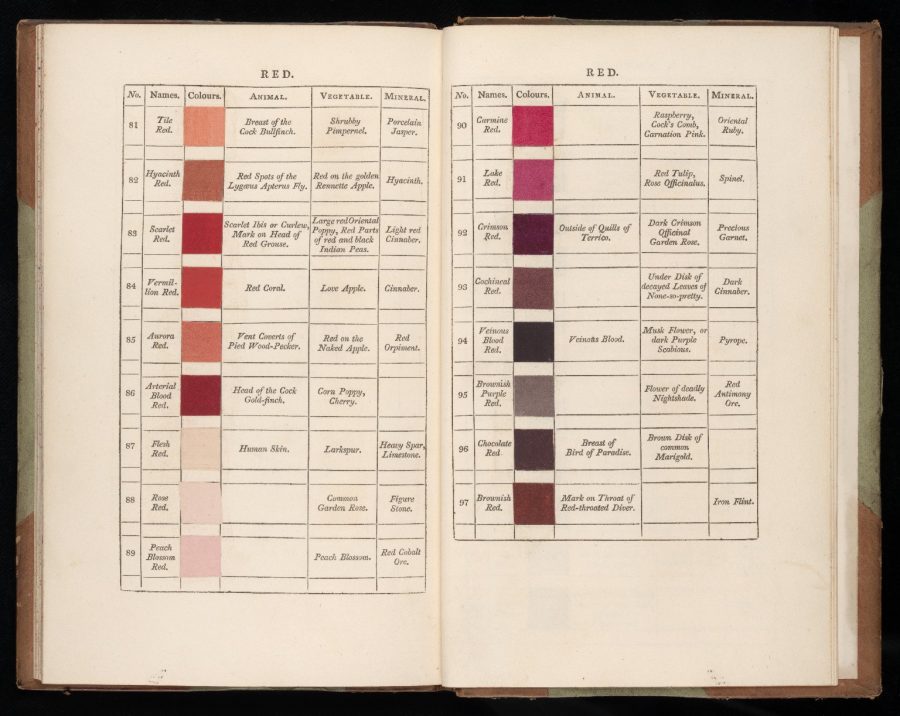
Before Pantone invented “a universal color language” or big box hardware stores arose with proprietary displays of colorfully-named paints—over a century before, in fact—a German mineralogist named Abraham Gottlob Werner invented a color system, as detailed and thorough a guide as an artist might need. But rather than only cater to the needs of painters, designers, and manufacturers, Werner’s Nomenclature of Colours also served the needs of scientists. “Charles Darwin even used the guide,” writes This is Colossal, “during his voyage to the Madeira, Canary, and Cape Verde islands on the H.M.S. Beagle.”
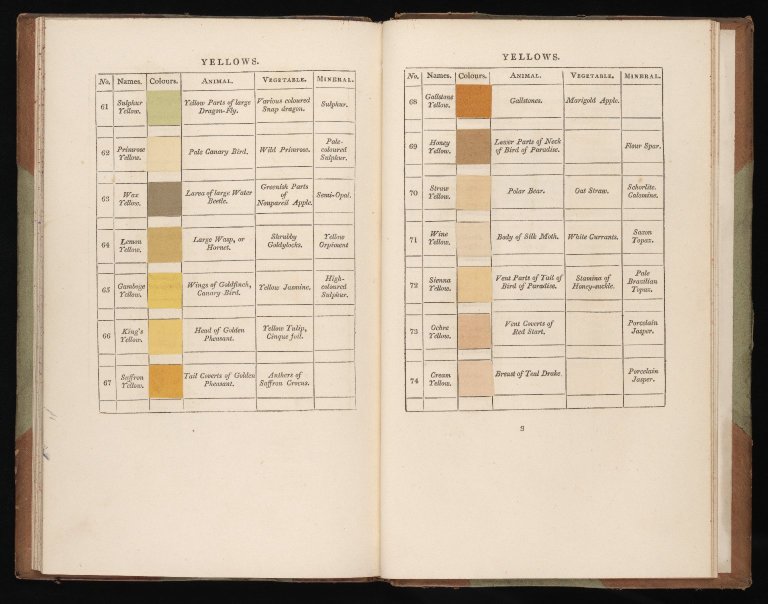
Werner’s is one of many such “color dictionaries” from the 19th century, “designed to give people around the world a common vocabulary,” writes Daniel Lewis at Smithsonian, “to describe the colors of everything from rocks and flowers to stars, birds, and postage stamps.” These guides appealed especially to naturalists.
Indeed, the book began—before Scottish painter Patrick Syme updated the system in English, with swatches of example colors—as a naturalist’s guide to the colors of the world, naming them according to Werner’s poetic fancy. “Without an image for reference,” the original text “provided immense handwritten detail describing where each specific shade could be found on an animal, plant, or mineral. Many of Werner’s unique color names still exist in common usage, though they’ve detached from his scheme ages ago.
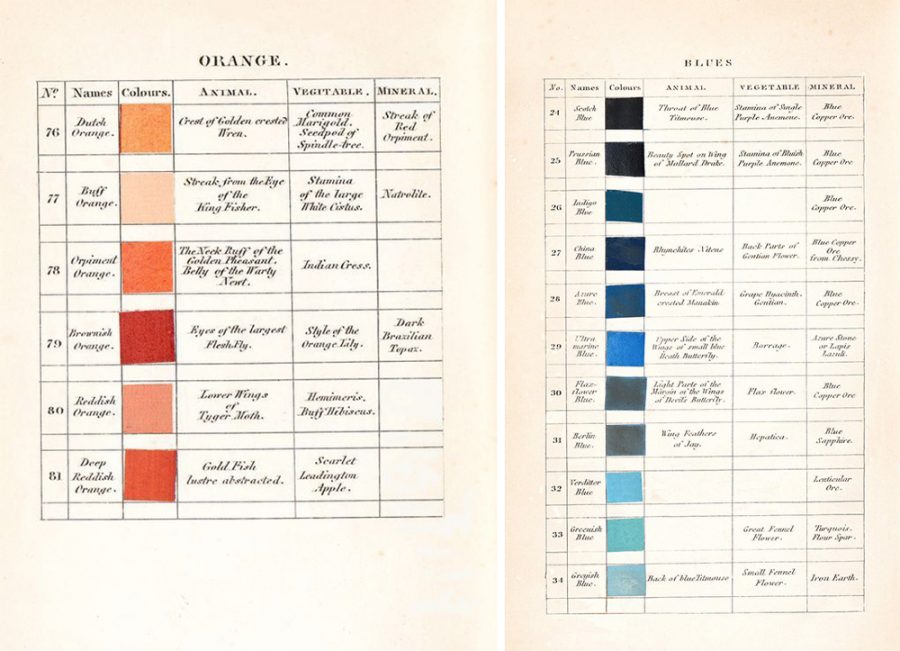
Prussian Blue, for instance, which can be located “in the beauty spot of a mallard’s wing, on the stamina of a bluish-purple anemone, or in a piece of blue copper ore.” Other examples, notes Fast Company’s Kelsey Campbell-Dollaghan, include “’Skimmed Milk White,’” or no. 7… found in ‘the white of the human eye’ or in opals,” and no. 67, or “’Wax Yellow’… found in the larvae of large Water Beetles or the greenish parts of a Nonpareil Apple.” It would have been Syme’s 1814 guide that Darwin consulted, as did scientists, naturalists, and artists for two centuries afterward, either as a taxonomic color reference or as an admirable historic artifact—a painstaking description of the colors of the world, or those encountered by two 18th and 19th century European observers, in an era before photographic reproduction created its own set of standards.
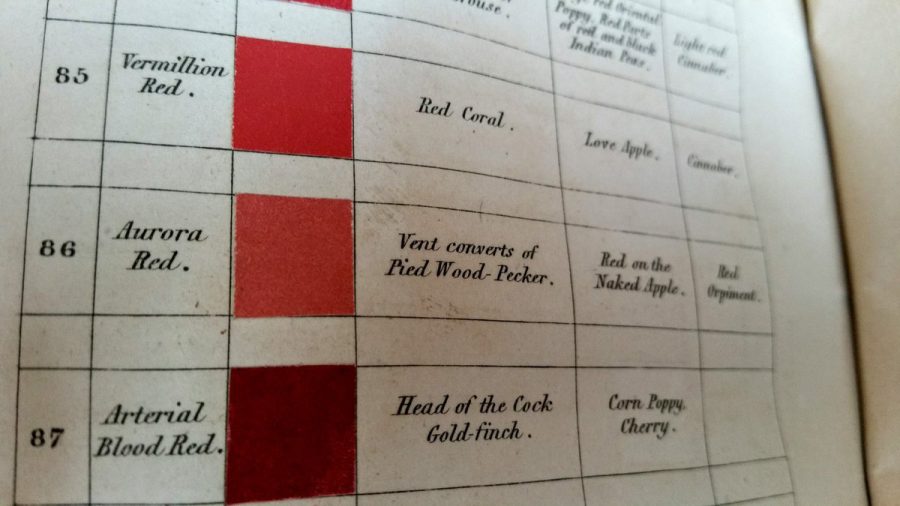
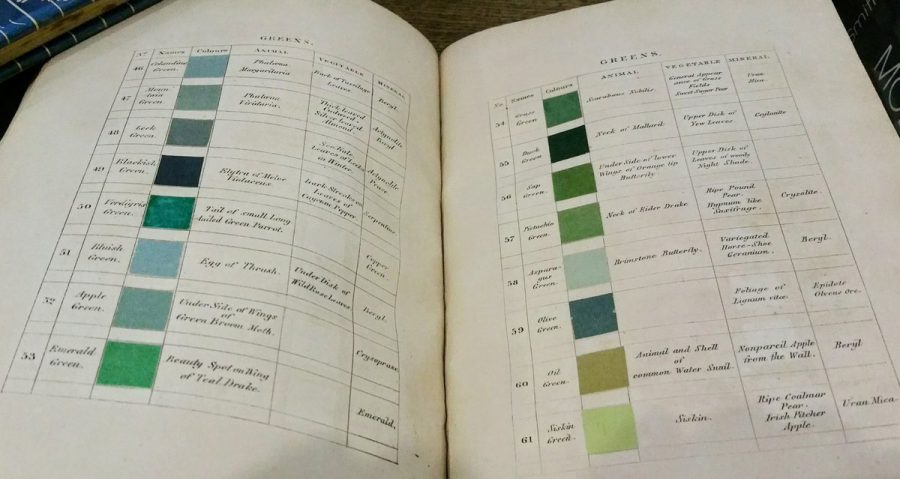
The book is now being republished in an affordable pocket-size edition by Smithsonian Books, who note that the Edinburgh flower painter Syme, in his illustrations of Werner’s nomenclature, “used the actual minerals described by Werner to create the color charts.” This degree of fidelity to the source extends to Syme’s use of tables to neatly organize Werner’s precise descriptions. Next to each color’s number, name, and swatch, are columns with its location on various animals, vegetables and minerals. “Orpiment Orange,” named after a mineral, though none is listed in its column, will be found, Werner tells us, on the “neck ruff of the golden pheasant” or “belly of the warty newt.” Should you have trouble tracking these down, surely you’ve got some “Indian cress” around?
While its references may not be those your typical industrial designer or graphic artist is likely to find helpful, Werner’s Nomenclature of Colours will still find a treasured place in the collections of designers and visual artists of all kinds, as well as historians, writers, poets, and the scientific inheritors of 19th century naturalism, as a “charming artifact from the golden age of natural history and global exploration.” Flip through a scanned version of the 1821 second edition just above, including Werner’s introduction and careful lists of color properties, or read it in a larger format at the Internet Archive. The new edition is now available for purchase here.
Related Content:
The Vibrant Color Wheels Designed by Goethe, Newton & Other Theorists of Color (1665–1810)
Josh Jones is a writer and musician based in Durham, NC. Follow him at @jdmagness
Read More...Photographer Puts Her Archive of Photos Documenting the 1970s New York Punk Scene on Instagram: Iggy Pop, Debbie Harry, Lydia Lunch, Tom Verlaine, and Even Jean Michel Basquiat
Just when you think the fabled downtown New York 70s punk scene centered around CBGBs has no more secrets to offer, another homegrown documentarian appears to show us photographs (on Instagram) we’ve never seen and tell some pretty nifty stories to go along with them. Julia Gorton came to New York from her native Delaware in 1976 and used a Polaroid camera to capture her firsthand encounters with legends like Debbie Harry, Patti Smith, David Byrne, Tom Verlaine, Iggy Pop, Richard Hell, and Teenage Jesus and the Jerks’ Lydia Lunch (below), “a natural for the glamorous black-and-white photos I liked to make,” she says, and a “a real partner” in Gorton’s enterprise and her most-photographed subject.
In Christina Cacouris’ interview with Gorton at Garage, we learn that the photographer “ended up meeting Tom’s mom [Television singer and guitarist Tom Verlaine] at the flea market in Wilmington [Delaware]. She was a proud mom who played her son’s single on a cassette player in the back of her station wagon while she sold things on a folding table.”
Exactly this kind of intimacy and family atmosphere pervades Gorton’s work in the punk clubs, downtown streets, and record stores. Like most of the performers onstage, Gorton was a relative amateur, learning her craft alongside the musicians and artists she photographed. “You didn’t need to be perfect before you started,” she says.
Although she found her lack of technical ability frustrating, in hindsight, Gorton says, “images that I perceived at the time as failures actually represent the true character of the time period more honestly and powerfully than the images I thought were ‘successful.’” In many cases, however, it has taken 21st century digital technology to unearth some of her most revealing shots.
The cost of film prohibited her from taking multiple exposures, and the darkness of CBGBs left many prints too murky. Using Photoshop, Gorton has been able to revisit many of these seemingly failed attempts, like the moody portrait above of Tom Verlaine. “I was able to scan and finally pull him out of the shadows of decades past,” she muses.
Along with the glamour of her portraits, Gorton’s candid shots of the period capture downtown legends in rare moments and poses. (Check out John Cale above at CBGBs, for example, or Jean Michel Basquiat, then known as SAMO, dancing on the right, below.) Shot while she was a student at the Parsons School of Design, Gorton’s photos of the punk, New Wave, and No Wave scene were the beginning of her long career as a photographer, illustrator, and graphic designer.
On her Instagram feed, 70s and 80s images mix in with her current projects, and the juxtaposition of contemporary musicians and artists with their counterparts from 40 years ago gives a sense of the long continuity reflected in Gorton’s engagement with street art and underground rock culture. Explore her photo collection here.
Related Content:
Watch an Episode of TV-CBGB, the First Rock ‘n’ Roll Sitcom Ever Aired on Cable TV (1981)
Take a Virtual Tour of CBGB, the Early Home of Punk and New Wave
Josh Jones is a writer and musician based in Durham, NC. Follow him at @jdmagness
Read More...Artificial Intelligence May Have Cracked the Code of the Voynich Manuscript: Has Modern Technology Finally Solved a Medieval Mystery?
What is it about the Voynich Manuscript—that cryptic, illustrated 15th century text of unknown origin and meaning—that has so fascinated and obsessed scholars for centuries? Written in what appears to be an invented language, with bizarre illustrations of otherworldly botany, mysterious cosmology, and strange anatomy, the book resembles other proto-scientific texts of the time, except for the fact that it is totally indecipherable, “a certain riddle of the Sphinx,” as one alchemist described it. The 240-page enigma inspires attempt after attempt by cryptologists, linguists, and historians eager to understand its secrets—that is if it doesn’t turn out to be a too-clever Medieval joke.
One recent try, by Nicholas Gibbs, has perhaps not lived up to the hype. Another recent attempt by Stephen Bax, who wrote the short TED Ed lesson above, has also come in for its share of criticism. Given the investment of scholars since the 17th century in cracking the Voynich code, both of these efforts might justifiably be called quite optimistic. The Voynich may forever elude human understanding, though it was, presumably, created by human hands. Perhaps it will take a machine to finally solve the puzzle, an artificial brain that can process more data than the combined efforts of every scholar who has ever applied their talents to the text. Computer scientists at the University of Alberta think so and claim to have cracked the Voynich code with artificial intelligence (AI).
Computer science professor Greg Kondrak and graduate student Bradley Hauer began their project by feeding a computer program 400 different languages, taken from the “Universal Declaration of Human Rights.” While “they initially hypothesized that the Voynich manuscript was written in [ancient] Arabic,” reports Jennifer Pascoe, “it turned out that the most likely language was [ancient] Hebrew.” (Previous guesses, the CBC notes, “have ranged from a type of Latin to a derivation of Sino-Tibetan.”) The next step involved deciphering the manuscript’s code. Kondrak and Hauer discovered that “the letters in each word… had been reordered. Vowels had been dropped.” The theory seemed promising, but the pair were unable to find any Hebrew scholars who would look at their findings.
Without human expertise to guide them, they turned to another AI, whose results, we know, can be notoriously unreliable. Nonetheless, feeding the first sentence into Google translate yielded the following: “She made recommendations to the priest, man of the house and me and people.” It’s at least grammatical, though Kondrak admits “it’s a kind of strange sentence to start a manuscript.” Other analyses of the first section have turned up several other words, such as “farmer,” “light,” “air,” and “fire”—indeed the scientists have found 80 percent of the manuscript’s words in ancient Hebrew dictionaries. Figuring out how they fit together in a comprehensible syntax has proven much more difficult. Kondrak and Hauer admit these results are tentative, and may be wrong. Without corroboration from Hebrew experts, they are also unlikely to be taken very seriously by the scholarly community.
But the primary goal was not to translate the Voynich but to use it as a means of creating algorithms that could decipher ancient languages. “Importantly,” notes Gizmodo, “the researchers aren’t saying they’ve deciphered the entire Voynich manuscript,” far from it. But they might have discovered the keys that others may use to do so. Or they may—as have so many others—have been led down another blind alley, as one commenter at IFL Science suggests, sarcastically quoting the wise Bullwinkle Moose: “This time for sure!”
You can find the Voynich Manuscript scanned at Yale’s Beinecke Rare Book & Manuscript Library. Copies can be purchased in book format as well.
Related Content:
1,000-Year-Old Illustrated Guide to the Medicinal Use of Plants Now Digitized & Put Online
Josh Jones is a writer and musician based in Durham, NC. Follow him at @jdmagness
Read More...A YouTube Channel Completely Devoted to Medieval Sacred Music: Hear Gregorian Chant, Byzantine Chant & More
The artists of medieval Europe, at least according to the impression we get in history class, gave far less consideration to the world around them than the world above. Historians argue about how much that general attitude hindered the improvement of the human lot during those ten centuries or so, but even we denizens of the 21st century can feel that the imaginations of the Middle Ages did tap into something resonant — and in the domain of music quite literally resonant, since the sacred songs of that time still create a properly otherworldly sonic atmosphere when they echo through cathedrals.
If you don’t happen to live near a cathedral, you can experience something of that atmosphere through your headphones anywhere you happen to be with Callixtus, a channel on the not normally sacred space of Youtube. “Perhaps named in honor of either Pope Callistus or Xanothopoulos Callistus, Patriarch of Constantinople,” writes Catholic web site Aleteia’s Daniel Esparza, it offers “an impressive collection of sacred music, mostly medieval, including choral works belonging to both Western Christianity and the Eastern tradition.”
Callixtus’ playlist includes such enduring “hits” of these traditions as the Gregorian chant “Invitatorium: Deum Verum,” the Byzantine chant “Δεύτε λαοί” (“Come Ye Peoples”), and the multi-part Medieval Chant of the Templars.
How did this still-haunting style of music come about? According to former Talking Heads frontman David Byrne, who laid out these ideas in a popular TED Talk, it evolved alongside the houses of worship themselves, the architecture shaping the music and the music shaping the architecture: “In a gothic cathedral, this kind of music is perfect,” says Byrne. “It doesn’t change key, the notes are long, there’s almost no rhythm whatsoever, and the room flatters the music. It actually improves it.” So familiarize yourself with all this sacred music through Callixtus, but as soon as you get the chance, hie thee to a gothic cathedral: no matter your religious sensibilities, it will certainly enrich your aesthetic ones.
via Aleteia and @dark_shark
Related Content:
David Byrne: How Architecture Helped Music Evolve
Hear What Homer’s Odyssey Sounded Like When Sung in the Original Ancient Greek
What Ancient Greek Music Sounded Like: Hear a Reconstruction That is ‘100% Accurate’
Listen to the Oldest Song in the World: A Sumerian Hymn Written 3,400 Years Ago
Based in Seoul, Colin Marshall writes and broadcasts on cities and culture. His projects include the book The Stateless City: a Walk through 21st-Century Los Angeles and the video series The City in Cinema. Follow him on Twitter at @colinmarshall or on Facebook.
Read More...The 10 Most Popular Courses on Coursera in 2017 (and 2,000 Courses You Can Take for Free in January, 2018)
Back in 2012, Coursera started offering MOOCS (Massive Open Online Courses) to the world at large. And they’ve since amassed some 28 million registered users, a catalogue of 2,000 courses, and reams of data about what people want to learn. In the waning days of December, Coursera published a list of their 1o most popular courses of 2017. (Find below, and enroll in any of these courses for free.) From this list, it drew some larger conclusions about trends in education and technology.
The list shows, writes Nikhil Sinha, Coursera’s Chief Content Officer, that “cutting-edge tech skills continue to be the most sought after in online education.” Artificial intelligence–encompassing Machine Learning, Neural Networks and Deep Learning–topped the list of courses. Meanwhile “Blockchain has also burst onto the scene, putting Princeton’s Bitcoin and Cryptocurrency course at number five on the list.” But, Sinha adds, it’s “not just technology skills that are trending.” The “basic learning and information-retention skills taught in our popular Learning How to Learn course are extremely sought-after by people of all ages.” The same applies to the problem-solving skills taught by Stanford’s Introduction to Mathematical Thinking.
You can review the Top 10 list below, and enroll in any of those regularly-offered courses.
- Machine Learning: A primer from Stanford University on getting computers to act without being explicitly programmed.
- Neural Networks and Deep Learning: Building on the course above, this course will teach you to feed a computer system a lot of data, which it can then use to make decisions about other data.
- Learning How to Learn: Powerful Mental Tools to Help You Master Tough Subjects: The most popular MOOC ever, this course developed by Dr. Barbara Oakley gives you access to the invaluable learning techniques used by experts in art, music, literature, math, science, sports, and many other disciplines.
- Introduction to Mathematical Thinking: Stanford University will teach you a style of thinking that will help you think outside the box and solve real problems in the everyday world.
- Bitcoin and Cryptocurrency Technologies: From Princeton University comes a course that explains what is special about Bitcoin, and how it works at a technical level.
- Programming for Everybody (Getting Started with Python): The University of Michigan offers a course everyone should take–a primer on the basics of programming computers, using Python.
- Algorithms, Part I: Princeton’s course covers “essential information that every serious programmer needs to know about algorithms and data structures, with emphasis on applications and scientific performance analysis of Java implementations.”
- English for Career Development: Created by the University of Pennsylvania, this course is for non-native English speakers “interested in advancing their careers in the global marketplace.” Along the way, you’ll learn about the job search, application, and interview process in the U.S., and also explore your own global career path.
- Neural Networks for Machine Learning: The University of Toronto gives you the chance to “learn about artificial neural networks and how they’re being used for machine learning, as applied to speech and object recognition, image segmentation, modeling language and human motion, etc.”
- Financial Markets: Created by Yale’s Robert Shiller (winner of the Nobel Prize in Economics), this course offers an overview of the financial markets, which allow human society to manage risks and foster enterprise. It includes an introduction to risk management and behavioral finance principles underlying the securities, insurance, and banking industries.
Note: Open Culture has a partnership with Coursera. If readers enroll in certain Coursera courses, it helps support Open Culture.
Related Content:
Learning How to Learn: The Most Popular MOOC of All Time
Read More...Hear the Christmas Carols Made by Alan Turing’s Computer: Cutting-Edge Versions of “Jingle Bells” and “Good King Wenceslas” (1951)

This Christmas, as our computers fast learn to compose music by themselves, we might gain some perspective by casting our minds back to 66 Christmases ago, a time when a computer’s rendition of anything resembling music at all had thousands and thousands listening in wonder. In December of 1951, the BBC’s holiday broadcast, in most respects a naturally traditional affair, included the sound of the future: a couple of much-loved Christmas carols performed not by a choir, nor by human beings of any kind, but by an electronic machine the likes of which almost nobody had even laid eyes upon.
“Among its Christmas fare the BBC broadcast two melodies that, although instantly recognizable, sounded like nothing else on earth,” write Jack Copeland and Jason Long at the British Library’s Sound and Vision Blog. “They were Jingle Bells and Good King Wenceslas, played by the mammoth Ferranti Mark I computer that stood in Alan Turing’s Computing Machine Laboratory” at the Victoria University of Manchester. Turing, whom we now recognize for a variety of achievements in computing, cryptography, and related fields (including cracking the German “Enigma code” during the Second World War), had joined the university in 1948.
That same year, with his former undergraduate colleague D. G. Champernowne, Turing began writing a purely theoretical computer chess program. No computer existed on which he could possibly try running it for the next few years until the Ferranti Mark 1 came along, and even that mammoth proved too slow. But it could, using a function designed to give auditory feedback to its operators, play music — of a kind, anyway. The computer company’s “marketing supremo,” according to Copeland and Long, called its brief Christmas concert “the most expensive and most elaborate method of playing a tune that has ever been devised.”
Since no recording of the broadcast survives, what you hear here is a painstaking reconstruction made from tapes of the computer’s even earlier renditions of “God Save the King,” “Baa Baa Black Sheep,” and “In the Mood.” By manually chopping up the audio, write Copeland and Long, “we created a palette of notes of various pitches and durations. These could then be rearranged to form new melodies. It was musical Lego.” But do “beware of occasional dud notes. Because the computer chugged along at a sedate 4 kilohertz or so, hitting the right frequency was not always possible.” Even so, somewhere in there I hear the historical and technological seeds of the much more elaborate electronic Christmas to come, from Mannheim Steamroller to the Jingle Cats and well beyond.
Related Content:
Hear Paul McCartney’s Experimental Christmas Mixtape: A Rare & Forgotten Recording from 1965
The Enigma Machine: How Alan Turing Helped Break the Unbreakable Nazi Code
Based in Seoul, Colin Marshall writes and broadcasts on cities and culture. His projects include the book The Stateless City: a Walk through 21st-Century Los Angeles and the video series The City in Cinema. Follow him on Twitter at @colinmarshall or on Facebook.
Read More...Support Us
We're hoping to rely on loyal readers, rather than erratic ads. Please click the Donate button and support Open Culture. You can use Paypal, Venmo, Patreon, even Crypto! We thank you!

About Us

Open Culture scours the web for the best educational media. We find the free courses and audio books you need, the language lessons & educational videos you want, and plenty of enlightenment in between.
Advertise With Us
FREE UPDATES!
GET OUR DAILY EMAIL
Get the best cultural and educational resources on the web curated for you in a daily email. We never spam. Unsubscribe at any time.
FOLLOW ON SOCIAL MEDIA
Open Culture editor Dan Colman scours the web for the best educational media. He finds the free courses and audio books you need, the language lessons & movies you want, and plenty of enlightenment in between.
Advertise With Us


