Eudora Welty’s Handwritten Eggnog Recipe, and Charles Dickens’ Recipe for Holiday Punch
’Tis the season to break out the family recipes of beloved relatives, though often their provenance is not quite what we think.
(Imagine the cognitive dissonance upon discovering that Mother swiped “her” Italian Zucchini Crescent Pie from Pillsbury Bake-Off winner, Millicent Nathan of Boca Raton, Florida…)
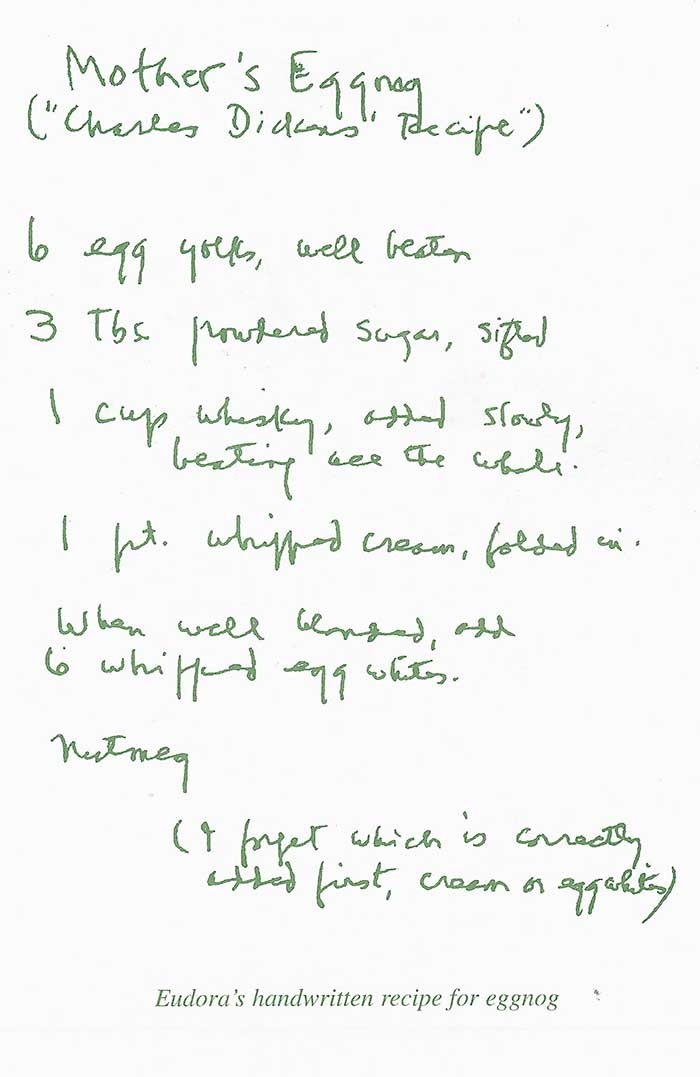
When it came to crediting the eggnog she dubbed “the taste of Christmas Day,” above, Pulitzer Prize-winning author Eudora Welty shared it out equally between her mother and author Charles Dickens:
In our house while I was growing up, I don’t remember that hard liquor was served at all except on one day in the year. Early on Christmas morning, we woke up to the sound of the eggbeater: Mother in the kitchen was whipping up eggnog. All in our bathrobes, we began our Christmas before breakfast. Throughout the day Mother made batches afresh. All our callers expected her eggnog.
It was ladled from the punch bowl into punch cups and silver goblets, and had to be eaten with a spoon. It stood up in peaks. It was rich, creamy and strong. Mother gave full credit for the recipe to Charles Dickens.
Nice, but perhaps Dickens is undeserving of this honor? The contents of his punchbowl bore little resemblance to Mother Welty’s, as evidenced by an 1847 letter to his childhood friend, Amelia Filloneau, in which he shared a recipe he promised would make her “a beautiful Punchmaker in more senses than one”:
Peel into a very strong common basin (which may be broken, in case of accident, without damage to the owner’s peace or pocket) the rinds of three lemons, cut very thin, and with as little as possible of the white coating between the peel and the fruit, attached. Add a double-handfull of lump sugar (good measure), a pint of good old rum, and a large wine-glass full of brandy — if it not be a large claret-glass, say two. Set this on fire, by filling a warm silver spoon with the spirit, lighting the contents at a wax taper, and pouring them gently in. Let it burn for three or four minutes at least, stirring it from time to Time. Then extinguish it by covering the basin with a tray, which will immediately put out the flame. Then squeeze in the juice of the three lemons, and add a quart of boiling water. Stir the whole well, cover it up for five minutes, and stir again.
This sounds very like the “seething bowls of punch” the jolly Ghost of Christmas Present shows Ebenezer Scrooge in A Christmas Carol, dimming the chamber with their delicious steam.
It’s also vegan, in contrast to what you might have been served in the Welty ladies’ home.
Why not serve both? In the words of Tiny Tim, “Here’s to us all!”
Eudora Welty’s Mother’s Eggnog (Attributed, Perhaps Erroneously, to Charles Dickens)
6 egg yolks, well beaten
Add 3 tbsp. powdered sugar
Add 1 cup whiskey, added slowly, beating all the while
Fold in 1 pint whipped cream
Whip 6 whipped egg whites and add to the mixture above.
Charles Dickens’ Holiday Punch (adapted from Punch by David Wondrich)
3/4 cup sugar
3 lemons
2 cups rum
1 1/4 cups cognac
5 cups black tea (or hot water)
Garnish: lemon and orange wheels, freshly grated nutmeg
In the basin of an enameled cast-iron pot or heatproof bowl, add sugar and the peels of three lemons.
Rub lemons and sugar together to release citrus oils. For more greater infusion, let sit for 30 minutes.
Add rum and cognac to the sugar and citrus.
Light a match, and, using a heatproof spoon (stainless steel is best), pick up a spoonful of the spirit mix.
Carefully bring the match to the spoon to light.
Carefully bring the lit spoon to the spirits in the bowl.
Let the spirits burn for about three minutes. The fire will melt the sugar and extract the oil from the lemon peels.
Extinguish the bowl by covering it with a heatproof pan or tray.
Skim off the lemon peels (leaving them too long in may impart a bitter flavor).
Squeeze in the juice of the three peeled lemons, and add hot tea or water.
If serving the punch hot, skip to the next step. If serving cold, cool punch in the refrigerator and, when cooled, add ice.
Garnish with citrus wheels and grated nutmeg.
Ladle into individual glasses.
Learn more about these and other festive holiday drinks in Master of Wine Elizabeth Gabay’s essay “Celebrating Christmas and New Year With Punch.”
Image above via Garden and Gun
Related Content:
Charles Mingus’ “Top Secret” Eggnog Recipe Contains “Enough Alcohol to Put Down an Elephant”
Blue Christmas: Feed Your Seasonal Depression with Holiday Masterpieces
Ayun Halliday is an author, illustrator, theater maker and Chief Primatologist of the East Village Inky zine. Follow her @AyunHalliday.
Read More...Salvador Dali’s 1978 Wine Guide, The Wines of Gala, Gets Reissued: Sensual Viticulture Meets Surreal Art
Popular food culture is dominated by status symbols of restaurant-inspired consumer kitchenware and appliances, thanks in large part to reality televisions shows about cooking competitions which can make the preparation of haute cuisine seem more accessible to the average home chef than it may actually be.
Many would argue, however, that we’ve come a long way since the 70s, when the mass-market products that held sway over best-selling cooking guides went by names like Hamburger Helper, Cool Whip, and Jello. Back then, willful anachronism Salvador Dali stepped into this commercial landscape with his 1973 cookbook Les Diners de Gala, offering aristocratic, extravagant recipes—next to even more extravagant art—with exotic ingredients often impossible to find at the local supermarket both then and now.
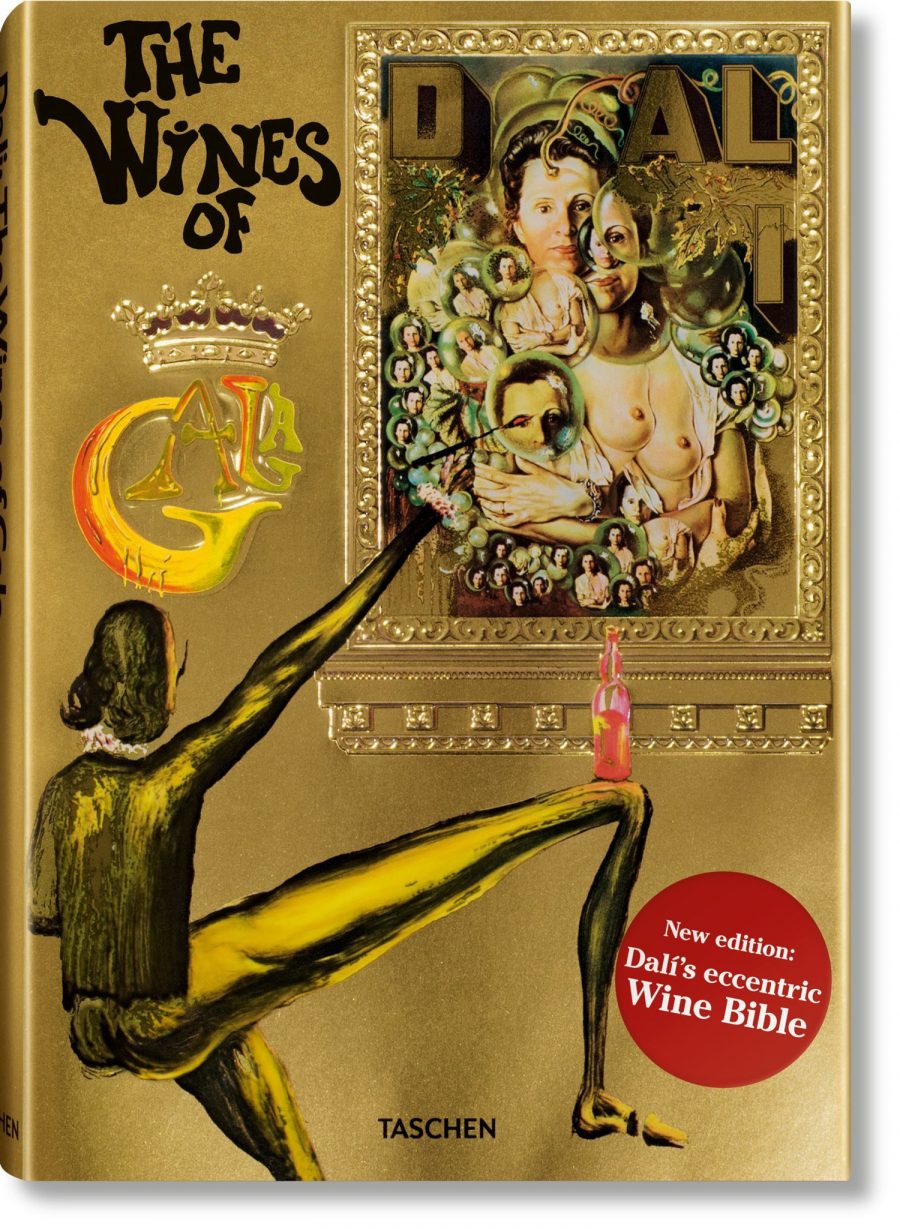
Dali made it plain that his object was to bring back pure pleasure to dining, the adventurous opulence he and his wife, Gala, so appreciated in their own outsized social lives. A few years later, Dali did the same thing with the fine-dining beverage of choice, publishing The Wines of Gala, an “eccentric guide to wine grapes and their origin,” writes This is Colossal. The book’s “groupings are appropriate imaginative classifications.”
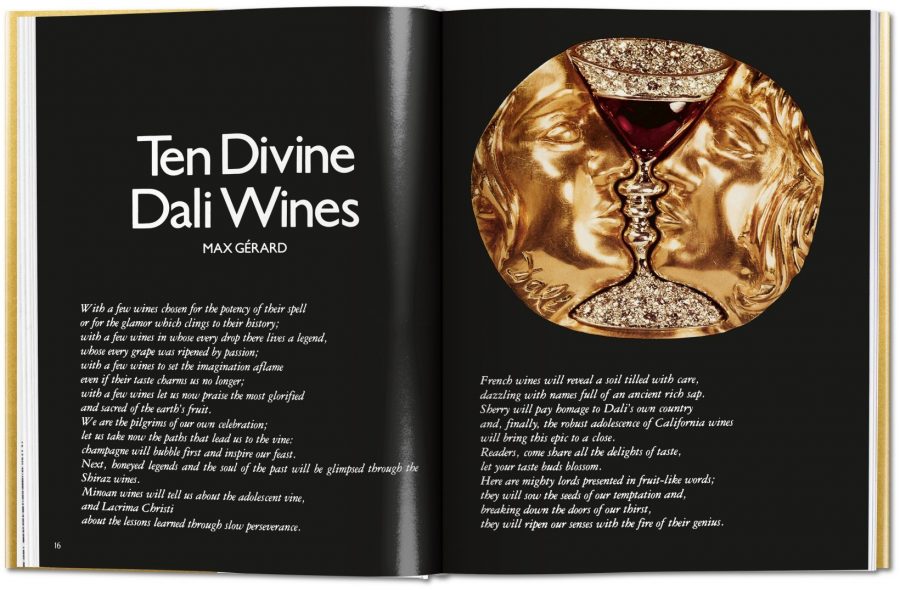
The Wines of Gala splits into two parts: “Ten Divine Dali Wines” and “Ten Gala Wines.” The latter includes categories like “Wines of Frivolity,” “Wines of Joy,” “Wines of Sensuality,” “Wines of Purpose,” and “Wines of Aestheticism.” Among the Divine Dali Wines, we find “The Wine of King Minos,” “Lacrima Christi,” “Chateauneuf-du-Pape,” and “Sherry.” In an appendix, Dali surveys “Vineyards of the World,” generally, and “Vineyards of France,” specifically, and offers “Advice to the Wine-Loving Gourmet.”
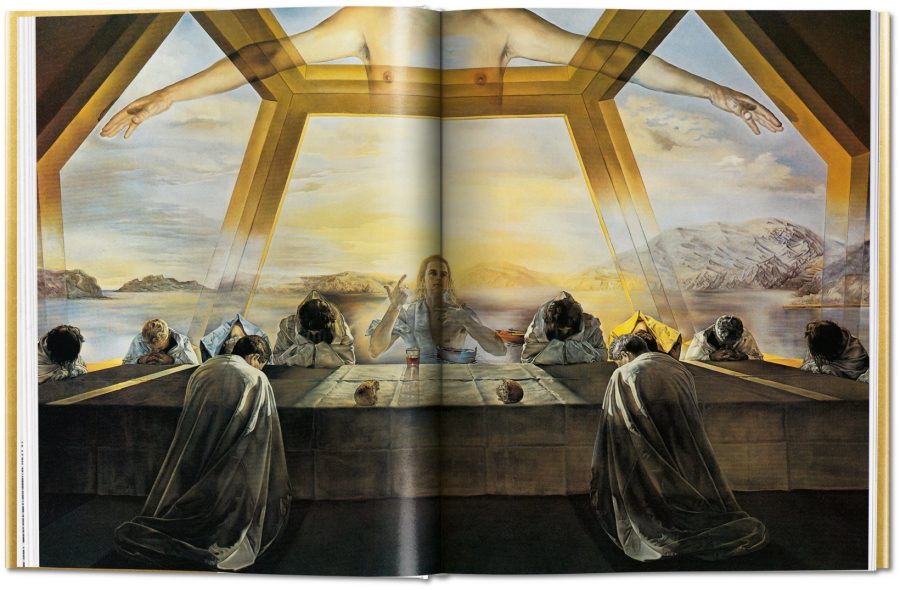
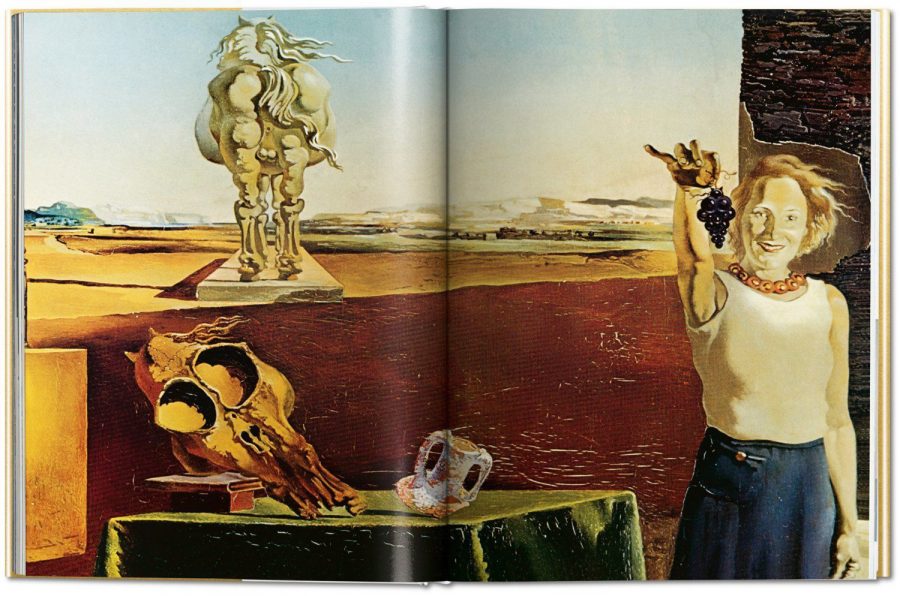
While some of Dali’s wine advice may go over our heads, maybe the real reason we’re drawn to his cookbook and wine guide is the artwork they contain within their pages, likely also the principle reason arts publisher Taschen has reissued both of these publications. The Wines of Gala is due out on November 21, but you can pre-order a hard copy now (or find used copies of the original 1970s edition here). In it you’ll find much bewitching original art to complement the passionate descriptions of wine.
The “rich and extravagant wine bible features 140 illustrations by Dali,” notes Rebecca Fulleylove. “Many of the artworks featured are appropriated pieces, including… a work from Dali’s late Nuclear Mystic phase, The Sacrament of the Last Supper.” Even to this solemn affair, Dali brings “his ability to seek out pleasure and beauty in everything.”
via This is Colossal/It’s Nice That
Related Content:
Salvador Dalí’s 1973 Cookbook Gets Reissued: Surrealist Art Meets Haute Cuisine
Salvador Dalí Goes Commercial: Three Strange Television Ads
Salvador Dalí’s Melting Clocks Painted on a Latte
Josh Jones is a writer and musician based in Durham, NC. Follow him at @jdmagness
Read More...The Power of Introverts: Author Susan Cain Explains Why We Need to Appreciate the Talents & Abilities of the Quiet Ones
Ours is a loud culture of nonstop personal sharing, endless chatter, and 24-hour news, opinion, and entertainment. Even those people who prefer reading alone to the overstimulating carnival of social media feel pressured to participate. How else can you keep up with your family—whose Facebook posts you’d rather see die than have to read? How else to build a profile for employers—whom you desperately hope won’t check your Twitter feed?
For the introvert, maintaining an always-on façade can be profoundly enervating—and the problem goes far beyond the personal, argues author Susan Cain, reaching into every area of our lives.
“If you take a group of people and put them into a meeting,” says Cain in the short RSA video above, “the opinions of the loudest person, or the most charismatic person, or the most assertive person—those are the opinions that the group tends to follow.” This despite the fact that research shows “zero correlation” between being the loudest voice in the room and having the best ideas. Don’t we know this all too well.
Cain is the author of Quiet: The Power of Introverts in a World That Can’t Stop Talking, a book about leadership for introverts, the group least likely to want the social demands leadership requires. And yet, she argues, we nonetheless need introverts as leaders. “We’re living in a society now that is so overly extroverted,” she says. Cain identifies the phenomenon as a symptom of corporate capitalism overcoming predominantly agricultural ways of life. Aside from the significant question of whether we can change the culture without changing the economy, Cain makes a timely and compelling argument for a society that values different personality types equally.
But can there be a “world where it’s yin and yang” between introverts and extroverts? That depends, perhaps on how much credence we lend these well-worn Jungian categories, or whether we think of them as existing in binary opposition rather than on a spectrum, a circle, a hexagram, or whatever. Cain is not a psychologist but a former corporate lawyer who at least seems to believe the balancing act between extroverted and introverted can be achieved in the corporate world. She has given talks on “Networking for Introverts,” addressed the engineers at Google, and taken to the TED stage, the thought leader arena that accommodates all kinds of personalities, for better or worse.
Cain’s TED talk above may be one of the better ones. Opening with a moving and funny personal narrative, she walks us through the barrage of messages introverts receive condemning their desire for quietude as somehow perverse and selfish. Naturally solitary people are taught to think of their introversion as “a second-class personality trait,” Cain writes in her book, “somewhere between a disappointment and a pathology.” Introverts must swim against the tide to be themselves. “Our most important institutions,” she says above, “our schools and our workplaces, they are designed mostly for extroverts, and for extroverts’ need for stimulation.”
The bias is deep, reaching into the classrooms of young children, who are now forced to do most of their work by committee. But when introverts give in to the social pressure that forces them into awkward extroverted roles, the loss affects everyone. “At the risk of sounding grandiose,” Cain says, “when it comes to creativity and to leadership, we need introverts doing what they do best.” Paradoxically, that can look like introverts taking the helm, but out of a genuine sense of duty rather than a desire for the spotlight.
Introverted leaders are more likely to share power and give others space to express ideas, Cain argues. Gandhi, Eleanor Roosevelt, and Rosa Parks exemplify such introverted leadership, and a quieter, more balanced and thoughtful culture would produce more leaders like them. Maybe this is a proposition anyone can endorse, whether they prefer Friday nights with hot tea and a novel or in the crush and bustle of the crowds.
Related Content:
Carl Jung Explains His Groundbreaking Theories About Psychology in a Rare Interview (1957)
The Neuroscience & Psychology of Procrastination, and How to Overcome It
Daily Meditation Boosts & Revitalizes the Brain and Reduces Stress, Harvard Study Finds
Josh Jones is a writer and musician based in Durham, NC. Follow him at @jdmagness
Read More...The Hummingbird Whisperer: Meet the UCLA Scientist Who Has Befriended 200 Hummingbirds
Common wisdom, and indelible memories of The Birds, warn that feeding seagulls, pigeons and other creatures who travel in flocks is a can of worms best left unopened.
But what about hummingbirds?
Melanie Barboni is research geochemist in UCLA’s Department of Earth, Planetary and Space Sciences. Near the UCLA Court of Sciences she took a break from volcanos and the moon long enough to hang a feeder filled with sugar water outside her ground floor office window.
This complimentary buffet proved such a hit, she hung up more.
Two years later, Barboni is serving a colony of over 200 hummingbirds from four 80-ounce feeders. Their metabolism requires them to consume 8 to 10 times their body weight on a daily basis.
Barboni’s service to her tiny jewel-toned friends extends well beyond the feeders. She’s diverted campus tree trimmers from interfering with them during nesting season, and given public talks on the habitat-destroying effects of climate change. She’s collaborating with another professor and UCLA’s Chief Sustainability Officer Nurit Katz to establish a special garden on campus for hummingbirds and their fellow pollinators.
The intimacy of this relationship is something she’s dreamed of since her birdwatching childhood in Switzerland where the only hummingbirds available for her viewing were the ones in books. Her dream came true when a fellowship took her from Princeton to Los Angeles, where hummingbirds live year-round.
Some longtime favorites now perch on their benefactor’s hand while feeding, or even permit themselves to be held and stroked. A few like to hang out inside the office, where the warm glow of Barboni’s computer monitor is a comforting presence on inclement days.
She’s bestowed names on at least 50: Squeak, Stardust, Tiny, Shy…
(Show of hands from those who wish she’d named them all after noted geologists: Mary Anning, Eugene Merle Shoemaker, Cecilia Helena Payne-Gaposchkin…)
Get to know the UCLA hummingbirds better through Melanie Barboni’s up-close-and-personal documentary photos. Learn more about the species itself through the National Geographic documentary below.
Related Content:
Free Entertainment for Cats and Dogs: Videos of Birds, Squirrels & Other Thrills
Ayun Halliday is an author, illustrator, theater maker and Chief Primatologist of the East Village Inky zine. Follow her @AyunHalliday.
Read More...Watch Brian Eno’s Experimental Film “The Ship,” Made with Artificial Intelligence
“How is Brian Eno still finding uncharted waters after half a century spent making music?” asked The Verge’s Jamieson Cox after the release of Eno’s 25th album, The Ship. Calling it a “dark near-masterpiece,” The Onion’s A.V. Club expressed similar astonishment. The album “can hold its own among the very best in a career full of brilliant work…. Forty-one years after Another Green World, Eno is still foraging for new musical ground, and what he’s able to come up with is nothing short of miraculous. When listening to The Ship, we get the sense that he will never stop.”
Should you think that an exaggeration, note that since The Ship, Eno has already released yet another critically acclaimed ambient album, Reflection—like its predecessor, a somber soundtrack for somber times. And like another endlessly productive multimedia artist of his generation, Laurie Anderson, Eno hasn’t only continued to make work that feels deeply connected to the moment, but he has adapted to wave after wave of technological innovation, this time around, harnessing artificial intelligence to create a “generative film” drawn from The Ship’s title track (below).
You can see a trailer for the film at the top of the post, but this hardly does the experience justice, since each viewer’s—or user’s—experience of it will be different. As Pitchfork describes the project: “On a website, ‘The Ship’ plays, and the user can click on tweets of news stories, which appear alongside historical photos.” The film utilizes “a bespoke artificial intelligence programme,” the site explains, “developed by the Dentsu Lab Tokyo,” exploring “various historical photographic images and real-time news feeds to compose a collective photographic memory of humankind.” (Dentsu received a prestigious prize nomination from the European Commission for their work.)
It’s a conceptually grandiose project—which makes sense given its source material. The Ship, the musical project, takes its inspiration from the Titanic, “the ship that could never sink,” Eno told The New York Times, “and… the First World War was the war that we couldn’t possibly lose—this mentality suffused powerful men. They get this idea that, ‘We’re unstoppable, so therefore, we’ll go ahead and do it….’ And they can’t.” Eno continues in this vein of tragic exploration with the film, remarking in a statement:
Humankind seems to teeter between hubris and paranoia: the hubris of our ever-growing power contrasts with the paranoia that we’re permanently and increasingly under threat. At the zenith we realise we have to come down again… we know that we have more than we deserve or can defend, so we become nervous. Somebody, something is going to take it all from us: that is the dread of the wealthy. Paranoia leads to defensiveness, and we all end up in the trenches facing each other across the mud.
The interactive visual representation takes these themes even further, asking how much we as spectators of hubris and paranoia are complicit in perpetuating them, or perhaps changing and shaping their direction through technology: “Does the machine intelligence produce a point of view independent of its makers or its viewers? Or are we—human and machine—ultimately co-creating new and unexpected meanings?”
You be the judge. See your own personalized version of Eno’s The Ship film here.
Related Content:
Brian Eno on Why Do We Make Art & What’s It Good For?: Download His 2015 John Peel Lecture
Josh Jones is a writer and musician based in Durham, NC. Follow him at @jdmagness
Read More...Musician Taryn Southern Is Composing Her New Album with Artificial Intelligence: Hear the First Track
“Break Free” is a new song by Taryn and Amper. The former, Taryn Southern, is a musician and singer popular on Youtube. The latter, however, is not human at all. Instead, Amper is an artificially intelligent music composer, producer and performer, developed by a combination of “music and technology experts” and now put to the test, being the engine behind Taryn’s single and eventually a full album, tentatively called I AM AI.
To understand what is Taryn and what is Amper in this project, the singer talks about it in this Verge interview:
The way it works is to give the platform certain input like BPM, instrumentation that I like, genre, key, etc. The platform will spit a song out at me, and then I can iterate from there, making adjustments to the instruments and the key. I can even change the genre or emotional feel or the song, until I get something that I’m relatively happy with. Once I have that, I download all the stems of the instrumentation to build actual song structure.
What Amper’s really good at is composing and producing instrumentation, but it doesn’t yet understand song structure. It might give you a verse or the chorus and it’s up to me to stitch these pieces together so that it sounds like something familiar you would hear on the radio. Once I’m happy with the song, then I write the vocal melody and lyrics.
The key sentence for cynics is the second to last one. Amper delivers the familiar, or rather, Taryn makes Amper work until she gets something familiar. AI is not at the stage yet where it might surprise us with a decision, except in the cases where it goes spectacularly wrong. Right now it’s very good at learning patterns, at imitating, at delivering a variation on a theme. (That’s why it’s really good at imitation Bach, for example.)
We could imagine, however, a future where AI would be able to take a number of musical elements, styles, and genres and come out with a hybrid that we’ve never heard before. And would that be any better than having a human do so?
By the way, you can try out Amper yourself here. Your mileage may vary.
Related content:
Artificial Intelligence Program Tries to Write a Beatles Song: Listen to “Daddy’s Car”
Ted Mills is a freelance writer on the arts who currently hosts the FunkZone Podcast. You can also follow him on Twitter at @tedmills, read his other arts writing at tedmills.com and/or watch his films here.
Read More...The Sex Pistols Make a Scandalous Appearance on the Bill Grundy Show & Introduce Punk Rock to the Startled Masses (1976)
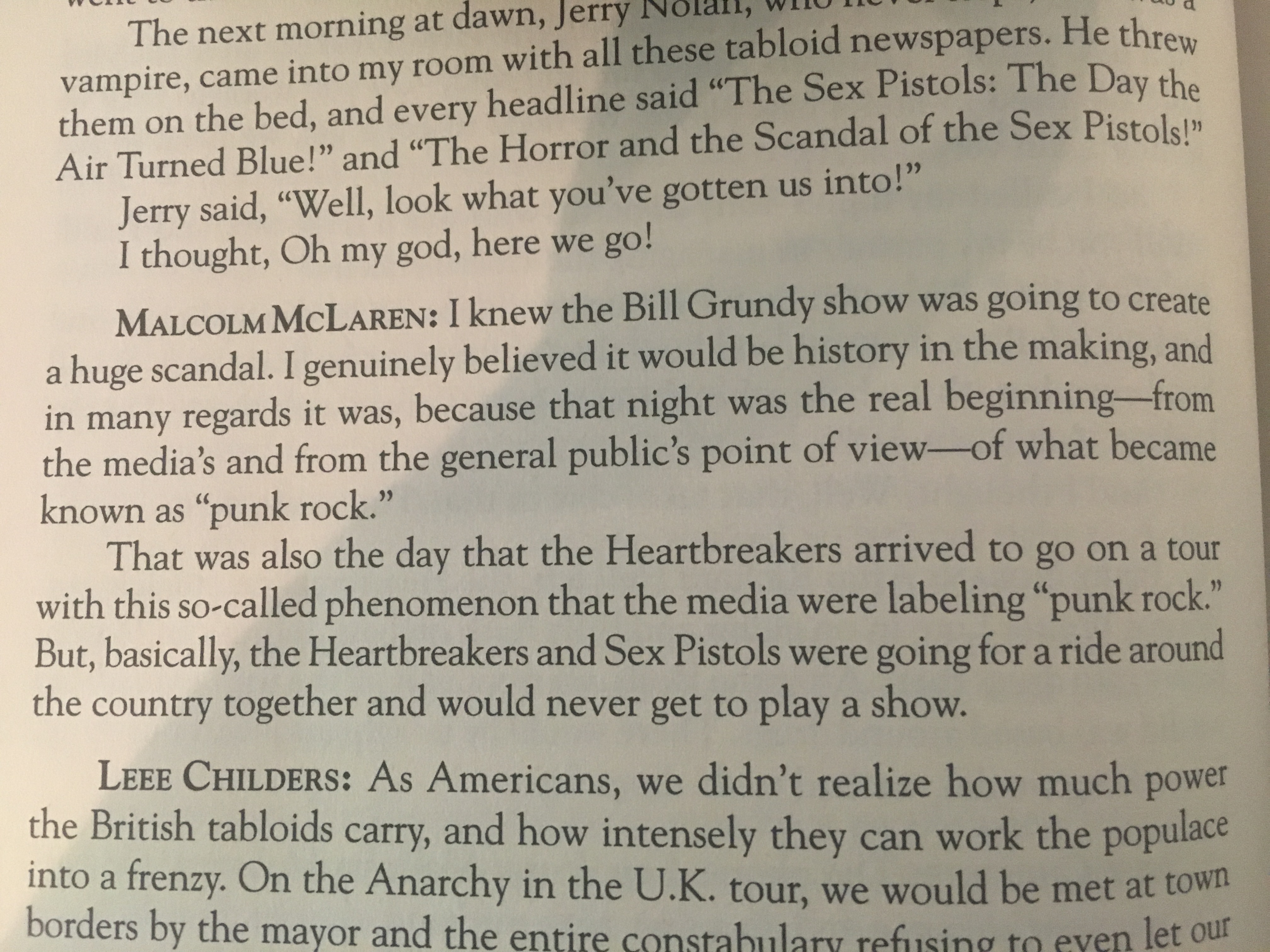
The brainlessness and hypocrisy of television has long been a source of fun and social commentary in punk rock—from Black Flag’s “TV Party” (“I don’t even bother to use my brain anymore”) to the Dead Kennedys’ “M.T.V. –Get Off the Air” (“… feeding you endless doses / of sugar-coated mindless garbage”). It’s fitting then that one of the seminal moments in punk history happened on television, orchestrated by Sex Pistols manager and arch provocateur Malcolm McLaren, who knew as well as anyone how to manipulate the media. The notorious Bill Grundy interview, which you can watch—likely not for the first or even second time—above, rocketed the Sex Pistols to national infamy overnight, simply because of a few swear words and some slightly rude behavior.
Though the U.S. does its damndest to keep up these days, no one in 1976 could match the outrage machinery of the UK press. As rock photographer and manager Leee Black Childers put it in the oral history of punk, Please Kill Me, the tabloids “can work the populace into a frenzy.” McLaren goes on record to say, “I knew the Bill Grundy show was going to create a huge scandal. I genuinely believed it would be history in the making.” We might expect him to take credit after the fact, but in any case, it worked: the day after the band’s appearance on the Grundy-hosted Today show on Thames Television, every tabloid paper featured them on the front page. The Daily Mirror provided the title of Julien Temple’s 2000 documentary with their clever headline, “The Filth and the Fury.”

Even in 2008, a survey showed the Grundy interview as the most requested clip in UK television history. With all this hype, you might be disappointed if you’re one of the few who hasn’t seen it. Though f‑bombs on TV can still cause a minor stir, a few mumbled curse words will hardly garner the kind of publicity they did forty years ago. McLaren claims punk rock began that day on the Today show, and that’s true, at least, for the viewing public who would have been treated to an appearance from Queen if Freddie Mercury hadn’t developed a crippling toothache. Instead, they were introduced to Paul Cook in a Vivienne Westwood naked breasts t‑shirt, and Glen Matlock, Steve Jones, and Johnny Rotten tossing insults at Grundy, who egged them on, hit on the teenage Siouxsie Sioux, part of the band’s entourage, and may have been drunk, though he denied it.
It may be one of the least witty exchanges in television history, and that’s saying a lot. But for all the pearl-clutching over the band’s crudity, it’s maybe Grundy who comes off looking the worse. More interesting than the interview itself is the hyperbolic fallout, as well as what happened immediately afterward. The station was flooded with complaints, and for some reason, its telephone system rerouted unanswered calls to the green room, where the band and their followers had decamped. “A producer on the programme ignored instructions to remain in the room,” notes Jon Bennett at Team Rock. “The result? The group started answering the phones and dishing out even more abuse. How this evaded the press at the time remains a mystery.” Indeed. It’s doubtful McLaren could have planned it, but the image evokes the sneer of every punk who has ever spit on the pious insistence that TV spoonfeed its viewers middle-class decorum with their advertising, sports, wish-fulfilling fantasies, and infotainment.
Related Content:
Watch the Sex Pistols’ Very Last Concert (San Francisco, 1978)
The Sex Pistols’ 1976 Manchester “Gig That Changed the World,” and the Day the Punk Era Began
The Sex Pistols Play in Dallas’ Longhorn Ballroom; Next Show Is Merle Haggard (1978)
Josh Jones is a writer and musician based in Durham, NC. Follow him at @jdmagness
Read More...Neil deGrasse Tyson is Creating a New Space Exploration Video Game with the Help of George R.R. Martin & Neil Gaiman
Although Neil deGrasse Tyson is somewhat hesitant to go in on plans to terraform and colonize Mars, that doesn’t mean he doesn’t like a good ol’–yet science-based–video game. Several outlets announced recently that the videogame Space Odyssey, spearheaded by deGrasse Tyson–one of America’s main defenders of logic and Enlightenment–has surpassed its Kickstarter funding goal. The game promises to send players on “real science-based missions to explore space, colonize planets, create and mod in real time.”
In the game, according to deGrasse Tyson, “you control the formation of planets, of comets, of life, civilization. You could maybe tweak the force of gravity and see what effect that might have.” It will be, he says, “an exploration into the laws of physics and how they shape the world in which we live.”
The game has been forming for several years now, and most importantly to our readers, has called in several sci-fi and fantasy writers to help create the various worlds in the game, as they have aptly demonstrated their skills in doing so on the printed page. That includes George R.R. Martin, currently ignoring whatever HBO is doing to his creation Game of Thrones; Neil Gaiman, who creates a new universe every time he drops a new novel; and Len Wein, who has had a hand in creating both DC’s Swamp Thing and Marvel’s Wolverine. Also on board: deGrasse Tyson’s buddy Bill Nye, former NASA astronaut Mike Massimino, and astrophysicist Charles Liu.

The idea of world/galaxy-building is not new in video games, especially recently. No Man’s Sky (2015) features “eighteen quintillion full-featured planets” and Minecraft seems limitless. But Space Odyssey (still a temporary title!) is the first to have deGrasse Tyson and friends working the controls in the background. And a game is as good as the visionaries behind it. 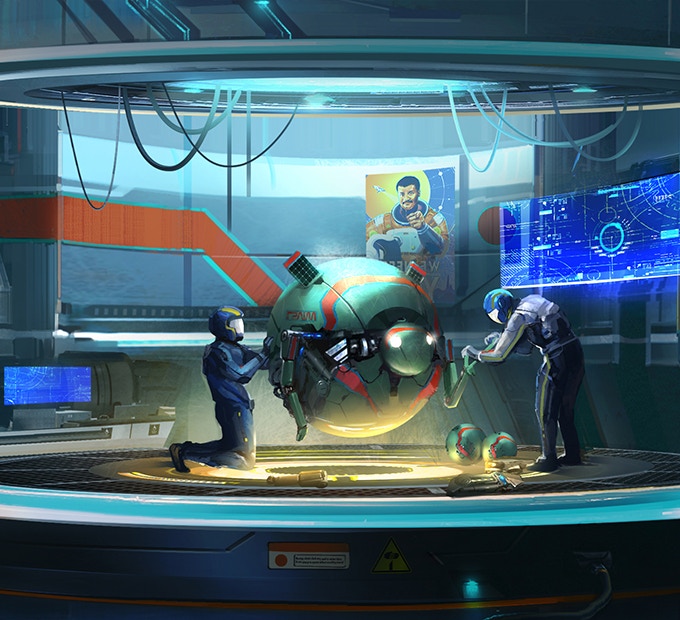
According to the Kickstarter page, the raised funds will go into “the ability to have this community play the game and engage with it while the final build is underway. As the Kickstarter gaming community begins to beta test game-play and provide feedback, we can begin to use the funds raised via Kickstarter to incorporate your modding, mapping and building suggestions, together building the awesome gaming experience you helped to create.”
DeGrasse Tyson will be in the game himself, urging players onward. There’s no indication whether Mr. Martin will be popping up, though.
Related Content:
Ted Mills is a freelance writer on the arts who currently hosts the artist interview-based FunkZone Podcast and is the producer of KCRW’s Curious Coast. You can also follow him on Twitter at @tedmills, read his other arts writing at tedmills.com and/or watch his films here.
Read More...Figures from Hieronymus Bosch’s “The Garden of Earthly Delights” Come to Life as Fine Art Piñatas

Oh sure, they look festive, but seriously, think twice before arming a blindfolded child (or a beer guzzling adult guest) with a sturdy stick and encouraging him to swing wildly.
There’s no need to worry, however, about anyone taking a bat to the intricate Hieronymus Bosch-inspired piñatas of Roberto Benavidez, a self-described half-breed, South Texan, queer figurative sculptor.

Even if you filled them with candy, the exteriors would be far more valuable than any treasures contained within.

Bosch, of course, excelled at scenarios far more nightmarish than anything one might encounter in a backyard party. Benavidez seems less drawn to that aspect than the beauty of the fantastical creatures populating The Garden of Earthly Delights.
In fact, the majority of his papier-mâché homages are drawn from the paradisiacal left panel of the famous triptych.
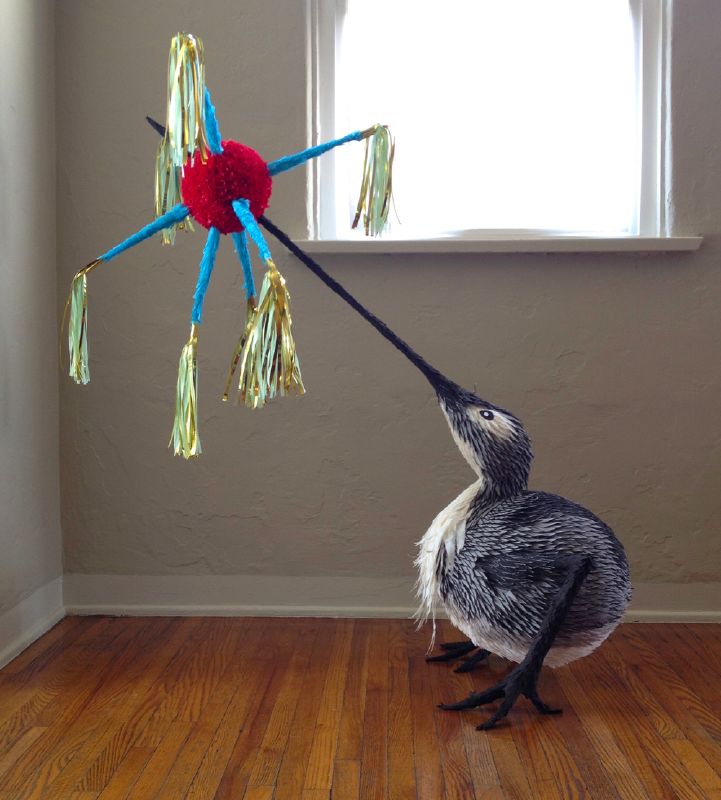
Not so the first in the series, 2013’s superbly titled Piñata of Earthly Delights #1, above
In the original, a misshapen waterbird uses its long beak to spear a cherry with which it tempts a passel of weak-willed mortals, crowded together inside a spiky pink blossom.
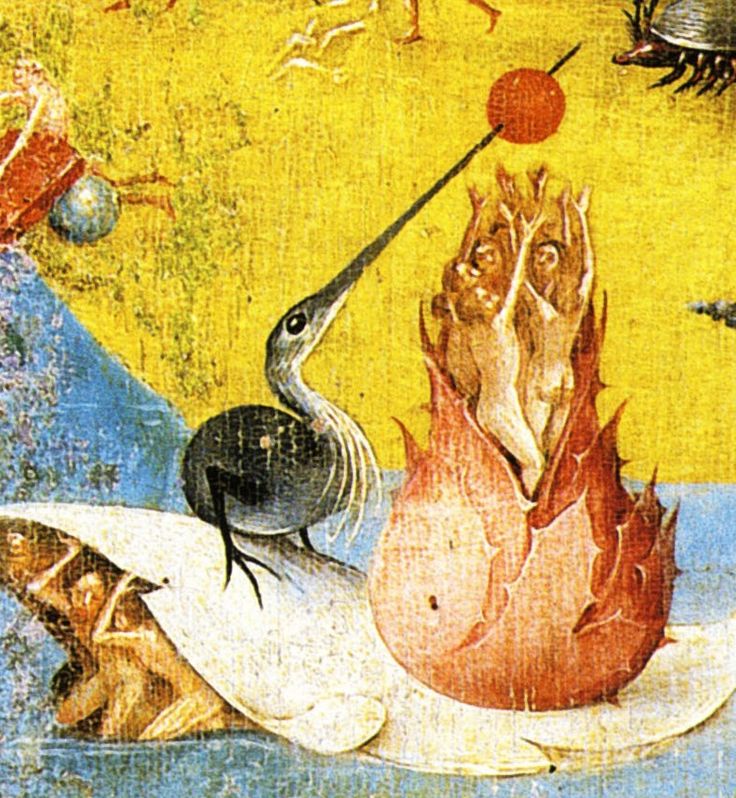
In Benavidez’s version the lack of naked humans allows us to focus on the creature, whose beak now pierces a simple star-shaped piñata of its own.
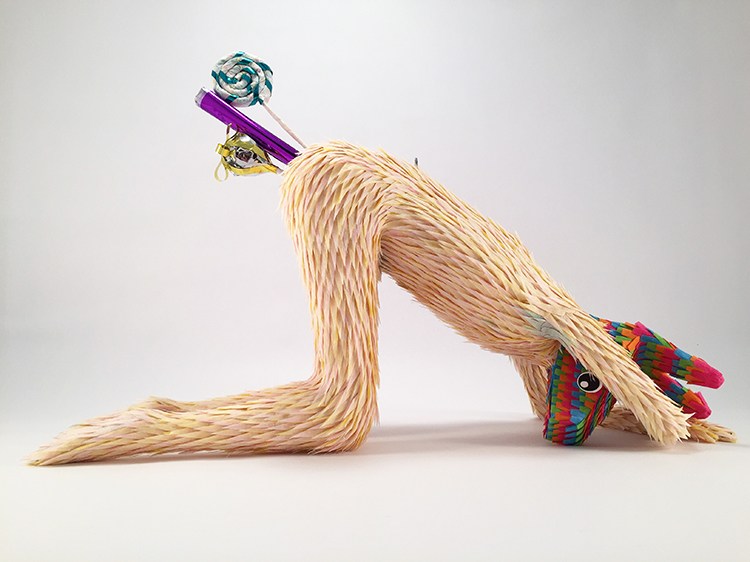
Those with a fascination for the antics of Bosch’s party people are invited to play a variation of Where’s Waldo, scouring the painting for the inspiration behind Candy Ass Bottom, above.
(Hint: if you’re gravitating toward those posteriors serving as vessels for flutes, flocks of blackbirds, or red hot pokers, you’re getting colder…)
While little is known about Bosch’s artistic training, Benavidez majored in acting, before returning to his childhood fascination for sculpting, taking classes in drawing, painting, and bronze casting at Pasadena City College. Thrift and portability led him to begin exploring paper as his primary medium.
As he remarked on the blog of the crepe paper manufacturer Cartotecnica Rossi:
I was intrigued by the idea of taking the piñata form, something seen as cheap and disposable, and moving it into the arena of fine art. I feel that my sculptural forms and fringing techniques set my work apart from what most people think of as a typical piñata and the themes are more complex than is typical.
Definitely.
View more of Roberto Benavidez’ fine art piñatas, including those inspired by Hieronymus Bosch on his website or Instagram feed.
Related Content:
Ayun Halliday is an author, illustrator, theater maker and Chief Primatologist of the East Village Inky zine. Follow her @AyunHalliday.
Read More...The Web Site “Centuries of Sound” is Making a Mixtape for Every Year of Recorded Sound from 1860 to Present
The vibrations of the Metropolitan Elevated Railroad in Manhattan, a recitation of “Mary Had a Little Lamb,” the announcements issuing forth from an inventor’s attempt at a talking clock — hardly a mix with which to get the party started, but one that provides the closest experience we can get to traveling in a sonic time machine. With Centuries of Sound, James Errington has assembled those recordings and a few others into its 1878–1885 mix, an early chapter in his project of creating one listening experience for each year in the history of recorded sound.
“Things get a little more listenable in 1887 with a recording of ‘Twinkle Twinkle Little Star,’ ” writes The A.V. Club’s Matt Gerardi. “It’s also with this third mix that we start to get a sense for Centuries Of Sound’s editing style, as speeches start to be layered over musical performances, creating a listening experience that’s as pleasurable as it is educational.”
In so doing, “Errington calls attention to the issue of representation, as one of his primary goals is to paint a global, multi-cultural picture of recording history,” digging past all the “marching bands, sentimental ballads, novelty instrumentals and nothing much else” in the historical archives while putting out the call for expert help sourcing and evaluating “Rembetika, early microtonal recordings, French political speeches, Tagore songs or anything else.”
Putting up another year’s mix each month, Centuries of Sound has so far made it up to 1893, the year of the World’s Columbian Exposition in Chicago which “set the tone for the next twenty-five years of architecture, arts, culture and the electrification of the world,” and also the first age of “ ‘hits’ – music produced with an eye to selling, even if only as a souvenir or a fun novelty.” With a decade remaining until Centuries of Sound catches up with the present moment, Errington has put together a taste of what its sonic dose of the almost-present will sound like with a 2016 preview mix featuring the likes of the final album by A Tribe Called Quest and Lazarus, the musical by David Bowie, both of whom took their final bows last year. We’re definitely a long way from the time of “Mary Had a Little Lamb.” But how will it all sound to the ears of 2027?
via The A.V. Club
Related Content:
Great New Archive Lets You Hear the Sounds of New York City During the Roaring 20s
Based in Seoul, Colin Marshall writes and broadcasts on cities and culture. He’s at work on the book The Stateless City: a Walk through 21st-Century Los Angeles, the video series The City in Cinema, the crowdfunded journalism project Where Is the City of the Future?, and the Los Angeles Review of Books’ Korea Blog. Follow him on Twitter at @colinmarshall or on Facebook.
Read More...Support Us
We're hoping to rely on loyal readers, rather than erratic ads. Please click the Donate button and support Open Culture. You can use Paypal, Venmo, Patreon, even Crypto! We thank you!

About Us

Open Culture scours the web for the best educational media. We find the free courses and audio books you need, the language lessons & educational videos you want, and plenty of enlightenment in between.
Advertise With Us
FREE UPDATES!
GET OUR DAILY EMAIL
Get the best cultural and educational resources on the web curated for you in a daily email. We never spam. Unsubscribe at any time.
FOLLOW ON SOCIAL MEDIA
Open Culture editor Dan Colman scours the web for the best educational media. He finds the free courses and audio books you need, the language lessons & movies you want, and plenty of enlightenment in between.
Advertise With Us