Hear the Beach Boys’ Angelic Vocal Harmonies in Four Isolated Tracks from Pet Sounds: “Wouldn’t It Be Nice,” “God Only Knows,” “Sloop John B” & “Good Vibrations”
I didn’t get the Beach Boys for a while. They had provided the soundtrack to an alien world, one I knew mostly from chewing gum commercials. They were “uncool—cornball,” writes Ben Ratliff, “unenlightened” purveyors of “beach privilege.” The “narrators of Beach Boys songs used their time as they liked: amusement parks, surfing, drag racing, dating, sitting in their rooms.” They had no cares, no real burdens, just shallow summer loves and heartaches. They came off as some of the blandest, safest-sounding people on earth.
Then, in a puzzling turn in the nineties, indie artists like Neutral Milk Hotel, Jim O’Rourke, and The Sea and Cake began experimenting with the complex arrangements, odd instrumentation, and sunny melodies of 60s pop artists like The Beach Boys and Burt Bacharach.
This is music that can seduce us into thinking it is simplistic, childish, uninspired vanilla. Its use as background muzak in supermarkets and shopping malls confirms the impression. But critical listening explodes it. (Dig the phrasing in the otherwise silly, Bacharach/Hal David-composed “Do You Know the Way to San Jose.”)
Yes, it took a retro-hip return to ’60s lounge music, bossa nova, and surf pop for many people to reconsider the Beach Boys as serious artists. And while the trend became a little cloying, once I put on the headphones and gave the radical Pet Sounds a few dozen spins, as so many songwriters I admired had gushed about doing, I got it. Of course. Yes. The arrangements, and those harmonies…. It isn’t only the technical wizardry, though there’s that. It’s how thoroughly weird those classically-inspired arrangements are. Perhaps a better way to put it would be, totally counterintuitive.
What nearly any other pop arranger would naturally do with a harmony or rhythm part—just to get the house in order and showcase more important “lead” parts—Brian Wilson almost never does. As the minimalist composer John Adams put it, “more than any other songwriter of that era, Brian Wilson understood the value of harmonic surprise.” At least in Pet Sounds and the long-unfinished “labyrinth of melody” SMiLE, each part of the song sustains its own individual interest without breaking away from the miniature symphonic whole.
Even within the harmonies, there is a strange tension, an off-kilter wobbling as in a machine whose gears are all just a bit off-center. Instruments and voices go in and out of key, tempos slow and quicken. The vocal harmonies are angelic, but troubled, uncertain, maudlin, and underlined with unexpected intensity given the innocuousness of their lyrics. In the isolated vocal tracks here for “Wouldn’t It Be Nice,” “God Only Knows,” “Sloop John B,” and “Good Vibrations,” you may catch it, or not. It isn’t foreboding, exactly, but a kind of uneasy recognition that the pleasures these songs celebrate will soon pass away. An Arcadian theme in the California pastoral.
The tension is there in Wilson’s idol Phil Spector’s compositons as well, but the contrast is remarkably greater in Pet Sounds, of longing, nostalgia, and youth at its peak. The utopia they imagine may only appeal to a specific subset of boomer Americans, but their intricate, melodically complex, yet harmoniously appealing soundworld belongs to everyone. As Zack Schonfeld observed in a sadly prophetic review of Wilson’s Pet Sounds performance in Brooklyn last summer, “it is hard to imagine modern indie or indie-pop—or pop in general—without Pet Sounds.” (That includes, of course The Beatles, who answered with Sgt. Peppers.) “A world without Pet Sounds is a frightening dystopia,” he writes, “like imagining a world without beaches or one in which Donald Trump is president.” Maybe as you sit back and listen to the otherworldly beauty of these naked harmonies, think of all those lovely beaches we still have left.
Related Content:
89 Essential Songs from The Summer of Love: A 50th Anniversary Playlist
Josh Jones is a writer and musician based in Durham, NC. Follow him at @jdmagness
Read More...The Color Palettes of Your Favorite Films: The Royal Tenenbaums, Reservoir Dogs, A Clockwork Orange, Blade Runner & More
We tend to think of film as roughly divided into the “black and white” and “color” eras, the latter ushered in by such lavish Technicolor productions as Gone with the Wind and The Wizard of Oz. But we also know it’s not as simple as that: those pictures came out in Hollywood’s “golden year” of 1939, but some filmmakers had already been experimenting with color, and the golden age of black-and-white film would continue through the 1960s. Movies today still occasionally dare to venture into the never-entirely-shuttered realm of the monochrome, but on the whole, color reigns supreme.
Even though most movies now use color, few use it to its fullest advantage. Color gives viewers something more to look at, of course, but it can also give a movie its visual identity. Think of the films you’ve seen that you can call back most vividly to mind, almost as if you had a projector inside your head, and most of them will probably have a distinctive color palette.
The most memorable cinematic images, in other words, will have been composed not just with any color they happened to need, but with a very specific set of colors, deliberately assembled by the filmmakers for its particular expressiveness.
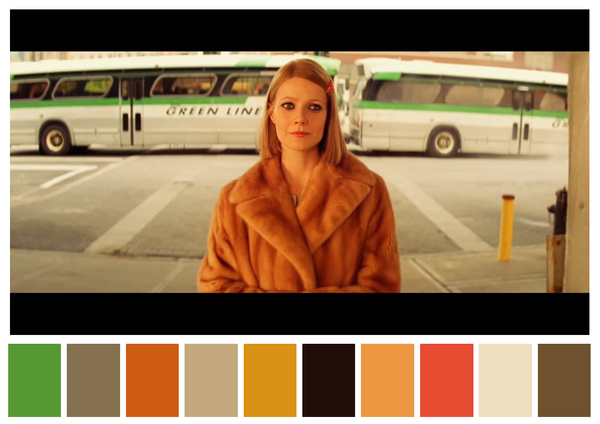
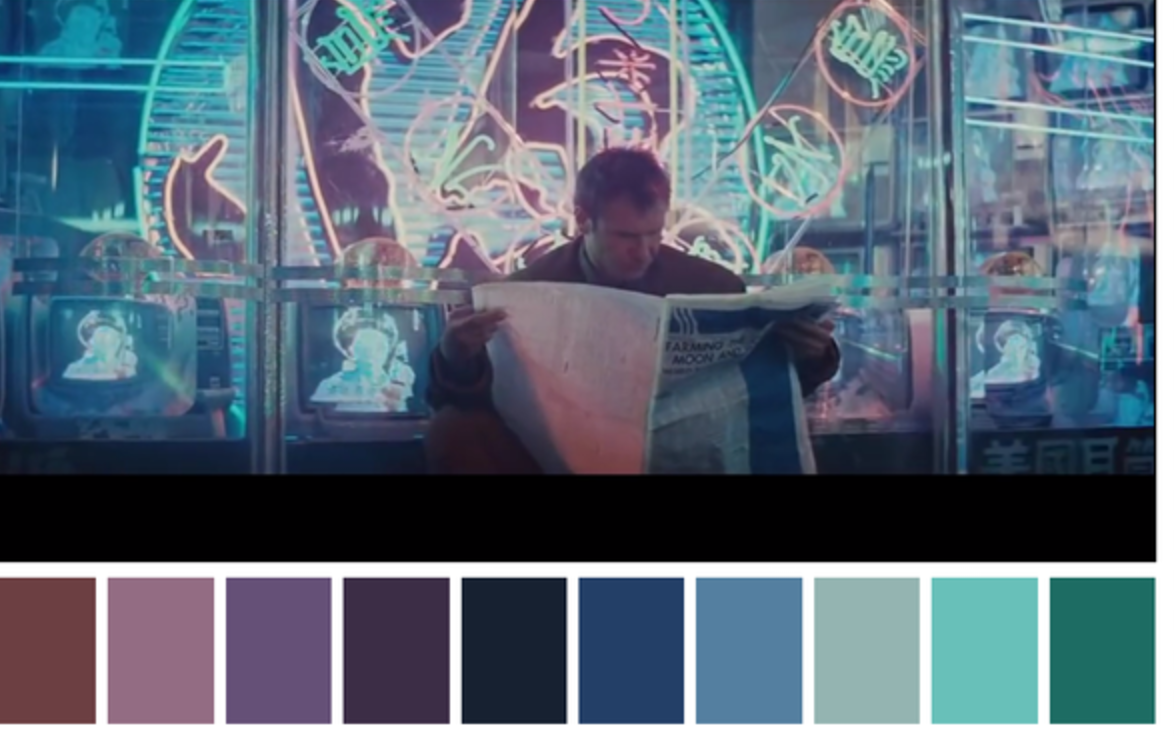
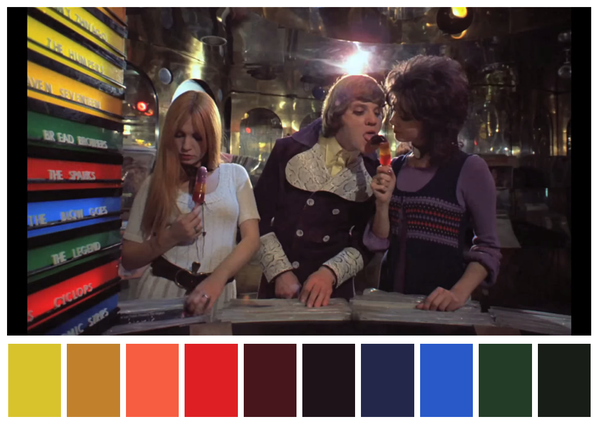
For a few years now, the Twitter account Cinema Palettes has drawn out and isolated those colors, ten per film, for all to see. “Though based on a momentary still, each spectrum of shades seems to encapsulate its movie’s overall mood,” writes My Modern Met’s Leah Pellegrini, pointing to “the somber, otherworldly blues of Harry Potter and the Deathly Hallows: Part 2, the dreamlike pinks and purples of The Grand Budapest Hotel, the cloyingly pretty pastels of Edward Scissorhands, and the earthly, organic greens and browns of Atonement.”
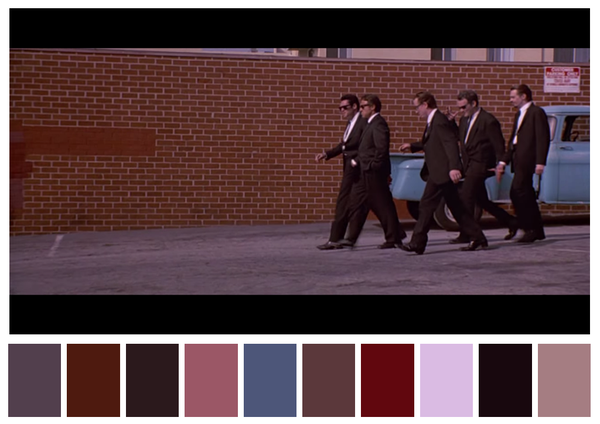
It will surprise nobody to see the work of Wes Anderson, famed for the care he gives not just to color but every visual element of his film, appear more than once on the feed. Here we see Cinema Palettes’ selections from The Royal Tenenbaums, as well as from Quentin Tarantino’s Reservoir Dogs, Stanley Kubrick’s A Clockwork Orange, and Ridley Scott’s Blade Runner. The project reveals an aspect of filmmaking that few of us may think consciously about, but nevertheless reflects the nature of cinema itself: the best films select not just the right colors but the right aspects of reality itself to present, to intensify, to diminish, and to leave out entirely.
Explore more films and colors at Cinema Palettes.
via My Modern Met and h/t Natalie W‑S
Related Content:
“Bleu, Blanc, Rouge”: a Striking Supercut of the Vivid Colors in Jean-Luc Godard’s 1960s Films
Wes Anderson Likes the Color Red (and Yellow)
Stanley Kubrick’s Obsession with the Color Red: A Supercut
Early Experiments in Color Film (1895–1935)
Based in Seoul, Colin Marshall writes and broadcasts on cities and culture. He’s at work on the book The Stateless City: a Walk through 21st-Century Los Angeles, the video series The City in Cinema, the crowdfunded journalism project Where Is the City of the Future?, and the Los Angeles Review of Books’ Korea Blog. Follow him on Twitter at @colinmarshall or on Facebook.
Read More...36 Abstract Covers of Vintage Psychology, Philosophy & Science Books Come to Life in a Mesmerizing Animation
Animated ebook covers are the wave of the future.
Graphic and motion designer Henning M. Lederer surfs that wave on the most unexpected of boards—a collection of abstract mid-century covers drawn from the Instagram feed of artist Julian Montague, who shares his enthusiasm for vintage minimalism.
Lederer first came to our attention in 2015, when we covered the first installment of what seems destined to become an ongoing project.
His latest effort, above, continues his explorations in the subjects which most frequently traded in these sorts of geometric covers—science, psychotherapy, philosophy and sociology.
No word on what inspired him to toss in the first cover, which features a cheerful, Playmobil-esque mushroom gatherer. It’s endearing, but—to quote Sesame Street—is not like the others. Those of us who can’t decipher Cyrillic script get the fun of imagining what sort of text this is—a mycology manual? A children’s tale? A psychological examination—and ultimately rejection—of midcentury publishers’ fascination for spirals, diagonal bars, and other non-narrative graphics?
Whether or not you’d be inclined to pick up any of these titles, you may find yourself wanting to dance to them, compliments of musician Jörg Stierle’s trippy electronics.
Or take your cue from yet another cover contained therein: I. P. Pavlov’s Essays in Psychology and Psychiatry with a Special Section on Sleep and Hypnosis.
Here’s the one that started it all:
Related Content:
Artist Animates Famous Book Covers in an Elegant, Understated Way
500+William S. Burroughs Book Covers from Across the Globe: 1950s Through the 2010s
Ayun Halliday is an author, illustrator, theater maker and Chief Primatologist of the East Village Inky zine. Follow her @AyunHalliday.
Read More...What Happens When the Books in William S. Burroughs’ Personal Library Get Artistically Arranged — with His Own “Cut-Up” Method
If your Facebook news feed looks anything like mine, you wake up each morning to a stream of not just food snapshots and selfies but pictures of books, whether stacked up, dumped into a pile, or arranged neatly on shelves. Why do we post digital photos of our printed matter? Almost certainly for the same reason we do anything on social media: to send a message about ourselves. We want to tell our friends who we are, or who we think we are, but not in so many words, or rather not in so few; a few of the books we’ve read (or intend to read), carefully selected and arranged, does the job. But what if, instead of assembling a self-portrait through books, someone else entered your personal library and did it for you?
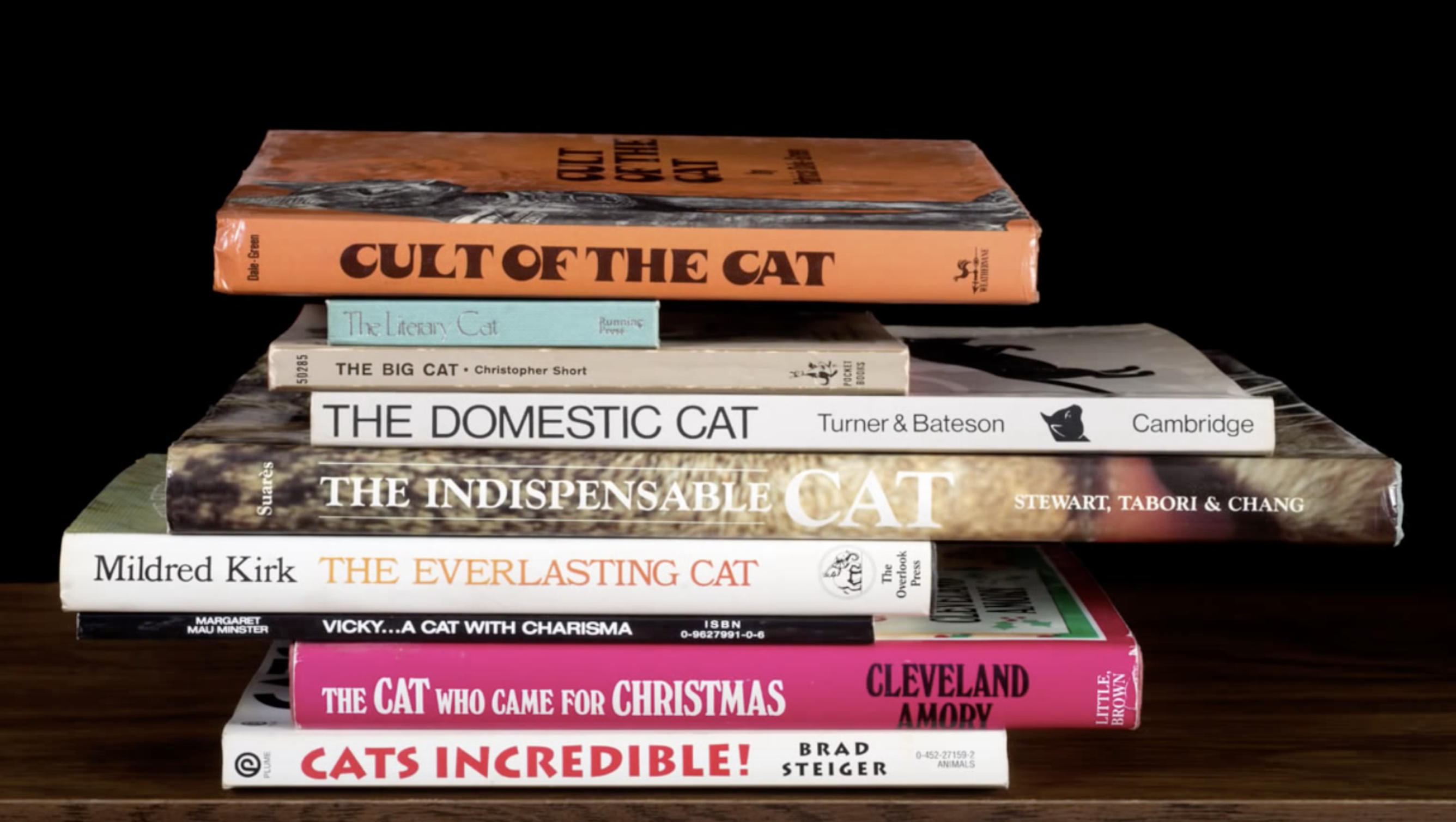
Artist Nina Katchadourian (she of, among many other endeavors, the airplane-bathroom 17th-century Flemish portraiture) recently took on that task in the Lawrence, Kansas home of famously hard-living and furiously creative beat writer William S. Burroughs. She did it as part of her long-running Sorted Books project, in which, in her words, “I sort through a collection of books, pull particular titles, and eventually group the books into clusters so that the titles can be read in sequence.
The final results are shown either as photographs of the book clusters or as the actual stacks themselves, often shown on the shelves of the library they came from. Taken as a whole, the clusters are a cross-section of that library’s holdings that reflect that particular library’s focus, idiosyncrasies, and inconsistencies.”

Kansas Cut-Up, the Burroughs chapter of Sorted Books, features such arrangements as How Did Sex Begin? / Uninvited Guests / Human Error, Memoirs of a Bastard Angel / A Night of Serious Drinking / A Little Original Sin, and American Diplomacy / Physical Interrogation Techniques / In the Secret State. Thom Robinson of the European Beat Studies Network describes Burroughs’ book collection as “a selection of largely European works whose contents include paranoia, theories of language, pseudoscience, mordant humour and drugs: in retrospect, it’s easy to imagine the owner of such an idiosyncratic library producing the melange of Naked Lunch. Perhaps for this reason, it seems hard to resist reordering the books which Burroughs owned in 1944 in order to emphasise the most recognisable elements of the later Burroughs persona.”
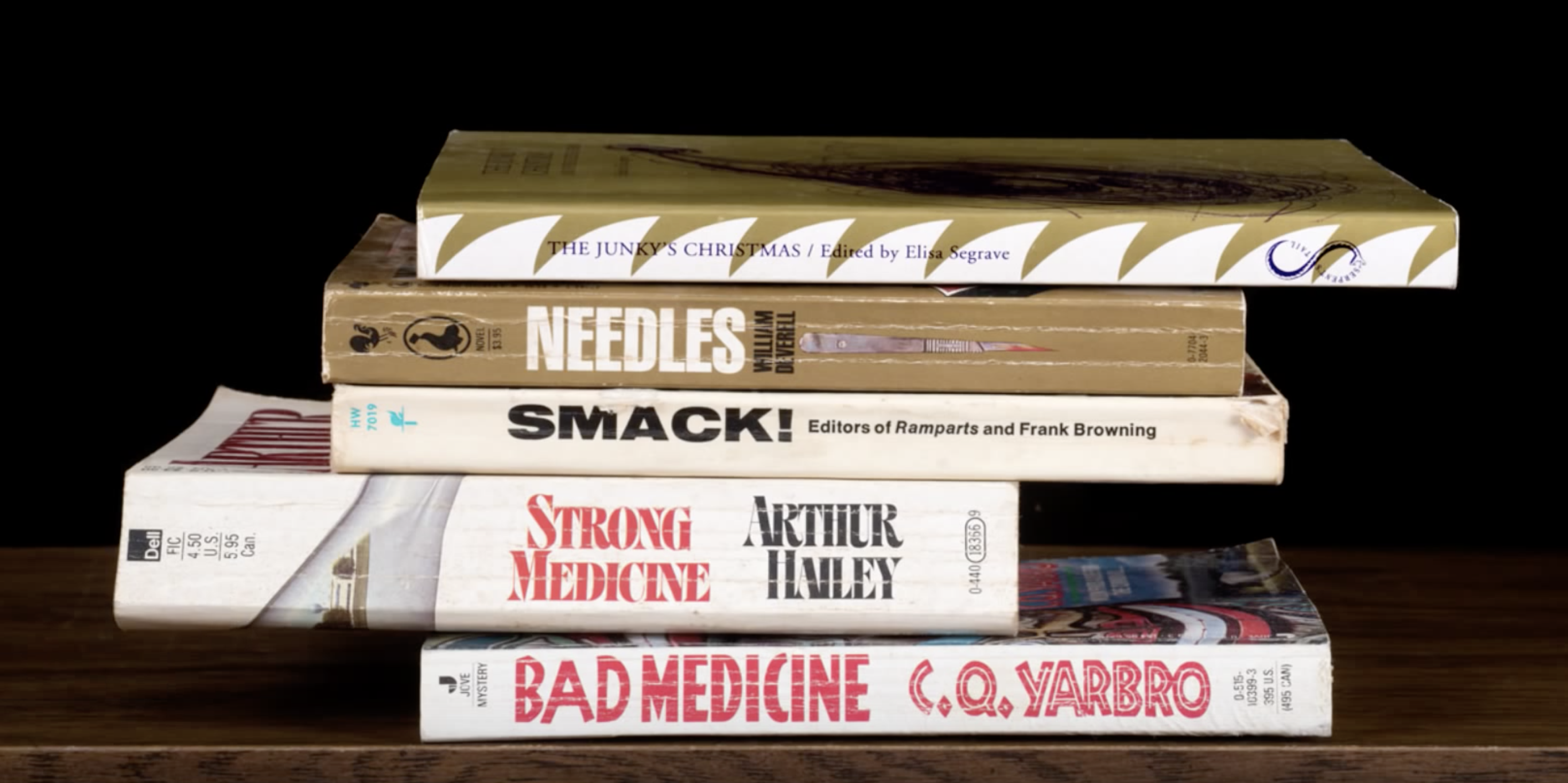
Sometimes Katchadourian seems to do just that and sometimes she doesn’t, but her method of book-sorting, which she explains in the episode of John and Sarah Green’s series The Art Assignment at the top of the post, bears more than a little resemblance to Burroughs’ own “cut-up” method of literary composition. “Take a page,” as Burroughs himself explained it. “Now cut down the middle and cross the middle. You have four sections: 1 2 3 4 … one two three four. Now rearrange the sections placing section four with section one and section two with section three. And you have a new page. Sometimes it says much the same thing. Sometimes something quite different.” And just as a rearranged book can speak in a new and strange voice, so can a rearranged library.
via Austin Kleon’s newsletter (which you should subscribe to here)
Related Content:
How to Jumpstart Your Creative Process with William S. Burroughs’ Cut-Up Technique
115 Books on Lena Dunham & Miranda July’s Bookshelves at Home (Plus a Bonus Short Play)
The 430 Books in Marilyn Monroe’s Library: How Many Have You Read?
Based in Seoul, Colin Marshall writes and broadcasts on cities and culture. He’s at work on the book The Stateless City: a Walk through 21st-Century Los Angeles, the video series The City in Cinema, the crowdfunded journalism project Where Is the City of the Future?, and the Los Angeles Review of Books’ Korea Blog. Follow him on Twitter at @colinmarshall or on Facebook.
Read More...Cindy Sherman’s Instagram Account Goes Public, Revealing 600 New Photos & Many Strange Self-Portraits
The career of Jenny Holzer, the artist who became famous in the 1970s and 80s through her public installations of phrases like “ABUSE OF POWER COMES AS NO SURPRISE” and “PROTECT ME FROM WHAT I WANT,” has made her into an ideal Tweeter. By the same token, the career of Cindy Sherman, the artist who became famous in the 1970s and 80s through her inventive not-exactly-self-portraits — pictures of herself elaborately remade as a variety of other people, including other famous people, in a variety of time periods — has made her into an ideal Instagrammer.
But though Sherman had been using Instagram for quite some time, most of the public had no idea she had any presence there at all until just this week. “The account, which mysteriously switched from private to public in recent months, is a mix of personal photos alongside Sherman’s ever-famous manipulated images of herself,” reports Artnet’s Caroline Elbaor.
“What we see here is somewhat of a departure from the artist’s traditional model: the frame is tighter and closer to her face, in what is clear use of a phone’s front-facing camera. Plus, the subject matter is decidedly intimate in comparison to her usual work — the latest posts document a stay in the hospital. She may even be having fun with filters.”
She apparently started having fun with them a few months ago, from one May post whose photo she describes as “Selfie! No filter, hahaha” — but in which she does seem to have made use of certain effects to give the image a few of the suite of uncanny qualities in which she specializes. Though not a member of the generations the world most closely associates with avid selfie-taking, Sherman brings a uniquely rich experience with the form, or forms like it. Her “method of turning the lens onto herself is uncannily appropriate to our times,” writes Elbaor,” in which the stage-managed selfie has become so ubiquitous that it’s now fodder for exhibitions and often cited as an art form in itself.”
Sherman’s Instagram self-portraiture, in contrast to the often (but not always) glamorous productions that hung on the walls of her shows before, has entered fascinating new realms of strangeness and even grotesquerie. Using the image-modification tools so many of us might previously assumed were used only by teenage girls desperate to erase their imagined flaws, Sherman twists and bends her own features into what look like living cartoon characters. “A bit scary,” one commenter wrote of Sherman’s recent hospital-bed selfie (taken while recovering from a fall from a horse), “but I can’t look away.” Many of the artist’s thousands and thousands of new and captivated Instagram followers are surely reacting the same way. Check out Sherman’s Instagram feed here.
Related Content:
Say What You Really Mean with Downloadable Cindy Sherman Emoticons
Museum of Modern Art (MoMA) Launches Free Course on Looking at Photographs as Art
See The First “Selfie” In History Taken by Robert Cornelius, a Philadelphia Chemist, in 1839
Based in Seoul, Colin Marshall writes and broadcasts on cities and culture. He’s at work on the book The Stateless City: a Walk through 21st-Century Los Angeles, the video series The City in Cinema, the crowdfunded journalism project Where Is the City of the Future?, and the Los Angeles Review of Books’ Korea Blog. Follow him on Twitter at @colinmarshall or on Facebook.
Read More...Marshall McLuhan Predicts That Electronic Media Will Displace the Book & Create Sweeping Changes in Our Everyday Lives (1960)
“The electronic media haven’t wiped out the book: it’s read, used, and wanted, perhaps more than ever. But the role of the book has changed. It’s no longer alone. It no longer has sole charge of our outlook, nor of our sensibilities.” As familiar as those words may sound, they don’t come from one of the think pieces on the changing media landscape now published each and every day. They come from the mouth of midcentury CBC television host John O’Leary, introducing an interview with Marshall McLuhan more than half a century ago.
McLuhan, one of the most idiosyncratic and wide-ranging thinkers of the twentieth century, would go on to become world famous (to the point of making a cameo in Woody Allen’s Annie Hall) as a prophetic media theorist. He saw clearer than many how the introduction of mass media like radio and television had changed us, and spoke with more confidence than most about how the media to come would change us. He understood what he understood about these processes in no small part because he’d learned their history, going all the way back to the development of writing itself.
Writing, in McLuhan’s telling, changed the way we thought, which changed the way we organized our societies, which changed the way we perceived things, which changed the way we interact. All of that holds truer for the printing press, and even truer still for television. He told the story in his book The Gutenberg Galaxy, which he was working on at the time of this interview in May of 1960, and which would introduce the term “global village” to its readers, and which would crystallize much of what he talked about in this broadcast. Electronic media, in his view, “have made our world into a single unit.”
With this “continually sounding tribal drum” in place, “everybody gets the message all the time: a princess gets married in England, and ‘boom, boom, boom’ go the drums. We all hear about it. An earthquake in North Africa, a Hollywood star gets drunk, away go the drums again.” The consequence? “We’re re-tribalizing. Involuntarily, we’re getting rid of individualism.” Where “just as books and their private point of view are being replaced by the new media, so the concepts which underlie our actions, our social lives, are changing.” No longer concerned with “finding our own individual way,” we instead obsess over “what the group knows, feeling as it does, acting ‘with it,’ not apart from it.”
Though McLuhan died in 1980, long before the appearance of the modern internet, many of his readers have seen recent technological developments validate his notion of the global village — and his view of its perils as well as its benefits — more and more with time. At this point in history, mankind can seem less united than ever than ever, possibly because technology now allows us to join any number of global “tribes.” But don’t we feel more pressure than ever to know just what those tribes know and feel just what they feel?
No wonder so many of those pieces that cross our news feeds today still reference McLuhan and his predictions. Just this past weekend, Quartz’s Lila MacLellan did so in arguing that our media, “while global in reach, has come to be essentially controlled by businesses that use data and cognitive science to keep us spellbound and loyal based on our own tastes, fueling the relentless rise of hyper-personalization” as “deep-learning powered services promise to become even better custom-content tailors, limiting what individuals and groups are exposed to even as the universe of products and sources of information expands.” Long live the individual, the individual is dead: step back, and it all looks like one of those contradictions McLuhan could have delivered as a resonant sound bite indeed.
Related Content:
McLuhan Said “The Medium Is The Message”; Two Pieces Of Media Decode the Famous Phrase
The Visionary Thought of Marshall McLuhan, Introduced and Demystified by Tom Wolfe
Based in Seoul, Colin Marshall writes and broadcasts on cities and culture. He’s at work on the book The Stateless City: a Walk through 21st-Century Los Angeles, the video series The City in Cinema, the crowdfunded journalism project Where Is the City of the Future?, and the Los Angeles Review of Books’ Korea Blog. Follow him on Twitter at @colinmarshall or on Facebook.
Read More...Watch Randy Newman’s Tour of Los Angeles’ Sunset Boulevard, and You’ll Love L.A. Too
“The longer I live here,” a Los Angeles-based friend recently said, “the more ‘I Love L.A.’ sounds like an unironic tribute to this city.” That hit single by Randy Newman, a singer-songwriter not known for his simple earnestness, has produced a multiplicity of interpretations since it came out in 1983, the year before Los Angeles presented a sunny, colorful, forward-looking image to the world as the host of the Summer Olympic Games. Listeners still wonder now what they wondered back then: when Newman sings the praises — literally — of the likes of Imperial Highway, a “big nasty redhead,” Century Boulevard, the Santa Ana winds, and bums on their knees, does he mean it?
“I Love L.A.“ ‘s both smirking and enthusiastic music video offers a view of Newman’s 1980s Los Angeles, but fifteen years later, he starred in an episode of the public television series Great Streets that presents a slightly more up-to-date, and much more nuanced, picture of the city. In it, the native Angeleno looks at his birthplace through the lens of the 27-mile Sunset Boulevard, Los Angeles’ most famous street — or, in his own words, “one of those places the movies would’ve had to invent, if it didn’t already exist.”
Historian Leonard Pitt (who appears alongside figures like filmmaker Allison Anders, artist Ed Ruscha, and Doors keyboardist Ray Manzarek) describes Sunset as the one place along which you can see “every stratum of Los Angeles in the shortest period of time.” Or as Newman puts it, “Like a lot of the people who live here, Sunset is humble and hard-working at the beginning,” on its inland end. “Go further and it gets a little self-indulgent and outrageous” before it “straightens itself out and grows rich, fat, and respectable.” At its coastal end “it gets real twisted, so there’s nothing left to do but jump into the Pacific Ocean.”
Newman’s westward journey, made in an open-topped convertible (albeit not “I Love L.A.“ ‘s 1955 Buick) takes him from Union Station (America’s last great railway terminal and the origin point of “L.A.‘s long, long-anticipated subway system”) to Aimee Semple McPherson’s Angelus Temple, now-gentrified neighborhoods like Silver Lake then only in mid-gentrification, the humble studio where he laid tracks for some of his biggest records, the corner where D.W. Griffith built Intolerance’s ancient Babylon set, the storied celebrity hideout of the Chateau Marmont, UCLA (“almost my alma mater”), the Lake Shrine Temple of the Self-Realization Fellowship, and finally to edge of the continent.
More recently, Los Angeles Times architecture critic Christopher Hawthorne traveled the entirety of Sunset Boulevard again, but on foot and in the opposite direction. The east-to-west route, he writes, “offers a way to explore an intriguing notion: that the key to deciphering contemporary Los Angeles is to focus not on growth and expansion, those building blocks of 20th century Southern California, but instead on all the ways in which the city is doubling back on itself and getting denser.” For so much of the city’s history, “searching for a metaphor to define Sunset Boulevard, writers” — or musicians or filmmakers or any number of other creators besides — “have described it as a river running west and feeding into the Pacific. But the river flows the other direction now.”
Los Angeles has indeed plunged into a thorough transformation since Newman first simultaneously celebrated and satirized it, but something of the distinctively breezy spirit into which he tapped will always remain. “There‘s some kind of ignorance L.A. has that I’m proud of. The open car and the redhead and the Beach Boys, the night just cooling off after a hot day, you got your arm around somebody,” he said to the Los Angeles Weekly a few years after taping his Great Streets tour. ”That sounds really good to me. I can‘t think of anything a hell of a lot better than that.”
Related Content:
Glenn Gould Gives Us a Tour of Toronto, His Beloved Hometown (1979)
Charles Bukowski Takes You on a Very Strange Tour of Hollywood
Join Clive James on His Classic Television Trips to Paris, LA, Tokyo, Rio, Cairo & Beyond
Based in Seoul, Colin Marshall writes and broadcasts on cities and culture. He’s at work on the book The Stateless City: a Walk through 21st-Century Los Angeles, the video series The City in Cinema, the crowdfunded journalism project Where Is the City of the Future?, and the Los Angeles Review of Books’ Korea Blog. Follow him on Twitter at @colinmarshall or on Facebook.
Read More...How Arabic Translators Helped Preserve Greek Philosophy … and the Classical Tradition
In the ancient world, the language of philosophy—and therefore of science and medicine—was primarily Greek. “Even after the Roman conquest of the Mediterranean and the demise of paganism, philosophy was strongly associated with Hellenic culture,” writes philosophy professor and History of Philosophy without any Gaps host Peter Adamson. “The leading thinkers of the Roman world, such as Cicero and Seneca, were steeped in Greek literature.” And in the eastern empire, “the Greek-speaking Byzantines could continue to read Plato and Aristotle in the original.”
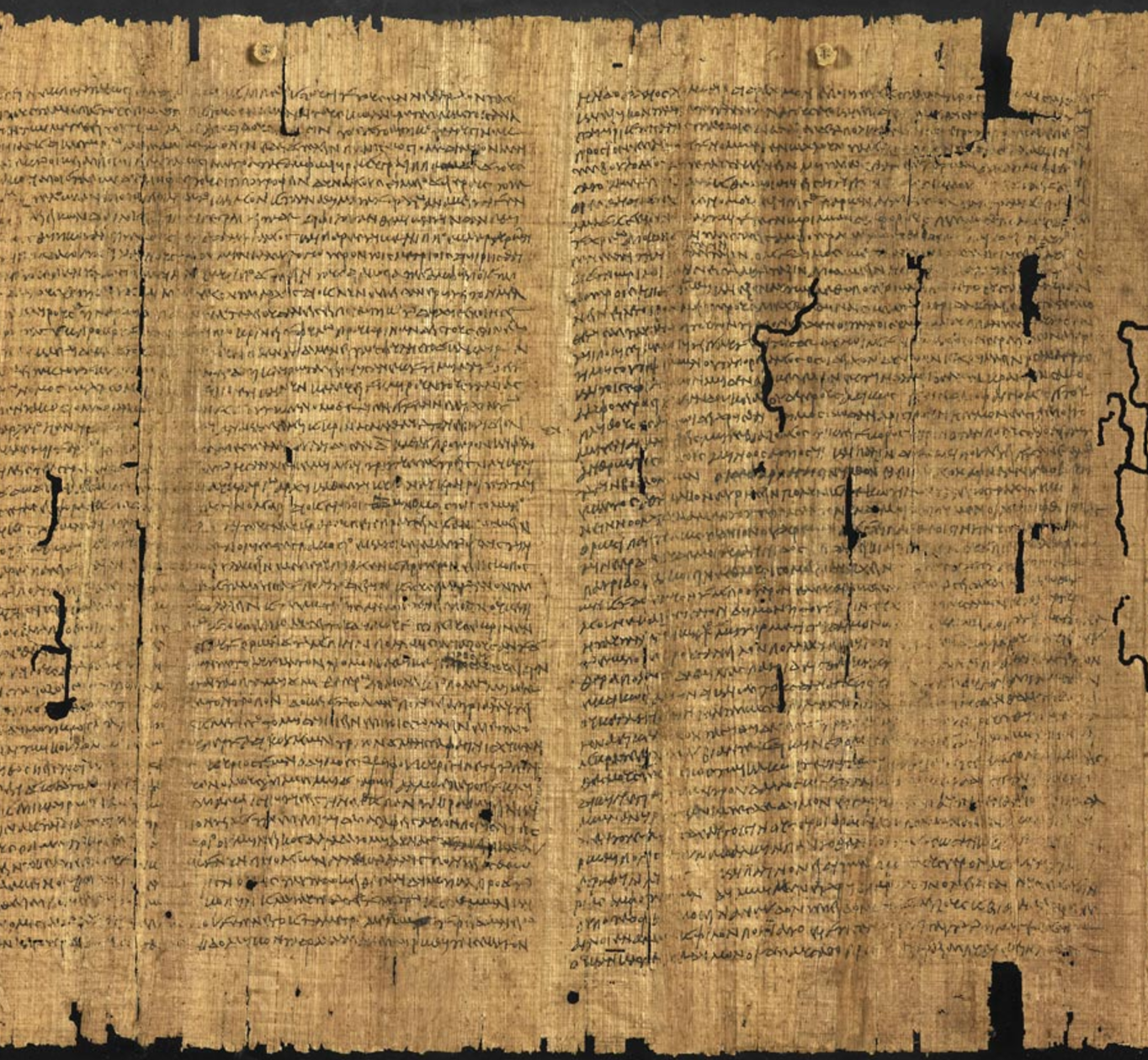
Greek thinkers also had significant influence in Egypt. During the building of the Library of Alexandria, “scholars copied and stored books that were borrowed, bought, and even stolen from other places in the Mediterranean,” writes Aileen Das, Professor of Mediterranean Studies at the University of Michigan. “The librarians gathered texts circulating under the names of Plato (d. 348/347 BCE), Aristotle and Hippocrates (c. 460–c. 370 BCE), and published them as collections.” The scroll above, part of an Aristotelian transcription of the Athenian constitution, was believed lost for hundreds of years until it was discovered in the 19th century in Egypt, in the original Greek. The text, writes the British Library, “has had a major impact in our knowledge of the development of Athenian democracy and the workings of the Athenian city-state in antiquity.”
Alexandria “rivalled Athens and Rome as the place to study philosophy and medicine in the Mediterranean,” and young men of means like the 6th century priest Sergius of Reshaina, doctor-in-chief in Northern Syria, traveled there to learn the tradition. Sergius “translated around 30 works of Galen [the Greek physician]” and other known and unknown philosophers and ancient scientists into Syriac. Later, as Syriac and Arabic came to dominate former Greek-speaking regions, the Greek texts became intense objects of focus for Islamic thinkers, and the caliphs spared no expense to have them translated and disseminated, often contracting with Christian and Jewish scholars to accomplish the task.
The transmission of Greek philosophy and medicine was an international phenomenon, which involved bilingual speakers from pagan, Christian, Muslim, and Jewish backgrounds. This movement spanned not only religious and linguistic but also geographical boundaries, for it occurred in cities as far apart as Baghdad in the East and Toledo in the West.
In Baghdad, especially, by the 10th century, “readers of Arabic,” writes Adamson, “had about the same degree of access to Aristotle that readers of English do today” thanks to a “well-funded translation movement that unfolded during the Abbasid caliphate, beginning in the second half of the eighth century.” The work done during the Abbasid period—from about 750 to 950—“generated a highly sophisticated scientific language and a massive amount of source material,” we learn in Harvard University Press’s The Classical Tradition. Such material “would feed scientific research for the following centuries, not only in the Islamic world but beyond it, in Greek and Latin Christendom and, within it, among the Jewish populations as well.”
Indeed this “Byzantine humanism,” as it’s called, “helped the classical tradition survive, at least to the large extent that it has.” As ancient texts and traditions disappeared in Europe during the so-called “Dark Ages,” Arabic and Syriac-speaking scholars and translators incorporated them into an Islamic philosophical tradition called falsafa. The motivations for fostering the study of Greek thought were complex. On the one hand, writes Adamson, the move was political; “the caliphs wanted to establish their own cultural hegemony,” in competition with Persians and Greek-speaking Byzantine Christians, “benighted as they were by the irrationalities of Christian theology.” On the other hand, “Muslim intellectuals also saw resources in the Greek texts for defending, and better understanding their own religion.”
One well-known figure from the period, al-Kindi, is thought to be the first philosopher to write in Arabic. He oversaw the translations of hundreds of texts by Christian scholars who read both Greek and Arabic, and he may also have added his own ideas to the works of Plotinus, for example, and other Greek thinkers. Like Thomas Aquinas a few hundred years later, al-Kindi attempted to “establish the identity of the first principle in Aristotle and Plotinus” as the theistic God. In this way, Islamic translations of Greek texts prepared the way for interpretations that “treat that principle as a Creator,” a central idea in Medieval scholastic philosophy and Catholic thought generally.
The translations by al-Kindi and his associates are grouped into what scholars call the “circle of al-Kindi,” which preserved and elaborated on Aristotle and the Neoplatonists. Thanks to al-Kindi’s “first set of translations,” notes the Stanford Encyclopedia of Philosophy, “learned Muslims became acquainted with Plato’s Demiurge and immortal soul; with Aristotle’s search for science and knowledge of the causes of all the phenomena on earth and in the heavens,” and many more ancient Greek metaphysical doctrines. Later translators working under physician and scientist Hunayn ibn Ishaq and his son “made available in Syriac and/or Arabic other works by Plato, Aristotle, Theophrastus, some philosophical writings by Galen,” and other Greek thinkers and scientists.
This tradition of translation, philosophical debate, and scientific discovery in Islamic societies continued into the 10th and 11th centuries, when Averroes, the “Islamic scholar who gave us modern philosophy,” wrote his commentary on the works of Aristotle. “For several centuries,” writes the University of Colorado’s Robert Pasnau, “a series of brilliant philosophers and scientists made Baghdad the intellectual center of the medieval world,” preserving ancient Greek knowledge and wisdom that may otherwise have disappeared. When it seems in our study of history that the light of the ancient philosophy was extinguished in Western Europe, we need only look to North Africa and the Near East to see that tradition, with its humanistic exchange of ideas, flourishing for centuries in a world closely connected by trade and empire.
Related Content:
Introduction to Ancient Greek History: A Free Online Course from Yale
Free Courses in Ancient History, Literature & Philosophy
Josh Jones is a writer and musician based in Durham, NC. Follow him at @jdmagness
Read More...Artists May Have Different Brains (More Grey Matter) Than the Rest of Us, According to a Recent Scientific Study
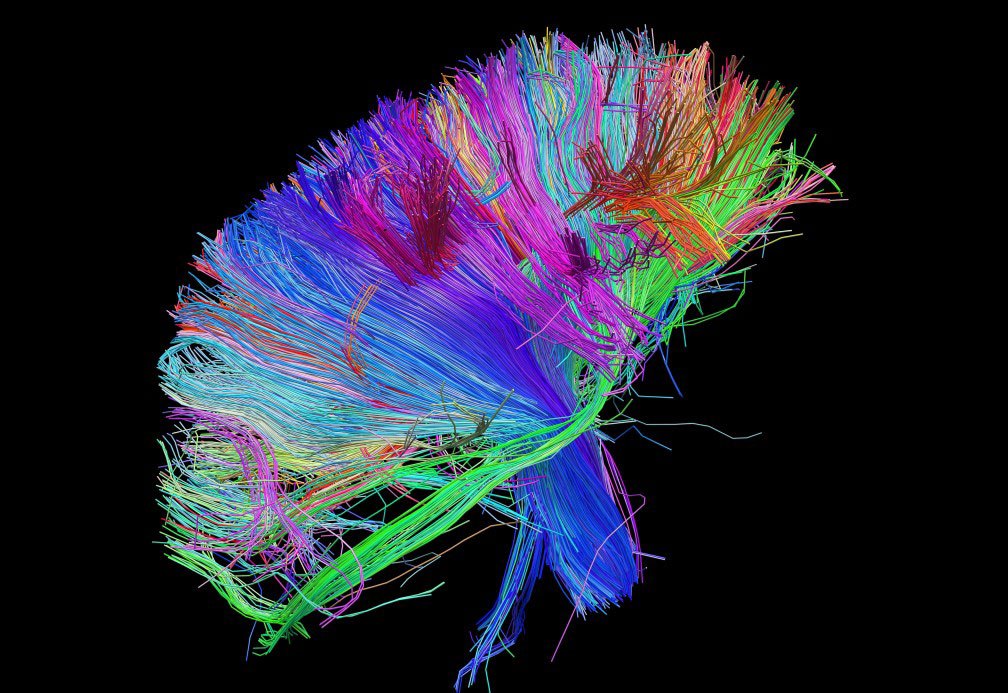
Image Photo courtesy of the Laboratory of Neuro Imaging at UCLA.
Sometimes—as in the case of neuroscience—scientists and researchers seem to be saying several contradictory things at once. Yes, opposing claims can both be true, given different context and levels of description. But which is it, Neuroscientists? Do we have “neuroplasticity”—the ability to change our brains, and therefore our behavior? Or are we “hard-wired” to be a certain way by innate structures.
The debate long predates the field of neuroscience. It figured prominently in the work, for example, of John Locke and other early modern theorists of cognition—which is why Locke is best known as the theorist of tabula rasa. In “Some Thoughts Concerning Education,” Locke mostly denies that we are able to change much at all in adulthood.
Personality, he reasoned, is determined not by biology, but in the “cradle” by “little, almost insensible impressions on our tender infancies.” Such imprints “have very important and lasting consequences.” Sorry, parents. Not only did your kid get wait-listed for that elite preschool, but their future will also be determined by millions of sights and sounds that happened around them before they could walk.
It’s an extreme, and unscientific, contention, fascinating as it may be from a cultural standpoint. Now we have psychedelic-looking brain scans popping up in our news feeds all the time, promising to reveal the true origins of consciousness and personality. But the conclusions drawn from such research are tentative and often highly contested.
So what does science say about the eternally mysterious act of artistic creation? The abilities of artists have long seemed to us godlike, drawn from supernatural sources, or channeled from other dimensions. Many neuroscientists, you may not be surprised to hear, believe that such abilities reside in the brain. Moreover, some think that artists’ brains are superior to those of mediocre ability.
Or at least that artists’ brains have more gray and white matter than “right-brained” thinkers in the areas of “visual perception, spatial navigation and fine motor skills.” So writes Katherine Brooks in a Huffington Post summary of “Drawing on the right side of the brain: A voxel-based morphometry analysis of observational drawing.” The 2014 study, published at NeuroImage, involved a very small sampling of graduate students, 21 of whom were artists, 23 of whom were not. All 44 students were asked to complete drawing tasks, which were then scored and compared to images of their brain taken by a method called “voxel-based morphometry.”
“The people who are better at drawing really seem to have more developed structures in regions of the brain that control for fine motor performance and what we call procedural memory,” the study’s lead author, Rebecca Chamberlain of Belgium’s KU Leuven University, told the BBC. (Hear her segment on BBC Radio 4’s Inside Science here.) Does this mean, as Artnet News claims in their quick take, that “artists’ brains are more fully developed?”
It’s a juicy headline, but the findings of this limited study, while “intriguing,” are “far from conclusive.” Nonetheless, it marks an important first step. “No studies” thus far, Chamberlain says, “have assessed the structural differences associated with representational skills in visual arts.” Would a dozen such studies resolve questions about causality–nature or nurture? As usual, the truth probably lies somewhere in-between.
At Smithsonian, Randy Rieland quotes several critics of the neuroscience of art, which has previously focused on what happens in the brain when we look at a Van Gogh or read Jane Austen. The problem with such studies, writes Philip Ball at Nature, is that they can lead to “creating criteria of right or wrong, either in the art itself or in individual reactions to it.” But such criteria may already be predetermined by culturally-conditioned responses to art.
The science is fascinating and may lead to numerous discoveries. It does not, as the Creators Project writes hyperbolically, suggest that “artists actually are different creatures from everyone else on the planet.” As University of California philosopher professor Alva Noe states succinctly, one problem with making sweeping generalizations about brains that view or create art is that “there can be nothing like a settled, once-and-for-all account of what art is.”
Emerging fields of “neuroaesthetics” and “neurohumanities” may muddy the waters between quantitative and qualitative distinctions, and may not really answer questions about where art comes from and what it does to us. But then again, given enough time, they just might.
Related Content:
This Is Your Brain on Jane Austen: The Neuroscience of Reading Great Literature
The Neuroscience of Drumming: Researchers Discover the Secrets of Drumming & The Human Brain
The Neuroscience & Psychology of Procrastination, and How to Overcome It
Josh Jones is a writer and musician based in Durham, NC. Follow him at @jdmagness
Read More...Manchester Benefit Concert Is Streaming Live Now
Just a quick fyi: The Manchester Benefit concert is happening now, and streaming live on YouTube. Coldplay, Pharrell Williams, Justin Bieber, Katy Perry, Miley Cyrus, Niall Horan, Usher, and Ariana Grande will all perform. Click play above to stream the live video feed.
If you would like to support the mission of Open Culture, consider making a donation to our site. It’s hard to rely 100% on ads, and your contributions will help us continue providing the best free cultural and educational materials to learners everywhere. You can contribute through PayPal, Patreon, and Venmo (@openculture). Thanks!
Read More...Support Us
We're hoping to rely on loyal readers, rather than erratic ads. Please click the Donate button and support Open Culture. You can use Paypal, Venmo, Patreon, even Crypto! We thank you!

About Us

Open Culture scours the web for the best educational media. We find the free courses and audio books you need, the language lessons & educational videos you want, and plenty of enlightenment in between.
Advertise With Us
FREE UPDATES!
GET OUR DAILY EMAIL
Get the best cultural and educational resources on the web curated for you in a daily email. We never spam. Unsubscribe at any time.
FOLLOW ON SOCIAL MEDIA
Open Culture editor Dan Colman scours the web for the best educational media. He finds the free courses and audio books you need, the language lessons & movies you want, and plenty of enlightenment in between.
Advertise With Us

