How Finland Created One of the Best Educational Systems in the World (by Doing the Opposite of U.S.)
Every conversation about education in the U.S. takes place in a minefield. Unless you’re a billionaire who bought the job of Secretary of Education, you’d better be prepared to answer questions about racial and economic equity, disability issues, protections for LGBTQ students, teacher pay and unions, religious charter schools, and many other pressing concerns. These issues are not mutually exclusive, nor are they distinct from questions of curriculum, testing, or achievement. The terrain is littered with possible explosive conflicts between educators, parents, administrators, legislators, activists, and profiteers.
The needs of the most deeply invested stakeholders, as they say, the students themselves, seem to get far too little consideration. What if we in the U.S., all of us, actually wanted to improve the educational experiences and academic outcomes for our children—all of them? Where might we look for a model? Many people have looked to Finland, at least since 2010, when the documentary Waiting for Superman contrasted struggling U.S. public schools with highly successful Finnish equivalents.
The film, a positive spin on the charter school movement, received significant backlash for its cherry-picked examples and blaming of teachers’ unions for America’s failing schools. By contrast, Finland’s schools have been described by William Doyle, an American Fulbright Scholar who studies them, as “the ‘ultimate charter school network’ ” (a phrase, we’ll see, that means little in the Finnish context.) There, Doyle writes at The Hechinger Report, “teachers are not strait-jacketed by bureaucrats, scripts or excessive regulations, but have the freedom to innovate and experiment as teams of trusted professionals.”
Last year, Michael Moore featured many of Finland’s innovative educational experiments in his humorous, hopeful travelogue Where to Invade Next. In the clip above, you can hear from the country’s Minister of Education, Krista Kiuru, who explains to him why Finnish children do not have homework; hear also from a group of high school students, high school principal Pasi Majassari, first grade teacher Anna Hart and many others. Shorter school hours—the “shortest school days and shortest school years in the entire Western world”—leave plenty of time for leisure and recreation. Kids bake, hike, build things, make art, conduct experiments, sing, and generally enjoy themselves.
“There are no mandated standardized tests,” writes LynNell Hancock at Smithsonian, “apart from one exam at the end of students’ senior year in high school… there are no rankings, no comparisons or competition between students, schools or regions.” Yet Finnish students have, in the past several years, consistently ranked in the top ten among millions of students worldwide in science, reading, and math. “If there was one thing I kept hearing over and over again from the Finns,” says Moore above, “it’s that America should get rid of standardized tests,” should stop teaching to those tests, stop designing entire curricula around multiple-choice tests. Hancock describes the results of the Finnish system, and its costs:
Ninety-three percent of Finns graduate from academic or vocational high schools, 17.5 percentage points higher than the United States, and 66 percent go on to higher education, the highest rate in the European Union. Yet Finland spends about 30 percent less per student than the United States.
Moore’s camera registers the shock on Finnish educators’ faces when they hear that many U.S. schools eliminated music, art, poetry and other pursuits in order to focus almost exclusively on testing. Though lighthearted in tone, the segment really drives home the depressing degree to which so many U.S. students receive an impoverished education—one barely worthy of the name—unless they luck into a voucher for a high-end charter school or have the independent means for an expensive private one. In Finland, says the Minister of Education, “all the schools are equal. You never ask where the best school is.”
It’s also illegal in Finland to profit from schooling. Wealthy parents have to ensure that neighborhood schools can give their kids the best education possible, because they are the only option. Many people in the U.S. object to comparisons like Moore’s by noting that societies like Finland are “homogenous” next to what may seem to them like maddening cultural diversity in the U.S. However, Finland has incorporated (not without difficulty) large immigrant and refugee populations—even as its schools continue to improve. The government has responded in part to rising immigration with educational solutions such as this one, a “national initiative to reinforce Finnish higher education institutions (HEIs) as significant stakeholders in migrants’ integration.”
The subtantive differences between the two countries’ educational systems may have less to do with demography and more to do with economics and the training and social status of teachers.
In Finland, writes Doyle, no teacher “is allowed to lead a primary school class without a master’s degree in education, with specialization in research and classroom practice.” Teaching “is the most admired job in Finland next to medical doctors.” And as Dana Goldstein points out at The Nation—a fact Waiting for Superman failed to mention—Finnish teachers are “gasp!—unionized and granted tenure.” Perhaps an even more significant difference the documentary glossed over: in Finland, “families benefit from a cradle-to-grave social welfare system that includes universal daycare, preschool and healthcare, all of which are proven to help children achieve better results at school.”
Hundreds of studies in recent years substantiate this claim. It would seem intuitive that stresses associated with hunger and poverty would have a pernicious effect on learning, especially when poorer schools are so egregiously under-resourced. And the data says as much, to varying degrees. And yet, we are now in the U.S. slashing breakfast and lunch programs that feed hungry children and deciding whether to uninsure millions of families as millions more still lack basic health coverage. Most every American parent knows that quality daycares and preschools can cost as much per year as a decent university education in this country.
It seems to many of us that the atrocious state of the U.S. educational system can only be attributed to an act of will on the part our political elite, who see schools as competition for fundamentalist belief systems, opportunities to punish their opponents out of spite, or as rich fields for private profit. But it needn’t be so. It took 40 years for the Finns to create their current system. In the 1960s, their schools ranked on the very low end—along with those in the U.S. By most accounts, they’ve since shown there can be systems that, while surely imperfect in their own way, work for all kids, embedded within larger systems that prize their teachers and families.
Related Content:
In Japanese Schools, Lunch Is As Much About Learning As It’s About Eating
Josh Jones is a writer and musician based in Durham, NC. Follow him at @jdmagness
Read More...The Story of Habitat, the Very First Large-Scale Online Role-Playing Game (1986)
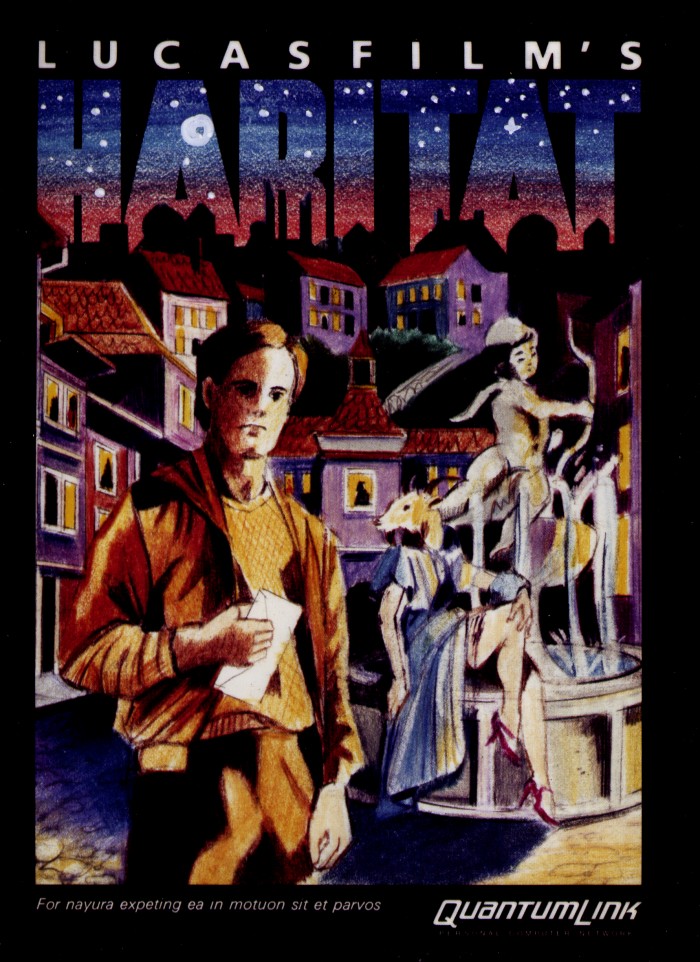
Long before World of Warcraft, before Everquest and Second Life, and even before Ultima Online, computer-gamers of the 1980s looking for an online world to explore with others of their kind could fire up their Commodore 64s, switch on their dial-up modems, and log into Habitat. Brought out for the Commodore online service Quantum Link by Lucasfilm Games (later known as the developer of such classic point-and-click adventure games as Maniac Mansion and The Secret of Monkey Island, now known as Lucasarts), Habitat debuted as the very first large-scale graphical virtual community, blazing a trail for all the massively multiplayer online role-playing games (or MMORPGs) so many of us spend so much of our time playing today.
Designed, in the words of creators Chip Morningstar and F. Randall Farmer, to “support a population of thousands of users in a single shared cyberspace,” Habitat presented “a real-time animated view into an online simulated world in which users can communicate, play games, go on adventures, fall in love, get married, get divorced, start businesses, found religions, wage wars, protest against them, and experiment with self-government.” All that happened and more within the service’s virtual reality during its pilot run from 1986 to 1988. The features both cautiously and recklessly implemented by Habitat’s developers, and the feedback they received from its users, laid down the template for all the more advanced graphical online worlds to come.
At the top of the post, you can watch Lucasfilm’s original Habitat promotional video promise a “strange new world where names can change as quickly as events, surprises lurk at every turn, and the keynotes of existence are fantasy and fun,” one where “thousands of avatars, each controlled by a different human, can converge to shape an imaginary society.” (All performed, the narrator notes, “with the cooperation of a huge mainframe computer in Virginia.”) The form this society eventually took impressed Habitat’s creators as much as anyone, as Farmer writes in his “Habitat Anecdotes” from 1988, an examination of the most memorable happenings and phenomena among its users.
Farmer found he could group those users into five now-familiar categories: the Passives (who “want to ‘be entertained’ with no effort, like watching TV”), the Active (whose “biggest problem is overspending”), the Motivators (the most valuable users, for they “understand that Habitat is what they make of it”), the Caretakers (employees who “help the new users, control personal conflicts, record bugs” and so on), and the Geek Gods (the virtual world’s all-powerful administrators). Sometimes everyone got along smoothly, and sometimes — inevitably, given that everyone had to define the properties of this brand new medium even as they experienced it — they didn’t.
“At first, during early testing, we found out that people were taking stuff out of others’ hands and shooting people in their own homes,” Farmer writes. Later, a Greek Orthodox Minister opened Habitat’s first church, but “I had to eventually put a lock on the Church’s front door because every time he decorated (with flowers), someone would steal and pawn them while he was not logged in!” This citizen-governed virtual society eventually elected a sheriff from among its users, though the designers could never quite decide what powers to grant him. Other surprisingly “real world” institutions developed, including a newspaper whose user-publisher “tirelessly spent 20–40 hours a week composing a 20, 30, 40 or even 50 page tabloid containing the latest news, events, rumors, and even fictional articles.”
Though developing this then-advanced software for “the ludicrous Commodore 64” posed a serious technical challenge, write Farmer and Morningstar in their 1990 paper “The Lessons of Lucasfilm’s Habitat,” the real work began when the users logged on. All the avatars needed houses, “organized into towns and cities with associated traffic arteries and shopping and recreational areas” with “wilderness areas between the towns so that everyone would not be jammed together into the same place.” Most of all, they needed interesting places to visit, “and since they can’t all be in the same place at the same time, they needed a lot of interesting places to visit. [ … ] Each of those houses, towns, roads, shops, forests, theaters, arenas, and other places is a distinct entity that someone needs to design and create. Attempting to play the role of omniscient central planners, we were swamped.”
All this, the creators discovered, required them to stop thinking like the engineers and game designers they were, giving up all hope of rigorous central planning and world-building in favor of figuring out the tricker problem of how, “like the cruise director on an ocean voyage,” to make Habitat fun for everyone. Farmer faces that question again today, having launched the open-source NeoHabitat project earlier this year with the aim of reviving the Habitat world for the 21st century. As much progress as graphical multiplayer online games have made in the past thirty years, the conclusion Farmer and Morningstar reached after their experience creating the first one holds as true as ever: “Cyberspace may indeed change humanity, but only if it begins with humanity as it really is.”
Related Content:
Free: Play 2,400 Vintage Computer Games in Your Web Browser
Long Live Glitch! The Art & Code from the Game Now Released into the Public Domain
Based in Seoul, Colin Marshall writes and broadcasts on cities and culture. He’s at work on a book about Los Angeles, A Los Angeles Primer, the video series The City in Cinema, the crowdfunded journalism project Where Is the City of the Future?, and the Los Angeles Review of Books’ Korea Blog. Follow him on Twitter at @colinmarshall or on Facebook.
Read More...Huge Hands Rise Out of Venice’s Waters to Support the City Threatened by Climate Change: A Poignant New Sculpture
Upon arriving in Venice in the late 1930s, columnist and Algonquin Round Table regular Robert Benchley immediately sent a telegram back home to America: “Streets full of water. Please advise.” The line has taken its place in the canon of American humor, but in more recent times the image of water-filled streets — unintentionally water-filled streets, that is — has arisen most often in the conversation about climate change. Some of the potential disaster scenarios envision every major coastal city on Earth eventually turning into a kind of Venice, albeit a much less pleasant version thereof.
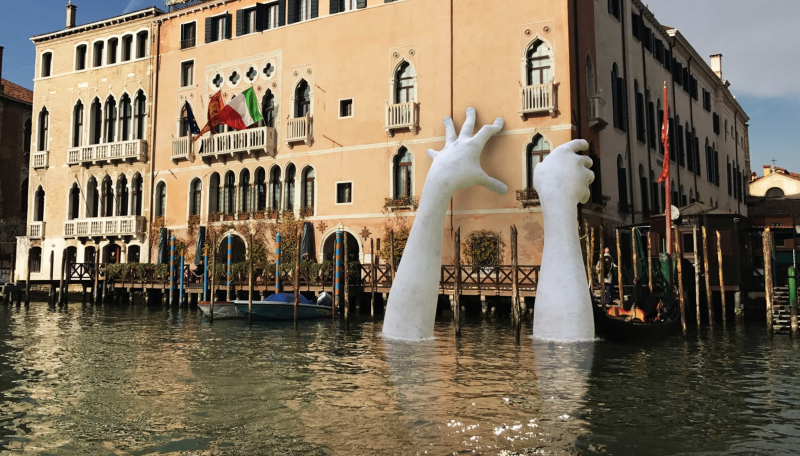
And so what better place than the one that hosts perhaps the world’s best known art exhibition, the Venice Biennale, to express climate-change anxiety in the form of public sculpture? “Venice is known for its gondolas, canals, and historic bridges,” writes Condé Nast Traveler’s Sebastian Modak, “but visitors will now also be greeted by another, albeit temporary, reminder of the city’s intimate relationship with water: a giant pair of hands reaching out of the Grand Canal and appearing to support the walls of the historic Ca’ Sagredo Hotel.” The piece is called Support, and it’s created by Barcelona-based Italian sculptor Lorenzo Quinn.
“I have three children, and I’m thinking about their generation and what world we’re going to pass on to them,” Quinn told Mashable’s Maria Gallucci. “I’m worried, I’m very worried.” The hands of his 11-year-old son actually provided the model for the polyurethane-and-resin hands of Support, weighing 5,000 pounds each, that stand on 30-foot pillars at the bottom of the Grand Canal. Modak quotes one of Quinn’s Instagram posts which describes the work as speaking to the people “in a clear, simple and direct way through the innocent hands of a child and it evokes a powerful message, which is that united we can make a stand to curb the climate change that affects us all.”
Those arguing in favor of more aggressive political measures to counteract the effects of climate change have gone to great lengths to point out what forms those effects have so far taken. But the fact that, apart from a stretch of hot summers, few of those effects have yet manifested undeniably in most people’s lives has certainly made their job harder. But nobody who visits Venice during the Biennale could fail to pause before Support, a work whose visual drama demands a reaction that temperature charts or data-filled studies can’t hope to provoke by themselves. And even apart from the issue at hand, as it were, Quinn’s sculpture reminds us that art, even in as deeply historical a setting as Venice, can also keep us thinking about the future.
Related Content:
Global Warming: A Free Course from UChicago Explains Climate Change
132 Years of Global Warming Visualized in 26 Dramatically Animated Seconds
A Song of Our Warming Planet: Cellist Turns 130 Years of Climate Change Data into Music
How Climate Change Is Threatening Your Daily Cup of Coffee
Frank Capra’s Science Film The Unchained Goddess Warns of Climate Change in 1958
Watch Episode 1 of Years of Living Dangerously, The New Showtime Series on Climate Change
Based in Seoul, Colin Marshall writes and broadcasts on cities and culture. He’s at work on a book about Los Angeles, A Los Angeles Primer, the video series The City in Cinema, the crowdfunded journalism project Where Is the City of the Future?, and the Los Angeles Review of Books’ Korea Blog. Follow him on Twitter at @colinmarshall or on Facebook.
Read More...Japanese Computer Artist Makes “Digital Mondrians” in 1964: When Giant Mainframe Computers Were First Used to Create Art
In the 21st century, most of us have tried our hand at making some kind of digital art or another — even if only touching up cellphone photos of ourselves — but imagine the task of producing it 50 years ago. To make digital art before the world had barely heard the term “digital” required access to a mainframe computer, those hugely expensive hulks that filled rooms and printed out reams and reams of paper data, and the considerable technical know-how to operate it.
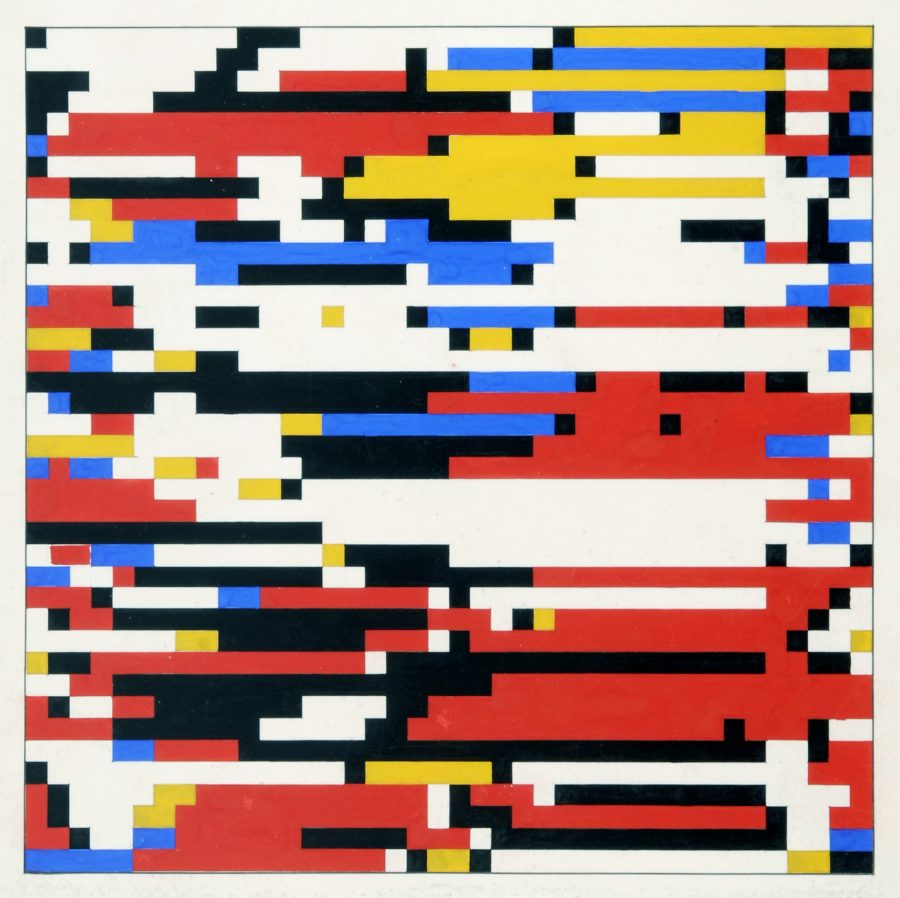
But the achievement also, to go by the very early example of Hiroshi Kawano, required a background in philosophy. A graduate of the University of Tokyo majoring in aesthetics and the philosophy of science before becoming a research assistant at that school and then a lecturer at the Tokyo Metropolitan College of Air-Technology, Kawano marshaled his knowledge and experience to create these “digital Mondrians,” so described because of their computer-generated resemblance to that Dutch painter’s most rigorously angular, solidly colored work.

Kawano had drawn inspiration, according to a Deutsche Welle article on his donation of his archives to Germany’s Center for Media Art, from “the writings of the German philosopher Max Bense, who proposed (among other things) the idea of measuring beauty using scientific rules. At the same time, Kawano heard that scientists were using computers to create music. Putting the two together, he decided to explore the possibility of using a computer to program beauty.”

Doing so required “writing programs in complex computer languages, then laboriously punching these programs into hundreds of cards before feeding them into the machine.” And “while the design of his works produced during the 1960s might look simple — they’re not. They are the result of complex mathematical algorithms programmed so that, although Kawano sets the rules for how the picture could look, he can’t determine exactly what will appear on the printer.”
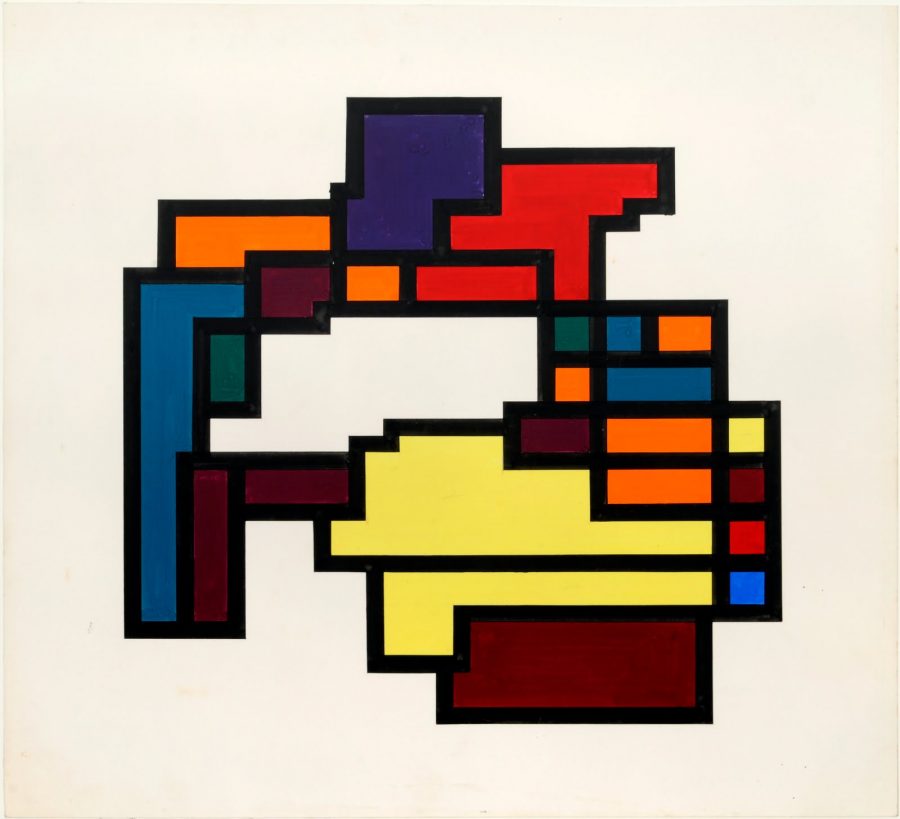
Just before Kawano passed away in 2012, the ZKM (or Center for Art and Media Karlsruhe), celebrated his pioneering digital art with the exhibition “The Philosopher at the Computer,” some of which you can see in this German-language video clip. “The retrospective emphasizes Kawano’s special role in the circle of pioneers in ‘computer art,’ ” says its introduction. “He was neither artist, who discovered the computer as a new production medium and theme, nor engineer who came to art via the new machine, but a philosopher, who left his desk for the computer center to experiment with theoretical models.”
Can computers create art? Can they even be used to create art? These questions now have practically obvious answers in the affirmative, but back in 1964 when Kawano produced the first of these pieces, working through trial and error with the advice of the curious staff of his university’s computer center, the questions must have sounded impossibly philosophical. Today, writes Overhead Compartment’s Claudio Rivera, Kawano’s digital Mondrians “suggest themselves as an oddly ephemeral transition in the nexus of technology and art. The familiar colors and forms are flash-frozen in crystalline pixelation, almost as if seized up in the final, overheated throes of a suddenly-too-old computer.”
Related Content:
Andy Warhol’s Lost Computer Art Found on 30-Year-Old Floppy Disks
Watch the Dutch Paint “the Largest Mondrian Painting in the World”
Based in Seoul, Colin Marshall writes and broadcasts on cities and culture. He’s at work on a book about Los Angeles, A Los Angeles Primer, the video series The City in Cinema, the crowdfunded journalism project Where Is the City of the Future?, and the Los Angeles Review of Books’ Korea Blog. Follow him on Twitter at @colinmarshall or on Facebook.
Read More...Holocaust Survivor Viktor Frankl Explains Why If We Have True Meaning in Our Lives, We Can Make It Through the Darkest of Times
In one school of popular reasoning, people judge historical outcomes that they think are favorable as worthy tradeoffs for historical atrocities. The argument appears in some of the most inappropriate contexts, such as discussions of slavery or the Holocaust. Or in individual thought experiments, such as that of a famous inventor whose birth was the result of a brutal assault. There are a great many people who consider this thinking repulsive, morally corrosive, and astoundingly presumptuous. Not only does it assume that every terrible thing that happens is part of a benevolent design, but it pretends to know which circumstances count as unqualified goods, and which can be blithely ignored. It determines future actions from a tidy and convenient story of the past.
We might contrast this attitude with a more Zen stance, for example, a radically agnostic “wait and see” approach to everything that happens. Not-knowing seems to give meditating monks a great deal of serenity in practice. But the theory terrifies most of us. Effects must have causes, we think, causes must have effects, and in order to predict what’s going to happen next (and thereby save our skins), we must know why we’re doing what we’re doing. The deep impulse is what psychologist and psychotherapist Viktor Frankl identifies, in his pre-gender-neutrally titled book, as Man’s Search for Meaning. Despite the misuse of this faculty to create neurotic or dehumanizing myths, “man’s search for meaning,” writes Frankl, “is the primary motivation in his life and not a ‘secondary rationalization’ of instinctual drives.”
Frankl understood perfectly well how the construction of meaning—through narrative, art, relationships, social fictions, etc.—might be perverted for murderous ends. He was a survivor of four concentration camps, which took the lives of his parents, brother, and wife. The first part of his book, “Experiences in a Concentration Camp,” recounts the horror in detail, sparing no one accountability for their actions. From these experiences, Frankl draws a conclusion, one he explains in the interview above in two parts from 1977. “The lesson one could learn from Auschwitz,” he says, “and in other concentration camps, in the final analysis was, those who were oriented toward a meaning—toward a meaning to be fulfilled by them in the future—were most likely to survive” beyond the experience. “The question,” Frankl says, “was survival for what?” (See a short animated summary of Frankl’s book below.)
Frankl does not excuse the deaths of his family, friends, and millions of others in his psychological theory, which he calls logotherapy. He certainly does not trivialize the most unimaginable of in-human experiences. “We all said to each other in camp,” he writes, “that there could be no earthly happiness which could compensate for all we had suffered.” But it was not the hope of happiness that “gave us courage,” he writes. It was the “will to meaning” that looked to the future, not to the past. In Frankl’s existentialist view, we ourselves create that meaning, for ourselves, and not for others. Logotherapy, Frankl writes, “defocuses all the vicious-circle formations and feedback mechanisms which play such a great role in the development of neuroses.” We must acknowledge the need to make sense of our lives and fill what Frankl called the “existential vacuum.” And we alone are responsible for writing better stories for ourselves.
To dig deeper in Frankl’s philosophy, you can read not only Man’s Search for Meaning but also The Will to Meaning: Foundations and Applications of Logotherapy.
Related Content:
Albert Camus’ Historic Lecture, “The Human Crisis,” Performed by Actor Viggo Mortensen
Josh Jones is a writer and musician based in Durham, NC. Follow him at @jdmagness
Read More...New Film Project Features Citizens of Alabama Reading Walt Whitman’s “Song of Myself,” a Poetic Embodiment of Democratic Ideals
In times of national anxiety, many of us take comfort in the fact that the U.S. has endured political crises even more severe than those at hand. History can be a teacher and a guide, and so too can poetry, as Walt Whitman reminds us again and again. Whitman witnessed some of the greatest upheavals and revolutionary changes the country has ever experienced: the Civil War and its aftermath, the assassination of Abraham Lincoln, the failure of Reconstruction, the massive industrialization of the country at the end of the 19th century.…
Perhaps this is why we return to Whitman when we make what critics call a “poetic turn.” His expansive, multivalent verse speaks for us when beauty, shock, or sadness exceed the limits of everyday language. Whitman contained the nation’s warring voices, and somehow reconciled them without diluting their uniqueness. This was, indeed, his literary mission, to “create a unified whole out of disparate parts,” argues Karen Swallow Prior at The Atlantic. “For Whitman, poetry wasn’t just a vehicle for expressing political lament; it was also a political force in itself.” Poetry’s importance as a binding agent in the fractious, fragile coalition of states, meant that for Whitman, the country’s “Presidents shall not be their common referee so much as their poets shall.”
Whitman wrote as a gay man who, by the time he published the first edition of Leaves of Grass in 1855, had gone from being an “ardent Free-Soiler” to fully supporting abolition. His poetry proclaimed a “radically egalitarian vision,” writes Martin Klammer, “of an ideal, multiracial republic.” A country that was, itself, a poem. “The United States themselves are essentially the greatest poem,” wrote Whitman in his preface. The nation’s contradictions inhabit us just as we inhabit them. The only way to resolve our differences, he insisted, is to embody them fully, with openness toward other people and the natural world. Understanding Whitman’s mission makes filmmaker Jennifer Crandall’s project Whitman, Alabama all the more poignant.
For two years, Crandall “crisscrossed this deep Southern state, inviting people to look into a camera and share part of themselves through the words of Walt Whitman.” To the question “Who is American?,” Crandall—just as Whitman before her—answers with a multitude of voices, weaving in and out of a collaborative reading of the epic “Song of Myself,” beginning with 97-year-old Virginia Mae Schmitt of Birmingham, at the top, who reads Whitman’s lines, “I, now thirty-seven years old in perfect health begin / Hoping to cease not till death.” No one watching the video, Crandall remarks, should ask, “Why isn’t’ a thirty-seven year old man reading this?” To do so is to ignore Whitman’s design for the universal in the particular.
When Whitman penned the first lines of “Song of Myself,” the country had not yet “Unlimber’d” the cannons “to begin the red business,” as he would later write, but the 1850 Fugitive Slave Act had clearly lain the foundation for civil war. The poet’s many revisions, additions, and subsequent editions of Leaves of Grass after his first small run in 1855 continued until his death in 1892. He was obsessed with the hugeness and dynamism of the country and its people, in their darkest, bloodiest moments and at their most flourishing. His vision lets everyone in, without qualification, constantly rewriting itself to meet new faces in the ever-changing nation.
As Mariam Jalloh, a 14-year old Muslim girl from Guinea, recites in her short portion of the reading further up, “every atom belonging to me as good belongs to you.” Jollah quite literally makes Whitman’s language her own, translating into her native Fulani the line, “If they are not just as close as they are distant, they are nothing.” Jalloh “may seem like a surprising conduit for the writing of Whitman, a long-dead queer socialist poet from Brooklyn,” writes Christian Kerr at Hyperallergic, “but such incongruity is the active agent in Whitman, Alabama’s therapeutic salve.” It is also, Whitman suggested, the matrix of American democracy.
See more readings from the project above from Laura and Brandon Reeder of Cullman, the Sullivan family of Mobile, and by Demetrius Leslie and Frederick George, and Patricia Marshall and Tammy Cooper, inmates at mens’ and womens’ prisons in Montgomery. Whitman’s voice winds through these bodies and voices, settling in, finding a home, then, restless, moving on, inviting us all to join in the chorus, yet also—in its contrarian way—telling us to find our own paths. “You shall no longer take things at second or third hand.…,” wrote Whitman, “nor look through the eyes of the dead, nor feed on the spectres in books, / You shall not look through my eyes either, nor take things from me, / You shall listen to all sides and filter them from yourself.”
Find many more readings at the Whitman, Alabama website. And stay tuned for new readings as they come online.
Also find works by Walt Whitman on our lists of Free Audio Books and Free eBooks.
Related Content:
The Civil War & Reconstruction: A Free Course from Yale University
Josh Jones is a writer and musician based in Durham, NC. Follow him at @jdmagness
Read More...Alec Baldwin Has a Podcast: Hear His Intimate Interviews with Patti Smith, Thom Yorke, Jerry Seinfeld, Ira Glass, Amy Schumer & More
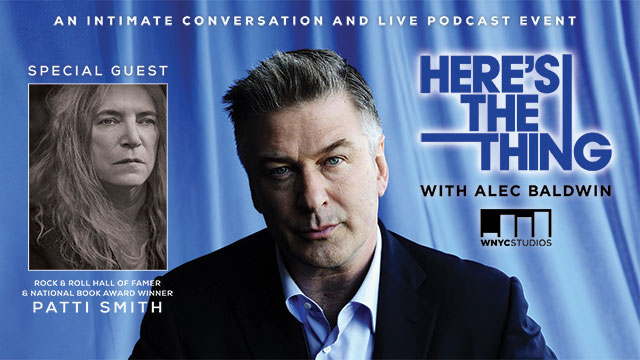
It somehow escaped me. Alec Baldwin has a podcast. With 133 episodes in its archive, Here’s The Thing with Alec Baldwin (Web — iTunes — Feeds) features “intimate and honest conversations” with “artists, policy makers and performers – to hear their stories, what inspires their creations, what decisions changed their careers, and what relationships influenced their work.” Below, we’ve embedded his recent conversation with Patti Smith. It’s quite good. But there are so many others worth a mention. Let me rattle off a quick list: REM’s Michael Stipe, Viggo Mortensen, Michael Pollan, Amy Schumer and Judd Apatow, William Friedkin, Paul Simon, Ira Glass, Jerry Seinfeld, David Simon, Radiohead’s Thom Yorke, Lena Dunham, Peter Frampton, David Letterman, Carol Burnett, Kristen Wiig, SNL’s Lorne Michaels, and Chris Rock.
Click the links to stream each interview, and don’t miss Baldwin’s new memoir, Nevertheless. He happens to narrate the audiobook version, which you can download for free if you sign up for Audible.com’s 30-day free trial. We have info on that here.
If you would like to support the mission of Open Culture, consider making a donation to our site. It’s hard to rely 100% on ads, and your contributions will help us continue providing the best free cultural and educational materials to learners everywhere. You can contribute through PayPal, Patreon, and Venmo (@openculture). Thanks!
Read More...Hamilton’s Lin-Manuel Miranda Creates a 19-Song Playlist to Help You Get Over Writer’s Block

Photo by Steve Jurvetson, via Flickr Commons
Last year we alerted you to a short doc about authors and their relationship with writer’s block. Many were philosophical. Others like Philipp Meyer dismissed it: ““I don’t think writer’s block actually exists,” he said. “It’s basically insecurity.”
How seriously you take it or how terribly it affects you, we have a Spotify playlist created by Lin-Manuel Miranda of Hamilton fame called “Write Your Way Out.”
He revealed the playlist on his Twitter feed on March 20 with an apology that the mix took longer to make than expected. It is a mix, he said, “about writing, songs that feature great writing, and everything in between.” Like his other mixes, he’s thinking about us, that kindly Mr. Miranda.
The eclectic mix begins with “Happy Birthday Darling” from Bright Lights Big City (“Now when you write my son, make the choice, find your voice, look down deep in your heart”), then features English-language hip hop from the Hamilton Mixtape (Nas’ “Wrote My Way Out”) and Spanish-language hip hop from Calle 13 (“Adentro”), folk classics (Joni Mitchell’s “Chelsea Morning”, Bob Dylan’s “My Back Pages”), even some jaunty pop from Vampire Weekend (“Oxford Comma”) and Sara Bareilles (“Love Song”). He ends with Raúl Esparza’s ballad “Why” from the musical Tick, Tick, BOOM!, which closes the mix with a paean to the healthy addiction of creativity. (“I make a vow, right here and now / I’m gonna spend my time this way,” he sings.)
And don’t worry if you don’t have Spotify (which you can download here). He’s listed the tracks on his Twitter post too.
It’s nice to know that Miranda fussed over this selection like one used to do back in the days of cassette tapes. Does that mean he has a crush on all of us?
Related Content:
How Famous Writers Deal With Writer’s Block: Their Tips & Tricks
Ray Bradbury Gives 12 Pieces of Writing Advice to Young Authors (2001)
Ted Mills is a freelance writer on the arts who currently hosts the artist interview-based FunkZone Podcast and is the producer of KCRW’s Curious Coast. You can also follow him on Twitter at @tedmills, read his other arts writing at tedmills.com and/or watch his films here.
Read More...S‑Town: The Podcast That Will Help You Binge-Listen Your Way Through This Week
Last week, the folks behind Serial and This American Life, teamed up to release S‑Town (short for Shittown), a seven-episode/seven-hour podcast which I devoured in three days flat. I don’t want to give any spoilers. So let me give you just the text that promotes the podcast on iTunes, and then suggest you start listening:
John despises his Alabama town and decides to do something about it. He asks a reporter to investigate the son of a wealthy family who’s allegedly been bragging that he got away with murder. But then someone else ends up dead, sparking a nasty feud, a hunt for hidden treasure, and an unearthing of the mysteries of one man’s life.
Find episodes on iTunes, Stitcher, RSS feed, Radio Public, or the web.
If you would like to support the mission of Open Culture, consider making a donation to our site. It’s hard to rely 100% on ads, and your contributions will help us continue providing the best free cultural and educational materials to learners everywhere. You can contribute through PayPal, Patreon, and Venmo (@openculture). Thanks!
Read More...I’m Just a Pill: A Schoolhouse Rock Classic Gets Reimagined to Defend Reproductive Rights in 2017
Like many American children of the 70s and 80s, my understanding of how our government is supposed to function was shaped by Schoolhouse Rock.
Immigration, separation of legislative, executive and judicial powers and of course, the promise of the Constitution (“a list of principles for keepin’ people free”) were just a few of the topics the animated musical series covered with clarity and wit.
The new world order in which we’ve recently found ourselves suggests that 2017 would be a grand year to start rolling out more such videos.
The Lady Parts Justice League, a self-declared “cabal of comics and writers exposing creeps hellbent on destroying access to birth control and abortion” leads the charge with the above homage to Schoolhouse Rock’s 1976 hit, “I’m Just a Bill,” recasting the original’s glum aspirant law as a feisty Plan B contraceptive pill. The red haired boy who kept the bill company on the steps of the Capital is now a teenage girl, confused as to how any legal, over-the-counter method for reducing the risk of unwanted pregnancy could have so many enemies.
As with the original series, the prime objective is to educate, and comic Lea DeLaria’s Pill happily obliges, explaining that while people may disagree as to when “life” begins, it’s a scientific fact that pregnancy begins when a fertilized egg lodges itself in the uterus. (DeLaria plays Big Boo on Orange is the New Black, by the way.) That process takes a while—72 hours to be exact. Plenty of time for the participants to scuttle off to the drugstore for emergency contraception, aka Plan B, the so called “morning-after” pill.
As per the drug’s website, if taken within 72 hours after unprotected sex, Plan B can reduce the risk of pregnancy by up to 89%. Taken within 24 hours, it is about 95% effective.
And yes, teenagers can legally purchase it, though Teen Vogue has reported on numerous stores who’ve made it difficult, if not impossible, for shoppers to gain access to the pill.
(The Reproductive Justice Project encourages consumers to help them collect data on whether Plan B is correctly displayed on the shelves as available for sale to any woman of childbearing age.)
There’s a helpful football analogy for those who may be a bit slow in understanding that Plan B is indeed a bonafide contraceptive, and not the abortifacient some mistakenly make it out to be. It’s NSFW, but only just, as a team of cartoon penis-outlines push down the field toward the uterine wall in the end zone.
The other bills who once stood in line awaiting the president’s signature have been reimagined as sperm, while songwriter Holly Miranda pays tribute to Dave Frishberg’s lyrics with a pizzazz worthy of the original:
I’m just a pill
A helpful birth control pill
No matter what they say on Capital Hill
So now you know my truth
I’m all about prevention
If your condom breaks
I’m here for intervention
Join me take a stand today
I really hope and pray that you will
Drop some facts
Tell the world
I’m a pill.
Let’s hope the resistance yields more catchy, educational animations!
And here, for comparison’s sake, is the magnificent original:
Via BUST Magazine
Related Content:
Schoolhouse Rock: Revisit a Collection of Nostalgia-Inducing Educational Videos
Conspiracy Theory Rock: The Schoolhouse Rock Parody Saturday Night Live May Have Censored
Ayun Halliday is an author, illustrator, theater maker and Chief Primatologist of the East Village Inky zine. Follow her @AyunHalliday.
Read More...Support Us
We're hoping to rely on loyal readers, rather than erratic ads. Please click the Donate button and support Open Culture. You can use Paypal, Venmo, Patreon, even Crypto! We thank you!

About Us

Open Culture scours the web for the best educational media. We find the free courses and audio books you need, the language lessons & educational videos you want, and plenty of enlightenment in between.
Advertise With Us
FREE UPDATES!
GET OUR DAILY EMAIL
Get the best cultural and educational resources on the web curated for you in a daily email. We never spam. Unsubscribe at any time.
FOLLOW ON SOCIAL MEDIA
Open Culture editor Dan Colman scours the web for the best educational media. He finds the free courses and audio books you need, the language lessons & movies you want, and plenty of enlightenment in between.
Advertise With Us