Young Patti Smith Rails Against the Censorship of Her Music: An Animated, NSFW Interview from 1976
The latest installment from Blank on Blank’s series of animated videos drops us inside the bohemian Portobello Hotel in London. It’s May, 1976, and we hear a young Patti Smith railing against the censorship of her music, using some colorful–that is to say, NSFW–words. She talks Rimbaud. The poetry and combat of rock. The dreams and hallucinations that feed her music. The stuff that would eventually earn her the cred to be called The Godmother of Punk.
The audio is part of a longer, two-hour interview with Mick Gold, which is available through Amazon and iTunes. Enjoy.
If you would like to support the mission of Open Culture, consider making a donation to our site. It’s hard to rely 100% on ads, and your contributions will help us continue providing the best free cultural and educational materials to learners everywhere. You can contribute through PayPal, Patreon, and Venmo (@openculture). Thanks!
Related Content:
Patti Smith’s List of Favorite Books: From Rimbaud to Susan Sontag
Patti Smith’s Cover of Nirvana’s “Smells Like Teen Spirit” Strips the Song Down to its Heart
Patti Smith Reads Her Final Words to Robert Mapplethorpe
Read More...Call Me Burroughs: Hear William S. Burroughs Read from Naked Lunch & The Soft Machine in His First Spoken Word Album (1965)
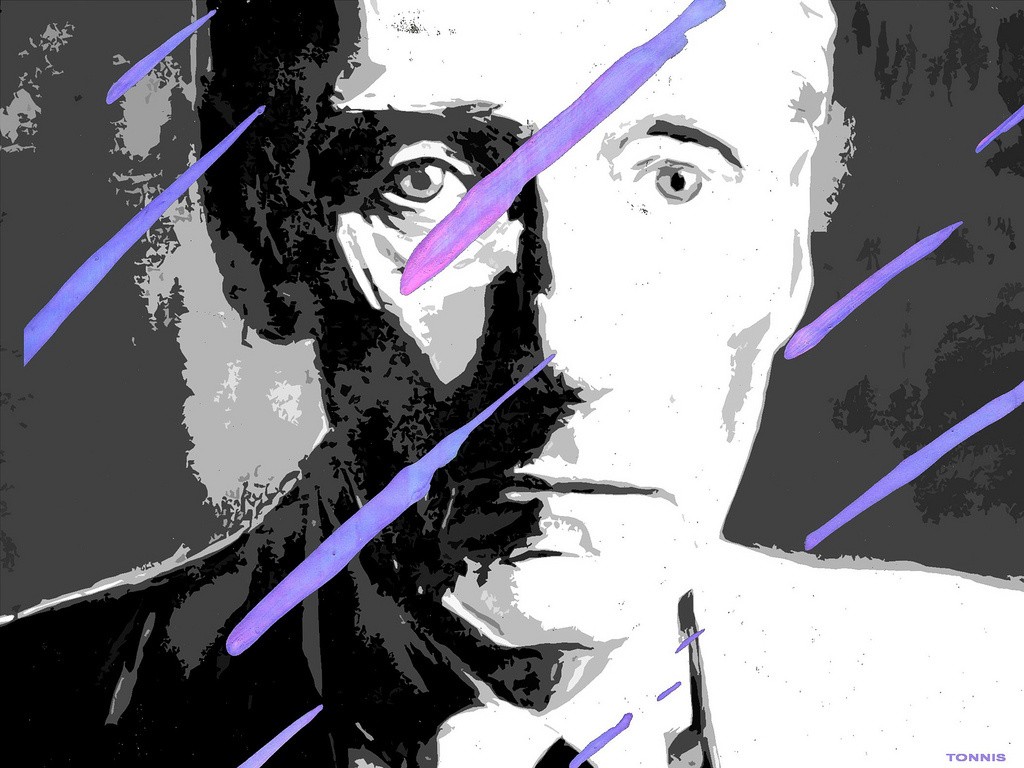
Image by Christiaan Tonnis, via Wikimedia Commons
Where did you first hear the voice of William S. Burroughs? Weary yet vigorous, flat yet powerful, wry yet haunting, it has, to a good-sized segment of several generations now, defined a cadence for the counterculture. Many of those enthusiasts (most of whom would have come to know the grand old man of the Beat Generation’s postmodernist wing through his writing, like the novels Naked Lunch and Junky) had their first genuine Burroughs listening experience through the record album Call Me Burroughs, first released in 1965, and more recently re-issued by Superior Viaduct.
In these sessions, recorded in the basement of The English Bookshop in Paris, Burroughs reads from Naked Lunch as well as Nova Express, the third book in the “Nova Trilogy” that the author considered a “mathematical continuation” of his best-known work. Both emerged as the fruits of the “cut-up” technique of literary composition Burroughs developed with artist Brion Gysin, creating new texts out of decontextualized and reassembled pieces of existing text found in the mass media.
“Burroughs believed that language and image were viral and that the mass-dissemination of information was part of an arch-conspiracy that restricted the full potential of the human mind,” writes Glenn O’Brian at Electronic Beats. “With cut-up, Burroughs found a means of escape; an antidote to the sickness of ‘control’ messages that mutated their original content. If mass media already functioned as an enormous barrage of cut-up material, the cut-up method was a way for the artist to fight back using its same tactics.”
Call Me Burroughs, which at one point became a deep-out-of-print collector’s item, has now come available free on Spotify. (You can download its free software here.) You can also stream it on Youtube. Counterculture chronicler Barry Miles notes that the Beatles all had copies (and Paul McCartney, particularly impressed with it, went on to hire its producer himself), and “art dealer Robert Fraser bought ten copies to give to friends such as Brian Jones and Mick Jagger. Marianne Faithful and Keith Richards’ dealer had copies, as did numerous painters and writers.” So whatever inspiration you draw from this “talisman of cool in Greenwich Village in the mid-1960s,” as Greil Marcus once called it, you’ll certainly join a long line of distinguished listeners.
Call Me Burroughs will be added to our collection, 1,000 Free Audio Books: Download Great Books for Free.
Related Content:
William S. Burroughs Reads & Sings His Experimental Prose in a Big, Free 7‑Hour Playlist
William S. Burroughs Teaches a Free Course on Creative Reading and Writing (1979)
William S. Burroughs Reads Edgar Allan Poe’s “The Masque of the Red Death”
How David Bowie, Kurt Cobain & Thom Yorke Write Songs With William Burroughs’ Cut-Up Technique
Based in Seoul, Colin Marshall writes and broadcasts on cities, language, and style. He’s at work on a book about Los Angeles, A Los Angeles Primer, the video series The City in Cinema, the crowdfunded journalism project Where Is the City of the Future?, and the Los Angeles Review of Books’ Korea Blog. Follow him on Twitter at @colinmarshall or on Facebook.
Read More...The Birth of London’s 1950s Bohemian Coffee Bars Documented in a Vintage 1959 Newsreel
I live in Seoul, by some measures the most coffee shop-saturated city in the world. But modern coffee life here (which I recently wrote about for the Los Angeles Review of Books) only really developed after Starbucks came to town around the turn of the 21st century. We’ve now got more Starbucks locations per capita than anywhere else, and even so, the homegrown Korean chains well outnumber those under the green mermaid. To understand how the coffee-house culture we know across the world today took its shape, we have to look back to London in the late 1950s, specifically as captured in the Look at Life newsreel on the city’s bohemian coffee house boom just above.
“Coffee is big business,” says its narrator, over a montage of neon signs advertising places like The Coffee House, Las Vegas Coffee Bar, Heaven & HELL Coffee Lounge, and La Roca. “The coffee bar boom in Britain began in 1952, when the first espresso machine arrived from Italy and was set up here, in London’s Soho.” The city’s many entrepreneurs vigorously seized the opportunity — maybe too vigorously, since “for every three coffee bars that opened up, two closed down.” They hadn’t planned on a few different factors, including overhead high enough that “if a character sits for half an hour over one cup of coffee, his share of the rent, heat, light, and service mount to the point where the management is paying him.”
They should’ve counted themselves lucky that the likes of me and my generation weren’t alive back then to, on a similarly single coffee, spend half the day typing on our laptops. But London’s midcentury coffee houses soon learned to diversify, offering Look at Life plenty–in its vivid colors and with its broad sense of humor–of life to look at: we see coffee bars hopping with live music and those who dance to it; jukebox coffee bars geared toward pompadoured hipsters; the film industry-beloved coffee bar in which T.S. Eliot once wrote the immortal line, “I have measured out my life with coffee spoons”; an “invisible coffee house” behind whose false newsstand front “curious characters congregate”; the Moka, which William S. Burroughs once shut down with his cut-up techniques; and even the famous Le Macabre, decorated with countless skeletal mementos mori.
The newsreel also finds its way to a coffee shop established by a newspaper where “university students and other assorted eggheads meet to put the world right — or more often left,” which reminds me of Guardian Coffee, a pop-up coffee house in a shipping-container complex in London’s Shoreditch (in some sense, the Soho of the 21st century) co-run by the eponymous newspaper, which I visited on my last trip to England. The Guardian Coffee experiment has since ended, but the Guardian has retained its interest in the beverage itself, as evidenced by recent articles like Rosie Spinks’ “The Caffeine Curse: Why Coffee Shops Have Always Signaled Urban Change.”
“As the coffee shop has become a byword for what everyone hates about urban change and gentrification – first come the creatives and their coffee shops, then the young professionals, then the luxury high-rises and corporate chains that push out original residents – it’s worth asking if that charge is fair,” Spinks writes. “As the function of the coffee house in London has evolved over time, was its early iteration so radically different than the ones many of us type and sip away in today?” And whatever form they take, coffee houses remain, as Look at Life calls them, “bright — or dim — fanciful, imaginative new additions to the British scene.” Or the American scene, or the Korean scene, or indeed the global scene.
Related Content:
The Curious Story of London’s First Coffeehouses (1650–1675)
“The Vertue of the COFFEE Drink”: London’s First Cafe Creates Ad for Coffee in the 1650s
The History of Coffee and How It Transformed Our World
Based in Seoul, Colin Marshall writes and broadcasts on cities, language, and style. He’s at work on a book about Los Angeles, A Los Angeles Primer, the video series The City in Cinema, the crowdfunded journalism project Where Is the City of the Future?, and the Los Angeles Review of Books’ Korea Blog. Follow him on Twitter at @colinmarshall or on Facebook.
Read More...Glass: The Oscar-Winning “Perfect Short Documentary” on Dutch Glassmaking (1958)
You’ll find many a bold claim on Wikipedia, even on the page for Bert Haanstra’s Glass, a 1958 short documentary on glassmaking in the Netherlands, which, as of this writing, mentions that the film “is often acclaimed to be the perfect short documentary.” Just the sort of thing you’d want to take with a grain of salt, right? But if you watch Glass itself, which won the 1959 Academy Award for Documentary Short Subject, you might find yourself joining in on that supposed chorus of acclaim.
Prashant Parvatneni at The Essential Mystery calls Glass “at once a passionate celebration of human labour and craftsmanship and a biting critique of the mechanistic mass-production of objects. On the very surface this documentary can appear as a demonstrative film keenly elucidating the very basic processes that go into the making of handmade glassware and juxtaposing it with the process of bottle-making in a mechanised factory.
Yet this very juxtaposition coupled with a Haanstra’s strong stylistic intervention takes the film into a polemical space.” Taking a slightly different tone, Colossal’s Christopher Jobson highlights the jazz of the traditional half, and the “whimsical score of more synthesized music” in the modern half. “Also,” he adds, “there’s a ton of great smoking!”
Jobson doesn’t mention that these guys also somehow manage to keep smoking even while blowing glass — an impressive feat indeed, and just one of the impressive qualities on display in Glass’ brief runtime. Eventually, the footage turns back from the factory to the workshop, and soon it begins oscillating between the two, cutting to the jazzy rhythm and even making the machines and workmen into musical instruments of a kind. The Dutch glassmaking industry has surely changed in the past half-century, but students of Dutch film can’t ignore the work of Haanstra, who in addition to this and other documentaries short and long, directed features including Fanfare, still one of the most popular films in the Netherlands ever. But as any film historian might suspect — and here comes another bold claim — Glass will outlive them all.
Glass will be added to our list of Free Documentaries, a subset of our collection 4,000+ Free Movies Online: Great Classics, Indies, Noir, Westerns, Documentaries & More.
via Colossal
Related Content:
Why Man Creates: Saul Bass’ Oscar-Winning Animated Look at Creativity (1968)
Oscar-Winning Animated Short, The Dot and the Line, Celebrates Geometry and Hard Work (1965)
36 Free Oscar Winning Films Available on the Web
Based in Seoul, Colin Marshall writes and broadcasts on cities, language, and style. He’s at work on a book about Los Angeles, A Los Angeles Primer, the video series The City in Cinema, the crowdfunded journalism project Where Is the City of the Future?, and the Los Angeles Review of Books’ Korea Blog. Follow him on Twitter at @colinmarshall or on Facebook.
Read More...Discovering Electronic Music: 1983 Documentary Offers a Fun & Educational Introduction to Electronic Music
The late sixties and seventies produced an explosion of electronic music that arrived on the scene as an almost entirely new art form. So much so that when composer Wendy Carlos released an album of Bach compositions played on the Moog synthesizer, it was as though she had invented another genre of music, rather than played baroque pieces on a new instrument. We had foremothers like Delia Derbyshire, experimental bands like Silver Apples and Suicide, innovators like Brian Eno and David Bowie and Kraftwerk, disco pioneers like Giorgio Moroder and Donna Summer… the list of electronic musicians at work creating the genre before the 1980s could go on and on.
You won’t learn any of that from the 1983 documentary above, Discovering Electronic Music, which is not at all to damn the short film; on the contrary, what this presentation offers us is something entirely different from the usual survey course in great men and women of commercial music. With an understated, pedagogical tone, Discovering Electronic Music gently leads its viewers through a thoughtful introduction to electronic music itself—what it consists of, how it differs from acoustic music, what kind of equipment produces it, and how that equipment works.
There are many musicians featured here, but none of them stars. They demonstrate, with competency and professionalism, the ways various electronic instruments and (now seemingly prehistoric) computer systems work. We do hear lots of classical music played on synthesizers, though not by the enigmatic and reclusive Wendy Carlos. And we hear modern compositions as well, though few you’re likely to recognize, from “Jean-Claude Risset, Douglas Leedy, F.R. Moore, Stephan Soomil, Rory Kaplan, Geral Strang and more forgotten geniuses of early electronic music,” writes Electronic Beats.
Early in the film, its presenter talks about the specifically modern appeal of electronic music: composers can work directly with sound like a sculptor or painter, rather than composing on paper and waiting to hear that written music performed by musicians. Much of Discovering Electronic Music shows us composers and musicians doing just that, with the thoroughly matter-of-fact manner of the most compellingly dry public television documentaries and with the strangely soothing quality common to both Mr. Rogers’ Neighborhood and Bob Ross’s painting lessons. Like the sound of the analog synthesizers and antique computer sequencers it features, the documentary has an eerie beauty all its own.
Find more documentaries in our collection, 4,000+ Free Movies Online: Great Classics, Indies, Noir, Westerns, Documentaries & More.
Related Content:
How the Moog Synthesizer Changed the Sound of Music
The History of Electronic Music in 476 Tracks (1937–2001)
Two Documentaries Introduce Delia Derbyshire, the Pioneer in Electronic Music
Josh Jones is a writer and musician based in Durham, NC. Follow him at @jdmagness
Read More...A Collection of Sun Ra’s Business Cards from the 1950s: They’re Out of This World
One of the hardest things to master as an independent musician is the art of promotion. Though many artists are extroverts and attention-seekers, many more are by nature introverted, or at least inner-directed, and disinclined to embrace the tools of the marketing trade. In days of yore, when such things as major record labels still roamed the earth at large, much of the promotion could be left up to those majestic, lumbering beasts. These days, when the majority of working musicians have to keep their day jobs and learn to do their own production, styling, booking, and PR, it’s essential to get over any squeamishness about blowing your own horn. If you’re looking for pointers, consider the example of self-invented musical genius Sun Ra, a master of self-promotion.
No one better understood what Sun Ra was up to than Sun Ra himself, and he knew how to sell his very out-there free jazz movement to a public used to more mundane presentations. As Mike Walsh at Mission Creep succinctly puts it, “nothing about Sun Ra’s six-decade musical career could be called normal.” He more or less re-invented what it meant to be a jazz musician and bandleader. It was in the 1950s that he really came into his own. After working steadily as a touring sideman for several other musicians, the man born Herman Blount changed his name first to Le Sony’r Ra, then Sun Ra, and put together his famous “Arkestra.”
His shows began to incorporate the elaborate costuming he became known for, and he would often stop the music “to lecture on his favorite subjects,” writes Jez Nelson at The Guardian, “Egyptology and space. He began to claim he had been abducted by aliens and was in fact from Saturn.” The act was both deadly serious space opera (he rehearsed his band for 12 hours at a stretch, after all) and absurdist schtick, and it both transported audiences to new worlds and made them laugh out loud.
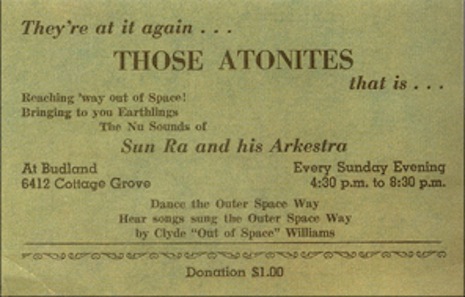
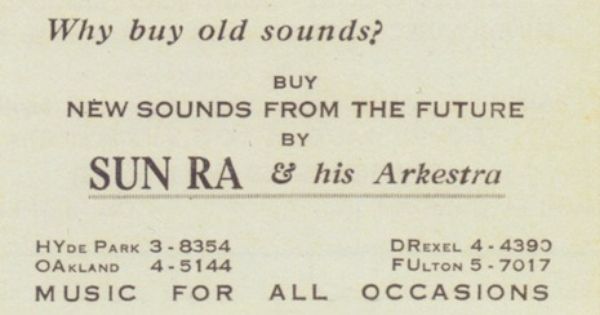
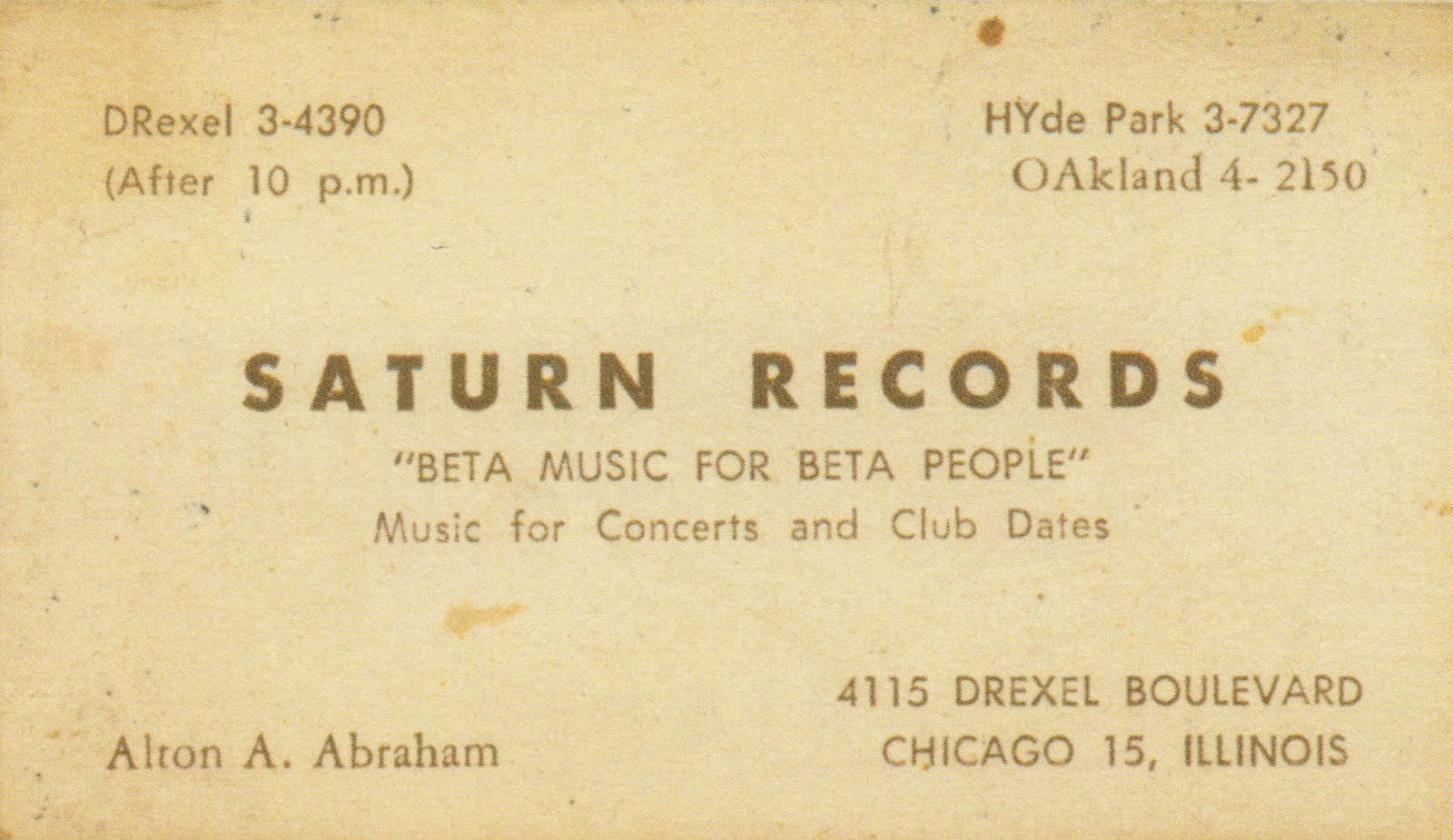
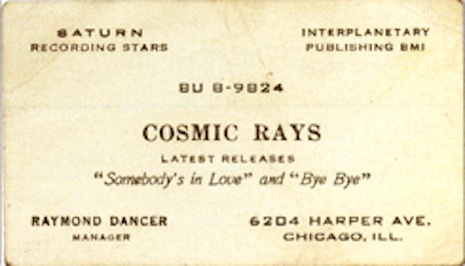
Sun Ra’s business cards from the 50s capture this tonal spectrum between avant-garde performance art and high-concept free jazz comedy. Advertising new releases, a band-for-hire, and ongoing local Chicago residencies, they combine the strict professionalism of a working bandleader with the wordplay and silliness Ra loved: he calls his coterie “Atonites,” which psychology professor Robert L. Campbell reads as meaning both “worshippers of Aton,” Egyptian sun god, and “performers of atonal music.” Audiences are invited to “Dance the Outer Space Way. Hear songs sung the Outer Space Way by Clyde ‘Out of Space’ Williams” (onetime singer with the band). And the card at the top of the post makes perhaps the simplest, most compelling pitch of them all: “Why buy old sounds?” Indeed.
Related Content:
Josh Jones is a writer and musician based in Durham, NC. Follow him at @jdmagness
Read More...Learn How to Code for Free: A DIY Guide for Learning HTML, Python, Javascript & More

This week, we’re launching the beginning of a new, ongoing series. We’re creating guides that will teach you how to learn important subjects on your own, using free resources available on the web. Want an example? Just look below. Here you’ll find a list of free resources–online courses, instructional videos, YouTube channels, textbooks, etc.–that will teach how to code for free. If we’re missing great items, please add your suggestions in the comments below.
This collection is just a start, and it will continue to grow over time. In the meantime, if there are other guides you’d like to see us develop in the coming weeks, please let us know in the comments section too. We’re happy to get your feedback.
How to Code (Software)
- Codecademy: A free site for learning everything from Making a Website to Python in a “user active” style—meaning that users can use tutorials to design projects of their own choosing. The site also makes it easy to track your progress. Other topics you can learn include: Create an Interactive Website, Ruby, Javascript, HTML & CSS, SQL and more. Register and sign up for all classes here. (See our post on Codecademy here.)
- Code School: Code School courses are built around a creative theme and storyline so that it feels like you’re playing a game, not sitting in a classroom. The site offers a set of free courses covering JavaScript, jQuery, Python, Ruby and more.
- Free Code Camp: An open source community that helps you learn to code. You can work through self-paced coding challenges, build projects, and earn certifications. According to Wired, the site “features a sequence of online tutorials to help the absolute beginner learn become a web developer, starting with building a simple webpage. Students move on to programming with JavaScript and, eventually, learning to build complete web applications using modern frameworks such as Angular and Node.”
- The Odin Project: Made by the creators of Viking Code School, an online coding bootcamp, the Odin Project offers free coding lessons in web development. Topics include: HTML, CSS, JavaScript & jQuery, Ruby programming, Ruby on Rails. Find an introduction to the curriculum here.
- Google’s Python Class: A free class (used within Google itself) for people with a little bit of programming experience who want to learn Python. The class includes written materials, lecture videos, and lots of code exercises to practice Python coding.
- Google’s C++ Course: Welcome to Google’s C++ Class. This class includes written materials, lecture videos, examples, and exercises to practice C++ coding.
- Coding for Kids from Code.org: Code.org, a non-profit, has created a fun way for students to learn the basics of coding. They’ve launched Star Wars: Building a Galaxy with Code, a tutorial designed to teach students how to write JavaScript. There’s also a version that teaches code with Minecraft, and a separate beginner’s tutorial for kids between the ages of 6 and 10.
- Online Computer/Coding Courses from Major Universities:
- You can find dozens of free courses, covering all facets of coding, listed in our collection of Free Online Computer Science Courses. The courses come from top universities.
- Massive Open Online Courses (MOOCs) focused on Coding are regularly offered through providers like Coursera, edx, Udacity, Alison, FutureLearn, MIT, and Khan Academy. Udemy itself has a short course called “The Best Free Resources To Learn How To Program.”
- Harvard’s Popular Intro to Computer Science: Get free access to Harvard’s popular introductory coding course designed for majors and non-majors alike. Combines courses typically known elsewhere as “CS1” and “CS2.”
- Stanford’s Free Course on Developing Apps with iOS: If you’re looking to develop apps for iPhone or iPad, this handy Stanford course will go a long way.
- YouTube Channels for Learning Coding: Channels you might want to visit include:
- Coder’s Guide: Features videos on HTML web development, cross-platform Java programming, beginner .net programming with Visual Basic and client side JavaScript web development.
- Code Course: Learn to code and build things with easy to follow tutorials. A number of videos focus on PHP. Find more materials on the channel’s web site.
- LearnCode.academy: HTML, CSS, JavaScript, CSS Layouts, Responsive Design etc.
- DevTips: Web design and web development.
- The New Boston: Programming, web design, networking, video game development, graphic design, etc.
- The Google Developers Channel: Offers lessons, talks, the latest news & best practices in subjects like Android, Chrome, Web Development, Polymer, Performance, iOS & more.
- You can find more YouTube Channels here: 33 Useful Youtube-channels for learning Web Design and Development.
- Free Programming Textbooks from Github: Access 500+ “free programming books that cover more than 80 different programming languages on the popular web-based Git repository hosting service.”
- Free Computer Science Textbooks: On our site, find a list of free textbooks (aka open textbooks) written by knowledgable scholars.
Sources that helped us create this list above include: Inc., Learn to Code with Me, and WebBuildDesign.
If you would like to support the mission of Open Culture, consider making a donation to our site. It’s hard to rely 100% on ads, and your contributions will help us continue providing the best free cultural and educational materials to learners everywhere. You can contribute through PayPal, Patreon, and Venmo (@openculture). Thanks!
Read More...Charlie Chaplin Gets Strapped into a Dystopian “Rube Goldberg Machine,” a Frightful Commentary on Modern Capitalism
I get into a lot of conversations these days about how we used to consider technological progress good by definition, but now — despite or maybe because of the farther-progressed-than-ever state of our technology — we feel a bit wary about it all. We line up for the latest smartphone, but as we do we reflect upon how it increasingly looks we’ll never line up for the jetpacks, flying cars, and moon colonies we dreamed of in childhood. We enjoy our phones, but we resent them as well, remembering those long-ago assurances that technology would increase our leisure, not fill it with anxiety about insufficiently rapid responses, nagging leftover work, and missed-out-on information of every kind. When did the trust between our tech and ourselves break down?
Not so recently, it turns out — or rather, not just recently. The human-technology relationship goes through its good times and its bad patches, and at any given time some of us like the direction its progress looks to be moving in more than others do. You may have heard of one particularly well-known technological critic of the early twentieth century, a cartoonist by the name of Rube Goldberg. More likely, you’ve heard of the preposterously elaborate machines he drew in his cartoons.
One representative example, an “automatic suicide device for unlucky stock speculators,” involves the ring of a phone (“probably a message from your broker saying you are wiped out”) which wakes up a dozing office manager whose stretching hits a lever which launches a toy glider which hits a dwarf whose jumping up and down in pain works a jack which lifts up a pig to the level of a potato, and when he eats the potato… well, in any case, the process ends up, some time later, pulling the trigger of a gun mounted right over the tickertape machine. “If the telephone call is not from your broker,” Goldberg notes, you’ll never find out the mistake because you’ll be dead anyway.
“The surrealism of Goldberg’s cartoon inventions,” writes Brendan O’Connor at The Verge, while meant to entertain, “also reveals a dark skepticism of the era in which they were made. The machines were symbols, Goldberg wrote, of ‘man’s capacity for exerting maximum effort to accomplish minimal results.’ ” They had a strong appeal in that “era of increasing automation, and increasing concern about automation, exemplified in Charlie Chaplin’s 1936 masterpiece Modern Times. One of the film’s dystopian curiosities, the Billows Feeding Machine, invented by Mr. J. Widdecombe Billows, has a distinctly Rube Goldbergian quality to it — this is likely no coincidence, as Goldberg and Chaplin were friends.”
In the clip at the top, we see the Billows Feeding Machine in action, not quite fulfilling its promise to “eliminate the lunch hour, increase your production, and decrease your overhead.” The disappointed higher-ups render their verdict: “It’s no good — it isn’t practical.” A modern-day J. Widdecombe Billows would know better how to respond to them: it’s still in beta.
Related Content:
The Falling Water: A Rube Goldberg Machine That Makes a Fine Cocktail
Students Tells the Passover Story with a Rube Goldberg Machine
Charlie Chaplin Does Cocaine and Saves the Day in Modern Times (1936)
Three Great Films Starring Charlie Chaplin, the True Icon of Silent Comedy
Discover the Cinematic & Comedic Genius of Charlie Chaplin with 60+ Free Movies Online
Based in Seoul, Colin Marshall writes and broadcasts on cities, language, and style. He’s at work on a book about Los Angeles, A Los Angeles Primer, the video series The City in Cinema, the crowdfunded journalism project Where Is the City of the Future?, and the Los Angeles Review of Books’ Korea Blog. Follow him on Twitter at @colinmarshall or on Facebook.
Read More...World Science U Lets You Take Free Physics Courses from Leading Minds in the Field
Two years ago, World Science U debuted on the net, promising to bring free science courses to anyone, from high schoolers to retirees. (We wrote about it here.) The courses would be taught by the top scientists in their fields, featuring lectures, animations, interactive exercises, feedback, and even virtual office hours. At the time, however, Brian Greene’s project to bring the latest in research on string theory, particle physics, dark energy, relativity and more featured only two courses.
Since then, World Science U has taken off. It now offers “Science Unplugged,” a series of short videos that offer answers to layperson questions about science; “Master Classes” which are short classes about various subjects (mostly in physics) that take a few hours to complete; and “University Courses” which take eight to ten weeks to complete and are designed for the more advanced learner. These latter two offerings offer certificates upon completion.
The current roster of lectures is impressive: MIT’s Alan Guth teaches Inflationary Cosmology; U. Chicago’s Michael Turner (who coined the term “dark energy”) presents the Dark Side of the Universe; Stanford’s Andrei Linde takes you into the Multiverse; and Caltech’s Maria Spiropulu probes Nature’s Constituents, to name a few Master Classes. Meanwhile Brian Greene currently teaches two of the university courses: “Special Relativity: A Math-Based Introduction” and (highlighted above) “Space, Time and Einstein: A Conceptual Tour of Special Relativity.”
All of the courses are absolutely free but the videos are only available if you register with World Science U.
Related Content:
Brian Greene Breaks Down Einstein’s Theory of Gravitational Waves for Stephen Colbert
Ted Mills is a freelance writer on the arts who currently hosts the artist interview-based FunkZone Podcast. You can also follow him on Twitter at @tedmills, read his other arts writing at tedmills.com and/or watch his films here.
Read More...Watch the Trailer for a “Fully Painted” Van Gogh Film: Features 12 Oil Paintings Per Second by 100+ Painters
Loving Vincent, an homage to Vincent van Gogh, promises to be “the first fully painted feature film in the world.” What does that mean exactly? According to filmmakers Dorota Kobiela and Hugh Welchman, every frame of Loving Vincent will be an oil painting on canvas, created with the same techniques Van Gogh used over a century ago. To make these frames, Kobiela and Welchman plan to hire skilled painters and put them through a 3‑week intensive training course, teaching each to paint like Van Gogh himself. Or so that’s how they explained things during their Kickstarter campaign several years ago.
Although production is still ongoing, you can see the first fruits of their labors. Above, watch a trailer for Loving Vincent, which features (according to the Youtube blurb accompanying the video) “12 oil paintings per second, all done by over 100 painters trained in the same style.”
If you’re a talented painter and want to contribute to making this original film (you can get an idea of what that looks like below), please visit the Loving Vincent website and scroll down to the recruitment section. The site also includes other material that takes you inside the making of this innovative film.
Enjoy…
Related Content:
13 Van Gogh’s Paintings Painstakingly Brought to Life with 3D Animation & Visual Mapping
Watch as Van Gogh’s Famous Self-Portrait Morphs Into a Photograph
Van Gogh’s 1888 Painting, “The Night Cafe,” Animated with Oculus Virtual Reality Software
Read More...Support Us
We're hoping to rely on loyal readers, rather than erratic ads. Please click the Donate button and support Open Culture. You can use Paypal, Venmo, Patreon, even Crypto! We thank you!

About Us

Open Culture scours the web for the best educational media. We find the free courses and audio books you need, the language lessons & educational videos you want, and plenty of enlightenment in between.
Advertise With Us
FREE UPDATES!
GET OUR DAILY EMAIL
Get the best cultural and educational resources on the web curated for you in a daily email. We never spam. Unsubscribe at any time.
FOLLOW ON SOCIAL MEDIA
Open Culture editor Dan Colman scours the web for the best educational media. He finds the free courses and audio books you need, the language lessons & movies you want, and plenty of enlightenment in between.
Advertise With Us



/cdn0.vox-cdn.com/uploads/chorus_asset/file/3629700/76_suicide_copy.0.png)