Lou Reed and Laurie Anderson’s Three Rules for Living Well: A Short and Succinct Life Philosophy
Regular readers of Open Culture know us to gush over our favorite celebrity couples now and then: John and Yoko, Jean-Paul and Simone, Frida and Diego…. Not your usual tabloid fare, but the juicy details of these amorous partners’ lives also happen to intersect with some of our favorite art, music and literature. One cultural power couple we haven’t covered much, surprisingly, well deserves the “power” adjective: Lou Reed and Laurie Anderson, two personalities whose influence on the art and music of the last several decades can hardly be overstated.
Has Reed’s reputation at times been inflated, and Anderson’s underplayed? Maybe. She doesn’t get nearly enough credit for the witty, profound, moving work she’s done, year after year (with one lengthy hiatus) since the 70s. Reed’s career since the 70s consisted of more misses than hits. But put them together (in 1992) and you get a harmonious meeting of Reed’s raw, gut-level assertions and Anderson’s curious, playful concepts.
Witness their personal strength together in the Charlie Rose excerpt at the top of the post. Reed, who was often a difficult interview subject, to put it mildly, and who gained a reputation as a brutally unpleasant, abusive rock and roll diva (immortalized lovingly in Bowie’s “Queen Bitch”), comes off in this sit-down with Anderson as almost warm and fuzzy. Did she make him want to be a better person? I don’t know. But Anderson’s short obituary after his 2013 death remembered Reed as a “prince and fighter,” her longer obit as a “generous” soul who enjoyed butterfly hunting, meditation, and kayaking. No reason he wasn’t all those things too.
When it came to music, Reed could pull his partner into the orbit of his sweet R&B songcraft, as in their duet of “Hang on to Your Emotions,” further up, and she could pull him out of it—like John Cale and Nico had done in the Velvet Underground—and into the avant-garde drone of her experimental scene (as above in the pair’s collaboration with composer and saxophonist John Zorn). Just this past Spring, in one of the most touching musical tributes I’ve ever seen, Anderson recreated Reed’s abrasive screw-you to his record label, Metal Machine Music, as a conceptual art piece called Drones, leaning several of his guitars against several fully-cranked vintage amps, letting the feedback ring out for five days straight.
None of us can be Lou Reed and Laurie Anderson; every couple is happy, or unhappy, in their own way. But what, in the grand tradition of mining celebrity couple’s lives for advice, can we learn from them? I guess the overall message—as Anderson herself suggested in her Rock & Roll Hall of Fame acceptance speech for Reed (above, in shaky audience video)—is this: keep it simple. Kansas State English Professor Philip Nel points out Anderson’s “wise… thoughtful” words on the subject of living well, delivered in her speech at the 8:55 mark:
I’m reminded also of the three rules we came up with, rules to live by. And I’m just going to tell you what they are because they come in really handy. Because things happen so fast, it’s always good to have a few, like, watchwords to fall back on.
And the first one is: One. Don’t be afraid of anyone. Now, can you imagine living your life afraid of no one? Two. Get a really good bullshit detector. And three. Three is be really, really tender. And with those three things, you don’t need anything else.
Can you imagine Lou Reed as “really, really tender”? He certainly was in song, if not always in person. In any case, these three rules seem to me to encapsulate a personal philosophy built solidly on fearless integrity and compassion. Difficult to live by, but well worth the effort. And because I’m now feeling super warm and fuzzy about Lou and Laurie, I’ll leave you with the short WNYC interview clip below, in which she reveals her favorite Lou Reed song, which he happened to write about her.
Related Content:
Laurie Anderson’s Top 10 Books to Take to a Desert Island
Lou Reed, John Cale & Nico Reunite, Play Acoustic Velvet Underground Songs on French TV, 1972
Josh Jones is a writer and musician based in Durham, NC. Follow him at @jdmagness
Read More...R Crumb, the Father of Underground Comix, Takes Down Donald Trump in a NSFW 1989 Cartoon
Nature’s way is to take away from those that have too much and give to those that have too little. Man’s way, on the contrary, is to take away from those who have too little to give more to those who already have too much.
Lao Tzu, Tao Te Ching, circa 500 BC
Two and a half thousand years later, the ancient sage’s quote continues to resonate, especially in this election year.
Lest we get too gloomy, there is another quote I would like to submit:
And isn’t this a nutty kinda country where you can draw any irreverent, degrading thing about the most powerful people and nobody cares! You don’t get jailed. You don’t get persecuted. They just ice you out of the marketplace.
- R Crumb, Hup, 1989
Crumb is to underground comix as Lao Tzu was to Taoism, but the fame Crumb achieved in the late 60s and early 70s did not protect him from the 80s, “an awful decade” as he told the Observer. His astonishing creative output never flagged, but he hated the culture and struggled to make ends meet:
…it all gradually fell apart through the 70s, and by the 80s with the rise of the yuppies, Reagan’s election and the real estate boom. In California it was always about real estate ever since the Gold Rush, but the 80’s saw a new explosion of it. They went crazy. Everybody was getting their real estate license. They kept on building these hideous housing developments where we lived. It used to be farmland there when we first arrived, then everything became a fight. Dow Chemical tried to come there, we fought that. Then the Super Collider, we fought that. It was this constant battle against these forces of development and business.
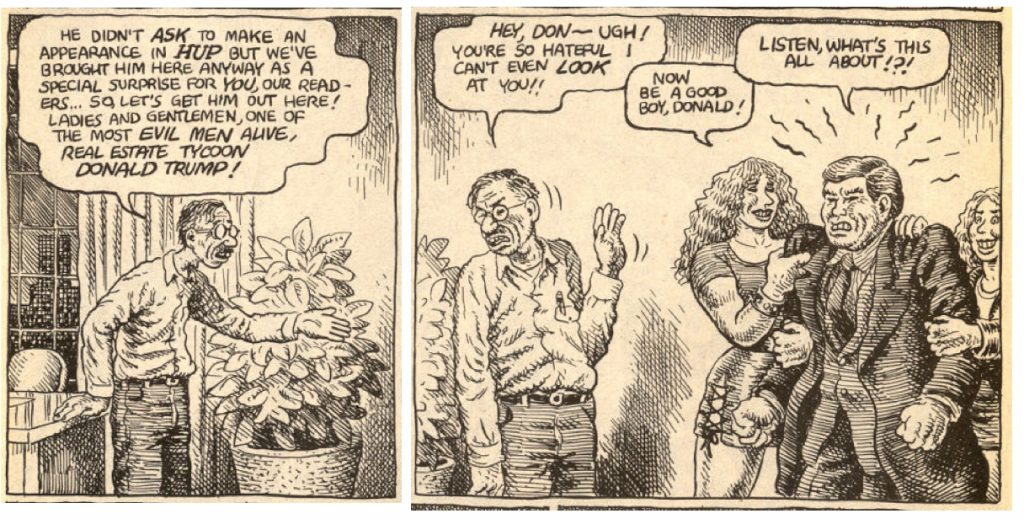
In 1991, he fled America for a small village in Southern France, a prescient move, given “Point the Finger,” a comic published two years earlier in his short-lived Hup series. The semi-fictional five-pager pits Crumb himself against real estate developer Donald Trump, billed as “one of the more visible big time predators who feed on society,” as well as “one of the most evil men alive.”
The then-42-year-old Trump is quick to take Crumb’s bait, piling on some insults of his own. He may not be familiar with the cartoonist’s work, but he knows how to mount an attack, with labels like “crass,” “venal,” “some kind of self-styled terrorist,” “the picture of negativity,” and “filled with hate.” Had Crumb set this smack down on a beach, Trump would be the bully kicking sand in the scrawny nerd’s face, as a couple of hot babes look on, admiringly.
In fact, the comic comes very close to ending on such a note. Two of Crumb’s characteristically powerfully-thighed females are on hand, ostensibly as members of his camp. Their heads are quickly turned, however, by an invitation to Mar-a-Lago, Trump’s lavish Palm Beach estate. The Donald starts looking pretty good to Tracy and Marny, bedazzled by the promise of banquets, manicures, world-class entertainment, and a hedonistic after-hours romp with Trump and his then-wife Ivana.
The cartoonist, defeated, compares the tycoon to Trimalchio, the vulgar but loaded host of Petronius’ Satyricon, before preparing to take things out with the Lao Tzu quote at the top of this post.
It’s here that things take a turn for the meta, as Stan “the Man” Shnooter, the self-assured fictional producer of Hup, rallies Crumb to assert authorial control.
Crumb rewinds to a pivotal moment. In this redo, Tracy and Marny remain steadfast. The bully is frogmarched to the toilet to be given a taste of his own medicine. The saga draws to a close with the sort of acrobatic, questionably consensual, NSFW sex that has rained feminist ire on Crumb for years, as the unlikely conquerer savors victory in his preferred style.
Is it fantasy? Reality? All just a dream?
(Any way you slice it, I’m pretty sure Tracy and Marny aren’t the winners…)
You can check out Crumb’s 1989 Trump comic in its extremely NSFW entirety here or buy Hup, Issue 3 to read it the old fashioned way. Some of the tamer panels can be sampled here.
Related Content:
R. Crumb Describes How He Dropped LSD in the 60s & Instantly Discovered His Artistic Style
Noam Chomsky on Whether the Rise of Trump Resembles the Rise of Fascism in 1930s Germany
Ayun Halliday is an author, illustrator, and Chief Primatologist of the East Village Inky zine. Follow her @AyunHalliday
Read More...Explore Harvard’s Iconic Spaces with 360° Interactive Videos
For me, nothing captures those occasional feelings of post-graduate yearning like “I Wish I Could Go Back to College,” a N‑quite-SFW track from the Broadway musical, Avenue Q.
With all due respect, it feels like the five members of Harvard University’s just-graduated Class of 2016 sharing their recollections in the interactive 360° video project, Harvard Students Say Farewell, left a few crucial details out. (Note: Youtube 360 videos only work in Chrome, Firefox, Internet Explorer, or Opera browsers.)
It’s completely safe for prospective parents, not a keg or condom wrapper in sight. (The project is hosted on Harvard’s official Youtube channel.)
Unsurprisingly, Harvard appears to have been the participants’ universal first choice of college. Hasty Pudding performer, Joshuah Campbell, above, a self-described “Black kid from the country,” confides that it was the only place he applied to.
He may have arrived wondering how he would fit in, but four years later, his grubby dorm room is one of the “iconic” Harvard locations viewers can explore digitally as he briefly reflects upon his experience.
That’s about as down and dirty as this series gets. The human subjects seem to have been selected with an eye toward diversity and humility, rather than the clenched Boston Brahmin jaw that once defined the institution.
Meanwhile, the libraries, quads, and theaters through which this new breed of Harvard men and women wander attest to the place’s ongoing exclusivity.
Sreeja Kalapurakkel, above, a member of the Harvard South Asian Dance Company, knew what she was getting into, as a student at a respected Boston secondary school. Shortly after graduation, she sung Harvard’s praises somewhat more frankly on her Facebook page:
Each day of my time at Harvard was filled with everything that makes life beautiful: darkness, struggle, despair, loneliness, friendship, hope, perseverance, light. Every experience, every lesson, every friend transformed me into someone more human and gave me something new to fight for.
Harvard, like every other college in the land, has relaxed its policy on ending a sentence in a preposition.
Ana-Maria Constantin arrived sight unseen from her native Romania to pull us out onto the deck of the Smithsonian Astrophysical Observatory.
On to the locker room! Hockey captain Kyle Criscuolo joins the Detroit Red Wings, reflecting that Harvard student athletes enjoy no special treatment. In future, the university may want to require them to listen to Will Stephen’s lecture, “How to Sound Smart in a TED Talk.” Criscuolo sounds sincere, but also stiff, as if reading from a sheet of paper, or the digital equivalent thereof.
(Thereof is an adverb, by the way. Not a preposition. I checked.)
Harvard Art Museums Student Board member Rachel Thompson paints herself so meekly, I’m tempted to check with her freshman year roommate. Was she really so filled with self doubt? I’ve always assumed Harvard acceptance letters would puff the recipient up. Good lord, imagine the effect the rejection letters must have!
Use a mouse to explore the immersive environment on your computer, or the YouTube app to navigate on a mobile device. Use a virtual reality headset and the Harvard Crimson staff’s vocabulary list to enhance the experience even more.
The complete playlist is here.
Related Content:
Harvard Presents Free Courses with the Open Learning Initiative
NPR Launches Database of Best Commencement Speeches Ever
The Harvard Classics: Download All 51 Volumes as Free eBooks
Ayun Halliday is an author, illustrator, Chief Primatologist of the East Village Inky zine, and a Northwestern University grad. Follow her @AyunHalliday
Read More...The History of Electronic Music, 1800–2015: Free Web Project Catalogues the Theremin, Fairlight & Other Instruments That Revolutionized Music

Hang around this site long enough and you’ll learn a thing or two about electronic music, whether it’s a very brief history of the Moog synthesizer, or the Theremin, or an enormous, obscure ancient ancestor, the Telharmonium. These mini-lessons are dwarfed, however, by the amount of information you’ll find on the site 120 Years of Electronic Music, wherein you can read about such strange creatures as the Choralcelo, the Staccatone, the Pianorad, Celluphone, Electronde, and Vibroexponator. Such oddities abound in the very long history of electronic musical instruments, which the site defines as “instruments that generate sounds from a purely electronic source rather than electro-mechanically or electro-acoustically.”

Despite these rather strict technical parameters, the site’s author Simon Crab admits that the boundaries “do become blurred with, say, Tone Wheel Generators and tape manipulation of the Musique Concrete era.” Then there are precursor instruments that predate the discovery and harnessing of electricity, such as the Clavecin Magnetique, above, invented by Abbé Bertholon de Saint-Lazare in 1789, a “simple instrument which produced sounds by attracting metal clappers to strike tuned bells by raising and lowering magnets operated by a keyboard.”

Yet the primary focus of 120 Years of Electronic Music is a period of growth and development from the late 1800s to the 1970s, when early digital synthesizers like the Fairlight (top) appeared. Thus, we should not expect here “an exhaustive list of recent commercial synthesizers or software packages”—the stuff of modern dance, pop, hip-hop, etc. Crab’s intent is academic, “encyclopedic, pedagogical,” and pitched to musicologists as well as “Synthesizer Geeks” likely to appreciate the niceties of the 1961 DIMI & Helsinki Electronic Music Studio.
But even non-academics and non-geeks can learn much from the history of such unusual instruments as the Klaviatursphäraphon (above), one of several creations of German composer Jörg Mager in his pursuit of “a new type of utopian ‘free’ music by means of new electronic cathode-ray musical instruments.”
Amidst the weird obscurities and high-concept musical theory, you’ll also find old favorites that revolutionized pop music, like the Hammond Organ (see a making-of promotional video above), the various iterations of Moog synthesizers, and of course the Fairlight CMI (short for Computer Musical Instrument). Invented by Kim Ryrie and Peter Vogel in Australia in 1979, the Fairlight is affectionately known as the “mother of all samplers,” and its technology jumpstarted the revolution in computer music from the 80s to today. You can see Vogel demonstrate the first version of his Fairlight in this video, or—for a slightly less geeky intro—see Peter Gabriel demonstrate it below (or watch Herbie Hancock and Quincy Jones show you how it’s done in a clip from Sesame Street.)
The Hammond, Moogs, and Fairlight aside, very few of the instruments featured on 120 Years of Electronic Music had any kind of direct impact on popular music. But many of them, like Hugh Le Caine’s 1945 Electronic Sackbut, influenced the influencers, and they all represent some evolutionary step forward, or sideways, in the development of the sounds we hear all around us now in every possible genre.
Additionally, Crab’s historical project explores what he calls “the dichotomy between radical culture and radical social change,” with discussions on the links between Bolshevism and the avant-garde and modernism and fascism—discussions of keen interest to cultural historians and critical theorists. Oh, and the name? “The project,” Crab explains, “was begun in 1996; considering electronic music started around 1880 this was quite an accurate title for the time.” It’s now “a bit out of date but… something of a brand-name.” We’ll forgive him this minor chronological inaccuracy for the tremendous service his open access encyclopedia offers to scholars and enthusiasts alike. Explore it here.
Related Content:
Hear the Greatest Hits of Isao Tomita (RIP), the Father of Japanese Electronic Music
The History of Electronic Music in 476 Tracks (1937–2001)
Hear Seven Hours of Women Making Electronic Music (1938- 2014)
Josh Jones is a writer and musician based in Durham, NC. Follow him at @jdmagness
Read More...Filmmaker Ken Burns Urges Stanford Graduates to Defeat Trump & the Retrograde Forces Threatening the U.S.
This time of year, we see graduation speeches popping up all over the web. The commencement address as a genre focuses on the opportunities, challenges, and responsibilities graduates will face post-college, and often espouses timeless life lessons and philosophies. But this year, as you may have seen, esteemed documentary filmmaker Ken Burns took the opportunity of his graduation speech, presented to the 2016 class at Stanford University, to address the timeliest of issues: the upcoming presidential election and the threat of “an incipient proto-fascism.” The graduation just happened to fall on the same day as the deadliest mass-shooting in recent American history.
Voters are angry at the system, we’re told again and again, and frankly the overwhelming majority of us have every reason to be. But anger can be intoxicating, and the segment of the electorate that carried Donald Trump to power seems drunk with rage and hostility. The promise of Trumpism puts me in mind of historian and critic Richard Slotkin’s classic study of U.S. mythology, Regeneration Through Violence, which describes the nation’s compulsion to purge the country of threatening others in order to restore some myth of lost innocence. “I will give you everything, I’m the only one,” the candidate vows, while scapegoating group after group for the country’s problems.
In his Stanford commencement speech on Sunday, Burns decried “the dictatorial tendencies of the candidate with zero experience in the much maligned but subtle art of governance; who is against lots of things, but doesn’t seem to be for anything, offering only bombastic and contradictory promises and terrifying Orwellian statements.” The Republican candidate for president is “a person,” Burns said in his impassioned speech, “who easily lies, creating an environment where truth doesn’t seem to matter.”
As a student of history, I recognize this type. He emerges everywhere and in all eras. We see nurtured in his campaign an incipient proto-fascism, a nativist anti-immigrant Know Nothing-ism, a disrespect for the judiciary, the prospect of women losing authority over their own bodies, African-Americans again asked to go to the back of the line, voter suppression gleefully promoted, jingoistic saber-rattling, a total lack of historical awareness, a political paranoia that, predictably, points fingers, always making the other wrong. These are all virulent strains that have at times infected us in the past. But they now loom in front of us again — all happening at once. We know from our history books that these are the diseases of ancient and now fallen empires. The sense of commonwealth, of shared sacrifice, of trust, so much a part of American life, is eroding fast, spurred along and amplified by an amoral internet that permits a lie to circle the globe three times before the truth can get started.
We no longer have the luxury of neutrality or “balance,” or even of bemused disdain. Many of our media institutions have largely failed to expose this charlatan, torn between a nagging responsibility to good journalism and the big ratings a media circus always delivers. In fact, they have given him the abundant airtime he so desperately craves, so much so that it has actually worn down our natural human revulsion to this kind of behavior. Hey, he’s rich; he must be doing something right. He is not. Edward R. Murrow would have exposed this naked emperor months ago. He is an insult to our history. Do not be deceived by his momentary “good behavior.” It is only a spoiled, misbehaving child hoping somehow to still have dessert.
And do not think that the tragedy in Orlando underscores his points. It does not. We must “disenthrall ourselves,” as Abraham Lincoln said, from the culture of violence and guns. And then “we shall save our country.”
The words of Lincoln that Burns quotes come from the president’s annual remarks to congress in 1862, in which Lincoln made the case for the Emancipation Proclamation, one month before signing it. (A document, ironically, that Slotkin says “radically expanded the existing powers of the presidency” in its pursuit of a just cause.) In his address, Lincoln makes a forceful moral argument, all the more eloquent for its characteristic brevity.
Fellow-citizens, we cannot escape history. We of this Congress and this administration, will be remembered in spite of ourselves. No personal significance, or insignificance, can spare one or another of us.
Likewise, Burns—addressing future leaders at an elite institution—makes his case for heeding the lessons of history, considering posterity, and rejecting Trump, independent of partisan interests: “This is not a liberal or conservative issue, a red state-blue state divide. This is an American issue.” He also implores “those ‘Vichy Republicans’ who have endorsed him to please, please reconsider.” The horrific mass murder in Orlando has further inflamed what Burns calls “the troubling, unfiltered Tourette’s of [Trump’s] tribalism”—with renewed calls for bans on all Muslims, more inflammatory insinuations that the president colludes with terrorists, and bizarre allegations that a Clinton aide is a Saudi agent.
Trump did not invent this rhetoric of bigotry, conspiracy, and paranoia, but he has manipulated and exploited it more effectively than anyone else, to potentially disastrous effect. “The next few months of your ‘commencement,’ ” Burns says, “that is to say, your future, will be critical to the survival of our republic.” He urges the graduating Stanford class to take action: “before you do anything with your well-earned degree, you must do everything you can to defeat the retrograde forces that have invaded our democratic process.” Those processes may already be deeply compromised by moneyed interests, but destroying the edifice on which they’re built, Burns suggests, will hardly restore any supposedly lost “greatness.” Watch Burns’ full commencement speech above.
Related Content:
Ken Burns on the Art of Storytelling: “It’s Lying Twenty-Four Times a Second”
Noam Chomsky on Whether the Rise of Trump Resembles the Rise of Fascism in 1930s Germany
Princeton Historian Sean Wilentz on How Trump May Change (If Not Destroy) the GOP
J.K. Rowling Defends Donald Trump’s Right to Be “Offensive and Bigoted”
Josh Jones is a writer and musician based in Durham, NC. Follow him at @jdmagness
Read More...Malcolm Gladwell Has Launched a New Podcast, Revisionist History: Hear the First Episode
Malcolm Gladwell has a podcast. Some of you will require no further information, and in fact have already clicked over to iTunes (or another podcast downloading application of your choice), desperate to download the first episode. Allow me to inform those cooler heads who remain that Revisionist History won’t begin its ten-week run, with one episode out per week, until June 16th. (Update: The first episode is now live and you can stream it below.) But you can subscribe right now (iTunes — Stitcher — RSS), and while you wait over the next few days, you can listen to the preview that Gladwell has already posted.
You can also get a little a taste of Gladwell’s new project by watching the trailer at the top of the post. “Every week, I’m going to take you back into the past,” Gladwell promises in the video’s narration, “to examine something that I think has been overlooked and misunderstood.”
He gets into more detail on the Brian Lehrer Show segment below, in which he describes the first episode of Revisionist History as about the question of what it means to be “the first outsider to enter a closed world,” starting from the career of British painter Elizabeth Thompson, whose 1874 canvas The Roll Call became, for a time, the most famous image in the country. It broke its female artist into the male-dominated world of painting, and seemed, for an even shorter time, to herald a new era rich with high-profile female painters. “Everyone waits and waits for the revolution to happen,” Gladwell says, already into his characteristic storytelling mode, “and it never happens.”
Lehrer reacts to Gladwell’s choice of the story of “the first woman to break through in a male-dominated field” with the obvious question: “Is that a coincidence?” It is absolutely not a coincidence, Gladwell replies, going on to connect the phenomenon in question to not just modern figures like Hillary Clinton but Barack Obama, Julia Gillard, and Margaret Thatcher as well, and in the podcast itself surely many others besides. He also hints at an episode later in the season that begins with an obscure Elvis Costello song — and a “terrible” one at that, he adds — and uses it “as a way of finding out how creativity works, and how an awful lot of what we consider works of genius had an incredibly circuitous path to greatness,” ending up at a gallery looking at Cézannes.
You can sign up for episode updates at the official Revisionist History site. The show comes as a product of Panoply, the podcast network of The Slate Group, and its first season promises slick production in addition to the kind of compelling stories and memorable social-science insights with which Gladwell has made himself famous. And we shouldn’t ignore his talent for marketing, either, fully in evidence from nothing more than the tagline he speaks in the trailer: “Because sometimes the past deserves a second chance.” All this together sounds like more than a good reason to give his podcast a first one.
Revisionist History is listed in our new collection, The 150 Best Podcasts to Enrich Your Mind.
Related Content:
The History of the World in 46 Lectures From Columbia University
Malcolm Gladwell: What We Can Learn from Spaghetti Sauce
Malcolm Gladwell: Taxes Were High and Life Was Just Fine
Based in Seoul, Colin Marshall writes and broadcasts on cities, language, and style. He’s at work on a book about Los Angeles, A Los Angeles Primer, the video series The City in Cinema, the crowdfunded journalism project Where Is the City of the Future?, and the Los Angeles Review of Books’ Korea Blog. Follow him on Twitter at @colinmarshall or on Facebook.
Read More...Moby Lets You Download 4 Hours of Ambient Music to Help You Sleep, Meditate, Do Yoga & Not Panic
Back in May, I wrote about the damaging effects stress has on the body, and the scientifically-validated power of yoga and meditation to undo them. Following close behind stress as a chronic contributor to illness is sleeplessness, which the Division of Sleep Medicine at Harvard Medical School links to diabetes, high blood pressure, heart disease, and shortened life expectancy. Add to all these risks the problems of poor productivity and disorganized thinking, and you’ll begin to see insomnia for the dangerous condition it is.
What to do with that anxious, overworked, overtired self? Well, again, I’d heartily recommend a yoga or meditation practice. Power naps throughout the day can boost your endurance and brainpower as well. But I’d also recommend music—music that calms the body and helps wash away the mental gunk that accumulates throughout the day. Composer Max Richter recently released an eight-hour piece of music intended to lull listeners to sleep and keep them there. His efforts are now joined by electronica superstar Moby, who has spoken frankly about the insomnia that has plagued him since the age of four.
For his own benefit, Moby began making what he describes on his website as “really really really quiet music to listen to when I do yoga or sleep or meditate or panic.” He “ended up with 4 hours of music,” he says, and “decided to give it away.” The collection consists of 11 “Long Ambient” pieces between around 20 and 30 minutes each. You can hear them all—or not, if they put you to sleep—at the Spotify playlist above, or download them at Moby’s site. (He also gives you the option to play the recordings on Apple Music, Soundcloud, Deezer and other platforms.) “It’s really quiet,” he reiterates, “no drums, no vocals, just very slow calm pretty chords and sounds and things.”
Consisting of rumbling drone notes with reverb-drenched synths floating atop, Moby’s “Long Ambient” compositions remind me of the soundscapes of Brian Eno or William Basinski, and like the work of those composers, his sleep music feels both oceanic and cinematic. Perhaps in his move a few years back from his native New York to L.A., Moby found himself musically inspired by the Pacific and the movies. (You might remember his gorgeous, dramatic soundtrack to the L.A.-set Michael Mann film Heat.) Wherever this music comes from, it’s a peaceful way to combat insomnia, stress, or panic.
Related Content:
Daily Meditation Boosts & Revitalizes the Brain and Reduces Stress, Harvard Study Finds
Josh Jones is a writer and musician based in Durham, NC. Follow him at @jdmagness
Read More...The British Library’s “Sounds” Archive Presents 80,000 Free Audio Recordings: World & Classical Music, Interviews, Nature Sounds & More
Online archives, galleries, and libraries offer Vegas-sized buffets for the senses (well two of them, anyway). All the art and photography your eyes can take in, all the music and spoken word recordings your ears can handle. But perhaps you’re still missing something? “Geordies banging spoons” maybe? Or “Tawang lamas blowing conch shell trumpets… Tongan tribesmen playing nose flutes…,” the sound of “the Assamese woodworm feasting on a window frame in the dead of night”?
No worries, the British Library’s got you covered and then some. In 2009, it “made its vast archive of world and traditional music available to everyone, free of charge, on the internet,” amounting to roughly 28,000 recordings and, The Guardian estimates “about 2,000 hours of singing, speaking, yelling, chanting, blowing, banging, tinkling and many other verbs associated with what is a uniquely rich sound archive.”
But that’s not all, oh no! The complete archive, titled simply and authoritatively “Sounds,” also houses recordings of accents and dialects, environment and nature, pop music, “sound maps,” oral history, classical music, sound recording history, and arts, literature, and performance (such as J.R.R. Tolkien’s short discourse on “Wireless,” animated in the video below).
The 80,000 recordings available to stream online represent just a selection of the British Library’s “extensive collections of unique sound recordings,” but what a selection it is. In the short video at the top of the post, The Wire Magazine takes us on a mini-tour of the physical archive’s meticulous digitization methods. As with all such wide-ranging collections, it’s difficult to know where to begin.
One might browse the range of unusual folk sounds on aural display in the World & Traditional music section, covering every continent and a daunting metacategory called “Worldwide.” For a more specific entry point, Electronic Beats recommends a collection of “around 8,000 Afropop tracks” from Guinea, recorded on “the state-supported Syliphone label” and “released between 1958 and 1984.”
Other highlights include “Between Two Worlds: Poetry & Translation,” an ongoing project begun in 2008 that features readings and interviews with “poets who are bilingual or have English as a second language, or who otherwise reflect the project’s theme of dual cultures.” Or you may enjoy the extensive collection of classical music recordings, including “Hugh Davies experimental music,” or the “Oral History of Jazz in Britain.”
The category called “Sound Maps” organizes a diversity of recordings—including regional accents, interviews with Holocaust survivors, wildlife sounds, and Ugandan folk music—by reference to their locations on Google maps.
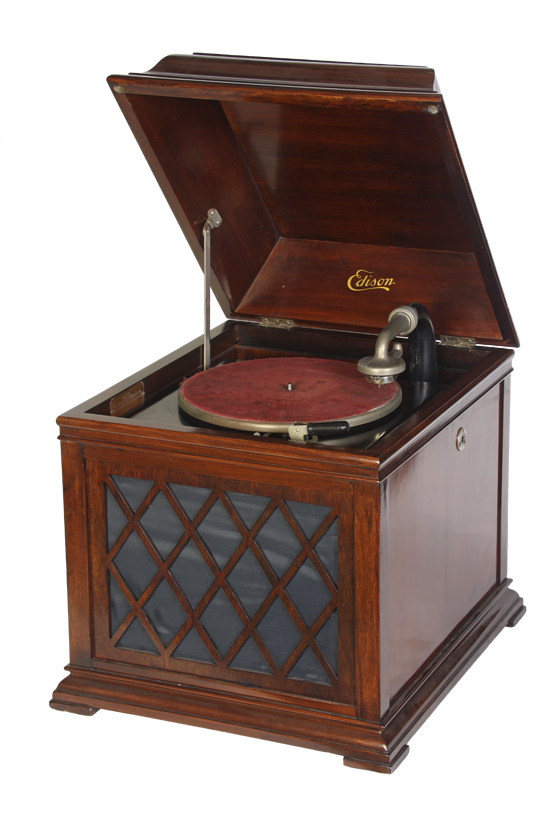
Not all of the material in “Sounds” is sound-based. Recording and audio geeks and historians will appreciate the large collection of “Playback & Recording Equipment” photographs (such as the 1912 Edison Disc Phonograph, above ), spanning the years 1877 to 1992. Also, many of the recordings—such as the wonderful first version of “Dirty Old Town” by Alan Lomax and the Ramblers, with Ewan MacColl and Peggy Seeger (below)—feature album covers, front and back, as well as disc labels.
The recordings in the Archive are unfortunately not downloadable (unless you are a licensed member of a UK HE/FE institution), but you can stream them all online and share any of them on your favorite social media platform. Perhaps the British Library will extend download privileges to all users in the future. For now, browsing through the sheer volume and variety of sounds in the archive should be enough to keep you busy.
Related Content:
The Alan Lomax Sound Archive Now Online: Features 17,000 Blues & Folk Recordings
Josh Jones is a writer and musician based in Durham, NC. Follow him at @jdmagness
Read More...Ursula K. Le Guin Names the Books She Likes and Wants You to Read
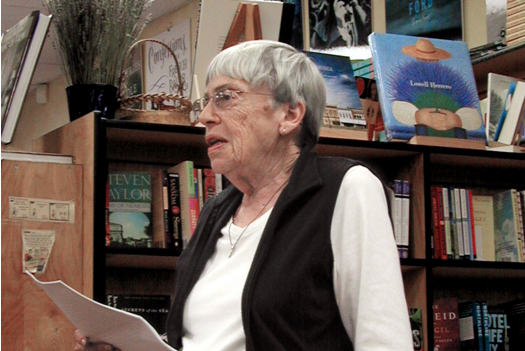
Image by Gorthian, via Wikimedia Commons
I’m sure I speak for many when I say that Ursula K. Le Guin’s novels and stories changed what I thought science fiction could be and do. Raised on H.G. Wells, Isaac Asimov, Robert Heinlein, and other mostly-white-male-centered classic sci-fi, I found Le Guin’s literary thought experiments startling and refreshing. Now it seems like almost a matter of course that science fiction and fantasy narratives come from a diversity of peoples and perspectives. But Le Guin remains the first to wake me from a dogmatic slumber about the potential of speculative fiction to imagine not only future technologies, but also expansive future identities.
Novels like The Left Hand of Darkness, The Dispossessed, and The Lathe of Heaven reflect Le Guin’s very broad range of interests in politics and the humanities and social sciences. She began her career as an academic studying Renaissance French and Italian literature, and her fiction synthesizes years of careful reading in anthropology, psychology, sociology, history, and Eastern and Western philosophy. Likewise, though she has been much influenced by traditional hard science fiction, Le Guin’s literary loves are wide and deep. All that’s to say she’s as admirable and interesting a reader as she is a writer. When she praises a book, I pay attention. Thanks to her genial, loquacious online presence for many years, her fans have had ample opportunity to find out what she’s reading and why.
Le Guin recently made a few lists of books she likes, and made sure to preface each one with a disclaimer: “This list is not ‘my favorite books.’ It’s just a list of books I’ve read or re-read, recently, that I liked and wanted to tell people about.” She leaps from genre to genre, writing mini-reviews of each book and linking each one to Powell’s, the independent bookstore in her beloved city of Portland, Oregon. Below, we’ve excerpted some of Le Guin’s “Books I’ve Liked” from each list, along with her commentary. Click on each date heading to see her complete lists of recommendations.
Seeing, by José Saramago. A sequel to his amazing novel Blindness. Saramago is not easy to read. He punctuates mostly with commas, doesn’t pararaph often, doesn’t set off conversation in quotes —; mannerisms I wouldn’t endure in a lesser writer; but Saramago is worth it. More than worth it. Transcendently worth it. Blindness scared me to death when I started it, but it rises wonderfully out of darkness into the light. Seeing goes the other way and is a very frightening book.
Changing Ones, by Will Roscoe. An examination of how gender has been constructed in Native American societies. Responsibly researched, very well written, generous in spirit, never oversimplifying a complex subject, this is a wonderfully enlightening book.
Age of Bronze: The Story of the Trojan War. I: A Thousand Ships, and II: Sacrifice by Eric Shanower. A graphic novel —; the first two volumes of a projected series. The drawing is excellent, the language lively, and the research awesome. Shanower goes back to the very origins of the war to follow the early careers of the various heroes —; Agamemnon and Menelaus, Achilles, Odysseus, Hector, Paris, Aeneas, and their families, parents, wives, lovers, children… Thus, by the end of Book Two, the actual siege of Troy, which the Iliad tells one part of, is yet to begin. I see a looming problem: the battles (of which there have been a good many already) are visually all alike, and there’s endlessly more to come —; battle scenes in Homer are brutally monotonous and interminable (as war is). But these two volumes are visually and narratively varied, and give a fascinating backgrounding and interpretation to the great stories.
The Yiddish Policemen’s Union, by Michael Chabon. Of course if you haven’t read Kavalier and Clay yet, go read it at once, what on earth have you been waiting for? Then read this. It is even a little crazier, maybe. Crazy like a genius.
Suffer the Little Children, by Donna Leon. The 16th of Leon’s Venetian mystery novels is one of the finest. I reviewed this book for the Manchester Guardian
Some young adult books I like — I had to read a lot of them this spring, and these stood out:
The Higher Power of Lucky by Susan Patron. This one has already won the Newbery Award and gone to Kiddilit Booksellers Heaven forever, so it doesn’t need my endorsement… but it’s a lovely, funny, sweet book, set in a truly godforsaken desert town in California.
Weedflower by Cynthia Kadohata. A novel that goes with its young heroine to one of the prison camps where our government sent all our citizens of Japanese ancestry in 1942 after Pearl Harbor. It’s a beautiful book, understated and strong and tender. If you read it you won’t forget it.
Charles Mann, 1491. A brilliant survey of what we know about the human populations of the Americas before the arrival of the Europeans, and a brief, often scathing history of how we’ve handled our knowledge. The author is not an archeologist or anthropologist, but he has done his homework, and is a fine reporter and summarizer, writing with clarity and flair, easy to read but never talking down. Discussing intensely controversial subjects such as dates of settlement and population sizes, he lets you know where he stands, but presents both sides fairly. A fascinating, mind-expanding book.
Michael Pollan, The Omnivore’s Dilemma. I have never eaten an Idaho potato since I read Pollan’s article about what potato fields are “treated” with, in his earlier book The Botany of Desire. This one is scary in a different way. It probably won’t stop you from eating anything, indeed it is a real celebration of (real) food; but the first section is as fine a description of the blind, incalculable power of Growth Capitalism as I ever read. (Did you know that cattle can’t digest corn, and have to be chemically poisoned in order to produce “cornfed beef”? So, there being lots and lots of grass, why feed them corn? Read the book!) There are some depressing bits in the section on “organic” food, too, but the last section, where he hunts and gathers his dinner, is funny and often touching.
Barbara Ehrenreich, Nickel and Dimed. Ehrenreich tries to get by on minimum wage, in three different towns, working as a waitress, a house cleaner, in a Wal-Mart… Yes, it came out eight years ago, and yes, it’s just as true now, if not truer. (I just read in my hometown paper that 47% of working people in Portland have to rely on food stamps. Not “welfare queens” — people with jobs, working people.) She writes her story with tremendous verve and exactness. It reads like a novel, and leaves you all shook up.
[Le Guin devoted this list to “Some Graphic Novels,” and wrote about her difficulty finding good “grown-up stuff.” Though most of it was not to her taste (“gross-out violence, or horror, or twee, or sexist, or otherwise not down my alley”), she kept “hoping, because the form seems to me such a hugely promising and adventurous one.” Below are two graphic novels she did like. Another, Age of Bronze, she mentioned above in her 2006 list.]
Marjane Satrapi’s Persepolis I and II, and her other books. (The movie of Persepolis was charming but it really didn’t add much to the book.) I admire her drawing, which is deceptively simple but very subtly designed, using the pure contrast-power of black-and-white. The drawings and the text combine so seamlessly that I’m not aware of looking back and forth between them, I’m just taking it all in at once — Which I think is pretty much my ideal for a graphic narrative?
Joann Sfar’s The Rabbi’s Cat I and II. Three connected stories in each volume. The first two stories in the first volume are pure delight. They are funny and wise and show you a world you almost certainly never knew existed. The rabbi is a dear, the rabbi’s daughter is a dear, and the rabbi’s cat is all cat, all through, all the way down. (I wondered why Sfar drew him so strangely, until I looked at the photograph of Sfar’s cat on the cover.) The second volume isn’t quite as great, but the first story in it is awfully funny and well drawn, with the most irresistible lion, and it’s all enjoyable. Sfar’s imagination and color are wonderful. His publisher should be pilloried in Times Square for printing the art in Vol II so small that you literally need a magnifying glass to read some of the continuity. — I gather that Sfar and Satrapi are friends. Are we on the way to having a great school of graphic novels by Foreigners Living in Paris?
Related Content:
Ursula Le Guin Gives Insightful Writing Advice in Her Free Online Workshop
Hear Ursula K. Le Guin’s Story, “The End” Dramatized: A Rare Audio Treat
Josh Jones is a writer and musician based in Durham, NC. Follow him at @jdmagness
Read More...A Clever Supercut of Writers Struggling with Writer’s Block in 53 Films: From Barton Fink to The Royal Tenenbaums
Quite patiently, Ben Watts cut apart and stitched together scenes from 53 films (find a complete list here) showing characters suffering through writer’s block. Adaptation, Barton Fink, Shakespeare in Love, The Royal Tenenbaums, and, yes, Throw Momma From the Train–they’re among the films featured in the 4‑minute supercut above. If you give the clip a little time, you’ll see that the supercut has an arc to it. It tells a tale, and has an ending that Hollywood would love.
If you would like to support the mission of Open Culture, consider making a donation to our site. It’s hard to rely 100% on ads, and your contributions will help us continue providing the best free cultural and educational materials to learners everywhere. You can contribute through PayPal, Patreon, and Venmo (@openculture). Thanks!
Related Content:
Watch a 44-Minute Supercut of Every Woody Allen Stammer, From Every Woody Allen Film
A Mesmerizing Supercut of the First and Final Frames of 55 Movies, Played Side by Side
Books in the Films of Wes Anderson: A Supercut for Bibliophiles
Read More...Support Us
We're hoping to rely on loyal readers, rather than erratic ads. Please click the Donate button and support Open Culture. You can use Paypal, Venmo, Patreon, even Crypto! We thank you!

About Us

Open Culture scours the web for the best educational media. We find the free courses and audio books you need, the language lessons & educational videos you want, and plenty of enlightenment in between.
Advertise With Us
FREE UPDATES!
GET OUR DAILY EMAIL
Get the best cultural and educational resources on the web curated for you in a daily email. We never spam. Unsubscribe at any time.
FOLLOW ON SOCIAL MEDIA
Open Culture editor Dan Colman scours the web for the best educational media. He finds the free courses and audio books you need, the language lessons & movies you want, and plenty of enlightenment in between.
Advertise With Us


