The Neuroscience & Psychology of Procrastination, and How to Overcome It
Procrastination is a skill, an art, a slight-of-hand technique. I’m procrastinating right now, but you’d never know it. How many tabs do I have open in my multiple browser windows? Pick a number, any number. How many tasks have I put off today? How many dreams have I deferred? I’ll never tell. The unskilled procrastinators stick out, they’re easy to spot. They talk a lot about what they’re not doing. They run around in circles of bewilderment like the troubled hero of Dr. Seuss’s Hunches in Bunches. The skilled practitioner makes it look easy.
But no matter how much Facebook time you get in before lunch and still manage to ace those performance reviews, you’re really only cheating yourself, am I right? You wanted to finish that novel/symphony/improv class/physics theorem. But something stopped you. Something in your brain perhaps. That’s where these things usually happen. When Stuart Langfield asked a neuroscientist about the neuroscience of procrastination, he got the following answer: “People think that you can turn on an MRI and see where something’s happening in the brain, but the truth is that’s not so. This stuff is vastly more complicated, so we have theories.”
There are theories aplenty that tell us, says Langfield, “what’s probably happening” in the brain. Langfield explains his own: the primitive, pleasure-seeking, pain-avoiding limbic system acts too quickly for our more deliberative, rational prefrontal cortex to catch up, rendering us stupefied by distractions. Piers Steel, Distinguished Research Chair at the University of Calgary and a procrastination expert, shares this view. You can see him explain it in the short video below. The evolutionary “design flaw,” says Langfield, might make the situation seem hopeless, were it not for “neuroplasticity,” a fancy buzzword that means we have the ability to change our brains.
Langfield’s purpose in his short video is not only to understand the biology of procrastination, but to overcome it. He asks psychologist Tim Pychyl, whose answers we see and hear as an incomprehensible jumble of ideas. But then Pychyl reduces the complicated theories to a simple solution. You guessed it, mindfulness meditation—to “downregulate the limbic system.” Really, that’s it? Just meditate? It is a proven way to reduce anxiety and improve concentration.
But Pychyl and his research team at Carleton University have a few more very practical suggestions, based on experimental data gathered by Steel and others. The Wall Street Journal offers this condensed list of tips:
Break a long-term project down into specific sub-goals. State the exact start time and how long (not just “tomorrow”) you plan to work on the task.
Just get started. It isn’t necessary to write a long list of tasks, or each intermediate step.
Remind yourself that finishing the task now helps you in the future. Putting off the task won’t make it more enjoyable.
Implement “microcosts,” or mini-delays, that require you to make a small effort to procrastinate, such as having to log on to a separate computer account for games.
Reward yourself not only for completing the entire project but also the sub-goals.
A Stockholm University study tested these strategies, assigning a group of 150 self-reported “high procrastinators” several of the self-help instructions over 10 weeks, and employing a reward system and varying levels of guidance. “The results,” WSJ reports, “showed that after intervention with both guided and unguided self-help, people improved their procrastination, though the guided therapy seemed to show greater benefit.”
Other times, adding self-help tasks to get us to the tasks we’re putting off doesn’t work so well. We can all take comfort in the fact that procrastination has a long history, dating back to ancient Egypt, Rome, and 18th century England. The wisdom of the ages could not defeat it, or as Samuel Johnson wrote, “even they who most steadily withstand it find it, if not the most violent, the most pertinacious of their passions, always renewing its attacks, and, though often vanquished, never destroyed.”
But there are people who procrastinate, beset by its pertinacity, and then there are chronic procrastinators. “If you’re an occasional procrastinator, says Pychyl, “quit thinking about your feelings and get to the next task.” Suck it up, in other words, and walk it off—maybe after a short course of self-help. For all the conflicting neuroscientific theory, “there is a quiet science behind procrastination,” writes Big Think, and “according to recent studies, procrastination is a learned habit.” Most research agrees it’s one we can unlearn through meditation and/or patient retraining of ourselves.
However if you’re of the chronic subset, say Pychyl, “you might need therapy to better understand your emotions and how you’re coping with them through avoidance.” Psychologist Joseph Ferrari at DePaul University agrees. Citing a figure of “20 percent of U.S. men and women” who “make procrastination their way of life,” he adds, “it is the person who does that habitually, always with plausible ‘excuses’ that has issues to address.” Only you can determine whether your trouble relates to bad habits or deeper psychological issues.
Whatever the causes, what might motivate us to meditate or seek therapy are the effects. Chronic procrastination is “not a time management issue,” says Ferrari, “it is a maladaptive lifestyle.” Habitual procrastinators, the WSJ writes, “have higher rates of depression and anxiety and poorer well-being.” We may think, writes Eric Jaffe at the Association for Psychological Science’s journal, of procrastination as “an innocuous habit at worst, and maybe even a helpful one at best,” a strategy Stanford philosophy professor John Perry argued for in The Art of Procrastination. Instead, Jaffe says, in a sobering summary of Pychyl’s research, “procrastination is really a self-inflicted wound that gradually chips away at the most valuable resource in the world: time.”
Related Content:
Free Online Psychology & Neuroscience Courses
Daily Meditation Boosts & Revitalizes the Brain and Reduces Stress, Harvard Study Finds
Miranda July Teaches You How to Avoid Procrastination
The Art of Structured Procrastination
Josh Jones is a writer and musician based in Durham, NC. Follow him at @jdmagness
Read More...Three-Hour Mixtape Offers a Sonic Introduction to Underground Goth Music
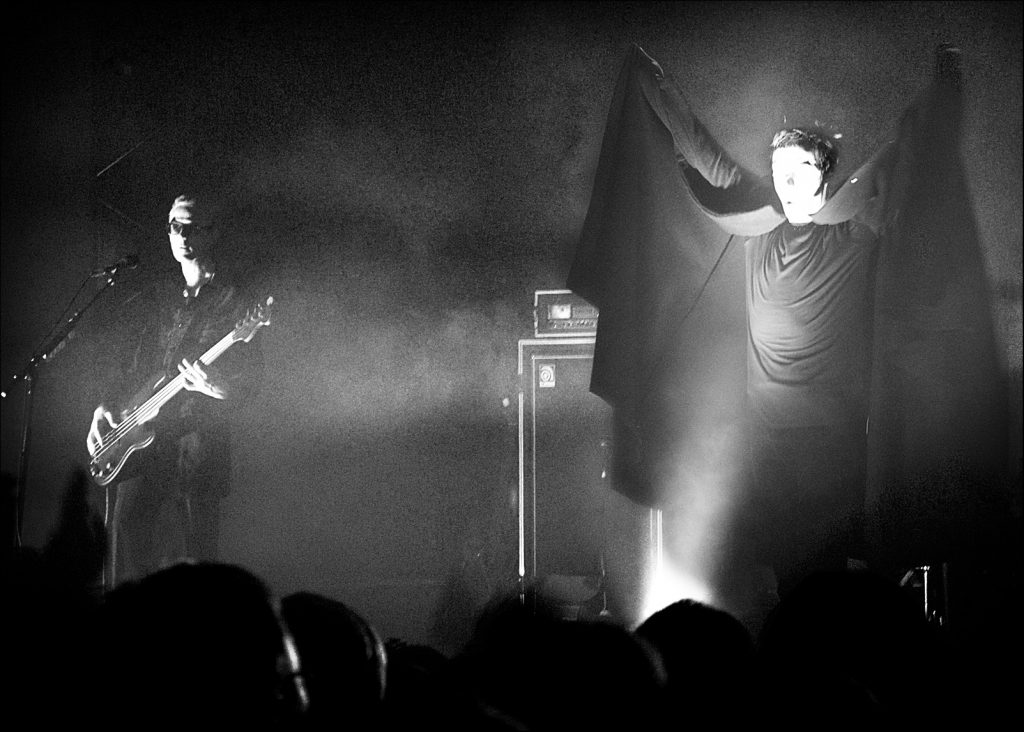
Image by Pedro Figueiredo, via Wikimedia Commons
Why, in my day we called it “post-punk” and we walked miles to find it in catacombs with secret passwords, far away from any mall apparel stores or beverage-sponsored music festivals….
Mostly rubbish, though I have heard many an old campaigner say as much, decrying Goth rock as a recent, devolution from more serious, avant-garde trends. Some amalgam of The Doors, Leonard Cohen, Nico and the Velvet Underground, The Damned, Screamin’ Jay Hawkins, and Hammer horror films, early goth rock went spare, atmospheric, and punky, like the early Cure, or baroque, morose, and cabaret like Bauhaus, or any other number of respectable art-rock directions.
These bands, many of my cohort believe, had integrity, and much better taste than kids today. All that get off my lawn-ness makes an easy target, as does the increasing popularity of a genre of music made for and by unpopular people.
Mix blog Secret Thirteen, curator of the goth rock mix above, admits as much. “Goth has never been an easy affair to discuss,” reads the mix intro in idiosyncratic English: “Kitschy atmosphere of massive contemporary goth festivals and stereotyping discourses usually overwhelmed the textural and emotional core of goth.” Contemporary perceptions, fair or not, obscure the diversity—stylistically, that is… of the music, with its “diverse elements including Dada movement, surrealist aesthetics, post-modernism, French ‘fin-de-siecle’ poetry, 19th century romanticism, punk, kraut, glam, shoegaze, ambient, folk, etc….”
Indeed, it’s all there, when a band with the abrasive low-camp, grindhouse punk of Nick Cave’s The Birthday Party shares a musical lineage with the early synthpop of Ministry (with DJ-scratching!) and the medieval- and world music-obsessed Dead Can Dance. But the key operator in these extremes is theatricality. Since Siouxsie Sioux’s fishnets and swastikas, Dave Vanian’s vampire costumes and pancake makeup, and Robert Smith’s enormous weeping willow hair and onstage mist-shrouded cathedrals of despair, goth has had to make overwrought spectacles of itself, at times horribly tacky ones.
But the Secret Thirteen mix, compiled by founder Justinas Mikulskis, reminds us it’s really about the music, by putting together “the deep cuts,” writes Electronic Beats, “none of this ‘Bela’s Lugosi’s Dead’ stuff” (referring to Bauhaus’ biggest hit).
Here instead we find “the boisterous deathrock of Mighty Sphincter, Specimen’s Batcave thrashiness, the artsy weirdness of Red Wedding and early 4AD stalwarts Mass.” It’s a very 80s mix, but unless you were digging deep in the crates of alternative record stores at the time, few names may be familiar. The Birthday Party shows up, and a band called Kommunity FK that had a very minor hit. Former Sex Pistol John Lydon’s Public Image Ltd. appears with their pounding rant “Religion II.” The Virgin Prunes also make the cut, number 42 in the mix—a very much overlooked, and very disturbing band, often only known for their childhood and family association with U2. Find a complete list of the tracks at the bottom of this page.
It is overall, I think, an excellent way to approach “goth”—or one definition of it—free from the wardrobe squabbles and generational condescension. The mix, writes Secret Thirteen, isn’t intended as “encyclopedic or anthological” in nature, but is “rather presented as a narrative with unexpected twists and turns showcasing a wide variety of elements, moods.” Sort of like a good story by Poe, or a good B horror movie.
Related Content:
A Massive 800-Track Playlist of 90s Indie & Alternative Music, in Chronological Order
Josh Jones is a writer and musician based in Durham, NC. Follow him at @jdmagness
Read More...Cate Blanchett Stars in a New Massive Attack Video, Which Doubles as a Short Art-House Film
Every director who casts Cate Blanchett—whether in period blockbusters like Elizabeth or Australian indies like Little Fishes—lets the camera dwell on her face for several silent beats in almost every scene she’s in. It’s almost a way of establishing her face as a character all its own, with its sharp features and consuming stare. Just above, Massive Attack’s video for their new song, “The Spoils,” takes this tendency deep into the uncanny valley.
Opening with a shot of Blanchett’s eyes, then several long, lingering looks at her face in close-up and deep chiaroscuro, the video quickly becomes more abstract and alien as it deconstructs her beauty into various kinds of artifice. It’s an art-house motif we’ve seen used effectively with other actresses known for their striking good looks—Scarlett Johansson in 2013’s Under the Skin, for example, or last year’s Ex Machina with Alicia Vikander.
These are films that defamiliarize their famous actresses and disrupt our comfortably shallow ideas about beauty and gender. “The Spoils”—scored by a band known for their cinematic sound (and occasionally Oscar-winning film soundtracks) and their political stances—functions beautifully as a mini-experimental film that takes us into profound and unsettling territory. This should come as no surprise; its director, John Hillcoat, also adapted Cormac McCarthy’s The Road into a film from which, for all its bleakness, we can hardly look away.
Massive Attack is also known for working with some of the most soulful of UK singers, including Shara Nelson, Tracey Thorn, Elizabeth Fraser, and Sinead O’Connor. In “The Spoils,” they collaborate with an American, another name we associate with the best of hazy, atmospheric 90s chill-out music, Mazzy Star’s Hope Sandoval. The results are hypnotic, as in all Sandoval’s work, and lushly, meticulously produced.
That said, taken separately, the song loses some of the arresting emotional power it has accompanying HIllcoat’s Twilight Zone images. You may be put in mind of the House intro with its x‑rays and organs shrouded in darkness, scored to Massive Attack’s “Teardrop.” But we can also compare “The Spoils” to “Teardrop”’s official video, above, another lingering meditation on human identity and personality.
Related Content:
Michel Gondry’s Finest Music Videos for Björk, Radiohead & More: The Last of the Music Video Gods
David Fincher’s Five Finest Music Videos: From Madonna to Aerosmith
Josh Jones is a writer and musician based in Durham, NC. Follow him at @jdmagness
Read More...Stream a Massive Collection of Indie, Noise Industrial Mixtapes from the 80s and 90s
They’ll never be worth as much as the alleged box of first edition Superman comics left in my father’s room when he shipped out to sea, allegedly given to the dump by his mother, though she forever denied it; but those overstuffed boxes full of cheap mixtapes from the late 80s and 90s in my closet have to be worth something, right? If only to the internet… the Internet Archive, a more specific place, and yes, it’s the one that hosts the Wayback Machine, preserver of webpages no one updates or, really, visits anymore.
But this is not a sad story about what happened to Web 1.0! But a happy one about where your mixtapes will go, because they are needed. Just as a recent generation decided to bypass the sixties and go back to the sources of Hendrix and CSNY so future hipsters of today ignore oughties retreads and return to the world just before the internet. They go full antiquarian with it, with authentic period costumes and period-era equipment, which means they often sound terrible. They need cassettes to get it right.

The cassette has already made its way back in a big way, reintroducing the sound of early synthpop, industrial music, DIY indie rock, and a genre called “tape experimentation” that encompasses anything from avant-garde musique concrète to the latest production of spliced together cassette tape. The sound of decaying tape—a soup of hiss and muffled, warped, out-of-tune copies of songs—birthed dark, sludgy metal and perfectly captured the soundtracks of horror movies. And, imperfectly, the sound of everything else. These were “the days when the audio cassette was the standard method of music sharing… generally the mid-eighties through early-nineties,” points out The Noise-Arch Archive, which hosts just such a collection, on just such a (digitized) medium. 30 gigs of tape hiss.
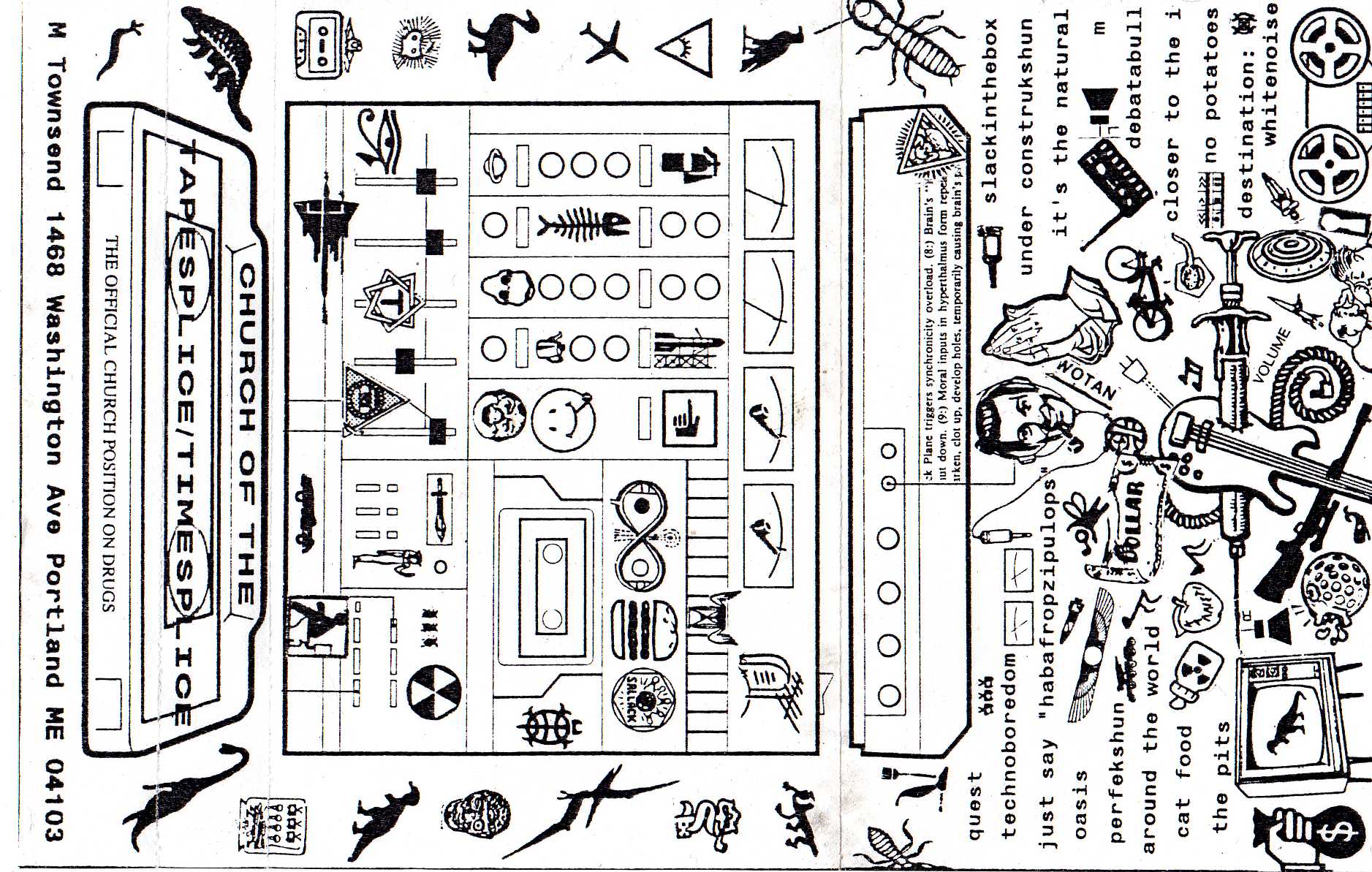
One needs a reliable guide like, say, Tom Waits, to understand how weird depression-era music was. This archive makes significant headway in conveying the same information about the Bush (the first) and Clinton (the first) years. One need only listen to Church of the Tapeslice / Timesplice at the top, as much as that’s possible, to get a flavor of how. It’s a mélange of Frank Zappa-like sound collage, Residents-like sardonic absurdity, Devo-like black humor, and free-form-the-DJ-is-really-stoned-level goofiness you’ve heard at least once late night on your college radio station. But they aren’t all this off-putting, and they aren’t all this approachable either.
Psychomania, further up, lives up to its name. It opens innocently enough, with some sort of nondescriptly tribal ditty, lilting, if unsettling. Then the mix shifts into full giallo mode, the loud, punishing synths and descending harmonies of doom that comprise the scores of “Spaghetti Slashers.” Expect the obscure of the obscure in every tape in this collection. “Much of this material defies category,” Noise-Arch advises, “and has therefore not been given one.” Much of it sounds like something you might recognize, only a few uncanny removes from your point of reference.
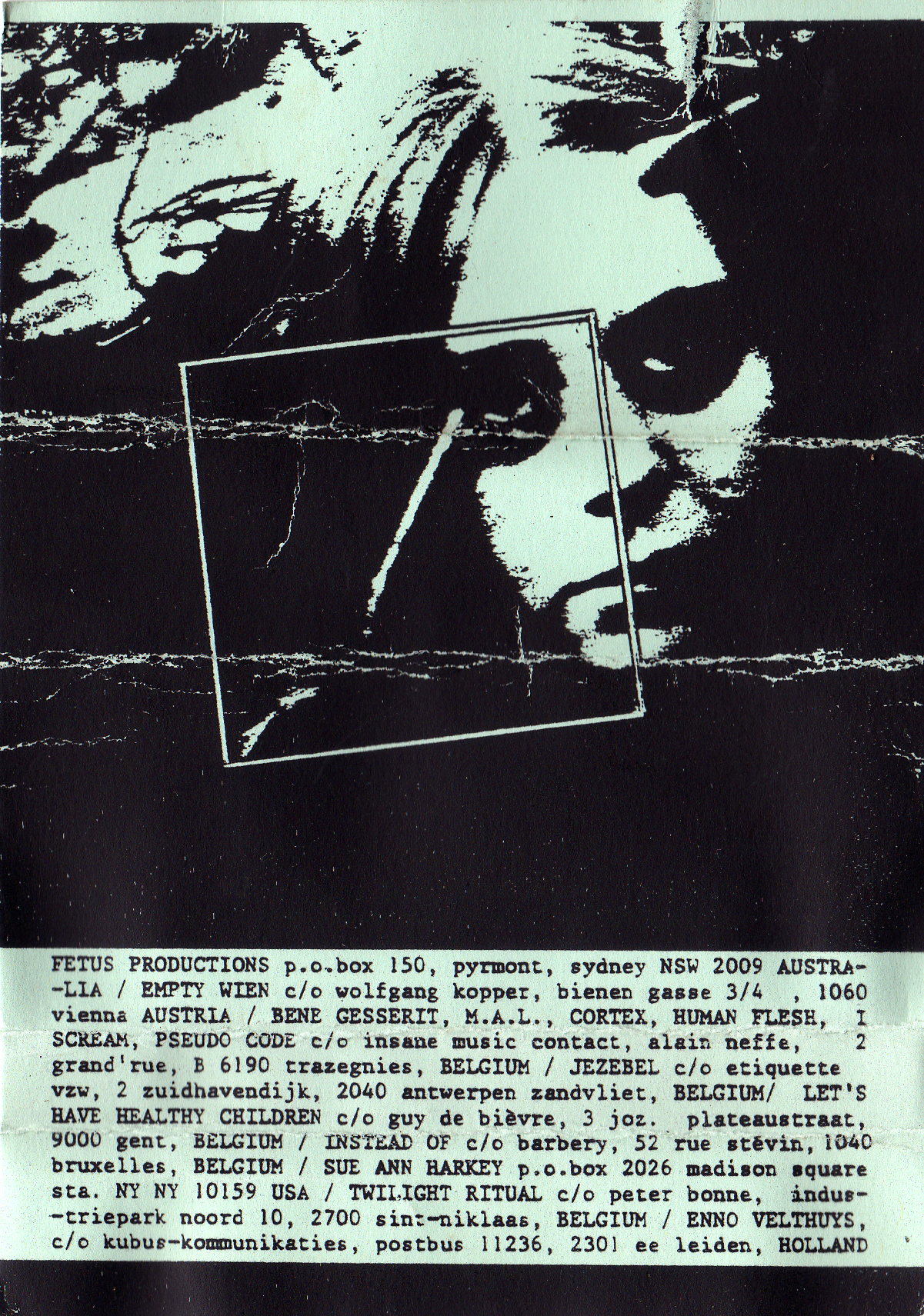
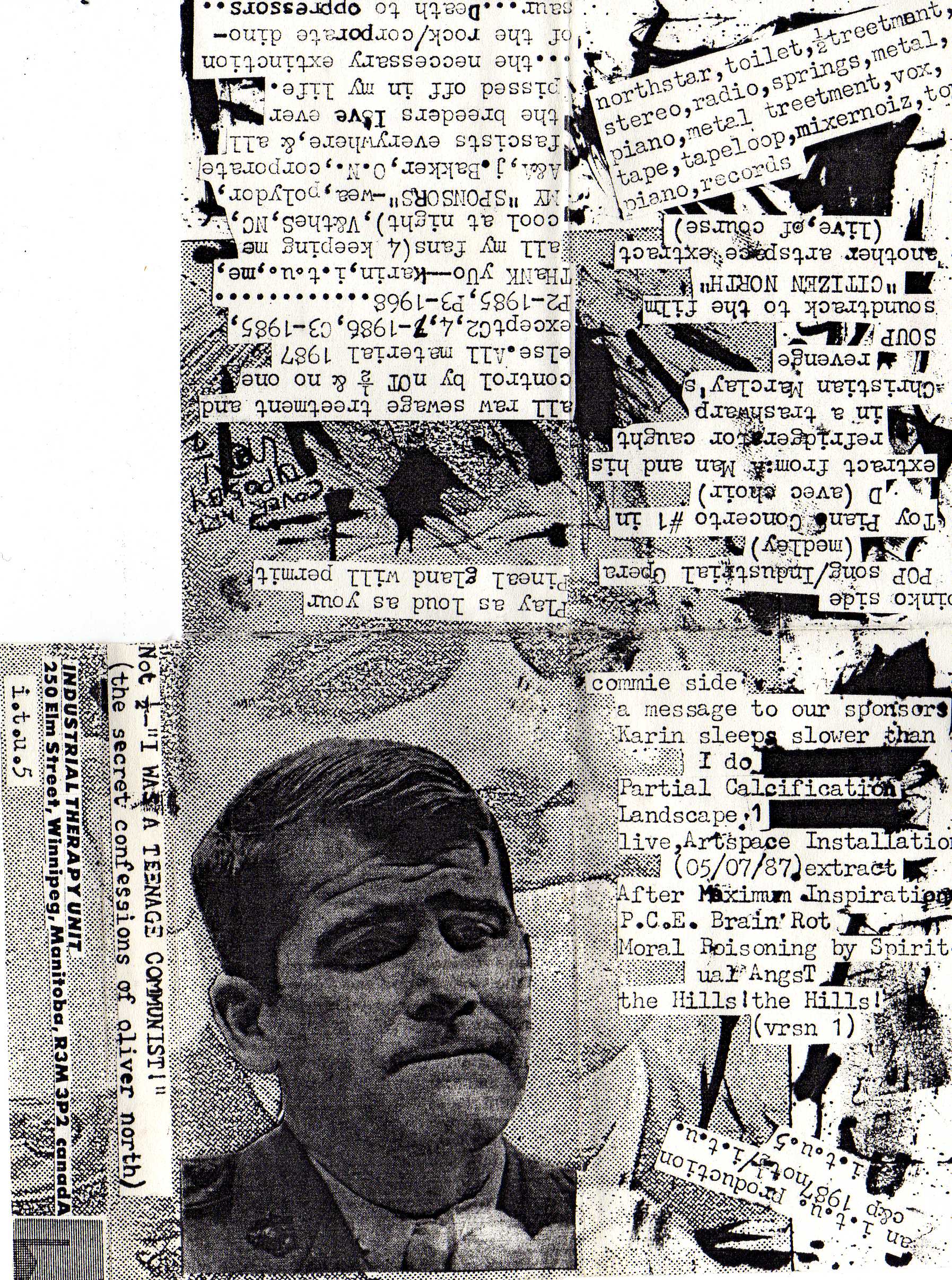
The collection above—its barely legible cover describes a compilation from “Fetus Productions” in Australia—opens with some really off-kilter electro-lounge music and progresses into a full-on synthpop opera. None of this music, obviously, should be missed. Nor the music stored in important archives currently occupying my closet. I’ll never sell it. Because who wants a bunch of worn-out crappy plastic tapes? It’s what’s on them that we need to preserve. Even the hard-to-love slacker nonsense of I Was a Teenage Communist (The Secret Confessions of Oliver North). Enter The Noise-Arch Archive here.
Related Content:
A Massive 800-Track Playlist of 90s Indie & Alternative Music, in Chronological Order
Josh Jones is a writer and musician based in Durham, NC. Follow him at @jdmagness
Read More...Hear 17,000+ Traditional Folk & Blues Songs Curated by the Great Musicologist Alan Lomax
For all its success with steamrolling over entire populations to build highways, factory towns, and office campuses, the U.S. has also, since its earliest days, produced scores of committed ethnologists, musicologists, and other documentarians of human cultural production in all its variety. This cruel paradox has, most generally speaking, left a dual legacy in both the country’s storied violence and its capacity for renewal through the appropriation, transformation, and amalgamation of other cultures.
And we would have no national treasure chest of folk music, art, story, and history to draw from without journeymen collectors like Alan Lomax. Where cultural historians like W.E.B. Dubois, Zora Neale Hurston, Franz Boas, and Margaret Mead lent their findings to revivals in American literature and philosophy, Lomax, along with his contemporary, folklorist Harry Smith, “unlocked the secrets of this kind of music,” as Dylan remarked, for hundreds of budding folk and blues musicians in the forties, fifties, and sixties.
With typically Dylan-like understatement, the phrase “this kind of music” undersells the diversity of Americana in Lomax’s collection, from Celtic Appalachiana to African Caribbeana. Lomax started out recording folk music under the tutelage of his folklorist father, John Lomax. Beginning in 1934, the two travelled the country, “gathering thousands of field recordings of folk musicians throughout the American South, Southwest, Midwest, and Northeast, as well as in Haiti and the Bahamas,” writes the Association for Cultural Equity, which hosts a huge archive of Lomax’s folk recordings. These were released in several popular anthologies of the time and housed at the Library of Congress’s Archive of American Folk Song, for whom the younger Lomax began working in 1937.
Throughout the 30s and 40s, Lomax furiously recorded songs, jokes, stories, interviews, etc. and produced films and radio programs “which brought 1940s New Yorkers blues, flamenco, calypso, and Southern ballad singing, all still relatively unknown genres.” A musician himself (hear him do “Rambling Gambler,” above), Lomax also discovered and promoted a number of folk artists who would be stars. He “exposed national audiences to regional American music and such homegrown talents as Woody Guthrie, Lead Belly, Aunt Molly Jackson, Josh White, the Golden Gate Quartet, Burl Ives, and Pete Seeger.” He made the first recordings of Muddy Waters (then McKinley Morganfield) and recorded seminal sessions and conversations with bluesmen like Memphis Slim, Big Bill Broonzy, and Sonny Boy Williamson.
It’s safe to say that without Lomax’s tireless curating, we would have had no folk and blues revival of the fifties and sixties, and thus, likely, no rock and roll. It’s easy in our cynical and anxiety-ridden current cultural moment to dismiss folklorists like the Lomaxes as pirates who profited from the work of others. But it’s also easy to forget how little opportunity the artists they worked with had to reach the world outside their local circuits, and how little opportunity the wider American public had to hear folk and local artists. In part because of Alan Lomax’s work in the beginnings of the 21st century, we never need to lose touch with the country’s tremendous cultural diversity, an essential feature of the U.S. throughout its history.
A fair amount of controversy roils over the business arrangements that folklorists came to with artists and collaborators like Lead Belly, and there are good historical and political reasons to follow these debates. Ideals of cultural equity did not erase racial and economic realities. But the best of what survives the meetings of Lomax father and son and the hundreds of men and women they encountered in their travels is captured on record, tape, and digital formats, and preserved for future generations to rediscover what the country sounds like outside the feedback loops of corporate media. There are innumerable ways to discover Lomax’s recordings. His own Association for Cultural Equity hosts hundreds of hours of audio and video recordings, available to stream for free at the site or on Youtube. The archive contains over 17,000 folk recordings by Lomax.
And in the Spotify playlist above, we’ve compiled a playlist of Lomax’s commercial releases. In the first two, we hear Lomax himself interpreting various cowboy and western songs. Then a massive album of recordings he made in Haiti after doing graduate work in anthropology (these include recordings of his fellow anthropologist Zora Neale Hurston). We have a compilation of early Delta blues recordings or “Negro Prison Blues,” and an album of popular Italian folk songs like “Funiculi, Funicula” and “Come Back to Sorrento.” Overall it’s a playlist that represents the surprising breadth of Lomax’s interest in “this kind of music”—the kind, as he put it in his “Appeal for Cultural Equity,” made by “each and every branch of the human family.”
Related Content:
Alan Lomax’s Music Archive Houses Over 17,400 Folk Recordings From 1946 to the 1990s
Legendary Folklorist Alan Lomax: ‘The Land Where the Blues Began’
Woody Guthrie at 100: Celebrate His Amazing Life with a BBC Film
Hear Zora Neale Hurston Sing the Bawdy Prison Blues Song “Uncle Bud” (1940)
Josh Jones is a writer and musician based in Durham, NC. Follow him at @jdmagness
Read More...Michio Kaku on Why Immigrants Are America’s Secret Weapon: They Compensate for Our Mediocre STEM Education & Keep Prosperity Going
Americans have often found themselves caught up in panics about immigration, like that now driving the campaign to build a wall between us and our third largest trading partner—when more Mexicans are leaving the U.S. than arriving. Then we have the talk of banning an entire world religion, though, of course, we’ve seen this before, lest we forget that the Klan resurged in large part as an anti-Catholic group. All of this misinformation, mistrust, and outright contempt comes at a high cost, including that of any real understanding of how immigration works, and why it works, no matter how vehemently certain organizations fight against it.
The fact is that the U.S. might be a dynamo for capital but not when it comes to what economists crudely call “human capital.” The point applies not only to immigrant workers who do jobs Americans won’t, but also those who do jobs Americans can’t, because, as physicist Michio Kaku argues above, “the United States has the worst educational system known to science.” Were it solely up to U.S. graduates, the scientific establishment and tech economy would collapse, he says, “forget about Google, forget about Silicon Valley. There would be no Silicon Valley.” Instead, U.S. science and tech thrive because of immigrants who come on H‑1B visas, “America’s secret weapon… the genius visa.”
Kaku goes on to press his case with daunting statistics about the number of foreign-born Ph.D. graduates, though he doesn’t say that all of those grads have H‑1Bs. In fact, his position is a highly controversial one. Reliable studies show that many companies abuse the specialized work visa to outsource jobs Americans are fully qualified to do, and to create a class of immigrant workers who earn less than their U.S. counterparts and work under a modified form of indentured servitude. The visa is, after all, “a non-immigrant visa,” points out one critic, “and so has nothing at all to do with staying in the USA, becoming a citizen, or starting a business.” It is, more or less, a guest worker program.
Kaku’s tone can also seem grating, a smarmy reminder of what David H. Freedman calls in The Atlantic “open season on the nonsmart.” Calling American grads “stupid” will not likely endear many of them to his position. Nonetheless, when it comes to science education, it’s hard to argue with his assessments, and with his case for allowing the best minds in the world to come work for American companies (under more equitable conditions). In the Big Think video above, Kaku again presses his argument for the H‑1B as instrumental to a “brain drain” into the United States, feeding its science and tech industries with fresh minds and fresh ideas constantly. His ideas about meritocracy may seem blithe, especially given the material advantages so many guest workers already have before arriving in the States. But in purely descriptive terms, the best U.S. graduates just simply cannot compete with many of their foreign-born colleagues.
Here Kaku’s argument takes a turn in both these videos and shows how the “secret weapon” is one we’ve pointed at ourselves. We can’t continue to depend on “geniuses” from other countries, he says, to prop up our science and technology sectors, especially since the brain drains back out, with H1‑B visa holders frequently leaving, given their temporary status, and establishing companies in their home countries. “In reality,” wrote Mother Jones in 2013, “most of today’s H‑1B workers don’t stick around to become the next Albert Einstein or Sergey Brin.” That year, “the top 10 users of H‑1B visas… were all offshore outsourcing firms… that hired nearly half nearly half of H1‑B workers.” As one expert explained, “The H‑1B worker learns the job and then rotates back to the home country and takes the work with him.”
It’s likely large numbers of those workers feel less and less welcome in the U.S. But it’s also true, as Kaku says, that Americans continue to fall far behind in math and science. There may indeed be few Americans who can fill many of those jobs or continue to push technological innovation forward in the U.S.
Related Content:
Michio Kaku Explains the Physics Behind Absolutely Everything
Colorful Animation Visualizes 200 Years of Immigration to the U.S. (1820-Present)
Portraits of Ellis Island Immigrants Arriving on America’s Welcoming Shores Circa 1907
Noam Chomsky Defines What It Means to Be a Truly Educated Person
Josh Jones is a writer and musician based in Durham, NC. Follow him at @jdmagness
Read More...The Largest Ever Tribute to Kate Bush’s “Wuthering Heights” Choreographed by a Flashmob in Berlin
When I’m feeling depressed or uninspired, I can always count on one of my favorite visionary musicians to remind me just how much wild weirdness and unexpected beauty the world contains. That person is Kate Bush, and for all of her many brilliant songs—too many to name—the touchstone for true fans will always be her first single, “Wuthering Heights,” written when she was only 16, recorded two years later, and turned into two astonishing videos. The first, UK version does Kate’s ethereal strangeness justice, without a doubt, placing her on a dark stage, in flowing white gown, fog machine at her feet, showcasing her idiosyncratic dance moves with several double-exposure versions of herself. All very Kate, but we’d seen this kind of thing before, if only at the meetings of our high school drama club.
It really wasn’t until the second, U.S. video’s release that audiences fully grasped the uniqueness of her genius. In this version, above, the young prodigy—who trained, by the way, with David Bowie’s mime and dance teacher Lindsay Kemp—appears in a flowing, Bohemian red gown, matching tights, and black belt, haunting a “wiley, windy” moor like Catherine Earnshaw, the doomed heroine of Emily Brontë’s novel.
Everything about this: the flowers in her hair, the editing tricks that have her fading in and out of the shot like a ghost, and most especially the fully uninhibited dance moves—not confined this time to the boundaries of a stage (which could never contain her anyway)…. It’s perfect, the very acme of melodramatic theatricality, and simply could not be improved upon in any possible way.
And so when fans seek to pay tribute to Kate Bush, they invariably call back to this video. In 2013, Kate Bush parody troupe Shambush! organized a group dance in Brighton, with 300 eager fans in red dresses and wigs, each one doing their best Kate Bush impression in a synchronized comedy homage. This year, on July 16th, a flashmob gathered in Berlin’s Tempelhof Field for “The Most Wuthering Heights Day Ever,” breaking the Shambush! record for most Kate Bush-attired dancing fans in one place. See them at the top of the post. Other flashmobs assembled around the world as well, in London, Wellington, Sydney, Adelaide, Melbourne, and elsewhere, reports German site Tonspion. Melbourne, it seems put on a particularly “strong showing of Bush-mania” (watch it above), according to Electronic Beats, who also suggest that next year the organizers “switch it up and find a good forest for a ‘The Sensual World’ flashmob.” That is indeed a stunning video, and it’s very hard to choose a favorite among Bush’s many visual masterpieces, but I’d like to see them try the wartime choreography of “Army Dreamers” next.
Related Content:
300 Kate Bush Impersonators Pay Tribute to Kate Bush’s Iconic “Wuthering Heights” Video
2009 Kate Bush Documentary Dubs Her “Queen of British Pop”
Josh Jones is a writer and musician based in Durham, NC. Follow him at @jdmagness
Read More...Hear Electronic Ladyland, a Mixtape Featuring 55 Tracks from 35 Pioneering Women in Electronic Music

Given that we’ve previously featured two documentaries on electronic music pioneer Delia Derbyshire, an introduction to four other female composers who pioneered electronic music (Daphne Oram, Laurie Spiegel, Éliane Radigue & Pauline Oliveros), and seven hours of electronic music made by women between 1938 and 2014, no loyal Open Culture reader could claim ignorance on the theme of this new mixtape, Electronic Ladyland. It comes from the French musical project Arandel, whose members remain anonymous and could therefore be of any gender, but who, in these 45 minutes (made of 55 different tracks by 35 female composers), display a mastery of the field.
“We realized that an unconscious feminine electronic music Internationale has existed throughout the ages and we wondered whether a secret intuition might have gathered around shared research,” says Arandel in a translated interview. “Was their mutual desires achieved differently in different countries, with different tools in different timezones? The idea was to see what would happen if we gathered them in the same fictitious room for 45 minutes, and built a choir from all their productions.”
Arandel’s interviewer describes the musicians in the mix as coming from “very different musical horizons: we find academic learned musicians, research music composers and experimenters who used to do DIY works composed for advertising or television in a pop or easy listening context, some eccentric women like The Space Lady or Ruth White.” We also hear from famous names like Laurie Anderson and Wendy Carlos, and Delia Derbyshire. “What she accomplished is fascinating,” says Arandel of Derbyshire, “as is listening to her talk about her interesting work in documentaries,” and they’ve also included work from Daphne Oram, Laurie Spiegel, Eliane Radigue, and Pauline Oliveiros, subjects of the other documentaries we’ve posted here.
Electronic Ladyland drops you right into a retro-futuristic sonic landscape equally danceable and haunting, one with great variety as well as an unexpected consistency. It provides not just a kind of brief overview of what certain generations of female composers discovered with their new and then-strange electronic instruments and other devices, but one you may well want to keep in your library for frequent listening. It will also, according to Arandel, make you think: “There is an almost magic link between women and electronic music, from the 50’s / 60’s. Have you asked yourself the question of social, artistic, maybe magic reasons behind this link?” Hit the play button, and you may start. Find the list of tracks below.
1. Glynis Jones : Magic Bird Song (1976)
2. Doris Norton : Norton Rythm Soft (1986)
3. Colette Magny : « Avec » Poème (1966)
4. Daphne Oram : Just For You (Excerpt 1)
5. Laurie Spiegel : Clockworks (1974)
6. Pauline Oliveiros : Bog Bog (1966)
7. Megan Roberts — I Could Sit Here All Day (1977)
8. Suzanne Ciani : Paris 1971
9. Laurie Anderson : Tape Bow Trio (Say Yes) (1981)
10. Glynis Jones : Schlum Rooli (1975)
11. Ruth White : Mists And Rains (1969)
12. Wendy Carlos : Spring (1972)
13. Ann McMillan : Syrinx (1978)
14. Delia Derbyshire : Restless Relays (1969)
15. Maggi Payne : Flights Of Fancy (1986)
16. Else Marie Pade : Syv Cirkler (1958)
17. Daniela Casa : Ricerca Della Materia (1975)
18. The Space Lady : Domine, Libra Nos (1990)
19. Johanna Beyer : Music Of The Spheres [1938]
20. Maddalena Fagandini : Interval Signal (1960)
21. Eliane Radigue : Chryptus I (1970)
22. Ruth White : Owls (1969)
23. Ursula Bogner : Speichen (1979)
24. Beatriz Ferreyra — Demeures Aquatiques (1967)
25. Doris Norton : War Mania Analysis (1983)
26. Tera De Marez Oyens : Safed (1967)
27. Daphne Oram : Rhythmic Variation II (1962)
28. Mireille Chamass-Kyrou : Etude 1 (1960)
29. Laurie Spiegel : Drums (1983)
30. Teresa Rampazzi : Stomaco 2 (1972)
31. Teresa Rampazzi : Esofago 1 (1972)
32. Suzanne Ciani : Fourth Voice: Sound Of Wetness (1970)
33. Ursula Bogner : Expansion (1979)
34. Alice Shields : Sacrifice (1993)
35. Megan Roberts and Raymond Ghirardo : ATVO II (1987)
36. Laurie Anderson : Drums (1981)
37. Doris Hays : Somersault Beat (1971)
38. Lily Greenham : Tillid (1973)
39. Ruth Anderson : Points (1973–74)
40. Pril Smiley : Kolyosa (1970)
41. Catherine Christer Hennix : The Electric Harpsichord (1976)
42. Joan La Barbara : Solo for Voice 45 (from Songbooks) (1977)
43. Slava Tsukerman, Brenda Hutchinson & Clive Smith : Night Club 1 (1983)
44. Monique Rollin : Motet (Etude Vocale) (1952)
45. Sofia Gubaidulina : Vivente – Non Vivente (1970)
46. Ruth White : Spleen (1967)
47. Doris Hays : Scared Trip (1971)
48. Daphne Oram : Pulse Persephone (Alternate Parts For Mixing)
49. Maggi Payne : Gamelan (1984)
50. Laurie Spiegel : The Unquestioned Answer (1980)
51. Ursula Bogner : Homöostat (1985)
52. Wendy Carlos : Summer (1972)
53. Suzanne Ciani : Princess With Orange Feet
54. Pauline Oliveiros : Poem Of Change (1993)
55. Suzanne Ciani : Thirteenth Voice: And All Dreams Are Not For Sale (1970)
Related Content:
Hear Seven Hours of Women Making Electronic Music (1938- 2014)
Two Documentaries Introduce Delia Derbyshire, the Pioneer in Electronic Music
The History of Electronic Music in 476 Tracks (1937–2001)
Based in Seoul, Colin Marshall writes and broadcasts on cities and culture. He’s at work on a book about Los Angeles, A Los Angeles Primer, the video series The City in Cinema, the crowdfunded journalism project Where Is the City of the Future?, and the Los Angeles Review of Books’ Korea Blog. Follow him on Twitter at @colinmarshall or on Facebook.
Read More...Watch “Don’t Be a Sucker!,” the 1947 US Government Anti-Hatred Film That’s Relevant All Over Again
If you aren’t seriously disturbed, even alarmed, that we in the U.S. have a presidential candidate from a major political party who succeeds by whipping up xenophobic fervor and telling us the country must not only reinstitute torture, but must do “the unthinkable”… well…. I don’t really know what to say to you. Perhaps more symptom than cause of a global turn toward tribal hatred, the GOP candidate has lent his name to a phenomenon characterized by cultish devotion to an authoritarian strongman, serial falsehood, and easy, uncritical scapegoating. We needn’t look far back in time to see the historical analogues, whether in the early 20th century, at the end of the 19th, or during any number of historical moments before and after.
We also needn’t look very far back to find a history of resistance to authoritarian bigotry, and not only from Civil Rights campaigners and leftists, but also, as you can see above, from the U.S. War Department. In 1947, the Department released the short propaganda film, “Don’t Be a Sucker!”, aimed at middle-class American Joes. Shot at Warner Studios, the film opens with some typical noirish crime scenarios, complete with convincingly noir lighting and camera angles, to visually set up the character of the “sucker” who gets taken in by sinister but seductive characters—“people who stay up nights trying to figure out how to take away” what the everyman has. What do naïve potential marks in this analogy have to lose? American plenty: “plenty of food, big factories to make things a man can use, big cities to do the business of a big country, and people, lots of people.”
“People,” the narrator says, working the farms and factories, digging the mines and running the businesses: “all kinds of people. People from different countries with different religions, different colored skins. Free people.” Is this disingenuous? You bet. We’re told this aggregate of people is “free to vote”—and we know this to be largely untrue in practice for many, necessitating the Voting Rights Act almost twenty years later. Free to “pick their own jobs”? Employment discrimination, segregation, and sexism effectively prevented that for millions. But the sentiments are noble, even if the facts don’t fully fit. As our average Joe wanders along, contemplating his advantages, he happens upon a reactionary streetcorner demogague haranguing against foreigners, African-Americans, Catholics, and Freemasons (?) on behalf of “real Americans.” Sounds plenty familiar.
The voice of reason comes from a naturalized Hungarian professor who witnessed the rise of Nazism in Berlin and who explains to our everyman the strategy of fanatics and fascists—divide and rule. “We human beings are not born with prejudices,” says the wise professor, “always they are made for us. Made by someone who wants something. Remember that when you hear this kind of talk. Somebody’s going to get something out of it. And it isn’t going to be you.” The remainder of the film mostly consists of the Hungarian professor’s recollections of how the Nazis won over ordinary Germans.
“Don’t Be a Sucker!” uses a clever rhetorical strategy, appealing to the self-interest and vanity of the everyman while couching that appeal in egalitarian values. The very recent historical example of fascist Europe carries significant weight, where too often today that history gets treated like a joke, turned into crude and muddled memes. This film would have had real impact on the viewing audience, who would have seen it before their feature in theaters across the country.
It’s worth noting that this film came out during a period of increasing American prosperity and comparative economic equity. The jobs “Don’t Be a Sucker!” lists with pride have disappeared. Today’s everyman, we might say, has even more reason for susceptibility to the demagogue’s appeals. The Internet Archive notes an irony here “in the light of Cold War anti-Communist politics, which really came into their own in the year this film was made.” The streetcorner populist calls to mind people like Joseph McCarthy and J. Edgar Hoover (and he looks like George Wallace)—powerful government authorities who cast suspicion on every movement for Civil Rights and social equality.
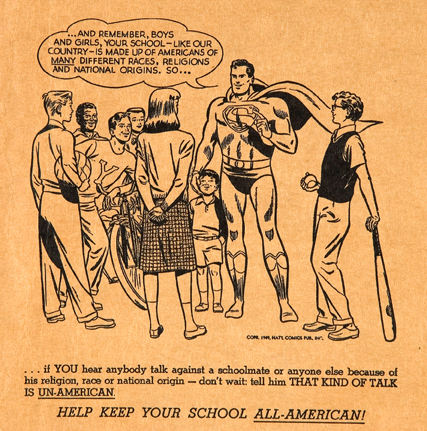
“Don’t Be a Sucker!” may seem like an outlier, but it’s reminiscent of another piece of patriotic, anti-racist-and-religious-bigotry propaganda—the Superman cartoon above, which first appeared in 1949, distributed to school children as a book cover by something called The Institute for American Democracy. You may have seen versions of a full-color poster, reprinted in subsequent years. Here, Superman expresses the same egalitarian values as “Don’t Be a Sucker!” only instead of calling racism a con-job, he calls it “Un-American,” using the favorite denunciation of HUAC and other anti-Communist groups.
History and the present moment may often prove otherwise—showing us just how very American racism and bigotry can be, but so too are numerous counter-movements on the left and, as these examples show, from more conservative, establishment corners as well.
“Don’t Be a Sucker!” will be added to our collection, 4,000+ Free Movies Online: Great Classics, Indies, Noir, Westerns, Documentaries & More.
Related Content:
Bertolt Brecht Testifies Before the House Un-American Activities Committee (1947)
Josh Jones is a writer and musician based in Durham, NC. Follow him at @jdmagness
Read More...An Eye-Popping Collection of 400+ Japanese Matchbox Covers: From 1920 through the 1940s
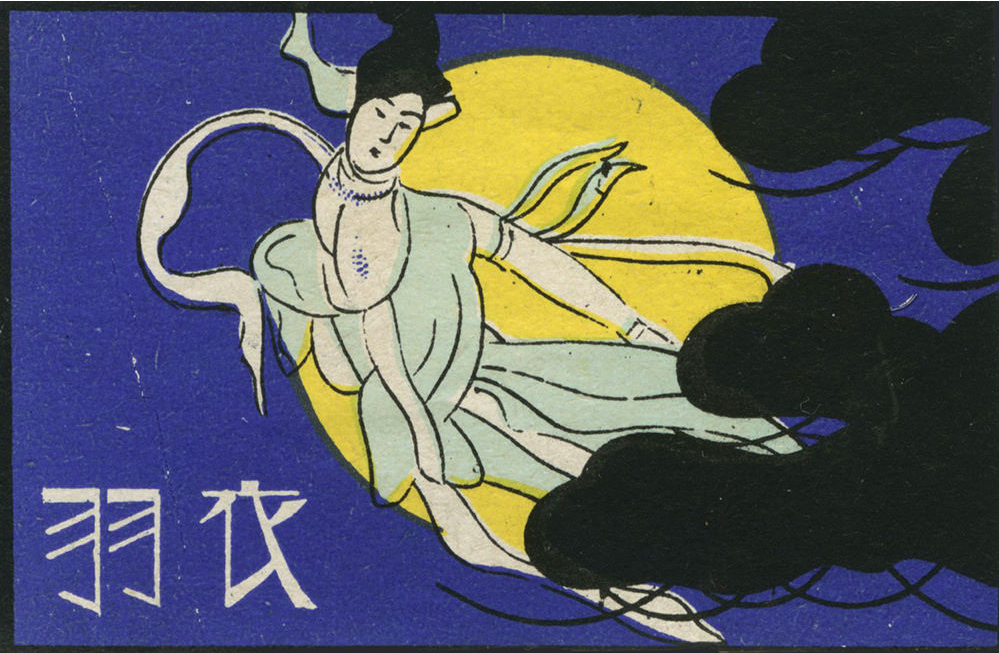
Phillumeny — the practice of collecting matchboxes — strikes me as a fun and practical hobby. As a child, I was fascinated with the contents of a large glass vase my grandparents had dedicated to this pursuit. Their collection was an ersatz record of all the hotels and nightclubs they had apparently visited before transforming into a dowdy older couple who enjoyed rocking in matching Bicentennial themed chairs, monitoring their bird feeder.
As any serious phillumenist will tell you, one need not have a personal connection to the items one is collecting. Most matchbox enthusiasts are in it for the art, a microcosm of 20th century design. The urge to preserve these disposable items is understandable, given the amount of artistry that went into them. It was good business practice for bars and restaurants to give them to customers at no charge, even if they never planned to strike so much as a single match.

Smoking’s heyday is over, but until someone figures out how to make fire with a smart phone, matchboxes and books are unlikely to disappear. Wherever you go, you’ll be able to find goodies to add to your collection, usually for free.
Or you could stay at home, trawling the Internet for some of the most glorious, and sought after examples of the form — those produced in Japan between the two World Wars. As author Steven Heller, co-chair of the School of Visual Arts’ MFA Design program, writes in Print magazine:
The designers were seriously influenced by imported European styles such as Victorian and Art Nouveau… (and later by Art Deco and the Bauhaus, introduced through Japanese graphic arts trade magazines, and incorporated into the design of matchbox labels during the late 1920s and ’30s). Western graphic mannerisms were harmoniously combined with traditional Japanese styles and geometries from the Meiji period (1868–1912), exemplified by both their simple and complex ornamental compositions. Since matches were a big export industry, and the Japanese dominated the markets in the United States, Australia, England, France, and even India, matchbox design exhibited a hybrid typography that wed Western and Japanese styles into an intricate mélange.
Find something that catches your eye? It shouldn’t cost more than a buck or two to acquire it, though Japanese clutter-control guru, Marie Kondo, would no doubt encourage you to adopt cartoonist Roz Chast’s approach to matchbook appreciation.

Earlier this spring, Chast shared her passion with readers of The New Yorker, collaging some of her favorites into an autobiographical comic wherein she revealed that she doesn’t collect the actual objects, just the digital images. Those familiar with Can’t We Talk About Something More Pleasant, Chast’s hilariously painful memoir about her difficult, aging parents’ “golden years,” will be unsurprised that she opted not to add to the unwelcome pile of “crap” that gets handed down to the next generation when a collector passes away.
If you’re inspired to start a Chast-style collection, have a rummage through the large album of Japanese vintage matchbox covers that web designer, Jane McDevitt posted to Flickr, from which the images here are drawn.
Those 418 labels, culled from a friend’s grandfather’s collection are just the tip of McDevitt’s matchbox obsession. To date, she’s posted over 2050 covers from all around the world, with the bulk hailing from Eastern Europe in the 50s and 60s. You can visit her collection of 400+ Japanese matchbox covers here. And if you’re into this stuff, check out the Japanese book, Matchbox Label Collection 1920s-40s.

Related Content:
Advertisements from Japan’s Golden Age of Art Deco
The Making of Japanese Handmade Paper: A Short Film Documents an 800-Year-Old Tradition
Ayun Halliday, author, illustrator, and Chief Primatologist of the East Village Inky zine, will be reading from her travel memoir, No Touch Monkey! And Other Travel Lessons Learned Too Late at Indy Reads Books in downtown Indianapolis, Thursday, July 7. Follow her @AyunHalliday
Read More...Support Us
We're hoping to rely on loyal readers, rather than erratic ads. Please click the Donate button and support Open Culture. You can use Paypal, Venmo, Patreon, even Crypto! We thank you!

About Us

Open Culture scours the web for the best educational media. We find the free courses and audio books you need, the language lessons & educational videos you want, and plenty of enlightenment in between.
Advertise With Us
FREE UPDATES!
GET OUR DAILY EMAIL
Get the best cultural and educational resources on the web curated for you in a daily email. We never spam. Unsubscribe at any time.
FOLLOW ON SOCIAL MEDIA
Open Culture editor Dan Colman scours the web for the best educational media. He finds the free courses and audio books you need, the language lessons & movies you want, and plenty of enlightenment in between.
Advertise With Us


