New Digital Archive, “Richard Pryor’s Peoria,” Takes You Inside the Dark, Lively World That Shaped the Pioneering Comedian
By Scott Saul:
Richard Pryor is a legendary comic, and for good reason. He had extraordinary gifts as a mimic, storyteller, physical comedian, satirist, and improvising actor — gifts he brought together in an act that had the dangerous electricity of an uninsulated wire. Meanwhile he established a feedback loop between his act and his personal life, making use of all those stage chops to draw comedy out of a life that was painfully full of self-sabotage, mayhem, and various forms of abuse.
It was my task, as Pryor’s biographer, to probe the legends of his life, starting with the vivid stories he told of his formative years in the red-light district of Peoria, Illinois. In his stage act and reminiscences, Pryor related how he’d been raised in a brothel by a grandmother and father who worked, respectively, as madam and pimp, and how he had both suffered at their hands and learned from them. He told, too, how he’d made his way in a larger world that, while brutal, was also touched with grace — that grace he felt when he ventured onstage, at school or in a club, and started to find himself as a performer.

Earlier biographers had wondered how much Pryor had embellished his past in building his act around his life story. In my research I discovered a motherlode of material — family photos, court records, newspaper articles, and more — that not only corroborated the outlines of Pryor’s story but also filled in the picture and gave it a historical depth. I could see, for instance, how Pryor’s taboo-busting comedy was rooted in his childhood environment, a black working-class underground where taboos were busted on a regular basis, and hypocrisies called to account. You can watch a short, four-minute film above that sets the story of the young Richard and his family against the backdrop of “Roarin’ Peoria.”
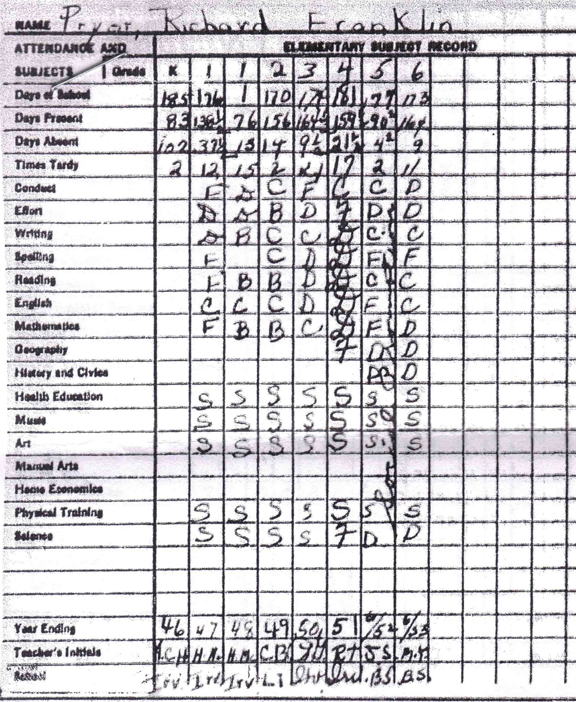
Ultimately, I discovered so much in my research into Pryor’s formative years that I felt it couldn’t be contained in the book I was writing (in which Pryor’s first two decades in Peoria make up only one of five sections). So I built a digital companion where you can explore over 200 documents from “Richard Pryor’s Peoria”. Here you can see, through the young Richard’s report card, how he struggled in the confines of Peoria schools. You can see, through the divorce case of his parents, how his mother (contrary to reports that she abandoned him) tried, unsuccessfully, to steal Richard away from his grandmother and father, and from the red-light district itself. You can see, through the paper trail of Richard’s formidable grandmother Marie, how she fought — with wiliness and blunt force — against her abusive husband and against the system of Jim Crow. And you can visit the various scenes of Richard’s youth, from his family’s tavern and the community center where he first took the stage to the sometimes raucous, sometimes stylish clubs where he got his start as an entertainer.
Richard Pryor was an exceptional human being — a genius who changed the rules of comedy in America — and the website aims to show how the seeds of that genius were planted. At the same time, it suggests how Pryor’s life story makes richer sense when set against larger historical backdrops: the story of how the Midwest’s premier “Sin City” became, during the Cold War, a leading “All-American City”; the story of how black neighborhoods were demolished in “urban renewal” efforts (Pryor’s childhood home was itself targeted by a wrecking ball so that Peoria might be linked to an interstate highway); and, most of all, the story of how black Americans, while locked into segregation in the Midwest, defied that system in inventive and forceful ways.
This post is by Scott Saul, the author of Becoming Richard Pryor (HarperCollins), now out in paperback. He teaches American history and literature at UC-Berkeley, and also is the host of the Chapter & Verse podcast. Follow him on Twitter @scottsaul4.
Read More...The 120 Minutes Archive Compiles Clips & Playlists from 956 Episodes of MTV’s Alternative Music Show (1986–2013)
In the first couple years after MTV’s 1981 debut, the fledgling cable network more or less reproduced the 70’s album-oriented rock radio format with video accompaniment, to the exclusion of a number of emerging popular artists (a fact David Bowie bemoaned in ’83). In the mid-80s, the network diversified: Michael Jackson’s “Billie Jean” broke the color barrier in 1984, and in the following years, the network moved toward edgier music with shows like Headbanger’s Ball in ’85 (originally Heavy Metal Mania) and, a few years later, Yo! MTV Raps.
In 1986, another show appeared that solidified MTV’s status—for a few years at least—as a genuine source for new, “alternative” music, before that term became an empty marketing word. Tucked away in a midnight to 2 A.M. slot, 120 Minutes initially “guided viewers through the late ‘80s college rock landscape, which was largely inspired by trends happening in the UK at the time.”
So writes Tyler at Tylerc.com, who hosts the hugely impressive 120 Minutes Archive, a recreation of the 27-year run of the two-hour music video, news, and interview show that broke many an “alternative” artist in the U.S. and gave many more a platform to promote their music, causes, and personalities. Enter the archive here.
I well remember staying up late, the volume turned down as low as possible so as not to wake the family, and catching videos for the Pixies’ “Here Comes Your Man” (above) and R.E.M.’s “It’s the End of the World (As We Know It),” among so many other bands art-pop, new wave, post-punk, industrial, etc. The show was like a video analogue to Trouser Press—and browsing the online database of that “’bible’ of alternative rock” will give you a good sense of 120 Minutes’ breadth. Though it featured a very healthy mix of hardcore, electronic, and new wave music from both sides of the pond, the show often seemed to be dominated by British bands like the Cure (whose Robert Smith once guest hosted), Depeche Mode, the Psychedelic Furs, and (second from top) Big Audio Dynamite, Mick Jones’ post-Clash project, which Lou Reed discusses briefly in the clip at the top from his 1986 stint as a guest host. (See several more clips of his hosting here.)
In the 90s, 120 Minutes became a showcase for much more homegrown product as the “blender of post-punk, goth, industrial, and jangle-rock gave way… to a coalesced grunge movement” after the seismic debut of Nirvana’s “Smells Like Teen Spirit” in 1991, with the likes of Mudhoney, Soundgarden, the Dandy Warhols, and the Smashing Pumpkins taking over for much of the British new wave. Those who came of age in the 90s will remember the show’s host Matt Pinfield’s obsessive, rock critic’s approach to “the rise and fall of alternative rock.” Soon, the show became a heavily eclectic mix: Brit pop arrived (along with the baggy Madchester of the Happy Mondays, Stone Roses, etc.), and “post-grunge bands, left of center singer-songwriters, west coast ska-inspired bands, and alternative hip hop acts” joined the playlist.
The mid-nineties seem like golden years in retrospect. Flush with cash, record companies threw money at anything vaguely Nirvana-shaped, which enabled a number of excellent bands and artists to break out of their local scenes and into larger studios and stages like the traveling circus of Lollapalooza. (The situation also produced a drag of derivative, dumbed-down awfulness.) Scroll through the playlists Tyler C has compiled for 1994, for example, a year I fondly, mostly, remember, to get a sense of the range of artists and genres the show embraced by this time—from the hammering industrial-metal of Ministry (above) to the hazy, ethereal psych-folk of Mazzy Star (below). Post-Nirvana “alternative rock” went so mainstream that the network eventually ran a companion show every weeknight called Alternative Nation, so named despite the fact that “alternative” came to mean precisely the opposite of the outsider status it had once described.
The boom times couldn’t last. As the millennium waned, so did the heyday of alt-rock music videos. Reality TV and bubblegum pop took over. “In the era of TRL,” writes Tyler C, “the future of 120 Minutes on MTV was uncertain.” As MTV relegated music videos—once its raison d’etre—to the margins, 120 Minutes became MTV’s “de facto rock show,” then moved to MTV 2, then off the air altogether in 2003 after a 17-year run. Then, as indie rock ascended to popularity, the show was revived for a 2003–2011 run as Subterranean and again as 120 Minutes until 2013.
Though Tyler C’s exhaustive archive contains few actual clips from the show, it does document 120 Minutes’ entire history, from its underground late 80s inception, through the mainstream 90s, and into the subdued 2000’s, with playlists from each episode and, writes Buzzfeed, “histories of what bands played, descriptions of tours the show appeared on, and anecdotes where possible.” You can watch full episodes of the show’s last couple years with Matt Pinfield on MTV Hive (Many, like this one, broadcast from New York’s Cake Shop).
The archive, Tyler told Buzzfeed, resonates with Gen X’ers because “it’s all about nostalgia”—and I can certainly testify to that effect—and appeals to younger people “because that era of music in the ’90s was so important. It was the age of EVERYTHING alternative.” For those of us who lived through the decade, and who aged out of MTV’s demographic around the time that Tyler aged in, it’s also an opportunity to catch up with later seasons of the show we probably missed. They may be as essential someday—in their own way—as the ones we so wistfully recall.
Related Content:
The First Live Performance of Nirvana’s “Smells Like Teen Spirit” (1991)
Jim Jarmusch’s Anti-MTV Music Videos for Talking Heads, Neil Young, Tom Waits & Big Audio Dynamite
The First 10 Videos Played on MTV: Rewind the Videotape to August 1, 1981
Josh Jones is a writer and musician based in Durham, NC. Follow him at @jdmagness
Read More...Producer Tony Visconti Breaks Down the Making of David Bowie’s Classic “Heroes,” Track by Track
Those familiar with David Bowie lore may know one or two things about the recording of his seminal 1978 track “Heroes.” One is that the recording studio did, in fact, look out over the Berlin Wall and the lovers that Bowie saw made it into the lyrics (“I can remember standing by the wall/And the guns shot above our heads/And we kissed as though nothing could fall”). The other is the microphone set up in Hansa’s expansive recording studio: one next to Bowie’s mouth, another 15 — 20 feet away, and another at the far end of the room to catch the reverb. (Hands up how many of us learned about that when Steve Albini copied it for Nirvana’s “All Apologies”? Anybody?) But as this video above with producer Tony Visconti shows, that’s only a few of the magical inventions and daring decisions made for this recording. The session contains lessons for any young producer endlessly fiddling about with their ProTools and the millions of choices afforded by a $2.99 synth app for the iPad.
When Bowie added his vocals at the end of the recording session, there was only one track left on the tape, having filled up the 23 other tracks with the band’s backing track, Eno’s synths, extra percussion, three (!) tracks of Robert Fripp commanding the gods through his guitar pickup and feedback, and more. If they didn’t like the take, they’d erase over it with the new one. Those were the analog days. But as Visconti says, that scary decision electrified Bowie. As an artist, everything was at stake. It’s like they knew they were making a song for the ages. Maybe it’s Visconti’s 20/20 hindsight, but they were right.
This small segment above is part of a longer three-hour tour through Visconti’s career, recorded in 2011 for the Red Bull Academy lecture series. Visconti talks about working with Marc Bolan, Morrissey, Paul McCartney and others, along with his thoughts on producing, and a great deal about Bowie’s “Berlin Trilogy.” (The second half of the talk is here.)
But there’s so much more to be discovered among those 24 audio tracks of “Heroes.” In this wonderful BBC documentary from 2012 (also see up top), Visconti sits down with the digitally transferred master tapes and takes us through the construction of the song. Here we get to hear Robert Fripp’s raw guitar tracks which sound so incredibly abrasive it’s hard to believe they exist in the song; Visconti’s “cowbell,” which is him hitting a pipe outside in the yard; Eno’s synth in a briefcase, the EMS Synthi‑A; and numerous painterly daubs of audio that all make up the mix. And then there’s that vocal, which Visconti lets play without any of the music, a song for the history books, a voice that couldn’t be constrained to just one mic. The video unfortunately couldn’t be embedded on our site, but it’s definitely worth your time.
Related Content:
Hear Demo Recordings of David Bowie’s “Ziggy Stardust,” “Space Oddity” & “Changes”
Dave: The Best Tribute to David Bowie That You’re Going to See
Ted Mills is a freelance writer on the arts who currently hosts the FunkZone Podcast. You can also follow him on Twitter at @tedmills, read his other arts writing at tedmills.com and/or watch his films here.
Read More...John Cleese on The Importance of Making and Embracing Mistakes
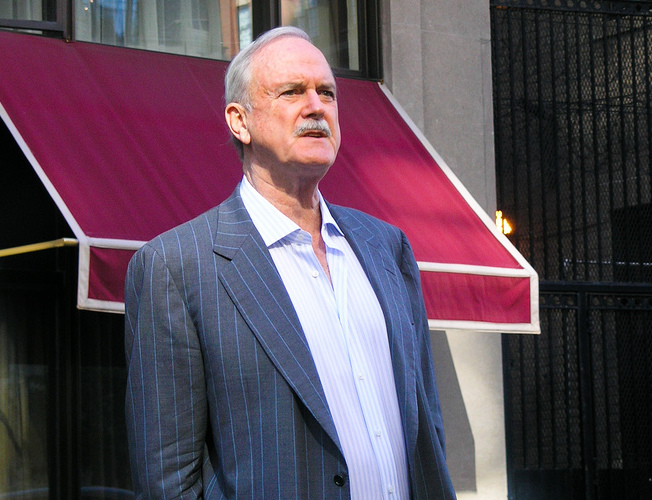
Creative Commons image by Paul Boxley
In his essay “The Relativity of Wrong,” Isaac Asimov argues persuasively against the common belief that “’right’ and ‘wrong’ are absolute; that everything that isn’t perfectly and completely right is totally and equally wrong.” Instead, he says, “it seems to me that right and wrong are fuzzy concepts,” and that certain ideas can be true in a sense, but still in need of further correction with new information. I can’t testify as to the strength of his argument when it comes to theoretical physics, but as far as basic inductive reasoning goes it seems perfectly sound to me, and a point worth making frequently. We don’t experience a world of binaries, but one full of “fuzziness” and near misses of all kinds.
As in science—argues former Monty Python member, comedy writer, and intellectual gadfly John Cleese—so in business. Cleese gave a motivational speech called “The Importance of Mistakes” in 1988 to an audience of 500 businessman at the British-American Chamber of Commerce, a demographic he has addressed remotely since 1972 with a series of business training videos made by his company, Video Arts. (“Better job training through entertainment,” as Kate Callen at UPI describes the company’s mission. Videos have titles like “Meetings, Bloody Meetings,” and “If Looks Could Kill.”)
In “The Importance of Mistakes,” Cleese explains that we do not veer wildly off course into total wrongness every time we make an error. Instead, our mistakes provide us with opportunities for feedback, which enables us to make course corrections, where we will inevitably make another mistake, receive more feedback, etc., until we hit the mark. These metaphors are not mine; Cleese uses a story called Gordon the Guided Missile as his primary example—which he dubiously claims was “the first nursery story I ever remember my mother reading to me”:
Gordon the guided missile sets off in pursuit of its target. It immediately sends out signals to discover if it is on the right course to hit that target. Signals come back: “No, you are not on course. So change it. Up a bit and slightly to the left.” And Gordon changes course as instructed and then, rational little fellow that he is, sends out another signal. “Am I on course now?” Back comes the answer, “No, but if you adjust your present course a bit further up and a bit further to the left, you will be.” He adjusts his course again and sends out another request for information. Back comes the answer, “No, Gordon, you’ve still got it wrong. Now you must come down a bit and a foot to the right.” And the guided missile goes on and on making mistakes, and on and on listening to feedback and on and on correcting its behavior until it blows up the nasty enemy thing. And we applaud the missile for its skill. If, however some critic says, “Well, it certainly made a lot of mistakes on the way”, we reply, “Yes, but that didn’t matter, did it? It got there in the end.” All its mistakes were little ones, in the sense that they could be immediately corrected. And as a results of making many hundreds of mistakes, eventually the missile succeeded in avoiding the one mistake which really would have mattered: missing the target.
The story illustrates, Cleese says, the importance of a “tolerant attitude towards mistakes”—even, a “positive attitude.” To take any other view would be to behave “irrationally, unscientifically, and unsuccessfully.” Cleese more or less recommends his audience adopt Asimov’s scientific perspective on error: mistakes are not disastrously irrecoverable missteps, but ways of learning how to get things “less wrong.”
Some clarification: Cleese means to validate only “those mistakes which, at the time they were committed, did have a chance.” A reasonably good try, in other words. There are some absolutes in the world, after all, and there are “true copper bottomed mistakes, like spelling the word ‘rabbit with three m’s or … starting a land war in Asia.” But the point stands. We’re usually in the realm of in-between, and instead of letting the anxiety of indeterminacy overwhelm us, Cleese recommends we take risks and “gain the confidence to contribute spontaneously to what’s happening,” thus overcoming inhibitions and the fear of looking ridiculous.
Cleese delivered this speech to a body of people not typically known for acting spontaneously. And while it seems to me that these days top executives can make egregious errors (or commit egregious fraud) and land squarely on their feet, I wonder if those on the tiers below have the privilege of daring to make errors in most industries. In any case, whether an assembly of corporate managers can afford to loosen up, the rest of us probably can, if we’re willing to adopt a “positive attitude” toward mistakes and consistently—scientifically, even—view them as opportunities to learn.
All of this requires a fine balance of the confidence to screw up and the humility to take constructive feedback when you do. “Healthy behavior actually arises out of confidence,” Cleese observed in an interview after his speech, and yet, “the worst problem in management—in fact, the worst problem in life—is the ego.”
Read many more excerpts from Cleese’s speech here.
Related Content:
John Cleese Explores the Health Benefits of Laughter
John Cleese’s Philosophy of Creativity: Creating Oases for Childlike Play
Josh Jones is a writer and musician based in Durham, NC. Follow him at @jdmagness
Read More...The Negro Travelers’ Green Book, the Pre-Civil Rights Guide to Traveling Safely in the U.S. (1936–66)
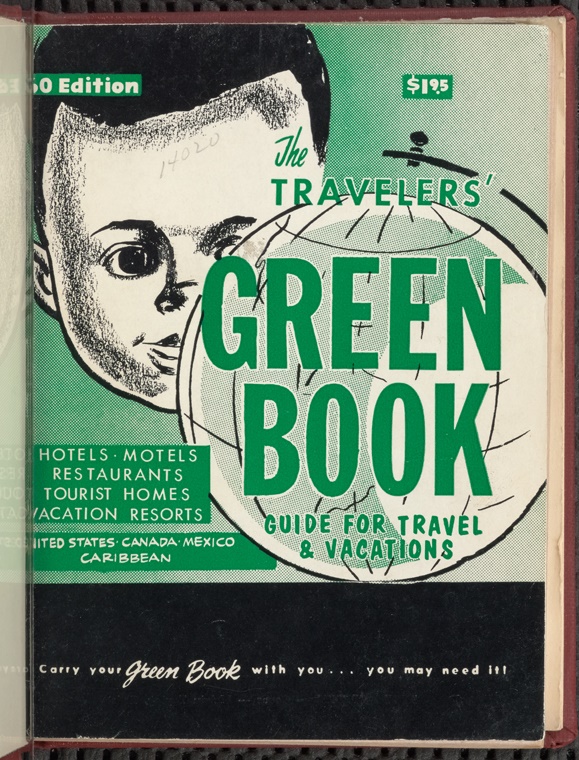
Popular entertainment has romanticized the idea of the road trip as a wholly spontaneous adventure, but for mid-century African American motorists, planning was essential. The lodgings, restaurants, and tourist attractions where they could be assured of a warm welcome were often few and far between in the era of segregation.
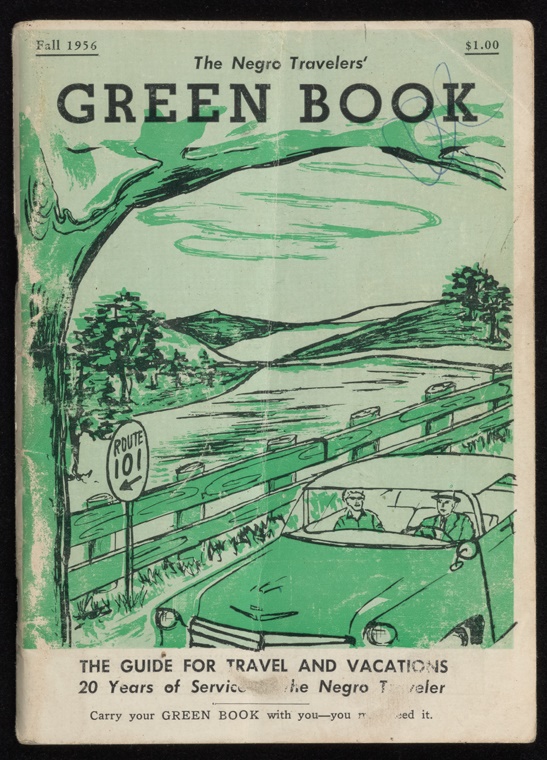
The Negro Travelers’ Green Book, first printed in 1936, was an invaluable resource for travelers of color, particularly when their route took them outside of urban areas. In the pre-Internet age, publisher Victor Green, a Harlem-dwelling mailman, relied on readers to supply feedback and new locations for subsequent editions:
There are thousands of first class business places that we don’t know about and can’t list, which would be glad to serve the traveler, but it is hard to secure listings of these places since we can’t secure enough agents to send us the information. Each year before we go to press the new information is included in the new edition. When you are traveling please mention the Green Book, in order that they might know how you found their place of business, as they can see that you are strangers. If they haven’t heard about this guide, ask them to get in touch with us so that we might list their place. If this guide has proved useful to you on your trips, let us know. If not, tell us also as we appreciate your criticisms and ideas in the improvement of this guide from which you benefit. There will be a day sometime in the near future when this guide will not have to be published. That is when we as a race will have equal opportunities and privileges in the United States. It will be a great day for us to suspend this publication for then we can go wherever we please, and without embarrassment. But until that time comes we shall continue to publish this information for your convenience each year.
- from the introduction to the 1949 edition
The New York Public Library’s Schomburg Center for Research in Black Culture has digitized 21 volumes of its Green Book collection for your browsing pleasure. It’s a trip back in time.
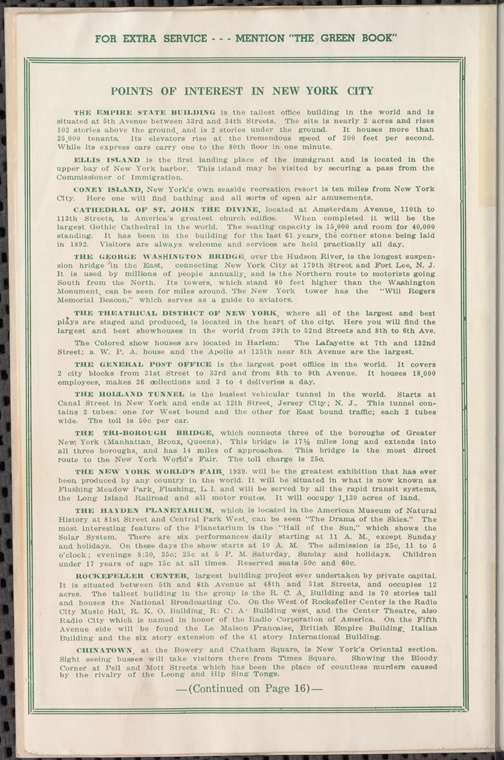
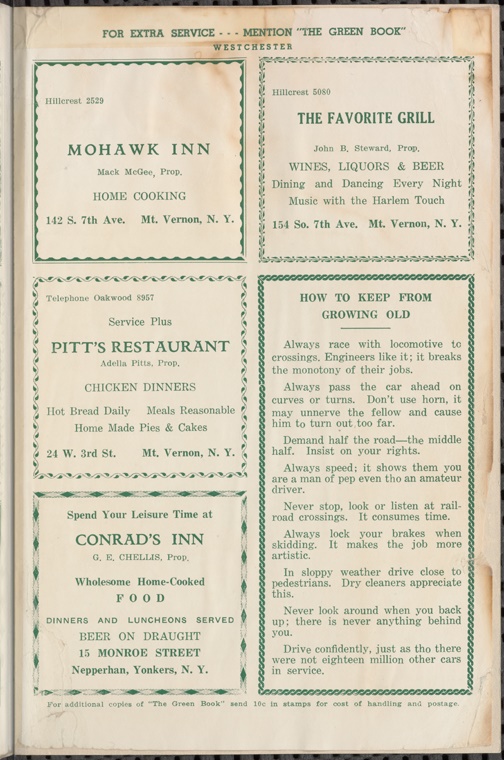
1936’s premier edition is geared toward visitors spending time in and around New York City. In appearance, it resembles a church bulletin or community theater program, with business card ads for beauty salons specializing in marcel waving and restaurants serving Southern home cooking. Publisher Green extols the wonders of Coney Island, Chinatown, and the Theatrical District, even as he notes that “the colored show houses are in Harlem.” He also seeks to give readers a laugh with “How to Keep From Growing Old,” a driver-specific list that could be read aloud from the passenger seat for the merriment of everyone in the car. (“In sloppy weather, drive close to pedestrians. Dry cleaners appreciate this.”)
The Green Book soon swelled to include national listings, as tourists and business travelers heeded Green’s call to beef up the info.
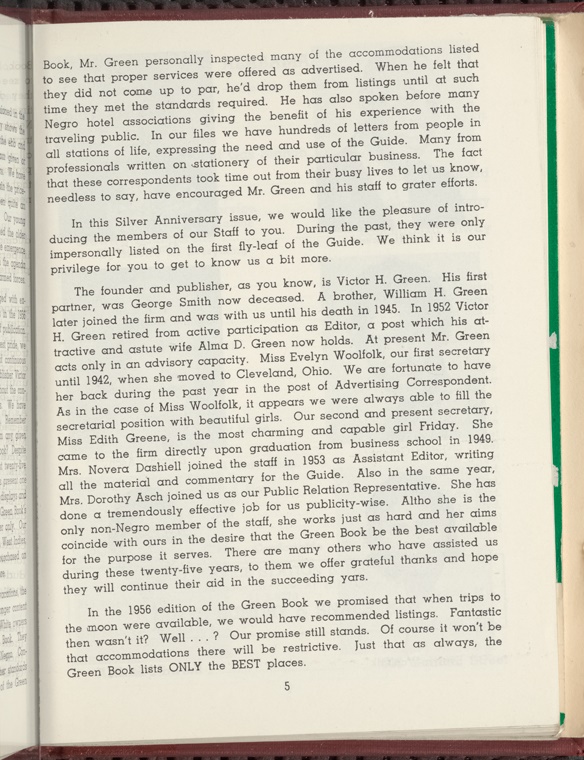
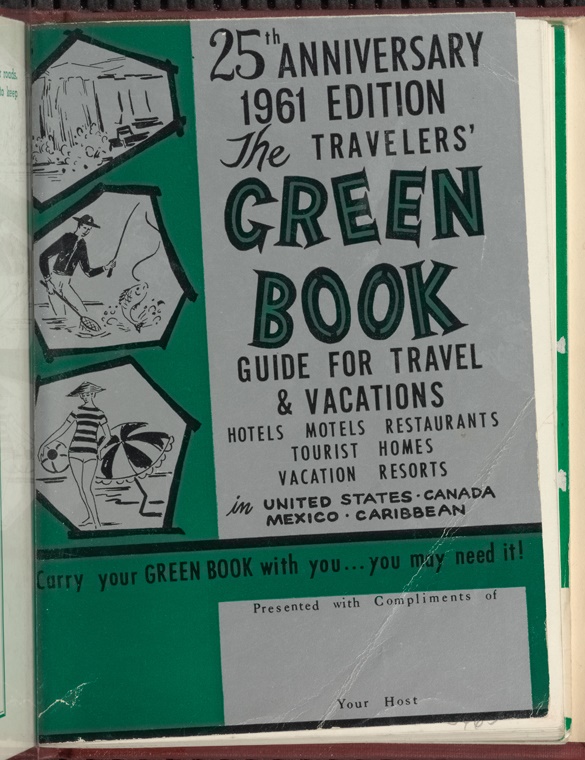
1961’s 25th anniversary edition includes a history of the enterprise, a fair amount of typos, newsy updates on the staff, and a renewed promise to list the best places on the moon, should lunar travel become an option.
Armchair travelers can take the NYPL’s digitized collection out for a spin by entering coordinates into a mapping feature for 1947 or 1956.
Starting in my Indiana hometown with sights set on Manhattan took me to the Cottage Restaurant in Columbus, Ohio, the Jones Restaurant in Grafton, West Virginia, and the beautifully named Trott Inn in Philadelphia, before I finally lay my virtual head at the America Hotel. (These days, it would be the Millennium Broadway.)
Enjoy your trip. In the words of Victor Green, “let’s all get together and make motoring better.”
Related Content:
Robert Penn Warren Archive Brings Early Civil Rights to Life
Vintage 1930s Japanese Posters Artistically Market the Wonders of Travel
Ayun Halliday is an author, illustrator, and Chief Primatologist of the East Village Inky zine. She documented her misadventures on the road in No Touch Monkey! And Other Travel Lessons Learned Too Late Follow her @AyunHalliday
Read More...The Memorial Service & Celebration of “Lemmy” Kilmister, Motörhead Frontman, is Now Streaming Live
Note: Though the service came to an end earlier today, it looks like you can now watch a recording of the farewell ceremony above. If you make it to the end, you’ll notice that there was an issue with the audio when Dave Grohl began speaking. You can hear a slightly touched-up version here.
Just a quick note: “Lemmy” Kilmister’s memorial service is now streaming live on Youtube. Click play above. Ian Fraser Kilmister was an English musician, singer and songwriter who founded and fronted the rock band Motörhead. He died on December 29th, at the age of 70.
Follow us on Facebook, Twitter, Google Plus and LinkedIn and share intelligent media with your friends. And if you want to make sure that our posts definitely appear in your Facebook newsfeed, just follow these simple steps.
Read More...Bruce Lee’s Only Surviving TV Interview, 1971: Lost and Now Found
Bruce Lee’s TV acting career began in 1966, when he landed a part in The Green Hornet. (Watch his thrilling audition here). But it took another five years before he gave his first–and, it turns out, only television interview in English. For 25 minutes in December 1971, the martial arts star sat down with Pierre Berton, a Canadian journalist, in Hong Kong. And their conversation covered a fair amount of ground – Lee’s success starring in Mandarin films .… despite only speaking Cantonese; his difficulty developing a career in a country still hostile toward China; and his work training other Hollywood stars in the martial arts.
Taped in 1971, the interview aired only once, then went missing, and wasn’t found until 1994, when it finally aired again as a TV special called ”Bruce Lee: The Lost Interview’.’ First featured on Open Culture in 2011, the recording is now considered his only surviving on-camera interview and/or his only meaningful interview conducted in English. A somewhat restored version can be viewed on Vimeo here.
Follow Open Culture on Facebook and Twitter and share intelligent media with your friends. Or better yet, sign up for our daily email and get a daily dose of Open Culture in your inbox. And if you want to make sure that our posts definitely appear in your Facebook newsfeed, just follow these simple steps.
Related Content:
Bruce Lee Auditions for The Green Hornet (1964)
The Poetry of Bruce Lee: Discover the Artistic Life of the Martial Arts Icon
Watch 10-Year-Old Bruce Lee in His First Starring Role (1950)
Read More...An Artful, Animated Tribute to The Wire, Created by a Fan of the Critically-Acclaimed TV Series
From director, designer, and animator Elliot Lim comes an animated tribute to his “favorite show of all time,” HBO’s The Wire – a sentiment that he shares with Pres. Obama, countless critics, and many casual TV viewers. As much as the episodes themselves, fans fondly remember The Wire’s opening credits, which functioned, Andrew Dignan once wrote, as short films that “distill each season’s themes, goals, and motifs.” The opening credits are what get the animated treatment in Lim’s video. Whether his video distills a particular set of themes, goals and motifs, I’m not yet sure. I’ll need to watch it a few more times and report back soon.
For more on The Wire and the Art of the Credit Sequence watch this 2012 video essay.
Follow Open Culture on Facebook and Twitter and share intelligent media with your friends. Or better yet, sign up for our daily email and get a daily dose of Open Culture in your inbox. And if you want to make sure that our posts definitely appear in your Facebook newsfeed, just follow these simple steps.
Related Content:
President Obama Chats with David Simon About Drugs, The Wire & Omar
The Wire as Great Victorian Novel
Charles Mingus’ Instructions For Toilet Training Your Cat, Read by The Wire’s Reg E. Cathey
Read More...Bill Gates, Book Critic, Names His Top 5 Books of 2015
When you think Bill Gates, you think Microsoft co-founder and big-time philanthropist. Now you can add to the list, book critic. This weekend, The New York Times profiled Bill Gates’ penchant for reviewing books on his blog, Gates Notes, and how (much like Oprah) when Gates gives a book a thumbs up, it moves copies. Many copies.
Above, you can watch a Gates-narrated video highlighting his five favorite books of 2015. It includes: 1.) Thing Explainer: Complicated Stuff in Simple Words by Randall Munroe, which “explains various subjects—from how smartphones work to what the U.S. Constitution says—using only the 1,000 most common words in the English language and blueprint-style diagrams”; 2) Mindset: The New Psychology of Success by Carol S. Dweck, a bestselling book that uses “clever research studies and engaging writing” to illuminate “how our beliefs about our capabilities exert tremendous influence on how we learn and which paths we take in life”; and 3) Sustainable Materials With Both Eyes Open, a book written by Cambridge researchers that explores the question, “How much can we reduce carbon emissions that come from making and using stuff?”. Other books on Gates’ short list includes David Brooks’ The Road to Character and Being Nixon: A Man Divided, by Evan Thomas.
You can find a number of Gates’ book reviews in the Books section of his site.
Follow Open Culture on Facebook and Twitter and share intelligent media with your friends. Or better yet, sign up for our daily email and get a daily dose of Open Culture in your inbox. And if you want to make sure that our posts definitely appear in your Facebook newsfeed, just follow these simple steps.
Related Content:
Six Books (and One Blog) Bill Gates Wants You to Read This Summer
Take Big History: A Free Short Course on 13.8 Billion Years of History, Funded by Bill Gates
View Bill Gates’ Mobile Library: The Books & Courses That Help Him Change The World
Read More...Hear Tom Lehrer Sing the Names of 102 Chemical Elements to the Tune of Gilbert & Sullivan
Tom Lehrer earned a BA and MA in mathematics from Harvard during the late 1940s, then taught math courses at MIT, Harvard, Wellesley, and UC-Santa Cruz. Math was his vocation. But, all along, Lehrer nurtured an interest in music. And, by the mid 1950s, he became best known for his satirical songs that touched on sometimes political, sometimes academic themes.
Today we’re presenting one of his classics: “The Elements.” Recorded in 1959, the song features Lehrer reciting the names of the 102 chemical elements known at the time (we now have 115), and it’s all sung to the tune of Major-General’s Song from The Pirates of Penzance by Gilbert and Sullivan. You can hear a studio version below, and watch a nice live version taped in Copenhagen, Denmark, in September 1967.
Decades later, this classic piece of “Tomfoolery” stays with us, popping up here and there in popular culture. For example, Daniel Radcliffe (of Harry Potter fame) performed Lehrer’s song on the BBC’s Graham Norton Show in 2010. Enjoy.
Follow Open Culture on Facebook and Twitter and share intelligent media with your friends. Or better yet, sign up for our daily email and get a daily dose of Open Culture in your inbox. And if you want to make sure that our posts definitely appear in your Facebook newsfeed, just follow these simple steps.
Related Content:
The Math in Good Will Hunting is Easy: How Do You Like Them Apples?
Mathematics in Movies: Harvard Prof Curates 150+ Scenes
Calculus Lifesaver: A Free Online Course from Princeton
Read More...
Support Us
We're hoping to rely on loyal readers, rather than erratic ads. Please click the Donate button and support Open Culture. You can use Paypal, Venmo, Patreon, even Crypto! We thank you!

About Us

Open Culture scours the web for the best educational media. We find the free courses and audio books you need, the language lessons & educational videos you want, and plenty of enlightenment in between.
Advertise With Us
FREE UPDATES!
GET OUR DAILY EMAIL
Get the best cultural and educational resources on the web curated for you in a daily email. We never spam. Unsubscribe at any time.
FOLLOW ON SOCIAL MEDIA
Open Culture editor Dan Colman scours the web for the best educational media. He finds the free courses and audio books you need, the language lessons & movies you want, and plenty of enlightenment in between.
Advertise With Us


