Intelligent YouTube Channels
Below, we have gathered together some of the most intelligent video collections on YouTube. A great place to find culturally enriching video…
General
- @GoogleTalks
- Google has lots of famous visitors speaking at its headquarters, and they’re all recorded and neatly presented here.
- Al Jazeera English
- The Middle Eastern news service, which has generated its share of controversy, now airs broadcasts in English and presents them here.
- American Museum of Natural History
- Includes the excellent “Known Universe” video.
- Amnesty International
- The leading human rights organization brings you various videos outlining human rights concerns across the globe, and the work they’re doing to improve conditions.
- Artists Space
- Artists Space supports contemporary artists working in the visual arts, video and electronic media, performance, architecture and design, and it promotes artistic experimentation and dialog in contemporary culture.
- Aspen Institute
- An international nonprofit organization dedicated to fostering enlightened leadership and open-minded dialogue.
- Bad Astronomy
- Bad Astronomy is devoted to debunking myths and misconceptions about astronomy, and also to slap down without apology bad thinking in all its forms.
- BBC
- A series of videos promoting programs coming out of Britain’s main media outlet. Unfortunately many of these videos are short and not entirely substantive. A missed opportunity.
- BBC Worldwide
- Ditto.
- Big Think
- This collection brings you videos featuring some of today’s leading thinkers, movers and shakers.
- BoingBoingTV
- These videos are brought to you by the makers of the very popular BoingBoing blog.
- British Film Institute National Archive
- The BFI (British Film Institute) promotes understanding and appreciation of Britain’s rich film and television heritage and culture. And it claims to have the “world’s largest and most diverse film and TV archive.”
- Brooklyn Museum
- A fairly rich lineup of videos exploring the collections at Brooklyn’s main art museum.
- Canal Educatif
- CED is a philanthropic producer of free high-quality educational videos in the domains of arts, economics and science.
- Charlie Rose
- PBS interviewer Charlie Rose presents segments of his nightly interviews.
- Cinetic
- Cinetic brings audiences the latest, greatest and classic festival favorites from around the globe. From award-winners by veteran filmmakers to up-and-coming talent telling new stories, Cinetic prides itself on being at the forefront of quality indie film in the digital space.
- Citizen Tube
- YouTube’s own channel presents videos dealing with the American political process and the 2008 election.
- Computer History Museum
- A good number of videos that delve into computers, networking, and semiconductors.
- Council on Foreign Relations
- A resource designed to provide insight into the complex international issues challenging policymakers and citizens alike.
- CSPAN
- Videos that keep a close eye on the inner-workings of the American political process.
- DailyHitchens
- Christopher Hitchens and more Christopher Hitchens.
- FORA.tv
- Delivers video presentations from the world’s great writers, leaders, activists and thinkers.
- Guardian Unlimited TV
- The Guardian brings you videos that make the television world its focus.
- Gizmodo
- A video collection from one of the most popular technology web sites.
- Google Tech Talks
- The name kind of says it all.
- Harvard University Press
- HUP, a major publisher of non-fiction, scholarly, and general interest books, brings you videos with new authors.
- HBO
- Provides outtakes from new HBO productions. The videos are all short and largely promotional. Give us some beef, sirs.
- KQED on Demand- San Francisco
- Media provided by the public broadcasting company in the San Francisco Bay Area. I drink at this well daily.
- MoMA
- Videos highlighting the art collection, public programs, and temporary exhibitions at The Museum of Modern Art in New York City.
- Monty Python Channel
- Their videos have been circulating around YouTube for a while. Now, the comedians have their own channel. A good place to have a laugh.
- National Geographic
- The collection is rich, but the videos are short. Another instance where the provider could use the medium to offer more substance/depth.
- New Scientist.
- Videos and vodcasts covering science, technology, space, the environment and a whole lot more. An international team of expert journalists brings you the latest innovations and ideas in science and technology, from the wonderful to the worrying to the weird.
- NOVA
- Short video outtakes from PBS’s popular science program.
- Oscar’s Channel
- The official channel of the Academy of Motion Picture Arts and Sciences is the only place to relive favorite Oscar® moments and see exclusive interviews with the talented film professionals who comprise the Academy membership. Includes some good vintage clips.
- Philip Scott Johnson
- Some great videos that put art in motion.
- PBS
- Promotes new PBS programming with painfully short videos.
- PoliticsTV
- Political videos with a progressive bent.
- Pulitzer Center on Crisis Reporting
- The Pulitzer Center on Crisis Reporting’s mission is to promote in-depth coverage of international affairs, focusing on topics that have been under-reported, mis-reported — or not reported at all.
- ReelNASA
- Videos show the latest happenings at NASA and new developments in space exploration.
- Reuters Video
- The latest video from Reuters.
- Richard Dawkins
- The channel features talks by Richard Dawkins, the Oxford evolutionary biologist, as well as others influenced by his thought.
- ScienCentral
- ScienCentral, Inc. produces science and technology content for television, video, and the web. From broadcast news features to educational products, they cover the medical, environmental, and technological issues that affect daily life.
- Slate
- Video from Slate Magazine
- Spoken Verse
- Roger Ebert calls it one of the richest resources on YouTube. Spoken Verse offers over 400 readings of great poems in English, from Shakespeare to today.
- Steve Spangler Science Show
- Catch the videos produced by a teacher nationally known for making science fun.
- Sundance
- Provides video clips from original series and films airing on the Sundance Channel.
- The Alcove
- A program that features interviews with various influential thinkers.
- The American Museum of Natural History
- This channel provides a rare glimpse into the Museum’s exhibitions, scientific research, public programs and educational endeavors. Videos presented by the Museum highlight its global mission to advance scientific discovery and increase understanding of nature and human cultures.
- The Commonwealth Club (San Francisco)
- Videos coming out of the nation’s oldest and largest public affairs forum, presenting topics ranging across politics, culture, and society.
- The Commoncraft Show
- The Common Craft Show is a series of short explanatory videos by Lee and Sachi LeFever. The goal is to fight complexity with simple tools and plain language.
- The Davos Question
- Every year, global leaders attend the World Economic Forum in Davos, Switzerland to discuss how to better the world. Here you get to see what they have to say.
- The Kahn Academy
- This channel features over 800 videos that will teach students the ins and outs of algebra, geometry, trigonometry, calculus, statistics, finance, physics, economics and more. The clips have been recorded by Salman Khan.
- The Library of Congress
- Timeless treasures and contemporary presentations from the Library of Congress in Washington, D.C. Features recordings dating from the earliest Edison films to the present.
- The New York Times
- All the news that’s fit to stream.
- The New Yorker
- The official video channel of The New Yorker magazine.
- The Nobel Prize
- Brings you fascinating insights into the minds of current and past Nobel Laureates.
- The Onion News Network
- A good dose of funny videos from The Onion. Good for when you need some comic relief.
- The Real News
- The Real News Network is a global online video news network that listens to and is dependent solely on its audience. No ads. No government subsidies. No corporate sponsorship.
- The Research Channel
- Based out of the University of Washington, the ResearchChannel brings together content from leading research and academic institutions.
- The World Bank
- Videos coming out of the institution whose goal is to rid the world of poverty..
- The YouTube Screening Room
- Provided by YouTube itself, this collection presents high quality, independent films to web users and promises to roll out four new films every two weeks.
- Thirteen WNET (PBS New Your)
- Features content from New York City’s flagship public television station.
- YouTube Movies
- YouTube now hosts a series of complete studio movies on its site. Above, I’ve linked you directly to the documentary/biography section. But feel free to peruse the larger collection. You’ll find some good films there.
- TED Talks
- Generally engaging videos coming out of the annual TED conference. Features important thinkers from different walks of life.
- TED x Talks
- In the spirit of ideas worth spreading, TEDx is a program of local, self-organized events that bring people together to share a TED-like experience.
- Travel Channel TV
- The Travel Channel brings you around the world on YouTube.
- Vanity Fair Magazine
- Videos from the magazine launched in 1913.
- WNYC Radio
- Videos provided by WNYC, New York Public Radio, the largest public radio station in the US.
- World Economic Forum
- The World Economic Forum is an independent international organization committed to improving the state of the world by engaging leaders in partnerships to shape global, regional and industry agendas.
- Yad Vashem
- Containing the world’s largest repository of information on the Holocaust, Yad Vashem is a leader in Holocaust education, commemoration, research and documentation.
- 92nd Street Y
- Pretty much anyone and everyone on the cultural radar passes through the 92nd Y in NYC.
Universities
Spotlighted Collections
- YouTube EDU
- YouTube got a lot more intelligent when it launched YouTube EDU, a section of the site that centralizes all of its educational/academic content. This is the best place to start if you’re looking for lectures and courses.
- University of California — Berkeley
- Arguably the most substantive YouTube collection out there. Features a large number of free courses, plus numerous lectures given by important figures.
- Cambridge University
- 800 years and now going digital.
- Harvard University
- Harvard was late to the Web 2.0 party, but they finally have their channel up on YouTube, and it contains some worthwhile content, including Michael Sandel’s famous course on Justice.
- Indian Institute of Technology/Indian Institute of Science
- Presented by the leading technology institutes in India, this collection features more than 50 free courses. Obviously has a strong technology/engineering bent.
- MIT (Massachusetts Institute of Technology)
- Makes available many of the videos produced as part of MIT’s leading OpenCourseWare initiative.
- Stanford University
- Newly launched, the collection already features a couple hundred videos, including several free courses.
- UChannel (Princeton)
- Spearheaded by Princeton, this collection aggregates quality videos coming from a consortium of major universities.
Other University Collections
- Auburn University
- Hard to separate the intellectual substance from videos that have a more promotional & internal bent. But some of the former is there to be found.
- Berkman Center for Internet and Society at Harvard Law School
- The videos hosted here look at how the digital world and the law intersect.
- Carnegie Mellon
- Among other things, this collection features the highly popular video: Randy Pausch’s Last Lecture: Achieving Your Childhood Dreams.
- Columbia University
- One of NYC’s finest.
- Duke University
- Individual videos explore the research coming out of one of America’s leading universities.
- Duke’s Fuqua School of Business
- Similar to Duke’s main collection, but focused on business.
- Emory University
- One of the finest universities in the South of the US.
- EGS (The European Graduate School)
- This European collection features important, contemporary theorists, philosophers, and filmmakers.
- Harvard’s Bok Center
- A small collection focused on pedagogy.
- Old Dominion
- A little bit of a hodgepodge but there’s some interesting items in the mix.
- Ohio State
- So far not an overwhelming use of the medium.
- Oxford University — Saïd Business School
- Rather internally focused. Not much in the way of educational content per se. But let’s keep our fingers crossed that it eventually offers more.
- Purdue University
- Again something of a hodgepodge. Wheat and chaff.
- Princeton University
- Ever heard of it?
- Sonoma State
- A more intellectually robust collection that features a fair amount of notable lectures.
- The Open University
- The Open University (OU) is the United Kingdom’s only university dedicated to distance learning. Some of the more educational videos can befound here.
- Tulane University
- You can access some of the speeches by esteemed guest speakers here.
- University of Arizona
- You can sort through a good number of talks here.
- UCLA
- Along with Berkeley, this is the other flagship public university in California.
- University of California TV
- UCTV pulls together videos from the campuses, national laboratories, and affiliated institutions of the University of California.
- University of Chicago Press
- Though still modest in size, the collection features some interesting items.
- University of Nottingham — The Periodic Table of Videos
- A nice university-sponsored project, this collection features a video about each element on the periodic table. A handy thing for chemistry students.
- University of North Carolina — Chapel Hill
- The collection is substantive on the whole. You will need to sift through the videos to find ones of interest.
- University of Pennsylvania
- UCSF Memory & Aging Channel
- UCSF, one of the leading medical schools in the US, features videos that will “educate patients, caregivers and health professionals about the various forms of neurodegenerative diseases.” The diseases covered here include Alzheimer’s, Frontotemporal dementia and Creutzfelt-Jakob
- USC (University of Southern California)
- Vanderbilt University
- An eclectic mix.
- Yale University
- On this page, you’ll find some of the highest quality open courses out there.

History, Power and our Global Society
Here’s a new, free course from Stanford University. Taught by James Sheehan, the History of the International System (iTunes) offers a historical view of international politics in the 20th century, exploring how international players have attempted to project their will and protect their interests, all while negotiating fluid and not always manageable external forces. The course looks back at communism, fascism and liberalism, then moves through the Cold War to the present day, and ends with current events in Iraq. An important historian and one of Stanford’s finest lecturers, Sheehan was recently President of the American Historical Association. So far four lectures have been posted (see here), and there will be more to come.
NOTE: This course has been added to our collection of Free Online Courses, where you can find about 120 top-notch courses.
Read More...
500 Years of Women in Art (Give This Video Points for Creativity)
This video takes you on a fairly amazing tour of the great portraits of women in Western art. It moves from da Vinci to Picasso, and, along the way, the portraits seamlessly morph one into another. This morphing allows you to see how artistic styles changed over time, and also how the human face has been artistically treated during different periods. Watch the video below, which is accompanied by Bach’s Suite No. 1 performed by Yo-Yo Ma. For information on the paintings covered in the clip, click here. And also see the related video, Women in Film.
 Subscribe to Our Feed
Read More...
Subscribe to Our Feed
Read More...

Samantha Power & the Obama Controversy
It’s rare that professors find themselves at the center of a political firestorm. But that’s where Samantha Power, Professor of Practice of Global Leadership and Public Policy at Harvard, found herself last week when, during an off-the-record conversation with a reporter, she referred to Hillary Clinton as a “monster” and then had to resign as senior foreign policy to adviser to Barack Obama.
Until then, Power had been riding a big wave of success. Only 37 years old, she won the Pulitzer Prize for her first book, A Problem from Hell: America and the Age of Genocide. She’s also now promoting her second book, Chasing the Flame: Sergio Vieira de Mello and the Fight to Save the World. (Watch a clip from the book tour here). And until this high profile slip-up, she was clearly helping shape Obama’s foreign policy. You can hear Power’s influence in how Obama answered the highly publicized question last summer — would you, as president, negotiate directly with Iran’s Ahmadinejad? (He said yes.) Power’s thinking on international diplomacy gets articulated fairly well in this lengthy interview. Below, we’ve also posted a clip (from FORA.tv) of Power speaking about Obama and the question of negotiating with enemies. (Get the full talk here.)

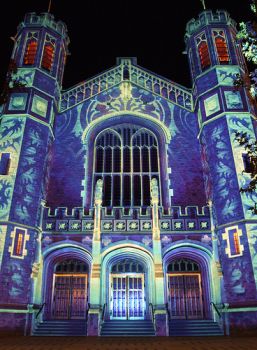
Australia’s Electronic Canvas
We wanted to post a quick photo from the lighting show at the Adelaide Festival of Arts. During the festival, artists project lights on the city’s architectural monuments, turning the buildings into electronic canvases. We’ve posted one photo below. For more good ones, see here. Thanks Carol for sharing these!

David Sedaris Delivers a Pizza
Apparently not the real deal, but a pretty good impersonation nonetheless…

Top 10 Grammar Myths
For National Grammar Day (March 4), The Grammar Girl (MP3 — iTunes — Feed — Web Site) issued another popular podcast that outlines and debunks 10 common grammar myths. If you’re already up to speed on these (preview them here), congrats. If not, give a listen.
Read More...Listening to Famous Poets Reading Their Own Work
Today, we have a guest feature by Don from Classic Poetry Aloud (iTunes — Feed — Web Site), a place where you can find a great lineup of poetry podcasts. We welcome other guest contributors. So, if you’re interested, just email us. Take it away (and thanks) Don…
The internet has given poetry new scope and a new freshness. It’s almost like the ‘70s, when punk fanzine readers were famously told ‘Here are three chords, now form a band’. Today, the injunction could be: ‘Here are three web sites, now perform some poetry’.
And the emphasis would very much be on performance, with readings taking place on blogs (individually) and at poetry slams (collectively).
But an interest in poetry readings is not confined to new work. My own daily poetry podcast, Classic Poetry Aloud, is dedicated to anything in the English language that is out of copyright, and attracts listeners on every continent.
While podcasts such as Classic Poetry Aloud (see a November Open Culture posting for a listing of poetry podcasts) feature a range of poets, the internet also offers a wealth of recordings of celebrated authors reading from their own work.
The BBC has a wonderful series of such recordings at Poetry Out Loud. My favourites include: Men and their Boring Arguments by contemporary British poet Wendy Cope, and an excerpt from Tennyson’s celebrated Charge of the Light Brigade, originally recorded in 1890 on a wax cylinder by Edison. In addition, the BBC has a series of interviews with poets discussing their work.
The Academy of American Poets’ listening booth offers more than 150 original readings. As well as the rolling tones of Dylan Thomas reading Do not go Gentle into that Good Night, there is Robert Frost’s The Road not Taken, and Gwendolyn Brooks’ We Real Cool – complete with an illuminating, humorous, wry introduction. This is an unashamed show stopper reading of a poem that runs to just 24 words.
Indeed, one of the joys of listening to poets reading from their own work is often the comments and insights that they offer. T.S. Eliot does this in introducing The Journey of the Magi, one of three of his poems to feature on the Poetry Archive. On this site, there are over 200 poems that feature some form of introduction by the poet.
The Poetry Archive is an ambitious project set up by British poet laureate Andrew Motion to capture poetry readings. The range here is so vast that it is impossible to say how many poems are featured on the site, but it makes for an invaluable resource, with poems accessible by theme as well as by form.
Among British poets is former laureate John Betjeman, apparently unable to remember the title of the poem he is best remembered for – A Subaltern’s Love Song – and he jokes with his audience before launching into a characteristically brisk and warm rendition. Not all of the Poetry Archive comes from the UK, though, and Allen Ginsberg reads three poems, including A Supermarket in California.
Author Andrew Keen has claimed that the internet is ‘killing culture’. That’s a good, alliterative tag line to sell books, but the growing popularity of poetry on the net shows that it’s also far from the truth.
Read More...Cat Shenanigans
It may not qualify as culture, but it’s funny and rings awfully true … (Along similar lines, you can get some good animated New Yorker cartoons here and here.)

Support Us
We're hoping to rely on loyal readers, rather than erratic ads. Please click the Donate button and support Open Culture. You can use Paypal, Venmo, Patreon, even Crypto! We thank you!

About Us

Open Culture scours the web for the best educational media. We find the free courses and audio books you need, the language lessons & educational videos you want, and plenty of enlightenment in between.
Advertise With Us
FREE UPDATES!
GET OUR DAILY EMAIL
Get the best cultural and educational resources on the web curated for you in a daily email. We never spam. Unsubscribe at any time.
FOLLOW ON SOCIAL MEDIA
Open Culture editor Dan Colman scours the web for the best educational media. He finds the free courses and audio books you need, the language lessons & movies you want, and plenty of enlightenment in between.
Advertise With Us

