Bach, Beethoven, Mozart, Wagner, Some Yo-Yo Ma and More: Free Classical Music Podcasts
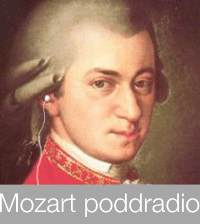 With the recent 250th anniversary of Mozart’s birth, there has been no shortage of podcasts dedicated to Mozart’s masterpieces. First, Radio Sweden (iTunes — Feed — Web Site) reissued a digital archive of Mozart recordings by the Royal Swedish Opera from the 1940s and 1950s. And, along very similar lines, Danmarks Radio (Feed — Web Site) issued podcasts of nine Mozart symphonies recorded by the Danish Radio Symphony Orchestra. (You’ll find here symphonies numbers 15, 17, 23, 34, 35, 36, 39, 40, and 41. Since the web site is in Danish, we’d recommend accessing these high quality MP3’s through the rss feed listed above.) Lastly, we should mention here that, as part of last year’s festivities, The International Mozart Foundation published online for the first time the entirety of of Mozart’s musical scores.
Along with Mozart, you can find plenty of Beethoven. We have highlighted here before, but it’s worth noting again, Deutsche Welle’s podcast collection called Beethovenfest (iTunes — Feed — Web Site). You’ll want to give it a look, and also see the podcast collection put together by the Boston Symphony Orchestra Conservatory (iTunes — Feed — Web Site). This educational series offers an extensive overview and recordings of Beethoven’s work, as well as that of Arnold Schoenberg. You can also catch more Beethoven (as well as a little Mozart and Bach) with the podcast series called The Concert (iTunes — Feed — Web Site), which features recordings from the Isabella Stewart Gardner Museum in Boston.
Speaking of Bach, you may want to give some time to these two podcasts: Bach Podcast from Magnatune.com (iTunes — Feed — Web Site) and Bach Festival of Philadelphia (Feed — Web Site).
Let’s now leave you with a few other good finds: Wagner Operas Podcast (iTunes — Feed — Web Site) lets you listen in on recordings from the annual Bayreuth Festival, plus more. An Intimate Tour Through the Music of Yo-Yo Ma (iTunes — Feed — Web Site) offers essentially what the title says. Finally, we’d recommend Classical Performance (iTunes Feed Web Site), which consists of classical music performances from WGBH’s Studio One in Boston; The New York Philaharmonic Podcast (iTunes — Feed — Web Site) which introduces you to the music and performers featured in the concerts of the New York Philharmonic; and From the Top. Live from Carnegie Hall Video Podcast (iTunes — Feed — Web Site), a podcast that showcases the top-notch skills and compelling stories of America’s best young classical musicians.
Read More...
Eat, Pray, Love @ Google
Elizabeth Gilbert’s Eat, Pray, Love has been on the New York Times bestseller list for 57 weeks. If you haven’t read it yet, then you may want to spend some time with Gilbert’s talk at Google. While her talk and reading didn’t completely strike a chord with me, it may well with you. So here you go (and, yes, we’ve added the video to our YouTube Playlist):

Top 10 Amazing Chemistry Videos
Courtesy of Wired’s Blog, here are 10 videos displaying some rather cool chemistry experiments at work. Below, we’ve posted one video that will let you answer a question that you’ve almost certainly pondered for ages — can liquid nitrogen neutralize molten iron? (For more videos along these lines, check out this site.)

The iPhone and the 21st Century University
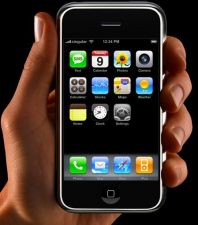 Next fall, all new freshmen attending ACU (Abilene Christian University) will receive an iPhone (or iPod Touch) when they get to campus. And, from there, the Apple gadget will figure centrally to students’ campus experience. The iPhone is the latest and greatest “converged mobile media device,” which combines in one gadget numerous functionalities — internet and email access, phone, audio, video, and maps. And once you put a generation of students reared on mobile devices on this common platform, new ways of running the university in the 21st century start to open up.
The changes begin with the way university administration gets done. ACU envisions students using their devices to check their meal and account balances, access course calendars, receive news and special bulletins from the university, and tap into the university phone/employee directory. Not far down the line, the university anticipates that the iPhone will fulfill certain registrar functions — meaning that students can use their iPhone to scope out, and even enroll in, various classes. Then, they’ll add some e‑commerce to the mix and let students use their mobile device to conduct commerce with the bookstore and university restaurants. Are you starting to get the picture? The iPhone becomes a “one stop shop for information and services” that can be accessed on the fly.
But what happens in the classroom? I had a chance to catch up with Bill Rankin, the Director of Mobile Learning Research (and also Associate Professor & Director of English Graduate Studies) who shared some of ACU’s thinking about how the iPhone creates new teaching opportunities. For starters, the device will allow students to access syllabi, course documents (created with Google Docs), homework assignments and podcasts that complement the course. (Imagine students downloading podcasted lectures from previous classes, or listening to clips of Mozart in their music appreciation class, or reviewing bits of French dialogue in the French 101 class.) From here, the pedagogical uses of the iPhone start to deepen. According to Rankin, the Apple gadget will give teachers the ability to conduct real-time surveys that gauge student perceptions of the class (are they understanding the course? is it moving too quickly?) and use the feedback to make the classes “more carefully tailored to the interests and abilities.” It’s also an added perk that the iPhone will let students contribute to the class through their online persona, which, research shows, “emboldens students [particularly shy ones] who might not otherwise share their ideas.” Then there’s this scenario (and others like it): With the iPhone, the “biology class in the field will be able to photograph specimens, post their findings to other classes not currently in the field, communicate with experts, and use the web to identify and research specimens. That’s transformational, and we think it will offer distinct advantages to our students.” Lastly, the iPhone opens up the possibility of creating “hybrid” courses, which means courses conducted partly in the classroom and partly online. For more on the hybrid concept (and other facets of the project), you can watch the video posted on YouTube that introduces ACU’s iPhone initiative. We’ve posted Part 1 below, and you can access Part 2 here. To get more insight into ACU’s intelligent thinking about the potential educational applications of the iPhone, you should spend some time on their “Connected” web site.

Neil Gaiman’s American Gods — Free Digital Copy
HarperCollins has rolled out another free book — the New York Times bestseller American Gods by Neil Gaiman. You can read it for free here (or buy it here). For more free books by HarperCollins, see our post from last week. And, as always, don’t forget to see our collection of free audiobooks.
Read More...
10 Ways to Make Your iPod a Better Learning Gadget
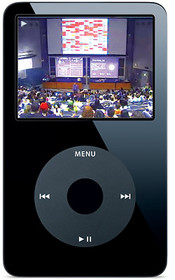 The iPod can supercharge your learning. But it’s often a matter of finding the right software and content. Below, we’ve listed several new pieces of software that will let you suck more educational media (DVDs, web videos, audio files, etc.) into your iPod. And we’ve also listed some important pieces of content that will make your iPod a better learning gadget. So here it goes and be sure to visit our Podcast Library and our related piece 10 Signs of Intelligent Life at YouTube:
1) Put Wikipedia on Your Ipod: Encyclopodia is a free piece of software that brings Wikipedia to the iPod. Encyclopodia can be installed on iPod generations 1 through 4, as well as iPod Minis. Definitely worth a try.
2) Watch DVDs on Your iPod: This free, open source software works on MacOS X, Linux and Windows, and makes it simple to load and watch DVDs on your video iPod. Here are some helpful instructions to get you started.
3) Load YouTube Videos to Your iPod: ConvertTube allows you to take any YouTube video and convert it to a format that works on your iPod. It’s as simple as entering a url and clicking “convert and download.” If you want to give the software a test run, try converting these UC Berkeley courses that were recently launched on YouTube. Or these Nobel Prize speeches.
4) Make Other Video Formats iPod-Ready: Lifehacker recently mentioned three other pieces of software that will make a variety of other video formats iPod-ready. For Windows, see Videora; for Mac, see iSquint. Or more generally see Zamzar. In a nutshell, these items will turn a wide range of video formats into the one video format (MPEG‑4) that your iPod likes.
5) Convert MP3 files into One Big iPod Audiobook File: Downloading free audiobooks can often require you to work with a series of separate mp3 files, which can make things rather cumbersome. This software does you a favor and mashes the files into one manageable file. And it has a feature that will let your Ipod remember where you stopped if you decide to take a break. (If this one appeals to you, be sure to see item # 10.)
6) Create eBooks for the iPod: This bit of software turns text files into ebooks that you can read on your iPod. After you load a text file, it will make the text readable through iPod Notes (which you can find under “Extra Setttings”). Then, voila, a portable text. Thanks to Pachecus.com for pointing this one out.
Read More...William F. Buckley v. Gore Vidal — 1968
William F. Buckley, Jr., the intellectual force behind the strand of conservatism that peaked with Ronald Reagan, died yesterday. (See NY Times obit.) Here, we have some vintage Buckley. The video clip below features Buckley and Gore Vidal going at it, almost coming to blows, during the contested presidential campaign of 1968. It offers a good reminder that American political discourse hasn’t been agreeable for quite some time. Comparatively, things look downright civil today.
Read More...Not Always a Nation of Dunces
Here’s a nice counterpoint to our post last week covering Susan Jacoby’s new book The Age of American Unreason and her lament that America has declined into a morass of anti-intellectualism and low expectations.
Let’s set the scene: A reporter selects a young Barack Obama supporter at a rally and starts peppering him with questions about the candidate. And it all feels like a staged effort to demonstrate that the mobilized youth has no real handle on the issues. He’s just blindly buying the hype. Without wasting time, the reporter leads the young man into a conversation on the complexities of health care. It’s the perfect setup. But then it suddenly becomes clear that the reporter chose the wrong kid (who is a naturalized immigrant, by the way) to play the fool. Watch the video below (and check out this follow up video that gives you more of the back story).

How to Learn a Foreign Language
We stumbled across this video (below) over on YouTube. It offers a quick survey of web resources that will teach you foreign languages for free. Among other items, the video mentions our Foreign Language Podcast Collection and, for that, we wanted to say thanks to whoever put this together.

Free Books from HarperCollins
As discussed in this NY Times article, HarperCollins has made a few of its books available online for free. You can read them from start to finish in digital format. But you can’t download them, and they’ll only be available for a few more weeks. (Presumably new books will be made available in the future.) Here’s what you’ll currently find.
- The Witch of Portobello by Paulo Coelho
- The Undecided Voter’s Guide to the Next President: Who the Candidates Are, Where They Come from, and How You Can Choose by Mark Halperin
- I Dream in Blue: Life, Death, and the New York Giants by Roger Director
Related Content:
For more free books, see our Audiobook Podcast Collection and 45 Free Cutting-Edge Books … Courtesy of Creative Commons
Read More...
Support Us
We're hoping to rely on loyal readers, rather than erratic ads. Please click the Donate button and support Open Culture. You can use Paypal, Venmo, Patreon, even Crypto! We thank you!

About Us

Open Culture scours the web for the best educational media. We find the free courses and audio books you need, the language lessons & educational videos you want, and plenty of enlightenment in between.
Advertise With Us
FREE UPDATES!
GET OUR DAILY EMAIL
Get the best cultural and educational resources on the web curated for you in a daily email. We never spam. Unsubscribe at any time.
FOLLOW ON SOCIAL MEDIA
Open Culture editor Dan Colman scours the web for the best educational media. He finds the free courses and audio books you need, the language lessons & movies you want, and plenty of enlightenment in between.
Advertise With Us

