Watch the First Trailer for Dune, Denis Villeneuve’s Adaptation of Frank Herbert’s Classic Sci-Fi Novel
It takes a fearless filmmaker indeed to adapt Dune. Atop its rich linguistic, political, philosophical, religious, and ecological foundations, Frank Herbert’s saga-launching 1965 novel also happens to have a plot “convoluted to the point of pain.” So writes David Foster Wallace in his essay on David Lynch, who directed the first cinematic version of Dune in 1984. That the result is remembered as a “huge, pretentious, incoherent flop” (with an accompanying glossary handout) owes to a variety of factors, not least studio meddling and the unsurprising incompatibility of the man who made Eraserhead with large-scale Hollywood sci-fi. The question lingered: could Dune be successfully adapted at all?
Well before Lynch took his crack, El Topo and The Holy Mountain director Alejandro Jodorowsky put together his own Dune adaptation. If all had gone well it would have come out as a ten-hour film featuring the art of H.R. Giger and Moebius as well as the performances of Orson Welles, Gloria Swanson, David Carradine, Alain Delon, Mick Jagger, and Salvador Dalí.
But all did not go well, and cinema was deprived of what would have been a singular spectacle no matter how it turned out. At least one element of Jodorowsky’s Dune has survived, however, in the latest attempt to bring Herbert’s complex bestseller to the screen: the music of Pink Floyd, heard in the just-released trailer for Denis Villeneuve’s Dune, starring Timothée Chalemet as the young hero Paul Atreides (as well as Oscar Isaac, Josh Brolin, and a host of other currently big names), scheduled for release in December.
If a credible Dune movie is possible, Villeneuve is the man to direct it. His previous two pictures, Blade Runner 2049 and the alien-visitation drama Arrival, demonstrate not just his capabilities with science fiction but his sense of the sublime. Beginning with its setting, the desert-wasteland planet of Arrakis, Dune demands to be envisioned with the kind of beauty that inspires something close to dread and fear. (The first director asked to adapt Dune was David Lean, perhaps due to his track record with majestic views of sand.) Villeneuve has also made the wise choice of refusing to compress the entire book into a single feature, presenting this as the first of a two-part adaptation. And as a lifelong Dune fan, he understands the attitude necessary to approaching this challenge: “Fear is the mind-killer,” as Paul famously puts it — so famously that the trailer couldn’t possibly exclude Chalamet’s delivery of the line.
Related Content:
Moebius’ Storyboards & Concept Art for Jodorowsky’s Dune
Based in Seoul, Colin Marshall writes and broadcasts on cities, language, and culture. His projects include the book The Stateless City: a Walk through 21st-Century Los Angeles and the video series The City in Cinema. Follow him on Twitter at @colinmarshall, on Facebook, or on Instagram.
Read More...The Fall of Civilizations Podcast Engagingly Explores the Collapse of Civilizations & Empires Throughout History
Now the country does not even boast a tree.
—Robert Browning, “Love Among the Ruins”
Every empire seems to think (as much as empires seem to think) that it will be the one to outlast them all. And all of them have ended up more or less the same way in the end. This isn’t just a gloomy fact of human history, it’s a fact of entropy, mortality, and the linear experience of time. If imperial rulers forget—begin to think themselves immortal—there have always been poets to remind them, though maybe not so directly. Epic poetry often legitimizes the founding of empires. Another form, the poetry of ruin, interprets their inevitable demise.
All the Romantics were doing it, and so too was an unknown 8th century British poet who encountered Roman ruins during the so-called “Dark Ages.” The poem they left behind “gives us a glimpse of a world of mystery,” says Paul Cooper above in episode one of his Fall of Civilizations podcast, which begins with Roman Britain and continues, in each subsequent (but not chronological) episode, to explore the collapse of empires around the world through literature and culture. “Every ruin,” says Cooper in an interview with the North Star Podcast, “is a place where a physical object was torn apart, and that happened because of some historical force.”
We are enthralled with ruins, though this can seem like the product of a distinctly modern sensibility—that of the poets who inhabited what novelist Rose Macaulay called in her 1953 study Pleasure of Ruins “a ruined and ruinous world.”
But as our Old English poet above demonstrates, the fascination predates Shakespeare and Marlowe. Cooper would know. He has dedicated his life to studying and writing about ruins, earning a PhD in their cultural and literary significance. Along the way, he has written for The New York Times, The Atlantic, National Geographic, Discover Magazine, and the BBC.
Cooper also began publishing one of the most intriguing Twitter feeds in 2017, detailing in “several nested threads” various “ruin-related thoughts and feelings,” as Shruti Ravindran writes at Timber Media. His tweets became so popular that he turned them into a podcast, and it is not your standard informally chatty podcast fare. Fall of Civilizations engages deeply with its subjects on their own terms, and avoids the sensationalist cliches of so much popular history. Cooper “knew, for certain, what he wanted to avoid,” when he began: the “focus on gruesome torture techniques, executions, and the sexcapades of nobles.”
“History writers often don’t trust their audience will be interested in the past if they don’t Hollywoodize it,” says Cooper. Instead, in the latest episode on the Byzantine Empire he recruits the choir from the Greek Orthodox Cathedral in London, “and a number of musicians playing traditional Byzantine instruments such as the Byzantine lyra, the Qanun and the Greek Santur,” he explains. In his episode on the Han dynasty, Cooper looks back through “ancient Chinese poetry, songs and folk music” to the empire’s rise, “its remarkable technological advances, and its first, tentative attempts to make contact with the empires of the west.”
This is a rich journey through ancient history, guided by a master storyteller dedicated to taking ruins seriously. (Cooper has published a novel about ruins, River of Ink, “inspired by time spent in UNESCO sites in Sri Lanka,” Ravindran reports.) There is “love among the ruins,” wrote Robert Browning, and there is poetry and music and story and song—all of it brought to bear in Fall of Civilizations to “make sense about what must have happened,” says Cooper. Find more episodes, on fallen civilizations all around the world, on YouTube or head to Fall of Civilizations to subscribe through the podcast service of your choice.
Related Content:
Josh Jones is a writer and musician based in Durham, NC. Follow him at @jdmagness
Read More...How Charlie Parker Changed Jazz Forever
Jazz has often moved forward in seismic shifts, powered by revolutionary figures who make everything that came before them seem quaint by comparison and radiate their influence beyond the jazz world. Perhaps no figure epitomizes such a leap forward more than Charlie Parker. The legendary inventor of bebop, born a little over a century ago, may be the most universally respected and admired musician in jazz, and far beyond.
Kansas City trumpet player Lonnie McFadden, who grew up hearing stories about hometown hero Parker, was told by everyone he met to learn from the master. “Everybody. It was a consensus. All of them said, ‘You got to listen to Bird. You got to listen to Charlie Parker.’” Furthermore, he says, “every tap dancer I know, every jazz musician I know, every rock and blues musician I know honors Charlie Parker.”
Parker has been called “The Greatest Individual Musician Who Ever Lived.” Not just jazz musician, but musician, period, as the PBS Sound Field short introduction above notes, because there had never been one single musician who influenced “all instruments.” Kansas City saxophone player Bobby Watson and archivist Chuck Haddix explain how Parker made such an impact at such a young age, before dying at 34.
Unlike the swing of Benny Goodman or Louis Armstrong, Parker’s bebop is completely non-danceable. He didn’t care. He was not an entertainer, he insisted, but an artist. Jazz might eventually return to danceability in the late 20th century, but the music—and popular music writ large—would never be the same.
The video’s host, LA Buckner gives a brief summary of the evolution of jazz in four regional centers—New Orleans, Chicago, Kansas City, and New York. Parker made a transit through the last three of these cities, eventually ending up on big apple stages. “By 1944,” Jazzwise writes, “the altoist was… making a huge impact on the young Turks hanging out in Harlem, Dizzy Gillespie and Thelonious Monk in particular… no one had ever played saxophone in this manner before, the harmonic, rhythmic and melodic imagination and the emotional intensity proving an overwhelming experience.”
It’s too bad more musicians didn’t listen to Bird when it came to playing high. “Anyone who said they played better when on drugs or booze ‘are liars. I know,’” he said. Heroin and alcohol abuse ended his career prematurely, but perhaps no single instrumental musician since has cast a longer shadow. Jazz critic Stanley Crouch, author of Parker biography Kansas City Lightning: The Rise and Times of Charlie Parker, explains in an interview how Parker created his own mystique.
Parker sometimes gave the impression that he was largely a natural, an innocent into whom the cosmos poured its knowledge while never bothering his consciousness with explanations.
The facts of his development were quite different. He worked for everything he got, and whenever possible, he did that work in association with a master.
Parker was not appreciated at first, either in his hometown of Kansas City or in New York, where “people didn’t like the way he played” when he first arrived in 1939. He responded to criticism with ceaseless practice, learning, and experimentation, an almost superhuman work ethic that probably wasn’t great for his health but has grown into a legend all its own, giving musicians in every form of music a model of dedication, intensity, and fearlessness to strive toward.
Related Content:
The Night When Charlie Parker Played for Igor Stravinsky (1951)
Josh Jones is a writer and musician based in Durham, NC. Follow him at @jdmagness
Read More...Watch an Epic Drum Battle, Pitting a 9‑Year-Old Girl Against Foo Fighter Dave Grohl
Foo Fighter Dave Grohl, formerly of Nirvana, and Nandi Bushell, an Ipswich elementary schooler, have something in common besides their incredible command of the drums.
By all appearances, both seem to have benefited from being reared by grounded, encouraging parents.
Nandi, at 10, likely has a few more years under her folks’ roof despite her growing renown—she’s jammed with Lenny Kravitz, gone viral in last year’s Argos Christmas advert, and most recently, matched Grohl beat for beat in an epic drum battle, above.
Nandi demonstrated a natural rhythmic ear at an early age, bobbing along to the Teletubbies while still in diapers.
Of course, everything she’s achieved thus far can be considered to have occurred at an early age.
On the other hand, it was half a lifetime ago when her father, a software engineer and self-described “massive music fan” introduced the then-5-year-old to “Hey, Jude,” as part of a weekly tradition wherein he makes pancakes with his children while sharing YouTube links to favorite songs.
She was immediately taken with Ringo Starr, and the joy he exuded behind his kit.
Shortly thereafter, she passed a math exam, earning a trip to Toys “R” Us to pick out a promised treat. Her eye went immediately to a £25 kiddie drum set.
The plastic toy was a far cry from the professional kit she uses today, but she’s shown herself to be adaptable in a recent series of video tutorials for Daniel Bedingfield’s “Gonna Get Through This,” encouraging viewers who lack equipment to bang on whatever’s handy—colanders, pot lids, biscuit tins… She recommends kebab skewers tipped with cellophane tape for the stickless.
Her YouTube channel definitely reveals a preference for hard rock.
Her father, John, dislikes playing publicly, but occasionally accompanies her on guitar, hoping she’ll grow accustomed to playing with other people.
Documenting his daughter’s performances lies more within his comfort zone as he told Drum Talk TV in a very glitchy, early-pandemic virtual interview. Asked by host Dan Shinder to share tips for other parents of young drummers, particularly girls, he counsels exposing them to as many musical genres as possible, nurturing their desire to play, and resolving to have as much fun as possible.
It’s clear that Nandi is having a ball twirling her sticks and whaling on the drum part of Foo Fighters’ hit “Everlong,” in a video uploaded last month.
Grohl got wind of the video and the challenge contained therein.
He took the bait, responding with an “epic” video of his own, playing a set of drums borrowed from his 11-year-old daughter:
I haven’t played that song since the day I recorded it in 1997, but Nandi, in the last week I’ve gotten at least 100 texts from people all over the world saying ‘This girl is challenging you to a drum-off, what are you going to do?’
Look, I’ve seen all your videos. I’ve seen you on TV. You’re an incredible drummer. I’m really flattered that you picked some of my songs… and you’ve done them all perfectly. So today, I’m gonna give you something you may not have heard before. This is a song called “Dead End Friends” from a band called Them Crooked Vultures… now the ball is in your court.
(Fast forward to the final thirty seconds if you want to see the ultimate in happy dances.)
The young challenger calls upon the rock Gods of old—Bonzo, Baker, Peart, Moon—to back her side for “THE GREATEST ROCK BATTLE IN THE HISTORY OF ROCK!!!”
(In addition to drum lessons, and participation in the Ipswich Rock Project and junior jam sessions, it looks like her acting classes at Stagecoach Performing Arts Ipswich are so paying off.)
Five days after Grohl threw down his gauntlet, she’s back on her drum throne, clad in a preteen version of Grohl’s buffalo check shirt and black pants, her snare bearing the legend “Grohl rocks.”
That sentiment would surely please Grohl’s mother, Virginia, author of From Cradle to Stage: Stories from the Mothers Who Rocked and Raised Rock Stars.
A born entertainer in his mother’s opinion, Grohl didn’t take up music until he was around the age Nandi is now, after which it monopolized his focus and energy, leading to a disastrous 6th grade report card.
Rather than freaking out about general education dips, Virginia, a public school teacher, was supportive when the opportunity arose for him to tour Europe at 17 with the Washington, DC band Scream after the departure of drummer Kent Stax.
Wise move. Her son may be a high school drop-out, but he’s using his fame to shine a spotlight on the concerns of teachers, who are essential workers in his view. Check out his essay in The Atlantic, in which he writes that he wouldn’t trust the U.S. Secretary of Percussion to tell him how to play “Smells Like Teen Spirit” if they had never sat behind a drum set:
It takes a certain kind of person to devote their life to this difficult and often-thankless job. I know because I was raised in a community of them. I have mowed their lawns, painted their apartments, even babysat their children, and I’m convinced that they are as essential as any other essential workers. Some even raise rock stars! Tom Morello of Rage Against the Machine, Adam Levine, Josh Groban, and Haim are all children of school workers (with hopefully more academically rewarding results than mine).
He’s also leaving time in his schedule for another drum battle:
Ok, @Nandi_Bushell .…..you win round one.…but it ain’t over yet! Buckle up, cuz I have something special in mind…
Stay tuned, Dave https://t.co/THyApmHHep — Foo Fighters (@foofighters) September 4, 2020
Watch more of Nandi Bushell’s drum and guitar covers on her parent-monitored YouTube channel.
Related Content:
The Fundamentals of Jazz & Rock Drumming Explained in Five Creative Minutes
The Case for Why Ringo Starr Is One of Rock’s Greatest Drummers
The Neuroscience of Drumming: Researchers Discover the Secrets of Drumming & The Human Brain
Ayun Halliday is an author, illustrator, theater maker and Chief Primatologist of the East Village Inky zine. Follow her @AyunHalliday.
Read More...A Short Introduction to Caravaggio, the Master Of Light
Like many a great artist, the fortunes of Michelangelo Merisi da Caravaggio rose and fell dramatically. After his death, possibly from syphilis or murder, his influence spread across the continent as followers called Caravaggisti took his extreme use of chiaroscuro abroad. He influenced Rubens, Rembrandt, and Velázquez—indeed, the entire Baroque period in European art history probably would never have happened without him. “With the exception of Michelangelo,” art historian Bernard Berenson wrote, “no other Italian painter exercised so great an influence.”
But later critics savaged his hyper-dramatic, high-contrast realism. His style, called “tenebrism” for its use of deep darkness in paintings like The Calling of St. Matthew, is shocking by comparison with the fanciful Mannerism that came before. In the video above, Evan Puschak, the Nerdwriter, explains what makes Caravaggio’s work so strangely hyperreal. He “preferred to paint his subjects as the eye sees them,” the Caravaggio Foundation writes, “with all their natural flaws and defects instead of as idealized creations…. This shift from standard practice and the classical idealism of Michelangelo was very controversial at the time…. His realism was seen by some as unacceptably vulgar.”
Also controversial was Caravaggio himself. His wild life made an ideal subject for Derek Jarman’s 1986 arthouse biopic starring Tilda Swinton. Famous for brawling, “the transcripts of his police records and trial proceedings fill several pages.” He never married or settled down and the male eroticism in his paintings has led many to suggestions he was gay .(Jarman’s film makes this an explicit part of his biography.) It’s likely, art historians think, that the painter had many tumultuous relationships, sexual and otherwise, with both men and women before his early death at the age of 38.
Despite his profane life, Caravaggio’s paintings evince a “remarkable spirituality” and illustrate, as Puschak notes, exactly the kind of passionate intensity the counter-Reformation Catholic Church wanted to use to stir the faithful. Caravaggio’s popularity meant commissions from wealthy patrons, and for a time, he was the most famous painter in Rome, as well as one of the city’s most infamous characters. Caravaggio painted from life, staging his intricate arrangements with real models who held the poses as he worked.
His figures were ordinary people one might meet on the 17th century streets of the city. And Caravaggio himself, despite his enormous talent, was an ordinary person as well, stereotypes of tragic, tortured geniuses aside. He was deeply flawed, it’s true, yet driven by an incredible longing to become something greater.
Related Content:
Living Paintings: 13 Caravaggio Works of Art Performed by Real-Life Actors
Paintings by Caravaggio, Vermeer, & Other Great Masters Come to Life in a New Animated Video
Why Babies in Medieval Paintings Look Like Middle-Aged Men: An Investigative Video
Josh Jones is a writer and musician based in Durham, NC. Follow him at @jdmagness
Read More...Hear Patti Smith’s First Poetry Reading, Accompanied by Her Longtime Guitarist Lenny Kaye (St. Mark’s Church, 1971)
There are so many origin stories of punk that no single history can count as definitive. But there’s also no disputing its roots in the New York poetry scene from which Patti Smith emerged in the 1960s and 70s. She learned from Allen Ginsberg and William S. Burroughs, and Gregory Corso and Sam Shepherd inspired the poetry/rock hybrid that would become the music of Horses.
Corso, who called himself a “punk debauche” in his 1960 poem “1959,” lived up to the label. He would heckle poets “during their listless performances,” writes Kembrew McLeod in Downtown Pop Underground, “yelling, ‘Shit! Shit! No blood! Get a transfusion!’ Sitting at Corso’s side,” during poetry readings hosted by the Poetry Project at St. Mark’s Church, “Smith made a mental note not to be boring.”
She followed her friend Sam Shepard’s advice to add music to her first public reading and called guitar player Lenny Kaye to accompany her. “It was primarily a solo poetry reading,” McLeod writes, “with occasional guitar accompaniment.” The 1971 appearance, which you can hear in the recording above, set the tone for almost all of her subsequent performances for the next several decades.
“We did ‘Mack the Knife,” Kaye recalls, “because it was Bertolt Brecht’s birthday, and then I came back for the last three musical pieces. I hesitate to call them ‘songs,’ but in a sense they were the essence of what we would pursue.” Oddly, that year also marked the first usage of “punk” to describe a style of music, though it was applied to the garage rock of ? and the Mysterians, not to Smith and Kaye’s music. She herself has said she didn’t consider what they were doing to be “punk” at all.
This doesn’t much matter. It was attitude and the energy Smith translated from St. Marks to the CBGBs scene that secures her “Godmother” status. She was impressed, as she says above, by Jim Morrison and Jimi Hendrix. She was also impressed by a 1971 essay written by Andrew Wylie, who published her first book after her St. Mark’s reading. “Living as we were in an extremely violent, fragile time,” Smith’s Unauthorized Biography recounts, “[Wylie] was drawn to short, almost amputated works.” He concluded that “just to be alive in such times was an act of violence.”
Punk poetry, or whatever we want to call it, was born in a church on St. Mark’s Place in New York City in 1971. From then on, whatever other strains came together to make punk rock, Smith’s channeling of Corso, Shepard, Burroughs, Morrison, etc., backed by Kaye’s steady guitar work, has resonated through the music into the present.
Related Content:
How Patti Smith “Saved” Rock and Roll: A New Video Makes the Case
Patti Smith’s List of Favorite Books: From Rimbaud to Susan Sontag
Patti Smith Sings “People Have the Power” with a Choir of 250 Fellow Singers
Josh Jones is a writer and musician based in Durham, NC. Follow him at @jdmagness
Read More...Watch Bob Dylan Perform “Only A Pawn In Their Game,” His Damning Song About the Murder of Medgar Evers, at the 1963 March on Washington
Trauma is repetition, and the United States seems to inflict and suffer from the same deep wounds, repeatedly, unable to stop, like one of the ancient Biblical curses of which Bob Dylan was so fond. The Dylan of the early 1960s adopted the voice of a prophet, in various registers, to tell stories of judgment and generational curses, symbolic and historical, that have beset the country from its beginnings.
The verses of “Blowin’ in the Wind,” from 1963’s The Freewheelin’ Bob Dylan, enact this repetition, both traumatic and hypnotic. In its dual refrains—“how many times…?” and “the answer is blowin’ in the wind” (ephemeral, impossible to grasp)—the song cycles between earnest Lamentations and the acute, world-weary resignation of Ecclesiastes. “This ambiguity is one reason for the song’s broad appeal,” as Peter Dreier writes at Dissent.
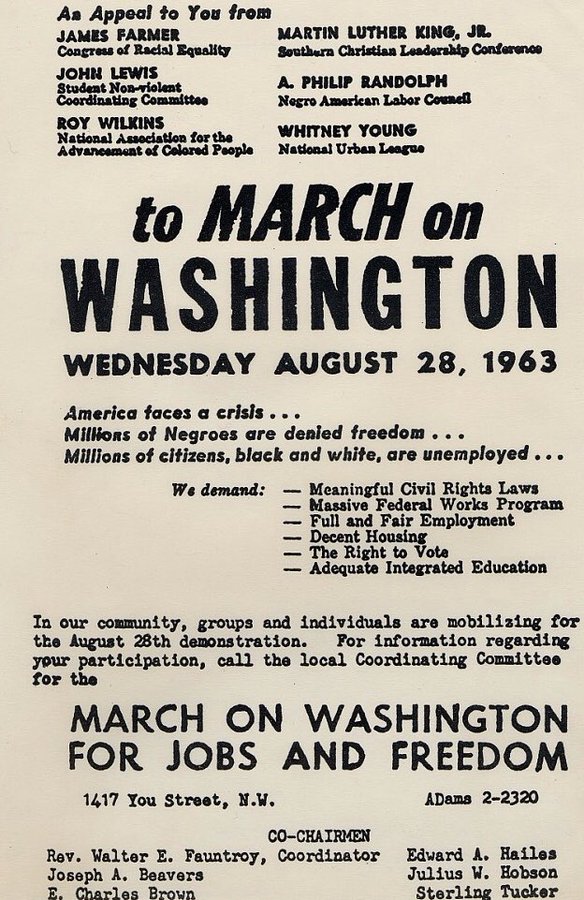
Just three months after its release, when Dylan performed at the March on Washington for Jobs and Freedom on August 28, 1963, “Blowin’ in the Wind” had become a massive civil rights anthem. But he had already ceded the song to Peter, Paul & Mary, who played their version that day. Dylan ignored his sophomore album entirely to play songs from the upcoming The Times They Are a‑Changing—songs that stand out for their indictments of the U.S. in some very specific terms.
Dylan played three songs from the new album: “When the Ship Comes In” with Joan Baez, “Only a Pawn in Their Game,” and “With God on Our Side.” (He also played the popular folk song “Keep Your Eyes on the Prize.”) In contrast to his vaguely allusive popular anthems, “Only a Pawn in Their Game”—about the murder of Medgar Evers—isn’t coy about the culprits and their crimes. We might say the song offers an astute analysis of institutional racism, white supremacy, and stochastic terrorism.
A bullet from the back of a bush
Took Medgar Evers’ blood
A finger fired the trigger to his name
A handle hid out in the dark
A hand set the spark
Two eyes took the aim
Behind a man’s brain
But he can’t be blamed
He’s only a pawn in their gameA South politician preaches to the poor white man
“You got more than the blacks, don’t complain
You’re better than them, you been born with white skin, ” they explain
And the Negro’s name
Is used, it is plain
For the politician’s gain
As he rises to fame
And the poor white remains
On the caboose of the train
But it ain’t him to blame
He’s only a pawn in their gameThe deputy sheriffs, the soldiers, the governors get paid
And the marshals and cops get the same
But the poor white man’s used in the hands of them all like a tool
He’s taught in his school
From the start by the rule
That the laws are with him
To protect his white skin
To keep up his hate
So he never thinks straight
‘Bout the shape that he’s in
But it ain’t him to blame
He’s only a pawn in their gameFrom the poverty shacks, he looks from the cracks to the tracks
And the hoofbeats pound in his brain
And he’s taught how to walk in a pack
Shoot in the back
With his fist in a clinch
To hang and to lynch
To hide ‘neath the hood
To kill with no pain
Like a dog on a chain
He ain’t got no name
But it ain’t him to blame
He’s only a pawn in their gameToday, Medgar Evers was buried from the bullet he caught
They lowered him down as a king
But when the shadowy sun sets on the one
That fired the gun
He’ll see by his grave
On the stone that remains
Carved next to his name
His epitaph plain
Only a pawn in their game
These lyrics have far too much relevance to current events, and they’re indicative of the changing tone of Dylan’s muse. His refrains drip with irony. The killer of Medgar Evers “can’t be blamed”—an evasion of responsibility that becomes a powerful force all its own.
Dylan revisits the themes of generational trauma and murder in “With God on Our Side” (hear him sing it with Baez at Newport, above). The song is a sharp satire of his historical education, with its inevitable repetitions of war and slaughter. Here, Dylan presents the exponentially gross, existentially dreadful, consequences of a national abdication of blame for historical violence.
Oh my name it ain’t nothin’
My age it means less
The country I come from
Is called the Midwest
I was taught and brought up there
The laws to abide
And that land that I live in
Has God on its sideOh, the history books tell it
They tell it so well
The cavalries charged
The Indians fell
The cavalries charged
The Indians died
Oh, the country was young
With God on its sideThe Spanish-American
War had its day
And the Civil War, too
Was soon laid away
And the names of the heroes
I was made to memorize
With guns in their hands
And God on their sideThe First World War, boys
It came and it went
The reason for fighting
I never did get
But I learned to accept it
Accept it with pride
For you don’t count the dead
When God’s on your sideThe Second World War
Came to an end
We forgave the Germans
And then we were friends
Though they murdered six million
In the ovens they fried
The Germans now, too
Have God on their sideI’ve learned to hate the Russians
All through my whole life
If another war comes
It’s them we must fight
To hate them and fear them
To run and to hide
And accept it all bravely
With God on my sideBut now we got weapons
Of chemical dust
If fire them, we’re forced to
Then fire, them we must
One push of the button
And a shot the world wide
And you never ask questions
When God’s on your sideThrough many a dark hour
I’ve been thinkin’ about this
That Jesus Christ was
Betrayed by a kiss
But I can’t think for you
You’ll have to decide
Whether Judas Iscariot
Had God on his side.So now as I’m leavin’
I’m weary as Hell
The confusion I’m feelin’
Ain’t no tongue can tell
The words fill my head
And fall to the floor
That if God’s on our side
He’ll stop the next war
Dylan’s race/class analysis in “Only a Pawn in the Game” and his succinct People’s History of Christian Nationalism in “With God on Our Side” stand out as interesting choices for the March for several reasons. For one thing, it’s as though he had written these songs expressly to take the political, economic, and religious mechanisms and mythologies of racism apart. This was radical speech in an event that was policed by its organizers to tone down inflammatory rhetoric for the cameras.
23-year-old John Lewis, for example, was forced to temper his speech, in which he meant to say, “We will march through the South, through the heart of Dixie, the way Sherman did. We shall pursue our own scorched earth policy and burn Jim Crow to the ground — nonviolently.… the revolution is at hand, and we must free ourselves of the chains of political and economic slavery.” As a popular white artist, rather than a potentially seditious Black organizer, Dylan had far more license and could “use his privilege,” as they say, to describe the systems of political and economic oppression Lewis had wanted to name.
Dylan’s performance was one of a handful of memorable musical appearances. Most of the singers made a far bigger impression, like Mahalia Jackson, Marian Anderson, and Baez herself, whose “We Shall Overcome” created a legendary moment of harmony. No one sang along to Dylan’s new songs—they wouldn’t have known the words. But Dylan was never careless. He chose these words for the moment, hoping to have some impact in the only way he could.
The 1963 March’s purpose has been overshadowed by a few passages in Martin Luther King, Jr.‘s powerful “I Have a Dream” speech, co-opted by everyone and reduced to meme-able quotes. But the protest “remains one of the most successful mobilizations ever created by the American Left,” historian William P. Jones writes. “Organized by a coalition of trade unionists, civil rights activists, and feminists–most of them African American and nearly all of them socialists.”
Dylan sang stories of how the country got to where it was, through a history of violence still playing out before the marchers’ eyes. Whatever political tensions there were among the various organizers and speakers did not distract them from pushing through the 1964 Civil Rights Act and the Fair Employment Practices clause banning discrimination on the basis of race, religion, national origin, or sex—protections that have been broadened since that time, and also challenged, threatened, and stripped away.
Fifty-seven years later, as the RNC convention ends and another March on Washington happens, we might reflect on Dylan’s small but prescient contributions in 1963, in which he aptly characterized the traumatic repetitions we’re still convulsively experiencing over half a century later.
Related Content:
A Massive 55-Hour Chronological Playlist of Bob Dylan Songs: Stream 763 Tracks
Josh Jones is a writer and musician based in Durham, NC. Follow him at @jdmagness
Read More...Billie Eilish Performs an NPR Tiny Desk Concert, with a Little Bit of Technology & Magic
Even COVID-19 can’t stop NPR’s series of Tiny Desk Concerts, which has previously featured Yo-Yo Ma, Adele, Wilco, The Pixies, and many, many other talented musicians. As NPR explains below, the performance involved a little bit of technology and some magic. Enjoy:
It didn’t take long for Billie Eilish to become one of the biggest pop stars in the world, sweep the Grammy Awards’ major categories and release the latest James Bond theme. And today, at just 18, she and her brother, Finneas, have accomplished what no one has been able to do for five and a half months: perform a Tiny Desk concert in what certainly appears to be the NPR Music offices.
Of course, due to safety concerns, even the NPR Music staff can’t set foot in the building that houses Bob Boilen’s desk. But if you look over Eilish’s shoulder, there’s no mistaking the signs that she’s appearing at the Tiny Desk in its present-day form: On the last day before staff began working from home, I took home the Green Bay Packers helmet that sat on the top shelf — the one Harry Styles had signed a few weeks earlier — for safe keeping. In this performance, that spot is empty.
So how the heck did they do it?
Honestly, it’s best that you watch the whole video to experience the extent of the technical feat — which, in the spirit of Eilish’s Saturday Night Live performance, they’re willing to share with you. And thankfully, we still have our ways of photographing the desk, even if the room has fallen silent.
So settle in for a welcome jolt of Tiny Desk innovation, not to mention two of the excellent standalone singles Billie Eilish has released in the past year: “my future” and “everything i wanted.” And, seriously, be sure to watch until the very end.
If you would like to support the mission of Open Culture, consider making a donation to our site. It’s hard to rely 100% on ads, and your contributions will help us continue providing the best free cultural and educational materials to learners everywhere. You can contribute through PayPal, Patreon, and Venmo (@openculture). Thanks!
Related Content
Read More...JamBase Launches a New Video Archive of 100,000 Streaming Concerts: Phish, Wilco, the Avett Brothers, Grateful Dead & Much More
People do not tend to answer the question, “do you like Phish?” with, “yeah, I guess they’re okay.” Those who like Phish, love Phish, devotedly and without reservation. And those who don’t like Phish, well….
For the purposes of maintaining objectivity, I shall pretend to remain agnostic on the question, but I do happen to think this kind of polarization is a mark of greatness, wherever one lands. Great art provokes. What could be more provocative than awesome riffs, 20-minute jams, and obscure in-jokes? There is, admittedly, a significant you-had-to-have-been-there quality to Phish fandom.…
Phish, and The Grateful Dead before them, have been instrumental in keeping live music—played at length and with abandon—relevant, not only through their constant touring but through the number of bands in their orbit who inspire their own devoted followings. Now the pandemic has made it impossible for fans of Phish, the String Cheese Incident, the Dave Matthews Band, Widespread Panic, or the Avett Brothers to make it out to shows.
To ease their pain, JamBase launched a Live Video Archive, a music aggregator that allows fans to search 100,000 free streaming concerts on YouTube. “Looking to find videos of Phish performing ‘Harry Hood’ in 2013? Enter ‘Harry Hood’ in the song filter and you’ll see a list of every version in our database,” Jambase explains.
“Use the ‘Event Year’ filter to pick 2013. You’ll then see many videos to choose from. Press ‘Play’ to watch in the player or press ‘queue’ to start a list of videos that will display in the order you selected to view at your leisure.”
Given their audience, JamBase’s catalogue skews heavily toward jam and jam-adjacent bands. But you’ll also find a huge archive of performances, over 14,000 clips, from Seattle independent radio station KEXP. “Performances from The Barr Brothers, Wilco, Jason Isbell and Yo La Tengo are just a few of the dozens of acts featured in KEXP videos on the JBLVA.”
JamBase’s own homepage is also full of great stuff for fans not only of jams and bluegrass bands but other genres as well, from Lucinda Williams’ gritty country folk to Emily King’s acoustic R&B, such as her latest single “See Me,” released in support of Black Lives Matter. These are tough times all around. It can be easy to lose sight of the good things we’re missing as we watch current events unfold. Let the JamBase Live Video Archive remind us of groovy times we had, and will have again.
Related Content:
Radiohead Will Stream Concerts Free Online Until the Pandemic Comes to an End
Metallica Is Putting Free Concerts Online: 6 Now Streaming, with More to Come
Josh Jones is a writer and musician based in Durham, NC. Follow him at @jdmagness
Read More...How Stevie Nicks Wrote “Rhiannon” & Embodied the Medieval Witch Character Onstage
It seems as inevitable as bell bottoms and shoulder-wide collars that Stevie Nicks would transform into the New Age priestess who greeted the 70s with a wave of a billowy, shawl-draped arm. “It makes sense,” Bill DeMain writes at Classic Rock, that her “signature song was inspired by a kind of ancient magic” of the kind that everybody was getting into. That song, “Rhiannon,” takes its name from “an old Welsh witch,” as Nicks would often announce onstage. During Fleetwood Mac’s Nicks/Buckingham heyday, Nicks embodied the character as though possessed, her performances of the song “like an exorcism,” Mick Fleetwood recalled.
The story of how “Rhiannon” came to be, however, is not as straightforward as Nicks’ reaching into the pages of the Mabinogion, the Welsh prose cycle in which Rhiannon first appears. The name came to her several steps removed from its mythical origins, from a novel by Mary Leader called Triad.
“It was just a stupid little paperback that I found somewhere at somebody’s house,” she recalls of the uncanny 1974 composition. “And it was all about this girl who becomes possessed by a spirit named Rhiannon. I read the book, but I was so taken with that name that I thought: ‘I’ve got to write something about this.’ So I sat down at the piano and started this song about a woman that was all involved with these birds and magic.”
“I come to find out,” she says, “after I’ve written the song, that in fact Rhiannon was the goddess of steeds, maker of birds.” The perfect anthem for a singer on the threshold of turning the already famous Fleetwood Mac into one of the biggest rock bands in the world. They were in a kind of wilderness period, having fired longtime guitarist and musical linchpin Danny Kirwan and lost guitarist Bob Welch. When Lindsay Buckingham, his replacement, insisted that Nicks join with him, she brought the song “about an old Welsh witch” along with the pair’s collection of shawls, capes, and kimonos.
You can learn more about the myths of the Mabinogion, the oldest known prose stories in Britain, in the Polyphonic video above. The collection inspired the epic fantasies of J.R.R. Tolkien, and by proxy the epic fantasies of Led Zeppelin and every heavy metal band thereafter. It also features in Lloyd Alexander’s 1960’s fantasy series Chronicles of Prydain (later poorly adapted in Disney’s The Black Cauldron). The pop culture of the 70s had been infused with ancient Welsh before Rhiannon came along, but the goddess herself seemed to belong exclusively to Stevie Nicks, who intuited a deep magic in the music of her ancient name.
Related Content:
Josh Jones is a writer and musician based in Durham, NC. Follow him at @jdmagness
Read More...Support Us
We're hoping to rely on loyal readers, rather than erratic ads. Please click the Donate button and support Open Culture. You can use Paypal, Venmo, Patreon, even Crypto! We thank you!

About Us

Open Culture scours the web for the best educational media. We find the free courses and audio books you need, the language lessons & educational videos you want, and plenty of enlightenment in between.
Advertise With Us
FREE UPDATES!
GET OUR DAILY EMAIL
Get the best cultural and educational resources on the web curated for you in a daily email. We never spam. Unsubscribe at any time.
FOLLOW ON SOCIAL MEDIA
Open Culture editor Dan Colman scours the web for the best educational media. He finds the free courses and audio books you need, the language lessons & movies you want, and plenty of enlightenment in between.
Advertise With Us

