Hand-Colored Maps of Wealth & Poverty in Victorian London: Explore a New Interactive Edition of Charles Booth’s Historic Work of Social Cartography (1889)
Mapping has always been contentious, no matter where you look in time. Maps preserve ideological assumptions on paper, rationalizing physical space as they render it in two dimensions. No matter how didactic, they can become political weapons. In the case of Charles Booth’s visually impressive Maps Descriptive of London Poverty, we have a series of maps whose own assumptions can sometimes seem at odds with their ostensible purpose: to improve the living conditions of London’s poor.
Booth’s “colourful poverty maps were created between 1886 and 1903,” Zoe Craig writes at Londonist, as part of a “ground-breaking study into the lives of ordinary Londoners.” A philanthropist born into wealth in the shipping trade, Booth took it upon himself to study poverty in London in order to initiate social reforms.
He succeeded. The study, conducted by Booth and a team of researchers, led to the creation of Old Age pensions, which Booth called “limited socialism,” as well as school meals for hungry children. He was clear about that fact that he saw such reforms as a bulwark against socialist revolution.
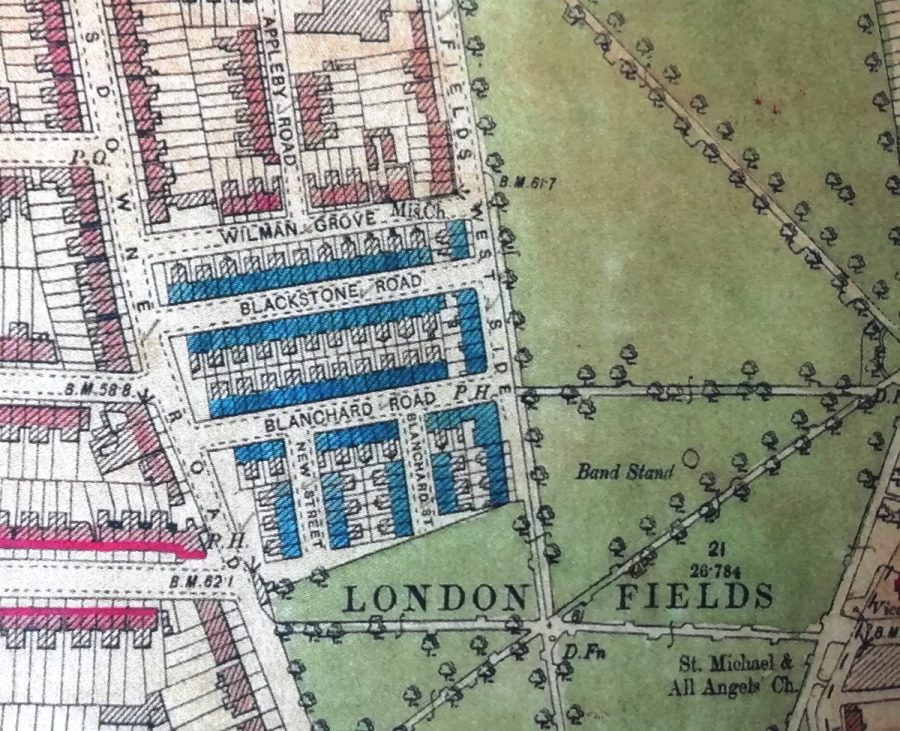
The study’s seventeen volumes are filled with picturesque accounts. “Picking through the tidbits of information from these people’s lives will make you feel a bit like a Victorian costume drama police detective,” Craig remarks. This reference to policing feels pointed, given the role of the police in maintaining class hierarchies in Victorian London. As an American, it can be hard to look at Booth’s map and not also see the 20th redlining practices in U.S. cities. Consider, for example, the categories Booth applied to London’s classes:
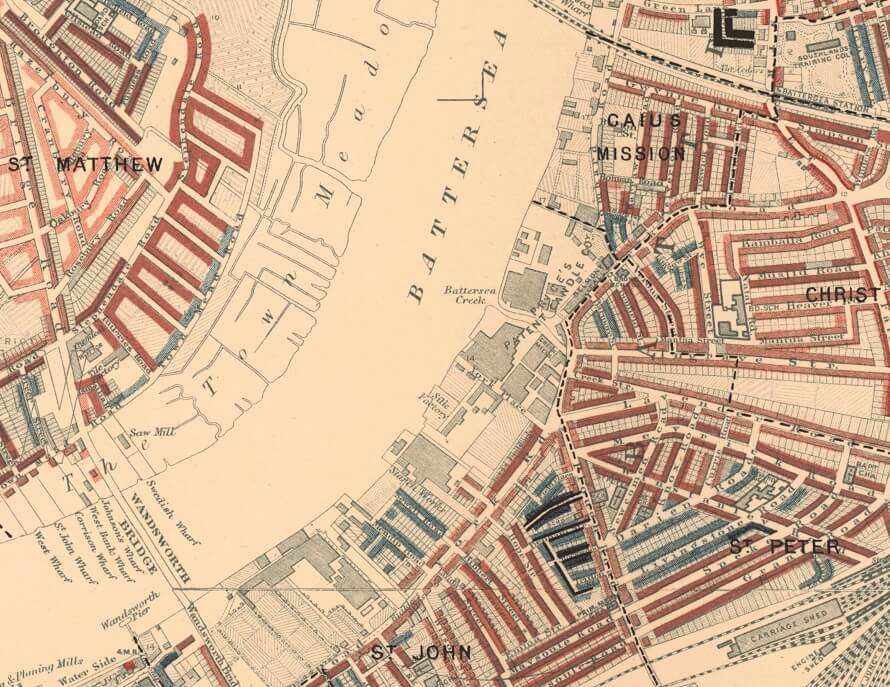
Called ‘Inquiry Into the Life and Labour of the People in London’, the epic work studied families and residents living across London, and coloured the streets according to their financial situation: between black for ‘lowest class, vicious, semi-criminal’ through pink for mixed ‘some comfortable, some poor’ to orange for ‘wealthy’.
As in Daniel Patrick Moynihan’s paternalistic 1965 report on the Black underclass in the U.S., the language reinforces Social Darwinist ideas that deem the “lowest class” unfit for full participation in civil society—“vicious, semi-criminal…”
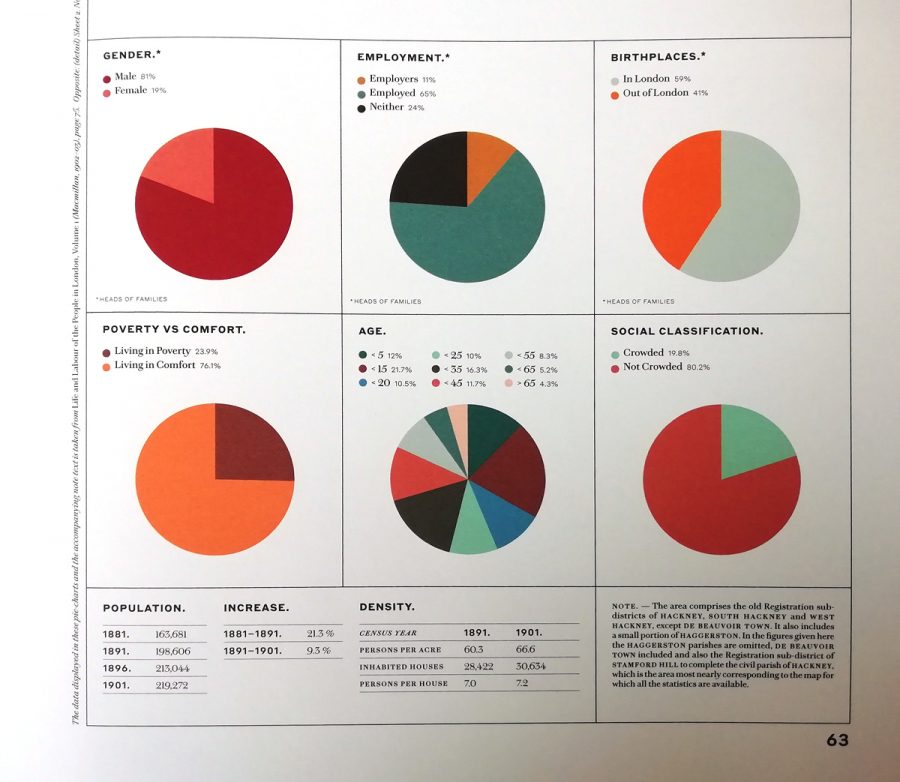
Of course, the social and historical context differs markedly, but we might also consider Feargus O’Sullivan’s observations at Bloomberg CityLab. A new published edition of the map, he writes, “accompanied by compelling if bleak period photos, reveals a city that possesses echoes of London today. It depicts, after all, a densely-packed metropolis with a cosmopolitan population where immensely wealthy people lived just around the corner from neighbors who were struggling to make ends meet.”
Maps may not create the social conditions they describe, but they can help perpetuate them, rendering people visible in ways that allow for even more control over their lives. Criticisms of Booth’s study claimed that not only did the proposed reforms not go far enough but that the report described London’s class structure while offering little to no analysis of the causes of poverty. In language that sounded less objectionable to Victorian ears, the poor are mostly blamed for their own condition.
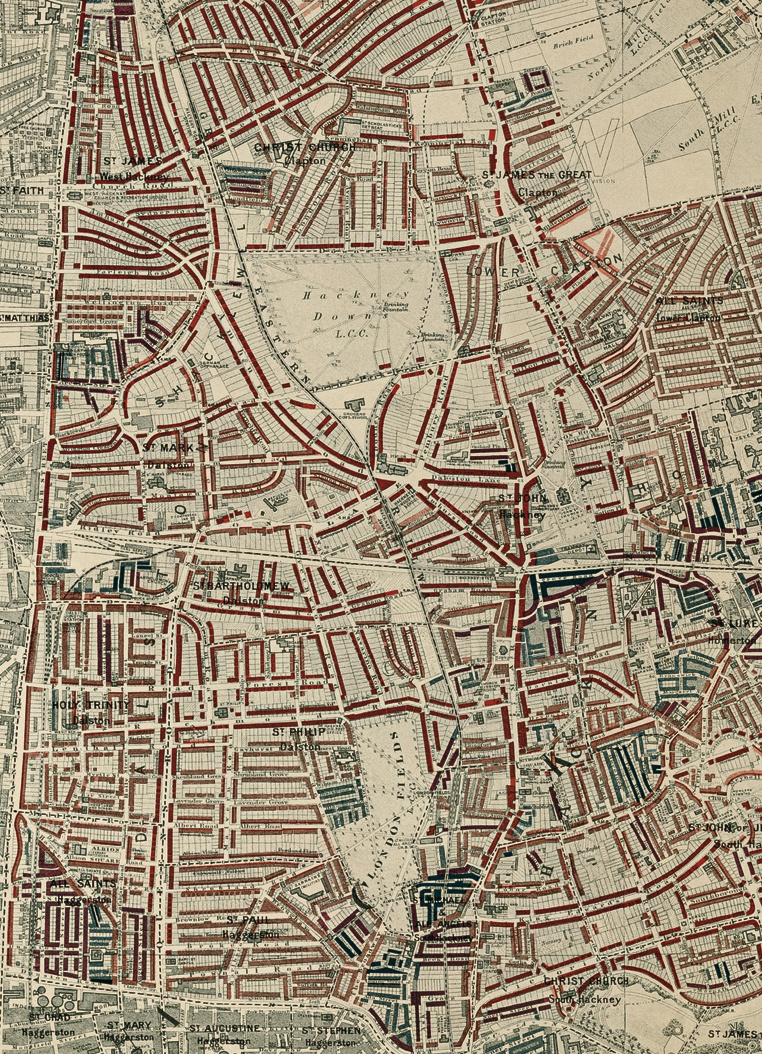
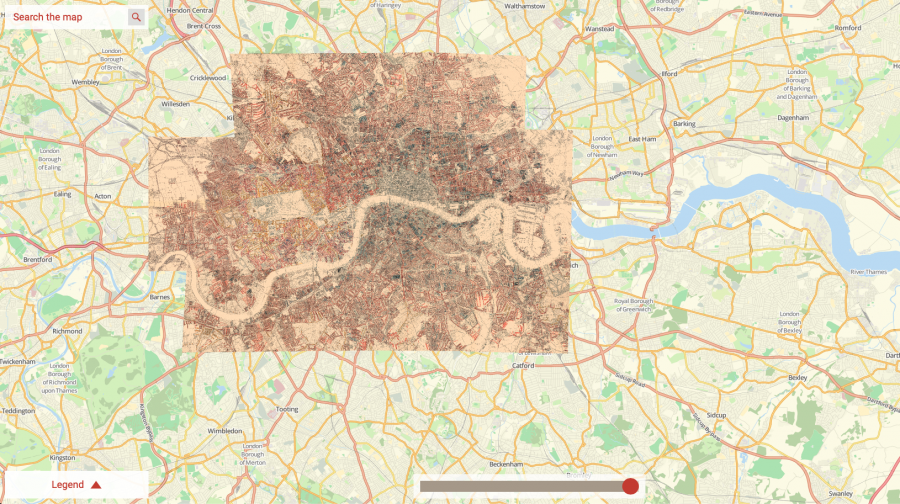
None of the study’s particular limitations take away from the graphic achievements of its maps and explanatory charts. They are, the London School of Economics writes, a striking “early example of social cartography.” The LSE hosts an incredibly detailed, searchable, high-resolution interactive version of the maps, assembled together and overlaid on a modern GPS map of London. They also detail the various editions of the maps as they appeared between 1898 and 1903.
Hand-colored and based on the 1869 Ordnance Survey, the maps seemed “sufficiently important” to Booth to warrant “comprehensive revision.” Here, the police appear in person to guide the process. “Social investigators accompanied policemen on their beats across London,” the LSE writes, “and recorded their own impressions of each street and the comments of the policemen.” You can read the police notebooks from these surveys at the LSE and learn more about the 12 district maps and the demographic data they represent at Mapping London. The LSE printed a hardcover print edition of Booth’s work in 2019, complete with 500 illustrations. You can purchase a copy here. Or visit the interactive edition here.
Related Content:
Josh Jones is a writer and musician based in Durham, NC. Follow him at @jdmagness
Read More...Why James Gandolfini’s Tony Soprano Is “the Greatest Acting Achievement Ever Committed to the Screen”: A Video Essay
The ongoing “golden age” of prestige television drama began more than twenty years ago, but how many shows have truly surpassed The Sopranos, the one that started it all? However many series come and go, raising large and often obsessive fan bases with their varying mixtures of crime, history, politics, science fiction, fantasy, and intrigue, none have shown the cultural staying power of this six-season tale of a mob boss in turn-of-the-21st-century New Jersey. That The Sopranos remains relevant owes in part to the vision of creator David Chase as well as to the tour de force performance of star James Gandolfini.
Evan Puschak, better known as the Nerdwriter, has stronger words of approbation: Gandolfini’s is “probably the greatest acting achievement ever committed to the screen, small or big.” In the video essay “How James Gandolfini Navigates Emotion” he marshals in support of this claim just one scene, but a scene that features Gandolfini at the height of his dramatic powers.
Taken from the fifth-season episode “Unidentified Black Males,” originally aired in 2004 (and co-written by Matthew Weiner, later to create the prestige-TV franchise Mad Men), this selection takes place in the office of Tony’s psychiatrist Dr. Jennifer Melfi, played by Lorraine Bracco. (When The Sopranos debuted, two months before the premiere of Harold Ramis’ Analyze This, a mobster in therapy was very much a novel idea.)
“Tony Soprano is going to have a panic attack in this therapy session,” says Puschak, and “the way James Gandolfini builds to that attack” demonstrates “how he carries us with him through a complex sequence of emotions.” Here Gandolfini rises to the formidable challenge of lying convincingly: not convincingly in the sense that Dr. Melfi believes him, but convincingly in the sense that we believe the grapple with conflicting truths and untruths that characterizes Tony’s life. Tony must pin his recent spate of panic attacks on something other than his cousin Tony B, who committed a hit he shouldn’t have. That Tony doesn’t quite believe his own words Gandolfini transmits with “his tone, his eyes, and the tilt of his head.” He uses the musicality of Tony’s speech, “some combination of leftover Italian rhythms and a New York-inflected North Jersey accent,” to build to “larger and larger crescendoes.”
As it foreshadows the approaching emotional turmoil, his “rhythmic anger, like waves crashing on the shore, is hypnotic, drawing you deeper into his mental and emotional space with each new cycle.” Tony then doubles down on his lie, trying to cover for his cousin by inventing on the spot a story about having been beaten up by a gang of shoe thieves in 1986. Only later in the scene does the truth come out, or at least partially leak out, even as Gandolfini portrays Tony struggling to fight back the panic attack that has emerged as a result of telling these stories. For all the technique it showcases, the scene ends in a classically dramatic fashion, with a kind of catharsis — which, if you know The Sopranos, you know is hardly the word Tony has for it.
Related Content:
How David Chase Breathed Life into the The Sopranos
David Chase Reveals the Philosophical Meaning of The Soprano’s Final Scene
James Gandolfini Reads from Maurice Sendak’s Children’s Story In The Night Kitchen
How Humphrey Bogart Became an Icon: A Video Essay
How David Lynch Manipulates You: A Close Reading of Mulholland Drive
Based in Seoul, Colin Marshall writes and broadcasts on cities, language, and culture. His projects include the Substack newsletter Books on Cities, the book The Stateless City: a Walk through 21st-Century Los Angeles and the video series The City in Cinema. Follow him on Twitter at @colinmarshall, on Facebook, or on Instagram.
Read More...The Beastie Boys’ Final Concert Streaming Free Online This Weekend
Until Monday, the Beastie Boys’ final concert–captured at Bonnaroo on June 12, 2009–will stream free on YouTube. (Watch it above.) Just five weeks after the show, Adam “MCA” Yauch would announce that he had been diagnosed with salivary gland cancer. Originally optimistic, Yauch said “I just need to take a little time to get this in check, and then we’ll release the record and play some shows.” “It’s a pain in the neck (sorry had to say it) because I was really looking forward to playing these shows, but the doctors have made it clear that this is not the kind of thing that can be put aside to deal with later.” Sadly, the cancer proved aggressive and took MCA’s life in May, 2012, leaving the show above as the Beastie Boys’ final live document. Find the setlist for the final show here.
If you would like to support the mission of Open Culture, consider making a donation to our site. It’s hard to rely 100% on ads, and your contributions will help us continue providing the best free cultural and educational materials to learners everywhere. You can contribute through PayPal, Patreon, and Venmo (@openculture). Thanks!
Related Content:
Watch 36 Beastie Boys Videos Now Remastered in HD
The Beastie Boys & Rick Rubin Reunite and Revisit Their Formative Time Together in 1980s NYC
Read More...
Is Mail-In Voting New in the United States?: It Actually Goes Back to the Civil War
Let’s say you go home for the holidays. Anything’s possible, who knows. It’s a wild world. Let’s say you get there and someone starts laying on you that trip about how Q Continuum said mail-in voting was orchestrated by satanic cables from Anarchist HQ. Let’s say you overhear something more down-to-earth, like how if mail-in voting happens, billions of people will vote illegally… even more people than live in the country, which is how you’ll know….
Maybe you’ll want to speak up and say, hey I know something about this topic, except then maybe you realize you don’t actually know much, but you know something ain’t right with this talk and maybe it’s probably good to have a functioning Postal Service and maybe people should be able to vote. In such situations (who can say how often these things happen), you might wish to have a little information at the ready, to educate yourself and share with others.
You might share information about how mail-in voting has been around since 1775. It has worked pretty well at scale since “about 150,000 of the 1 million Union soldiers were able to vote absentee in the 1864 presidential election in what became the first widespread use of non-in person voting in American history,” Alex Seitz-Wald explains at NBC News. Since the federal government has managed to make mail-in voting work for soldiers serving away from home for over 150 years, “it’s now easier in some ways for a Marine in Afghanistan to vote than it is for an American stuck at home during the COVID-19 lockdown.”
“Some part of the military has been voting absentee since the American Revolution,” Donald Inbody, former Navy Captain turned political science professor at Texas State University, tells NBC News. Inbody refers to one of the first documented instances, when Continental Army soldiers voted in a town meeting by proxy in New Hampshire. But history is complicated, and “mail-in voting has worked just fine so shut up” needs some nuance.
In the very same election in which 150,000 Union soldiers mailed their ballots, Lincoln urged Sherman to send troops stationed in Democratic-controlled Indiana—which had banned absentee voting—back to their home states so that they could vote. The practice has always had its vocal critics and suffered accusations of fraud from all sides, though little evidence seems to have emerged. Absentee voting helped win the Civil War, Blake Stilwell argues at Military.com, in spite of a conspiracy theory alleging fraud that might have unseated Lincoln.
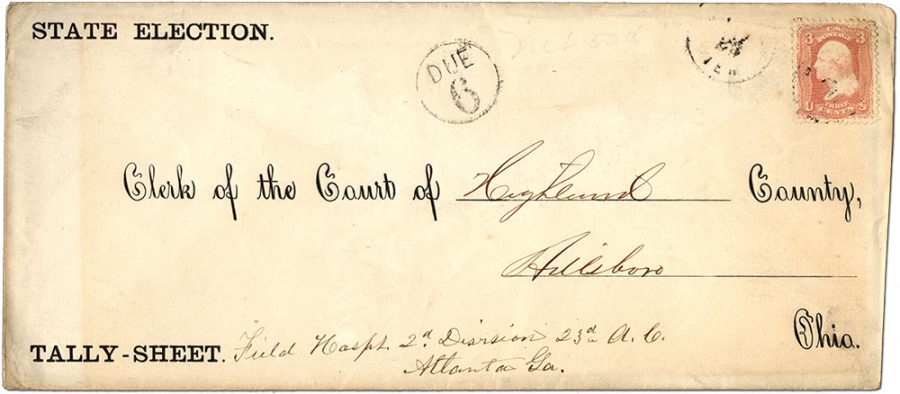
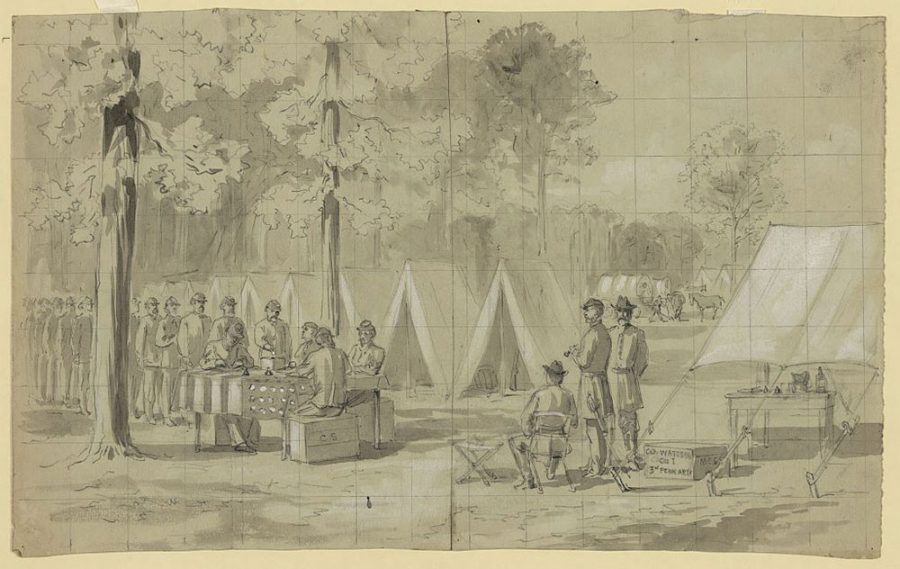
There are several remnants from the time of careful record-keeping, like the pre-printed envelope above that “contained a tally sheet of votes from the soldiers of Highland County the Field Hospital 2nd Division 23rd Army Corps,” notes the Smithsonian National Postal Museum. (The drawing at the top shows Pennsylvania soldiers voting in 1864.) And this is all fascinating stuff. But soldiers are actually absent, which is why they vote absentee, right? I mean, if you’re at home, why can’t you just go to the polling place in the global pandemic in your city that closed all the polling places?
It’s true that civilian mail-in voting often works differently from military absentee voting. While every state offers some version, some restrict it to voters temporarily out of state or suffering an illness. Currently, only “30 states have adopted ‘no-excuse absentee balloting,’ which allows anyone to request an absentee ballot,” Nina Strochlic reports at National Geographic. State laws vary further among those 30.
“In 2000,” for example, “Oregon became the first state to switch to fully vote-by-mail elections.” Things have rapidly changed, however. “In the face of the coronavirus pandemic, voters in every state but Mississippi and Texas were allowed to vote by mail or by absentee ballot in this year’s primaries.” If you live in the U.S. (or outside it) and don’t know what happened next… bless you. It involves defunding the post office instead of the police.
Voting by mail has expanded to meet major crises throughout history, says Alex Keyssar, history professor at the Kennedy School of Government at Harvard. “That’s the logical trajectory” and “we are not in normal times.” If a highly infectious disease that has killed at least 200,000 Americans on top of ongoing voter suppression and an election security crisis and massive civil unrest and economic turmoil aren’t reasons enough to expand the vote-by-mail franchise to every state, I couldn’t say what is.
Should only soldiers have the ability to vote easily? I imagine someone might say YES, loudly over the centerpiece, because voting is a privilege not a right!
You, empowered purveyor of accurate information, understander of absentee voting history, change-maker, will pull out your pocket Constitution and ask someone to find the word “privilege” in amendments that start with “The right of citizens of the United States to vote shall not be denied or abridged by the United States or by any State,” etc. That’ll show ’em. But if the gambit fails to impress, you’ve still got a better understanding of why voting by mail may not be one of the signs of the end times.
Related Content:
Take The Near Impossible Literacy Test Louisiana Used to Suppress the Black Vote (1964)
Three Public Service Announcements by Frank Zappa: Vote, Brush Your Teeth, and Don’t Do Speed
Sal Khan & the Muppets’ Grover Explain the Electoral College
Josh Jones is a writer and musician based in Durham, NC. Follow him at @jdmagness
Read More...The Internet Archive Will Digitize & Preserve Millions of Academic Articles with Its New Database, “Internet Archive Scholar”
Open access publishing has, indeed, made academic research more accessible, but in “the move from physical academic journals to digitally-accessible papers,” Samantha Cole writes at Vice, it has also become “more precarious to preserve…. If an institution stops paying for web hosting or changes servers, the research within could disappear.” At least a couple hundred open access journals vanished in this way between 2000 and 2019, a new study published on arxiv found. Another 900 journals are in danger of meeting the same fate.
The journals in peril include scholarship in the humanities and sciences, though many publications may only be of interest to historians, given the speed at which scientific research tends to move. In any case, “there shouldn’t really be any decay or loss in scientific publications, particularly those that have been open on the web,” says study co-author Mikael Laasko, information scientist at the Hanken School of Economics in Helsinki. Yet, in digital publishing, there are no printed copies in university libraries, catalogued and maintained by librarians.
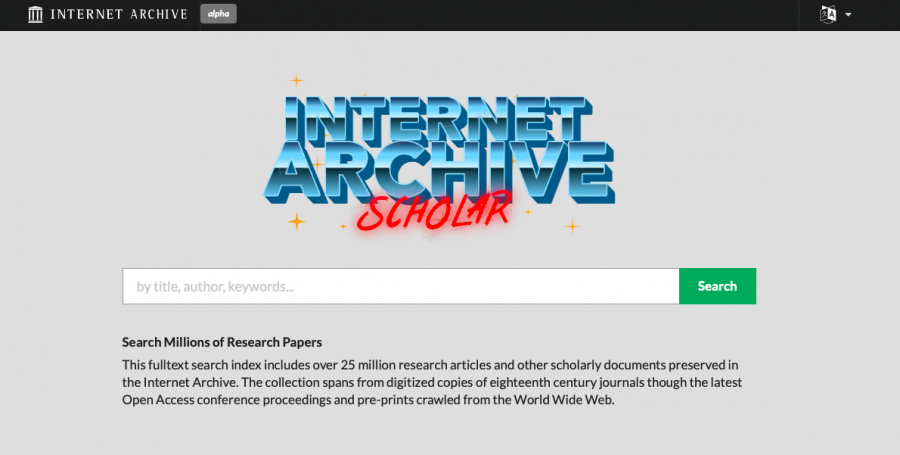
To fill the need, the Internet Archive has created its own scholarly search platform, a “fulltext search index” that includes “over 25 million research articles and other scholarly documents” preserved on its servers. These collections span digitized and original digital articles published from the 18th century to “the latest Open Access conference proceedings and pre-prints crawled from the World Wide Web.” Content in this search index comes in one of three forms:
- public web content in the Wayback Machine web archives (web.archive.org), either identified from historic collecting, crawled specifically to ensure long-term access to scholarly materials, or crawled at the direction of Archive-It partners
- digitized print material from paper and microform collections purchased and scanned by Internet Archive or its partners
- general materials on the archive.org collections, including content from partner organizations, uploads from the general public, and mirrors of other projects
The project is still in “alpha” and “has several bugs,” the site cautions, but it could, when it’s fully up and running, become part of a much-needed revolution in academic research—that is if the major academic publishers don’t find some legal pretext to shut it down.
Academic publishing boasts one of the most rapacious legal business models on the global market, and one of the most exploitative: a double standard in which scholars freely publish and review research for the public benefit (ostensibly) and very often on the public dime; while private intermediaries rake in astronomical sums for themselves with paywalls. The open access model has changed things, but the only way to truly serve the “best interests of researchers and the public,” neuroscientist Shaun Khoo argues, is through public infrastructure and fully non-profit publication.
Maybe Internet Archive Scholar can go some way toward bridging the gap, as a publicly accessible, non-profit search engine, digital catalogue, and library for research that is worth preserving, reading, and building upon even if it doesn’t generate shareholder revenue. For a deeper dive into how the Archive built its formidable, still developing, new database, see the video presentation above from Jefferson Bailey, Director of Web Archiving & Data Services. And have a look at Internet Archive Scholar here. It currently lacks advanced search functions, but plug in any search term and prepare to be amazed by the incredible volume of archived full text articles you turn up.
Related Content:
The Boston Public Library Will Digitize & Put Online 200,000+ Vintage Records
Josh Jones is a writer and musician based in Durham, NC. Follow him at @jdmagness
Read More...The Life, Work & Philosophy of Bill Murray: Happy 70th Birthday to an American Comedy Icon
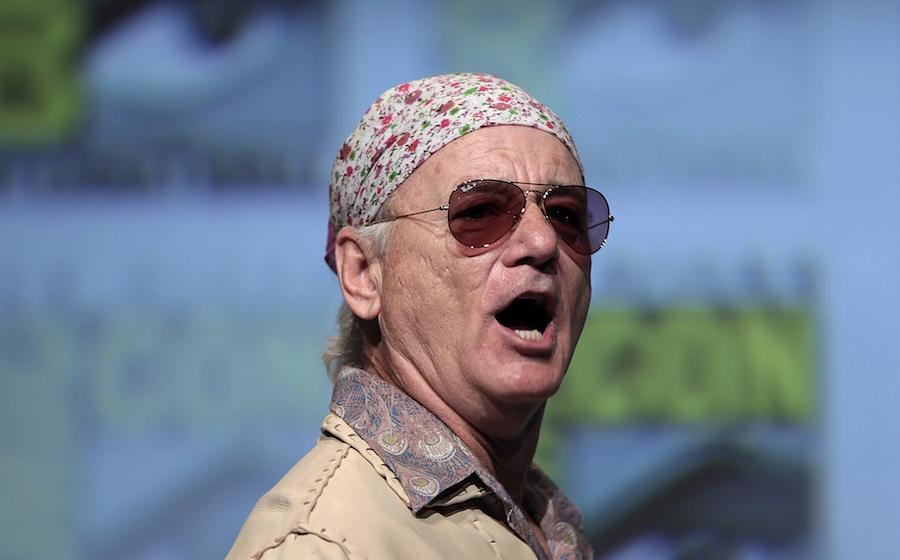
Image by Gage Skidmore, via Wikimedia Commons
“Bill Murray is to me what calculators are to math,” Jason Schwartzman once said of his esteemed colleague. “I never knew math before calculators, and I never knew life before Bill Murray.” Having been born in the 1980s, a decade Murray entered already well-known after three early seasons of Saturday Night Live, I could say the same. Through characters like Nick the lounge singer and half a nerd couple with Gilda Radner, Murray established himself on that show as a goofball, but a goofball of a higher order. As the 80s got into full swing, Murray got into the movies, and ever more prominent roles in the likes of Caddyshack, Stripes, and Ghostbusters assured him a permanent place in the pantheon of American comedy.
For those who cared to look, there has long been evidence of concentrated thought and feeling behind the deadpan impulsiveness of Murray’s onscreen persona: his supporting turn as Dustin Hoffman’s lemon-eating playwright roommate in Tootsie, his passion-project adaptation of Somerset Maugham’s The Razor’s Edge, his post-Ghostbusters escape to the Sorbonne.
It was in Paris that Murray studied the work of the Greco-Armenian Sufi mystic G.I. Gurdjieff, who describes a path to enlightenment called “the way of the sly man,” one who makes maximum use of “the world, the self, and the self that is observing everything.” This concept, according to the Wisecrack video above, has become integral to Murray’s distinctive way of not just acting, but being.
That counts as just one of the theories advanced over the decades to explain the curious phenomenon of Bill Murray. The man has also been called upon to explain it himself now and again, as when an interviewer at the Toronto International Film Festival asked what it feels like to be him. His response takes the audience into a guided meditation meant to make everyone listening understand how it feels to be themselves, right here, right now.
Maintaining this sense of the moment, as Murray later explained to Charlie Rose, is one of the goals of his own life — and presumably not an easy goal to achieve for someone who’s been so famous for so long, a condition he addresses in the 1988 interview animated for Blank on Blank below. “I’m just an obnoxious guy who can make it appear charming,” he says in summation of his appeal. “That’s what they pay me to do.”
That same year, they paid him $6 million for his role in Scrooged (playing, incidentally, the most obnoxious character of his career). He’d already been cautioned against the dangers of such rapidly acquired wealth and fame by the fate of his fellow Chicagoan and SNL alumnus John Belushi, who by that time had already been dead for five years. Murray had also, he says, undergone a “spiritual change” that showed him “there was some other life to live. It changed the way that I worked,” giving everything “a different presence, a different tension.” Onscreen, this change culminated in the roles he took on after putting broad comedies behind him beginning with 1999’s Rushmore, the breakout feature by an up-and-coming director named Wes Anderson.
Casting Murray opposite the teenage Schwartzman, Rushmore showed that he could be more affecting — and indeed funnier — in minor emotional keys. A few years later, Sofia Coppola’s Lost in Translation took him to Japan, where he drew an Academy Award nomination with his performance from the depths of cultural and personal disorientation. Today, on Murray’s 70th birthday, his fans impatiently await his appearances in Anderson’s The Paris Dispatch and Coppola’s On the Rocks, both of which come out next month. Having long since become an institution (albeit an insistently unconventional and unpredictable one) unto himself, Murray can surely look to the heavens and say what, with uncharacteristic earnestness, he told his SNL audience he wanted to say 33 years ago: “Dad, I did it.”
Related Content:
Bill Murray Explains How a 19th-Century Painting Saved His Life
Art Exhibit on Bill Murray Opens in the UK
Watch Bill Murray Perform a Satirical Anti-Technology Rant (1982)
Listen to Bill Murray Lead a Guided Meditation on How It Feels to Be Bill Murray
Based in Seoul, Colin Marshall writes and broadcasts on cities, language, and culture. His projects include the Substack newsletter Books on Cities, the book The Stateless City: a Walk through 21st-Century Los Angeles and the video series The City in Cinema. Follow him on Twitter at @colinmarshall, on Facebook, or on Instagram.
Read More...Good Movies as Old Books: 100 Films Reimagined as Vintage Book Covers
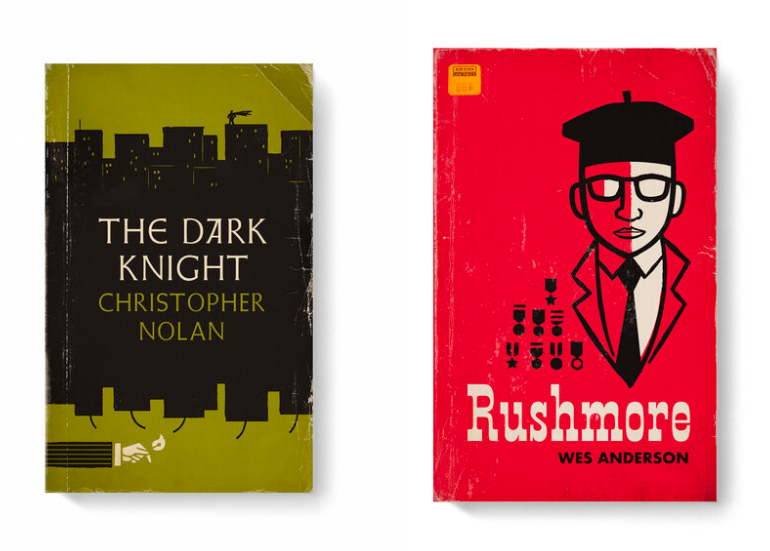
At one time paperback books were thought of as trash, a term that described their perceived artistic and cultural level, production value, and utter disposability. This changed in the mid-20th century, when certain paperback publishers (Doubleday Anchor, for example, who hired Edward Gorey to design their covers in the 1950s) made a push for respectability. It worked so well that the signature aesthetics they developed still, nearly a lifetime later, pique our interest more readily than those of any other era.
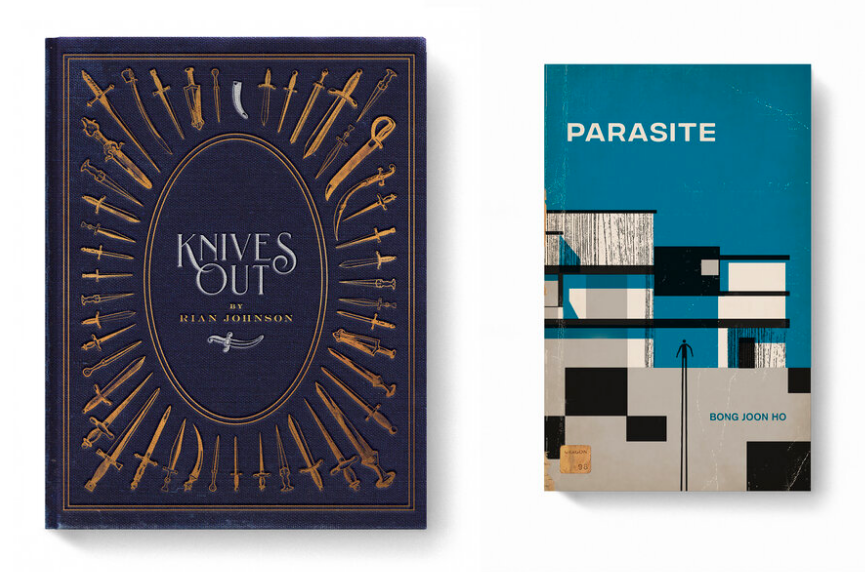
Even today, graphic designers put in the time and effort to master the art of the midcentury paperback cover and transpose it into other cultural realms, as Matt Stevens does in his “Good Movies as Old Books” series. In this “ongoing personal project,” Stevens writes, “I envision some of my favorite films as vintage books. Not a best of list, just movies I love.”
These movies, for the most part, date from more recent times than the mid-20th century. Some, like Jordan Peele’s Us, the Safdie brothers’ Uncut Gems, and Bong Joon-ho’s Parasite, came out just last year. The oldest pictures among them, such as Alfred Hitchcock’s The Birds, date from the early 1960s, when this type of graphic design had reached the peak of its popularity.
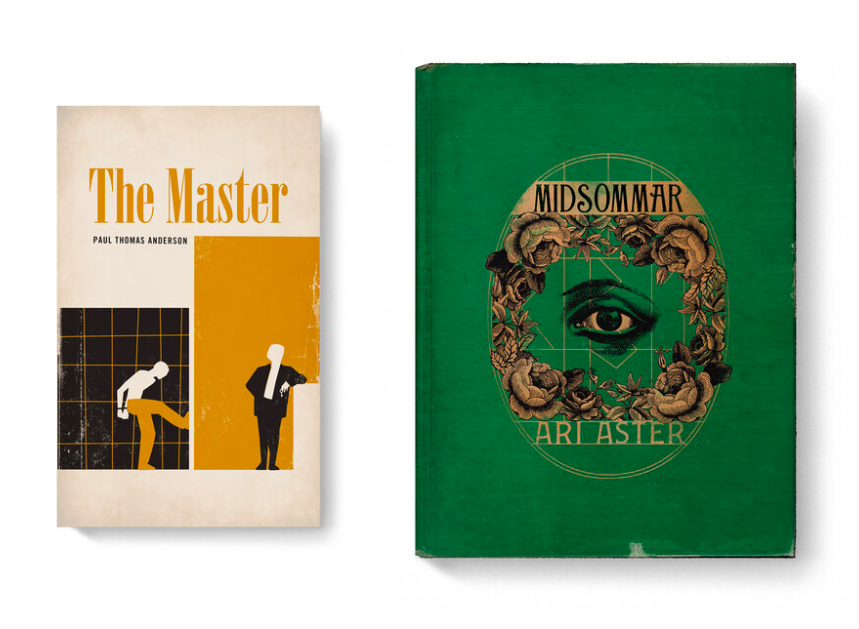
Suitably, Stevens also gives the retro treatment to a few already stylized period pieces like Steven Spielberg’s Raiders of the Lost Ark, Joe Johnston’s The Rocketeer, and Andrew Niccol’s Gattaca, a sci-fi vision of the future itself imbued with the aesthetics of the 1940s. Each and every one of Stevens’ beloved-movies-turned-old-books looks convincing as a work of graphic design from roughly the decade and a half after the Second World War, and some even include realistic creases and price tags. This makes us reflect on the connections certain of these films have to literature, most obviously those, like David Fincher’s Fight Club and Stephen Frears’ High Fidelity, adapted from novels in the first place.
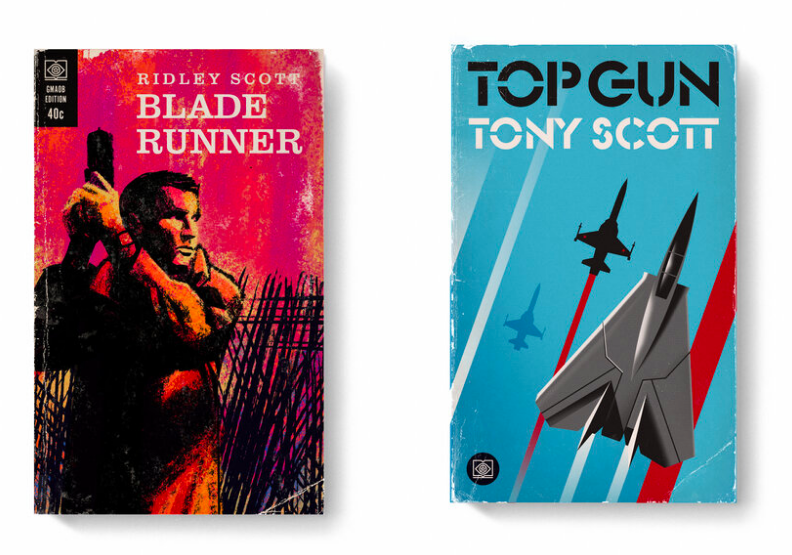
More subtle are Rian Johnson’s recent Knives Out, a thoroughgoing tribute to (if not an adaptation of) the work of Agatha Christie; Ridley Scott’s Blade Runner, which hybridizes a Philip K. Dick novella with pulp detective noir; and Wes Anderson’s Rushmore, a statement of its director’s intent to revive the look and feel of the early 1960s (its books and otherwise) for his own cinematic purposes. Stevens has made these imagined covers available for purchase as prints, but some retro design-inclined, bibliophilic film fans may prefer to own them in 21st-century book form. See all of his adaptations in web format here.
Related Content:
157 Animated Minimalist Mid-Century Book Covers
Vintage Book & Record Covers Brought to Life in a Mesmerizing Animated Video
Based in Seoul, Colin Marshall writes and broadcasts on cities, language, and culture. His projects include the book The Stateless City: a Walk through 21st-Century Los Angeles and the video series The City in Cinema. Follow him on Twitter at @colinmarshall, on Facebook, or on Instagram.
Read More...Four Classic Prince Songs Re-Imagined as Pulp Fiction Covers: When Doves Cry, Little Red Corvette & More
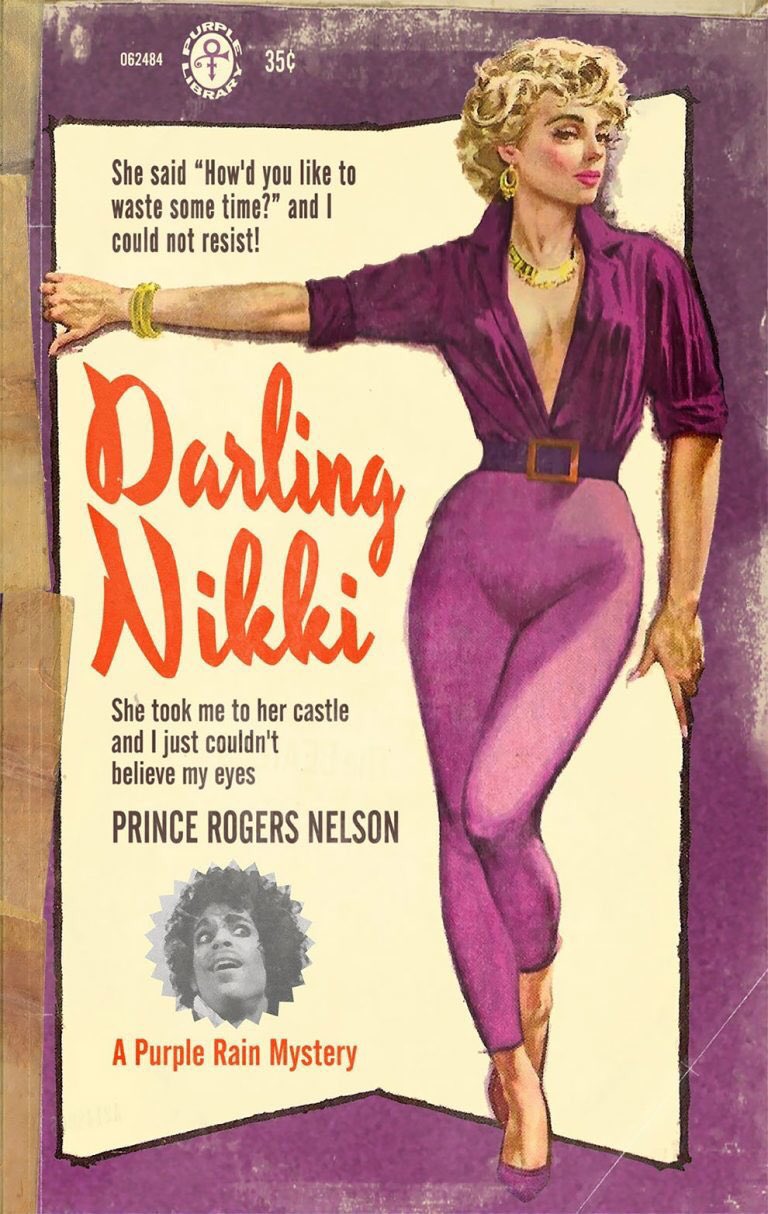
There’s a book-lined Knowledge Room in the late Prince Rogers Nelson’s Paisley Park, but the Prince-inspired faux-books that artist Todd Alcott imagines are probably better suited to the estate’s purple-lit Relaxation Room.
The Knowledge Room was conceived of as a library where the world’s most famous convert to Jehovah’s Witnesses could delve into religious literature, reflect on the meaning of life, and study the Bible deep into the night.
Alcott’s covers harken to an earlier stage in Prince’s evolution—one the star eventually disavowed—as well as several bygone eras of book design.
Lyrically, there’s no mistaking what Prince’s notorious 1984 “Darling Nikki” is about. There’s a direct line between it and the creation of parental advisory stickers for musical releases containing what is politely referred to as “mature content.”
Alcott’s 1950s pulp novel treatment, above, is similarly graphic. Those skintight purple curves are a promise that even purpler prose lays within, or would, were there any text couched behind that steamy cover.
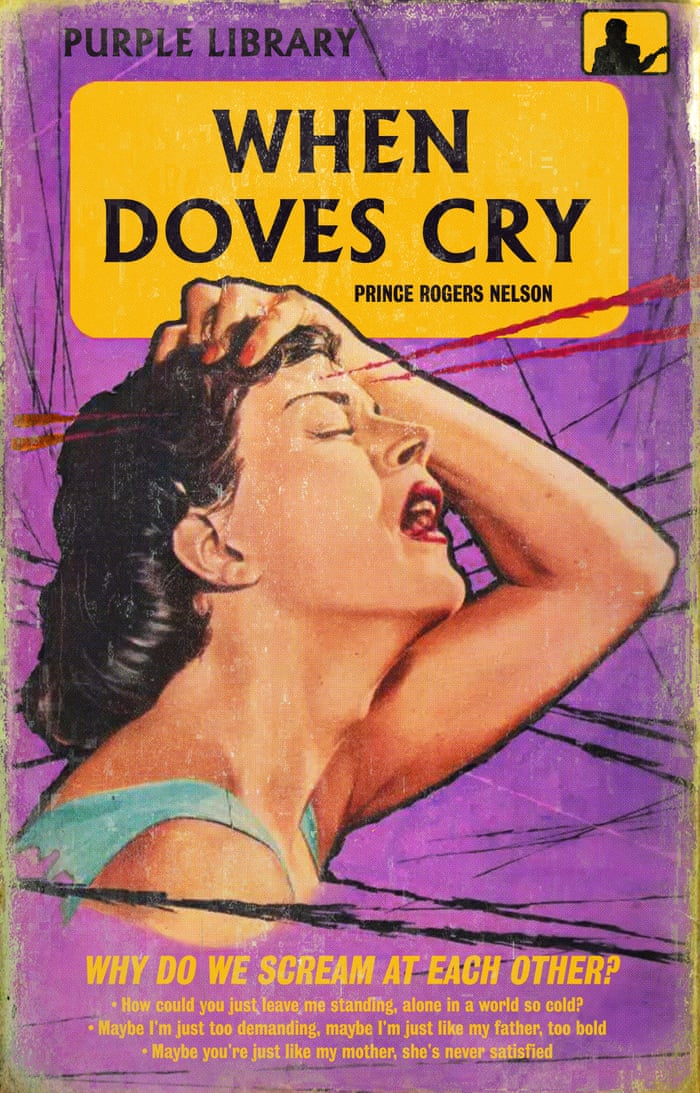
“When Doves Cry” makes for a pretty purple cover, too. In this case, the inspiration is a 1950s self-help book, enriched with some Freudian taglines from Prince’s own pen. (“Maybe you’re just like my mother, she’s never satisfied.”)
Alcott remembers Prince being “an incredibly liberating figure” when he burst onto the scene:
There was his flamboyant, outrageous sexuality, but also his musical omnivorousness; he played funk, rock, pop, jazz, everything. Purple Rain was the Sergeant Pepper’s of its day, a wall-to-wall brilliant album that everyone could recognize as a remarkable achievement. I remember when I first saw Purple Rain, at the very beginning of the movie, before the movie has even begun, the Warner Bros logo came up and you heard the sound of an expectant crowd, and an announcer says “Ladies and Gentlemen, The Revolution,” and the first shot is of Prince, backlit, silhouetted in purple against a dense mist, and he says “Dearly beloved, we have gathered here today to get through this thing called life.” And I was instantly, incontrovertibly, a fan for life. The confidence of that opening, the sheer audacity of it, adopting the tone of a priest at a wedding, in his Hendrix outfit and hairdo, the sheer gutsiness of that statement, alone, just blew me away. And then he proceeded to play “Let’s Go Crazy” which completely lived up to that opening. After that he could have run Buick ads for the rest of the movie and I’d still be a fan.
Decades later, I was sitting in a Subway restaurant at the end of a very, very long, tiring day, and was feeling completely exhausted and miserable, and out of nowhere, “When Doves Cry” came on the sound system. And I was reminded that the song, which was a huge hit in 1984, the song of the year, had no bass line. The arrangement of it made no sense. It was a song put together by force of will, with its metal guitar and its synth strings and its electronic drums. And in that moment, at the end of a long, tiring day, I was reminded that miracles are possible.
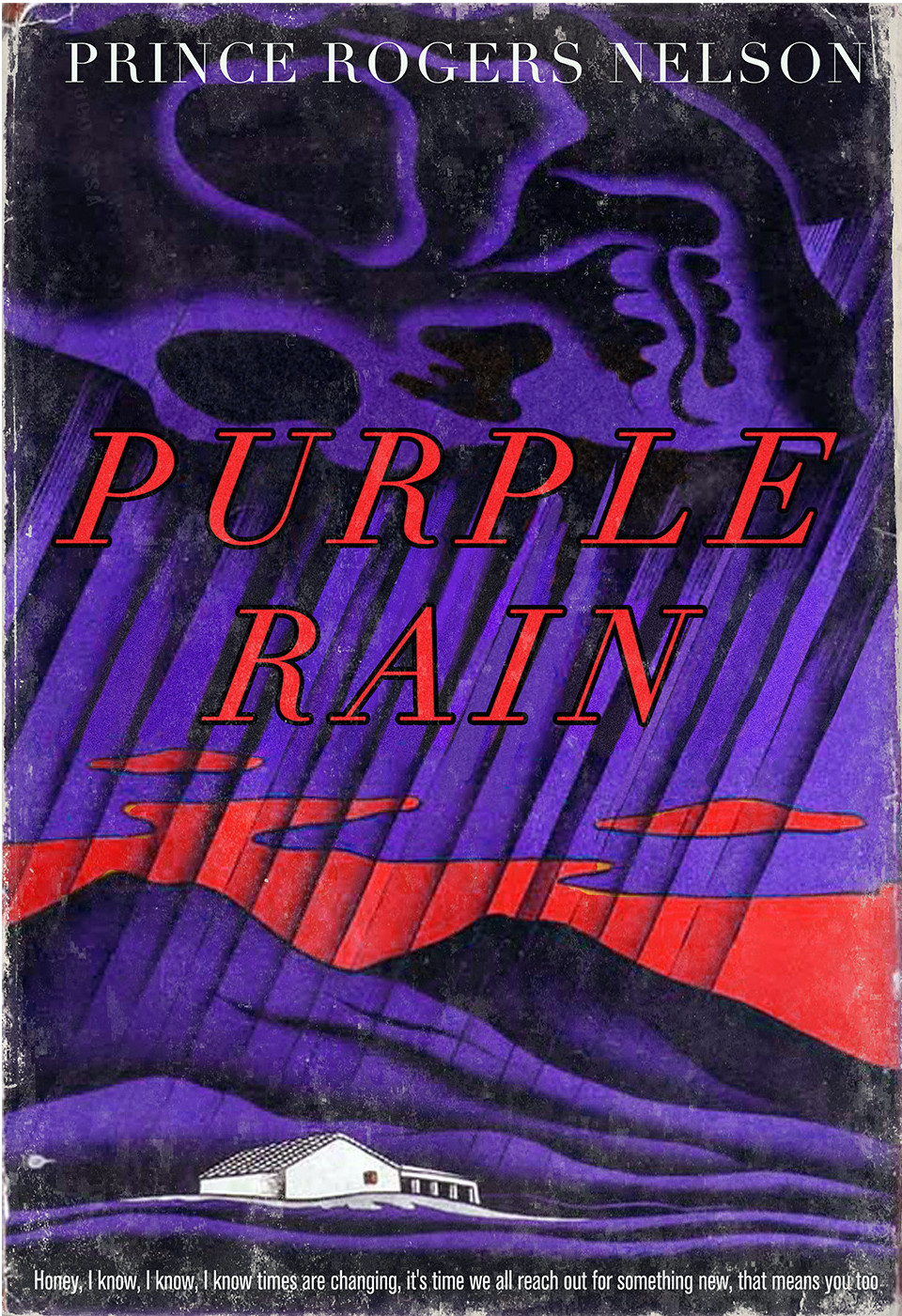
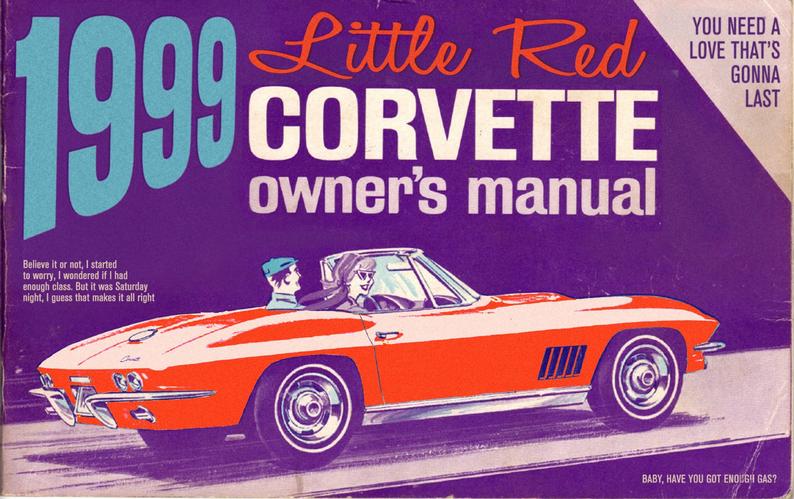
Alcott’s miraculous graphic transformations are rounded out with a comparatively understated 1930s murder mystery, Purple Rain and an ingenious Little Red Corvette owner’s manual dating to the mid-60s. Prints of Todd Alcott’s Prince-inspired paperback covers are available in his Etsy shop.
Related Content:
Ayun Halliday is an author, illustrator, theater maker and Chief Primatologist of the East Village Inky zine. Follow her @AyunHalliday.
Read More...Sounds of the Forest: A Free Audio Archive Gathers the Sounds of Forests from All Over the World

Some of my fondest memories are of hiking the Olympic National Forest in Washington State and the forests of the Shenandoah Valley in Virginia, seeking the kind of silence one can only find in busy ecosystems full of birds, insects, woodland creatures, rustling leaves, etc. This experience can be transformative, a full immersion in what acoustic ecologist Gordon Hempton calls a “natural acoustic system,” the endless interplay of calls and responses that evolved to harmonize over millennia.
Tragically, human noise pollution encroaches on the acoustic space of such refuges, and climate change may irrevocably alter their nature. But they will be preserved, in digital recordings at least, thanks in part to the efforts of a project called Sounds of the Forest, which has been documenting the pregnant silences of forests around the world and has so far collected audio files from six continents, with western Europe most heavily represented.
The Sounds of the Forest library, accessible via its interactive map or Soundcloud page, “will form an open source library,” the project announces, “to be used by anyone to listen to and create from.”
Nature lovers can contribute their own recordings, helping to fill in the many remaining areas on the map without representation. “Visit a woodland,” the project recommends, “recharge under the canopy and record your sounds of the forest.” The site gives specific instructions for how to upload audio file submissions.
Sounds of the Forest came out of the annual Timber Festival, an international gathering in the UK’s National Forest, which is the “boldest environmentally-led regeneration project: the creation of England’s first new forest in a thousand years… an imaginative and ambitious statement of sustainable development.” When the pandemic scuttled plans for an in-person 2020 Timber Festival, organizers conceived of the sound files as a way to bring the world together in a virtual forest gathering. They are also foraging material for next year’s fest, in which “selected artists will be responding to the sounds that are gathered, creating music, audio, artwork or something else incredible.”
If you can’t make it to Timber Festival 2021 next summer, or to your forest refuge of choice this autumn, you can still immerse yourself in the restorative sounds of forests worldwide. Open the sound map, click on a file, close your eyes, and imagine yourself in Nelson Lakes National Park in New Zealand, Yasuni National Park at night in Ecuador, or Chernyaevsky Forest in Russia. Experiencing the busy silences of nature brings us back to ourselves—or to the ancient parts of ourselves that once also harmonized with the natural world.
via Kottke
Related Content:
How to Find Silence in a Noisy World
Free: Download the Sublime Sights & Sounds of Yellowstone National Park
10 Hours of Ambient Arctic Sounds Will Help You Relax, Meditate, Study & Sleep
Josh Jones is a writer and musician based in Durham, NC. Follow him at @jdmagness
Read More...Watch Lime Kiln Club Field Day, One of the Earliest Surviving Feature Films with an All Black Cast (1913)
For some of us (no names) the world of TikTok is baffling and bizarre. Why does Gen Z flock to it? Who knows, but they do, in droves. Anyone can be a “creator” on what Jason Parham at Wired calls “the most exciting cultural product of this time.” It also happens to be a place where “digital blackface” has evolved—an online cultural phenomenon in which Black users of a platform get disproportionately censored while others who adopt the trappings of Black American culture, often in exaggerated, stereotypical ways, rack up followers and views.
21st century forms of blackface persist for all sorts of reasons. The intent may not be consciously to demean, but the effects are usually otherwise, especially given the long history of blackface as a way of mocking Black Americans, while forcing Black actors to themselves perform in blackface to gain an audience and get work. Minstrelsy performed by white stage actors, comedians, musicians, etc. set a tragically low bar for Black actors.
A once-prominent example comes from the career of performer Bert Williams. “Largely forgotten today,” Claudia Roth Pierpont writes at The New Yorker, Williams was “the first African-American star: the most famous ‘colored man’ in America during the early years of the twentieth century.” He performed at Buckingham Palace, was the only Black member of Ziegfeld Follies (and a headliner) and played “alongside Fanny Brice and Eddie Cantor—for nearly a decade.”
He did all of it in blackface, decades after the original Jim Crow character appeared in 1830. Born in 1874 in the Bahamas, says Caribbean novelist Caryl Phillips, Williams “was an outsider in all sorts of ways… He didn’t see himself to be fully a part of African American traditions, so in a sense he didn’t quite understand the full implications of the blackface performance. He saw it as part of his costume.” That may not necessarily be so. In his stage act, Williams and his partner resisted the practice for as long as they could, until they realized that they would be subject to constant violence from white audiences without it.
Blackface affectations helped Williams cross over into a film career. He “produced, wrote, directed and starred in two short films for Biograph,” the San Francisco Silent Film Festival notes, “A Natural Born Gambler (1916) and Fish (1916). Produced by a black man for white audiences, they were groundbreaking, however, these films featured characters and storylines that still satisfied dominant racist stereotypes of black men.”
In contrast, a third film, produced three years earlier, titled Lime Kiln Club Field Day, “one of a handful of surviving silent films with an all-black cast,” told a very different kind of story. Williams appeared in blackface, but the other actors did not. “The film … features one of the first examples of on-screen intimacy between a black man and a black woman—a kiss—along with scenes of middle class leisure; story elements that challenged the mostly negative, sometimes evil, depictions of blacks in the majority of white-produced films, which reached a distressing nadir in D.W. Griffith’s The Birth of a Nation, released two years later.”
Lime Kiln Club Field Day was never completed. Its many unedited reels of film were only recently rediscovered, a century later, in the archives at New York’s Museum of Modern Art. See the film above, restored by curator Ron Magliozzi and preservation officer Peter Williamson, who conducted research “over nearly a decade,” the MoMA writes, to decipher the plot of the film and recover its production history, even going so far as to employ a lip reader and explore Staten Island and New Jersey in search of locations.”
Film historians do not know why the project was abandoned. They do know that Williams suffered significantly for the racist caricatures he felt forced to perform. Read more about his extraordinary career at The New Yorker and learn more about the Lime Kiln Club Field Day restoration project at the San Francisco Silent Film Festival site.
Related Content:
Watch the Pioneering Films of Oscar Micheaux, America’s First Great African-American Filmmaker
Josh Jones is a writer and musician based in Durham, NC. Follow him at @jdmagness
Read More...Support Us
We're hoping to rely on loyal readers, rather than erratic ads. Please click the Donate button and support Open Culture. You can use Paypal, Venmo, Patreon, even Crypto! We thank you!

About Us

Open Culture scours the web for the best educational media. We find the free courses and audio books you need, the language lessons & educational videos you want, and plenty of enlightenment in between.
Advertise With Us
FREE UPDATES!
GET OUR DAILY EMAIL
Get the best cultural and educational resources on the web curated for you in a daily email. We never spam. Unsubscribe at any time.
FOLLOW ON SOCIAL MEDIA
Open Culture editor Dan Colman scours the web for the best educational media. He finds the free courses and audio books you need, the language lessons & movies you want, and plenty of enlightenment in between.
Advertise With Us


.jpg)
