Foreign Exchange Students Debate Whether American Teenagers Have Too Much Freedom (1954)
The teenager was invented in the 1950s. Of course, the stages of physical development that characterize those years taking us from childhood to adulthood haven’t fundamentally changed as long as Homo sapiens has existed. But even though there were “teenagers” in, say, ancient Rome, they weren’t teenagers as we’ve known them over the past three or four generations. It happened amid the economic growth of the years after World War II, first in the United Kingdom and even more so the United States: adolescents, especially high-school students, turned from mere immature adults into a distinct demographic group with its own tastes, politics, spaces, mobility, and culture.
Before teenagers invaded the rest of the world, they must have struck visitors to America as by turns thrilling and troubling. So it was with the students in the video above, who came to the U.S. in 1955 — the year of Rebel Without a Cause — as participants in the New York Herald Tribune’s World Youth Forum.
This filmed discussion on the curious phenomenon of the American teenager features Minji Karibo of Nigeria, Nasreen Ahmad of Pakistan, Paik Nak-chung of South Korea, and Ava Leitenan of Finland, all of whom had just spent a few months visiting American schools. Leitenan begins on a positive note: “I didn’t know there would be so much smile,” she says. “I can just feel the friendliness flow against me.”
But as many a first-time traveler in America has discovered, that characteristic (and sometimes overwhelming) friendliness masks a more complex realty. Karibo criticizes American girls who “think it’s fashionable to tell lies about going on dates during weekends, when as a matter of fact they sat at home all the time.” After reminding everyone that “you cannot judge the amount of freedom the American children have by your standard,” Paik admits that “I see such an informality between the ages and between the sexes, I get rather shocked, but the fact that it is shocking does not necessarily mean it is not good for them.”
None of these exchange-student panelists shows more skepticism about America than Ahmad, whose glimpses of dating and education there have confirmed her preference for arranged marriage and sex-segregated schools. Maybe it works for American teenagers, but “if we were given suddenly this amount of freedom,” she says, “I’m afraid you would get fearful consequences.” However much the four disagree about the benefits and dangers of that freedom, they all seem to believe that Americans could stand to reflect on how to make better use of it than they do. “I think it is a lack of intellectual capacity to use their freedom properly,” says the young Paik, trying delicately to pin down the problem with American life.
After the World Youth Forum, Paik traveled the world before finishing high school in Korea. He would then return to the U.S. to study at Brown University before starting his career as a literary critic and public intellectual in his homeland. In 2018 he gave a speech at the University of Chicago on Korea’s “Candlelight Revolution,” and this past summer he published a new book on D.H. Lawrence, which Korean-speakers can hear him interviewed about here. He’s one of the success stories among the many participants in the World Youth Forum, more of whose 1950s discussions — on race, on social relations, the Middle-East conflict — you can watch on this Youtube playlist. 65 years later, no matter our age or nationality, we all have something of the American teenager about us. Whether that’s good or bad remains a matter for debate.
Related Content:
What Life Was Like for Teenagers in Ancient Rome: Get a Glimpse from a TED-ED Animation
Nigerian Teenagers Are Making Slick Sci Fi Films With Their Smartphones
In Japanese Schools, Lunch Is As Much About Learning As It’s About Eating
Based in Seoul, Colin Marshall writes and broadcasts on cities, language, and culture. His projects include the Substack newsletter Books on Cities, the book The Stateless City: a Walk through 21st-Century Los Angeles and the video series The City in Cinema. Follow him on Twitter at @colinmarshall, on Facebook, or on Instagram.
Read More...Why Do People Join Cults? An Animated Primer Explains
As much as we might like to think we make free choices as rational individuals, we are all more or less suggestible and subject to social pressures. Social media marketers aren’t under any illusions about this. Guides for how to exploit psychological vulnerabilities and influence behavior proliferate. (One of the top-selling business books on Amazon is a manual titled Influence: The Psychology of Persuasion.) Such techniques form the basis of a massive, global ad-based industry that also happens to traffic in political propaganda and disinformation. None of this would be as wildly profitable and effective as it is if human beings could easily resist manipulation.
But there are degrees of influence and susceptibility. Not everyone who makes an easy mark for advertisers, for example, is liable to join a cult or an extremist group. What makes people subject to the inducements of a cult leader? What makes them—in the clichéd phrase callously drawn from the mass suicide at Jonestown—“drink the Kool-Aid”? The TED-Ed video above, scripted by cult expert Dr. Janja Lalich, professor emerita of Sociology at California State University, Chico, begins with some basic qualifications.
Not all cults are religious: some are political, therapy-based, focused on self-improvement, or otherwise.
Not all new religions are cults.
Lalich defines a cult as a “group or movement with a usually extreme ideology, typically embodied in a charismatic leader…. Most cults share some basic characteristics,” such as a “high-level of commitment from its members,” a strict hierarchy, and “claims to provide answers to life’s biggest questions.” Cults have little tolerance for dissent from either the inside or outside.
The distinctions between cults and religions can seem slight, but cults separate their members from the larger society and seek direct and total control over their lives, while most mainstream religions (which may have begun as cults) do not. Religions may proselytize, but cults use methods more akin to pyramid schemes to pressure recruits into personally identifying with the ideology and spreading it. By exploiting our desires for connection, comfort, meaning, and belonging, they create what the DSM‑V terms “identity disturbance due to prolonged and intense coercive persuasion.”
Cults “discourage critical thinking, making it hard to voice doubts when everyone around you is modeling absolute faith.” New recruits experience painful cognitive dissonance that, over time, they try to overcome by strengthening their devotion. The sense of sunk cost makes it increasingly hard for them to admit they have been lied to, manipulated, and used. Cults stunt their members’ “psychological and emotional growth,” which is “a particular problem for children” who are born or indoctrinated into them. Belief, Lalich’s lesson states, should not force a person to sacrifice their family, friends, personal morality, and money to an authoritarian leader.
Lalich herself understands cults not only as an academic researcher but as a former member of a political cult in which, she says, “you weren’t allowed to think for yourself at the same time as you were told to think for yourself.” Which brings us to the burning question that has been asked so many times over the past four years. Does the absolute, unwavering devotion to the current president constitute cult-like behavior? Is “Trumpism” a cult? An open letter on Lalich’s Cult Research site, signed by a number of prominent psychologists, psychiatrists, and other experts, advises, “We should look to the evidence, and there is evidence aplenty.”
Related Content:
Isaac Asimov Laments the “Cult of Ignorance” in the United States (1980)
Umberto Eco Makes a List of the 14 Common Features of Fascism
Josh Jones is a writer and musician based in Durham, NC. Follow him at @jdmagness
Read More...Jazz Typefaces Capture the Essence of 100 Iconic Jazz Musicians
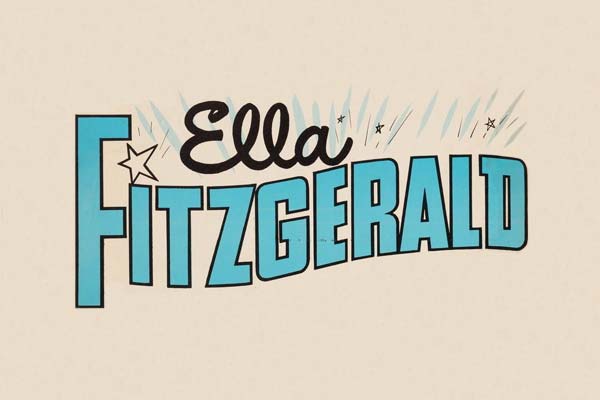
In the 1950s and 60s, one record label stood “like a beacon,” writes Robin Kinross at Eye, among a host of Civil Rights era independents that helped jazz “escape the racial-commercial constraints applied by White Americans, and find its own place, unpatronised and relatively free of exploitation.” That label, Blue Note, ushered in the birth of the cool—both cool jazz and its many hip signifiers—as much through graphic design as through its meticulous approach to recording.
Blue Note album covers may seem principally distinguished by the photography of Francis Wolff, whose instincts behind the camera produced visual icon after icon. But the label’s style depended on the layout, graphic design, and lettering of Reid Miles, who drew on minimalist Swiss trends in “over 500 album covers for Blue Note Records,” designer Reagan Ray writes. “He pioneered the use of creatively-arranged type over monochromatic photography, which is a style that is still widely used in graphic design today.”
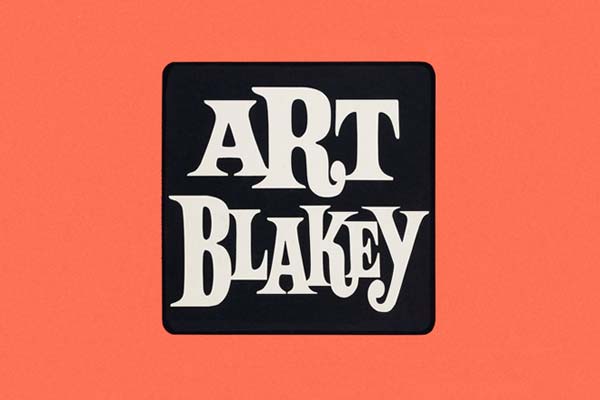
As we noted in a recent post on Blue Note’s legendary design team, Reid’s lettering sometimes edged the photography to the margins, or off the cover altogether. Jazz greats were given the freedom to create the music they wanted, but it was the designers who had to sell their creativity to the public in a visual language.
They had done so with distinctive typefaces before Reid, of course. But the art of lettering became far more interesting through his influence, both more playful and more refined at the same time.
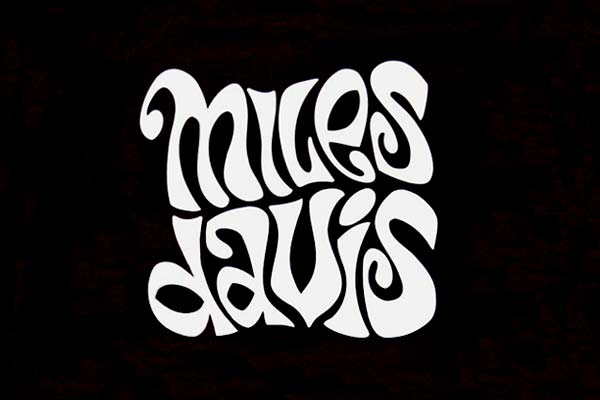
Since typeface has always played a significant role in the music’s commercial success, Ray decided to compile several hundred samplings of album lettering of jazz musician’s names, “for easy browsing and analysis” of typeface as an essential element all on its own. The gallery may attempt “to cover most of the genre’s significant musicians,” but there are, Ray admits, many inevitable omissions.
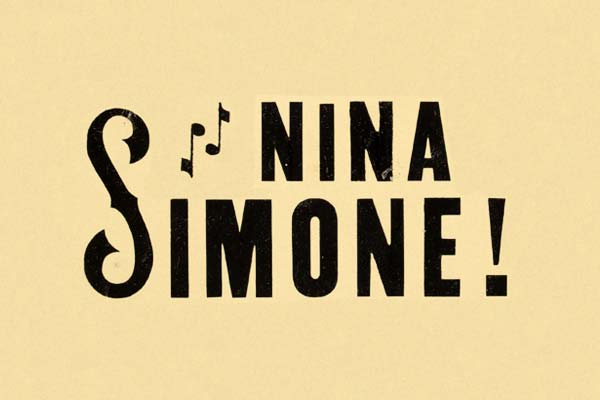
Nonetheless, it’s a formidable visual record of the various looks of jazz in lettering, and the visual identities of its biggest artists over the course of several decades. Ray does not name any of the designers, which is frustrating, but those in the know will recognize the work of Reid and others like album cover pioneer Alex Steinweiss. You may well spot lettering by Milton Glaser, whom Ray previously covered in a huge curated gallery of the famous designer’s album art.
The names behind the big names matter, but it’s the musicians themselves these individualized typefaces are meant to immediately evoke. Consider just how well most all of these examples do just that—representing each artist’s music, period, and image with the perfect font and graphic arrangement, each one a unique logo. Somewhat like the music it represents, Ray’s gallery is, itself, a collective tour-de-force performance of visual jazz.
Visit Ray’s gallery here.
Related Content:
Classic Jazz Album Covers Animated & Brought to Life
The Groundbreaking Art of Alex Steinweiss, Father of Record Cover Design
Josh Jones is a writer and musician based in Durham, NC. Follow him at @jdmagness
Read More...Dear Facebook, This is How You’re Breaking Democracy: A Former Facebook Insider Explains How the Platform’s Algorithms Polarize Our Society
Is this what we want? A post-truth world where toxicity and tribalism trump bridge building and consensus seeking? —Yaël Eisenstat
It’s an increasingly familiar occurrence.
A friend you’ve enjoyed reconnecting with in the digital realm makes a dramatic announcement on their social media page. They’re deleting their Facebook account within the next 24 hours, so shoot them a PM with your email if you’d like to stay in touch.
Such decisions used to be spurred by the desire to get more done or return to neglected pastimes such as reading, painting, and going for long unconnected nature walks.
These announcements could induce equal parts guilt and anxiety in those of us who depend on social media to get the word out about our low-budget creative projects, though being prone to Internet addiction, we were nearly as likely to be the one making the announcement.
For many, the break was temporary. More of a social media fast, a chance to reevaluate, rest, recharge, and ultimately return.
Legitimate concerns were also raised with regard to privacy. Who’s on the receiving end of all the sensitive information we’re offering up? What are they doing with it? Is someone listening in?
But in this election year, the decision to quit Facebook is apt to be driven by the very real fear that democracy as we know it is at stake.
Former CIA analyst, foreign service officer, and—for six months—Facebook’s Global Head of Elections Integrity Ops for political advertising, Yaël Eisenstat, addresses these preoccupations in her TED Talk, “Dear Facebook, This is How You’re Breaking Democracy,” above.
Eisenstat contrasts the civility of her past face-to-face ”hearts and minds”-based engagements with suspected terrorists and anti-Western clerics to the polarization and culture of hatred that Facebook’s algorithms foment.
As many users have come to suspect, Facebook rewards inflammatory content with amplification. Truth does not factor into the equation, nor does sincerity of message or messenger.
Lies are more engaging online than truth. As long as [social media] algorithms’ goals are to keep us engaged, they will feed us the poison that plays to our worst instincts and human weaknesses.
Eisenstat, who has valued the ease with which Facebook allows her to maintain relationships with far-flung friends, found herself effectively demoted on her second day at the social media giant, her title revised, and her access to high level meetings revoked. Her hiring appears to have been purely ornamental, a palliative ruse in response to mounting public concern.
As she remarked in an interview with The Guardian’s Ian Tucker earlier this summer:
They are making all sorts of reactive changes around the margins of the issues, [to suggest] that they are taking things seriously – such as building an ad library or verifying that political advertisers reside in the country in which they advertising – things they should have been doing already. But they were never going to make the fundamental changes that address the key systemic issues that make Facebook ripe for manipulation, viral misinformation and other ways that the platform can be used to affect democracy.
In the same interview she asserted that Facebook’s recently implemented oversight board is little more than an interesting theory that will never result in the total overhaul of its business model:
First of all, it’s another example of Facebook putting responsibility on someone else. The oversight board does not have any authority to actually address any of the policies that Facebook writes and enforces, or the underlying systemic issues that make the platform absolutely rife for disinformation and all sorts of bad behaviour and manipulation.
The second issue is: it’s basically an appeal process for content that was already taken down. The bigger question is the content that remains up. Third, they are not even going to be operational until late fall and, for a company that claims to move fast and break things, that’s absurd.
Nine minutes into her TED Talk, she offers concrete suggestions for things the Facebook brass could do if it was truly serious about implementing reform:
- Stop amplifying and recommending disinformation and bias-based hatred, no matter who is behind it—from conspiracy theorists to our current president.
- Discontinue personalization techniques that don’t differentiate between targeted political content and targeted ads for athletic footwear.
- Retrain algorithms to focus on a metrics beyond what users click or linger on.
- Implement safety features that would ensure that sensitive content is reviewed before it is allowed to go viral.
Hopefully viewers are not feeling maxed out on contacting their representatives, as government enforcement is Eisenstat’s only prescription for getting Facebook to alter its product and profit model. And that will require sustained civic engagement.
She supplements her TED Talk with recommendations for artificial intelligence engineer Guillaume Chaslot’s insider perspective op-ed “The Toxic Potential of YouTube’s Feedback Loop” and The Filter Bubble: How the New Personalized Web Is Changing What We Read and How We Think by MoveOn.org’s former Executive Director, Eli Pariser.
Your clued-in Facebook friends have no doubt already pointed you to the documentary The Social Dilemma, which is now available on Netflix. Or perhaps to Jaron Lanier’s Ten Arguments for Deleting Your Social Media Accounts Right Now.
Read the transcript of Yaël Eisenstat’s TED Talk here.
Related Content:
The Problem with Facebook: “It’s Keeping Things From You”
Ayun Halliday is an author, illustrator, theater maker and Chief Primatologist of the East Village Inky zine. Follow her @AyunHalliday.
Read More...The Grateful Dead Movie: Watch It Free Online
The Grateful Dead Movie documents “a tour-ending five night stand at the Winterland Ballroom in October 1974. These were their last shows with the Wall of Sound, and the film includes amazing performances of many favorites like One More Saturday Night, Goin’ Down The Road Feelin’ Bad, Truckin’, Sugar Magnolia/Sunshine Daydream, Stella Blue, Casey Jones, and Morning Dew.”
Enjoy it online, rather than having to drop $90 for a DVD. The Grateful Dead Movie will be added to our list of Free Documentaries, a subset of our collection, 4,000+ Free Movies Online: Great Classics, Indies, Noir, Westerns, Documentaries & More.
If you would like to support the mission of Open Culture, consider making a donation to our site. It’s hard to rely 100% on ads, and your contributions will help us continue providing the best free cultural and educational materials to learners everywhere. You can contribute through PayPal, Patreon, and Venmo (@openculture). Thanks!
Related Content:
The Grateful Dead’s “Ripple” Played by Musicians Around the World
10,173 Free Grateful Dead Concert Recordings in the Internet Archive
Read More...GPS Tracking Reveals the Secret Lives of Outdoor Cats
We track sharks, rhino, and bears, so why not Boo Boo Kitty, Peanut, and Pumpkin?
The Long Island feline residents volunteered—or more accurately, were volunteered—by their human companions to participate in a domestic cat movement study as part of the international Cat Tracker project.
Each beast was outfitted with a GPS tracker-enhanced harness, which they wore for a week.
(Many cat owners will find that alone something of an achievement.)
In total, almost a thousand households in four countries took part—the United States, New Zealand, Australia, and the UK.
Scientists were particularly interested to learn the degree of mayhem these cherished pets were visiting on surrounding wildlife in their off hours.
Anyone who’s been left a present of a freshly murdered baby bunny, mole, or wingless bat can probably guess.
It’s a considerable amount, though by and large the domesticated participants stuck close to home, rarely traveling more than two football fields away from the comforts of their own yards. The impulse to keep the food bowl within easy range confines their hunting activities to a fairly tight area. Woe to the field mice who set up shop there.



Their movements also revealed the peril they put themselves in, crossing highways, roads, and parking lots. Researcher Heidy Kikillus, who tracked cats in New Zealand, reported that a number of her group’s subjects wound up in a fatal encounter with a vehicle.
Generally speaking, gender, age, and geography play a part in how far a cat roams, with males, younger animals, and country dwellers covering more ground. Unsurprisingly, those who have not been neutered or spayed tend to have a freer range too.
“Without the motivations of food and sex, most cats seem content to be homebodies,” zoologist Roland Kays, one of the US Project leaders, noted.
American citizen scientists who’d like to enroll their cat can find information and the necessary forms on the Cat Tracker website.
The cat-less and those with indoor cats can enjoy photos of select participants and explore their tracks here.
And what better fall craft than a DIY cat tracking GPS harness?
Related Content:
In 1183, a Chinese Poet Describes Being Domesticated by His Own Cats
How Humans Domesticated Cats (Twice)
Ayun Halliday is an author, illustrator, theater maker and Chief Primatologist of the East Village Inky zine. Follow her @AyunHalliday.
Read More...Chris Frantz Breaks Down How He Crafted Songs for Talking Heads & Tom Tom Club: A Nakedly Examined Music Interview

Chris founded Talking Heads in the early ’70s with his wife Tina Weymouth and David Byrne, and he focuses heavily on these early years of his career in his new memoir Remain in Love, describing it as very much a group effort, even though they intentionally put the spotlight on David, who in turn pretty early on announced that he had to write all the lyrics, that he couldn’t sing other people’s songs.
On the Nakedly Examined Music Podcast, Mark Linsenmayer interviews songwriters about their creative decision-making, and in this interview, Chris tells how he and Tina and David collaborated on lyrics for their early single “Psycho Killer,” and then how Chris’ lyrics were used for “Warning Sign,” a song (played in full as part of the podcast) that appeared on the Heads’ second album, 1978’s More Songs About Buildings and Food.
Also surprising is that Chris and Tina’s spin-off band, Tom Tom Club, formed in an interval when both David and the Heads’ lead guitarist Jerry Harrison wanted to pause Talking Heads to record solo albums, actually had its best-selling single, “Genius of Love,” prior to the Talking Heads real financial success with hits like “Burning Down the House” and “And She Was.”
The interview includes a detailed treatment of the composition and arrangement of two Tom Tom Club songs that are also played in full: “Bamboo Town,” a reggae-inspired track from their second album Close to the Bone (1983); and “Who Feelin’ It,” a dance track replete with record scratch percussion from The Good the Bad and the Funky (2000). This song was later remixed by The interview concludes with a song that Chris sings: the title track from Tom Tom Club’s most recent release, Downtown Rockers (2012).
Both these last two tracks have as their main lyrics lists of artists that Chris and Tina wanted to pay tribute to, both in influencing their musical sensibilities and/or playing shows with them at CBGB’s during their formative years as Talking Heads in New York City. Chris’ book gives us a vivid glimpse of that scene, as well as the excitement of their first album, working with Brian Eno, their first European tour, and other milestones all the way up to their induction into the Rock and Roll Hall of Fame in 2002, which was their first time playing together since the group’s split in 1991.
For more Nakedly Examined Music in-depth interviews about songwriting, arrangement, and the musical life, visit nakedlyexaminedmusic.com.
Mark Linsenmayer is also the host of The Partially Examined Life Philosophy Podcast and Pretty Much Pop: A Culture Podcast. He releases music under the name Mark Lint.
Read More...
What Would the World of Charlie Chaplin Look Like in Color?: Watch a Colorfully Restored Version of A Night at the Show (1915)
When we imagine Charlie Chaplin, we imagine a man somehow existing in black-and-white. The obvious reason is that he became not just a movie star but a cultural icon in the 1910s and 20s, the era before sound came to the movies, let alone color. But to attain such success required skills tailored to the state of the medium at the time: that of making people laugh without saying a word, of course, but also of crafting an image instantly recognizable in monochrome. Thus we don’t always feel we’re seeing the “real” Charlie Chaplin in technically more realistic color photographs, or even colorized ones. But what would it feel like to watch one of his classic comedies in color?
You can find out by watching the colorized version of A Night in the Show above. Originally released in 1915, the 25-minute short was directed by and stars Chaplin, who plays the dual role of characters called Mr. Pest and Mr. Rowdy. Both attend the same music-hall performance, and though Mr. Pest is of the upper crust and Mr. Rowdy is a working man, both get equally inebriated, their disparate social classes producing different styles of mischief-making.
The English-born Chaplin had previously developed these characters on stage, having played the music-hall circuit himself since adolescence. Safe to say that, by the time Hollywood came calling, he’d seen far worse than Pest and Rowdy himself.
The quality of this colorization will perhaps not win the controversial process any new converts, but it does give us a sense of what an evening at an English music hall of the late 19th and early 20th century would actually have looked like, a valuable re-creation now that none of us have memories of this once-common experience. We can more easily imagine the kind of spectacles such establishments would have offered, including but not limited to snake-charming and bursts of fire, as well as its ramshackle exaggerations that Chaplin so energetically satirizes. We could also consider this his valediction to that environment: the previous year’s-introduced the Tramp, who would go on to become his most beloved character of all, ensured that he would soon be able to put the music hall behind him forever.
Related Content:
60+ Free Charlie Chaplin Films Online
Colorized Photos Bring Walt Whitman, Charlie Chaplin, Helen Keller & Mark Twain Back to Life
Charlie Chaplin Films a Scene Inside a Lion’s Cage in 200 Takes
Charlie Chaplin Does Cocaine and Saves the Day in Modern Times (1936)
Based in Seoul, Colin Marshall writes and broadcasts on cities, language, and culture. His projects include the Substack newsletter Books on Cities, the book The Stateless City: a Walk through 21st-Century Los Angeles and the video series The City in Cinema. Follow him on Twitter at @colinmarshall, on Facebook, or on Instagram.
Read More...Ella Fitzgerald Imitates Louis Armstrong’s Gravelly Voice While Singing “I Can’t Give You Anything But Love, Baby”
Are great artists born, or are they made? Probably a little of both, but I suspect that deep down, even if we don’t like to admit it, we know it’s probably a little more the former. We can become skilled at most anything with dedication and hard work. Talent is another matter—a mysterious combination of qualities we know when we hear but can’t always define. Ella Fitzgerald had it when she first stepped on stage on amateur night at Harlem’s Apollo Theater as a teenager, intending to do a tap dance routine.
She’d only done the performance on a dare, had no formal training outside of singing in church, her bedroom, and the Harlem streets, and she only chose to sing that night because the act before her did a tap dance and stole her thunder.
She blew the audience away—a tough New York crowd not known for being forgiving—and rendered even the boisterous teenagers in the balcony speechless. “Three encores later,” she wrote, “the $25 prize was mine.” Fitzgerald’s golden, three-octave voice, impeccable timing, and improvisational brilliance are not exactly the kinds of things that can be taught.
She didn’t look the part of the typical female jazz singer, at least according to popular perception, writes Holly Gleason at NPR. “A large woman who’d grown up rough,” including time spent in a New York State reformatory, she was rejected by bandleaders even after that first, revelatory performance, and the press frequently referred to her in terms that disparaged her appearance. “Fitzgerald recognized she didn’t possess Billie Holiday’s torchy allure,” Holly Gleason writes, or “Eartha Kitt’s feral sensuality or Carmen McRae’s sex appeal. But that would not stop the woman who took her vocal cues from the horns, as well as from jazz singer Connee Boswell.”
It didn’t stop her from winning a Grammy in the Grammy’s first year, or having a record label, Verve, founded just to put out her music. Ella’s range and pitch-perfect ear meant she could imitate not only the horn section or her favorite singer Boswell but just about anyone else as well, from popular jazz singer Rose Murphy, with her high, cartoonish voice, “chee chee” affectations, and “brrrp” telephone sound effects, to the low, gravelly rasp of Fitzgerald’s longtime duet partner Louis Armstrong. See her do exactly that in the clip at the top, moving effortlessly in “I Can’t Give You Anything but Love, Baby” from her own voice, to Murphy’s, to Armstrong’s in the space of just a few minutes.
Whatever obstacles Fitzgerald faced, her voice seemed to soar above it all. In becoming a global jazz star and “The First Lady of Song,” says jazz writer Will Friedwald, “she showed people that this is music Americans should be proud of.”
via Ben Phillips
Related Content:
Ella Fitzgerald Sings ‘Summertime’ by George Gershwin, Berlin 1968
How Marilyn Monroe Helped Break Ella Fitzgerald Into the Big Time (1955)
Josh Jones is a writer and musician based in Durham, NC. Follow him at @jdmagness
Read More...When R.E.M.‘s Michael Stipe Created the Lyrics for “The Voice of Harold” by Riffing on the Liner Notes of an Old Gospel Album (1983)
R.E.M. is one of those bands that just thinking about can send me into a reverie of memories of the rooms of friends with whom I listened to “Pretty Persuasion,” “Rockville,” and the poetry of “7 Chinese Bros.”—one of Michael Stipe’s early, incomprehensible songs, like “Swan Swan H,” whose cryptic lyrics one must seemingly take on faith. The song must mean something, after all, to Stipe. Maybe the mystery of who, exactly, the “seven Chinese brothers swallowing the ocean” were to him would be revealed someday in an interview or stray reference in a biography….
Now that we live in an age of instant information gratification, we can skip the years of wonder and find the answer right away: the song was partly inspired, we learn at Songfacts, by a 1938 children’s book called The Five Chinese Brothers, based on a traditional folk tale of young brothers with supernatural powers. (It’s also partly a tribute to photographer Carol Levy, a friend who died in a car crash before the recording of Reckoning.) Needing another syllable, maybe, Stipe changed the number to seven, an oddly prophetic move given that a new version of the story, published ten years later, also featured seven brothers.
The reference shows how many great songwriters work: picking at bits and pieces from their memories and whatever captivating text happens to be laying around…. And Stipe is one of those singers, like Elton John, who can sell any line, no matter how obscure or absurd.
In early songs, especially, he showed an uncanny ability to invest incantatory combinations of words with haunting pathos and urgency. He could sing from the phone book or the back of a cereal box and make it compelling. In fact, the story of “7 Chinese Bros.” involves an almost similar feat in the form of “Voice of Harold,” familiar to fans as the B‑side to “So. Central Rain” and part of the 1987 odds and ends collection Dead Letter Office. What possible explanation could there be for these non sequitur gospel lyrics, sung to the tune of… “7 Chinese Bros.”?
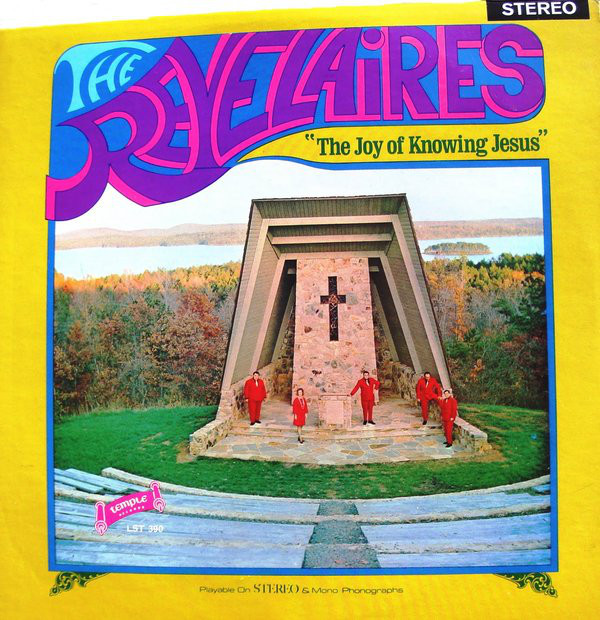
Was Stipe a secret Evangelist, hoping to win converts by extolling “the pure tenor quality of the voice of Harold Montgomery”? More teasingly vague themes emerge, along with references to figures like the Reverend Bill Funderburk, Charles Surratt, John Barbee, and Rhonda Montgomery (“That’s Rhonda! An artist!”). Instead of “Seven Chinese brothers swallowing the ocean,” the chorus introduces us to “The Revelaires, A must / The Revelaires / A must.” If you’re one of those who heard this song and thought, “What…?”, you can wonder no more.
The explanation comes to us from a 2009 interview producer Don Dixon gave to Uncut magazine. (For some reason, Dixon refers to “7 Chinese Bros.” as “7 Chinese Blues,” never a title of the song). The story begins with Stipe feeling down in the dumps in a stairwell outfitted as a lounge for him in the studio.
We were working on the vocal for “7 Chinese Blues,” but Michael just wasn’t into it. He was down in his stairwell. I hit the talk-back to let him know I was coming through to make an adjustment… This was just an excuse to take a look at him, see if I could loosen him up a little. While I was in the attic, I’d noticed a stack of old records that had been taken up there to die, local R&B and gospel stuff mostly. I grabbed the one off the top (a gospel record entitled The Joy of Knowing Jesus by the Revelaires) and as I passed Michael on the way to the Control Room, I tossed it down to him. I thought he might be amused. When I fired up the tape a few seconds later, Michael was singing, but not the lyrics to “7 Chinese Blues.” He was singing the liner notes to the LP I’d tossed him. When Michael began to sing these liner notes, he was much louder than he’d been earlier and it took a few seconds for me to realise what was going on and adjust the levels. He made it all the way through the song, working in every word on the back of that album! I rewound the tape, we had a chuckle and proceeded to sing the beautiful one-take vocal of the real words that you hear on Reckoning. He seemed more confident after that day.
Stipe didn’t just sing the words from the back of the album, he improvised cut-ups as he went, re-arranging phrases to fit the meter of the original song. “Voice of Harold” became a fan favorite for much the same reason as “7 Chinese Bros.” and “Swan Swan H”—it seemed to hide a mystery in plain view, its impassioned delivery at odds with its nonsensical narrative. Released after Reckoning, it turns a spontaneous motivational tool during the making of the album into a creation all its own.
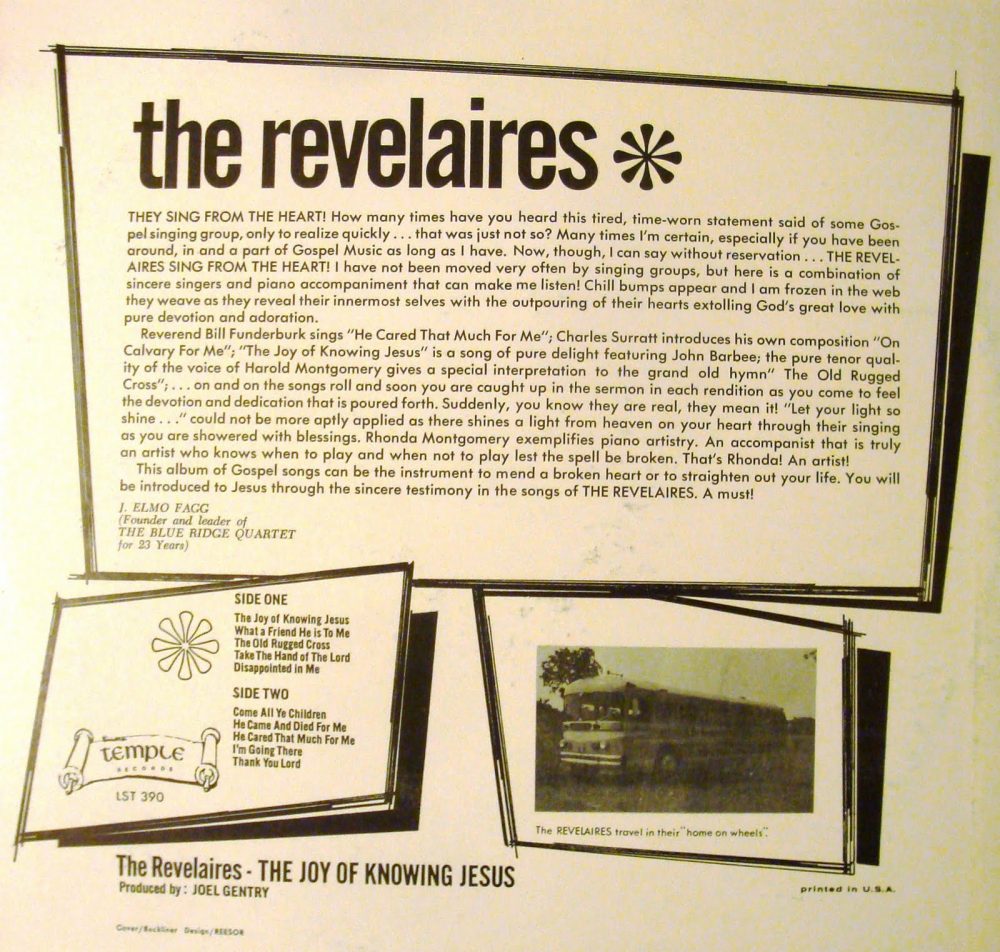
Jim Connelly explores the relationship between “7 Chinese Bros.” and “Voice of Harold” even further in a post at Medialoper, pointing to the firm conviction that’s so “chill-inducing” in the latter (and that comes through in the former recording, made immediately afterward). They may be found words, serendipitously picked up and put together on the spot, but in Stipe’s voice we can tell that “He’s real. He means it,” whatever the hell it is. See a video of “Voice of Harold” with lyrics, at the top, and follow along with the liner notes on the back of Revelaires’ gospel album The Joy of Knowing Jesus just above.
Related Content:
“It’s the End of the World as We Know It,” Michael Stipe Proclaims Again, and He Still Feels Fine
Why R.E.M.’s 1991 Out of Time May Be the “Most Politically Important Album” Ever
R.E.M.’s “Losing My Religion” Reworked from Minor to Major Scale
Josh Jones is a writer and musician based in Durham, NC. Follow him at @jdmagness
Read More...Support Us
We're hoping to rely on loyal readers, rather than erratic ads. Please click the Donate button and support Open Culture. You can use Paypal, Venmo, Patreon, even Crypto! We thank you!

About Us

Open Culture scours the web for the best educational media. We find the free courses and audio books you need, the language lessons & educational videos you want, and plenty of enlightenment in between.
Advertise With Us
FREE UPDATES!
GET OUR DAILY EMAIL
Get the best cultural and educational resources on the web curated for you in a daily email. We never spam. Unsubscribe at any time.
FOLLOW ON SOCIAL MEDIA
Open Culture editor Dan Colman scours the web for the best educational media. He finds the free courses and audio books you need, the language lessons & movies you want, and plenty of enlightenment in between.
Advertise With Us

