Watch Ridley Scott’s Controversial Nissan Sports Car Ad That Aired Only Once, During the Super Bowl (1990)
Every commercial is a fantasy, but car commercials are more fantastical than most. Just look at the settings, with their roads, whether remote or urban, completely empty of not just other cars but obstacles of any kind: stop signs, street-crossers, speed traps. This leaves the heroic everyman behind the wheel free to take on the straightaways and curves alike just as he sees fit. But what the standard car commercial offers in driver wish fulfillment, it lacks in drama: how to tell a story, after all, about a featureless character who faces no obstacles, subject to no desires beyond those for comfort and speed? Commissioned to direct a commercial for Nissan’s 300ZX Turbo, Ridley Scott found a way.
“I’m in a Turbo Z,” says the narrator of the resulting spot “Turbo Dream,” first broadcast during Super Bowl XXIV in 1990. “These guys are after me, but they can’t catch me.” These mysterious pursuers first chase him on motorcycles, then in an F1 race car, and then in an experimental-looking jet. (We’re a long way indeed from Hovis bread.)
But “just as they’re about to catch me, the twin turbos kick in.” Those twin turbochargers constitute only one of the cornucopia of features available for the 300ZX, then the latest model of Nissan’s “Z‑cars,” a series acclaimed for its combination of sports-car performance, luxury-car features, and high technology. The lineage goes all the way back to 1969, when the company introduced its Japanese Fairlady Z in the U.S. as the 240Z.
For most of the 1960s, “Japanese sports car” would have sounded like a contradiction in terms. But by the 1990s many once-loyal American drivers had been enticed to defect, not least by the promise of the Z‑car. Taken by surprise, the colossal U.S. auto industry did not react charitably to its foreign competitors, and the 1980s wave of economic anti-Japanese sentiment swept America. Hollywood wasted no time capitalizing on these feelings: countless action movies began featuring corporate-raiding Japanese villains, and one of the least shoddy among them was Black Rain — directed by a certain Ridley Scott, who in Blade Runner had already realized one vision of a thoroughly Japanified America.
Black Rain had come out just four months before the broadcast of “Turbo Dream,” and anyone who’d seen the film would surely be reminded of its opening motorcycle race. The spot did draw a backlash, but the anger had nothing to do with Japan: “The commercial was protested by groups like the Insurance Institute for Highway Safety, the American Academy of Pediatrics, the National Association of Governors’ Highway Safety Representatives and others,” writes Jalopnik’s Jason Torchinsky. “The issue was that the ad was thought to glorify speeding,” and the commercial never aired again. The 300ZX itself would go on for a few more years, until the American SUV trend and the rising yen-to-dollar ratio temporarily retired it in 1997. When they bring the newly unveiled Z Proto to market, Nissan could do worse than enlisting Scott to come up with another turbocharged fantasy.
Related Content:
See Ridley Scott’s 1973 Bread Commercial—Voted England’s Favorite Advertisement of All Time
Wes Anderson’s New Commercials Sell the Hyundai Azera
Filmmaker Creates a Luxury-Style Car Commercial to Sell a 21-Year-Old Used Honda Accord
Cars: Past, Present & Future (A Free Course from Stanford)
Based in Seoul, Colin Marshall writes and broadcasts on cities, language, and culture. His projects include the Substack newsletter Books on Cities, the book The Stateless City: a Walk through 21st-Century Los Angeles and the video series The City in Cinema. Follow him on Twitter at @colinmarshall, on Facebook, or on Instagram.
Read More...The 100 Most Influential Photographs: Watch TIME’s Video Essays on Photos That Changed the World
We live in a culture oversaturated with images. Videos of violence and death circulate with disturbing regularity, only rarely rising to the level of mass public outrage. Social media and news feeds bombard us not only with distressing headlines but with photograph after photograph–doctored, memed, repeated, then discarded and forgotten. It’s impossible to do otherwise than to forget: the sheer volume of visual information most of us take in daily overwhelms the brain’s ability to sort and process.
As if insisting that we look and really see, the judges of the Pulitzer Prize have given the award for feature photography almost exclusively to images of tragedy in recent years. In most cases, the conflicts and disasters they depict have not gone away, they have only disappeared from headline news. Whether we can say that photography is losing its power to move and shock us in the overwhelming sea of visual noise is a subject for a much longer meditation. But I can think of few recent images comparable to those in the TIME 100 Photographs series.
Of course the saying “time will tell” isn’t just a pun here: we can only know if a photo will have historic impact in hindsight, but in nearly all of the 100 photos featured—which have been given their own mini-documentaries—the impact was immediate and galvanizing, inspiring action, activism, widespread, sorrow, anger, appreciation, or awe. The emotional resonance, in many cases, has only deepened over the decades.
The image of Emmett Till’s face, battered into unrecognizability, has not lost its power to shock and appall one bit. Although the specific context may now elude us, its details still mysterious, we can still be moved by Jeff Widener’s photograph of a defiant Chinese citizen facing down the tanks in Tiananmen Square. Alberto Korda’s 1960 portrait of Che Guevarra became not only iconic but a literal icon.
What will we see fifty, or 100, years from now, on the other hand, in “Oscars Selfie” (2014), by Bradley Cooper? The photo seems to me an eerily cheerful portent from the point-of-view of 2020, just a handful of years later, with its well-groomed, smiling, mask-less faces and lack of social distancing. It is an image of a genuinely simpler, or at least a profoundly more oblivious, time. And it was also just yesterday in the scale of TIME’s list, whose earliest photo dates to almost 200 years ago and happens to be the “first known permanent photograph.”
TIME itself, once a standard bearer for photojournalism, shows us how much our interaction with photography has changed. The so-called “turn to video” may have been mostly hype—we continue to read, listen to podcasts, and yes, pour over striking photographs obsessively. But hardly anything these days, it seems, can pass by without a mini-YouTube documentary. We may not need them to be emotionally moved by these photographs, yet taken altogether, these short videos offer “an unprecedented exploration,” writes TIME, of how “each spectacular image… changed the course of history.”
Watch all of the 21 short documentary videos currently available at TIME’s YouTube channel, with more, it seems, likely to come.
Related Content:
The First Photograph Ever Taken (1826)
The First Faked Photograph (1840)
Josh Jones is a writer and musician based in Durham, NC. Follow him at @jdmagness
Read More...A Master List of 1,500 Free Courses From Top Universities: 50,000 Hours of Audio/Video Lectures to Enrich Your Mind

For the past 14 years, we’ve been busy rummaging around the internet and adding courses to an ever-growing list of Free Online Courses, which now features 1,500 courses from top universities. Let’s give you the quick overview: The list lets you download audio & video lectures from schools like Stanford, Yale, MIT, Oxford, Harvard and many other institutions. Generally, the courses can be accessed via YouTube, iTunes or university web sites, and you can listen to the lectures anytime, anywhere, on your computer or smart phone. We haven’t done a precise calculation, but there’s about 50,000 hours of free audio & video lectures here. Enough to keep you busy for a very long time–something that’s useful during these socially distant times.
Right now you’ll find 200 free philosophy courses, 105 free history courses, 170 free computer science courses, 85 free physics courses and 55 Free Literature Courses in the collection, and that’s just beginning to scratch the surface. You can peruse sections covering Astronomy, Biology, Business, Chemistry, Economics, Engineering, Math, Political Science, Psychology and Religion.
Here are some highlights from the complete list of Free Online Courses. We’ve added a few unconventional/vintage courses in the mix just to keep things interesting.
- A History of Philosophy in 81 Video Lectures: From Ancient Greece to Modern Times — Free Online Video — Arthur Holmes, Wheaton College
- A Romp Through Ethics for Complete Beginners - Various Formats – Marianne Talbot, Oxford University
- Ancient Greek History — Various Formats — Donald Kagan, Yale
- Creative Reading and Writing by William S. Burroughs — Free Online Audio — Naropa University
- Critical Reasoning for Beginners — Various Formats – Marianne Talbot, Oxford
- Deep Learning — Free Online Video — Vincent Vanhoucke, Google
- Edible Education 101 – Free Online Video – Michael Pollan, UC Berkeley
- Financial Markets — Various Formats — Robert Shiller, Yale
- Growing Up in the Universe – Free Online Video – Richard Dawkins, Oxford
- Harvard’s Introductory Computer Science Course - Free Online Course — David Malan, Harvard
- Hemingway, Fitzgerald, Faulkner – Various Formats – Wai Chee Dimock, Yale
- Heidegger’s Being & Time – Free Online Audio — Hubert Dreyfus, UC Berkeley
- How to Listen to Music — Various Formats — Craig Wright, Yale
- Human Behavioral Biology – Various Formats – Robert Sapolsky, Stanford
- Introduction to the Old Testament (Hebrew Bible) – Free Online Video — Christine Hayes, Yale.
- Lectures on Digital Photography — Free Online Video — Marc Levoy, Stanford/Google
- Physics for Future Presidents – Free Online Video – Richard Muller, UC Berkeley
- Science and Cooking: From Haute Cuisine to the Science of Soft Matter — Various Formats — Team taught, Harvard
- Speak Italian with Your Mouth Full - Various Formats — MIT, Dr. Paola Rebusco
- The American Novel Since 1945 – Various Formats – Amy Hungerford, Yale
- The Central Philosophy of Tibet — Free Online Audio – Robert Thurman, Columbia University
- The Character of Physical Law (1964) - Free Online Video — Richard Feynman, Cornell
- The Hobbit – Free iTunes Video – More – Corey Olsen, Washington College
- The Tempest - Free Online Audio — Allen Ginsberg, Naropa
- Walter Kaufmann Lectures on Nietzsche, Kierkegaard and Sartre — Free Online Audio
The complete list of courses can be accessed here: 1,700 Free Online Courses from Top Universities. For more enriching material, see our other collections below.
Related Content:
1,000 Free Audio Books: Download Great Books for Free.
4,000+ Free Movies Online: Great Classics, Indies, Noir, Westerns, Documentaries & More.
Learn 45+ Languages Online for Free: Spanish, Chinese, English & More.
200 Online Certificate & Microcredential Programs from Leading Universities & Companies.
Read More...
The Dance Theatre of Harlem Dances Through the Streets of NYC: A Sight to Behold
It’s nearly impossible to find an unblemished square of pavement in New York City.
Unless the concrete was poured within the last day or two, count on each square to boast at least one dark polka dot, an echo of casually discarded gum.
Confirm for yourself with a quick peek beneath the exuberant feet of the Dance Theatre of Harlem company members performing on the plaza of the Adam Clayton Powell Jr. State Office Building during the 46th annual Harlem Week festival.
For obvious reasons, this year’s festival took place entirely online, but the Dance Theatre’s offering is a far cry from the gloomy Zoom‑y affair that’s become 2020’s sad norm.
Eight company members, including co-producers Derek Brockington and Alexandra Hutchinson, hit the streets, to be filmed dancing throughout Harlem.
Those who gripe about the discomfort of wearing a mask while exerting themselves should shut their traps until they’ve performed ballet on the platform of the 145th and St. Nicholas Subway Station, where the dancers’ pristine white shoes bring further buoyancy to the proceedings.
The City College of New York—in-state tuition $7,340—provides the Neo-Gothic stage for four ballerinas to perform en pointe.
The Hudson River and the George Washington Bridge serve as backdrop as four young men soar along the promenade in Denny Farrell Riverbank State Park. Their casual outfits are a reminder of how company founder Arthur Mitchell, the New York City Ballet’s first black principal dancer, deliberately relaxed the dress code to accommodate young men who would have resisted tights.
The piece is an excerpt of New Bach, part of the company’s repertoire by resident choreographer and former principal dancer, Robert Garland, described in an earlier New York Times review as “an authoritative and highly imaginative blend of classical vocabulary and funk, laid out in handsome formal patterns in a well-plotted ballet.”
The music is by J.S. Bach.
And in these fractious times, it’s worth noting that only one of the dancers is New York City born and bred. The others hail from Kansas, Texas, Chicago, Louisiana, Delaware, Orange County, and upstate.
The group seizes the opportunity to amplify a much needed public health message—wear a mask!—but it’s also a beautiful tribute to the power of the arts and the vibrant neighborhood where a world-class company was founded in a converted garage at the height of the civil rights movement.
Contribute to Dance Theater of Harlem’s COVID-19 Relief Fund here.
Related Content:
Ballerina Misty Copeland Recreates the Poses of Edgar Degas’ Ballet Dancers
Ayun Halliday is an author, illustrator, theater maker and Chief Primatologist of the East Village Inky zine. Follow her @AyunHalliday.
Read More...11 Hypnotic, Close-Up Minutes Watching Tool’s Legendary Drummer Danny Carey in Action
Like the great prog drummers of old—Bill Bruford, Neil Peart, Phil Collins—Tool’s Danny Carey is an artisan. They don’t make drumming like that anymore. He says so himself (sort of) in an interview with Music Radar about his side project Legend of the Seagullmen with Mastadon’s Brent Hinds. Remembering how Robert Fripp would stand on the edge of the stage, watching Tool play when King Crimson opened for the modern prog-metal giants, Carey remarks, “We weren’t syncing to some bullshit like so many other bands. We were actually playing live. It’s a sad thing when almost every band you see isn’t doing that. It’s the clicks and backing tracks that are keeping time. I’ve never played to a click on stage in my life.”
A “click track,” for those who don’t know, is exactly what it sounds like: a playback of clicks (or any percussive sound) to the desired tempo, pumped into a musician’s earpiece to keep them playing in time. A useful tool of the recording studio, many musicians, as Carey says, now use it on stage, along with vocal pitch correction software and pre-recorded backing tracks to make sure everything sounds exactly like it does on record.
All of this technology ruins the feel of live performance, Carey maintains. He would know. He’s been playing live since the 80s and playing with Tool since the band formed thirty years ago. He also jams every other month, he says, “with these weird dudes who played with Miles Davis or Mahavishnu Orchestra.” So… yeah. The dude’s got some classic chops.
But technology isn’t all bad in live music, far from it. Being a drummer used to mean that hardly anyone could see you on a big stage. You might be the most talented, best-looking member of the band, but you were hidden away behind your kit with the singers and guitarists soaking up the glory. Even when certain celebrity rock drummers get their own stages (with their own mini-roller coasters), it can be impossible to see what they’re doing up close. No longer. Thanks to unobtrusive cameras that can stream video from anywhere, no corner of the stage need be obscured. We can watch a Tool show from over Carey’s shoulder, as in the video of “Pneuma,” live in concert, at the top, produced by drum equipment company Vic Firth to demonstrate Carey’s new signature sticks.
It’s better to let Carey’s playing speak for itself, but for reference, “Pneuma” comes from Tool’s very eagerly-awaited 2019 album Fear Inoculum, just one of many tracks “filled with twist after turn, conventional song structure be damned,” Ilya Stemkovsky writes at Modern Drummer, “with Carey at the center of the storm, providing the heaviest, most massive bottom possible. He even gets his own solo percussion track, ‘Chocolate Chip Trip,’ on which he incorporates gongs and bells, among other sounds.” Maybe this live view, and Tool’s well-deserved Grammy Win for Best Metal Performance this year for “7empest,” will inspire more drummers to drop the click and bring back what Carey calls the “dedication to your vibe” from the days of artisanal drumming.
Related Content:
The Neuroscience of Drumming: Researchers Discover the Secrets of Drumming & The Human Brain
Witness Rush Drummer Neil Peart’s (RIP) Finest Moments On Stage and Screen
What Makes John Bonham Such a Good Drummer? A New Video Essay Breaks Down His Inimitable Style
See Why Ginger Baker (RIP) Was One of the Greatest Drummers in Rock & World Music
Josh Jones is a writer and musician based in Durham, NC. Follow him at @jdmagness
Read More...Marionette Freddie Mercury Performs on the Streets of Madrid
When the pandemic ends and travel resumes, you’ll hopefully find puppeteers Diana Romero and Andrés Maturana entertaining folks, both young and old, on the streets of Madrid. Above, watch them entertain passersby with a marionette of Freddie Mercury singing the Queen classic, “I Want to Break Free.” Down below, you can see their marionette take on the Beatles.
Here’s some quick backstory on their work:
Periplo Puppets are Diana Romero and Andrés Maturana: designers and makers of puppets and stories. We began in 2003 with TitiriBeatles at the Ramblas of Barcelona and studying self-taught at Institut del Teatre Library. We traveled with our puppets through the streets of Europe and America gathering information and experience, until in 2009 we decided to live in Madrid and be a Theatre company. …We focus on audiovisual performance mixing video mapping, string puppets, and latex puppets to make shows that involve the audience.
Related Content:
Make an Adorable Crocheted Freddie Mercury; Download a Free Crochet Pattern Online
Meet Freddie Mercury and His Faithful Feline Friends
Watch Behind-the-Scenes Footage From Freddie Mercury’s Final Video Performance
Freddie Mercury Reimagined as Comic Book Heroes
Read More...How Science Fiction Formed Jimi Hendrix
“Through the entirety of his short life Jimi Hendrix was an avid fan of science fiction. As a young child Hendrix and his brother Leon would escape their troubled upbringing by dreaming up stories of far-off planets and flying saucers.” So begins the Polyphonic video above, an exploration of how sci-fi informed the apocalyptic images and spaced-out sounds in Hendrix’s songs. His love of science fiction “only intensified as an adult,” especially when Hendrix moved in with Chas Chandler, who would become his manager and producer, and who owned a large collection of sci-fi novels.
The books Hendrix read at the time provided him with the material he needed for a psychedelic revolution. He turned the “purplish haze” in Philip Jose Farmer’s Night of Light into “Purple Haze.” The song’s lyrics reference the disorienting state of mind characters in Farmer’s story experience from cosmic radiation, while they also allude, of course, to other kinds of altered states. Hendrix didn’t just weave sci-fi themes and references into his songs. He and Chandler composed space-rock epics that expanded the possibilities of the electric guitar and the recording studio.
“Third Stone from the Sun” is written “from the perspective of an alien scout who is observing Earth from afar.” Though he deflects with humor and innuendo, the alien character in the song expresses complete disgust with humanity: “Your people I do not understand / So to you I shall put an end.” In “Up from the Skies,” Hendrix sings from “the perspective of one who lived on Earth long ago, and is dismayed at the state of the planet when he comes back to visit.” Calling the Earth a “people farm,” he says to the planet as a whole, “I heard some of you got your families / Living in cages.”
The video links Hendrix’s use of science fiction as social commentary to some of the best-known writers of the genre, including Aldous Huxley, Isaac Asimov, Stanislaw Lem, and Ursula K. LeGuin. These are worthy comparisons, to be sure, but there is another tradition in which to situate him, one that had been at work in popular music since Sun Ra first stepped onstage and claimed to be from outer space. Hendrix’s responses to the “apocalyptic” images of the Vietnam War and the mass protest, civil unrest, and racial strife in the U.S. draws on an Afrofuturist lexicon as much as from predominately white sci-fi.
Coined in 1995 by critic Mark Dery in conversation with science fiction giant Samuel R. Delany, critic Greg Tate, and Professor Tricia Rose, the term “Afrofuturism” describes a hybrid sci-fi aesthetic that ties together past, present, and future Black experiences. “From Sun-Ra to Janelle Monáe, the appropriation of other-worldly and alien iconography establishes Afro-futurists as outsiders,” writes Mawena Yehouessi. Afrofuturism is the creative expression of double consciousness: C. Brandon Ogbunu traces the genre back to W.E.B. Du Bois’ 1920 short story “The Comet” and argues that the ability of Black artists to view the culture as both insiders and outsiders can “help us to consider universes of better alternatives.”
Hendrix’s narrators describe apocalyptic visions, but they do so from the point-of-view of other, better worlds, or better times, or, in “A Merman I Should Turn to Be”—perhaps one of Hendrix’s most trenchant critiques—an undersea refuge.
Well it’s too bad that our friends, can’t be with us today
Well it’s too bad
‘The machine, that we built,
Would never save us’, that’s what they say
(That’s why they ain’t coming with us today)
And they also said it’s impossible for a man to live and breathe under
Water, forever,
Was their main complaint
And they also threw this in my face, they said:
Anyway, you know good and well it would be beyond the will of God,
And the grace of the King (grace of the King)
(Yeah, yeah)
The perspective seems to anticipate the pessimistic, post-apocalyptic visions of Octavia Butler. It’s a view Afrofuturist theorist Kodwo Eshun links to the experiences of people of the African diaspora generally, who “live the estrangement that science-fiction writers envision. Black experience and science fiction are one and the same.” Afrofuturism has “always looked forward,” Taylor Crumpton writes at Clever, providing a “blueprint for cultural growth.” In Hendrix’s songs, we feel the urgent tension between a world on fire and a desire to escape, resolving, Polyphonic concludes, with “hope in a new way of living.”
Related Content:
Behold Moebius’ Many Psychedelic Illustrations of Jimi Hendrix
Josh Jones is a writer and musician based in Durham, NC. Follow him at @jdmagness
Read More...The Great Illustration That Accompanied Eddie Van Halen’s Application to the U.S. Patent and Trademark Office (1987)
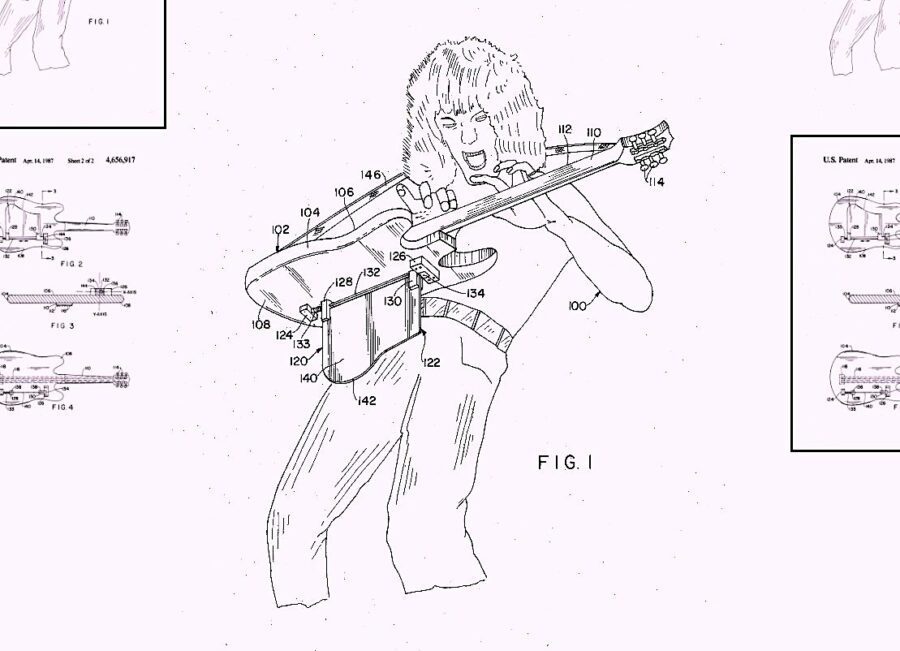
Throughout the past week, we’ve read many tributes to Eddie Van Halen and his endless capacity for innovation. Stylistically, EVH changed the sound of rock with tapping, a technique that let him play rapid arpeggios with two hands on the guitar’s fretboard. (Exhibit A is here.) Technically, he created a unique sound by fashioning his own guitar, the Frankenstrat, which melded the sounds of Gibson and Fender guitars. And what’s more, he patented three inventions, one of which came with the dazzling illustration above. Edward L. Van Halen’s 1987 patent for a “musical instrument support” was described as follows:
A supporting device for stringed musical instruments, for example, guitars, banjos, mandolins and the like… The supporting device is constructed and arranged for supporting the musical instrument on the player to permit total freedom of the player’s hands to play the instrument in a completely new way, thus allowing the player to create new techniques and sounds previously unknown to any player. The device, when in its operational position, has a plate which rests upon the player’s leg leaving both hands free to explore the musical instrument as never before. Because the musical instrument is arranged perpendicular to the player’s body, the player has maximum visibility of the instrument’s entire playing surface.
What would this device look like? The graphic above visualizes it all. Find the illustration in the patent application here.
Back in 2015, Van Halen wrote a piece in Popular Mechanics discussing his patents and other technical work on guitars and amps. For those who want to delve deeper into his tinkering, read the article here.
via Bradford Peterson & Boing Boing
If you would like to support the mission of Open Culture, consider making a donation to our site. It’s hard to rely 100% on ads, and your contributions will help us continue providing the best free cultural and educational materials to learners everywhere. You can contribute through PayPal, Patreon, and Venmo (@openculture). Thanks!
Related Content:
Musical Comedian Reggie Watts Reinvents Van Halen’s Classic, “Panama”
Read More...A Virtual Table Read of Fast Times at Ridgemont High, Featuring Jennifer Aniston, Morgan Freeman, Shia LaBeouf, Sean Penn, Brad Pitt, Julia Roberts, John Legend & More
If you will forgive a gross oversimplification, there are two kinds of people in this world:
Those (like me) who, having seen Fast Times at Ridgemont High the night before the first day of their senior year of high school, made sure to pack carrots in their lunchboxes, and those who were too young to see it in its original release, possibly because they hadn’t been born yet.
For those of us in the first group, Feelin’ A‑Live’s #FastTimesLive, a virtual table read of the script for Cameron Crowe’s 1982 semi-autobiographical teen sex romp, is a bit of a tough sell, even as a fundraiser for two good causes: the COVID-19 relief organization CORE and REFORM Alliance, which is dedicated to criminal justice reform and staunching COVID-19’s spread within the incarcerated population.
It’s kind of a mess.
Possibly we’re just crabby from all the Zoom performances we’ve watched and taken part in over the last 6+ months.
Were we supposed to be charmed that this live, unrehearsed performance featured A‑list movie stars, bumbling through like regular Joes circa April 2020?
Ray Liotta, reprising the late Ray Walston’s authority figure, Mr. Hand, is hamstrung by his old school paper script, ensuring that most of his lines will be delivered with downcast eyes.
Julia Roberts, as 15-year-old heroine, Stacy, is winsomely fresh, but out of focus.
Is it this blurriness of the technical difficulties that caused the production, originally conceived of as a feature-length table read, to be re-packaged as a sort of highlights tribute?
(Roberts’ computer glitch appears to have been cleared up after organizer Dane Cook’s first interruption to encourage donations (currently standing at a $2,132, which is particularly disappointing given that the film took in $2,545,674 its opening weekend, in 1992.))
Jennifer Aniston, in the role originated by Seventeen model, Phoebe Cates, is predictably funny, and also brings professional quality make up and lighting to the proceedings, but it’s somehow unjust that her celebrity status excuses her face-obscuring hairdo. Actresses of her generation, lacking her star power, plying their trade on Zoom are invariably ordered to barrette up.
The technical problems were not enough to spare us from a reenactment of the film’s most notorious scene, in which Stacy’s older brother, originally played by Judge Reinhold, now brought to life by Anniston’s ex, Brad Pitt, fantasizes about Cates unclasping her bikini top, only to be barged in on enjoying an extremely private moment by the very object of those fantasies.
It’s at the 37 minute mark, FYI.
A fitting punishment for those of us who, remembering the tabloid headlines, eagerly focused on Aniston’s face as Pitt was being introduced.
It wouldn’t hold a candle to the now-problematic original, if Pitt weren’t blushing and Morgan Freeman weren’t reading the stage directions.
(“Do you want me to use my Lorne Greene sonorous voice or just read like I’m not here?”)
Many viewers picked up on the players’ seemingly cool reception of their castmate, Method actor, Shia LaBeouf, born four years after the original film’s release. In the role of surfin’ stoner, Jeff Spicoli, he was tasked with some very big shoes to fill.
It’s a tribute to original Spicoli, activist Sean Penn’s versatility that he wasn’t forever typecast as variants on his star making role. As the only member of the original cast in attendance (as well as the founder of one of the designated charities), he alone seems to be enjoying the hell out of LaBeouf’s scene stealing antics.
Writer Crowe and director Amy Heckerling dish on his audition at the end of the proceedings, and in so doing shed some light on LaBeouf’s eccentricities, and the others’ wariness.
Even though the story conflicts, somewhat, with the casting director’s recollection below, we’re willing to take it on faith that LaBeouf’s fellows’ failure to clap for him is as much a part of the joke as Pitt’s game use of iconic headgear.
Dane Cook hedged his bets in deference to those who may not have lived through the period parodied by the film:
One more thing, before we start, the big disclaimer with a capital D, a whole lot of beliefs and language have changed since this came out, so don’t @ us, unless it’s to donate. Remember, it was a certain time and place, and the sentiments in the script do not reflect the people reading it today. They do reflect the fictional characters from an imaginary school in a totally make believe story, got it?
We get it!
The recasting with actors the same age as Jennifer Jason Leigh (Stacy) and Phoebe Cates remains a bitter pill, but perhaps it spares us all comments fixating on the ravages of time. Instead, we get to hear about the “timeless” beauty of Anniston and Roberts.
Related Content:
1980s Metalhead Kids Are Alright: Scientific Study Shows That They Became Well-Adjusted Adults
10 Tips From Billy Wilder on How to Write a Good Screenplay
Ayun Halliday is an author, illustrator, theater maker and Chief Primatologist of the East Village Inky zine. Follow her @AyunHalliday.
Read More...Restored Footage of 1896 Snowball Fight Makes It Seem Like the Fun Happened Yesterday
Early cinema is full of legends, but none as enduring as the legend of the Lumière Brothers’ Arrivée d’un train à la Ciotat (Arrival of a Train at La Ciotat). The fifteen-second reel of a locomotive so startled audiences, allegedly, they scrambled from their seats. German film scholar Martin Loiperdinger calls the anecdote “cinema’s founding myth,” a story repeated over and over, for over 100 years, though there’s no evidence it actually happened. One film history text even titled a chapter “Beginning with Terror” to underline the seminal importance of the event.
If we think about it, the incident, however apocryphal, does mark an origin. Consider how many films afterward featured trains as a central scene of the action, from The Great Train Robbery to Strangers on a Train to Snowpiercer. There are magical trains and train heists in space. Trains are everywhere in the movies. If we think about it some more, isn’t cinema itself something like a train? Even films that play with time still move inexorably from beginning to end, following some sort of discernible through-line from one end to the other.
But, say we were to entertain an alternate film history, a Philip K. Dick-like version in which, rather than trains, the founding myth of cinema involved snowballs….
In 1896, the year after the supposed public shock of Arrival of a Train, the Lumières shot Bataille de boules de neige, “Snowball Fight,” which you can see in its original black and white, above (with added, faux-vaudeville music). A group of solid citizens pummels each other with snowballs, then a cyclist, unawares, rides into the fray, gets pelted, and hurries off for dear life. It’s a madcap verité gem. “The film was shot in Lyon, France using one of the duo’s all-in-one cinématographe creations,” notes Petapixel, “which was part camera, part projector, and part developer.” There were no reports of panics in the theater.
At the top of the post, you can experience the short in full color and HD, thanks to Joaquim Campa, “who used the AI-powered software DeOldify to upscale the footage to 1080p, interpolate additional frames for a smoother result, and colorize the old footage.” Despite appearances, it seems the film’s speed remains unchanged. Campa’s startlingly immediate version arrives in the midst of a debate over the trendy colorization of old films and photos. Rather than bringing us closer to history, the British Library’s Luke McKernan told Wired, digital processing “increases the gap between now and then.”
Colorized, cleaned-up, and upscaled images show us the past as it never actually existed, historians claim. But isn’t that what film and photography have always done? As media of technical invention and reinvention, they inevitably shape and alter the scenes they capture, both during and after shooting. When Georges Méliès saw the Lumière’s films, he was not interested in their realism but in their potential for creating fantasies. He went off to make his special-effects masterpiece, A Trip to the Moon, which screened in both black-and-white and garishly hand-colored prints in 1902.
“Sure, it can be argued that adding color, interpolating frames, and removing scratches is creating information that was never there and could ‘obscure the past instead of highlighting it,’” writes Petapixel. “But how many people (who aren’t film buffs) will have ever heard of ‘Bataille de boules de neige’ before today? And how many might discover a passion for filmmaking or history as a result?” Personally, I’d like to see more films that look like “Snowball Fight.”
Related Content:
Watch the Films of the Lumière Brothers & the Birth of Cinema (1895)
Josh Jones is a writer and musician based in Durham, NC. Follow him at @jdmagness
Read More...Support Us
We're hoping to rely on loyal readers, rather than erratic ads. Please click the Donate button and support Open Culture. You can use Paypal, Venmo, Patreon, even Crypto! We thank you!

About Us

Open Culture scours the web for the best educational media. We find the free courses and audio books you need, the language lessons & educational videos you want, and plenty of enlightenment in between.
Advertise With Us
FREE UPDATES!
GET OUR DAILY EMAIL
Get the best cultural and educational resources on the web curated for you in a daily email. We never spam. Unsubscribe at any time.
FOLLOW ON SOCIAL MEDIA
Open Culture editor Dan Colman scours the web for the best educational media. He finds the free courses and audio books you need, the language lessons & movies you want, and plenty of enlightenment in between.
Advertise With Us

