iPod Classic Not Quite Ready for Primetime
Robert X. Cringley’s weekly article/podcast (iTunes — Feed — Web Site) may make you think twice about buying an iPod Classic … at least for now. Despite the name, the guts of the iPod Classic are actually new, and the bugs haven’t been fully worked out. The list of problems experienced by users includes (and I quote Cringley directly):
- VERY Slow menu switching response
- Display of clock rather than song info when “Now Playing”
- Inability to use existing AUTHORIZED 3rd party dock products (including Apple-advertised)
- Audio skipping during operation
- Slow connection to Macs and PCs
- Inability to disable “split-screen” menus
- Lagging and unresponsive Click Wheel
- Camera connector not working
- Inability to use EQ settings without skipping and distortion
Seeing that the “Classic” is Apple’s only iPod that currently has more than 16 gigs of storage, the company will be hustling to fix these problems. But, for now, podcast lovers might want to stick to their tried and true mp3 player. Source: I, Cringley
See our Technology Podcast Collection
Read More...The New York Times “Opens Up” at Midnight
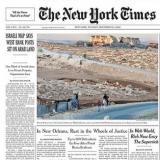 Effective at midnight, The New York Times will make the “TimesSelect” section of its website entirely free. (It used to cost subscribers $49.95 a year.) And it will also free up “its archives from 1987 to the present … , as well as those from 1851 to 1922, which are in the public domain.”
In making this move, the paper will be giving up $10 million in annual subscription revenue. But it will likely make up that money (and then some) by using ads to monetize those pages. For more info, read the full article here. And click here to see what formerly closed-off content will now become freely available.
Update: Have a look at Deeplinking’s piece called Mining the New York Times Archive. It pulls out of the archive some interesting finds, including reviews of James Joyce’s Ulysses (1922) and Oscar Wilde’s Disgrace (1895), plus articles that survey the dynamic art scene of the early 20th century.
Explore our list of 100 Great Culture Blogs
Read More...500 Greatest Albums of All Time
at least according to Rolling Stone. (Get the list here). Yes, these lists are always highly subjective. But if I were the arbiter of musical taste, I’d pick many of the same, so here it is.
Read More...SmartLinks From Our Readers
Below, we have some links recommended by our readers. Feel free to send other good bits our way. The more we give, the more we get:
- Sean Penn reads an excerpt from Bob Dylan’s autobiography, Chronicles, here. (Or check out the full audiobook version.)
- Jared Diamond, the Pulitzer Prize-winning author of Guns, Germs, and Steel and Collapse speaks at The Long Now Foundation about why civilizations have historically endured or failed. Two important factors include how they managed their natural resources and dealt with climate change. Does this ring any bells? Get the lecture here: (iTunes — Feed — MP3s)
- Ayn Rand’s Literature of Capitalism. A piece in The New York Times explores Atlas Shrugged and its impact on Alan Greenspan.
- Interview with Hal Varian, Chief Economist at Google (and UC Berkeley Professor), who talks (iTunes - Feed — MP3 — Web Site) about the internet as an “engine for democracy.”
- Appearing in The New York Review of Books, this piece, entitled Citizen Gore, takes a look a Al Gore’s new book, The Assault on Reason, and how Gore, being freed up from politics, has been remarkably able to prod the conscience of the nation. For some, however, it’s not enough. Hence the recent “Draft Al Gore” campaign that has gotten underway.
- Check out the Voodoo Music Festival coming up on October 26, 27 & 28 in New Orleans. The lineup of artists includes Rage Against The Machine, Common, Tiesto, The Smashing Pumpkins, Black Rebel Motorcycle Club, M.I.A., Ben Harper, Wilco and more. To win passes to the show and some travel money, you can enter a contest here.
Remembering Lenny Bruce and When Taboo-Breaking Comedy Collided with the Law
Lenny Bruce (born Leonard Alfred Schneider) introduced a strongly satirical, taboo-breaking form of comedy during the 1950s and 1960s, which paved the way for some of America’s great comedians — Richard Pryor, George Carlin, Chris Rock, even John Stewart. And for ushering in this new era of comedy, Bruce paid a heavy personal price. In 1961, San Francisco authorities arrested Bruce on obscenity charges. Then, in 1964, Bruce found himself in the crosshairs of Manhattan’s District Attorney, Frank Horgan. A six month trial followed, which raised important First Amendment issues, and which also brought Woody Allen, Bob Dylan, Allen Ginsberg, Norman Mailer, and William Styron to Bruce’s defense. (Dylan would later write a song about the affair.) But, regardless, the trial ended badly for Bruce, and, two years later, the impoverished comedian would die of a heroin overdose.
For Bruce’s legacy, things have gotten a little better. In 2003, Governor George Pataki granted New York’s first posthumous pardon to the satirist, calling it “a declaration of New York’s commitment to upholding the First Amendment.” Meanwhile, legal scholars have written books that paint Bruce and his First Amendment battles in a rather sympathetic light. Below you can find a video clip of Lenny Bruce appearing on the very popular Steve Allen Show. It gives you a pretty good look at the brand of comedy that Bruce presented to the wider nation. (You can access Part II of the video here.) Beyond this, you may also want to check out the actual FBI file that was kept on Bruce. It’s been published thanks to the Freedom of Information Act. And if you’re up for more video footage, here is a clearly deflated Bruce using his trial as fodder for comedy.
The New iPod Lineup Versus Its Rivals
 Since we talk a lot here about podcasts and mp3 files, it seems worth flagging this Yahoo gadget review that pits the new iPod lineup against its rivals. Here, we’ve got the new iPod Touch v. the Samsung Yepp YP-P2; the new Nano (with video) v. the Sansa View, and the iPod Classic v. Microsoft’s Zune. The net result is that the new iPods come out ahead, but not by much. Get review here.
(For another review of the new iPod Touch, have a look at this piece on Gizmodo.)
Quick note: As part of the new lineup, the iPod Classic features a new 160 GB model for $349. It apparently holds 40,000 songs (twice as many as the previous model), which translates to three continuous months of listening entertainment. Imagine how many mind-expanding podcasts that could include.
Read More...
The World Without Us: The Staggering Thought Experiment

Based on his considerable research and extensive interviews with experts, Weisman sees things playing out like this (and here I’m quoting from the New York Times book review): “With no one left to run the pumps, New York’s subway tunnels would fill with water in two days. Within 20 years, Lexington Avenue would be a river. Fire- and wind-ravaged skyscrapers would eventually fall like giant trees. Within weeks of our disappearance, the world’s 441 nuclear plants would melt down into radioactive blobs, while our petrochemical plants, ‘ticking time bombs’ even on a normal day, would become flaming geysers spewing toxins for decades to come… After about 100,000 years, carbon dioxide would return to prehuman levels. Domesticated species from cattle to carrots would revert back to their wild ancestors. And on every dehabitated continent, forests and grasslands would reclaim our farms and parking lots as animals began a slow parade back to Eden.” And, it’s also helpful to know, perhaps, that not even cockroaches would fare well in a world without Homo sapiens.
How Weisman researched this big question and drew his conclusions is fascinating, and fortunately it’s all explained in this Scientific American podcast (iTunes — Feed — Web Site) that features two recent interviews with Weisman. You can also catch Weisman speaking on John Stewart’s Daily Show in less scientific terms. Watch the video here.
 Subscribe to our feed in a reader
Related Content:
- For more related podcasts, check out our Science Podcast Collection
- Also check out Scientific American’s June 12 interview with Jared Diamond (author of Guns, Germs & Steel: The Fate of Human Societies), who talks about the “State of the World Environment.” (iTunes — Feed — Web Site).
The Return of Dr. Strangelove?
 The Stanley Kubrick classic Dr. Strangelove or: How I Learned to Stop Worrying and Love the Bomb centers around a Soviet doomsday device. If Russia is attacked by nuclear weapons, the device will set off countless nuclear bombs automatically, thereby rendering the Earth uninhabitable. It was dark humor when Peter Sellers brought it to life on the silver screen…but what if it’s real?
That’s just what a new book from the U.K. is arguing. Doomsday Men by P. D. Smith provides evidence that a Russian doomsday system called “Perimetr” went operational in the mid-1980s, and still is. As Ron Rosenbaum points out in Slate, this is particularly upsetting news since Vladimir Putin recently announced that Russian nuclear bombers would recommence “strategic flights”–potentially armed with nukes. The prospect of war between the U.S. and Russia might seem remote, but the return to nuclear posturing is not a good sign for humanity. Rosenbaum once interviewed some of the Minuteman commanders who control our own nuclear arsenal and his article makes a great read:
“This doomsday apparatus, which became operational in 1984, during the height of the Reagan-era nuclear tensions, is an amazing feat of creative engineering.” According to Blair, if Perimetr senses a nuclear explosion in Russian territory and then receives no communication from Moscow, it will assume the incapacity of human leadership in Moscow or elsewhere, and will then grant a single human being deep within the Kosvinsky mountains the authority and capability to launch the entire Soviet nuclear arsenal.
Other content worth exploring:
- How to Learn 21 Languages with Your iPod
- 25 UC Berkeley Courses Available via Free Video
- The Decline and Fall of the Roman Empire: A Free Audiobook
- James Joyce’s Ulysses: A Free Podcast
- Bestselling Novelist Sells Story Ideas for $1
- Subscribe to our feed in a reader
New Springsteen Album: Free Download of Lead Single
Quick fyi: Bruce Springsteen’s next album, Magic, will be released on October 2. To whet appetites, the lead single, “Radio Nowhere,” has been released. You can download the mp3 here. (PC users, right click ‘save target as’; Mac users, control and click, then Download Linked File.) To watch the free music video of the single, just click here and scroll down. Finally, here are the newly announced dates for Springsteen’s upcoming tour.
Read More...A Bungled Beauty Pageant and Our Reason for Being
By now, millions of web users have watched Miss Teen South Carolina explain in mortifying fashion (see below) why many Americans can’t find the United States on a map. And, in their own unintended way, her comments effectively answered the question posed to her. Education simply isn’t what it should be in America. And that holds true for many other nations.
All of this sets the stage for explaining Open Culture’s reason for being. Put simply, we try to put people, no matter what their age or where they live, in a position to continue learning and improving themselves. With the help of our podcast collections, you can now start learning over 25 foreign languages, listen to over 100 audiobooks, including classic works in literature, poetry and philosophy, and take over 75 complete courses from some of the world’s leading universities (MIT, Stanford, UC Berkeley, Oxford, etc.). Our podcast library includes many more educational resources as well, and the best part is that they’re completely free. Hours of free education are at your disposal whenever you want it. To benefit, you simply need the desire and the will, and the ability to use podcasts. (If you don’t know how, simply read our Podcast Primer. We’ll get you up to speed.) We hope that you profit from these podcast collections and our daily posts (subscribe to our feed), and, if they can benefit a friend, please let them know about us at www.openculture.com.
P.S. For those who want to bone up on geography, check out Geography of World Cultures on iTunes. This informative course was taught by Martin Lewis at Stanford University.
Read More...Support Us
We're hoping to rely on loyal readers, rather than erratic ads. Please click the Donate button and support Open Culture. You can use Paypal, Venmo, Patreon, even Crypto! We thank you!

About Us

Open Culture scours the web for the best educational media. We find the free courses and audio books you need, the language lessons & educational videos you want, and plenty of enlightenment in between.
Advertise With Us

FREE UPDATES!
GET OUR DAILY EMAIL
Get the best cultural and educational resources on the web curated for you in a daily email. We never spam. Unsubscribe at any time.
FOLLOW ON SOCIAL MEDIA

Open Culture editor Dan Colman scours the web for the best educational media. He finds the free courses and audio books you need, the language lessons & movies you want, and plenty of enlightenment in between.
Advertise With Us

