Dan Ariely’s Animated Talk Reveals How and Why We’re All Dishonest
If it is the bulk of the world’s cheating, stealing, and deception you seek, says Duke professor of psychology and behavioral economics Dan Ariely, look not to the heinous acts of individual villains; look to the countless dishonest acts committed daily by the rest of humanity. “The magnitude of dishonesty we see in society is by good people who think they’re being good but are in fact cheating just a little bit,” so we learn in the lecture above (find the complete lecture here). Ariely speaks these words, but they also appear written onscreen by a pen-wielding hand that rapidly summarizes and (literally) illustrates Ariely’s points as he makes them. This unusual style of animation appears in a whole series of videos from the Royal Society for the Encouragement of Arts, Manufactures and Commerce called RSA Animate. These have, the RSA claims, “revolutionised the field of knowledge visualisation whilst spreading the most important ideas of our time.” Revolutionary or not, The Truth About Dishonesty makes, in under twelve minutes, the kind of observations that let you see reality just a little more clearly.
“Human beings basically try to do two things at the same time,” Ariely says and the hand writes. “On one hand, we want to be able to look in the mirror and feel good about ourselves. On the other hand, we want to benefit from dishonesty.” This dilemma would seem to allow no compromise — you’re either honest or you’re dishonest, right? — but Ariely finds that most of us instinctively strive for the gray area between: “Thanks to our flexible cognitive psychology and our ability to rationalize our actions, we could do both.” We then hear and see how, if the proper rationalization happens and the instances of cheating remain minor and distanced from their effects, everybody acts with a mixture of honesty and dishonesty. (But sometimes the “what the hell effect” — the lecture’s finest coinage — kicks in, where people temporarily stop considering themselves good and proceed to act freely.) Ariely brings up the example, ripped from the headlines, of bankers and hedge fund managers who, distanced by vast corporate structures and elaborate mathematics from those whom their actions concretly affect. The hand draws a caricature of Oscar Wilde, then writes the most appropriate quote beside it: “Morality, like art, means drawing a line someplace.”
via Brain Pickings
More RSA Talks:
Renata Salecl: The Paradox of Choice
Sir Ken Robinson: A Creative Education
Good Capitalist Karma: Zizek Animated
Smile or Die: The Perils of Positive Psychology
Steven Pinker: How Innuendo Makes Things Work
Colin Marshall hosts and produces Notebook on Cities and Culture. Follow him on Twitter at @colinmarshall.
Read More...Eric Clapton and Steve Winwood Join Forces at the Historic Blind Faith Concert in Hyde Park, 1969
On a sweltering summer day in 1969, over 100,000 people crammed into Hyde Park in central London for a first look at what promised to be the next great thing in rock and roll: Blind Faith.
It was an amazing lineup. The band was made up of two-thirds of Cream (guitarist Eric Clapton and drummer Ginger Baker) along with the frontman of Traffic (keyboardist and vocalist Steve Winwood) and the bassist from the progressive group Family (Ric Grech). The free concert on June 7, 1969 (see here) was promoted with a great deal of fanfare and hyperbole. Expectations were high, so perhaps disappointment was inevitable. In any case the band came off sounding hesitant and unsteady. For a “supergroup,” they seemed surprisingly unsure of themselves.
“It was our first gig,” Winwood said later, “and to do that in front of 100,000 people was not the best situation to be in. Nerves were showing and it was very daunting. We couldn’t relax like you can on tour.” The band showed none of the verve or audacity of Cream. Clapton stood behind the drums and seemed reluctant to let loose. “In rehearsals and during recording,” said Baker, “Eric had been doing amazing stuff, but in Hyde Park I kept wondering when he was going to start playing. It wasn’t a brilliant start, obviously.”
The band avoided playing anything by Cream. The set list included one Traffic song (“Means to an End”) and another by the Rolling Stones (“Under My Thumb”), but was otherwise made up entirely of original songs written for their yet-to-be-released album, Blind Faith:
- Well All Right
- Sea of Joy
- Sleeping in the Ground
- Under My Thumb
- Can’t Find My Way Home
- Do What You Like
- Presence of the Lord
- Means to an End
- Had to Cry Today
Later that year the band toured Scandinavia and America, and their debut album was a commercial success despite considerable controversy over its strange cover image of a topless pubescent-looking girl holding a toy airplane. But it was clear from the start that Blind Faith wouldn’t last. Clapton’s heart, in particular, wasn’t into it. “I’d left The Yardbirds because of success,” he said later, “and Cream ended as a direct result of its false success. So with Blind Faith I wanted no more to do with success. I wanted to be accepted as a musician.” At the end of Blind Faith’s American tour Clapton made the unusual career move of quitting a supergroup to become a sideman for its supporting act, the relatively obscure Delaney & Bonnie. In a 1996 Mojo article on Blind Faith called “Born Under a Bad Sign,” rock journalist Johnny Black sums things up:
In retrospect, Blind Faith was cursed almost from the outset. This was a band whose members rarely seemed to tell each other anything. A band at loggerheads with its management. A management at loggerheads with itself. A heroin addicted drummer. A guitarist who wanted out almost from the word go. A stadium tour that the keyboard player didn’t want to be on. A record cover scandal. Worst of all, though, they were mind-numbingly successful when they didn’t want to be.
Related content:
A Young Eric Clapton Demonstrates the Elements of His Sound
Read More...The Moby Dick Big Read: Tilda Swinton & Others Read a Chapter a Day from the Great American Novel
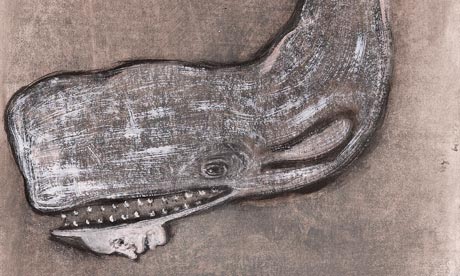
“Moby-Dick is the great American novel. But it is also the great unread American novel. Sprawling, magnificent, deliriously digressive, it stands over and above all other works of fiction, since it is barely a work of fiction itself. Rather, it is an explosive exposition of one man’s investigation into the world of the whale, and the way humans have related to it. Yet it is so much more than that.”
That’s how Plymouth University introduces Herman Melville’s classic tale from 1851. And it’s what sets the stage for their web project launched earlier this week. It’s called The Moby Dick Big Read, and it features celebrities and lesser known figures reading all 135 chapters from Moby Dick — chapters that you can start downloading (as free audio files) on a rolling, daily basis. Find them on iTunes, Soundcloud, RSS Feed, or the Big Read web site itself.
The project started with the first chapters being read by Tilda Swinton (Chapter 1), Captain R.N. Hone (Chapter 2), Nigel Williams (Chapter 3), Caleb Crain (Chapter 4), Musa Okwonga (Chapter 5), and Mary Norris (Chapter 6). John Waters, Stephen Fry, Simon Callow and even Prime Minister David Cameron will read future chapters, which often find themselves accompanied by contemporary artwork inspired by the novel.
If you want to read the novel as you go along, find the text in our collection of Free eBooks. We also have versions read by one narrator in our Free Audio Books collection. Tilda Swinton’s narration of Chapter 1 appears right below:
Read More...An Annotated Charlie Chaplin Filmography — 82 Films with Links to Videos
Last year we published a handy list of 20 Free Charlie Chaplin Films Available Online. And it looked pretty good … until yesterday. That’s when Metafilter posted an Annotated Filmography of Charlie Chaplin featuring a list of Chaplin’s 82 “official short and feature films in chronological order … with links to where you can watch them [online].” Above, we’ll start you off above with a short Charlie Chaplin Film Festival which includes four works in one collection — The Adventurer, The Cure, Easy Street and The Immigrant.
For a broader selection of films, don’t miss our meta list of 700 Free Movies Online, where you’ll find great Hitchcock films and noir classics; Western films, including many with John Wayne; animated gems; documentaries and much more. Or, if you want to narrow down your list, check out our list of 33 Free Oscar-Winning Films on the Web.
Follow us on Facebook, Twitter and now Google Plus.
Read More...Thomas Edison’s Boxing Cats (1894), or Where the LOLCats All Began
I’m willing to bet a lot of someone else’s money that there are thousands more lolcat lovers than cat lovers in the world. Since I happen to be unashamedly both, I was suckered by the little 1894 film above from Thomas Edison’s Black Maria studios featuring “Professor Welton’s Boxing Cats.” Now, granted, there is no disclaimer telling us no animals were harmed, but it looks to me like good clean cat-boxing fun. As the Smithsonian page that posted this little gem declares, Edison is perhaps the “mogul who started lolcats.”
Edison is given credit for inventing a lot of things, many of which he simply appropriated, made his own, and marketed heavily. In this way, he exemplifies a particular brand of American entrepreneur skilled not so much in making things as in patenting them. The so-called “Wizard of Menlo Park” patented 1,093 inventions, among them his motion picture camera, or “kinetograph.” But as the Library of Congress reports, it is likely that Edison’s awkwardly-named assistant William Kennedy Laurie Dickson did the actual work of turning Edison’s concept (which he took from Eadweard Muybridge) into a reality.
Complexities of due credit aside, we can at least thank Edison for managing an efficient operation and also, for better or worse, pioneering litigation against his competitors (putting many of them out of business). His Black Maria Studios amassed quite an archive of early “actuality” films and silent fictional films of the Nickelodeon era, the most famous of which, The Great Train Robbery, you can watch below (with dubbed-in score).
The Library of Congress’s Edison page is an excellent resource for information on the history of film in general and Edison’s contributions in particular, and it features dozens of his short films available for download in RealMedia, Quick Time, or as MPEGs.
Josh Jones is a doctoral candidate in English at Fordham University and a co-founder and former managing editor of Guernica / A Magazine of Arts and Politics.
Read More...Always the Director: Martin Scorsese Spoofs Himself in Two Commercials
Over the years, Martin Scorsese has earned a reputation as a consummate filmmaker, an obsessive perfectionist who lives and breathes cinema. In these two commercials the famed director moves to the front of the camera to make fun of his own manic perfectionism.
In 2003 Scorsese was asked to play himself in a commercial for American Express (see above), which was one of the sponsors of the Tribeca Film Festival. In keeping with his reputation for fastidiousness, Scorsese demanded to see a resume and show reel from veteran commercial director Jim Jenkins before agreeing to the shoot. “It’s like Kobe Bryant asking for your basketball credentials,” Jenkins told Stefano Hatfield at Advertising Age. “What are you gonna say? I once directed Tonya Harding in a Fox Sports commercial?”
Scorsese apparently liked what he saw, because Jenkins was hired. The shoot took place in a Los Angeles drugstore during a single day. “The main challenge,” wrote Hatfield in his article, “was to get Mr. Scorsese to speak as quickly as we all think he does. He actually had to be coaxed into that machine-gun delivery we have all come to expect of him. While it is entirely credible that this perfectionist would have his nephew stage a party all over again for a better shoot, Mr. Scorsese admitted that he hadn’t actually collected a roll of film from a drugstore for 15 years.”
Jenkins and Scorsese teamed up again for a 2008 AT&T commercial that was shown in theaters to encourage movie-goers to silence their phones. It shows Scorsese barging into the home of a mother and her young son and proceeding to direct a private phone call. The message: “We won’t interrupt your phone calls. Please don’t interrupt our movies.” Scorsese was originally expected to direct the commercial, according to Jenkins, but decided just to act in it. “Obviously he’s a natural actor,” Jenkins said of Scorsese in an interview with Creativity-online. “But he was nervous. He just wanted it to be funny. He said, ‘I can’t know if it’s funny. Just make it funny.’ ”
You can watch the commercial below to decide for yourself whether it’s funny. And be sure to come back tomorrow, when we feature an imaginative commercial directed by Scorsese himself.
Related content:
Martin Scorsese’s Very First Films: Three Imaginative Short Works
Martin Scorsese Appears in New Apple Ad, Plays on His Chilling Cameo in Taxi Driver
Read More...Roy Lichtenstein and Andy Warhol Demystify Their Pop Art in Vintage 1966 Film
By the mid-sixties, Roy Lichtenstein and Andy Warhol had come to define a certain current of process-intensive, only superficially simple American visual art. Lichtenstein created his work using processes and materials developed for traditional commercial production; Warhol developed methods for producing his work as if they were traditional commercial products. This half-hour documentary captures both artists in 1966, discussing their methods in interviews and executing them in their studios. Lichtenstein speaks clearly and in great detail about how he finds the American landscape “made up of the desire to sell products,” how he decided to portray in his paintings “an anti-sensibility that pervades the society” within a “structure of half-tone dots and flat printed areas,” and his driving notion that “whatever approach one uses, he ought to go as far as he can with it, in order to make as much impact as possible.”
Warhol, though, as journalists who encountered him will wincingly remember, wasn’t much for interviews. Or rather, he granted interviews, but responded mostly in ways that reinforced his persona of unknowability — indeed, of containing nothing to be known. “Andy Warhol’s reticence about himself masks a unique sensibility,” reads the narrator. That’s one way of putting it. Here he tells his interviewer, who maintains an admirable equanimity throughout, how nice it would be if he could just be told what sentences to answer with, and then repeat them. Yet behind his opaque-looking sunglasses and intercut with footage of his various projects, Warhol reveals things, and interesting ones, about the whats, hows, and whys of his grand enterprise. He even revealed a detail about his immediate plans to which audiences of 1966 would’ve done particularly well to pay attention: “We’re sponsoring a new band. It’s called the Velvet Underground.”
Andy Warhol and Roy Lichtenstein will be added to our collection, 4,000+ Free Movies Online: Great Classics, Indies, Noir, Westerns, Documentaries & More.
Colin Marshall hosts and produces Notebook on Cities and Culture. Follow him on Twitter at @colinmarshall.
Read More...How Leo Tolstoy Learned to Ride a Bike at 67, and Other Tales of Lifelong Learning
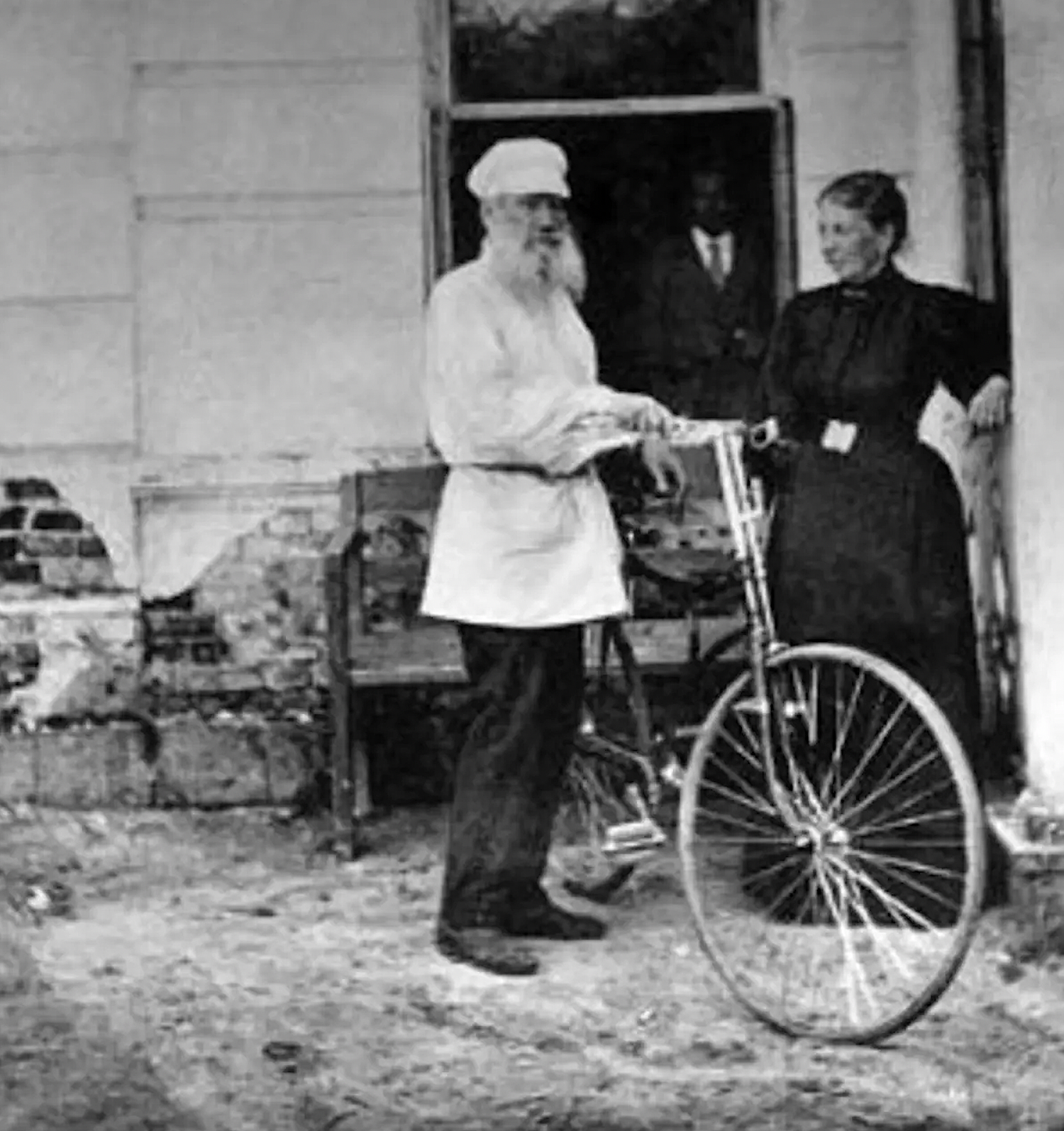
Some say you’re never too old to learn something new. Others say you can’t teach an old dog new tricks. Well, you know where we come down on this. And we’ve got some celebrity case studies to back us up. In a blog post yesterday, The New York Times featured four cultural icons and one war hero who learned new skills later in life. Miles Davis started boxing when most boxers are hanging up their gloves. Ayn Rand, in her 60s, improbably took up the hobby of stamp collecting. Marie Curie learned to swim in her 50s. And the great novelist Leo Tolstoy took his first bike ride at the age of 67. The Times writes that he started cycling:
only a month after the death of his 7‑year-old son, Vanichka. He was still grieving, and the Moscow Society of Velocipede-Lovers provided him a free bike and instruction along the garden paths on his estate. He became a devotee, taking rides after his morning chores. “Count Leo Tolstoy … now rides the wheel,” declared Scientific American in 1896, “much to the astonishment of the peasants on his estate.”
Apparently that’s Tolstoy and his bike above.
via @kirstinbutler
Related Content:
The Last Days of Leo Tolstoy Captured on Video
Rare Recording: Leo Tolstoy Reads From His Last Major Work in Four Languages, 1909
The Art of Leo Tolstoy: See His Drawings in the War & Peace Manuscript & Other Literary Texts
Read More...
Empire State of Pen: Patrick Vale’s Epic Freehand Drawing of the Manhattan Skyline
Give UK artist Patrick Vale 80 seconds, and he’ll show you his freehand drawing of New York City unfold in rapid-fire motion. Vale planted himself on the 102nd floor of the Empire State Building, looked outside his window, and began drawing, with his iPhone duct taped to a rostrum and recording the action. From start to finish, the drawing took, he says in a HuffPo interview, four to five days. He calls the drawing of the Manhattan skyline “Empire State of Pen.” The great Charles Mingus provides the soundtrack.
via Metafilter
Follow us on Facebook, Twitter and now Google Plus and share intelligent media with your friends. You won’t be sorry!
Read More...Classic Ray Charles Performance: ‘What’d I Say’ Live in Paris, 1968
Late one night in 1958, Ray Charles and his band were nearing the end of a very long performance at a dance somewhere in the Midwest when they found themselves in a jam. They were out of material. What Charles came up with that night to kill a little time would wind up making music history.
In his memoir Brother Ray: Ray Charles’ Own Story, co-written with David Ritz, Charles describes the scene:
It was nearly 1:00 A.M., I remember, and we had played our whole book. There was nothing left that I could think of, so I finally said to the band and the Raeletts, “Listen, I’m going to fool around and y’all just follow me.”
So I began noodling. Just a little riff which floated up into my head. It felt good and I kept on going. One thing led to another, and suddenly I found myself singing and wanting the girls to repeat after me. So I told ’em, “Now!”
Then I could feel the whole room bouncing and shaking and carrying on something fierce. So I kept the thing going, tightening it up a little here, adding a dash of Latin rhythm there. When I got through, folk came up and asked where they could buy the record. “Ain’t no record,” I said, “just something I made up to kill a little time.”
The song, “What’d I Say,” became a hit not only on the rhythm and blues charts, where Charles had already had some success, but on the pop charts as well. It was Charles’s first cross-over hit, and his first gold record. It was widely covered by other artists and became Charles’s signature song, the one he ended his concerts with.
The video above was made almost exactly ten years after “What’d I Say” was written. It’s from one of a pair of concerts Charles gave on October 8 and 9, 1968, at the Salle Pleyel in Paris. The orchestra was led by Wallace Davenport, and the back-up singers, the Raeletts, were: Susaye Greene, Verlyn Flenaugh, Barbara Ann Lesure, and Barbara Nell Terrault.
Despite the eventual triumph of “What’d I Say,” the song encountered strong resistance when it was first released by Atlantic Records in 1959. Some radio stations banned it. “They said it was suggestive,” writes Charles. “Well, I agreed. I’m not one to interpret my own songs, but if you can’t figure out ‘What I Say,’ then something’s wrong. Either that, or you’re not accustomed to the sweet sounds of love.”
Related content:
‘Willie and the Hand Jive,’ by the Late Great Johnny Otis
The Queen of Soul Conquers Europe: Aretha Franklin in Amsterdam, 1968
Read More...Support Us
We're hoping to rely on loyal readers, rather than erratic ads. Please click the Donate button and support Open Culture. You can use Paypal, Venmo, Patreon, even Crypto! We thank you!

About Us

Open Culture scours the web for the best educational media. We find the free courses and audio books you need, the language lessons & educational videos you want, and plenty of enlightenment in between.
Advertise With Us

FREE UPDATES!
GET OUR DAILY EMAIL
Get the best cultural and educational resources on the web curated for you in a daily email. We never spam. Unsubscribe at any time.
FOLLOW ON SOCIAL MEDIA

Open Culture editor Dan Colman scours the web for the best educational media. He finds the free courses and audio books you need, the language lessons & movies you want, and plenty of enlightenment in between.
Advertise With Us

