Neil Armstrong’s Parents Appear on the Classic American TV Show “I’ve Got a Secret,” 1962
“I’ve Got a Secret” was an American game show aired by CBS. By asking a series of questions, a panel had to determine the secret of contestants. On September 17, 1962, Stephen Koenig Armstrong and Viola Louise Engel Armstrong came on the show and harbored this secret — their son was one of nine men made an astronaut that very day. Almost seven years later, on July 20, 1969, Armstrong became the first person to set foot on the moon. This is why host Garry Moore’s question is all the more amazing: “Now, how would you feel, Mrs. Armstrong, if it turned out — of course nobody knows — but if it turns out that your son is the first man to land on the moon? How would you feel?”
Neil Armstrong died on August 25, 2012 in Cincinnati, at the age of 82. Here is NASA’s tribute to his life and achievements.
By profession, Matthias Rascher teaches English and History at a High School in northern Bavaria, Germany. In his free time he scours the web for good links and posts the best finds on Twitter.
Read More...John Waters Reads Steamy Scene from Lady Chatterley’s Lover for Banned Books Week (NSFW)
In case you didn’t realize it, we’re smack dab in the middle of Banned Books Week, which reminds us not to take intellectual freedom for granted. Hundreds of books are censored each year in America’s schools, bookstores and libraries, many of them works of unquestionable literary merit, books like The Catcher in the Rye, To Kill a Mockingbird and Huckleberry Finn.
The New York Times has created a handy guide outlining Ways to Celebrate Banned Books Week, while City Lights, the beloved San Francisco bookstore founded by Lawrence Ferlinghetti, came up with its own way to raise awareness. They got filmmaker John Waters to read a steamy passage from D.H. Lawrence’s controversial novel, Lady Chatterley’s Lover. Although originally published in 1928, an uncensored version of the book didn’t appear in Britain until 1960. And almost immediately Penguin, the publisher, was tried under the Obscene Publications Act. A jury returned with a verdict of ‘Not Guilty.’ As you can imagine, the lines read by Mr. Waters are not safe for work. You can find Lady Chatterley’s Lover housed in our collection of Free eBooks.
– Censorship is telling a man he can’t have a steak just because a baby can’t chew it. Mark Twain
via @GalleyCat
Related Content:
Frank Zappa Debates Censorship on CNN’s Crossfire (1986)
Allen Ginsberg Reads His Classic Beat Poem, Howl
Mike Wallace and Bennett Cerf (Founder of Random House) Talk Censorship
Read More...The ‘Tractate on the Steppenwolf’: Max Von Sydow Narrates Animated Scene from Hermann Hesse’s Novel
Hermann Hesse’s 1927 novel Steppenwolf is a curious mixture of mysticism and existential angst. It’s the story of a strange man who appears one day in an unnamed town and rents an attic apartment. By day he stays alone in his rooms, reading Goethe and Novalis. By night he wanders the dark alleyways of the Old Town, like “a wolf of the steppes that had lost its way and strayed into the towns and the life of the herd.”
Despite a strong element of magic in the story, Steppenwolf is essentially an autobiographical book. Hesse wrote it during a time of acute personal crisis, when he had entered middle age and was dealing with the failure of his marriage to a younger woman. Struggling against thoughts of suicide, the bookish Hesse sought to overcome his sense of isolation and estrangement from society by going out at night to the taverns and dance halls. For a sense of his mental state, here is a passage from Steppenwolf in which the protagonist Harry Haller talks in a dream to his “immortal” hero, Johann Wolfgang von Goethe:
Like all great spirits, Herr von Goethe, you have clearly recognized and felt the riddle and the hopelessness of human life, with its moments of transcendence that sink again to wretchedness, and the impossibility of rising to one fair peak of feeling except at the cost of many days’ enslavement to the daily round; and, then, the ardent longing for the realm of the spirit in eternal and deadly war with the equally ardent and holy love of the lost innocence of nature, the whole frightful suspense in vacancy and uncertainty, this condemnation to the transient that can never be valid, that is ever experimental and dilettantish; in short, the utter lack of purpose to which the human state is condemned–to its consuming despair.
But Hesse saw Steppenwolf as an optimistic book. It’s about a man’s journey to self-awareness and spiritual liberation. As he wrote in the introduction, “The ‘Treatise’ [see above] and all those spots in the book dealing with matters of the spirit, of the arts and the ‘immortal’ men oppose the Steppenwolf’s world of suffering with a positive, serene, super-personal and timeless world of faith. This book, no doubt, tells of griefs and needs; still it is not a book of a man despairing, but of a man believing.”
The animated sequence above is from the rarely seen 1974 film of Steppenwolf by Fred Haines, in which the Harry Haller character played by Max von Sydow reads from the “Tractate on the Steppenwolf,” a mysterious text that was given to Haller and then left behind by him, describing the Steppenwolf’s divided nature. The scene features imagery by the Czech artist Jaroslav Bradác.
Related content:
Franz Kafka: The Animated Short Film
Read More...Steven Spielberg Reveals He Is Dyslexic. Making Movies Offered Him a “Great Escape” as a Child
We recently brought you an interview with Steven Spielberg and his father, discussing the films the director made as a teenager. Of all American auteurs, Spielberg may be the most in touch with his inner child, so it comes as no surprise that the young Spielberg recorded train crashes and battles using his own room or yard as the backdrop.
What no one, including the DreamWorks co-founder himself, knew until recently is that all those 8 mm shorts were more than just a pastime. In a recent interview Spielberg revealed that he is dyslexic and that he was only diagnosed five years ago. “It explained a lot of things,” Spielberg told Quinn Bradlee. “It was like the last puzzle part in a tremendous mystery that I’ve kept to myself all these years.”
Always two years behind the class in reading, Spielberg was teased by other kids in school. He dreaded having to read in front of the class. He never lacked for friends, though looking back on it several of his friends were probably also dyslexic.
“Even my own friends who were just like me, we didn’t have the skills to talk about it,” he recalled in the interview for Friends of Quinn, a site for people with learning differences. “I got bullied. I dealt with it by making movies. That was my cover up.”
Spielberg, whose films have spanned all genres over more than four decades, says that moviemaking was his “great escape” from feeling painfully different.
“I never felt like a victim. Movies helped save me from shame, from guilt from putting it on myself when it wasn’t my burden,” he says. “In light of feeling like an outsider, movies made me feel inside my own skill set.”
He says that it takes him about three hours to read what most people could read in a little more than an hour.
“I’m slow, but I’ve learned to adjust,” he says. “I am in a business where reading is very important. I read often and I have great comprehension. I retain almost everything I read. I really take my time going through a book or a script.”
With all of that said, don’t miss our previous post: Steven Spielberg’s Debut: Two Films He Directed as a Teenager
Kate Rix is an Oakland-based freelance writer. Find more of her work at .
Read More...Bob Dylan’s Historic Newport Folk Festival Performances, 1963–1965
“You know him, he’s yours: Bob Dylan.” It’s hard to imagine a more ironic introduction, but those were the words used by Ronnie Gilbert of The Weavers to introduce Dylan at the 1964 Newport Folk Festival. “What a crazy thing to say!” Dylan wrote in his memoir, Chronicles. “Screw that. As far as I knew, I didn’t belong to anybody then or now.” A year later at Newport he made his point loud and clear. They didn’t know him, and he wasn’t theirs.
On July 25, 1965 Dylan shocked the folk purists at Newport by plugging his Fender Stratocaster into an amplifier and joining guitarist Mike Bloomfield and others from the Butterfield Blues Band in a blistering rendition of “Maggie’s Farm,” a song often interpreted as Dylan’s protest song against the expectation of singing protest songs. (The farm in the title is viewed as a pun on Silas McGee’s farm in Mississippi, where Dylan made his famous appearance during a civil rights rally.) Many in the audience took it as a slap in the face. Boos rose up amid the cheering, and the booing continued into Dylan’s next song, the now-classic “Like a Rolling Stone.” Music writer Greil Marcus described the scene:
There was anger, there was fury, there was applause, there was stunned silence, but there was a great sense of betrayal. As if something precious and delicate was being dashed to the ground and stomped. As if the delicate flower of folk music, the priceless heritage of impoverished black farmers and destitute white miners, was being mocked by a dandy, with a garish noisy electric guitar, who was going to make huge amounts of money as a pop star by exploiting what he found from these poor people.
The controversial “electric” performance was the last of three Dylan appearances at the Newport festival. His first time there was in 1963, when he was an obscure young singer, little known outside of Greenwich Village. He appeared at the festival as a guest of Joan Baez, who was far better known and had recently appeared on the cover of Time magazine. Baez introduced Dylan to audiences around the country and encouraged him to write politically committed folk songs. But by the 1964 festival Dylan had already caught up to Baez, in terms of fame, and by 1965 he was breaking free of Baez and her expectations, and of folk music in general.
Murray Lerner’s The Other Side of the Mirror: Bob Dylan Live at the Newport Folk Festival 1963–1965 (above) captures Dylan’s evolution over those three years. The footage was originally shot for Lerner’s classic 1967 documentary, Festival!, and was eventually acquired by Dylan, whose manager agreed to let Lerner assemble it into a film–but only after the release of Martin Scorsese’s No Direction Home, which uses some of the material. The Other Side of the Mirror was released in 2007. The documentary was shot on Kodak Plus‑X and Tri‑X film with a three-person crew. As Lerner later explained in an interview, his intention was to let Dylan’s evolving music speak for itself:
We decided on no narration, no pundit interviews, no interviews with Dylan. nothing except the experience of seeing him. That to me is exciting. Just the clear experience gives you everything you need. I felt that when screened the music of The Other Side of the Mirror, because he’s touted metaphorically as the mirror of his generation, and I thought no, he’s beyond that. He always takes the generation beyond that, and he’s like on the other side of the mirror. But I also felt the wondrous quality of his imagination took us like Alice to a new world on the other side of the mirror.
Related content:
Bob Dylan’s (In)Famous Electric Guitar From the Newport Folk Festival Discovered?
The Times They Are a‑Changin’: 1964 Broadcast Gives a Rare Glimpse of the Early Bob Dylan
Read More...
Art Lovers Rejoice! New Goya and Rembrandt Databases Now Online

Two of the the towering figures of Western art–Francisco de Goya and Rembrandt van Rijn–have just become more accessible to people around the world with the introduction of a pair of new online databases.
The Museo del Prado in Madrid has just launched a Web site, Goya en el Prado, which makes over 1,000 works by the late 18th- and early 19th-century Spanish master available for online viewing, along with his correspondence and other documents. Although the site is currently available only in Spanish (tip: view the site with Google Chrome and it will translate things for you!) the pictorial contents are easy to explore for people who are not fluent in the language. They fall under three categories: paintings (pinturas), drawings (dibujos) and prints (estampas). More than half of Goya’s surviving works–from his masterpieces to obscure sketches–are housed at the Prada and are now available for browsing by scholars and the general public alike. Many of the works are rarely seen. “Notable features within this exceptionally important and interesting project,” writes artdaily.org, “include the option to access online the unique collection of works on paper by Goya in the Museum, which is not normally on display for conservation reasons.” Here’s the link: Goya en el Prado.

Two venerable Dutch art institutions–the Netherlands Institute for Art History (RKD) and the Royal Picture Gallery Mauritshuis have joined forces to create The Rembrandt Database, a resource that brings together materials from research institutions around the world, including the National Gallery of London and the Metropolitan Museum of Art. Unlike the Prado’s Goya project, which is intended for a wide audience, the Rembrandt site is designed specifically for art scholars. “The Rembrandt Database aims to become the first port of call for research on Rembrandt’s paintings,” according to a statement on the site. “Our objective is not to present a final set of data, but to develop and grow continually, especially as more documentation becomes available through new research and collaboration with new partners.” By 2014 the organizers hope to have material from 20 museums. At present there are only a dozen Rembrandt paintings in the database, but some of the entries are supported by extensive documentation, including infrared and X‑ray imagery. Here’s the link: The Rembrandt Database.
via Metafilter/The Art Tribune
Read More...Eisenhower Answers America: The First Political Advertisements on American TV (1952)
Going into the 1952 presidential election, the Democrats had held the White House for nearly twenty years. FDR took office in 1933, beginning the first of twelve years in office. Then Harry S. Truman led the nation for nearly another eight years. During that time, America endured a lot. War, economic depression, and more war — some hot, some cold. By the time the 1950s rolled around, Americans were tired and ready for a change.
In the 1952 election, we find Adlai Stevenson, the reluctant Democratic candidate, squaring off against Dwight D. Eisenhower, the war hero who had led American troops to victory in Europe, instantly becoming the “most admired living American” (according to opinion polls). Eisenhower, it turns out, knew how to win elections as well as wars. In ’52, Ike aired the first ad campaigns on television. Called Eisenhower Answers America, the ads featured “everyday” Americans asking questions about the issues of the day — the war in Korea, inflation, high taxes, etc. PBS has a well-researched introduction to this innovation in American politics, while the nicely-curated web site, The Living Room Candidate, offers a rich collection of campaign commercials aired between 1952 and 2008.
You can watch a playlist of ads from the Eisenhower Answers America campaign below.
Read More...F. Scott Fitzgerald Reads From Shakespeare’s Othello (c.1940)
When F. Scott Fitzgerald died in 1940, his New York Times obituary claimed, “the promise of his brilliant career was never fulfilled.” This is a sentence that may puzzle modern-day lovers of Fitzgerald’s enduringly-relevant fiction, but it was the judgment of the time on the exhausted, alcoholic writer’s career. And it was a judgment he often applied to himself, as he demonstrated publicly in his 1936 essay “The Crack-Up,” about his depression. Reduced at the end of his life to writing film scripts for money, a task he found degrading for a “successful literary man” such as himself, Fitzgerald also, at some time near his final year, made recordings of himself reading the work of Shakespeare, Keats, and others, presumably also for money, though it’s not exactly clear who produced the recordings or why.
In the first video (above), listen to Fitzgerald deliver a dignified reading of Othello’s speech to the Venetian Senators from Act 1, Scene 3 of Othello. Fitzgerald stumbles and slurs occasionally, and the speech may in fact be composed of several different takes edited together, suggesting that he may have had difficulty making it through. Nonetheless, his voice is seductive and sonorous; he reads the speech as a literary monologue, rather than a declaration. Hear more of him below, reading an edited version of John Masefield’s “On Growing Old,” a poem which may have had particular poignancy to the man who wrote in 1936, “of course all life is in a process of breaking down.” But even in decline, Fitzgerald was worth listening to. You can find major works by F. Scott Fitzgerald in our Free eBooks and Free Audio Books collections.
Josh Jones is a doctoral candidate in English at Fordham University and a co-founder and former managing editor of Guernica / A Magazine of Arts and Politics.
Related Content:
F. Scott Fitzgerald Creates a List of 22 Essential Books, 1936
Seven Tips From F. Scott Fitzgerald on How to Write Fiction
Rare Footage of Scott and Zelda Fitzgerald From the 1920s
Read More...Vladimir Nabokov Makes Editorial Tweaks to Franz Kafka’s Novella The Metamorphosis
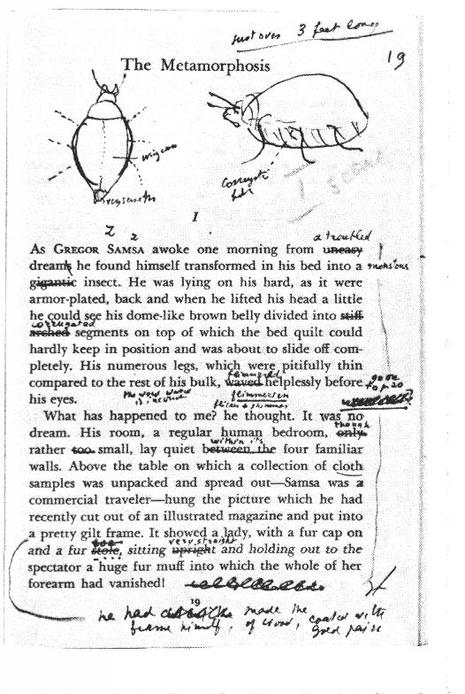
Vladimir Nabokov admired Franz Kafka’s novella, The Metamorphosis. Hence the lecture that Nabokov dedicated to the work here. But he also saw some small ways to wordsmith the story, or at least the English translation of it. Above, we have some edits — the nips and tucks — that Nabokov scribbled on his personal copy of Kafka’s most famous work.
In 1989, Nabokov’s lecture on The Metamorphosis was actually turned into a television production starring Christopher Plummer. You can watch The Metamorphosis — A Study: Nabokov on Kafka online. It runs 30 minutes. Of course, you can also download your own copy of Kafka’s near perfect work of poetic imagination, to borrow a phrase from Elias Canetti. Visit our collections of Free eBooks and Free Audio Books.
If you would like to support the mission of Open Culture, consider making a donation to our site. It’s hard to rely 100% on ads, and your contributions will help us continue providing the best free cultural and educational materials to learners everywhere. You can contribute through PayPal, Patreon, and Venmo (@openculture). Thanks!
Related Content:
Take Vladimir Nabokov’s Quiz to See If You’re a Good Reader–The Same One He Gave to His Students
Vladimir Nabokov Names the Greatest (and Most Overrated) Novels of the 20th Century
Vladimir Nabokov (Channelled by Christopher Plummer) Teaches Kafka at Cornell
Read More...Discovered: Lord Byron’s Copy of Frankenstein Signed by Mary Shelley
The story behind the writing of Frankenstein is famous. In 1816, Mary Shelley and Percy Bysshe Shelley, summering near Lake Geneva in Switzerland, were challenged by Lord Byron to take part in a competition to write a frightening tale. Mary, only 18 years old, later had a waking dream of sorts where she imagined the premise of her book:
When I placed my head on my pillow, I did not sleep, nor could I be said to think. My imagination, unbidden, possessed and guided me, gifting the successive images that arose in my mind with a vividness far beyond the usual bounds of reverie. I saw — with shut eyes, but acute mental vision, — I saw the pale student of unhallowed arts kneeling beside the thing he had put together. I saw the hideous phantasm of a man stretched out, and then, on the working of some powerful engine, show signs of life, and stir with an uneasy, half vital motion.
This became the kernel of Frankenstein; or, The Modern Prometheus, the novel first published in London in 1818, with only 500 copies put in circulation.
Nearly two centuries later, a first edition signed by Shelley has turned up in the vestiges of Lord Byron’s library. The grandson of Lord Jay notes, “I saw the book lying at an angle in the corner of the top shelf. On opening it, I saw the title page, recognised what it was at once and leafed hungrily through the text — it was only when I flicked idly back to the first blank that I saw the inscription in cursive black ink, “To Lord Byron, from the author.”
Today this inscribed copy is on display at Peter Harrington’s, a London specialist in rare books. And there it will be put on auction, likely fetching north of £350,000, or $575,000. The video above gives you more of the backstory on the writing and gifting of the book.
You can find Frankenstein in our collections of Free eBooks and Free Audio Books. Also don’t miss the first film adaptation of Frankenstein from 1910 here, or the 1931 version listed in our meta list of Free Movies Online.
via HuffPo
Read More...Support Us
We're hoping to rely on loyal readers, rather than erratic ads. Please click the Donate button and support Open Culture. You can use Paypal, Venmo, Patreon, even Crypto! We thank you!

About Us

Open Culture scours the web for the best educational media. We find the free courses and audio books you need, the language lessons & educational videos you want, and plenty of enlightenment in between.
Advertise With Us

FREE UPDATES!
GET OUR DAILY EMAIL
Get the best cultural and educational resources on the web curated for you in a daily email. We never spam. Unsubscribe at any time.
FOLLOW ON SOCIAL MEDIA

Open Culture editor Dan Colman scours the web for the best educational media. He finds the free courses and audio books you need, the language lessons & movies you want, and plenty of enlightenment in between.
Advertise With Us

