James Joyce Encoded in Venter’s Artificial Life
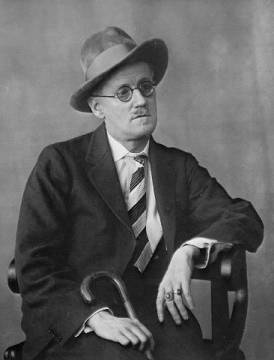 You may have heard the news last week: J. Craig Venter and a team of scientists created the first living organism – a “synthetic cell” – by way of a computer-generated genome. We’re now seeing the beginnings of artificial life. And it’s a big story, with many far-reaching implications. But where does James Joyce fit into this picture? Let me add this little factoid to the mix: According to The Christian Science Monitor, Venter’s team inserted DNA watermark codes into the genome so that they can distinguish between natural and synthetic bacteria moving forward. And when this code is translated into English, it will “spell out the names of the 46 researchers who helped with the project, quotations from James Joyce, physicist Richard Feynman and J. Robert Oppenheimer, and a URL that anyone who deciphers the code can e‑mail.” Lots of smarts packed into the tiniest of packages.
UPDATE: The quotes in watermark apparently read: “TO LIVE, TO ERR, TO FALL, TO TRIUMPH, TO RECREATE LIFE OUT OF LIFE.” — James Joyce’s A Portrait of the Artist as a Young Man; “SEE THINGS NOT AS THEY ARE, BUT AS THEY MIGHT BE.”-A quote from an Oppenheimer biography, American Prometheus; “WHAT I CANNOT BUILD, I CANNOT UNDERSTAND.” — Richard Feynman.
Read More...David Simon Takes New York Down a Peg
Speaking in New York City, David Simon, the creator of The Wire, wasn’t shy about taking the city to task. “There is no city more vain about its position in popular culture, more indifferent to other realities, more self absorbed than other cities.” “Manhattan is [now] one big pile of money,” which leaves it divorced from the real problems facing other American cities. So why are so many stories and television shows still centered in New York, and how can they tell the real tale of urban America in 2010?
This talk took place at The New School for Liberal Arts in NYC.
via The Daily Dish
Read More...Spring: A Short Film Based on Hemingway’s Memoir
British filmmaker Temujin Doran may be better known for his strong, highly opinionated views on democracy and politics, but his adaptation of Ernest Hemingway’s memoir, A Moveable Feast, is something else entirely.
Though still narrated in Doran’s characteristically urgent, restless tone, Spring offers a quiet tribute to Parisian urbanity and the richness of seasonality, captured with cinematic minimalism and eerily indulgent aesthetic austerity.
Maria Popova is the founder and editor in chief of Brain Pickings, a curated inventory of eclectic interestingness and indiscriminate curiosity. She writes for Wired UK, GOOD Magazine, BigThink and Huffington Post, and spends a disturbing amount of time curating interestingness on Twitter.
Read More...The New York Times Starts New Philosophy Blog
This week, The New York Times began a philosophy blog called The Stone, moderated by Simon Critchley. The series will address “issues both timely and timeless – art, war, ethics, gender, popular culture and more.” And it will ask: “What does philosophy look like today? Who are philosophers, what are their concerns and what role do they play in the 21st century?”
Not everyone is happy with the choice of Critchley as moderator, but it looks like there will be participants to suit all temperaments: “Nancy Bauer, Jay Bernstein, Arthur C. Danto, Todd May, Nancy Sherman, Peter Singer and others.”
Critchley begins with a question bound to invite snarky comments: What is a Philosopher? Such comments have a long history (I’ve included a YouTube clip of my all-time favorite parody above). And so the natural starting point for any answer to that question is the popular conception of philosopher as bullshit artist and “absent-minded buffoon”: “Socrates tells the story of Thales, who … was looking so intently at the stars that he fell into a well.” That’s a conception that, I have to admit, troubled me when I was a philosophy graduate student and led me to drop out. And it has troubled philosophers historically: many a sober treatise begins with the unflattering comparison of philosophy to the empirical sciences and the stated goal of remedying this deficiency. And some strains of analytic philosophy argue that the solution to philosophical problems is to realize that there are no such problems, and that philosophy has a relatively modest supporting role in clarifying the foundations of science.
True to my philosophical pedigree, I think that the question is in a way its own answer: philosophical problems naturally elide into the problem of what philosophy is and what it is that philosophers do. One level of reflection tends to lead to the next, and doubt to self-doubt. Philosophers are people who spend their time trying to figure out what they’re doing with their time and why they’re doing it. And so for instance, questions about how we should live (ethics) and what we can know (epistemology) are also questions about whether the life of the mind is worthwhile and whether philosophical pursuits are properly scientific. The unavoidable state of affairs here is that philosophy falls perpetually into one crisis (or well) after another –recent department closures are just one example.
One way of remedying the nagging thought that philosophy is merely a retreat from worldly affairs, practicality, and life in general is to do precisely what The New York Times has done here, and try to initiate more popular and less academic conversations about the subject. (And to get in a plug, it’s what I and two other philosophy grad school dropouts have tried to do with our podcast, The Partially Examined Life; and what I think Open Culture does with its focus on the intersection of education and new media).
For Critchley, the question of time is paramount to answering his opening question: newspapers and blogs are typically focused on timeliness rather than timelessness, and they’re meant for busy people who want to quickly absorb “information.”
But that tension is inherently philosophical.
Wes Alwan lives in Boston, Massachusetts, where he works as a writer and researcher and attends the Institute for the Study of Psychoanalysis and Culture. He also participates in The Partially Examined Life, a podcast consisting of informal discussions about philosophical texts by three philosophy graduate school dropouts.
Read More...Iron Man: The Science in Science Fiction
As Robert Bly noted in his book, The Science in Science Fiction, some of the most intriguing scientific ideas have originated not in labs, but in sci-fi books and movies. With Iron Man 2 hitting the screens, Sidney Perkowitz, a physicist at Emory University, talks about whether the science in the new pop movie has any roots in scientific reality – or, for that matter, whether it might inspire any new scientific thinking down the road. He offers his thoughts above. In addition to writing Hollywood Science: Movies, Science and the End of the World, Perkowitz sits on the advisory board of the Science and Entertainment Exchange, a National Academy of Sciences program that tries to bring more scientific accuracy to mass market entertainment.
Thanks Nicole for the tip on this one.
Read More...Lawrence of Arabia Remembered with Rare Footage
Seventy-five years ago today, on the morning of May 13, 1935, a 46-year-old retired British army officer was riding his motorcycle home from the post office, when he swerved to avoid hitting two boys on bicycles. He was thrown onto the road and sustained head injuries, then died six days later in a provincial hospital. It was a mundane circumstance for the death of an extraordinary man.
Thomas Edward (T. E.) Lawrence was an intellectual and adventurer who became known to the world as “Lawrence of Arabia.” Lawrence could read books by the age of four. He attended Oxford on scholarship and spent one of his summer vacations hiking 1,100 miles through Syria, Palestine and Turkey to survey crusader castles for a thesis on military architecture. He spoke Arabic, Turkish, German, French, Latin and Greek. When World War I broke out in 1914, he was recruited into the British army for his extensive first-hand knowledge of the Middle East. During the course of the war, Lawrence became one of the architects and leaders of the Arab Revolt against the Ottoman Turks – a remarkable adventure that was retold in David Lean’s 1962 film, Lawrence of Arabia, starring Peter O’Toole, Omar Sharif and Alec Guinness.
Lawrence was an intensely private man who, as Lowell Thomas famously put it, “had a genius for backing into the limelight.” When the war was over, however, he succeeded in staying out of the limelight by refusing a knighthood and serving out his military career under assumed names. He translated Homer and wrote a memoir of the Arab Revolt, The Seven Pillars of Wisdom. And he had a penchant for fast motorcycles, including the custom-made Brough Superior SS100 which he rode into town on a mundane errand 75 years ago today.
Today, to mark the 75th anniversary of his tragic motor cycle accident, we feature some of the only known footage of T.E. Lawrence above.
Read More...Ask Philosophers Goes Mobile
AskPhilosophers puts real philosophers at the service of the general public. Have a big, lofty question that only a professional philosopher can tackle? They’ll answer it on the web. And now on the iPhone. This new, free app (designed by Amherst College) lets you access their Q&A archive on the go. While waiting in line for a coffee, you can chew over this kind of exchange:
Read More...Question: If you fail to stop something bad happening to you is it the same as being complicit in the act?
Answer: There is a complicated literature in moral philosophy about how to draw the distinction between doing and merely allowing harm and whether this distinction has moral significance. Without trying to navigate that deep intellectual thicket, it is still possible to begin to address your question. If I’m complicit in doing something bad, for instance, harming another person, then it seems I share the aim of my accomplices in harming someone else. I intend harm. By contrast, if I merely allow someone else to harm, I needn’t and typically don’t intend harm. While not intending harm, I may be indifferent to the harm. It depends. I may not be indifferent to the harm (more…)
The College Dorm Window Show
Students at Poland’s Wroclaw University of Technology got a little techie (or is it techno?) this week, turning their dorm windows into a full color light show. Happily, we can report that all lights were controlled wirelessly. Thanks Bartosz for sending this our way.
Read More...Piano Stairs
How can you change behavior for the better? It’s simple. Make it fun. The next thing you know, people will climb stairs instead of ride the escalator. And they’ll properly throw their trash away too (the subject of another engaging video)…
Thanks Adolfo for the great finds.
Read More...The Very End of Time
The Big Bang gave birth to our universe. But what will bring it to an absolute end? In 21 minutes, a mere mega blip of time, this episode of Cosmic Journeys offers an impressive visual account of this big enchilada question, taking you across trillions of years. The sun will die but make the earth uninhabitable well beforehand. A similar process of decay will play itself out across the universe and we will enter the “degenerate era.” Dark energy, dead stars, and black holes will reign supreme. But what will happen in the very, very end, when the cosmic clock strikes a number known as a “googol” or some time thereafter? A lot of that will get sorted out by the work physicists are now doing with the Large Hadron Collider, the giant particle accelerator located near Geneva, Switzerland. Give the video a little bit of time. The second half gives you the goods.
Hat tip to Wilter for sending this video our way.
Read More...Support Us
We're hoping to rely on loyal readers, rather than erratic ads. Please click the Donate button and support Open Culture. You can use Paypal, Venmo, Patreon, even Crypto! We thank you!

About Us

Open Culture scours the web for the best educational media. We find the free courses and audio books you need, the language lessons & educational videos you want, and plenty of enlightenment in between.
Advertise With Us

FREE UPDATES!
GET OUR DAILY EMAIL
Get the best cultural and educational resources on the web curated for you in a daily email. We never spam. Unsubscribe at any time.
FOLLOW ON SOCIAL MEDIA

Open Culture editor Dan Colman scours the web for the best educational media. He finds the free courses and audio books you need, the language lessons & movies you want, and plenty of enlightenment in between.
Advertise With Us

