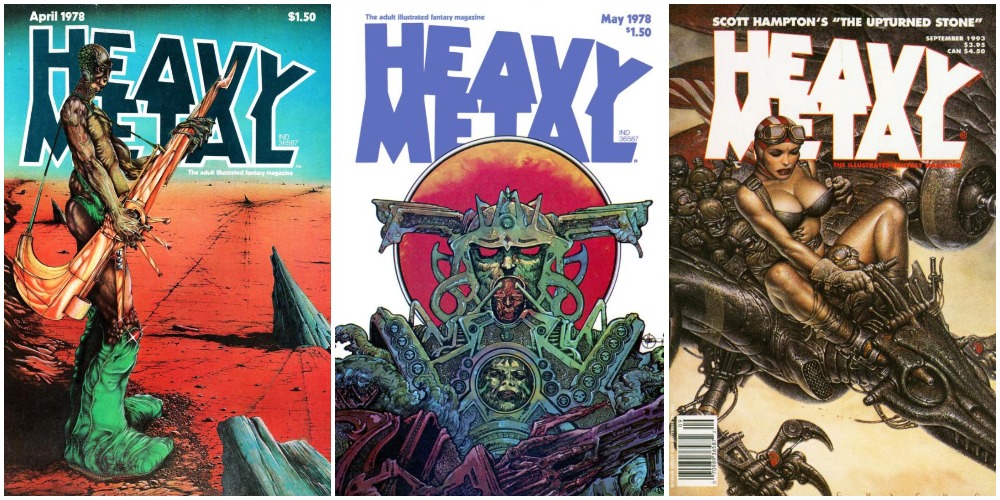
In making a time capsule of the late 20th century, one would be remiss if they did not include at least an issue or two of Heavy Metal magazine. Yes, it specialized in unapologetically turning women in metal bras into sex objects. The gleeful amount of T&A on its covers, surrounded by spaceships, swords, and sorcery, mark it as a relic of its era that appealed to a specific demographic. But Heavy Metal was much more than sexy sci-fi mascots drawn in lurid pulpy styles. Along with its share of erotica, the “adult illustrated fantasy magazine” provided a vivid showcase for some of the most interesting artists and storytellers working in the mainstream and in various subgenres of fantasy and sci-fi. (It continues to do so.)
Debuting in 1977, the year of the first Star Wars film, Heavy Metal was not named after the brand of guitar rock pioneered by Led Zeppelin and Black Sabbath, though there’s an obvious influence, but after a French magazine that started two years earlier called Métal hurlant, or literally “Howling Metal.” (We’ve featured it here on OC before.) When publisher Leonard Mogel decided to adapt the original for an American readership, he changed the name, but kept the content, republishing work by Jean Giraud—the artist better known as Moebius—and many other accomplished European illustrators.
Founded and staffed by the creators of National Lampoon, the magazine later featured original work from artists like H.R. Giger, interviews with Dennis Hopper, John Waters, Francis Ford Coppola, John Carpenter, Roger Corman, and even Federico Fellini; and with musicians like the Eurythmics and Debbie Harry. It ran popular serialized stories, showcased graphic literary adaptations (of Paradise Lost, for example), and published authors like Ray Bradbury, Stephen King, and other heavies. Rock, comics, film, and fiction all got their due in between the magazine’s extravagant pinup covers, many of which inspired the art painted on the side of many a carpeted van in the 70s.
Heavy Metal’s interests are very focused, one might say, but the few things the magazine does, and has done since 1977, it has done exceptionally well. Enter the archive here.
As part of an effort to make Artificial Intelligence more comprehensible to the broader public, Google has created an educational website Learn with Google AI, which includes, among other things, a new online course called Machine Learning Crash Course. The course provides “exercises, interactive visualizations, and instructional videos that anyone can use to learn and practice [Machine Learning] concepts.” To date, more than 18,000 Googlers have enrolled in the course. And now it’s available for everyone, everywhere. You can supplement it with other AI courses found in the Relateds below.
If you would like to support the mission of Open Culture, consider making a donation to our site. It’s hard to rely 100% on ads, and your contributions will help us continue providing the best free cultural and educational materials to learners everywhere. You can contribute through PayPal, Patreon, and Venmo (@openculture). Thanks!
I’m not a lyric writer. I get all my inspiration from looking at the written page. — Elton John
Inspiration is one thing. Acting on it is another. Sir Elton’s output seems to go beyond his magical combination of talent, work ethic, and training. He claims to have taken all of 30 minutes to complete “Your Song.” In his 2005 appearance on Inside the Actor’s Studio, excerpted above, he passed his genius off as something akin to a party trick, calling on the audience to pass up a book—any book—as source material for an insta-song.
Given the number of student actors in the audience, it’s really not so surprising that the first volume to hit the stage was Henrik Ibsen’s 1867 verse play Peer Gynt.
Magicians heighten the drama by demanding absolute silence prior to a difficult trick.
John swings the other way. The resulting improvised tune is all the more impressive for his off the cuff, raunchy text-based patter. It’s hard to imagine Ibsen playing so fast and loose with lines like:
Everything spites me with a vengeance
Sky and water and those wicked mountains
Fog pouring out of the sky to confound him
The water hurling in to drown him
The mountains pointing their rocks to fall-
And those people, all of them out for the kill!
Oh no, not to die!
I mustn’t lose him. The lout!
Why’s the devil have to tease him?
What might Metallica or Iron Maiden have conjured from such material? In John’s hands, it becomes a lush, emotionally charged ballad, the mountains and fog apt metaphors.
In a 2012 interview with NPR, John went into the nature of his collaboration with his longtime word man, Bernie Taupin. Unlike other lyricists, Taupin does not think in terms of verse and chorus, leaving it to John to free the song from a wall of text:
It’s just a blank—well, not a blank, but it’s a piece of paper. In the old days, it was handwritten. Then it got typed. Then it got faxed. Now it gets emailed. And it’s no suggestions, nothing. And we’ve never written in the same room. I don’t know if people know that. But he gives me the lyric, and I go away and write the song, and then come back and play it to him. And I’ve never lost the enjoyment or the thrill of playing him the song that I’ve just written to his lyric.
If you’d like to finish what John started by further musicalizing Ibsen’s Peer Gynt, the complete script can be read here. Or listen to the 1946 radio adaptation starring Ralph Richardson as Peer Gynt and Laurence Olivier as the Troll King and a button-moulder, below. Also above, you can watch John turn instructions for using an oven (yes, that daily appliance) into song.
Course description: You may think you know ancient Israel quite well, or you may be sure you know nothing. In either case, this course is designed to make the acquaintance from scratch. My ancient Israel is strange, sometimes shocking, diverse, and mostly hidden. It can be approached from archaeology and non-biblical writing as well as from the Bible as its most famous artifact. I am a biblical scholar and student of ancient literature, so this class will lean toward what is written, embracing the Bible as a source. In a broadly chronological framework, we will ask what I hope to be unfamiliar questions, trying to get you to see things you had not considered before. The course assumes no prior knowledge, and all knowledge is built from the ground up based on “primary evidence,” the actual material from the ancient world – including the Bible. Every full-class meeting will involve conversation in response to some piece of primary evidence, with expectation that students have as much right as any scholar to figure out who these people are for themselves.
Course description: This is the first of two courses in the graduate public economics sequence at Harvard. This one-semester course covers basic issues in the optimal design of tax and social insurance policies, with emphasis on combining theoretical models with empirical evidence. Topics include efficiency costs and incidence of taxation, income taxation, transfer and welfare programs, public goods and externalities, optimal social insurance (excluding social security), and welfare analysis in behavioral models.
It was taught by Raj Chetty when he was at Harvard. He now teaches at Stanford.
Course description: Public finance (also known as public economics) analyzes the impact of public policy on the allocation of resources and the distribution of income in the economy. In this course, you will learn how to use the tools of microeconomics and empirical analysis to analyze the economic effects of public expenditures and taxation.
This course requires a working knowledge of certain prerequisite courses, namely Statistics, Microeconomics, and Financial Management.
It was taught by Nirupama Rao, when she taught at NYU. She now teaches at the University of Michigan.
From Mark Siegal, Associate Professor of the Center for Genomics and Systems Biology at NYU, comes Genomes and Diversity. The 25 lectures in the playlist above cover the following ground:
Millions of species of animals, plants and microbes inhabit our planet. Genomics, the study of all the genes in an organism, is providing new insights into this amazing diversity of life on Earth. We begin with the fundamentals of DNA, genes and genomes. We then explore microbial diversity, with an emphasis on how genomics can reveal many aspects of organisms, from their ancient history to their physiological and ecological habits. We follow with examinations of animal and plant diversity, focusing on domesticated species, such as dogs and tomatoes, as examples of how genomic methods can be used to identify genes that underlie new or otherwise interesting traits. Genomics has also transformed the study of human diversity and human disease. We examine the use of DNA to trace human ancestry, as well as the use of genomics as a diagnostic tool in medicine. With the powerful new technologies to study genomes has come an increased power to manipulate them. We conclude by considering the societal implications of this ability to alter the genomes of crop plants, livestock and potentially humans.
Below find the texts originally used in the course:
For those students wanting an extra resource for learning about the basics of DNA, RNA and other aspects of molecular biology, see: Rene F. Kratz, Molecular & Cell Biology for Dummies (Wiley, Inc., 2009).
Required Multimedia DVD:
DNA Interactive (Cold Spring Harbor Laboratory Press, 2003).
Required Articles:
“Meselson and Stahl: the art of DNA replication”, Davis TH, 2004, PNAS 101:17895–17896
“Entering the postgenome era” Novak R, 1995, Science270:368 371
“From genome to proteome: looking at a cell’s proteins” Kahn P. 1995, Science 270:369 370
“Interpreting the universal phylogentic tree” Woese CR 2000, Proc Natl Acad Sci USA 97:8392 8396
“Is it time to uproot the tree of life?” Pennisi E. 1999, Science 284:1305 1307
“Small dogs evolved in Middle East”, Wogan T. 2010, Science NOW, 24 Feb. 2010
“The taming of the cat” Driscoll CA, Clutton-Brock J. Kitchener AC and O’Brien SJ, 2009, Scientific America 300:68–75
“The Genes We Share with Yeast, Flies, Worms and Mice” Howard Hughes Medical Institute 2001
“Diversifying selection in plant breeding”, McCouch S. 2004, PLoS Biology 2:e347
“The genetic, development, and molecular bases of fruit size and shape variation in tomato” Tanksley SD 2004, The Plant Cell 16:S181 S189
“The molecular genetics of crop domestication”, Doebley JF, Gaut BS and Smith BD 2006, Cell127:1309–1321
“Facing your genetic destiny (part I)”, Pistoi S. 2002, Scientific American Digital, 18 February 2002
“Facing your genetic destiny (part II)”, Pistoi S. 2002, Scientific American Digital, 18 February 2002
“A genetic melting-pot”, Feldman MW, Lewontin RC and King M‑C, 2003, Nature 424:374
“Off the beaten path: an interview with Spencer Wells”, PLoS Genetics 3:e44
“A decade of cloning mystique”, Cibelli J. 2007, Science316:990–992
“Couples cull embryos to halt heritage of cancer” Harmon A. 2006, The New York Times, 3 September 2006
“That wild streak? Maybe it runs in the family”, Harmon A. 2006, The New York Times, 15 June 2006
“If I gave you a million dollars, would you…?” (insert possibly life-altering risk, humiliation, or soul-selling crime here). What about ten million? 100 million? One BILLION dollars? Put another way, in the terms social scientists use these days, how much money is enough to make you happy?
Hypothetical windfalls aside, the question of how much is enough is an urgent one for many people: as in, how much to feed a family, supply life’s necessities, purchase just enough leisure for some small degree of personal fulfilment?
As the misery of Monty Burns demonstrates, we have a sense of the 1% as eternally unfulfilled. He’s the wicked heir to more serious tragic figures like Charles Foster Kane and Jay Gatsby. But satire is one thing, and desire, that linchpin of the economy, is another.
“What we see on TV and what advertisers tell us we need would indicate there is no ceiling when it comes to how much money is needed for happiness,” says Purdue University psychologist Andrew T. Jebb, “but we now see there are some thresholds.” In short: money is a good thing, but there is such a thing as too much of it.
Jebb and his colleagues from Purdue and the University of Virginia addressed questions in their study “Happiness, income satiation and turning points around the world” like, “Does happiness rise indefinitely with income, or is there a point at which higher incomes no longer lead to greater wellbeing?” What they found in data from an international Gallup World Poll survey of over 1.7 million people in 164 countries varies widely across the world.
People in wealthier areas seem to require more income for happiness (or “Subjective Well Being” in the social science terminology). In many parts of the world, higher incomes, “beyond satiation”—a metric that measures how much is enough—“are associated with lower life evaluations.” The authors also note that “a recent study at the country level found a slight but significant decline in life evaluation” among very high earners “in the richest countries.”
You can see the wide variance in happiness worldwide in the “Happiness” study. As Dan Kopf notes at Quartz, these research findings are consistent with those of other researchers of happiness and income, though they go into much more detail. Problems with the methodology of these studies—primarily their reliance on self-reported data—make them vulnerable to several critiques.
But, assuming they demonstrate real quantities, what, on average, do they tell us? “We found that the ideal income point,” averaged out in U.S. dollars, “is $95,000 for [overall life satisfaction],” says Jebb, “and $60,000 to $75,000 for emotional well-being,” a measure of day-to-day happiness. These are, mind you, individual incomes and “would likely be higher for families,” he says.
Peter Dockrill at Science Alert summarizes some other interesting findings: “Globally, it’s cheaper for men to be satisfied with their lives ($90,000) than women ($100,000), and for people of low ($70,000) or moderate education ($85,000) than people with higher education ($115,000).”
Yes, the study, like those before it, shows that after the “satiation point,” happiness decreases, though perhaps not to Monty Burns levels of dissatisfaction. But where does this leave most of us in the new Gilded Age? Given that “satiation” in the U.S. is around $105K, with day-to-day happiness around $85K, the majority of Americans fall well below the happiness line. The median salary for U.S. workers at the end of 2017 was $44, 564, according to the Bureau of Labor Statistics. Managers and professionals averaged $64,220 and service workers around $28,000. (As you might imagine, income inequality diverged sharply along racial lines.)
And while the middle class saw a slight bump in income in the last couple years, median household income was still only $59,039 in 2016. However, we measure it the “middle class… has been declining for four decades,” admits Business Insider—“identifying with the middle class is, in part, a state of mind” rather than a state of debt-to-income ratios. (One study shows that Millennials make 20% less than Baby Boomers did at the same age.) Meanwhile, as wealth increases at the top, “the country’s bottom 20% of earners became worse off.”
This may all sound like bad news for the happiness quotient of the majority, if happiness (or Subjective Well Being) requires a certain amount of material security. Maybe one positive takeaway is that it doesn’t require nearly the amount of vast private wealth that has accumulated in the hands of a very few people. According to this research, significantly redistributing that wealth might actually make the wealthy a little happier, and less Mr. Burns-like, even as it raised happiness standards a great deal for millions of others.
Not only are higher incomes “usually accompanied by higher demands,” as Jebb and his colleagues conclude—on one’s time, and perhaps on one’s conscience—but “additional factors” may also play a role in decreasing happiness as incomes rise, including “an increase in materialistic values, additional material aspirations that may go unfulfilled, increased social comparisons,” etc. The longstanding truism about money not buying love—or fulfillment, meaning, peace of mind, what-have-you—may well just be true.
FYI: If you sign up for a MasterClass course by clicking on the affiliate links in this post, Open Culture will receive a small fee that helps support our operation.
School just got fun. And funny. Days after announcing that New Yorker author Malcolm Gladwell will teach his first online course on writing, MasterClass revealed that Judd Apatow, the director of umpteen funny films (The 40-Year-Old Virgin, Knocked Up,This Is 40, etc.), will present his own course on comedy, offerings lessons on how to “create hilarious storylines, write great stand-up, and direct comedies that leave audiences laughing.”
In 32 video lessons, students will learn how to: find comedic inspiration; mine your life for material; outline and structure stories for film and TV; write stand-up material; write comic dialogue; pitch projects to studios and networks; work with actors; and navigate the entertainment industry. Now open for enrollment, the course will officially get started this spring. Anyone looking to study comedy can also immediately get started with an existing comedy course taught by Steve Martin.
If you would like to support the mission of Open Culture, consider making a donation to our site. It’s hard to rely 100% on ads, and your contributions will help us continue providing the best free cultural and educational materials to learners everywhere. You can contribute through PayPal, Patreon, and Venmo (@openculture). Thanks!
one thing you have to do today is watch this video of amiri and rahiem taylor covering the beatles — they sound exactly like lennon/mccartney and it gives me serious chills pic.twitter.com/lr3r9ew5Dm
From Matt Whitlock comes a tweet featuring Amiri and Rahiem Taylor, two New York City buskers, singing a spot-on version of The Beatles’ “Eight Days a Week.” Close your eyes and imagine listening to John and Paul.
According to their website, Amiri and Rahiem are twins from Bed Stuy, Brooklyn. And although they grew up “surrounded by hip hop culture and all it’s glory,” they had exposure to pop and funk, and they’ve steadily built up a Beatles repertoire. You can find plenty other Beatles covers by the twins on YouTube. Enjoy.
If you would like to support the mission of Open Culture, consider making a donation to our site. It’s hard to rely 100% on ads, and your contributions will help us continue providing the best free cultural and educational materials to learners everywhere. You can contribute through PayPal, Patreon, and Venmo (@openculture). Thanks!
We're hoping to rely on loyal readers, rather than erratic ads. Please click the Donate button and support Open Culture. You can use Paypal, Venmo, Patreon, even Crypto! We thank you!
Open Culture scours the web for the best educational media. We find the free courses and audio books you need, the language lessons & educational videos you want, and plenty of enlightenment in between.
Get the best cultural and educational resources on the web curated for you in a daily email. We never spam. Unsubscribe at any time.
FOLLOW ON SOCIAL MEDIA
Open Culture editor Dan Colman scours the web for the best educational media. He finds the free courses and audio books you need, the language lessons & movies you want, and plenty of enlightenment in between.