Get Free Drawing Lessons from Katsushika Hokusai, Who Famously Painted The Great Wave of Kanagawa: Read His How-To Book, Quick Lessons in Simplified Drawings
Even if you don’t know eighteenth and nineteenth century Japanese art, you definitely know the work of eighteenth and nineteenth century Japanese artist Katsushika Hokusai — specifically his Great Wave off Kanagawa. (And if you’d like to know a little more about it, have a look at this short video from PBS’ The Art Assignment.) But if that so often reproduced, imitated, and parodied 1830s woodblock print stands for Hokusai’s oeuvre, it also obscures it, for in his long life he created not just many other works of art but works that helped, and continue to help, others create art as well.
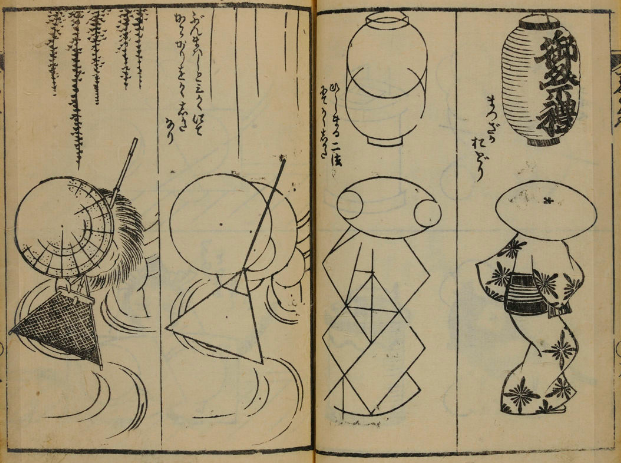
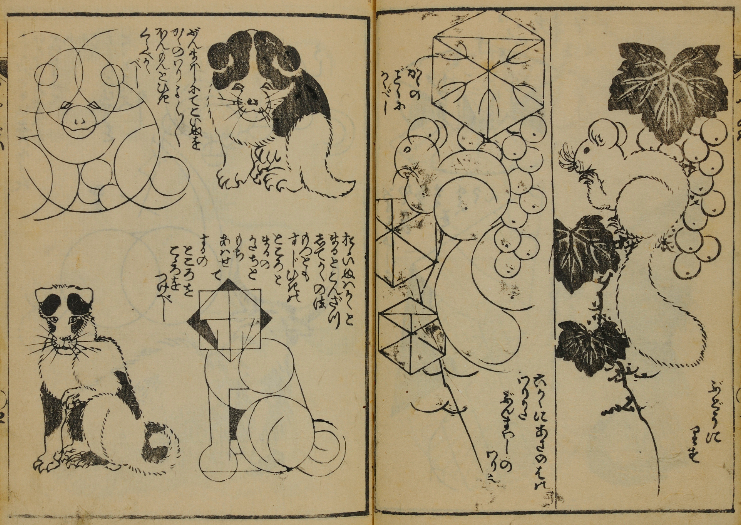
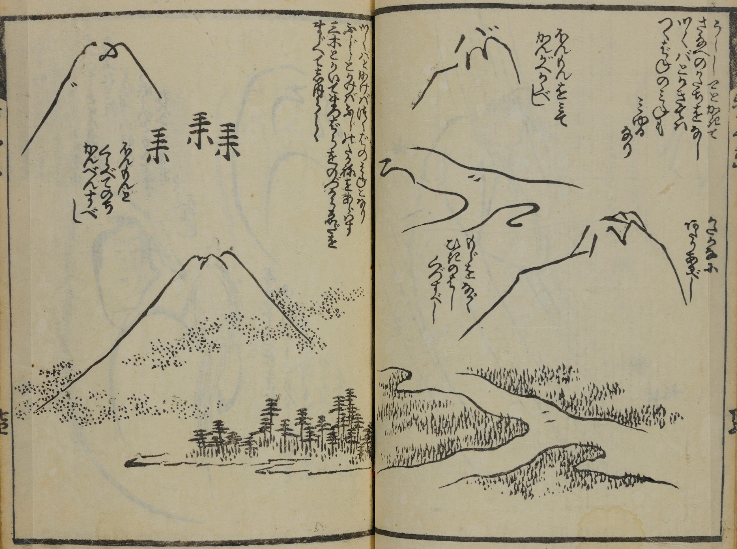
Hokusai’s bibliography, writes a Metafilter user by the name of Theodolite, includes “a little-known how-to book: 略画早指南, or Quick Lessons in Simplified Drawings, a manual in three parts. Volume I breaks every drawing down into simple geometric shapes; volume II decomposes them into fragmentary contours; and volume III neatly diagrams each stroke and the order in which they were drawn.”
Follow those links and you can read each of the books page-by-page, and not to worry if you don’t read Japanese; the artist renders his examples so clearly that the astute student can easily follow them.
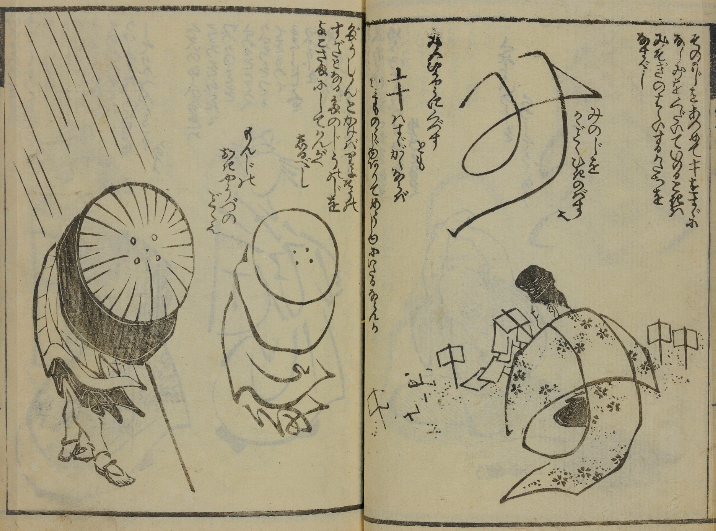
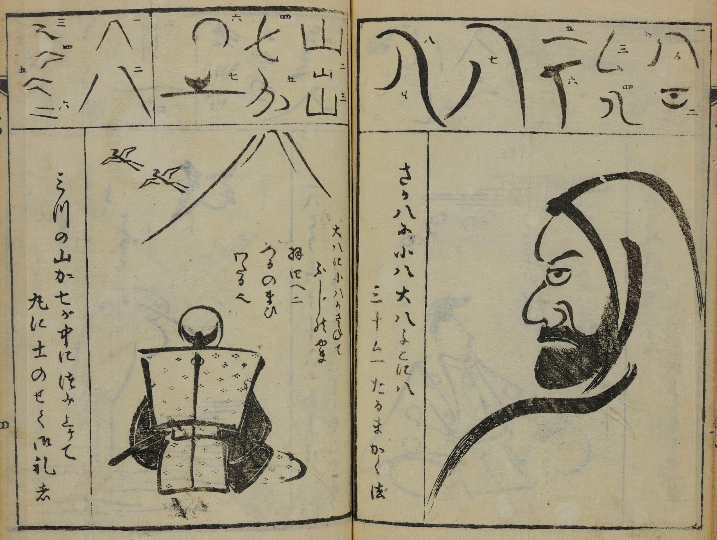
Not that an understanding of Japanese wouldn’t enrich the reading experience: “Those are not all contours — they’re often characters,” notes another Mefite in the comments. “On page 4, there are drawings based on の, no, and the cranes start with ふ, fu. On page 9, the drawing of the man on the right is elaborated from み, mi. The hill on page 12 comes from 山, san, ‘mountain.’ The rocks on page 19 are from 石, ishi, ‘stone.’ ” These pages thus provide the especially astute student a way to learn Hokusai’s style of drawing and the elements of the written Japanese language at once.
In addition to the Quick Lessons books, adds Theodolite, Hokusai’s “other pedagogical works include his Drawing Methods, Quick Pictorial Dictionary, Dance Instruction Manual, and the lovely, three-color Pictures Drawn in One Stroke.” Considering the immense respect accorded to Hokusai today from all corners of the world — up to and including subtle tributes paid in major motion pictures — it surprises some to learn that he considered himself a “mere” commercial artist. But perhaps that very attitude endowed him with a relatively common touch, of the kind that enabled him to share his techniques with the reading public so openly, and so elegantly.
(via Metafilter)
Related Content:
Enter a Digital Archive of 213,000+ Beautiful Japanese Woodblock Prints
Download 2,500 Beautiful Woodblock Prints and Drawings by Japanese Masters (1600–1915)
Download Hundreds of 19th-Century Japanese Woodblock Prints by Masters of the Tradition
Based in Seoul, Colin Marshall writes and broadcasts on cities and culture. His projects include the book The Stateless City: a Walk through 21st-Century Los Angeles and the video series The City in Cinema. Follow him on Twitter at @colinmarshall or on Facebook.
Read More...Pablo Neruda’s Poem, “The Me Bird,” Becomes a Short, Beautifully Animated Film
From 18bis, a Brazilian design & motion graphics studio, comes this: an animated interpretation of “The Me Bird,” a poem by the Nobel Prize-winning poet Pablo Neruda. Writes 18bis, “The inspiration in the strata stencil technique helps conceptualize the repetition of layers as the past of our movements and actions. The frames depicted as jail and the past as a burden serve as the background for the story of a ballerina on a journey towards freedom. A diversified artistic experimentation recreates the tempest that connects bird and dancer.” It’s all pretty wonderful.
Bonus material: You can watch The Making of The Me Bird here. And find the original text of the Neruda poem here. We have more poetry put to animation below.
Note: An earlier version of this post appeared on our site in 2013.
Related Content:
Poems as Short Films: Langston Hughes, Pablo Neruda and More
Watch an Animated Film of Emily Dickinson’s Poem ‘I Started Early–Took My Dog’
The Animation of Billy Collins’ Poetry: Everyday Moments in Motion
Four Charles Bukowski Poems Animated
Neil Gaiman’s Dark Christmas Poem Animated
Read More...Harvard Launches a Free Online Course to Promote Religious Tolerance & Understanding
It is difficult to have discussions in our current public square without becoming forced into false choices. Following Marshall McLuhan, we might think that the nature of the digital medium makes this happen, as much as the content of the messages. But some messages are more polarizing than others—with arguments over religion seemingly primed for binary oppositions.
That many nuanced positions exist between denying the validity of every religion and proclaiming a specific version as the only one true path shows how durable and flexible religious thought can be. The widespread diversity among religions cannot mask the significant degree of commonality between them, in all human societies, leading scholars like anthropologist Pascal Boyer to conclude, as he writes in Religion Explained, that “the explanation for religious beliefs and behaviors is to be found in the way all human minds work….”
I really mean all human minds not the just the minds of religious people or some of them. I am talking about human minds, because what matters here are properties of minds that are found in all members of our species with normal brains.
Famed Stanford biologist Robert Sapolsky, who happens to be an atheist, claims that somewhere around 95% of the human population believes in some sort of supernatural agency or religious set of explanations, and that such faith has “undeniable health benefits,” and is thus biologically motivated.
The real question, he reluctantly admits, is not why so many people believe, but “what’s up with the 5% of atheists who don’t do that?” The question needn’t imply there’s anything abnormal, inferior, or superior, about atheists. Variations don’t come with inherent values, though they may eventually become the norm.
But if we accept the well-supported thesis that religion is a phenomenon rooted in and naturally expressed by the human mind, like art, language, and literature, we would be negligent in remaining willfully ignorant of its expressions. And yet, Diane Moore, director of Harvard Divinity School’s Religious Literacy Project, tells the Huffington Post, “widespread illiteracy about religion… spans the globe” and “fuels bigotry and prejudice and hinders capacities for cooperative endeavors in local, national, and global arenas.”
Harvard aims to help change attitudes with their Religious Literacy Project, which offers free online courses on the world’s five major religions—Christianity, Islam, Judaism, Buddhism, and Hinduism—through their edX platform. The first course of the series, taught by Moore, is self paced. “Religious Literacy: Traditions and Scriptures” surveys the methodology of the project as a whole, exploring “case studies about how religions are internally diverse, how they evolve and change through time, and how religions are embedded in all dimensions of human experience.” (See a promo video at the top and a teaser for the project as a whole above.)
Understanding religion as both a universal phenomenon and a set of culturally and historically specific events resolves misunderstandings that result from oversimplified, static stereotypes. Studying the historical, theological, and geographical varieties of Islam, for example, makes it impossible to say anything definitive about one singular, monolithic “Islam,” and therefore about Muslims in general. The same goes for Christians, Hindus, Jews, Buddhists, etc. The fact that religion is embedded in nearly every facet of human experience, writes Moore in an introductory essay for the project, means that we can credit it with the “full range of agency from the heinous to the heroic,” rather than flipping between these extremes to score chauvinist points or invalidate entire realms of social life.
We’ve previously featured one of the courses from the big five series of classes, “Buddhism through its Scriptures.” The method there applies to each course, which all engage rigorously with primary sources and scholarly commentary to get students as close as possible to understanding religious practice from both the inside and the outside. Granted this canonical approach ignores the practices of millions of people outside the big five categories, but one could ostensibly apply a similar academic rubric to the study of syncretisms and indigenous religions all over the world.
Professor Moore’s “Religious Literacy” class—which you can audit free of charge or take for a certificate for $50—promises to give students the tools they need to understand how to survey religions critically, yet sympathetically, and to “interpret the roles religions play in contemporary and historic contexts.” Like it or not, religions of every kind remain pervasive and seemingly intractable. Rather than fighting over this fact of life, we would all do better to try and understand it. Begin to enlarge your own understanding by signing up for “Religious Literacy: Traditions and Scriptures” for free.
Related Content:
Atheist Stanford Biologist Robert Sapolsky Explains How Religious Beliefs Reduce Stress
Free Online Religion Courses
Josh Jones is a writer and musician based in Durham, NC. Follow him at @jdmagness
Read More...Hear Music Played on the Viola Organista, a Piano That Sounds Like a Violin, Which Leonardo da Vinci Invented, But Never Heard
The most illustrious of inventors, Leonardo da Vinci, was not moved by conventional ideas about success. He took commission after commission from his wealthy, aristocratic patrons, created meticulous plans, then moved on to the next thing without finishing—as if he had learned all he needed and had no more use for the project. The works we remember him for were a tiny handful among thousands of planned designs and artwork. They have the distinction of being his major masterpieces because they happen to be completed.
Had Leonardo finished all of his proposed projects, they would fill the Louvre. He was content to leave many of his paintings unpainted, sculptures unsculpted, and inventions unbuilt—sketched out in theory in his copious notebooks, protected from theft by his ingenious cryptography, and left for future generations to discover.
One such invention, the Viola Organista, might have changed the course of musical history had Leonardo had the wherewithal or desire to build one in his lifetime. Or it might have remained a minor curiosity; there is no way to know.
Sketched out in notebook pages contained in the Codex Atlanticus, the design showed “an outline of a construction concept for a bowed string instrument which at the same time is a keyboard instrument.” A violin that is also a piano, sort of…. Having built a version of the instrument 500 years after its invention, Polish concert pianist Slawomir Zubrzycki describes it as having “the characteristics of three [instruments] we know: the harpsichord, the organ and the viola da gamba.”
Zubrzycki spent four years working on his Viola Organista. A few years back, we featured a brief performance, his first public debut of the instrument in 2012. Now, we have much more audio of this incredible musical invention to share, including a longer performance from Zubrzycki at the top of the post, Marin Marais’ Suite in B Minor, performed in 2014 at the Copernicus Festival in Krakow. (You can see the full concert just above.) Despite these notable performances, and his notable creation, Zubrzycki is not the first to build a Viola Organista.
In 2011, Eduardo Paniagua, another musician devoted to Leonardo’s instrument—which does indeed sound like a “one person string ensemble,” as a commenter at this MetaFilter post noted—released a disc of 19 songs by Baroque composers, contemporaries of Leonardo, played on a Viola Organista built by Japanese maker Akio Obuchi. (Hear the full album on Spotify above.) Accompanying the album, writes Spanish site Musica Antigua (quoted in English here via Google translate), is “a profusely illustrated booklet with eleven of the organist viola prototypes that Leonardo himself devised,” with descriptions of the instrument’s operation by Paniagua.
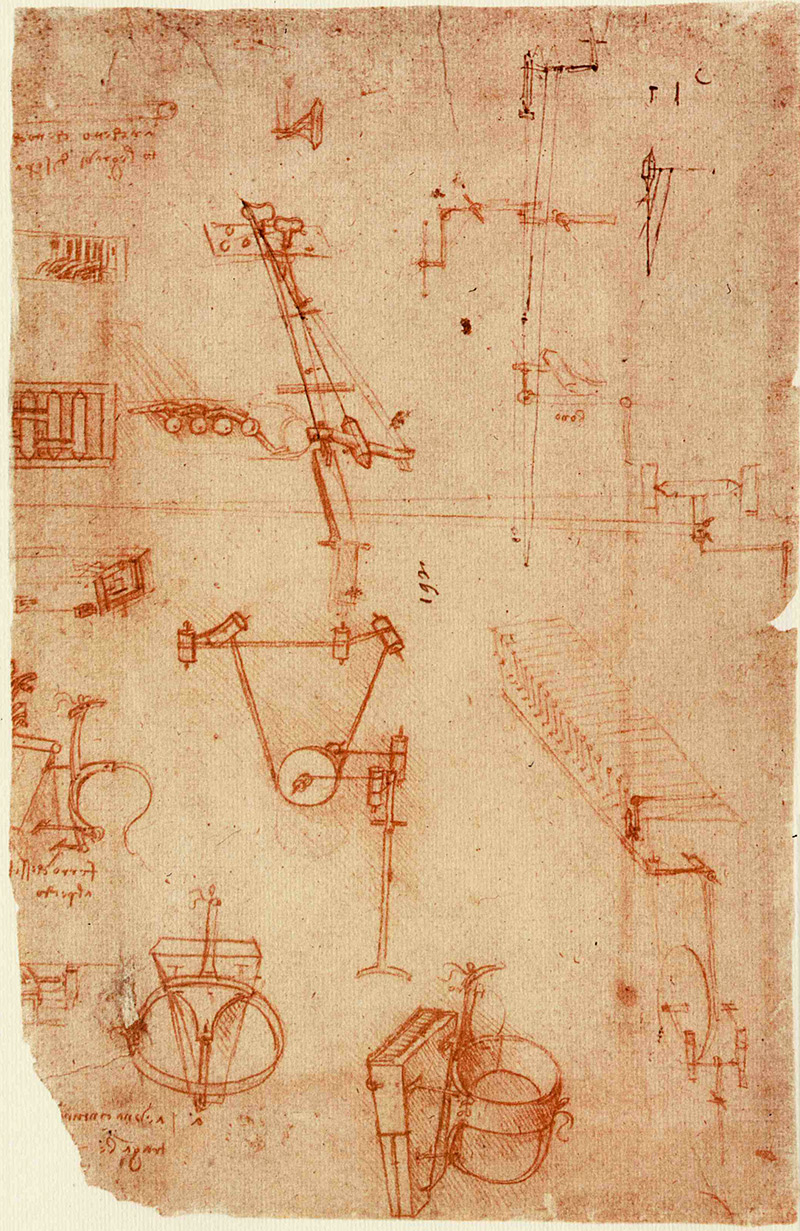
Though Leonardo himself never built, nor heard, the instrument, it did attract interest not long after his death. “The oldest surviving model,” notes Musica Antigua, “is in El Escorial and is dated at the beginning of the seventeenth century.” Every version of the Viola Organista worked from original design specs like those in Leonardo’s hand above, using wheels to bow the strings when the keys are pressed, rather than hammers to strike them.
It’s an ingenious solution to a problem musicians had sought for many years to solve: creating a keyboard with rich dynamics and sustain. Whether Leonardo’s design is superior to other attempts, like the clavichord or, for that matter, the piano, I leave to musicologists to debate. We might all agree that the sound of his instrument, as played by Paniagua and Zubrzycki, is truly original and totally captivating.
Related Content:
Leonardo da Vinci’s Visionary Notebooks Now Online: Browse 570 Digitized Pages
Leonardo da Vinci’s Bizarre Caricatures & Monster Drawings
Josh Jones is a writer and musician based in Durham, NC. Follow him at @jdmagness
Read More...Tattoos Can Now Start Monitoring Your Medical Conditions: Harvard and MIT Researchers Innovate at the Intersection of Art & Medicine
Once reserved for rebels and outliers, tattoos have gone mainstream in the United States. According to recent surveys, 21% of all Americans now have at least one tattoo. And, among the 18–29 demographic, the number rises to 40%. If that number sounds high, just wait until tattoos go from being aesthetic statements to biomedical devices.
At Harvard and MIT, researchers have developed “smart tattoo ink” that can monitor changes in biological and health conditions, measuring, for example, when the blood sugar of a diabetic rises too high, or the hydration of an athlete falls too low. Pairing biosensitive inks with traditional tattoo designs, these smart tattoos could conceivably provide real-time feedback on a range of medical conditions. And also raise a number of ethical questions: what happens when your health information gets essentially worn on your sleeve, available for all to see?
To learn more about smart tattoos, watch the Harvard video above, and read the corresponding article in the Harvard Gazette.
If you would like to support the mission of Open Culture, consider making a donation to our site. It’s hard to rely 100% on ads, and your contributions will help us continue providing the best free cultural and educational materials to learners everywhere. You can contribute through PayPal, Patreon, and Venmo (@openculture). Thanks!
Related Content:
A Dazzling Gallery of Clockwork Orange Tattoos
Free Online Biology Courses
Read More...Maya Angelou’s Secret to Living Your Best Life
Humans are proud of rationality, maybe to a fault. It can come at a significant cost: the tendency to overcomplicate the simplest of tasks, not the least being the task of life itself. Treatise after treatise, discourse after discourse, book after book, lecture after lecture appears over the centuries, promising to show us how to live the good life. We struggle, amidst the hundreds of other operations we must perform at any given time, to remember complex ethical systems in the moment, to incorporate new postures and routines.
Perhaps this is why we have mystics and poets, to cut through the tangles of logical thought, to remind us of the unchanging essentials: Rumi and Rilke, William Blake, Emily Dickinson, and Maya Angelou, who dazzled readers and audiences with advice both eloquent and plainspoken, transcendent and immanently down-to-earth. Angelou’s impassioned, warm delivery and hard-won wisdom made her an excellent spokesperson for some universal truths that get glossed over or explained away in the scramble to improve and enrich ourselves, such as the advice she gives on Oprah’s OWN network, above: “Just do right.”
We might recoil at the seeming naiveté: “who is right?,” “what is right?,” “how does anyone know what is right?,” “what if your right is my wrong?” etc. All reasonable questions up for reasonable debate. But Angelou isn’t interested here in philosophy but in life. “Just do right” speaks to a deeper part of us, the part we colloquially call a conscience, though maybe no such thing appears in an fMRI scan. “Just do right,” she says, and you pretty much know what that is. “You don’t really have to ask anybody,” she says. “The truth is, right may not be expedient, it may not be profitable, but it will satisfy your soul. It brings you the kind of protection that bodyguards can’t give you.”
Compassion, a clean conscience, a good reputation: this is the stuff of the good life, distilled down to its essence, at the heart of Greek, Roman, African, Chinese, Indian, Native American, and every other world philosophy and religion. We may find no more a succinct universal encouragement, and warning, than in Angelou’s advice:
Try to live your life in a way that you will not regret years of useless virtue and inertia and timidity…. You make your own choices… pick up the battle and make it a better world, just where you are.
This wisdom requires no high theory and is available to everyone free of charge—find out how you can make things better in your community, stop agonizing over productivity and money, and “just do right” right where you are. If this sounds too easy or too hard, listen to Angelou describe in brief what it takes in the clip above, and why “courage is the most important of the virtues.”
Related Content:
Maya Angelou Reads Her Poem “On the Pulse of Morning” (1993)
Maya Angelou Tells Studs Terkel How She Learned to Count Cards & Hustle in a New Animated Video
What is the Good Life? Plato, Aristotle, Nietzsche, & Kant’s Ideas in 4 Animated Videos
Josh Jones is a writer and musician based in Durham, NC. Follow him at @jdmagness
Read More...Malcolm Gladwell Teaching His First Online Course: A Master Class on How to Turn Big Ideas into Powerful Stories
FYI: If you sign up for a MasterClass course by clicking on the affiliate links in this post, Open Culture will receive a small fee that helps support our operation.
The one about the dog whisperer, the one about how job interviews and sports drafts work (or don’t), the one about the ideas Apple took from Xerox PARC to create the personal computer as we know it: most of us have a favorite Malcolm Gladwell article. (I happen to like the one on how an Austrian architect invented the American shopping mall, so much that I’ve previously cited it here on Open Culture.) Those all ran in the New Yorker, where Gladwell has contributed since 1996. Since then, his enterprises have expanded to include bestselling books, much-circulated TED Talks, and even a hit podcast. How does he do it?
We now have the chance to learn just that in a new online course taught by Gladwell himself, going live this spring on Masterclass. Though many know him only from his speaking or audiovisual media, the core of his work still gets done when he puts words on a page. Hence the title and subject matter of his Masterclass: “Malcolm Gladwell Teaches Writing.”
If you sign up for MasterClass through an All-Access Pass, we’re promised insight into how Gladwell uses ordinary subjects to help “millions of readers devour complex ideas like behavioral economics and performance prediction” and an understanding of how he “researches topics, crafts characters, and distills big ideas into simple, powerful narratives.”
“We’re going to talk about suspense, structure, research, humility, characters, puzzles, and semicolons,” says Gladwell in the course’s trailer above. He also mentions one of the common mistakes he’ll correct: that “writers spend a lot of time thinking about how to start their stories and not a lot of time thinking about how to end them.” If you’ve always wanted to write Gladwellian prose — “at an eighth grade level,” as he himself describes it, “but with ideas that are super sophisticated” — this Masterclass’ twenty lessons will get you putting in a few of the ten thousand (or so) hours you need to attain mastery. That might sound like a lot of time, but keep Gladwell’s words of guidance in mind: “The job of the writer is not to supply the ideas; it is to be patient enough to find the ideas.”
You can take this class by signing up for a MasterClass’ All Access Pass. The All Access Pass will give you instant access to this course and 85 others for a 12-month period.
Related Content:
Malcolm Gladwell: Taxes Were High and Life Was Just Fine
Malcolm Gladwell: What We Can Learn from Spaghetti Sauce
Based in Seoul, Colin Marshall writes and broadcasts on cities and culture. His projects include the book The Stateless City: a Walk through 21st-Century Los Angeles and the video series The City in Cinema. Follow him on Twitter at @colinmarshall or on Facebook.
Read More...Enter the Cover Art Archive: A Massive Collection of 800,000 Album Covers from the 1950s through 2018
When I get to muttering in my beard about kids today, the subject oft turns to digital music and how everything sounds the same and looks the same and “what ever happened to album covers, man….” I mean I know they still exist, but they’re terrible, right? Shiny thumbnail-sized afterthoughts with no more purpose than candy in a shop window display? I will admit it, and not without some chagrin, I’ve always thought that whoever designed Taylor Swift’s 1989 had a canny sense of the derivative as a quality one should wear proudly on one’s sleeve—it’s evocative!, in a fun way, not in the way of her most recent, severely Teutonic cover incarnation.
So, it’s not all bad, because there’s one good Taylor Swift album cover. But then album art has never been all good. Far from it. I remember album covers like this and this and these being the norm. And then there’s … well you’ve probably seen these jaw-dropping monstrosities from the distant past….
Maybe the truly awful album cover is as rare a treasure as the truly great one. Maybe the album cover is as it always was, despite so rarely appearing in a physical form: sometimes an inspired work of art, sometimes a half-assed, tossed-off marketing job, sometimes a half-baked, so-bad-its-good (or not) concept, completely unrelated to the music.
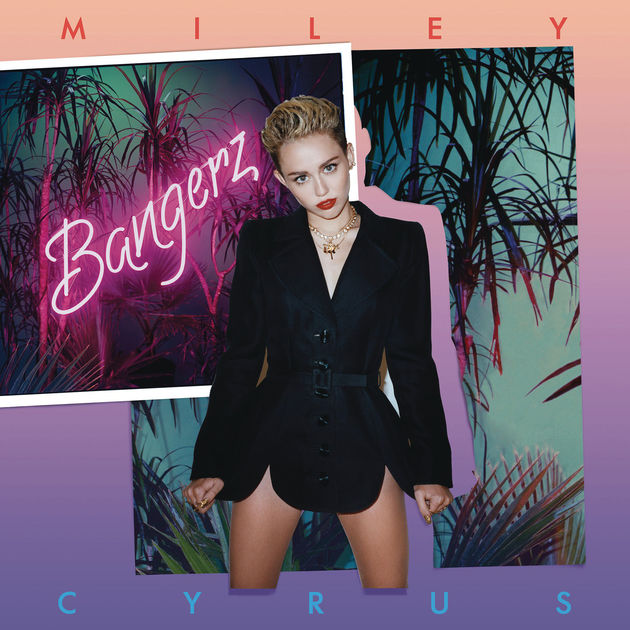
It can sometimes seem like all we have left is nostalgia, but nostalgia can be done well, as in 1989 (even if that record’s cover does evoke, in part, an image from Joni Mitchell’s weird stint in blackface). Or it can be done badly, as in Justin Timberlake’s widely disliked 2018 Man of the Woods, which makes a lame artsy attempt to dress up the fact that it’s kinda ripping off 1989 four years later. I do not know how to evaluate Miley Cyrus’ various Miami Vice-themed covers for her album Bangerz, which came out in the same year as 1989, except to say, good for her for going all the way with this, like, why hold back?
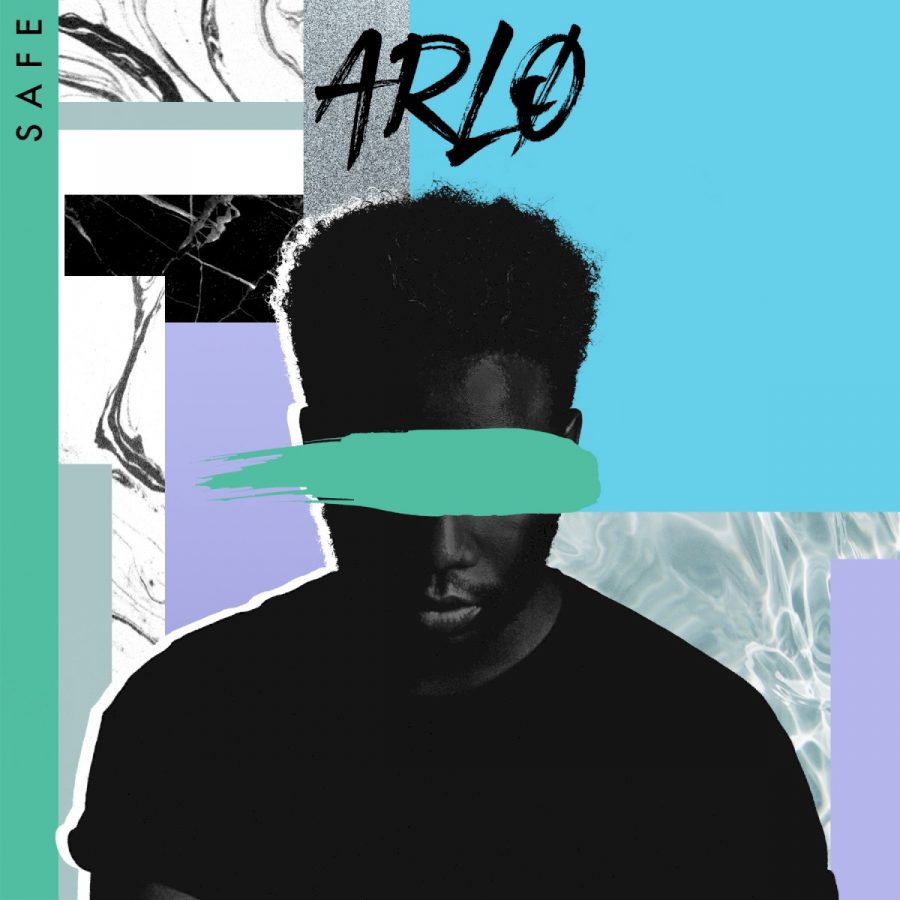
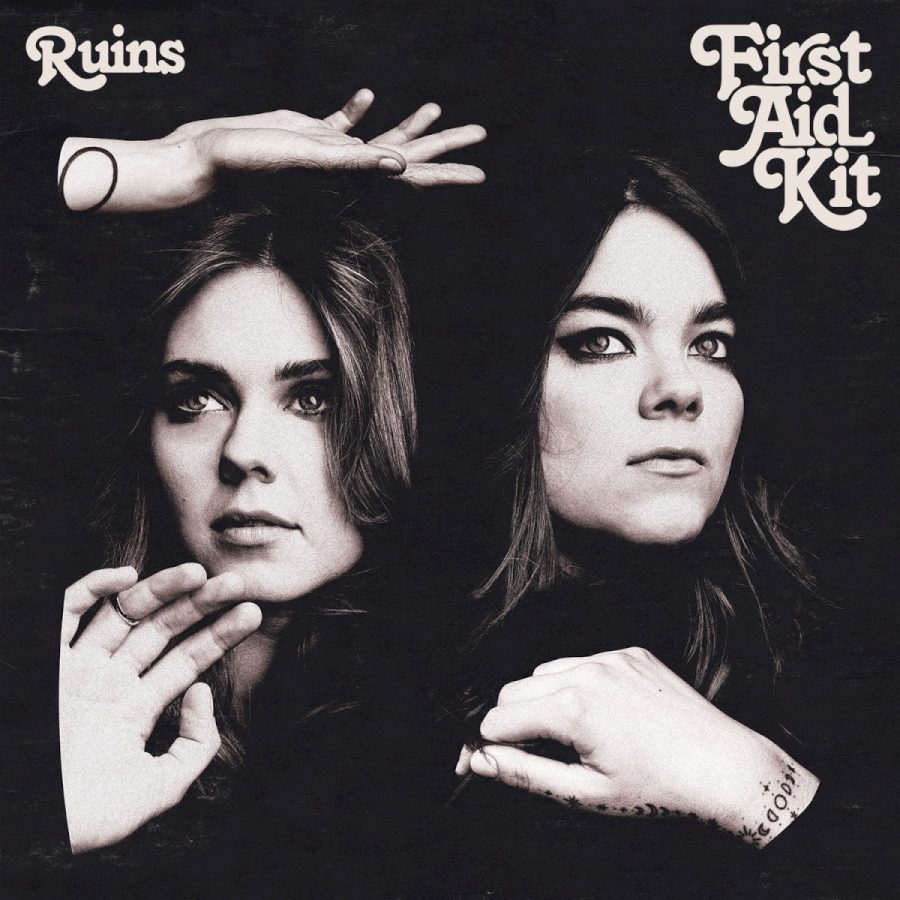
Other recent album covers mime the style of decades past with real swagger, like Swedish folk sister duo First Aid Kit’s Heart-inspired Ruins cover, at the top, featuring one of many retro 70s fonts that have returned of late, as easy to read in thumbnail images as they were on 8‑track tapes. The cover of London artist Arlo’s 2017 single “Safe” has its obvious 80s Duran Duran pastel and marble swirl deco trends down, tastefully and knowingly applied.
You can do your own cultural anthropology of the album cover, from 2018’s era of eye candy glamor, and the recent creative—and not-so-creative—repurposing of the past, to the genuine articles from the 50s, 60s, 70s, 80s, and 90s at the Cover Art Archive, a joint project of the Internet Archive and MusicBrainz, an “open music encyclopedia that collects music metadata and makes it available to the public.
The collection now numbers in the several hundred thousands—upwards of 800,000, according to its results counter—but some of the uploads are not yet complete with images. You are invited to contribute and help make this amazing resource even more comprehensive. “To get started,” the MusicBrainz blog writes, “log in with your MusicBrainz account (or create a new one) find your favorite release and then click on the cover art tab to view the existing pieces of art and/or upload new ones.”
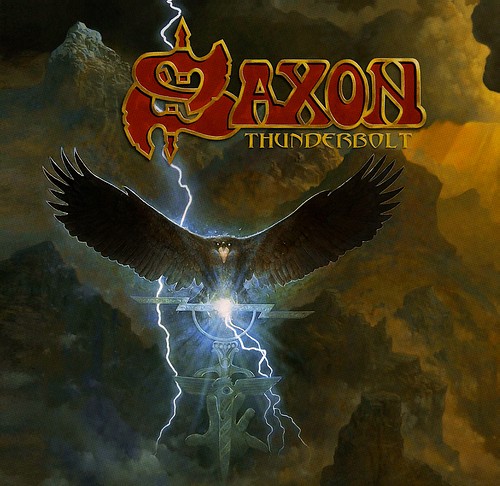
You may find, as you browse and compare genres and eras, that perhaps the album cover is in decline, or you may find that it is alive and well, still an innovative form despite the massive shift in modes of production. At least aged British metal band Saxon, a true original, still keeps it real, further up, with the cover of their 22nd album, 2018’s Thunderbolt. Many of Saxon’s progeny have continued in the tradition of high fantasy metal cover art.
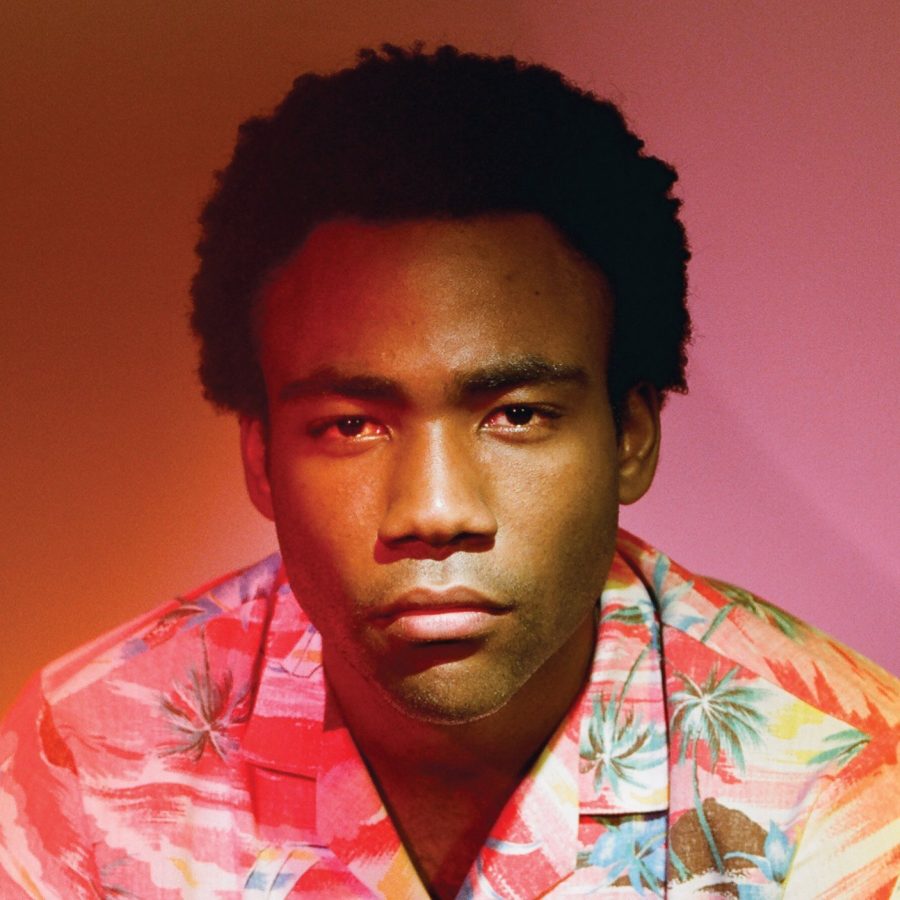
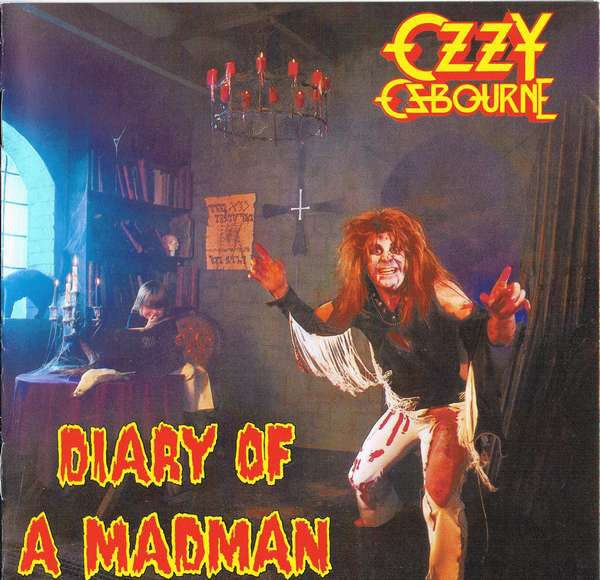
Some things will never return. There’ll never be another Diary of a Madman, that’s for sure, or another Ozzy. But the in-your-face soft-focus garishness of the 80s, and the styles of nearly every other decade, live on, to take a phrase from Childish Gambino’s 2013 outing, Because the Internet.
Enter the Cover Art archive and start searching by year, artist, and other parameters here.
Related Content:
How The Beatles’ Sgt. Pepper’s Lonely Hearts Club Band Changed Album Cover Design Forever
Josh Jones is a writer and musician based in Durham, NC. Follow him at @jdmagness
Read More...A Big Archive of Occult Recordings: Historic Audio Lets You Hear Trances, Paranormal Music, Glossolalia & Other Strange Sounds (1905–2007)
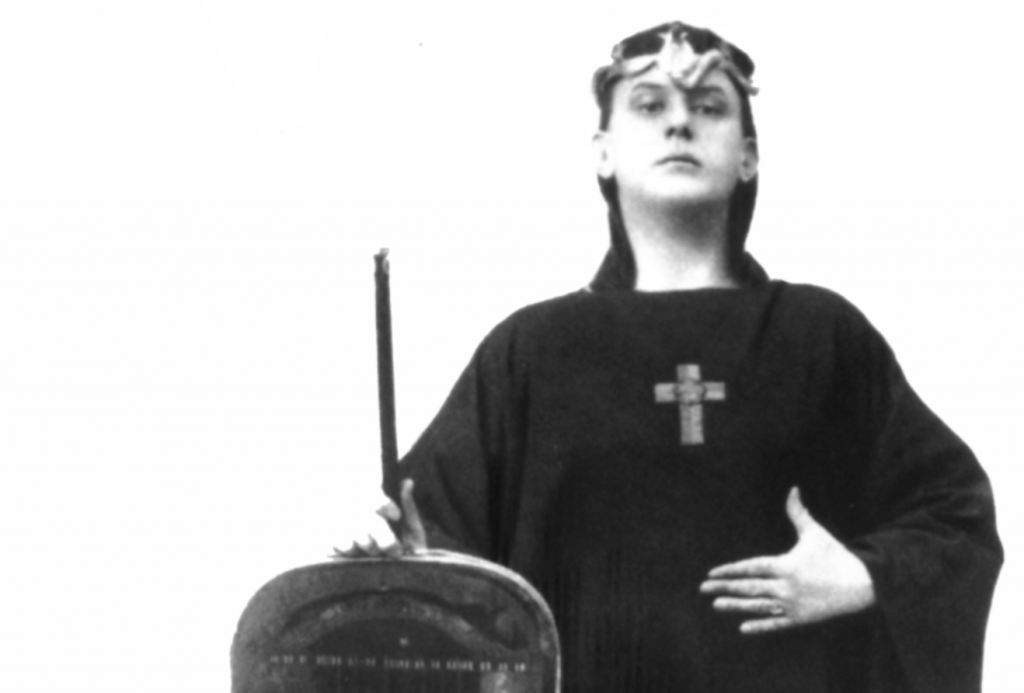
Aleister Crowley in ceremonial garb, 1912, via Wikimedia Commons
We’ve all had our wits scared out of us by films, images, and the written word, but somehow few forms work their haunting magic quite so effectively as sound alone. Think of the snap of the twig in the woods or the creak of the staircase in the empty house — or, to take it farther, the sound of possessed children speaking in tongues. You can hear recordings of that and other unusual phenomena at Ubuweb, which hosts the collection Occult Voices – Paranormal Music, Recordings of Unseen Intelligences 1905–2007.
The eerie recordings on offer include “audio documents of paranormal phenomena including trance speech, direct voices, clairvoyance, xenoglossy, glossolia including ethnological material, paranormal music, ‘rappings’ and other poltergeist manifestations as well as so-called ‘Electronic voice phenomena.’ ”
A rich mixture indeed, and one that begins with those possessed kids, all of them recorded in the post-Exorcist late 1970s and early 80s; you can hear the eight-year-old “Janet” sounding not unlike the devil-filled Linda Blair in the recording embedded above.
Later we hear from mediums like Britain’s famed Leslie Flint, one of the last of his kind to ostensibly speak directly in the voices of the channeled deceased, including figures as accomplished and distinctive as Oscar Wilde in 1975 (above), Charlotte Brontë in 1973, and Winston Churchill in 1980.
The collection also contains the voice of Arthur Ford, who made his name as a medium by claiming to have made contact with the spirit of Harry Houdini. In the clip above, you can hear five minutes of Ford’s final Houdini séance, conducted in 1936.
No collection of occult materials would be complete, of course, without something from Aleister Crowley, surely the most famous occultist in modern history, and one known in his time as “the wickedest man in the world.” Just above we have Crowley reciting “The Call of the First Aethyr,” a piece of occult poetry he recorded in a 1920 session that produced the only known recordings of his voice.
Though Crowley, like many of the other spiritualists captured here, hailed from Britain, much of the material in the collection comes from Germany, especially the kind of paranormal music heard just above. But no matter where in the world these recordings were made, and whether or not you believe in the existence of other realms beyond that world, describing any of the recordings gathered here will leave you grasping for any adjective besides otherworldly.
Enter the archive of Occult Voices here.
Related Content:
Aleister Crowley Reads Occult Poetry in the Only Known Recordings of His Voice (1920)
The Strange, Sci-Fi Sounds of Skating on Thin Black Ice
Based in Seoul, Colin Marshall writes and broadcasts on cities and culture. His projects include the book The Stateless City: a Walk through 21st-Century Los Angeles and the video series The City in Cinema. Follow him on Twitter at @colinmarshall or on Facebook.
Read More...Hear Rick Wakeman’s Musical Adaptation of Jules Verne’s Journey to the Centre of the Earth, “One of Prog Rock’s Crowning Achievements”
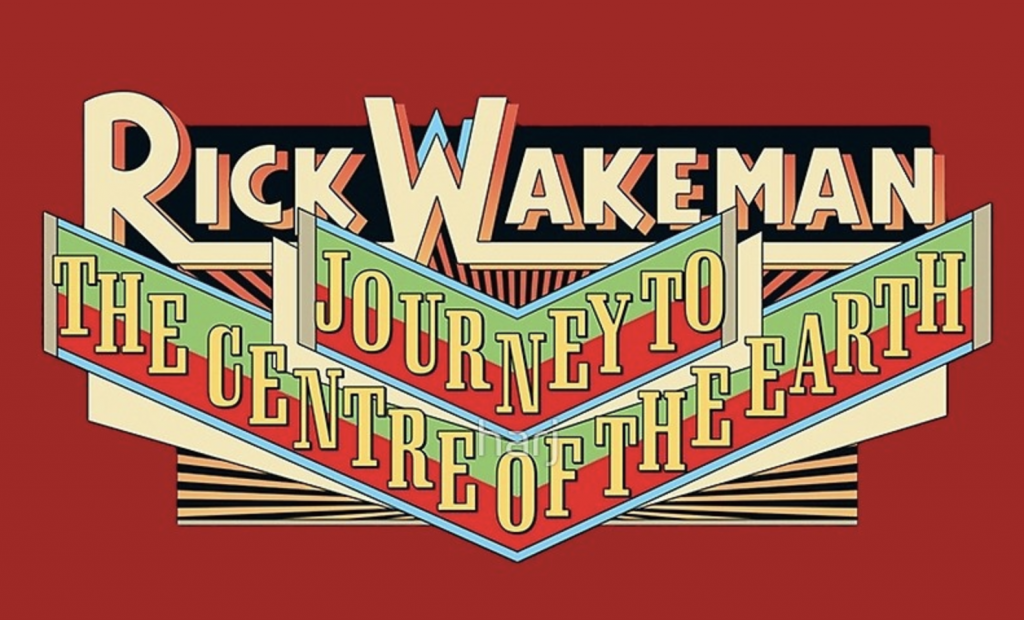
So unfashionable for so long, progressive rock has lately come in for a re-evaluation. The qualities that current music critics have come to appreciate — often the very same ones that bothered so many of their colleagues in the 1970s — include its technical virtuosity, its compositional inventiveness, its sheer performative unabashedness, and its willingness to draw from other forms of art, especially literature. Or literature of a certain kind, anyway: having previously featured prog-rock adaptations of Isaac Asimov’s I, Robot by the Alan Parsons Project, George Orwell’s 1984 by Rick Wakeman, and H.G. Wells’ War of the Worlds by Jeff Wayne, today we give you Jules Verne’s Journey to the Centre of the Earth as adapted by Wakeman in 1974.
You can listen to the album, which All Music Guide’s Mike DeGagne calls “one of progressive rock’s crowning achievements,” on Spotify (and if you don’t have Spotify’s free software, you can download it here). “With the help of the London Symphony Orchestra and the English Chamber Choir, Rick Wakeman turns this classic Jules Verne tale into an exciting and suspenseful instrumental narrative,” using not just his own Hammond organ and Moog synthesizer but Blow-Up star David Hemmings’ recitation of Verne’s words as well.
“Recorded at London’s Royal Festival Hall, the tale of a group of explorers who wander into the fantastic living world that exists in the Earth’s core is told musically through Wakeman’s synthesized theatrics and enriched by the haunting vocals of a chamber choir.”
Wakeman’s Journey to the Centre of the Earth demonstrates what not just Verne’s subterranean explorers but all the best prog-rockers have in spades: ambition. And though the work evidences deep familiarity with the novel on Wakeman’s part, you needn’t have read a page of Verne — nor of the recent books attempting to bring prog-rock to respectability — to enjoy it. You don’t even need to take it seriously, as one All Music Guide user-reviewer, present as a wide-eyed teenager at the Royal Festival Recording, adds: “It was all very avant garde and I felt quite sophisticated as a 16-year-old attending the show with smart kids who use to sit around crossed legged on the floor listening to Dark Side Of The Moon.” For him, the album now provides “a view back to the oh so earnest days of grandiose prog-rock and for that reason alone it can be seen as something it never was at the time… fun!”
Related Content:
Rick Wakeman’s Prog-Rock Opera Adaptation of George Orwell’s 1984
Hear The Alan Parson Project’s Prog-Rock Interpretation of Isaac Asimov’s, I Robot (1977)
The Great Leonard Nimoy Reads H.G. Wells’ Seminal Sci-Fi Novel The War of the Worlds
Based in Seoul, Colin Marshall writes and broadcasts on cities and culture. His projects include the book The Stateless City: a Walk through 21st-Century Los Angeles and the video series The City in Cinema. Follow him on Twitter at @colinmarshall or on Facebook.
Read More...Support Us
We're hoping to rely on loyal readers, rather than erratic ads. Please click the Donate button and support Open Culture. You can use Paypal, Venmo, Patreon, even Crypto! We thank you!

About Us

Open Culture scours the web for the best educational media. We find the free courses and audio books you need, the language lessons & educational videos you want, and plenty of enlightenment in between.
Advertise With Us

FREE UPDATES!
GET OUR DAILY EMAIL
Get the best cultural and educational resources on the web curated for you in a daily email. We never spam. Unsubscribe at any time.
FOLLOW ON SOCIAL MEDIA

Open Culture editor Dan Colman scours the web for the best educational media. He finds the free courses and audio books you need, the language lessons & movies you want, and plenty of enlightenment in between.
Advertise With Us


