Hear Rick Wakeman’s Musical Adaptation of Jules Verne’s Journey to the Centre of the Earth, “One of Prog Rock’s Crowning Achievements”
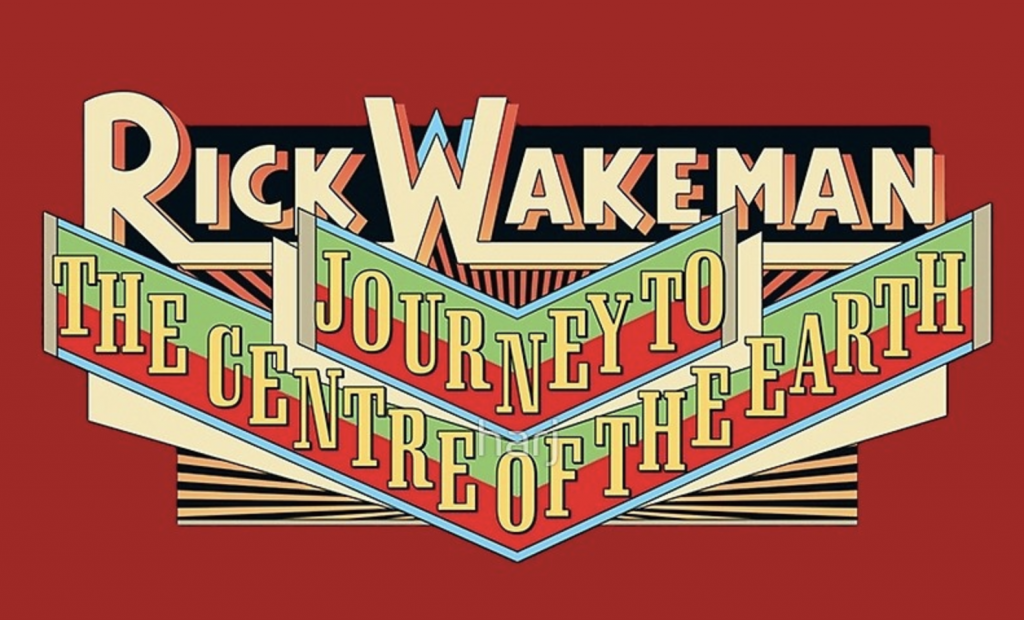
So unfashionable for so long, progressive rock has lately come in for a re-evaluation. The qualities that current music critics have come to appreciate — often the very same ones that bothered so many of their colleagues in the 1970s — include its technical virtuosity, its compositional inventiveness, its sheer performative unabashedness, and its willingness to draw from other forms of art, especially literature. Or literature of a certain kind, anyway: having previously featured prog-rock adaptations of Isaac Asimov’s I, Robot by the Alan Parsons Project, George Orwell’s 1984 by Rick Wakeman, and H.G. Wells’ War of the Worlds by Jeff Wayne, today we give you Jules Verne’s Journey to the Centre of the Earth as adapted by Wakeman in 1974.
You can listen to the album, which All Music Guide’s Mike DeGagne calls “one of progressive rock’s crowning achievements,” on Spotify (and if you don’t have Spotify’s free software, you can download it here). “With the help of the London Symphony Orchestra and the English Chamber Choir, Rick Wakeman turns this classic Jules Verne tale into an exciting and suspenseful instrumental narrative,” using not just his own Hammond organ and Moog synthesizer but Blow-Up star David Hemmings’ recitation of Verne’s words as well.
“Recorded at London’s Royal Festival Hall, the tale of a group of explorers who wander into the fantastic living world that exists in the Earth’s core is told musically through Wakeman’s synthesized theatrics and enriched by the haunting vocals of a chamber choir.”
Wakeman’s Journey to the Centre of the Earth demonstrates what not just Verne’s subterranean explorers but all the best prog-rockers have in spades: ambition. And though the work evidences deep familiarity with the novel on Wakeman’s part, you needn’t have read a page of Verne — nor of the recent books attempting to bring prog-rock to respectability — to enjoy it. You don’t even need to take it seriously, as one All Music Guide user-reviewer, present as a wide-eyed teenager at the Royal Festival Recording, adds: “It was all very avant garde and I felt quite sophisticated as a 16-year-old attending the show with smart kids who use to sit around crossed legged on the floor listening to Dark Side Of The Moon.” For him, the album now provides “a view back to the oh so earnest days of grandiose prog-rock and for that reason alone it can be seen as something it never was at the time… fun!”
Related Content:
Rick Wakeman’s Prog-Rock Opera Adaptation of George Orwell’s 1984
Hear The Alan Parson Project’s Prog-Rock Interpretation of Isaac Asimov’s, I Robot (1977)
The Great Leonard Nimoy Reads H.G. Wells’ Seminal Sci-Fi Novel The War of the Worlds
Based in Seoul, Colin Marshall writes and broadcasts on cities and culture. His projects include the book The Stateless City: a Walk through 21st-Century Los Angeles and the video series The City in Cinema. Follow him on Twitter at @colinmarshall or on Facebook.
Read More...HBO Drops a Teaser Trailer for Fahrenheit 451, Its New Adaptation of Ray Bradbury’s Classic Dystopian Novel
From HBO comes the latest teaser trailer for a new adaptation of Ray Bradbury’s 1953 dystopian novel, Fahrenheit 451. Scheduled to debut in May 2018, the new film will feature Michael B. Jordan and Michael Shannon.
Ostensibly Fahrenheit 451 is a story about government censorship. And some have considered it a response to McCarthyism. But, when asked what the story is really about, Ray Bradbury said this: It’s about people “being turned into morons by TV.” As a medium, television “gives you the dates of Napoleon, but not who he was,” spreading “factoids” instead of knowledge. “They stuff you with so much useless information, you feel full.” Just something to keep in mind before and after the new HBO film hits your TV sets this spring.
If you would like to support the mission of Open Culture, consider making a donation to our site. It’s hard to rely 100% on ads, and your contributions will help us continue providing the best free cultural and educational materials to learners everywhere. You can contribute through PayPal, Patreon, and Venmo (@openculture). Thanks!
Related Content:
Hear Ray Bradbury’s Classic Sci-Fi Story Fahrenheit 451 as a Radio Drama
Read More...Large Archive of Hannah Arendt’s Papers Digitized by the Library of Congress: Read Her Lectures, Drafts of Articles, Notes & Correspondence
Many people read the German-Jewish political philosopher and journalist Hannah Arendt as something of an oracle, a secular prophet whose most famous works—her essay on the trial of Adolf Eichmann and her 1951 Origins of Totalitarianism—contain secrets about our own times of high nationalist fervor. And indeed they may, but we should also keep in mind that Arendt’s insights into the horrors of Nazism did not emerge until after the war.
Arendt did not identify as Jewish during the Nazi’s rise to power, but as a fully assimilated German; she had a romantic relationship with her professor Martin Heidegger, who became a doctrinaire Nazi, and she seemed to have little understanding of German antisemitism during the thirties and forties. Arendt, many have alleged, sometimes seemed too close to her subject.
In such times as hers, to use the words of Wallace Stevens—a writer with his own complicated relationship to fascism—the “difficult rigor” of observing the moment means that “we reason of these things with later reason.” Arendt’s observations of Europe in the 1950s were reckonings with the recent past—she drew together strains of experience that could not always be connected during what Stevens calls the “irrational moment.” So too, intellectual observers of our own “irrational moment” may only truly understand it “with later reason.”
But if Americans wish to learn about their country’s longstanding political tendencies from Arendt’s work, it is perhaps not to her writing on Germany or the U.S.S.R. that we should turn, but to her work on the U.S., much of which is reflected in typed drafts of essays and lectures, correspondence, and notes contained at the Library of Congress’s Hannah Arendt Papers collection. All of the collection has been digitized, and some of those scans are online. Finding out which documents have been uploaded and which only remain viewable onsite takes a little digging around in the catalog, but it is work that pays off for those with a genuine interest in the fascinating turns of Arendt’s thought.
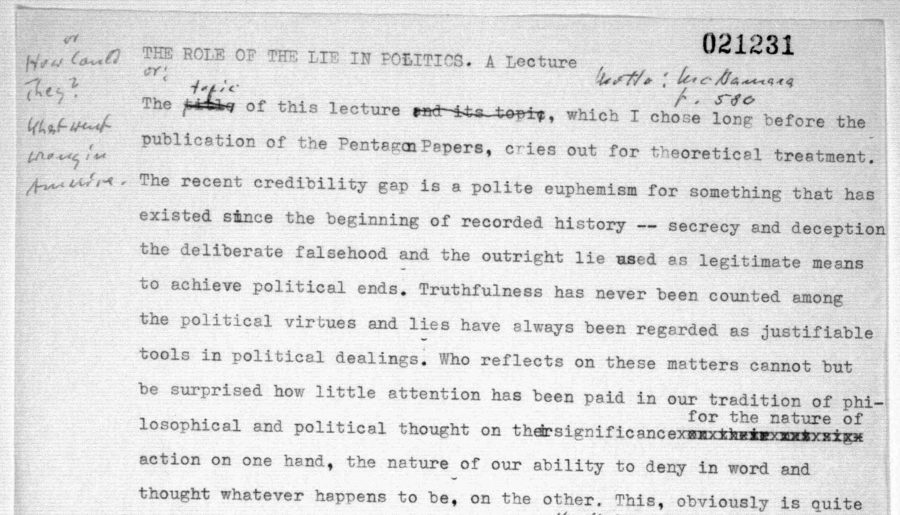
We may turn to essays such as 1971’s “Lying in Politics,” written after the release of the Pentagon Papers, notes Brain Pickings, and “included in Crises of the Republic—a collection of Arendt’s timelessly insightful and increasingly timely essays on politics [and] civil disobedience.” As Arendt writes in an earlier lecture that preceded “Lying in Politics”—with the earlier title “The Role of the Lie in Politics” (top)—“Truthfulness has never been counted as among the political virtues.” You can view and download high-quality images of that typed lecture here, and see her revise her ideas in corrections and marginal notes.
The political lie, she writes wearily, “has existed since the beginning of recorded history.” And yet, there is something unique about its use in U.S. politics, in which “the only person likely to be an ideal victim of complete manipulation is the President of the United States.” Despite her dispassionate philosophical view, Arendt found the lies of the Vietnam War-era particularly disturbing. In the typescript page at the top, you can see a proposed subtitle penciled in at the top left corner: “How Could They? What Went Wrong in America.”
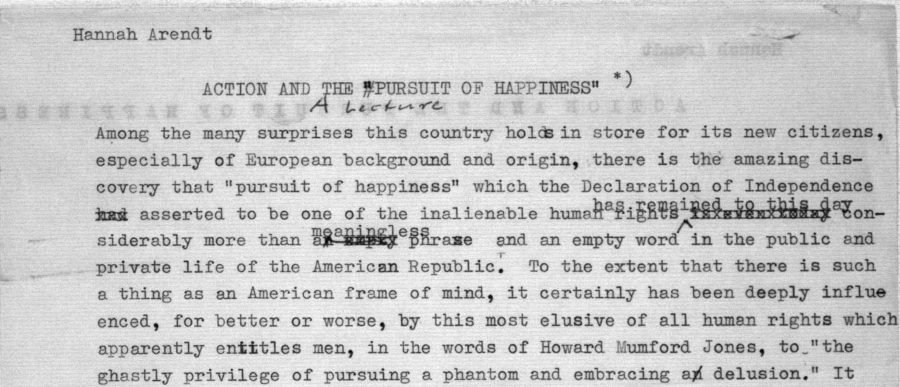
In the typed lecture above, “Action and the Pursuit of Happiness,” from 1960, Arendt remarks on the “amazing discovery” by the country’s naturalized “new citizens” that the “pursuit of happiness” remains a “more than meaningless phrase and an empty word in the public and private life of the American Republic.” This “most elusive of all human rights,” she continues, “apparently entitles men, in the words of Howard Mumford Jones, to ‘the ghastly privilege of pursuing a phantom and embracing a delusion.’”
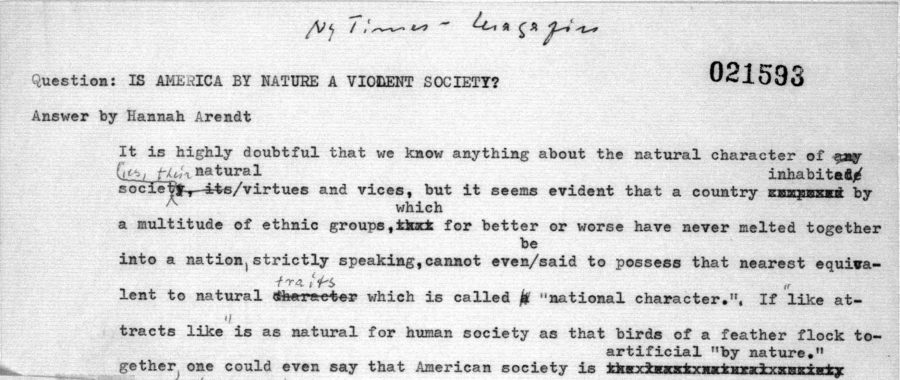
Arendt’s 1968 New York Times editorial “Is America By Nature a Violent Society,” whose typescript you can see in part above, opens with a number of assumptions about the country’s “national character,” beginning with the comment that the country’s “multitude of ethnic groups… for better or worse have never melted together into a nation.” Perhaps this is too broad a characterization. Or perhaps the U.S. as a nation is no more “artificial ‘by nature,’” in its composition than many other, much older, nations.
Arendt’s observations on her adopted land weren’t always so astute, but she did have enough critical distance from the country to closely observe it during times of crisis and see clearly what others could or would not. You’ll find many more of Arendt’s keen observations—typed in drafts and notes, scribbled in margins, and written in letters—at the Library of Congress’ Hannah Arendt Papers collection, (partly) online.
Related Content:
Josh Jones is a writer and musician based in Durham, NC. Follow him at @jdmagness
Read More...What Ancient Chinese Philosophy Can Teach Us About Living the Good Life Today: Lessons from Harvard’s Popular Professor, Michael Puett
It has at times been concerning for some Buddhist scholars and teachers to watch mindfulness become an integral part of self-help programs. A casual attitude toward the practice of mindfulness meditation can make it seem accessible by making it seem relaxing and effortless, which often results in missing the point entirely. Whatever the school, lineage, or particular tradition from which they come, the source texts and sages tend to agree: the purpose of meditation is not self improvement—but to realize that there may, indeed, be no such thing as a self.
Instead, we are all epiphenomenon arising from combinations of ever-shifting elements (the aggregates, or skandhas). The self is a conventionally useful illusion. This notion in the ancient Indian texts has its echo in Scottish enlightenment philosopher David Hume’s so-called “bundle theory,” but Hume’s thoughts about the self have mostly remained obscure footnotes in western thought, rather than central premises in its philosophies and religions. But as thinkers in India took the self apart, so too did philosophers in ancient China, before Buddhism reached the country during the Han Dynasty.
Harvard Professor Michael Puett has been lecturing on Chinese philosophy to audiences of hundreds of students—and at 21st century temples of self-actualization like TED and the School of Life. He has co-authored a book on the subject, The Path: What Chinese Philosophers Can Teach Us About the Good Life, drawn from his enormously popular university courses, in which he expounds the philosophies of Confucius, Mencius, Zhuangzi, and Xunzi. The book has found a ready audience, and Puett’s “Classical Chinese Ethical and Political Theory” is the 3rd most popular class among Harvard undergraduates, behind intro to economics and computer science. What Professor Puett offers, in his distillation of ancient Chinese wisdom, is not at all to be construed as self-help.
Rather, he says, “I think of it as sort of anti-self-help. Self-help tends to be about learning to love yourself and embrace yourself for who you are. A lot of these ideas are saying precisely the opposite—no, you overcome the self, you break the self. You should not be happy with who you are.” Lest this sound like some form of violence, we must understand, Puett tells Tim Dowling at The Guardian, that in “breaking” the self, we are only doing harm to an illusion. As in the Buddhist thought that took root in China, so too in the earlier Confucianism: there is no self, just a “a messy and potentially ugly bunch of stuff.”
While our current circumstances may seem unique in world history, Puett shows his students how Chinese philosophers 2,500 years ago also experienced rapid societal change and upheaval, as his co-author Christine Gross-Loh writes at The Atlantic; they navigated and understood “a world where human relationships are challenging, narcissism and self-centeredness are on the rise, and there is disagreement on the best way for people to live harmoniously together.” A majority of students at Harvard are driven to pursue “practical, predetermined” careers. By teaching them Confucian and Daoist philosophy, Puett tries to help them become more spontaneous and open to change.
Whatever we call it, the interacting phenomenon that give rise to the self cannot, we know, be observed in anything resembling an unchanging steady state. Yet Western culture (for several motivated reasons) has lagged far behind both intuitive and scientific observations of this fact. Puett’s students have been told, “’Find your true self, especially during these four years of college,’” and “try and be sincere and authentic to who you really are” in making choices about careers, partners, passions, and consumer products. They take to his class because “they’ve spent 20 years looking for this true self and not finding it.”
In the two lectures above—a shorter one at the top from TEDx Nashville and a longer talk above for Ivy, “The Social University”—you can get a taste of Puett’s enthusiastic style. Chinese philosophy, “in its strong form,” he says above, “can truly change one’s life.” Not by making us more empowered, personally-fulfilled agents who re-create reality to better meet our narrow specs. But rather, as he tells Dowling, by training us “to become incredibly good at dealing with this capricious world.”
Related Content:
An Introduction to Confucius’ Life & Thought Through Two Animated Videos
Josh Jones is a writer and musician based in Durham, NC. Follow him at @jdmagness
Read More...Hunter S. Thompson’s Decadent Daily Breakfast: The “Psychic Anchor” of His Frenetic Creative Life
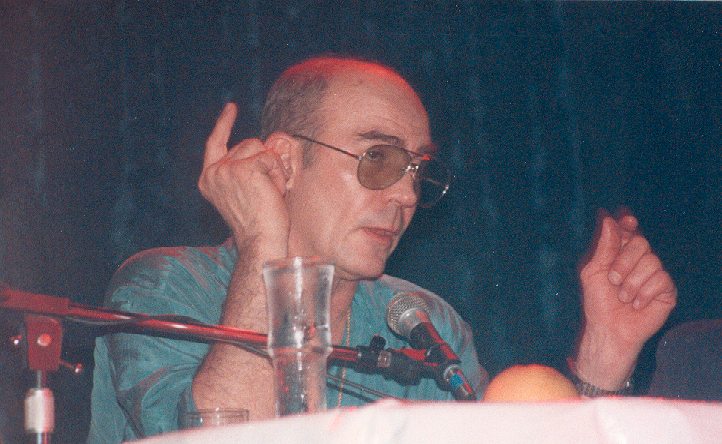
Image via Wikimedia Commons
Is breakfast really the most important meal of the day?
It certainly seems so from all the carefully staged photos of overnight oatmeal on Instagram.
The physical and mental benefits are well documented. A nutritious meal in the morning boosts blood glucose levels, improving concentration, boosting energy levels and maintaining healthy weight.
Sadly, many Americans gobble their breakfasts on the fly. How many hundreds of film and television scenes have you seen wherein the main characters hurtle through the kitchen snatching bananas, granola bars, and travel mugs on their way to the door?
The late gonzo journalist Hunter S. Thompson would surely not have approved, though he may have enjoyed the sense of superiority these morning scrambles would have engendered.
This was a man who bragged that he could “cover a hopelessly scrambled presidential campaign better than any six-man team of career political journalists on The New York Times or The Washington Post and still eat a three-hour breakfast in the sun every morning.”
Reporting for Rolling Stone in “Fear and Loathing on the Campaign Trail 76,” he intimated that he viewed breakfast with the “traditionalized reverence that most people associate with Lunch and Dinner.”
One wonders who exactly he meant by “most people”?
Regardless of whether he had been to bed, or what he had gotten up to the night before, he insisted upon a massive repast—consumed al fresco, and preferably in the nude. The sun he enjoyed basking in was usually at its zenith by the time he sat down. The meal, which he called the “psychic anchor” of “a terminally jangled lifestyle, consisted of the following:
Four bloody Marys
Two grapefruits
A pot of coffee
Rangoon crêpes
A half-pound of either sausage, bacon, or corned beef-hash with diced chilies
A Spanish omelette or eggs Benedict
A quart of milk
A chopped lemon for random seasoning
Something like a slice of Key lime pie
Two margaritas
And six lines of the best cocaine for dessert
Last summer, a Danish Vice reporter recreated Thompson’s breakfast of choice, inviting a poet friend (and “aspiring alcoholic”) to partake along with him. It ended with him vomiting, naked, into a shrub. His guest, who seems to be made of sturdier stuff, praised the eggs benedict, the Bloody Marys, and dessert.
Thompson preferred that his first meal of the day be consumed solo, in order to get a jump on the day’s work. In addition to the edible menu items, he required:
Two or three newspapers
All mail and messages
A telephone
A notebook for planning the next twenty four hours
And at least one source of good music
Read “Fear and Loathing on the Campaign Trail 1976” here. The key breakfast quote reads as follows:
I like to eat breakfast alone, and almost never before noon; anybody with a terminally jangled lifestyle needs at least one psychic anchor every twenty four hours, and mine is breakfast. In Hong Kong, Dallas, or at home—and regardless of whether or not I have been to bed—breakfast is a personal ritual that can only be properly observed alone, and in a spirit of genuine excess. The food factor should always be massive: Four bloody Marys, two grapefruits, a pot of coffee, Rangoon crêpes, a half-pound of either sausage, bacon, or corned beef-hash with diced chilies, a Spanish omelette or eggs Benedict, a quart of milk, a chopped lemon for random seasoning, and something like a slice of Key lime pie, two margaritas, and six lines of the best cocaine for dessert… Right, and there should also be two or three newspapers, all mail and messages, a telephone, a notebook for planning the next twenty four hours, and at least one source of good music… All of which should be dealt with outside, in the warmth of the hot sun, and preferably stone naked.
And just in case, here is a recipe for Crab Rangoon Crepes…
Related Content:
Hear the 10 Best Albums of the 1960s as Selected by Hunter S. Thompson
Read 11 Free Articles by Hunter S. Thompson That Span His Gonzo Journalist Career (1965–2005)
Ayun Halliday is an author, illustrator, theater maker and Chief Primatologist of the East Village Inky zine. Follow her @AyunHalliday.
Read More...A Demonstration of Perfect Samurai Swordsmanship
The age of the samurai has long since ended, but does its spirit live on? You might well feel that, despite everything, the flame of the samurai still burns in Japan today after watching the swordsmanship skills on display in the clip above. Or perhaps we should call it swordswomanship: the modern-day warrior executing those perfect cuts is the daughter of grandmaster Fumon Tanaka, and her bearing and self-possession bring to mind the onna bugeisha of old Japan. And as we see, gender matters not at all in the stark reality of blade on bone — or in this case, blade on a similarly dense stalk of bamboo.
Tanaka, showing an imperfectly cut piece of bamboo, explains that its curved edge means “your left and right hands are not balanced. If a samurai decapitates a man with this bad technique, it would cause great pain. It has to be one precise cut. That is the way of the samurai.”
His daughter then demonstrates just how handily she can attend to any of your decapitation needs, halving the bamboo with what her father deems “a perfect straight cut.” Though it only takes a single stroke, that single stroke comes as the culmination of years and years of work toward mastery — and work that, in this modern onna bugeisha’s case, no doubt began early indeed.
The Smithsonian Channel produced this video as part of their series Samurai Headhunters, more of whose material on “how these elite knights actually lived, loved, fought, and died” you can watch on Youtube. If you’d like a more in-depth sense of how their sword techniques work, have a look at Masayuki Shimabukuro’s video series on samurai swordsmanship, which begins with an episode on the basics and continues on to subjects like postures, two-hand cuts (as seen executed on those bamboo stalks), and flicking the blood — that last perhaps more useful in feudal Japan than 21st-century Tokyo, or for that manner everywhere else, but a good samurai has always known how to honor the past.
Related Content:
Japanese Craftsman Spends His Life Trying to Recreate a Thousand-Year-Old Sword
Female Samurai Warriors Immortalized in 19th Century Japanese Photos
A Hypnotic Look at How Japanese Samurai Swords Are Made
Hand-Colored 1860s Photographs Reveal the Last Days of Samurai Japan
Meet Yasuke, Japan’s First Black Samurai Warrior
Based in Seoul, Colin Marshall writes and broadcasts on cities and culture. His projects include the book The Stateless City: a Walk through 21st-Century Los Angeles and the video series The City in Cinema. Follow him on Twitter at @colinmarshall or on Facebook.
Read More...175+ College Admissions Offices Promise Not to Penalize High School Students Who Get Suspended for Protesting Peacefully Against Gun Violence

Image by Lorie Shaull, via Flickr Commons
“Will my admission get rescinded if I get suspended for engaging in a school walk-out meant to bring attention to the school shooting issue?” That’s a question many high school students have posed to college admissions offices around the country, especially after some high school officials threatened to suspend students taking part in anti-gun demonstrations.
Many leading universities have since issued policy statements and given these students their blessing and support. In a post called “In Support of Student Protests,” Hannah Mendlowitz, from Yale’s Admissions Office, writes:
[W]e continue to get the question: will Yale look unfavorably upon discipline resulting from peaceful demonstrations?
The answer is simple: Of course not.
To the students who have reached out to us with these concerns, we have made clear that they should feel free to participate in walk-out events to bring attention to this issue without fear of repercussion. Yale will NOT be rescinding anyone’s admission decision for participating in peaceful walkouts for this or other causes, regardless of any high school’s disciplinary policy. I, for one, will be cheering these students on from New Haven.
And on the official Twitter feed for the Brown University, a tweet reads:
Applicants to Brown: Expect a socially conscious, intellectually independent campus where freedom of expression is fundamentally important. You can be assured that peaceful, responsible protests against gun violence will not negatively impact decisions on admission to Brown.
And that’s just the tip of the iceberg. Below, find a list of 175+ universities that have granted similar assurances, along with links to their statements. The list comes from Alex Garcia, who is maintaining a regularly-updated Google Doc. Access it online here.
- Agnes Scott
- Alfred University
- American
- Amherst
- Baldwin Wallace
- Bard
- Bates
- Bellarmine
- Bennington
- Berkeley
- Berkshire CC
- Binghamton
- Boston College
- Bowdoin
- Brandeis
- Bridgewater State
- Brown
- Bryn Mawr
- BU
- Bucknell
- Cal State U System
- CalTech
- Case Western
- Catholic
- Chapman
- Clark
- CMU
- Colby
- Colgate
- Coll. of the Atlantic
- College of NJ
- College of Wooster
- Colorado College
- Colorado State
- Columbia U.
- Conn. College
- Cornell University
- CU Boulder
- CU Denver
- Dartmouth
- Davidson
- Denison
- DePaul
- Dickinson
- Dominican U of Cal
- Drew
- Duke
- Eastern CT State
- Elmira
- Emerson
- Emory
- Florida
- Fordham
- Georgetown
- Gettysburg
- GMU
- Gonzaga
- Goucher
- Grinnell
- Guilford
- GW
- Hamilton College
- Hamline
- Hampshire
- Hanover
- Harvard
- Harvey Mudd
- Haverford
- Hofstra
- Holy Cross
- Illinois State
- Indiana University
- Johns Hopkins
- Juniata
- Kalamazoo
- Kenyon College
- Knox
- Lafayette
- LawrenceU
- Lebanon Valley College
- Lehigh
- Lewis & Clark
- Lindenwood
- Loyola Marymount
- Macalester
- Manchester
- Miami of Ohio
- Middlebury
- MIT
- Mt Holyoke
- Muhlenberg College
- NCSU
- New School
- Northeastern
- Northwestern
- NYU
- Oberlin
- Occidental
- Ohio Wesleyan
- Pace
- Pacific Lutheran
- Penn
- Penn State
- Pitzer College
- Plymouth State
- Pomona
- Providence College
- Randolph
- Reed
- Rhodes College
- Rice
- RIT
- Saint Mary’s
- Salve Regina
- Sarah Lawrence
- Seattle University
- Simon’s Rock
- Skidmore
- Smith
- St. Johns
- St. Lawrence
- Stanford
- Stetson
- Stevens
- Suffolk
- Swarthmore
- Sweet Briar
- Syracuse
- Temple
- Transylvania
- Trinity College
- Trinity Washington
- Tufts
- Tulane
- U. Dayton
- U. Maryland
- U. New England
- U. Puget Sound
- U. Richmond
- U. South Carolina
- U. Southern California
- UCDavis
- UCLA
- UConn
- UIUC
- UMass-Amherst
- UMass Lowell
- UMBC
- UNH
- UPitt
- UVA
- UVM
- UWashington
- Vassar
- Villanova
- Virginia Tech
- W&M
- Wake Forest
- Wellesley
- Wesleyan
- Western Mich. U.
- Western Washington
- Wheaton
- Whitman college
- Widener
- Willamette
- Williams
- Winthrop University
- Wisconsin
- Wittenberg
- Worcester State
- WPI
- WUSTL
- WVU
- Yale
Again, you can refer to this Google Doc for more updates.
If you would like to support the mission of Open Culture, consider making a donation to our site. It’s hard to rely 100% on ads, and your contributions will help us continue providing the best free cultural and educational materials to learners everywhere. You can contribute through PayPal, Patreon, and Venmo (@openculture). Thanks!
Read More...Leo Tolstoy Makes a List of the 50+ Books That Influenced Him Most (1891)
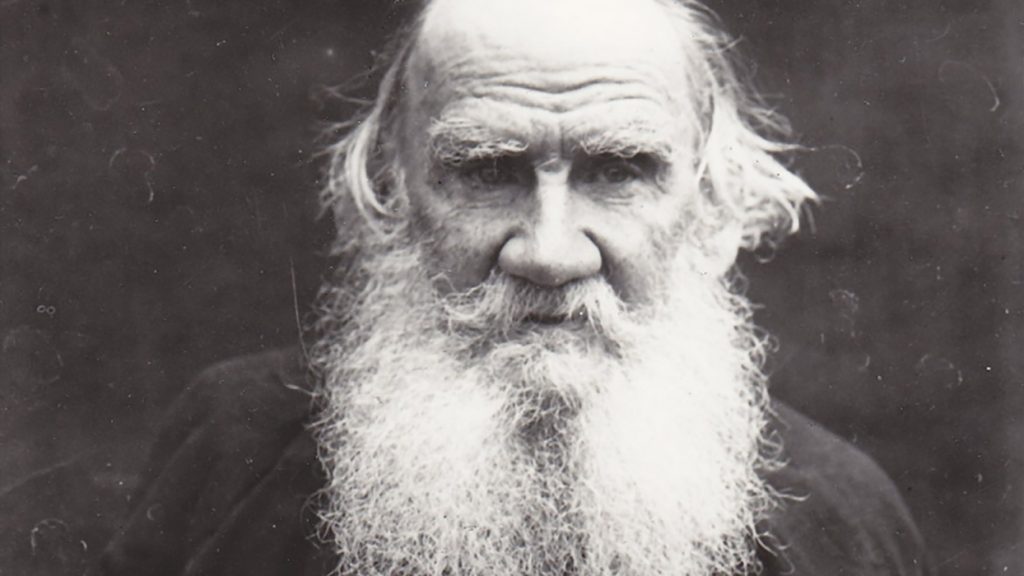
War and Peace, Anna Karenina, The Death of Ivan Ilyich —many of us have felt the influence, to the good or the ill of our own reading and writing, of Leo Tolstoy. But whose influence did Leo Tolstoy feel the most? As luck would have it, we can give you chapter and verse on this, since the novelist drew up just such a list in 1891, which would have put him at age 63.
A Russian publisher had asked 2,000 professors, scholars, artists, and men of letters, public figures, and other luminaries to name the books important to them, and Tolstoy responded with this list divided into five ages of man, with their actual degree of influence (“enormous,” “v. great,” or merely “great”) noted.
It comes as something of a rarity, up to now only available transcribed in a post at Northampton, Massachusetts’ Valley Advocate:
WORKS WHICH MADE AN IMPRESSION
Childhood to the age of 14 or so
The story of Joseph from the Bible — Enormous
Tales from The Thousand and One Nights: the 40 Thieves, Prince Qam-al-Zaman — Great
The Little Black Hen by Pogorelsky - V. great
Russian byliny: Dobrynya Nikitich, Ilya Muromets, Alyosha Popovich. Folk Tales — Enormous
Puskin’s poems: Napoleon — Great
Age 14 to 20
Matthew’s Gospel: Sermon on the Mount — Enormous
Sterne’s Sentimental Journey — V. great
Rousseau Confessions — Enormous
Emile — Enormous
Nouvelle Héloise — V. great
Pushkin’s Yevgeny Onegin — V. great
Schiller’s Die Räuber — V. great
Gogol’s Overcoat, The Two Ivans, Nevsky Prospect — Great
“Viy” [a story by Gogol] — Enormous
Dead Souls — V. great
Turgenev’s A Sportsman’s Sketches — V. great
Druzhinin’s Polinka Sachs — V. great
Grigorovich’s The Hapless Anton — V. great
Dickens’ David Copperfield — Enormous
Lermontov’s A Hero for our Time, Taman — V. great
Prescott’s Conquest of Mexico — Great
Age 20 to 35
Goethe. Hermann and Dorothea — V. great
Victor Hugo. Notre Dame de Paris — V. great
Tyutchev’s poems — Great
Koltsov’s poems — Great
The Odyssey and The Iliad (read in Russian) — Great
Fet’s poems — Great
Plato’s Phaedo and Symposium (in Cousin’s translation) — Great
Age 35 to 50
The Odyssey and The Iliad (in Greek) — V. great
The byliny — V. great
Victor Hugo. Les Misérables — Enormous
Xenophon’s Anabasis — V. great
Mrs. [Henry] Wood. Novels — Great
George Eliot. Novels — Great
Trollope, Novels — Great
Age 50 to 63
All the Gospels in Greek — Enormous
Book of Genesis (in Hebrew) — V. great
Henry George. Progress and Poverty — V. great
[Theodore] Parker. Discourse on religious subject — Great
[Frederick William] Robertson’s sermons — Great
Feuerbach (I forget the title; work on Christianity) [“The Essence of Christianity”] — Great
Pascal’s Pensées — Enormous
Epictetus — Enormous
Confucius and Mencius — V. great
On the Buddha. Well-known Frenchman (I forget) [“Lalita Vistara”] — Enormous
Lao-Tzu. Julien [S. Julien, French translator] — Enormous
The writer at the Valley Advocate, a Tolstoy aficionado, came across the list by sheer happenstance. “On my way to work, I found something just for me in a box of cast-off books on a sidewalk,” they write: a biography of Tolstoy with “something cooler inside”: a “yellowed and fragile New York Times Book Review clipping” from 1978 containing the full list as Tolstoy wrote it. “Gold,” in other words, “for this wannabe Tolstoy scholar.” If you, too count yourself among the ranks of wannabe Tolstoy scholars — or indeed credentialed Tolstoy scholars — you’ll no doubt find more than a few intriguing selections here. And if you simply admire Tolstoy, well, get to reading: learn not how to make the same things your idols made, I often say, but to think how they thought. Not that any of us have time to write War and Peace these days anyway, though with luck, we do still have time to read it — along with The Thousand and One Nights, David Copperfield, The Odyssey, and so on. Many of these works you can find in our collection, 800 Free eBooks for iPad, Kindle & Other Devices.
Looking for free, professionally-read audio books from Audible.com? Here’s a great, no-strings-attached deal. If you start a 30 day free trial with Audible.com, you can download two free audio books of your choice. Get more details on the offer here.
Note: An earlier version of this post originally appeared on our site in July, 2014.
Related Content:
Rare Recording: Leo Tolstoy Reads From His Last Major Work in Four Languages, 1909
Why Should We Read Tolstoy’s War and Peace (and Finish It)? A TED-Ed Animation Makes the Case
Vintage Footage of Leo Tolstoy: Video Captures the Great Novelist During His Final Days
Leo Tolstoy’s Family Recipe for Macaroni and Cheese
Colin Marshall hosts and produces Notebook on Cities and Culture and writes essays on cities, language, Asia, and men’s style. He’s at work on a book about Los Angeles, A Los Angeles Primer. Follow him on Twitter at @colinmarshall or on Facebook.
Read More...When Archie Bunker’s Advice on Gun Control Becomes Mainstream GOP Policy (1972)
The more things change, the more the talking points stay the same. Just swap teachers for airplane passengers, and watch a silly sitcom punchline morph into actual GOP policy.
Read More...The Truth Behind Jane Austen’s Fight Club: Female Prize Fights Were a Thing During the 18th Century
The first rule of Fight Club is: you do not talk about Fight Club.
The second rule of Fight Club is: you DO NOT talk about Fight Club!
- Chuck Palahniuk, Fight Club
Could it be a case of authorial oversight that all subsequent rules are exclusively concerned with such practical matters as dress and fight duration?
Given the macho reputation of both the book and the film adaptation, it seems like the third rule of Fight Club should be: you DO NOT talk about the fact that a fair number of Edwardian ladies were badass bare knuckle fighters.
Because doing so might diminish Fight Club’s street cred just a bitsy…
Filmmaker (and popular audiobook narrator) Emily Janice Card has a good deal of fun in Jane Austen’s Fight Club, above, marrying Palahniuk’s tropes to the social mores of England’s Regency period.
“No corsets, no hat pins and no crying,” Tyler Durden stand-in Lizzie instructs the eager young ladies in her circle. Soon, they’re proudly sporting bruises beneath their bonnets and stray blood spots on their tea dresses.
While young women of the fictional Bennet sisters’ social class refrained from brutal fisticuffs, there’s ample evidence of female combatants from the proletarian ranks. They fought for money, and occasionally to settle a disagreement, training hard for weeks in advance.
Their bouts drew spectators to the amphitheater owned by boxing promoter James Figg, and the marvelously named Hockley in the Hole, a seedy establishment whose other attractions included bearbaiting, bullbaiting, and fighting with broadswords and cudgels.
The female fist fighters challenged each other with paid notices in local papers, like this one from “championess and ass-driver” Ann Field of Stoke Newington:
Whereas I, Ann Field, of Stoke Newington, ass-driver, well known for my abilities, in boxing in my own defense wherever it happened in my way, having been affronted by Mrs. Stokes, styled the European Championess, do fairly invite her to a trial of her best skill in Boxing for 10 pounds, fair rise and fall; and question not but to give her such proofs of my judgment that shall oblige her to acknowledge me Championess of the Stage, to the satisfaction of all my friends.
Mrs. Stokes promptly announced her readiness to come out of retirement:
I, Elizabeth Stokes, of the City of London, have not fought in this way since I fought the famous boxing- woman of Billingsgate 29 minutes, and gained a complete victory (which is six years ago); but as the famous Stoke Newington ass-woman dares me to fight her for the 10 pounds, I do assure her I will not fail meeting her for the said sum, and doubt not that the blows which I shall present her with will be more difficult for her to digest than any she ever gave her asses.
Rather than keeping mum on Fight Club, these female pugilists shared Muhammad Ali’s flare for drumming up interest with irresistibly cocky wordplay.
References to adversaries fighting in “close jacket, short petticoats, and holland drawers … with white stockings and pumps” suggest that the adversaries played to the spectators’ prurience, though not always. Unlike the 20th-century stunt of bikini clad jello wrestling, sex appeal was not obligatory.
In a chapter devoted to public entertainments, sports and amusements, Alexander Andrews, author of The Eighteenth Century or Illustrations of the Manners and Customs of Our Grandfathers, documents how the Merry Wives of Windsor, a crew comprised of “six old women belonging to Windsor town” took out an ad seeking “any six old women in the universe to outscold them.”
On June 22nd, 1768, a woman called Bruising Peg “beat her antagonist in a terrible manner” to win a new chemise, valued at half a guinea.
In 1722, Hannah Hyfield of Newgate Market, resolved to give her challenger, Elizabeth Wilkinson, “more blows than words,” promising to deliver “a good thumping.” Both parties agreed to hold a half-crown in their fists for the duration of the fight. William B. Boulton, author of 1901’s Amusements of Old London, speculates that this was a practical measure to minimize scratching and hair-pulling.
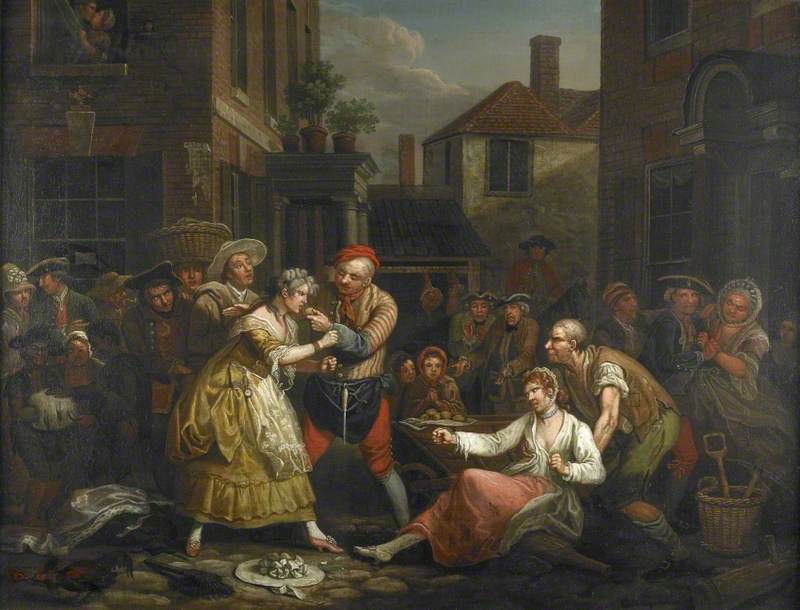
Time travel to an 18th-century female bare knuckles fight via Female Single Combat Club’s exhaustive coverage, Sarah Murden’s excellent analysis of John Collet’s painting, The Female Bruisers, above, or Jeremy Freeston’s short documentary available on YouTube.
Related Content:
Watch Author Chuck Palahniuk Read Fight Club 4 Kids
Ayun Halliday is an author, illustrator, theater maker and Chief Primatologist of the East Village Inky zine. Follow her @AyunHalliday.
Read More...Support Us
We're hoping to rely on loyal readers, rather than erratic ads. Please click the Donate button and support Open Culture. You can use Paypal, Venmo, Patreon, even Crypto! We thank you!

About Us

Open Culture scours the web for the best educational media. We find the free courses and audio books you need, the language lessons & educational videos you want, and plenty of enlightenment in between.
Advertise With Us

FREE UPDATES!
GET OUR DAILY EMAIL
Get the best cultural and educational resources on the web curated for you in a daily email. We never spam. Unsubscribe at any time.
FOLLOW ON SOCIAL MEDIA

Open Culture editor Dan Colman scours the web for the best educational media. He finds the free courses and audio books you need, the language lessons & movies you want, and plenty of enlightenment in between.
Advertise With Us


