How to Get Over the Anxiety of Public Speaking?: Watch the Stanford Video, “Think Fast, Talk Smart,” Viewed Already 15 Million Times
How many of us fear public speaking more than death: four out of five, nine out of ten, 99 out of 100? We’ve all heard a variety of statistics, all of them suggesting the formidability — perceived or real — of the task of getting up and talking in front of other people. But perhaps you’ll get an even clearer sense of that from the number 15,021,560: the total view count, as of this writing, racked up by “Think Fast, Talk Smart,” an hour-long talk on public speaking techniques by communication coach and Stanford Graduate School of Business lecturer Matt Abrahams.
The pedants among us, myself included, will have already taken note of that linguistic infelicity in the very title of the talk, but Abrahams himself wastes little time pointing it out himself. He also points out its value: you’ve got to catch the attention of your audience, and a deliberately made mistake (or even a non-deliberately made one) catches it as well as anything.
He goes on to elaborate on various other techniques we can use not just to get other people listening well, but to get ourselves talking well, the first priority being to get ourselves to stop tripping over our innate desire to talk perfectly.
Abrahams leads his audience through several short “games,” instructing them to do things like explaining their weekends to one another by spelling out loud and selling one another Slinkys, with the underlying goal of breaking the habits that have so often impeded our ability to simply get up and speak. He also provides physical techniques, like doing push-ups or taking a walk around the block before giving a talk in order to get your mind more “present,” and intellectual ones, like always adhering to a structure, no matter how simple and no matter how ordinary the situation. (“I practice these structures on my kids,” he notes.)
Taking the wider view, we shouldn’t look at speaking as a challenge, according to Abrahams, but as a chance to explain and influence. “A Q&A session is an opportunity for you,” he says, and practicing what he preaches, he opens one up at the end of the talk, underscoring that we can improve our public speaking skills by doing as he says, but even more so by doing as he does. Some of those more than eleven million views surely come from people who have watched more than once, studying Abrahams’ own use of language, both verbal and body. He also demonstrates a good deal of humor, though brevity, as Shakespeare wrote, being the soul of wit, you might consider chasing his talk with the four-minute Big Think video on the same subject just above.
Abrahams regularly teaches courses on Public Speaking at Stanford Continuing Studies. If you live in the San Francisco Bay Area, give his classes a look. Also see his books, Speaking Up without Freaking Out: 50 Techniques for Confident and Compelling Presenting.
Related Content:
Teacher Helps His Student Overcome Stuttering and Read Poetry, Using the Sound of Music
NPR Launches Database of Best Commencement Speeches Ever
How to Sound Smart in a TED Talk: A Funny Primer by Saturday Night Live‘s Will Stephen
Based in Seoul, Colin Marshall writes and broadcasts on cities and culture. His projects include the book The Stateless City: a Walk through 21st-Century Los Angeles and the video series The City in Cinema. Follow him on Twitter at @colinmarshall or on Facebook.
Read More...How Do Computers Work?: New Video Series Explains the Inner Workings of the Device You Use Every Day
How do computers work? Yes, that appliance you use every day? To help answer the question, Code.org (a non-profit dedicated to expanding access to computer science) has put together a collection of primers that explain some of the oft-discussed components of computers–circuits, memory, CPU, etc. And how they all fit together.
The first video starts off with an introduction by Bill Gates. Watch the remaining five videos (each about five minutes long) just by letting the playlist run above. Or see this video collection on YouTube.
h/t Paul
If you would like to support the mission of Open Culture, consider making a donation to our site. It’s hard to rely 100% on ads, and your contributions will help us continue providing the best free cultural and educational materials to learners everywhere. You can contribute through PayPal, Patreon, and Venmo (@openculture). Thanks!
Related Content:
Free Online Computer Science Courses
Learn to Code with Harvard’s Popular Intro to Computer Science Course: The 2016 Edition
Free Textbooks: Computer Science
Learn Python: A Free Online Course from Google
Learn Python: A Free Online Course from Google
Read More...Read A Classical Dictionary of the Vulgar Tongue, a Hilarious & Informative Collection of Early Modern English Slang (1785)
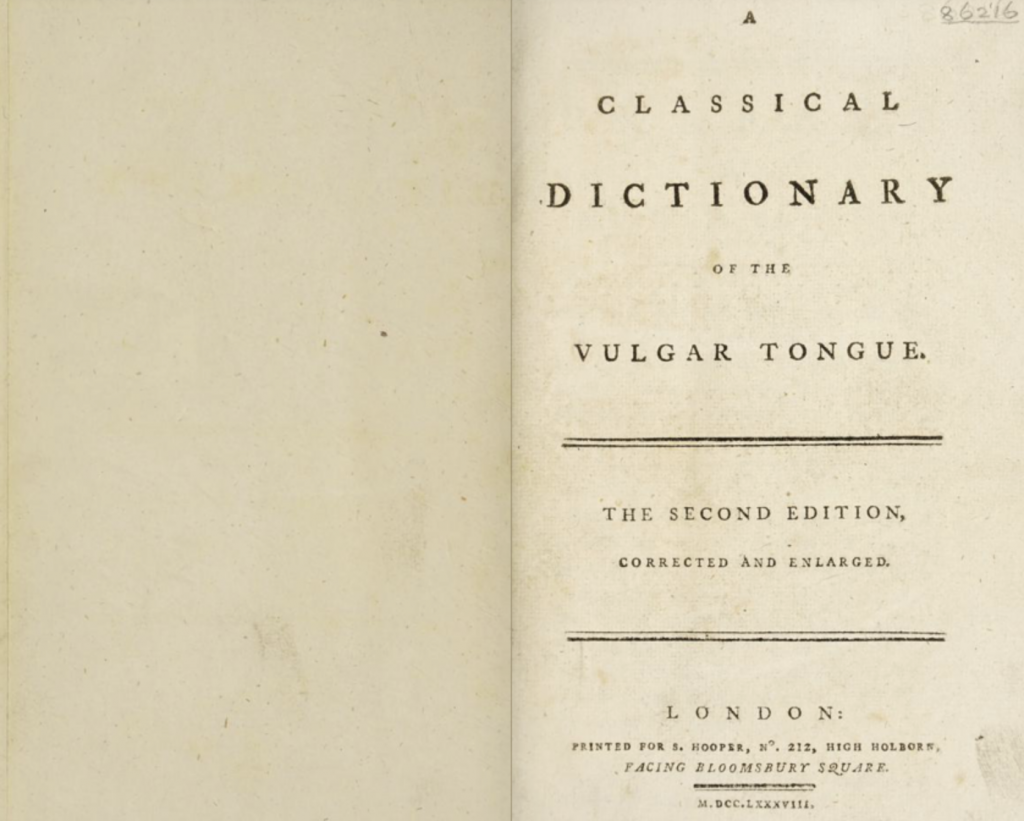
A deep appreciation for profanity may rate high as a mark of a sophistication and authenticity. Cognitive psychologist Steven Pinker has made the neuroscience of swearing an object of study; legendary comic actor, writer, and “language enthusiast” Stephen Fry declares the practice a fine art; studies show that those who swear may be more honest than those who don’t; and if you have any doubt about how much swearing contributes to the literary history of the English language, just do a search on Shakespeare’s many profane insults, so rich and varied as to constitute a genre all their own.
Not all vulgar speech is considered “swear words,” referencing sex acts and bodily functions, but many a critic and lexicographer has nonetheless decided that slang, obscene or otherwise, doesn’t belong in polite company with formal diction. Samuel Johnson, the esteemed 18th-century essayist, poet, and compiler of the 1755 Dictionary of the English Language deemed slang “unfit for his learned tome,” writes The Public Domain Review. So, enter Francis Grose to correct the error thirty years later with his Classical Dictionary of the Vulgar Tongue, a “compendium of slang” chock full of hilarious idioms of every kind.
There is the bawdy (“Sugar stick—the virile member”), the scatological (“Cackling farts—eggs”), the oddly obscure (“Kittle pitchering—to disrupt the flow of a ‘troublesome teller of long stories’ by constantly questioning and contradicting unimportant details, especially at the start”). Puns make their inevitable way in (“Just-ass—a punning name for justice [judge]”), as of course do comic images for body parts (“Tallywags/Whirligigs—testicles”). Much of this Early Modern English slang sounds to American ears just as colorfully askew as contemporary English slang does (“Dog booby—an awkward lout”; “Captain queernabs—a shabby ill-dressed fellow”).
Grose, compiler of the dictionary, “was not one for library work” and preferred to collect his specimens in the field where slang lives and breathes—the streets, pubs, and houses of ill-repute. “Supported by his trusty assist Tom Cocking [your joke here],” Grose “cruised the watering holes of Covent Garden and the East End, eating, boozing, and listening. He took pleasure in hearing his name punningly connected to his rotund frame. And he produced a book brimming with Falstaffian life.” Very much a Shakespearean bon vivant, Grose appears as something of a ribald doppelganger of the rotund, yet moralistic and often scowling Dr. Johnson. (See his portrait here.)
The so-called “long 18th-Century”—a period lasting from the restoration of the Monarchy after the English Civil War to around the French Revolution—presents a tradition of lewd witticism, from the poetry of John Wilmot, Earl of Rochester, to Jonathan Swift’s “The Lady’s Dressing Room,” to the sordid fantasies of the Marquis de Sade. Such pornographic humor and rude earthiness offered a counterweight to heady Enlightenment philosophy, just as Shakespeare’s insults provide needed comic relief for his bloody tragedies. Grose’s dictionary can be seen as adding needed comic local color to the many serious dictionaries and studies of language that emerged in the 1700s.
But A Classical Dictionary of the Vulgar Tongue is also an important academic resource all its own, and “would strongly influence later dictionaries of this kind,” notes the British Library—those like J. Redding Ware’s 1909 Passing English of the Victorian Era: A Dictionary of Heterodox English, Slang, and Phrase. We can see in Grose’s work how many slang words and phrases still in common use today—like “baker’s dozen,” “gift of the gab,” “birds of a feather,” “birthday suit,” and “kick the bucket”—were just as current well over 200 years ago. And we get a very vivid sense of the world in which Grose moved in the many metaphors employed, most involving food and drink. (A “butcher’s dog,” for example, refers to someone who “lies by the beef without touching it; a simile often applicable to married men.”)
But we needn’t worry too much about scholarly uses for Grose’s work. Instead, we might find ourselves motivated to do as he did, hit the streets and the bars, and maybe bring back into circulation such locutions as “Betwattled” (surprised, confounded, out of one’s senses), “Chimping merry” (exhilarated with liquor), or, perhaps my favorite so far, “Dicked in the nob” (silly, crazed).
Page through Grose’s dictionary above or read it in a larger format (and/or download as a PDF or ePub) at the Internet Archive.
Related Content:
The Very First Written Use of the F Word in English (1528)
People Who Swear Are More Honest Than Those Who Don’t, Finds a New University Study
Stephen Fry, Language Enthusiast, Defends The “Unnecessary” Art Of Swearing
Josh Jones is a writer and musician based in Durham, NC. Follow him at @jdmagness
Read More...When the Sex Pistols Played at the Chelmsford Top Security Prison: Hear Vintage Tracks from the 1976 Gig
Serious fans of live recordings well know that such productions are usually doctored before they reach the masses, with effects added to sweeten the mix, recording errors corrected, instruments and crowd noise overdubbed, tracks rearranged, and performances from different nights combined. It’s a common practice and shouldn’t alarm anyone expecting absolute documentary fidelity. If you couldn’t make the show to experience the band firsthand, they’d at least like you to hear them at their best. (Who could resist the opportunity to revise, say, a public speaking gig after the fact?)
When record companies are involved, every effort can go into making a saleable product, but heavy editing usually doesn’t happen to taped bootlegs. One notable exception happens to come from an exceptional gig, when the Sex Pistols followed Johnny Cash’s example and played the Chelmsford Top Security Prison during their first major tour of England in 1976 for an audience of 500 prisoners. Partly due to a serious recording issue—the near total failure to capture original bassist Glen Matlock—and partly to a “confused idea of what would make for a worthy release,” writes Ned Raggett at Allmusic, the band’s soundman Dave Goodman decided to make several alterations to the recording.
These changes, in turn, gave rise to a mythology surrounding the show, raising its reputation to the levels of chaos for which the Pistols are renowned. That reputation itself largely revolves around Sid Vicious’ later onstage antics, and is at times inflated. The Pistols could be a great live band—Steve Jones, Paul Cook, and Matlock were all more than capable musicians, and Johnny Rotten was a perfect punk spectacle all his own. But the elements didn’t always come together amidst the band’s unrehearsed disorder.
The audience at Chelmsford were, please excuse the pun, a captive one, and therefore, unable to display the same unbridled enthusiasm as the band’s usual crowds of rubberneckers and scenesters. To play up the gig, then, Goodman dubbed in the sounds of “random crowd and violence noise” and sirens. He didn’t only see fit to overdub Matlock’s missing bass, but also added in “an incredibly poor Rotten imitator goading the ‘prisoners’ on between songs,” Ragett notes, “as well as often singing on top of the real Rotten himself!” That first 1990 release of Live at Chelmsford does not so much gild the band’s musical strengths as it “plays on the revolutionary/anarchy side of the punk image to no avail.”
Luckily, the original recordings remained, and were released later on the Sex Pistols Alive compilation, in their original order, and, rearranged, on a second Live at Chelmsford Prison CD. It is the originals, with minimal treatment, that you can hear here. At the top is “Anarchy in the UK,” below it “Submission,” and a sneering cover of The Who’s “Substitute” further down. The giant hole in the middle of the mix where Matlock’s bass should be is hard to ignore, but overall, these are some occasionally great performances, particularly from Cook and Jones, whose pounding drums and blistering guitar come through loud and clear, often burying Rotten’s voice, which is muddied throughout.
But a good recording of half the band hardly sells the legend of the Sex Pistols, especially the Sex Pistols in prison. “By all accounts,” writes Raggett, “it was a bit of a harrowing experience.” But you’d have to have been there to know it, and you probably wouldn’t want to be. So it’s no wonder Goodman saw the need to spruce things up with what Discogs’ notes describe as “a canned audio track of a riot (complete with shouting, scuffles, breaking glass, etc.)” A lot of people hated it, but if you’re really curious, you can grab a copy of the overdubbed version and hear for yourself. Or listen to the full, undoctored, recording on YouTube.
Related Content:
Watch the Sex Pistols’ Very Last Concert (San Francisco, 1978)
Josh Jones is a writer and musician based in Durham, NC. Follow him at @jdmagness
Read More...Noam Chomsky Explains What’s Wrong with Postmodern Philosophy & French Intellectuals, and How They End Up Supporting Oppressive Power Structures
Noam Chomsky has always had irascible tendencies—when he doesn’t like something, he lets us know it, without ever raising his voice and usually with plenty of footnotes. It’s a quality that has made the emeritus MIT professor and famed linguist such a potent critic of U.S. empire for half a century, vigorously denouncing the Vietnam War, the Iraq War(s), and the possibility of a catastrophic war with North Korea. Chomsky isn’t a professional historian or political philosopher; these are avocations he has taken on to bolster his arguments. But those arguments are strengthened by his willingness to engage with primary sources and take them seriously.
When it comes, however, to his much-publicized feud with “Postmodernism,” a term he uses liberally at times to describe almost all post-war French intellectual culture, Chomsky rarely confronts his opponents in their own terms. That’s largely because, as he’s said on many occasions, he can’t make any sense of them. It’s not exactly an original critique. Mandarins of French thought like Jean-Francois Lyotard, Jacques Lacan, and Jean Baudrillard have been accused for decades, and not without merit, of knowingly peddling bullshit to a French readership that expects, as Michel Foucault once admitted, a mandatory “ten percent incomprehensible.” (Sociologist Pierre Bourdieu asserts that the number is much higher.)
But Chomsky’s critique goes further, in a direction that doesn’t get nearly as much press as his charges of obscurantism and overuse of insular jargon. Chomsky claims that far from offering radical new ways of conceiving the world, Postmodern thought serves as an instrument of oppressive power structures. It’s an interesting assertion given some recent arguments that “post-truth” postmodernism is responsible for the rise of the self-described “alt-right” and the rapid spread of fake information as a tool for the current U.S. ruling party seizing power.
Not only is there “a lot of material reward,” Chomsky says, that comes from the academic superstardom many high-profile French philosophers achieved, but their position—or lack of a clear position—“allows people to take a very radical stance… but to be completely dissociated from everything that’s happening.” Chomsky gives an example above of an anonymous postmodernist critic branding a talk he gave as “naïve” for its discussion of such outmoded “Enlightenment stuff” as making moral decisions and referring to such a thing as “truth.” In his brief discussion of “the strange bubble of French intellectuals” at the top of the post, Chomsky gets more specific.
Most post-war French philosophers, he alleges, have been Stalinists or Maoists (he uses the example of Julia Kristeva), and have uncritically embraced authoritarian state communism despite its documented crimes and abuses, while rejecting other modes of philosophical thought like logical positivism that accept the validity of the scientific method. This may or may not be a fair critique: political orientations shift and change (and at times we accept a thinker’s work while fully rejecting their personal politics). And the postmodern critique of scientific discourse as form of oppressive power is a serious one that needn’t entail a wholesale rejection of science.
Are there any post-structuralist thinkers Chomsky admires? Though he takes a little dig at Michel Foucault in the clip above, he and the French theorist have had some fruitful debates, “on real issues,” Chomsky says, “and using language that was perfectly comprehensible—he speaking French, me English.” That’s not a surprise. The two thinkers, despite the immense difference in their styles and frames of reference, both engage heavily with primary historical sources and both consistently write histories of ideology.
It is partly through the interplay between Foucault and Chomsky’s ideas that we might find a synthesis of French Marxist post-structuralist thought and American anarchist political philosophy. Rather than seeing them as professional wrestlers in the ring, with the postmodernist as the heel and headlines like “Chomsky DESTROYS Postmodernism,” we could look for complementarity and points of agreement, and genuinely read, as difficult as that can be, as many of the arguments of postmodern French philosophers as we can (and perhaps this defense of obscurantism) before deciding with a sweeping gesture that none of them make any sense.
Related Content:
Free Online Philosophy Courses
Noam Chomsky Calls Postmodern Critiques of Science Over-Inflated “Polysyllabic Truisms”
Noam Chomsky Slams Žižek and Lacan: Empty ‘Posturing’
Clash of the Titans: Noam Chomsky & Michel Foucault Debate Human Nature & Power on Dutch TV, 1971
Josh Jones is a writer and musician based in Durham, NC. Follow him at @jdmagness
Read More...Reading Mary Shelley’s Frankenstein on Its 200th Anniversary: An Animated Primer to the Great Monster Story & Technology Cautionary Tale
200 years ago, 18-year-old Mary Shelley did an extraordinary thing. After a dreary winter evening spent indoors telling ghost stories during the storied “year without a summer,” she took her idea and turned it into a novel. In January of 1818, Frankenstein; or, The Modern Prometheus appeared, first published anonymously in an edition of 500 copies, with a preface by her husband, poet Percy Bysshe Shelley. Granted, Mary Shelley wasn’t an ordinary 18-year-old. In addition to her romance with Shelley and friendship with Lord Byron, she was also the daughter of philosophers William Godwin and Mary Wollstonecraft. Which is to say that she was steeped in Romantic poetry and Victorian thought from a very early age, and conversant with the intellectual controversies of the day.
Nonetheless, the young novelist’s achievement—her synthesis of so many 19th-century anxieties into a monster story rivaled only, perhaps, by Bram Stoker’s Dracula—remains as impressive now as it was then. Shelley tells the legendary tale of the novel’s composition herself in an introduction to the heavily revised 1831 edition. In the animated video above, scholar Iseult Gillespie sketches out the book’s basics (as we know, Frankenstein is the name of the monster’s creator; the monster himself remains nameless), then briefly explains some of its “multiple meanings.”
We may be conditioned by the genius of James Whale and Mel Brooks to think of the novel’s center as the doctor’s electrified laboratory, but “the plot turns on a chilling chase” between monster and doctor, and what a chase it is. The book’s gripping action scenes get badly undersold in conceptions of Frankenstein (or the monster, rather) as a sad, stupid, lumbering beast. In fact, Frankenstein, says Gillespie, “is one of the first cautionary tales about artificial intelligence.” The novel’s Romantic interest in mythology (spelled out more directly by Percy two years later in his Prometheus Unbound) and its use of Gothic devices to evoke dread mark it as a complicated work, and its creature as a very complicated monster—a perpetually relevant symbol of the horrors unchecked scientific experimentation might unleash.
Shelley also inscribed her personal trauma in the text; though well-known as the daughter of the famed Wollstonecraft—author of the “key feminist text” A Vindication of the Rights of Women—Shelley never actually got to know her mother. Wollstonecraft died of complications in childbirth, and Shelley, haunted by guilt, and her grief over several miscarriages she suffered, the first at age 16, uses what seems like a story solely about male creative agency to introduce themes of childbirth “as both creative and destructive.”
But mostly Frankenstein comes to us as a novel about the “power of radical ideas to expose darker areas of life.” Though it may do the novel a critical injustice to call it the Black Mirror (or Prometheus) of its time, the anxious contemporary anthology show is inseparable from a lineage of creative texts in horror and science fiction that owe a tremendous debt to the brilliance of the young Mary Shelley. For more info on the origins of this famous book, read Jill Lepore’s 200th-anniversary essay at The New Yorker, and see all of the known manuscripts digitized at the Shelley-Godwin archive.
Related Content:
Mary Shelley’s Handwritten Manuscripts of Frankenstein Now Online for the First Time
Frankenweenie: Tim Burton Turns Frankenstein Tale into Disney Kids Film (1984)
Josh Jones is a writer and musician based in Durham, NC. Follow him at @jdmagness
Read More...Watch Edith+Eddie, an Intense, Oscar-Nominated Short Film About America’s Oldest Interracial Newlyweds
It says a great deal about the acceptance of interracial marriage in America that you don’t much hear the phrase “interracial marriage” itself anymore: in much of the country, such unions have become so common as not to merit their own intellectual category. But what about elderly interracial newlyweds? That much more demographically unusual phenomenon — or rather, the actual nonagenarian, recently married interracial couple of Edith Hill and Eddie Harrison — provides the subject for Laura Checkoway’s short documentary Edith+Eddie, which you can watch free on Topic.com.
“Hill was 96 and Harrison 95 years old when they were married, and the film bills the two as ‘America’s oldest interracial newlyweds’ at the time of their union in 2014,” writes the Hollywood Reporter’s Chris Gardner in an article on the film’s having been produced by Cher.
But “what could’ve been a heart-warming love story turned into something tragic as the two were separated by Hill’s family in a bitter family feud,” a source of much of the considerable drama in the movie’s 30 minutes. “The couple had been sharing Hill’s Virginia home until one of her daughters forcibly moved her to Florida, separating the couple.”
Alas, Harrison died during a bout of influenza just three months later. “He lived for her, and she lived for him. It’s the love story of the century,” said Hill’s daughter, quoted in a Guardian article that describes how “their marriage was problematic because Hill has been declared legally incapacitated for several years.” Another daughter “contested the marriage, saying it would complicate the eventual distribution of Hill’s estate. But Hill and Harrison said they wanted to stay together.” And given all they’d lived through — “the two longtime Virginians would not have been allowed to marry if they had met in their 20s, 30s or 40s under state law at the time” — one easily understands why.
Stream Edith+Eddie for free on Topic.com.
Related Content:
Charles Darwin Creates a Handwritten List of Arguments for and Against Marriage (1838)
Based in Seoul, Colin Marshall writes and broadcasts on cities and culture. His projects include the book The Stateless City: a Walk through 21st-Century Los Angeles and the video series The City in Cinema. Follow him on Twitter at @colinmarshall or on Facebook.
Read More...Watch David Bowie Perform “Imagine”: A Touching Tribute to His Friend John Lennon (1983)
John Lennon’s “Imagine” is one of the most covered songs in rock history. Its simple message is evergreen, its sentiments not hard to get across, but few renditions are as moving as David Bowie’s one-night-only performance when his 1983 Serious Moonlight tour wrapped at the Hong Kong Coliseum.
It was especially fitting given that this, the final night of the tour, coincided with the 3rd anniversary of Lennon’s murder.
While legions feel a deep personal connection to that song, Bowie and Lennon were “as close as family,” according to Lennon’s widow, Yoko Ono.
Lennon cowrote Bowie’s 1975 hit, “Fame,” joining him in the studio with his guitar and a memorable falsetto. As Bowie recalls below, he also provided some much-appreciated counsel regarding managers.
As the anniversary loomed, Serious Moonlight guitarist Earl Slick, who played on several Lennon albums, suggested that a tribute was in order. He suggested “Across the Universe,” which Bowie had covered in the same session that yielded “Fame.”
Bowie reportedly responded, “Well if we’re going to do it, we might as well do ‘Imagine.’ ”
It was the final song played that night, Bowie setting the stage with some personal anecdotes, including one that had taken place at a nearby vendor’s stall, where Bowie spied a knock-off Beatles jacket and convinced Lennon to pose in it. (What we wouldn’t give to be able to share that photo with readers…)
Frequent Bowie collaborator back up singer George Simms told Voyeur, the fanzine of the international David Bowie Fanclub:
If I remember well, we didn’t rehearse that song. The night David did the ‘Imagine’ song, none of us in the band had any idea how that song was going to come off. David told us before, at a certain point, he would cue the band to start the song instrumentally. We didn’t know what he was going to do in the beginning but he had it very carefully worked out with the lighting people. We were on stage and it was dark. David was sitting on the stage at one particular place and, all of a sudden, a single spotlight went on David and hit him exactly where he was sitting. David started to tell something about John Lennon. During this, it went dark a few times again, but then when the spots went on again David was sitting somewhere else on the stage. David cued the band and we started the song. It was the third anniversary of Lennon’s death; it was December 8. We all grew up listening to The Beatles and John Lennon. After we did “Imagine,” we all went off the stage and back into the holding area. Normally we’d be slap-happy, talking and laughing, but that night there was absolute silence because of all the emotion of doing a tribute to John Lennon—especially knowing that David was a friend of his and that David was speaking from his heart. We didn’t know how dramatic the lights’ impact was going to be. Nobody wanted to break the silence; it was like a sledgehammer into your chest.
Lennon’s admiration mirrored the respect Bowie had for him. He may have busted Bowie’s chops a bit by reducing the glam-rocker’s approach as “rock n’ roll with lipstick,” but he also described his own Double Fantasy album as an attempt to “do something as good as (Bowie’s) Heroes.”
Related Content:
Watch John Lennon’s Last Live Performance (1975): “Imagine,” “Stand By Me” & More
The Making of Queen and David Bowie’s 1981 Hit “Under Pressure”: Demos, Studio Sessions & More
Ayun Halliday is an author, illustrator, theater maker and Chief Primatologist of the East Village Inky zine. Follow her @AyunHalliday.
Read More...The 25 Principles for Adult Behavior: John Perry Barlow (R.I.P.) Creates a List of Wise Rules to Live By
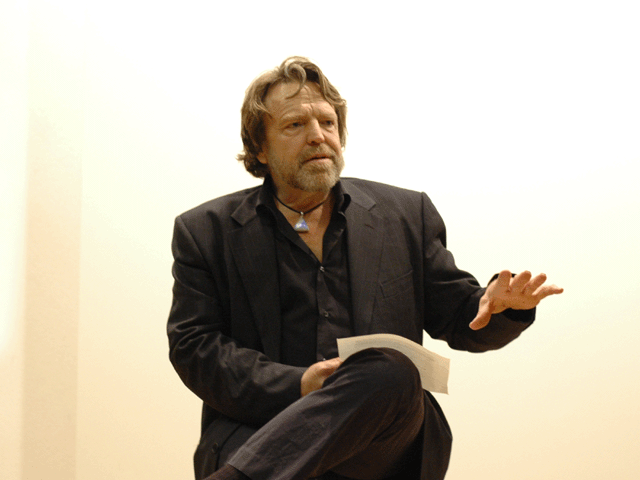
Image by the European Graduate School, via Wikimedia Commons
The most successful outlaws live by a code, and in many ways John Perry Barlow, founder of the Electronic Freedom Foundation, Wyoming rancher, and erstwhile songwriter for the Grateful Dead—who died on Wednesday at the age of 70—was an archetypal American outlaw all of his life. He might have worn a white hat, so to speak, but he had no use for the government telling him what to do. And his charismatic defense of unfettered internet liberty inspired a new generation of hackers and activists, including a 12-year-old Aaron Swartz, who saw Barlow speak at his middle school and left the classroom changed.
Few people get to leave as lasting a legacy as Barlow, even had he not pioneered early cyberculture, penning the “Declaration of Independence of the Internet,” a techo-utopian document that continues to influence proponents of open access and free information. He introduced the Grateful Dead to Dr. Timothy Leary, under whose guidance Barlow began experimenting with LSD in college. His creative and personal relationship with the Dead’s Bob Weir stretches back to their high school days in Colorado, and he became an unofficial member of the band and its “junior lyricist,” as he put it (after Robert Hunter).
“John had a way of taking life’s most difficult things and framing them as challenges, therefore adventures,” wrote Weir in a succinctly poignant Twitter eulogy for his friend. We might think of Barlow’s code, which he laid out in a list he called the “25 Principles of Adult Behavior,” as a series of instructions for turning life’s difficulties into challenges, an adventurous reframing of what it means to grow up. For Barlow, that meant defying authority when it imposed arbitrary barriers and proprietary rules on the once-wild-open spaces of the internet.
But being a grown-up also meant accepting full responsibility for one’s behavior, life’s purpose, and the ethical treatment of oneself and others. See his list below, notable not so much for its originality but for its plainspoken reminder of the simple, shared wisdom that gets drowned in the assaultive noise of modern life. Such uncomplicated idealism was at the center of Perry’s life and work.
1. Be patient. No matter what.
2. Don’t badmouth: Assign responsibility, not blame. Say nothing of another you wouldn’t say to him.
3. Never assume the motives of others are, to them, less noble than yours are to you.
4. Expand your sense of the possible.
5. Don’t trouble yourself with matters you truly cannot change.
6. Expect no more of anyone than you can deliver yourself.
7. Tolerate ambiguity.
8. Laugh at yourself frequently.
9. Concern yourself with what is right rather than who is right.
10. Never forget that, no matter how certain, you might be wrong.
11. Give up blood sports.
12. Remember that your life belongs to others as well. Don’t risk it frivolously.
13. Never lie to anyone for any reason. (Lies of omission are sometimes exempt.)
14. Learn the needs of those around you and respect them.
15. Avoid the pursuit of happiness. Seek to define your mission and pursue that.
16. Reduce your use of the first personal pronoun.
17. Praise at least as often as you disparage.
18. Admit your errors freely and soon.
19. Become less suspicious of joy.
20. Understand humility.
21. Remember that love forgives everything.
22. Foster dignity.
23. Live memorably.
24. Love yourself.
25. Endure.
Barlow the “cowboy, poet, romantic, family man, philosopher, and ultimately, the bard of the digital revolution”—as Stephen Levy describes him at Wired—“became a great explainer” of the possibilities inherent in new media. He watched the internet become a far darker place than it had ever been in the 90s, a place where governments conduct cyberwars and impose censorship and barriers to access; where bad actors of all kinds manipulate, threaten, and intimidate.
But Barlow stood by his vision, of “a world that all may enter without privilege or prejudice accorded by race, economic power, military force, or station of birth… a world where anyone, anywhere may express his or her beliefs, no matter how singular, without fear of being coerced into silence or conformity.”
This may sound naïve, yet as Cindy Cohn writes in EFF’s obituary for its founder, Barlow “knew that new technology could create and empower evil as much as it could create and empower good. He made a conscious decision to move toward the latter.” His 25-point code urges us to do the same.
via Kottke/Hacker News
Related Content:
Alejandro Jodorowsky’s 82 Commandments For Living
Josh Jones is a writer and musician based in Durham, NC. Follow him at @jdmagness
Read More...An Animated Introduction to Epicurus and His Answer to the Ancient Question: What Makes Us Happy?
These days the word Epicurean tends to get thrown around in regard to things like olive oil, cutting boards, and wine aerators. The real Epicurus, an ancient Greek philosopher of the third and fourth century BCE, might not have approved, knowing as he did that happiness doesn’t come from products that signal one’s appreciation of high-end comestibles. But where, then, does happiness come from? Epicurus devoted his school of philosophy to finding an answer to that ancient question, and these two brief animated introductions, one by Alain de Botton’s School of Life and one from Wireless Philosophy, will give you a sense of what he discovered.
Epicurus proposed, as de Botton puts it, that “we typically make three mistakes when thinking about happiness.” Number one: “We think happiness means having romantic, sexual relationships,” never considering the likelihood of them being “marred by jealousy, misunderstanding, cheating, and bitterness.”
Number two: “We think that what we need to be happy is a lot of money,” without factoring in “the unbelievable sacrifices we’re going to have to make to get this money: the jealousy, the backbiting, the long hours.” Number three: We obsess over luxury, “especially involving houses and beautiful serene locations” (and, nowadays, that with which we stock their kitchens).
Only three things, Epicurus concluded, can truly ensure our happiness. Number one: “Your friends around,” which led the philosopher to buy a big house and share it with all of his. (“No sex, no orgy,” de Botton emphasizes, “just your mates.”) Number two: Stop working for others and do your own work, which the members of Epicurus’ commune did in the form of farming, cooking, potting, and writing. Number three: Find calm not in the view out your window, but cultivated within your own mind by “reflecting, writing stuff down, reading things, meditating.” The big meta-lesson: “Human beings aren’t very good at making themselves happy, chiefly because they think it’s so easy.”
Wireless Philosophy’s video, narrated by University of California, San Diego philosophy professor Monte Johnson, draws more rules for happiness from the teachings of Epicurus, breaking down his “tetrapharmakos,” or four-part cure for unhappiness:
- God is nothing to fear
- Death is nothing to worry about
- It is easy to acquire the good things in life
- It is easy to endure the terrible things
Johnson expands on the fine points of each of these dictates while accompanying his explanations with illustrations, including one drawing of the bread on which, so history has recorded, Epicurus lived almost entirely. That and water made up most of his meals, supplemented with the occasional olive or pot of cheese so that he could “indulge.” Not exactly the diet one would casually describe as Epicurean in the 21st century, but dig into Epicureanism itself and you’ll see that Epicurus, who described himself as “married to philosophy,” understood sensual pleasure more deeply than most of us do today — and a couple millennia before the advent of Williams-Sonoma at that.
To further delve into this philosophy, read Epicurus’ classic work The Art of Happiness.
Related Content:
Based in Seoul, Colin Marshall writes and broadcasts on cities and culture. His projects include the book The Stateless City: a Walk through 21st-Century Los Angeles and the video series The City in Cinema. Follow him on Twitter at @colinmarshall or on Facebook.
Read More...Support Us
We're hoping to rely on loyal readers, rather than erratic ads. Please click the Donate button and support Open Culture. You can use Paypal, Venmo, Patreon, even Crypto! We thank you!

About Us

Open Culture scours the web for the best educational media. We find the free courses and audio books you need, the language lessons & educational videos you want, and plenty of enlightenment in between.
Advertise With Us

FREE UPDATES!
GET OUR DAILY EMAIL
Get the best cultural and educational resources on the web curated for you in a daily email. We never spam. Unsubscribe at any time.
FOLLOW ON SOCIAL MEDIA

Open Culture editor Dan Colman scours the web for the best educational media. He finds the free courses and audio books you need, the language lessons & movies you want, and plenty of enlightenment in between.
Advertise With Us


