Illustrations Of J. R. R. Tolkien’s The Hobbit from the Soviet Union (1976)
Until I read J. R. R. Tolkien’s The Lord of The Rings, my favorite book growing up was, by far, The Hobbit. Growing up in Russia, however, meant that instead of Tolkien’s English version, my parents read me a Russian translation. To me, the translation easily matched the pace and wonder of Tolkien’s original. Looking back, The Hobbit probably made such an indelible impression on me because Tolkien’s tale was altogether different than the Russian fairy tales and children’s stories that I had previously been exposed to. There were no childish hijinks, no young protagonists, no parents to rescue you when you got into trouble. I considered it an epic in the truest literary sense.
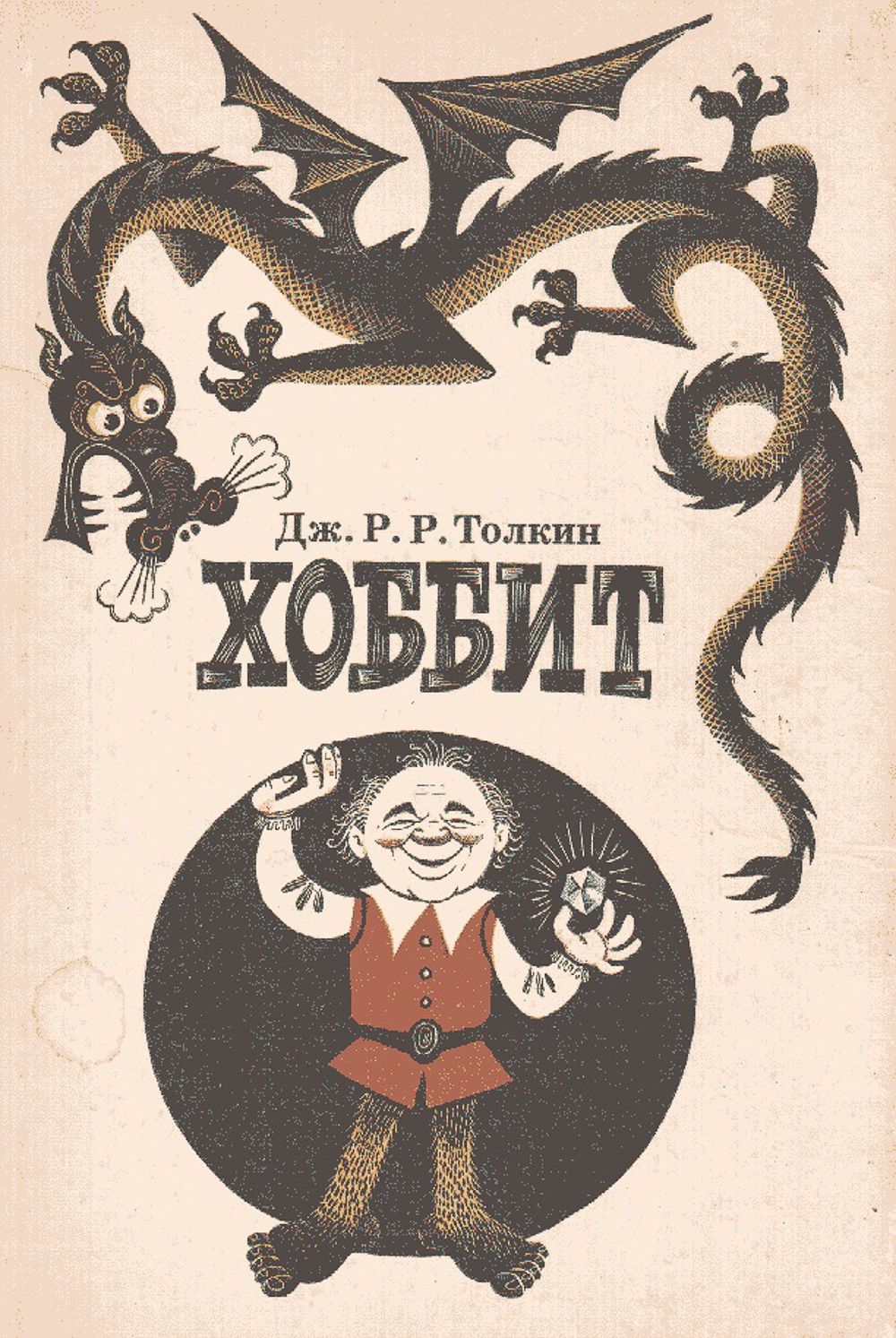
As with many Russian translations during the Cold War, the book came with a completely different set of illustrations. Mine, I remember regretting slightly, lacked pictures altogether. A friend’s edition, however, was illustrated in the typical Russian style: much more traditionally stylized than Tolkien’s own drawings, they were more angular, friendlier, almost cartoonish.
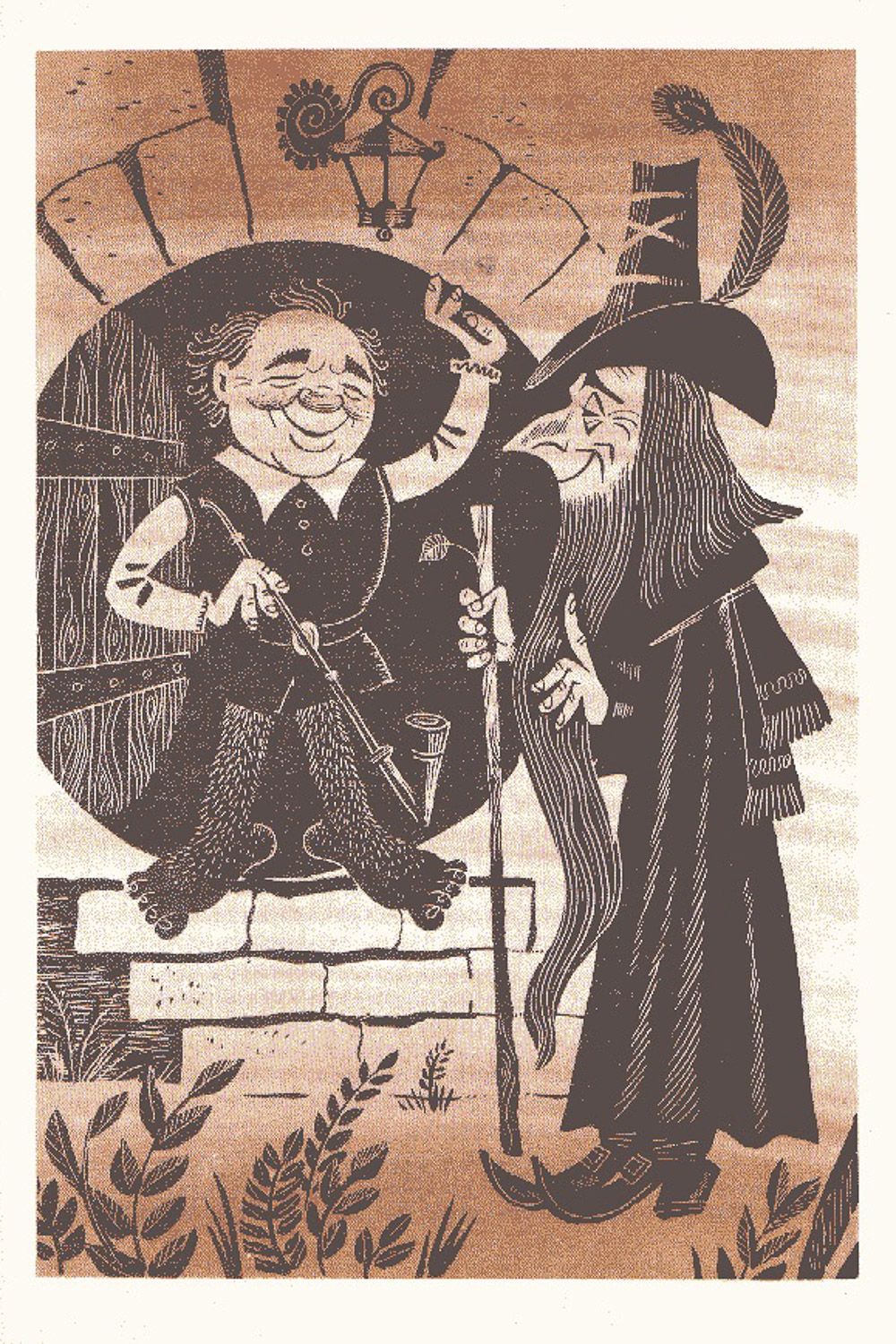
In this post, we include a number of these images from the 1976 printing. The cover, above, depicts a grinning Bilbo Baggins holding a gem. Below, Gandalf, an ostensibly harmless soul, pays Bilbo a visit.
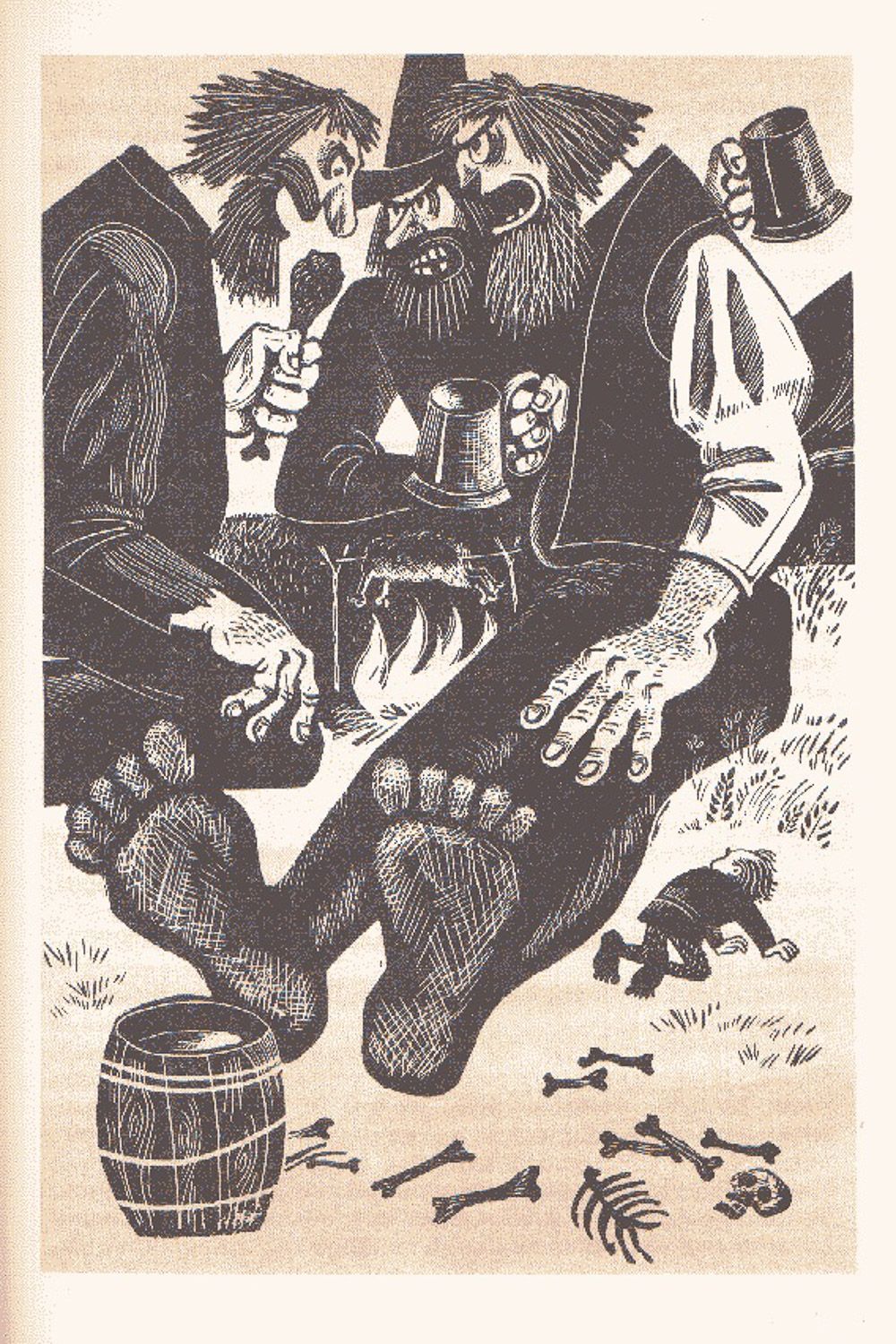
Next, we have the three trolls, arguing about their various eating arrangements, with Bilbo hiding to the side.
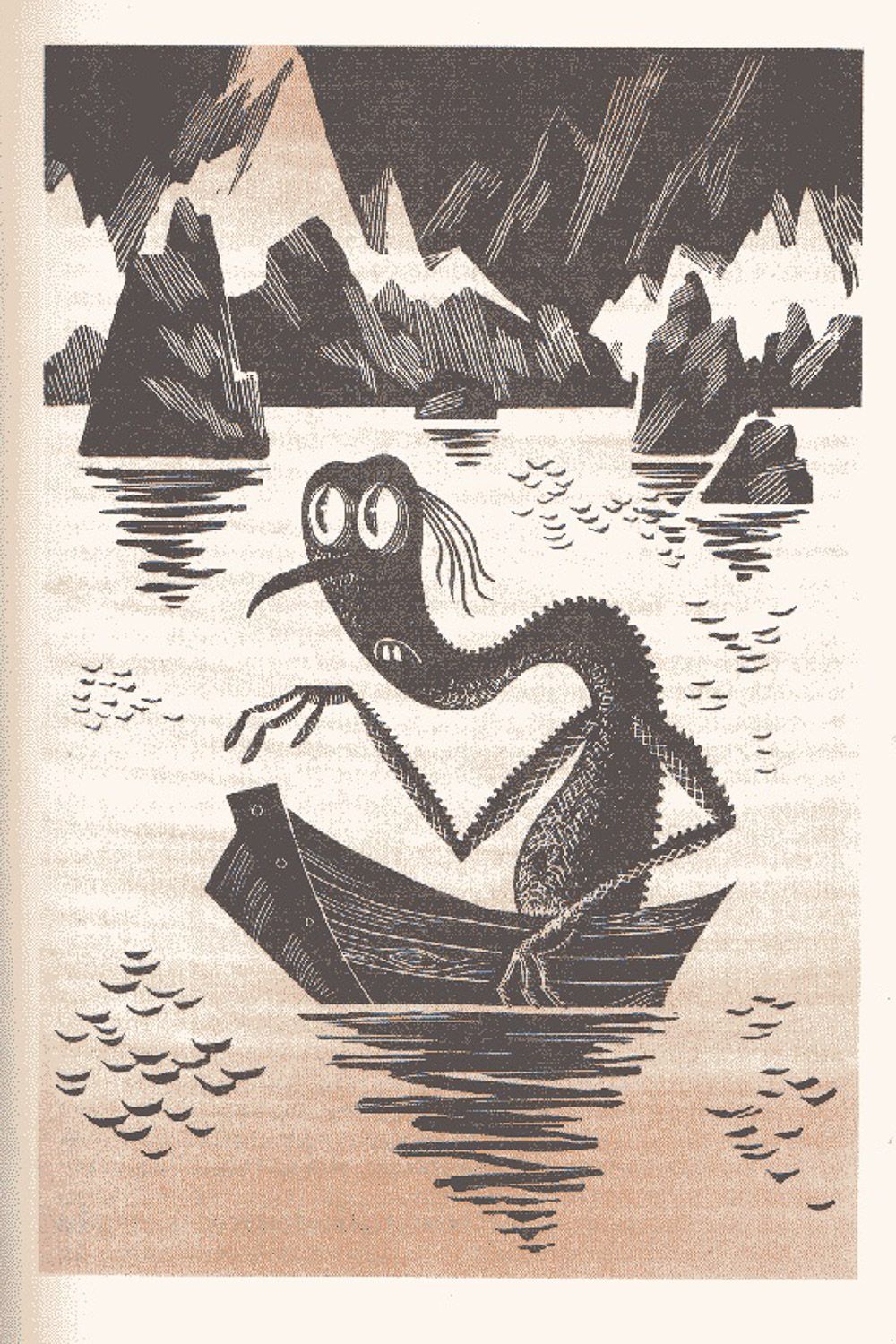
Here, Gollum, née Smeagol, paddles his raft in the depths of the mountains.
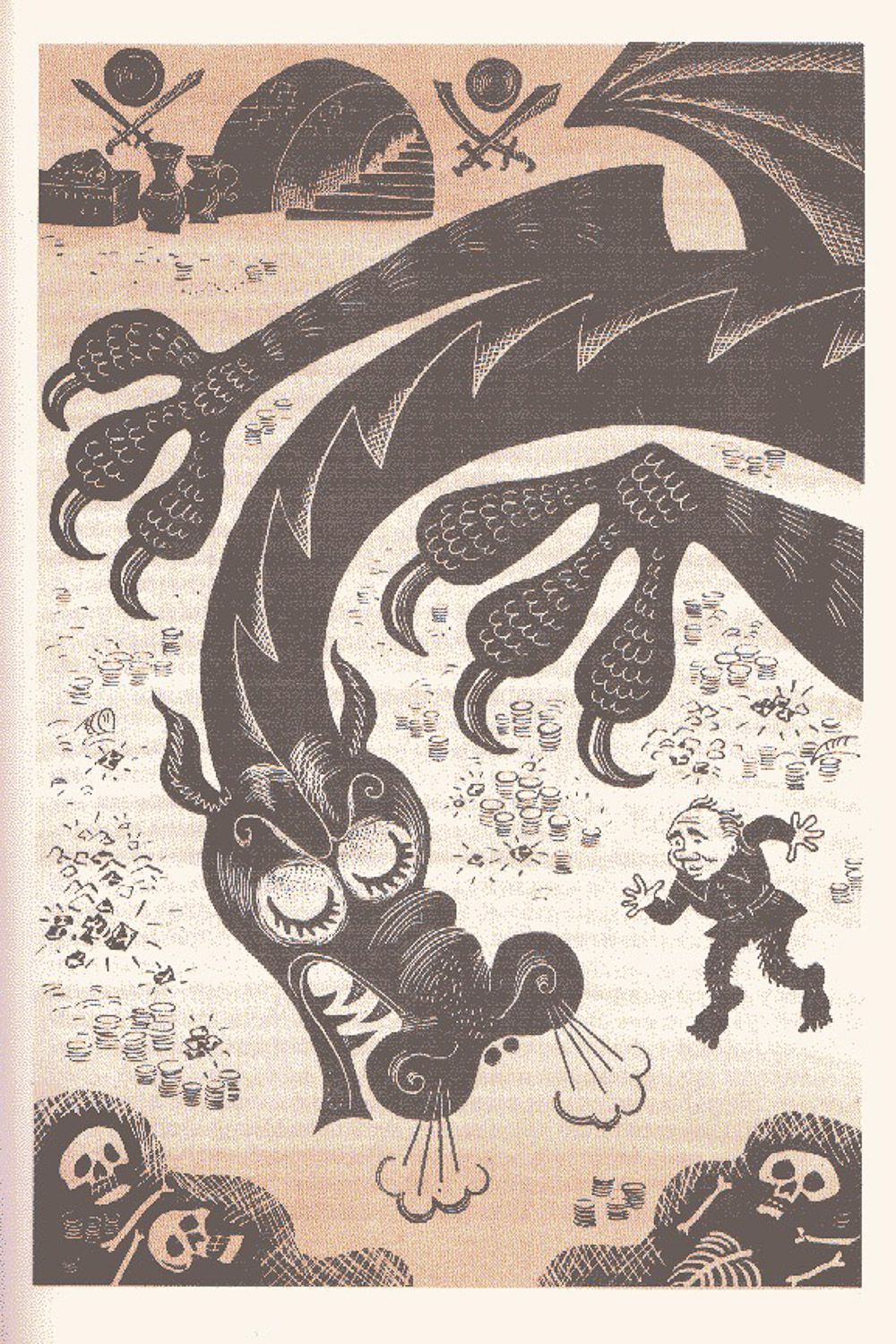
Finally, here’s Bilbo, fulfilling his role as a burglar in Smaug’s lair.
For more of the Soviet illustrations of The Hobbit, head on over to Mashable.
Note: An earlier version of this post appeared on our site in March, 2015
Ilia Blinderman is a Montreal-based culture and science writer. Follow him at @iliablinderman, or read more of his writing at the Huffington Post.
Related Content:
Download a Free Course on The Hobbit by “The Tolkien Professor,” Corey Olsen
Discover J.R.R. Tolkien’s Personal Book Cover Designs for The Lord of the Rings Trilogy
The Only Drawing from Maurice Sendak’s Short-Lived Attempt to Illustrate The Hobbit
Read More...The Art of Explaining Hard Ideas: Scientists Try to Explain Gene Editing & Brain Mapping to Young Kids & Students
If you’ve seen Bong Joon-ho’s film Okja, about an Agribusiness-engineered gargantuan mutant pig and her young Korean girl sidekick, you may have some very specific ideas about CRISPR, the science used to edit and manipulate genes. In fact, the madcap fictional adventure’s world may not be too far off, though the science seems to be moving in the other direction. Just recently, Chinese scientists have reported the creation of 12 pigs with 24 percent less body fat than the ordinary variety. It may not be front-page news yet, but the achievement is “a big issue for the pig industry,” says the lead researcher.
There’s much more to CRISPR than bioengineering lean bacon. But what is it and how does it work? I couldn’t begin to tell you. Let biologist Neville Sanjana explain. In the Wired video above, he undertakes the ultimate challenge for science communicators—explaining the most cutting-edge science to five different people: a 7‑year-old, 14-year-old, college student, grad student, and—to really put him on the spot—a CRISPR expert. CRISPR is “a new area of biomedical science that enables gene editing,” Sanjana begins in his short intro for viewers, “and it’s helping us understand the basis of many genetic diseases like autism and cancer.”
That’s all well and good, but does he have anything to say about the pig business? Watch and find out, beginning with the adorable 7‑year-old Teigen River, who may or may not have been primed with perfect responses. Play it for your own kids and let us know how well the explanation works. Sanjara runs quickly through his other students to arrive, halfway through the video, at Dr. Matthew Canver, CRISPR expert.
From there on out you may wish to refer to other quick references, such as the Harvard and MIT Broad Institute’s short guide and video intro above from molecular biologist Feng Zhang, who explains that CRISPR, or “Clustered Regularly Intersperced Short Palindromic Repeats,” is actually the name of DNA sequences in bacteria. The gene editing technology itself is called CRISPR-Cas9. Just so you know how the sausage is made.
Enough of pig puns. Let’s talk about brains, with neuroscientist Dr. Bobby Kasthuri of the Argonne National Laboratory. He faces a similar challenge above—this time explaining high concept science to a 5‑year-old, 13-year-old, college student, grad student, and a “Connectome entrepreneur.” A what? Connectome is the product of the NIH’s Human Connectome Project, which set out to “provide an unparalleled compilation of neural data” and “achieve never before realized conclusions about the living human brain.” This brain-mapping science has many objectives, one of which, in the 5‑year-old version, is “to know where every cell in your brain is, and how it can talk to every other cell.”
To this astonishing explanation you may reply like Daniel Dodson, 5‑year-old, with a stunned “Oh.” And then you may think of Philip K. Dick, or Black Mirror’s “San Junipero” episode. Especially after hearing from “Connectome Entrepreneur” Russell Hanson, founder and CEO of a company called Brain Backups, or after listening to Sebastian Seung—“leader in the field of connectomics”—give his TED talk, “I am my connectome.” Want another short, but grown-up focused, explanation of the totally science-fiction but also completely real Connectome? See Kasthuri’s 2‑minute animated video above from Boston University.
Related Video:
Richard Feynman Creates a Simple Method for Telling Science From Pseudoscience (1966)
125 Great Science Videos: From Astronomy to Physics & Psychology
Josh Jones is a writer and musician based in Durham, NC. Follow him at @jdmagness
Read More...Why Should You Read James Joyce’s Ulysses?: A New TED-ED Animation Makes the Case
There may be innumerable moral and philosophical reasons why we should read certain books, hear certain symphonies, see certain paintings…. Those reasons are mostly intangible, which makes them nobler, I suppose, than the reasons we should buy a luxury car or vacation home. Nevertheless, the salesmanship of high culture can sometimes feel of a piece, making subtle, or not so subtle, appeals to safety, status, and investment value. What of pure enjoyment? The immersion in a work of art because it simply feels good? To allow for pleasure alone to guide our aesthetic tastes, some might feel, would be amoral; would cheapen culture and elevate some supposedly vulgar products to the status of high art. Can’t have that.
Of course, how much high art was once considered a hazard to good taste and public morality? Modernism puffs out its chest with pride for having fostered many creative works that shocked and titillated their first mass audiences. James Joyce’s Ulysses ranks quite highly upon that list. The novel’s initial reputation as highbrow smut seems at odds with Sam Slote’s characterization of it in the TED-Ed video above as “both a literary masterpiece and one of the hardest works of literature to read.” But it can be all those things and more. Inside the dense experimental epic is a charmingly detailed travelogue of Dublin, a theological treatise on heresy, a series of Freudian jokes with the kinds of sophomoric punchlines “stately, plump Buck Mulligan” would appreciate….
Not for nothing has Joyce inspired a cult following, if not something of a downright cult, whose members gather all over the world on June 16th for “Bloomsday”—the single day on which the novel takes place, and on which Joyce met his lifelong partner Nora Barnacle in 1904. Dressed in period costume, Joyce fans read the novel aloud, and hundreds make the pilgrimage to Dublin to follow the perambulations of protagonists Leopold Bloom and Stephen Dedalus. “What is it,” asks Slote, an Associate Professor at Trinity College Dublin’s School of English, “about this famously difficult novel that inspires so many people?” Professor Slote is no dilettante but an expert who has published six books on Joyce and an annotated edition of Ulysses. He admits “there’s no one simple answer to that question.”
Nevertheless, the answers Slote does provide in the six-minute animated intro to Ulysses relate not to the novel’s moral, social, psychological, or political virtues, but to those qualities that give readers enjoyment. Each chapter is written in a different style,” a play, a “cheesy romance novel,” an imitation of music. Ulysses is a modern parody of Homer’s Odyssey and a virtuoso medley of technical performances, including a chapter which “reproduces the evolution of English literary prose style, from its beginnings in Anglo Saxon right up to the 20th century.” The final chapter, Molly Bloom’s stream-of-consciousness soliloquy, is a tour-de-force, capping off the “narrative gymnastic routines.” The shifting styles are augmented by “some of the most imaginative uses of language you’ll find anywhere.”
As for the novel’s frequent passages of “impenetrable” density? Well, Slote admits that “it’s up to the reader to let their eyes skim over them or grab a shovel and dig in.” In the remaining few minutes, he may have you convinced that the pleasure is worth the effort.
Related Content:
James Joyce: An Animated Introduction to His Life and Literary Works
James Joyce Reads From Ulysses and Finnegans Wake In His Only Two Recordings (1924/1929)
Read Joyce’s Ulysses Line by Line, for the Next 22 Years, with Frank Delaney’s Podcast
Josh Jones is a writer and musician based in Durham, NC. Follow him at @jdmagness
Read More...Samuel L. Jackson Teaches Acting in a New Online Course, Drawing on His Iconic Pulp Fiction Performance & Others
FYI: If you sign up for a MasterClass course by clicking on the affiliate links in this post, Open Culture will receive a small fee that helps support our operation.
With an actor as prolific and as long in the game as Samuel L. Jackson, a fan can pick a favorite performance only with great difficulty. Should it come from his roles in Hollywood blockbusters like Jurassic Park, Die Hard with a Vengeance, the Star Wars prequels, or the comic-book spectacles of Marvel Studios? His roles for iconoclastic auteurs like Spike Lee, Martin Scorsese, Steven Soderbergh, and Paul Thomas Anderson? His role — immortal title line and all — in Snakes on a Place? For many, though, Jackson attains prime Jacksonianism in only one context: his ongoing collaboration with Quentin Tarantino.
Whenever Jackson appears in a Tarantino film, whichever character he plays immediately becomes one of the most memorable in cinema’s past 25 years. But will any ever surpass Pulp Fiction’s Jheri-curled hitman Jules Winnfield for sheer impact per moment onscreen? Tarantino wrote the part especially for Jackson after seeing what he could do with a thuggish character in Tony Scott’s True Romance, whose script Tarantino had also written. Tarantino’s second feature film (and Jackson’s thirtieth) rocketed the actor to the top of the zeitgeist, not least on the strength of what we now call the “Ezekiel speeches,” the scenes in which Jackson-as-Winnfield quotes what he describes as the Bible passage Ezekiel 25:17:
Blessed is he who, in the name of charity and good will, shepherds the weak through the valley of the darkness. For he is truly his brother’s keeper and the finder of lost children. And I will strike down upon thee with great vengeance and furious anger those who attempt to poison and destroy my brothers. And you will know I am the Lord when I lay my vengeance upon you.
Jackson’s first Ezekiel speech (which owes as much to martial-arts star Sonny Chiba as to any holy text) comes toward the beginning of the movie, as he and his partner in killing Vincent Vega (a role that also did a great deal for its performer John Travolta, returning him to his former cultural prominence) turn up to an apartment to do a job. He delivers his final one in the highly Tarantinian setting of a Los Angeles diner booth, and both Tarantino and Jackson do their utmost to make it reveal his character’s transformation in his journey through the story.
It makes sense, then, that Jackson would break down and recreate that diner scene in the online course “Samuel L. Jackson Teaches Acting,” newly offered (for a fee of $90) by the education startup Masterclass. “I made a decision early in life that I wasn’t going to live and die in Chattanooga, Tennessee,” he says in its trailer, a line that could belong to the kind of monologue he delivers so powerfully in the movies. “Being able to embody a lot of different characters in film has been very cathartic, being able to let go of the anger or the disappointment that I had in my life.” Jackson’s Masterclass promises coverage of script breakdown, voice, characterization, auditioning, collaboration, and voiceover acting — catharsis, it seems, comes as a bonus. You can enroll now and get access to the 20-lesson course. Or you can purchase an All-Access Annual Pass for every course in the MasterClass catalog for $180.
Related Content:
Quentin Tarantino’s Original Wish List for the Cast of Pulp Fiction
Free Audio: Go the F–k to Sleep Narrated by Samuel L. Jackson
Samuel L. Jackson Stars in “Wake the F**ck Up for Obama,” a NSFW Political Children’s Tale
Based in Seoul, Colin Marshall writes and broadcasts on cities and culture. His projects include the book The Stateless City: a Walk through 21st-Century Los Angeles and the video series The City in Cinema. Follow him on Twitter at @colinmarshall or on Facebook.
Read More...Stephen Hawking’s Ph.D. Thesis, “Properties of Expanding Universes,” Now Free to Read/Download Online

Image by NASA, via Flickr Commons
Imagine being Stephen Hawking’s dissertation advisor? Not that most of us can put ourselves in the shoes of eminent Cambridge physicist Dennis Sciama… but imagine a student succeeding so profoundly, after having overcome such remarkable difficulty, to become the celebrated Stephen Hawking? One would feel immensely proud, I’d guess, and maybe just a little intimidated. Some graduate-level professors might even feel threatened by such a student. It’s doubtful, however, that Sciama—who signed off on Hawking’s thesis in 1966 and died in 1999—felt this way.
As F.R. Ellis and Roger Penrose write, when Hawking announced a significant finding about black holes in 1974, Sciama “quickly recognized the importance… hailing it as initiating a new revolution in our understanding.” Despite his portrayal by David Thewlis as “a kind of authoritarian gatekeeper” in the Hawking biopic The Theory of Everything, Sciama “was much more than that picture suggests,” writes another of his highly accomplished mentees, Adrian Melott; “he was a superb mentor who brought out the best in his students.” Ellis and Penrose, themselves esteemed scientists strongly influenced by Sciama, write of his “astonishing succession of research students,” three of whom became fellows of the Royal Society.
I mention these names because they are just a few of the many people who inspired, challenged, and guided Hawking, much of whose fame rests on his bestselling popular cosmology, A Brief History of Time. While he may be talked of as a lone eccentric singularity whose mind operates above our mortal plane, like every scientist, he developed in a community that includes many such minds. The observation in no way diminishes Hawking’s accomplishments–it might, ideally, spur those of us with an interest in his work to look at how it developed in conversation and debate with others, like eminent Cambridge physicist Fred Hoyle.
We can begin to do that now by going back to Hawking’s graduate days and reading his doctoral thesis, which has been made available for free download by the Cambridge University Library. “Properties of Expanding Universes” has proven so popular that it crashed the library web site, with more than 60,000 views yesterday. By contrast, “other popular theses might have 100 views per month,” says Stuart Roberts, deputy head of research communications at Cambridge.
In a statement accompanying the dissertation’s release, Hawking matter-of-factly situates himself in a vast community of “great” minds:
By making my PhD thesis Open Access, I hope to inspire people around the world to look up at the stars and not down at their feet; to wonder about our place in the universe and to try and make sense of the cosmos. Anyone, anywhere in the world should have free, unhindered access to not just my research, but to the research of every great and enquiring mind across the spectrum of human understanding.
Should we have such open access, all of us could follow the debates across academic projects, learn how the most sophisticated views of the universe’s nature get formulated and refined. However, we’d probably also find that few other physicists express themselves with as much clarity as Hawking. Whether or not we understand his scientific explanations, we can understand his prose, and his directness of expression has won him millions of readers who may have never have otherwise read any theoretical physics. See the first paragraph of Hawking’s introduction below:
The idea that the universe is expanding is of recent origin. All the early cosmologies were essentially stationary and even Einstein whose theory of relativity is the basis for almost all modern developments in cosmology, found it natural to suggest a static model of the universe. However there is a very grave difficulty associated with a static model such as Einstein’s which is supposed to have existed for an infinite time. For, if the stars had been radiating energy at their present rates for an infinite time, they would have needed an infinite supply of energy. Further, the flux of radiation now would be infinite. Alternatively, if they had only a limited supply of energy, the whole universe would by now have reached thermal equilibrium which is certainly not the case. This difficulty was noticed by Olders who however was not able to suggest any solution. The discovery of the recession of the nebulae by Hubble led to the abandonment of static models in favour of ones which were expanding.
Whether the remainder of “Properties of Expanding Universes” is as readable may be difficult to determine for a little while. As of the writing of this post, at least, both the original link and a secondary URL hosting a photographed version of the document have ground to a halt. (Update: Pages are serving fairly well again, at least for now.) No doubt many of the visitors are physicists and grad students themselves. But their numbers may be dwarfed by laypeople eager to see Hawking’s peculiar genius first emerge into the world, from a community of similarly brilliant cosmologists.
Related Contents:
Read John Nash’s Super Short PhD Thesis with 26 Pages & 2 Citations: The Beauty of Inventing a Field
Stephen Hawking’s Lectures on Black Holes Now Fully Animated with Chalkboard Illustrations
The Big Ideas of Stephen Hawking Explained with Simple Animation
Josh Jones is a writer and musician based in Durham, NC. Follow him at @jdmagness
Read More...Coursera Partners with Leading Universities to Offer Master’s Degrees at a More Affordable Price
If you’re a regular Open Culture reader, you’re already familiar with Coursera, the ed tech company, which, since its founding in 2012, has given the world access to online courses from top universities–e.g. courses on Roman Architecture (Yale), Modern and Postmodern Philosophy (Wesleyan), and Buddhism and Neuroscience (Princeton). And you’ve perhaps noticed, too, that Coursera has recently bundled certain courses into “Specializations”–essentially areas of concentration–that let students specialize in fields like Deep Learning and Data Science.
But what if students want to deepen their knowledge further and get a traditional degree? In what perhaps marks the beginning of a significant new trend, Coursera has partnered with leading universities to offer full-fledged graduate degrees in a more affordable online format. As described in the video above, HEC Paris (the #2 business school in Europe) now offers through Coursera’s platform a Master’s in Innovation and Entrepreneurship. Designed for aspiring entrepreneurs, the program consists of 20 courses (all online) and takes an estimated 10–16 months to complete. The total tuition amounts to 20,000 Euros (roughly 23,500 U.S. dollars), a sum that’s considerably less than what executive education programs usually cost.
For students looking for a broader education in business, the University of Illinois at Urbana-Champaign has launched an entire MBA program through Coursera. Consisting of 18 online courses and three capstone projects, the iMBA program covers the subjects usually found in b‑school programs–leadership, strategy, economics, accounting, finance, etc. The complete curriculum should take roughly 24 to 36 months to complete, and costs less than $22,000–about 25%-33% of what an on-campus MBA program typically runs.
(The iMBA is actually one of three degree programs the University of Illinois has launched on Coursera. The other two include a Masters in Accounting (iMSA) and a Master of Computer Science in Data Science (MCS-DS).)
Now, in case you’re wondering, the diplomas and transcripts for these programs are granted directly by the universities themselves (e.g., the University of Illinois at Urbana-Champaign and HEC Paris). The paperwork doesn’t carry Coursera’s name. Nor does it indicate that the student completed an “online program.” In short, online students get the same transcript as bricks and mortar students.
Finally, all of the degree programs mentioned above are “stackable”–meaning students can (at no cost) take an individual course offered by any of these programs. And then they can decide later whether they want to apply to the degree program, and, if so, retroactively apply that course towards the actual degree. Essentially, you can try things out before making a larger commitment.
If you want to learn more about these programs, or submit an application, check out the following links. We’ve included the deadlines for submitting applications.
- Online Master’s in Innovation and Entrepreneurship from HEC Paris
- Application deadline, December 7
- Master of Business Administration (iMBA) from the University of Illinois at Urbana-Champaign
- Application deadline, November 17
- Master of Science in Accountancy (iMSA) from the University of Illinois at Urbana-Champaign
- Application deadline, December 4
- Master of Computer Science in Data Science (MCS-DS) from the University of Illinois at Urbana-Champaign
- (Application deadline, October 15)
If you would like to support the mission of Open Culture, consider making a donation to our site. It’s hard to rely 100% on ads, and your contributions will help us continue providing the best free cultural and educational materials to learners everywhere. You can contribute through PayPal, Patreon, and Venmo (@openculture). Thanks!
Note: Open Culture has a partnership with Coursera. If readers enroll in certain Coursera courses, it helps support Open Culture.
Related Content:
MOOCs from Great Universities (Many With Certificates)
Read More...Stream Joni Mitchell’s Complete Discography: A 17-Hour Playlist Moving from Song to a Seagull (1968) to Shine (2007)
In “Fear of a Female Genius,” a recent essay on Joni Mitchell, Lindsay Zoladz explains why “one of the greatest living artists in popular music still isn’t properly recognized.” If you’re thinking that has something to do with gender bias, it does. But there’s so much more to Mitchell’s complex story. Those who fully embrace her are an eclectic group with leanings, like Mitchell, toward folk, jazz, classical, and instrumental music worldwide: sometimes all at once. Despite occasional breezy plainspokenness, she never makes for easy listening.
Her albums take us on winding journeys through peculiarly evocative lyrical tableaus, rich with unexpected, even jarring, images. Even the most accessible songs—for example, Court and Spark’s Burt Bacharach-like “Help Me”—spin like vertigo-inducing roller coasters, little gyres powered by boundless creative energy. Her most popular tunes glow with a worldly-wise intensity all their own. Hear them all, from 1968’s Song to a Seagull to 2007’s Shine, in the 18-hour Spotify playlist below. Or access it directly here.
The idiosyncratic beauty of Mitchell’s music, woven from shimmering tonal patterns, shifting polyrhythms, and odd timings and tunings, defies the labels we might apply. “I think when you listen to Court and Spark,” says Barney Hoskyns, editor of a new anthology of writing about Mitchell, “you can’t really sit there and say, ‘Well this is just pop music.’ You have to think of it on a level with the greatest art that’s been done in the last hundred years.” If Bob Dylan “is sort of Shakespeare,” Hoskyns says, “then Joni Mitchell is Milton… or Dante,” two writers whose labyrinthine verse often poses significant challenges for readers.
These kinds of “crass analogies,” as Hoskyns terms it, might seem off-putting and pretentious. But if it seems like Mitchell’s name appears more in the company of famous men than women, it’s an association she made herself. “Most of my heroes are monsters, unfortunately,” she has said, “and they are men.” Pablo Picasso, Miles Davis, Charles Mingus, whose surname Mitchell took for the title of her tenth album…. “This kind of male-hero worship,” writes Zoladz, “has made Mitchell a difficult figure to some feminist critics.”
Indeed, there is something “internet-proof” about Mitchell—her “unruliness” and unwillingness to remain in one place, to play the roles assigned her, to adopt hip stances, pander, or deny herself the freedom to move in unfamiliar artistic directions, making discoveries and risking missteps more cautious artists would avoid.
Chuck Mitchell, the estranged ex-husband and musical partner who seemed to resent her incredible talent, called her odd tunings “mystical.” But she resists the characterization of her playing as strange. “How can there be weird chords?” she asks; “these chords that I heard inside that suited me—they feel like my feelings.” As much as her work has emerged from her admiration of male heroes and collaborators, it has also been defined by escape from the restrictions men in her life might place on her, from Mitchell to Graham Nash, whose marriage proposal she declined. “As much as I loved and cared for Graham,” she remembered later, “I just thought, I’m gonna end up like my grandmother, kicking the door off the hinges, you know what I mean? It’s like, I better not.”
Albums like Hejira—her version of an Arabic word meaning something like “journey to a better place”—and The Hissing of Summer Lawns, with its nightmare vision of domesticity, document Mitchell’s release from the snares of marriage. But it has been difficult for the 21st century to come to terms with her for other reasons. Her casual appropriation of cultural tropes and her decision to appear in literal blackface, not only at a Halloween party but on the cover of 1977’s Don Juan’s Reckless Daughter, have been called marks of poor taste, at best. Her albums became increasingly experimental in the late 70s, showcasing a pastiche of influences and guest musicians overlaying her already unusual musicality, and alienating many of her fans.
As she left behind the “confessional” voice of albums like 1971’s critically-vaunted Blue and headed into weirder territory, she lost listeners and critics, who savaged abstract projects like The Hissing of Summer Lawns, only to find, forty years later, that these were essential works of art pushed aside by the weight of expectation. Mitchell had been pushing against that weight her entire life. Like some other uniquely talented guitarists—Django Reinhardt, Tony Iommi—her style developed around a disability, in her case a left hand weakened by the polio she had as a child in Canada. “So she invented her own way of playing,” writes Zoladz, and invented her own way of being in the music business and the world at large. “For good and at times for ill, Joni Mitchell believes she is a genius.” Spend some time with her discography and you may find it hard to disagree with her.
Related Content:
Vintage Video of Joni Mitchell Performing in 1965 — Before She Was Even Named Joni Mitchell
Josh Jones is a writer and musician based in Durham, NC. Follow him at @jdmagness
Read More...The Raven: a Pop-up Book Brings Edgar Allan Poe’s Classic Supernatural Poem to 3D Paper Life
You know a story has staying power not just when when we keep telling it decades and even centuries after its composition, but when we keep telling it in new forms. Even when Edgar Allan Poe set his literary sights on writing a poem that would win both high critical praise and a wide popular audience back in 1845, he could hardly have imagined that it would still bring haunted delight to its readers, listeners and even viewers more than 170 years later. But The Raven does endure, not just in the various celebrity readings we’ve featured here on Open Culture but in numerous illustrated editions, a beloved Simpsons segment, and now even a pop-up book.
Though The Raven: a Pop-up Book, illustrated and designed by Christopher Wormell and David Pelham, adapts Poe’s work of supernatural verse into a perhaps unexpected medium, it does so with thoroughness indeed.
Flip through it as do the hands in the video above, you’ll find springing to paper life before you not just the poem’s lovelorn narrator and the talking crow who pays him a visit, but every element of the setting as well, from the furniture and other objects of the narrator’s study — the velvet chair, the books, the bust of Pallas, the locket with the image of lost Lenore — to the seaside castle in which this vision of the story locates it.
Those of us who haven’t opened a pop-up book since childhood might be surprised to see how far its art has come. Not only would the illustrations of The Raven: a Pop Up Book hold up in a mere two dimensions as well, they interlock in three to form relatively complex geometric structures, ones that sometimes move with an almost eerie hint of naturalness. (You may, as I did, want to watch the narrator open his locket-holding hand more than once.) What’s more, the design allows viewing from more than one angle, providing details that those who only look at the book straight on will never see. Using the archaic apostrophe of which Poe himself might have approved, Boing Boing’s Cory Doctorow recommends the book “if you’re gearing up for Hallowe’en and want to get your kids in the spirit of things” — and especially if those kids wrongly believe themselves too old for pop-up books or too 21st-century for Poe. Get your copy of The Raven: a Pop Up Book here.
Related Content:
Gustave Doré’s Splendid Illustrations of Edgar Allan Poe’s “The Raven” (1884)
A Reading of Edgar Allan Poe’s “The Raven” in 100 Celebrity Voices
1,000 Free Audio Books: Download Great Books for Free
Based in Seoul, Colin Marshall writes and broadcasts on cities and culture. His projects include the book The Stateless City: a Walk through 21st-Century Los Angeles and the video series The City in Cinema. Follow him on Twitter at @colinmarshall or on Facebook.
Read More...The Women of the Blues: Hear a Playlist of Great Blues Singers, from Bessie Smith & Etta James, to Billie Holiday & Janis Joplin
Everybody gets the blues but not everybody gets the blues the same. Women get some serious blues. Black women get some very serious blues. Bessie Smith maybe had the most deep and soulful blues anyone ever had: “Crazy Blues,” “Down Hearted Blues,” “Careless Love Blues,” “Empty Bed Blues,” “Black Water Blues,” “Gulf Coast Blues,” and “St. Louis Blues,” which also happens to be the title of her only known film appearance, as well as one of the earliest talkies in cinema history. (See a transporting acapella performance from the film above.)
Released in 1929, the “flawed, but absolutely essential” film frames Smith’s character through the lyrics of composer W.C. Handy, widely considered the “father of the blues” for his popularization of the form. But Smith was more than an ancestor—she was royalty. The press in her day called her the “Empress of the Blues.”
Smith “comes off as a force of nature,” writes Mark Cantor, “whose startling power is rivaled in 1920s jazz and blues only by Louis Armstrong.” Like Armstrong, her influence is incalculable. Sadly, the year she made her film appearance is also the year of her decline, when the Great Depression hit her—and the record business—hard, and the very medium she helped launch, sound film, crippled the Vaudeville venues that made her career.
Smith’s tragic end after a car accident in 1937 was immortalized in Edward Albee’s 1959 The Death of Bessie Smith. Her voice lives on forever—in her recordings and through singers from Billie Holiday to Janis Joplin—who paid for her gravestone in 1970. (See Joplin’s phenomenal “Ball and Chain,” from the Monterey Pop Festival, further up.) Bessie Smith may have been Empress, but another Smith needs mention as the Foremother.
Despite its origins in Southern Black life and culture, until 1920, notes NPR, “no black singer had been recorded doing a blues song.” That changed when Mamie Smith recorded “Crazy Blues.” Like Bessie, she also appeared in a 1929 talking film, Jailhouse Blues. (See her above mime to the title song, about that age-old problem, the “no good man.”)
A number of female singers haven’t made it into the canon, itself largely produced—as critics like Lisa Hix and Amanda Petrusich have shown—by the selection bias of an insular community of collectors. But you can hear many incredible, less-famous women of the blues appear in the Spotify playlist further up, in the company of more famous names like Bessie and Mamie Smith, Holiday, Joplin, Memphis Minnie, Ma Rainey, Etta James, and Dinah Washington. Blues hounds will likely recognize most, if not all, of these names. More casual fans will be in for a treat. (Note one mistake: the artist Bumble Bee Slim was a man.)
Everyone should know Koko Taylor, whose fierce growls and howls set Willie Dixon’s “Wang Dang Doodle” on fire further up in 1967 (with Little Walter). And Etta James—whose “I’d Rather Go Blind,” above, gives me chills from start to finish—should have a constellation named after her, she’s so deservedly a star. We’re less likely to hear the name Viola McCoy these days (singing Bessie Smith’s “Back Water Blues,” below), whose style of blues sounds dated but whose voice is as fresh as ever. Likely born Amanda Brown, she sang under a handful of aliases in the 20s and 30s, none of them household names.
Dozens more names appear on the playlist—Ida Cox, Alberta Hunter, (unfortunately no Big Mama Thornton or Sister Rosetta Tharpe)—all of them fabulous in their own way. Given this incredibly rich tradition of female blues vocalists it should come as no surprise that women are currently keeping the blues alive, whether it’s the rock-soul revivalism of the Alabama Shakes’ Brittany Howard or the raw power of Susan Tedeschi, whose “earthy, soulful belting,” writes The Washington Post’s Richard Harrington, is reminiscent of “Koko Taylor, Aretha Franklin and Janis Joplin,” who can all trace their musical lineage directly back to Bessie and Mamie Smith.
Related Content:
Women of Jazz: Stream a Playlist of 91 Recordings by Great Female Jazz Musicians
Josh Jones is a writer and musician based in Durham, NC. Follow him at @jdmagness
Read More...Calm Down & Study with Relaxing Piano, Jazz & Harp Covers of Music from Hayao Miyazaki Films
Calling all pediatric dentists!
Cat Trumpet, aka musician and anime lover Curtis Bonnett, may have inadvertently hit on a genius solution for keeping young patients calm in the chair: relaxing piano covers of familiar tunes from Studio Ghibli’s animated features.
The results fall somewhere between pianist George Winston’s early 80s seasonal solos and Ryuichi Sakamoto’s soundtrack for the film Merry Christmas, Mr. Lawrence. Let us remember that most of these tunes were fairly easy on the ears to begin with. Composer Joe Hisaishi, who has collaborated with director Hayao Miyazaki on every Studio Ghibli movie save Castle of Cagliostro, isn’t exactly a punk rocker.
Many listeners report that the playlist helps them stay focused while studying or doing homework. Others succumb to the emotional riptides of childhood nostalgia.
Tender prenatal and newborn ears might prefer Cat Trumpet’s even gentler harp covers of seven Ghibli tunes, above.
Meawhile, the Japan-based Cafe Music BGM Station provides hours of jazzy, bossa-nova inflected Studio Ghibli covers to hospitals, hair salons, boutiques, and cafes. You can listen to three-and-a-half-hours worth, above. This, too, gets high marks as a homework helper.
Cat Trumpet’s Relaxing Piano Studio Ghibli Complete Collection
00:00:03 Spirited Away — Inochi no Namae
00:04:14 Howl’s Moving Castle — Merry Go Round of Life
00:07:16 Kiki’s Delivery Service — Town With An Ocean View
00:09:31 The Secret World of Arrietty — Arrietty’s Song
00:13:29 Laputa Castle In The Sky — Carrying You
00:17:05 Porco Rosso — Theme
00:19:55 Whisper of the Heart — Song of the Baron
00:22:33 Porco Rosso — Marco & Gina’s Theme
00:26:19 Only Yesterday — Main Theme
00:29:07 From Up On Poppy Hill — Reminiscence
00:34:12 Spirited Away — Shiroi Ryuu
00:37:06 Nausicaä of the Valley of the Wind — Tori no Hito
00:41:14 Nausicaä of the Valley of the Wind — Kaze no Densetsu
00:43:25 My Neighbor Totoro — Kaze no Toori Michi
00:47:48 Castle of Cagliostro — Fire Treasure
00:51:38 Princess Mononoke — Tabidachi nishi e
00:53:07 Tales From Earthsea — Teru’s Theme
00:58:17 My Neighbor Totoro — Tonari no Totoro
01:02:35 Whisper of the Heart — Theme
01:06:03 Ponyo — Rondo of the Sunflower House
01:10:34 Howl’s Moving Castle — The Promise of the World
Cat Trumpet’s Relaxing Harp Studio Ghibli Collection Playlist
00:03 Spirited Away — Inochi no Namae
04:01 Spirited Away — Waltz of Chihiro
06:43 Howls Moving Castle — Merry Go Round of Life
09:45 Howl’s Moving Castle — The Promise of the World
13:15 Laputa Castle In The Sky — Main Theme
16:55 Ponyo on the Cliff by the Sea — Main Theme
20:15 Tonari no Totoro — Kaze no Toori Michi
Cafe Music BGM’s Relaxing Jazz & Bossa Nova Studio Ghibli Cover Playlist (song titles in Japanese)
0:00 海の見える街 〜魔女の宅急便/Kiki’s Delivery Service
4:10 もののけ姫 〜もののけ姫/Princess Mononoke
7:28 君をのせて 〜天空の城ラピュタ/Laputa, the Castle of the Sky
11:09 風の通り道 〜となりのトトロ/My Neibour Totoro
16:26 ひこうき雲 〜風立ちぬ/THE WIND RISES〜
19:48 空とぶ宅急便 〜魔女の宅急便/Kiki’s Delivery Service
25:05 人生のメリーゴーランド
〜ハウルの動く城/Howl’s Moving Castle
28:07 いつも何度でも 〜千と千尋の神隠し/Spirited Away
32:08 となりのトトロ 〜となりのトトロ/My Neibour Totoro
36:40 さんぽ 〜となりのトトロ/My Neibour Totoro
38:40 崖の上のポニョ 〜崖の上のポニョ/Ponyo
42:08 ねこバス 〜となりのトトロ/My Neibour Totoro
46:06 旅路 〜風立ちぬ/THE WIND RISES
49:16 アシタカとサン 〜もののけ姫/Princess Mononoke
53:38 おかあさん 〜となりのトトロ/My Neibour Totoro
58:19 旅立ち 〜魔女の宅急便/Kiki’s Delivery Service
1:02:25 風の谷のナウシカ 〜風の谷のナウシカ/Nausicaa of the Valley of the Wind
1:06:59 やさしさに包まれたなら 〜魔女の宅急便/Kiki’s Delivery Service
Tune in to Cat Trumpet’s Spotify channel for his relaxing takes on Disney and anime, as well as Studio Ghibli. They are available for purchase on iTunes and Google Play, or enjoy some free downloads by patronizing his Patreon. He takes requests, too.
Tune in to Cafe Music’s BGM Spotify channel for Studio Ghibli jazz, in addition to some relaxing Hawaiian guitar jazz and a selection of nature-based mellow tunes. They are available for purchase on iTunes.
Related Content:
Insanely Cute Cat Commercials from Studio Ghibli, Hayao Miyazaki’s Legendary Animation Shop
Hayao Miyazaki Picks His 50 Favorite Children’s Books
How the Films of Hayao Miyazaki Work Their Animated Magic, Explained in 4 Video Essays
Ayun Halliday is an author, illustrator, theater maker and Chief Primatologist of the East Village Inky zine. Follow her @AyunHalliday.
Read More...Support Us
We're hoping to rely on loyal readers, rather than erratic ads. Please click the Donate button and support Open Culture. You can use Paypal, Venmo, Patreon, even Crypto! We thank you!

About Us

Open Culture scours the web for the best educational media. We find the free courses and audio books you need, the language lessons & educational videos you want, and plenty of enlightenment in between.
Advertise With Us

FREE UPDATES!
GET OUR DAILY EMAIL
Get the best cultural and educational resources on the web curated for you in a daily email. We never spam. Unsubscribe at any time.
FOLLOW ON SOCIAL MEDIA

Open Culture editor Dan Colman scours the web for the best educational media. He finds the free courses and audio books you need, the language lessons & movies you want, and plenty of enlightenment in between.
Advertise With Us

