The Last Known Photos of Jim Morrison, Taken Days Before His Death in Paris (June 1971)
It’s got to be one of my favorite ledes of all time: “The Doors legend Jim Morrison ‘faked his own death’ and is living as an aging homeless hippy in New York, according to a conspiracy theorist.”
This deadpan gem from wacky UK tabloid Express might convince the credulous, with its photo spread comparing white-bearded “Richard”—the aged, supposedly re-surfaced Morrison—with those of Morrison in his last years: bearded, bloated, and looking ten years older.
These are often the images we remember, but the photos in the video montage above (set to some inexplicably un-Door-sy music that you might want to mute) show us a more youthful, clean-shaven, baby-faced, and much healthier lizard king, traveling through Paris with his girlfriend Pamela Courson and their friend Alain Ronay, who took the photos on June 28th, 1971. (See a photo spread here at Vintage Everyday.)
Morrison was “clearly not in a good way,” writes Ultimate Classic Rock, “when he headed off for Paris,” but in these images, he appears fully ready to embark on a new career as a published poet instead of joining the “27 Club,” as he would just days later, when Courson awoke to find him dead in the bathtub of their Paris apartment on July 3rd.
Part of the reason fans have doggedly held on to the theory Morrison faked his death has to do with the mysterious circumstances surrounding that discovery–the “naggingly non-specific ‘heart failure’” ascribed as the cause by French authorities, the lack of an autopsy, and the “dozens of rumors—many of them unfounded” that proliferated around the mystery.
It turns out that circumstances of Jim Morrison’s death were sordidly predictable, if we believe onetime Doors publicist Danny Sugerman, who wrote in his 1989 memoir Wonderland Avenue about conversations with Courson, who “stated that Morrison had died of an accidental heroin overdose, having snorted what he believed to be cocaine,” writes The Vintage News.
Her account is supported by the confession of Alain Ronay—in a 1991 issue of Paris Match, where many of these photos appeared—who wrote that Courson nodded off instead of getting help for Morrison. Ronay also describes in his account (read it in full, translated, here), how he and filmmaker Agnes Varda helped mislead authorities as to Morrison’s identity, covered up his prior drug use, threw the press off track, and guided the investigation away from the drugs and Courson’s involvement.
Ronay seems credible enough, but whatever the circumstances surrounding Morrison’s death, it’s clear he had a lot of writing left in him. In his last interview with Rolling Stone, he talked about his poetry and his admiration for Norman Mailer and revealed he’d been working on a screenplay. While in Paris, he made several recordings of his poetry with some unnamed musicians. Last year, a handwritten poem found in his Paris apartment went up for auction. Its final, ominous line read, “Last words, Last words out.”
via The Vintage News/Dangerous Minds
Related Content:
“The Lost Paris Tapes” Preserves Jim Morrison’s Final Poetry Recordings from 1971
The Doors Play Live in Denmark & LA in 1968: See Jim Morrison Near His Charismatic Peak
A Young, Clean Cut Jim Morrison Appears in a 1962 Florida State University Promo Film
Josh Jones is a writer and musician based in Durham, NC. Follow him at @jdmagness
Read More...
What Are the Most Stolen Books? Bookstore Lists Feature Works by Murakami, Bukowski, Burroughs, Vonnegut, Kerouac & Palahniuk
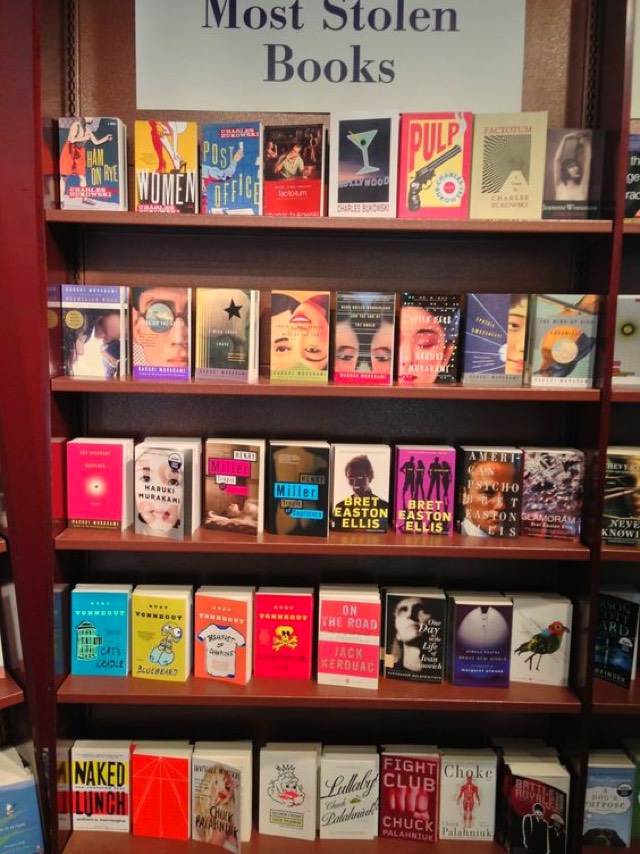
In 1971, Abbie Hoffman published his countercultural how-to/”hip Boy Scout handbook,” Steal This Book. Since then, millions of people have queued up to pay for it. Did they misread the very clear instruction in the title? Or did most of Hoffman’s readers think of it as another Yippie hoax, not to be taken any more seriously than Pigasus, the 145-pound pig Hoffman and his merry band of pranksters nominated for president in 1968? Seems to me Hoffman was dead serious about the pig, and about his call for shoplifting, or “inventory shrink.”
Nevertheless, millions of people have needed no unambiguous prodding from the Andy Kaufman of political theater to steal millions of other books from shops worldwide, to the detriment of publishers and booksellers and the edification of penurious readers. The books most stolen from bookstores happen to also be those that might best appeal to the kind of radical anarcho-hippies Hoffman addressed, including Jack Kerouac’s On the Road and anything by Bukowski and Burroughs.
Also high on the list is Haruki Murakami’s The Wind-Up Bird Chronicle, not a novel we necessarily associate with dumpster-divers and boxcar-hoppers, but one of many Murakamis book thieves have taken to lifting nonetheless. Kurt Vonnegut ranks highly, including his very popular Cat’s Cradle and Breakfast of Champions. Other favorite authors include hyper-masculine seers of societal decadence, Chuck Palahniuk and Brett Easton Ellis.
How do we know this? One source is simply an image, above, tweeted out by Vintage/Anchor Books—a photo of a “Most Stolen Books” shelf at an unnamed bookstore. We might assume whichever store it is has all the evidence it needs from a consistently shrinking inventory of these titles. And another major bookstore confirms much of the anonymous shelf above.
Melissa MacAulay at The Editing Company blog writes that during a part-time gig at Canadian giant Indigo books, Palahniuk’s Fight Club ended up behind the counter. Readers looking for a copy instead found “a small sign directing you to ‘please ask for assistance.’” In addition to Palahniuk, Indigo’s big three most stolen authors are Murakami, Kurt Vonnegut, and Bukowski, who tops out as the “reigning king of ‘Shoplift Lit.’”
In yet another “Most Stolen” list, blogger Candice Huber—inspired by Markus Zusak’s 2013 novel The Book Thief—undertook her own informal research and came up with similar results, with Bukowski and Burroughs in the top spot and Kerouac at number two. “All of the books listed,” notes Kottke, “are by men and most by ‘manly’ men” (whatever that means). See her list, with commentary, below.
Anything by Charles Bukowski or William S. Burroughs. Book sellers tend to keep books by these authors behind the counter because they get swiped so often.
On the Road by Jack Kerouac. If you notice a theme here, Bukowski, Burroughs, and Kerouac books all share, shall I put it bluntly, content of sex and drugs. It seems that those most likely to commit a reckless act (stealing) are also interested in reading about reckless acts.
Graphic Novels. The majority of book thieves are young, white males, and this is what they read.
The Great Gatsby by F. Scott Fitzgerald. Which was actually one of the most commonly stolen books long before the movie came out.
Various Selections from Ernest Hemingway, including A Moveable Feast and The Sun Also Rises.
Naked and Me Talk Pretty One Day by David Sedaris. David Sedaris? Really?
The New York Trilogy by Paul Auster. I wouldn’t have thought this was the stuff of the five-finger discount.
Steal this Book did not crack the top seven, though it did receive honorable mention, along with Hunter S. Thompson’s Fear and Loathing in Las Vegas, Jeffrey Eugenides’ The Virgin Suicides, Paulo Coelho’s The Alchemist, and “anything by Martin Amis.” Having been a poor college student myself once (not that I lifted my books!), and having taught many a cash-strapped undergrad, I’d assume a good number of the missing Fitzgeralds and Hemingways left bookstores in the hands of thieves bearing syllabi.
A 2009 Guardian list gives us an entirely different image of British book thieves with a penchant for boxer Lenny McLean’s memoirs, Yolanda Celbridge’s “modern S&M classic” The Taming of Trudi, comic books Tintin and Asterix, Banksy’s coffee table book Wall and Piece, and Harry Potter. Hoffman comes in at number six.
When it comes to books stolen from libraries, on the other hand, Huber points out this dynamic: “library theft leans more toward the practical than the popular, whereas bookstore theft leans toward the popular.” The top seven here include expensive art books, The Bible, The Guinness Book of World Records, textbooks/reference books/exam prep books, and, naturally, books on university reading lists. Also, Sports Illustrated Swimsuit Edition and “other racy books/magazines”—many stolen, perhaps, to avoid the embarrassment of prying librarian eyes.
We do not assume that you, dear upstanding reader, have ever stolen a book, or anything else. And yet, did you find anything on these lists surprising? (I thought Henry Miller might make the cut.…) What books would you expect to see stolen often that didn’t appear? What about a list of “most borrowed” (and maybe never returned) books from friends/acquaintances/family/roommates? Let us know your thoughts below.
Related Content:
The 20 Most Influential Academic Books of All Time: No Spoilers
28 Important Philosophers List the Books That Influenced Them Most During Their College Days
The 10 Greatest Books Ever, According to 125 Top Authors (Download Them for Free)
Josh Jones is a writer and musician based in Durham, NC. Follow him at @jdmagness
Read More...Replica of an Algerian City, Made of Couscous: Now on Display at The Guggenheim

If you head over to The Guggenheim in New York City, you’re bound to spend time immersing yourself in the Moholy-Nagy exhibit that’s now on display. It’s well worth your time. You can also take a side trip through a smaller exhibition featuring the work of Middle Eastern and North African artists. And there you’ll discover the work of Kader Attia, a French-Algerian artist whose work “reflects on the impact of Western societies on their former colonial counterparts.” Above, we have Attia’s replica of an Algerian city (Ghardaïa) made out of couscous. The Tate explains the conceptual thrust of the piece as follows:
The installation presents a model of the Algerian town Ghardaïa made from cous cous, shown alongside photographs of the Swiss-born architect Le Corbusier and the French architect Fernand Pouillon, and a print of the UNESCO declaration that the town is a World Heritage site. During the nineteenth century Ghardaïa was colonised by France, but the buildings were not altered during this period and remain characteristic of Mozabite architecture. Le Corbusier visited Ghardaïa in 1931, just three years after becoming a French citizen, and made sketches of the buildings. These strongly resemble the style of modernist architecture he subsequently espoused in his treatise on urban planning, La cité radieuse.
That a noted French architect should take inspiration from an Algerian town may not seem significant, however, as Attia notes, ‘architecture has first to do with politics, with the political order.’ As Attia is a child of Algerian immigrants and grew up partly in a Parisian banlieue, this statement seems particularly resonant. The use of cous cous as the material to ‘build’ the model is appropriate as it will provide an approximation of the town’s decay over time throughout the exhibition, while representing one of the region’s most popular foods – now a staple of European cuisine.
By replicating the town as an architects’ model in this way Attia shows the impact of his native culture, which had operated as a non-powerful host to colonial France, on their old colonisers, who went on to play host to the artist and his family. As well as highlighting the cultural impact of the colonised onto the coloniser, reversing the normally reported direction of influence, this also reveals the complexity of hospitality between people and nations which often relates to dispossession and re-appropriation…
Attia’s couscous installation is also on display at The Tate. If you’re in London, pay them a visit.
If you would like to support the mission of Open Culture, consider making a donation to our site. It’s hard to rely 100% on ads, and your contributions will help us continue providing the best free cultural and educational materials to learners everywhere. You can contribute through PayPal, Patreon, and Venmo (@openculture). Thanks!
Related Content:
The Guggenheim Puts Online 1600 Great Works of Modern Art from 575 Artists
Rijksmuseum Digitizes & Makes Free Online 210,000 Works of Art, Masterpieces Included
The National Gallery Makes 25,000 Images of Artwork Freely Available Online
Download 448 Free Art Books from The Metropolitan Museum of Art
Read More...How Did Hitler Rise to Power? : New TED-ED Animation Provides a Case Study in How Fascists Get Democratically Elected
How does one rise to public office? In part, by flattering the sensibilities of those one seeks to serve.
Do you appeal to their higher nature, their sense of civic responsibility and interconnectness?
Or do you capitalize on pre-existing biases, stoking already simmering fears and resentments to the boiling point?
The world paid a ghastly price when Germany’s Chancellor and eventual Führer Adolf Hitler proved himself a master of the latter approach.
It seems like we’ve been hearing about Hitler’s rise to power a lot lately… and not in anticipation of the fast-approaching 80th anniversary of the 1936 Olympic Games in Berlin.
We must always resist the temptation to oversimplify history, especially when doing so serves our own ends. There are way too many contributing factors to Hitler’s ascendancy to squeeze into a five minute animation.
On the other hand, you can’t dump a ton of information on people’s heads and expect them to absorb it all in one sitting. You have to start somewhere.
TED-Ed lesson planners Alex Gendler and Anthony Hazard, in collaboration with the Uncle Ginger animation studio, offer a very cogent explanation of how “a tyrant who orchestrated one of the largest genocides in history” achieved such a calamitously powerful position. All in a democratic fashion.
When viewers have more than five minutes to devote to the subject, they can delve into additional resources and participate in discussions on the subject.
The video doesn’t touch on Hitler’s mental illness or the particulars of Weimar era political structures, but even viewers with limited historical context will walk away from it with an understanding that Hitler was a master at exploiting the German majority’s mood in the wake of WWI. (A 1933 census shows that Jews made up less than one percent of the total population.)
Hitler’s reputation as a charismatic speaker is difficult to accept, given hindsight, modern sensibilities, and the herky-jerky quality of archival footage. He seems unhinged. How could the crowds not see it?
Perhaps they could, Gendler and Hazard suggest. They just didn’t want to. Businessmen and intellectuals, wanting to back a winner, rationalized that his more monstrous rhetoric was “only for show.”
Quite an attention-getting show, as it turns out.
Could it happen again? Gendler and Hazard, like all good educators, present students with the facts, then open the floor for discussion.
Related Content:
Rare 1940 Audio: Thomas Mann Explains the Nazis’ Ulterior Motive for Spreading Anti-Semitism
Noam Chomsky on Whether the Rise of Trump Resembles the Rise of Fascism in 1930s Germany
Ayun Halliday is an author, illustrator, and Chief Primatologist of the East Village Inky zine. Follow her @AyunHalliday
Read More...Marina Abramović and Ulay’s Adventurous 1970s Performance Art Pieces
Marina Abramović, who in her over forty-year career has put herself through countless harrowing works of performance art — involving knives, fire, unprescribed medication, and arduously long periods of motionlessness — doesn’t do things by half measures. “Once you enter into the performance state,” she once said, “you can push your body to do things you absolutely could never normally do.” It makes sense that she would connect with people who think and feel similarly about the artistic potential of endurance (or the endurance potential of art), and no such connection has had as dramatic an impact on her career as that with her fellow performance artist Ulay.
After meeting in Amsterdam in 1976, Abramović and Ulay entered into a twelve-year romantic relationship and artistic collaboration that brought them together into what they for a time described as a “two-headed body.” In the form of this “collective, androgynous being,” says one blog devoted to Abramović’s work, they “questioned the socially defined identities of both femininity and masculinity, and encouraged viewers to participate through their own exploration of gender relationships.” At the top of the post, you can see a video of their 1977 piece Relation in Time, which shows a couple minutes of the sixteen hours they spent tied together by their hair, never moving. The video just above shows a few moments of that same year’s Imponderabilia, in which they nakedly formed a narrow human corridor through which every audience member wanting to enter the gallery must pass.
“ ‘We are kneeling face to face, pressing our mouths together,” say Abramović and Ulay by way of introduction to Breathing In/Breathing Out. “Our noses are blocked with cigarette filters.” This piece, which they also put on in their evidently productive year of 1977, had them passing one another’s breath back and forth, breathing nothing else, for as long as they found humanly possible. The following year’s AAA AAA, rather than beginning with mouth-to-mouth contact, culminates in it: “Abramović and Ulay stand opposite of each other and make long sounds with their mouths open. Gradually, they move closer and closer to one another, until eventually they are yelling directly into each other’s open mouths” in an “exploration of aggression between physically present figures.”
Back in 2013, we featured a clip of Abramović’s The Artist Is Present, a much-publicized 2010 piece in which, for a total of 736 and a half hours, she sat silently in the atrium of New York’s Museum of Modern Art, opposite a chair in which anyone who cared to could sit across from her. 1,545 people, some having stood in line overnight, seized the opportunity, one of the earliest participants being Ulay himself. Alas, things have since soured. Ulay and Abramović have had a contract meant, according to The Guardian’s Noah Charney, “to manage their joint oeuvre.” It’s owned by Abramović with 20 percent of the profits for all “saleable work” derived from it going to Ulay. But last year, suspecting that the former other half of the “collective, androgynous being” has violated that contract and “is trying to write him out of art history,” Ulay mounted the ultimate endurance test: a lawsuit.
Related Content:
In Touching Video, Artist Marina Abramović & Former Lover Ulay Reunite After 22 Years Apart
Yoko Ono Lets Audience Cut Up Her Clothes in Conceptual Art Performance (Carnegie Hall, 1965)
Watch Chris Burden Get Shot for the Sake of Art (1971)
Based in Seoul, Colin Marshall writes and broadcasts on cities and culture. He’s at work on a book about Los Angeles, A Los Angeles Primer, the video series The City in Cinema, the crowdfunded journalism project Where Is the City of the Future?, and the Los Angeles Review of Books’ Korea Blog. Follow him on Twitter at @colinmarshall or on Facebook.
Read More...Allen Ginsberg Teaches You How to Meditate with a Rock Song Featuring Bob Dylan on Bass
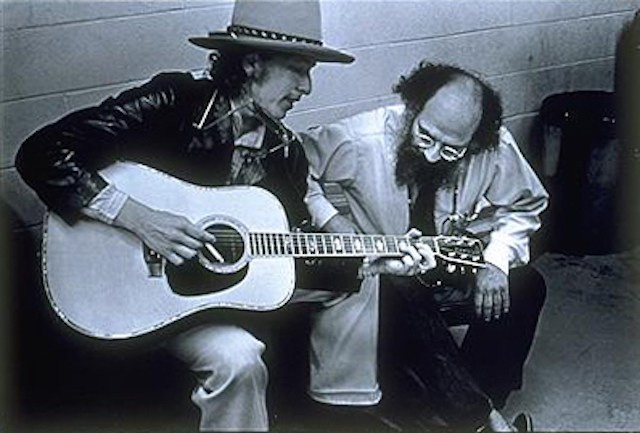
Image via Elisa Dorman, Wikimedia Commons
Whatever other criteria we use to lump them together—shared aims of psychedelic consciousness-expanding through drugs and Eastern religion, frank explorations of alternative sexualities, anti-establishment cred—the Beats were each in their own way true to the name in one very simple way: they all collaborated with musicians, wrote song or poems as songs, and saw literature as a public, performative art form like music.
And though I suppose one could call some of their forays into recorded music gimmicky at times, I can’t imagine Jack Kerouac’s career making a whole lot of sense without Bebop, or Burroughs’ without psychedelic rock and tape and noise experimentation, or Ginsberg’ without… well, Ginsberg got into a little bit of everything, didn’t he? Whether writing calypsos about the CIA, performing and recording with The Clash, showing up on MTV with Philip Glass and Paul McCartney…. He never worked with Kanye, but I imagine he probably would have.
For each of these artists, the medium delivered a message. Kerouac’s odes to jazz, loneliness, and wanderlust; Burroughs’ dark, paranoid prophecies about government control; and Ginsberg’s anti-war jeremiads and insistent pleas for peace, freedom, tolerance, and enlightenment. Ever the trickster and teacher, Ginsberg often used humor to disarm his audience, then went in for the kill, so to speak. We may find no more pointed an example of this comedic pedagogy than his 1981 song, “Do the Meditation Rock,” recorded in 1982 as a shambling folk-rock jam below with guitarist Steven Taylor, and members of Bob Dylan’s touring band—including Dylan himself making a rare appearance on bass.
As the story goes, according to Hank Shteamer at Rolling Stone, Ginsberg was in Los Angeles and “eager to book some studio time. Dylan obliged, and agreed to foot the bill for the studio costs on the condition that Ginsberg would pay the musicians. The two met at Dylan’s Santa Monica studio and, as Taylor remembers it, jammed for 10 hours.” Many more recordings from that session made it onto the recently released The Last World on First Blues, which also includes contributions from Jack Kerouac’s musical partner David Amram, folk legend Happy Traum, and experimental cellist, singer, and disco producer Arthur Russell.
See Ginsberg, Taylor, Russell, and Ginsberg’s partner Peter Orlovsky (meditating), perform the song above on a PBS special called “Good Morning, Mr. Orwell,” created in 1984 by Korean video artist Naim June Paik. As Ginsberg explains it in the liner notes to his collection Holy Soul, Jelly Roll, the song came together after his own meditation training in the late seventies, when the poet got the okay from his Buddhist teacher Chogyam Trungpa Rinpoche (founder of Naropa University) to “show basic meditation in his traditional classrooms or groups at poetry readings”—his goal, he says, to “knock all the poets out with sugar-coated dharma.”
Christmas Eve, I stopped in the middle of the block at a stoop and wrote the words down, notebook on my knee. I figured that if anyone listened to the words, they’d find complete instructions for classical sitting practice, Samatha-Vipassana (“Quieting the mind and clear seeing”). Some humor in the form, it doesn’t have to be taken over-seriously, yet it’s precise.
You may have noticed the familiar cadence of the chorus; it’s a take-off, he says, on “I Fought the Law,” recorded in 1977 by his soon-to-be musical partners, The Clash. In the live version below at New York’s Ukranian National Home, the song gets a more stripped-down, punk rock treatment with Tom Rogers on guitar. Like many a wandering bard, Ginsberg changes and adapts the lyrics slightly to the venue and occasion. See the Allen Ginsberg Project for several published versions of the lyrics and his changes in this rendition.
Apart from the basic meditation instructions, which are easy to follow in writing and song, Ginsberg’s “Do the Meditation Rock” had another message, specific to his understanding of the power of meditation; it can change the world, in spite of “a holocaust” or “Apocalypse in a long red car.” As Ginsberg speak/sings, “If you sit for an hour or a minute every day / you can tell the Superpower, sit the same way / you can tell the Superpower, watch and wait.” No matter how bad things seem, he says, “it’s never too late to stop and meditate.” Hear another recorded version of the song below from Holy Soul, Jelly Roll, recorded live in Kansas City by William S. Burroughs in 1989.
Related Content:
Allen Ginsberg Recordings Brought to the Digital Age. Listen to Eight Full Tracks for Free
Josh Jones is a writer and musician based in Durham, NC. Follow him at @jdmagness
Read More...Hear Maggie Gyllenhaal Read the Opening Lines of Anna Karenina: The Beginning of a 36-Hour, New Audio Book

Back in 2007, J. Peder Zane asked 125 top writers–everyone from Stephen King and Jonathan Franzen, to Claire Messud, Annie Proulx, and Michael Chabon–to name their favorite 10 books of all time. Zane then published each author’s list in his edited collection, The Top Ten: Writers Pick Their Favorite Books. And he capped it off with one meta list, “The Top Top Ten.” When you boil 125 lists down to one, it turns out [SPOILER ALERT] that Leo Tolstoy’s Anna Karenina is the very best of the best. If you’ve read the novel, you’ll likely understand the pick. If you haven’t, you’re missing out.
Above, you can hear actress Maggie Gyllenhaal (The Dark Knight, The Honourable Woman, etc.) read the opening lines of Anna Karenina, which famously begins “All happy families are alike; each unhappy family is unhappy in its own way.” Gyllenhaal spent 120 hours in the studio, making a recording that runs close to 36 hours in total. A lot more than she originally bargained for. Although available for purchase online, you can download the reading for free if you sign up for a 30-Day Free Trial with Audible. We have more information on that program here.
Related Content:
The 10 Greatest Books Ever, According to 125 Top Authors (Download Them for Free)
1,000 Free Audio Books: Download Great Books for Free.
800 Free eBooks for iPad, Kindle & Other Devices.
Read More...Hear Albert Camus Read the Famous Opening Passage of The Stranger (1947)
It is closing-time in the gardens of the West and from now on an artist will be judged only by the resonance of his solitude or the quality of his despair –Cyril Connolly
My mind has been drawn to lately Albert Camus’ The Stranger, in which an alienated French-Algerian man, simply called Meursault, shoots a nameless “Arab,” for no particular reason that he can divine. He thinks, perhaps, it may have been the sun in his eyes. Meursault is not a police officer, he has not been called to a scene. He ambles into a scene, sees a stranger coming toward him, and fires five shots, commenting—in language that recalls the impersonal copspeak of a “discharged weapon”—that “the trigger gave.”
The import of Camus’ 1942 novel—translated as The Outsider in the first British edition, with its introduction by despairing literary critic Cyril Connolly—became such a hobby horse for critics that Louis Hudon wrote in 1960, “L’Etranger no longer exists…. Almost everyone has approached Camus and L’Etranger bound by his own tradition, prejudices, or critical apparatus.” But maybe we cannot do otherwise. Maybe there is never the “magnificently naked purity of the text” Hudon eulogizes.
Part of the difficulty, Hudon alleged, was down to Camus himself, who made available his journals and manuscripts, thus encouraging over-interpretation. In 1955, Camus remarked, “I summarized The Stranger a long time ago, with a remark I admit was highly paradoxical: ‘In our society any man who does not weep at his mother’s funeral runs the risk of being sentenced to death.’” The book has been read and taught in light of this general statement ever since.
Recent commentary on The Stranger in English has turned, almost obsessively, on the translation of the novel’s first sentence: Aujourd’hui, maman est morte. Typically, as in that first British edition, the line has been rendered “Mother died today”—using a “static, archetypal term… like calling the family dog ‘Dog’ or a husband ‘Husband,’” writes Ryan Bloom in The New Yorker. For decades, Anglophone readers have come to know Meursault “through the detached formality of his statement.”
Perhaps if translators were to leave the word in its original French—maman—which connotes something between the formal “Mother” and childish “Mommy”—we would see Meursault differently. (French-speaking readers, of course, are not faced with this particular interpretive challenge.) But whether or not it makes a difference, and no matter how we have imagined Meursault’s internal voice, we can hear it the way Camus heard it, in the audio above from 1947, in which the author reads the opening section of the novel in French. (See the French passage and English translation at the bottom of the post.)
Does it matter whether we translate maman as “Mother” or leave it be? “Mommy” may be inappropriate, and while “mom” might “seem the closest fit… there’s still something off-putting and abrupt about the single-syllable word.” (Some translations have opted for the equally jarring, one-syllable “Ma.”) If the debate seems agonizingly scholastic, keep in mind that Meursault’s fate, his very life, as Camus remarked, turns on whether a jury views him as a sympathetic fellow human or a psychopath, based on exactly this kind of scrutiny.
But what of the murder? The murder victim? A man who is given no name, no history, no family, and no funeral that we see. Leaving maman in French, writes Bloom, serves another purpose—reminding readers “that they are in fact entering a world different from their own”—that of Camus’ native colonial French Algeria. (Though in some ways not so different.) Here, “the likelihood of a Frenchman in colonial Algeria getting the death penalty for killing an armed Arab was slim to nonexistent.” This historical context is often elided.
Many of us were taught that the murder is all of a piece with Meursault’s callous detachment from the world. But that interpretation itself betrays a profound callousness, one that takes for granted Meursault’s objectification of the faceless “Arab.” Absent in such a reading is the fact that Meursault is “a citizen of France domiciled in North Africa,” as Connolly writes, “an homme du midi yet one who hardly partakes of the traditional Mediterranean culture” …a colonist, who, because of his race and nationality, has likely been taught to view the Algerian “Arabs” as sub-human, other, outside, strange, undifferentiated, an enemy….
The shooting is a reflex born of that training. Why does he do it? He doesn’t know.
The freshest response to Camus’ novel happens to be a novel itself, Algerian writer Kamel Daoud’s 2013 The Meursault Investigation, narrated by “the Arab”’s younger brother, Harun, who notes that in Camus’ book “the world ‘Arab’ appears twenty-five times, but not a single name, not once.” Here, writes Claire Messud in her review, “Harun wants his listener to understand that the dead man had a name [“Musa”] and a family.” In his metafictional commentary, Harun ruminates: “Just think, we’re talking about one of the most read books in the world. My brother might have been famous if your author had merely deigned to give him a name.”
Daoud’s novel does not exist to upbraid Camus or supplant The Stranger but to humanize the figure of “the Arab,” tell the complicated stories of Algerian identity, and ask some very Camus-inspired questions about the morality of killing. Perhaps, as the consideration of maman suggests to us English readers, Meursault is not a sociopath, or an emotional vacuum, or a symbol of the amoral absurd, but a person who had a certain vague fondness for his mother, just not in the falsely sentimental way his judges would like. This is what we often take away from the novel—Meursault’s condemnation of a social order that insists on an inauthentic performance of humanity. Perhaps also Meursault’s seemingly senseless, casual murder of “the Arab” is not an outcome of his existential emptiness but a reflexively ordinary act that makes him more like his peers than we would like to admit.
Here’s the full text, in French and English, that Camus reads:
Aujourd’hui, maman est morte. Ou peut-être hier, je ne sais pas. J’ai reçu un télégramme de l’asile : « Mère décédée. Enterrement demain. Sentiments distingués. » Cela ne veut rien dire. C’était peut-être hier. (See full text below)
L’asile de vieillards est à Marengo, à quatre-vingts kilomètres d’Alger. Je prendrai l’autobus à deux heures et j’arriverai dans l’après-midi. Ainsi, je pourrai veiller et je rentrerai demain soir. J’ai demandé deux jours de congé à mon patron et il ne pouvait pas me les refuser avec une excuse pareille. Mais il n’avait pas l’air content. Je lui ai même dit : « Ce n’est pas de ma faute. » Il n’a pas répondu. J’ai pensé alors que je n’aurais pas dû lui dire cela. En somme, je n’avais pas à m’excuser. C’était plutôt à lui de me présenter ses condoléances. Mais il le fera sans doute après-demain, quand il me verra en deuil. Pour le moment, c’est un peu comme si maman n’était pas morte. Après l’enterrement, au contraire, ce sera une affaire classée et tout aura revêtu une allure plus officielle.
J’ai pris l’autobus à deux heures. Il faisait très chaud. J’ai mangé au restaurant, chez Céleste, comme d’habitude. Ils avaient tous beaucoup de peine pour moi et Céleste m’a dit : « On n’a qu’une mère. » Quand je suis parti, ils m’ont accompagné à la porte. J’étais un peu étourdi parce qu’il a fallu que je monte chez Emmanuel pour lui emprunter une cravate noire et un brassard. Il a perdu son oncle, il y a quelques mois.
J’ai couru pour ne pas manquer le départ. Cette hâte, cette course, c’est à cause de tout cela sans doute, ajouté aux cahots, à l’odeur d’essence, à la réverbération de la route et du ciel, que je me suis assoupi. J’ai dormi pendant presque tout le trajet. Et – 5 – quand je me suis réveillé, j’étais tassé contre un militaire qui m’a souri et qui m’a demandé si je venais de loin. J’ai dit « oui » pour n’avoir plus à parler.
MOTHER died today. Or, maybe, yesterday; I can’t be sure. The telegram from the Home says: YOUR MOTHER PASSED AWAY. FUNERAL TOMORROW. DEEP SYMPATHY. Which leaves the matter doubtful; it could have been yesterday.
The Home for Aged Persons is at Marengo, some fifty miles from Algiers. With the two o’clock bus I should get there well before nightfall. Then I can spend the night there, keeping the usual vigil beside the body, and be back here by tomorrow evening. I have fixed up with my employer for two days’ leave; obviously, under the circumstances, he couldn’t refuse. Still, I had an idea he looked annoyed, and I said, without thinking: “Sorry, sir, but it’s not my fault, you know.”
Afterwards it struck me I needn’t have said that. I had no reason to excuse myself; it was up to him to express his sympathy and so forth. Probably he will do so the day after tomorrow, when he sees me in black. For the present, it’s almost as if Mother weren’t really dead. The funeral will bring it home to me, put an official seal on it, so to speak. …
I took the two‑o’clock bus. It was a blazing hot afternoon. I’d lunched, as usual, at Céleste’s restaurant. Everyone was most kind, and Céleste said to me, “There’s no one like a mother.” When I left they came with me to the door. It was something of a rush, getting away, as at the last moment I had to call in at Emmanuel’s place to borrow his black tie and mourning band. He lost his uncle a few months ago.
I had to run to catch the bus. I suppose it was my hurrying like that, what with the glare off the road and from the sky, the reek of gasoline, and the jolts, that made me feel so drowsy. Anyhow, I slept most of the way. When I woke I was leaning against a soldier; he grinned and asked me if I’d come from a long way off, and I just nodded, to cut things short. I wasn’t in a mood for talking.
Related Content:
Albert Camus’ Historic Lecture, “The Human Crisis,” Performed by Actor Viggo Mortensen
Josh Jones is a writer and musician based in Durham, NC. Follow him at @jdmagness
Read More...Stanley Kubrick’s Daughter Vivian Debunks the Age-Old Moon Landing Conspiracy Theory
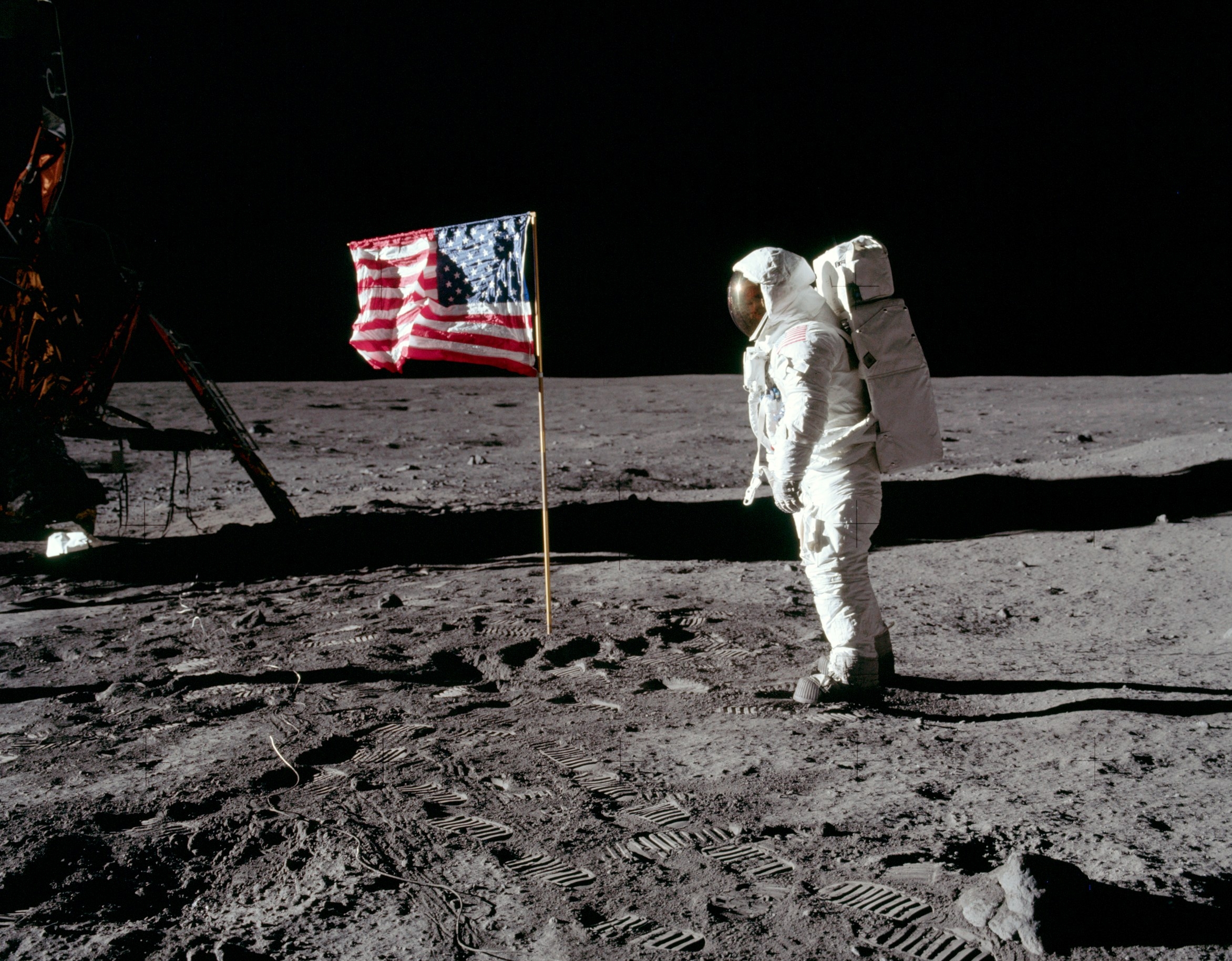
All moon-landing conspiracy theorists refuse to believe that the United States landed on that much-mythologized rock 250,00 miles away in 1969. As to why the rest of us believe that it did happen, moon-landing conspiracy theorists vary in the specifics of their stories. Perhaps the most interesting element of the lore — interesting to cinephiles, at least — holds that Stanley Kubrick, fresh off the production of 2001: A Space Odyssey, secretly shot the landing video seen across America in a studio, later cashing in on the favor by borrowing one of NASA’s custom-made Zeiss lenses to shoot 1975’s Barry Lyndon.
Kubrick died in 1999, and so can’t clear up the matter himself, unless you believe the “confession” video that circulated last year, convincing nobody but the already-convinced. But his daughter Vivian took to Twitter just this month to put the matter to rest herself, embedding an impassioned defense of her father’s integrity (and an encouragement to focus on the more plausible abuses of power quite possibly going on right this moment) that goes way beyond 140 characters:
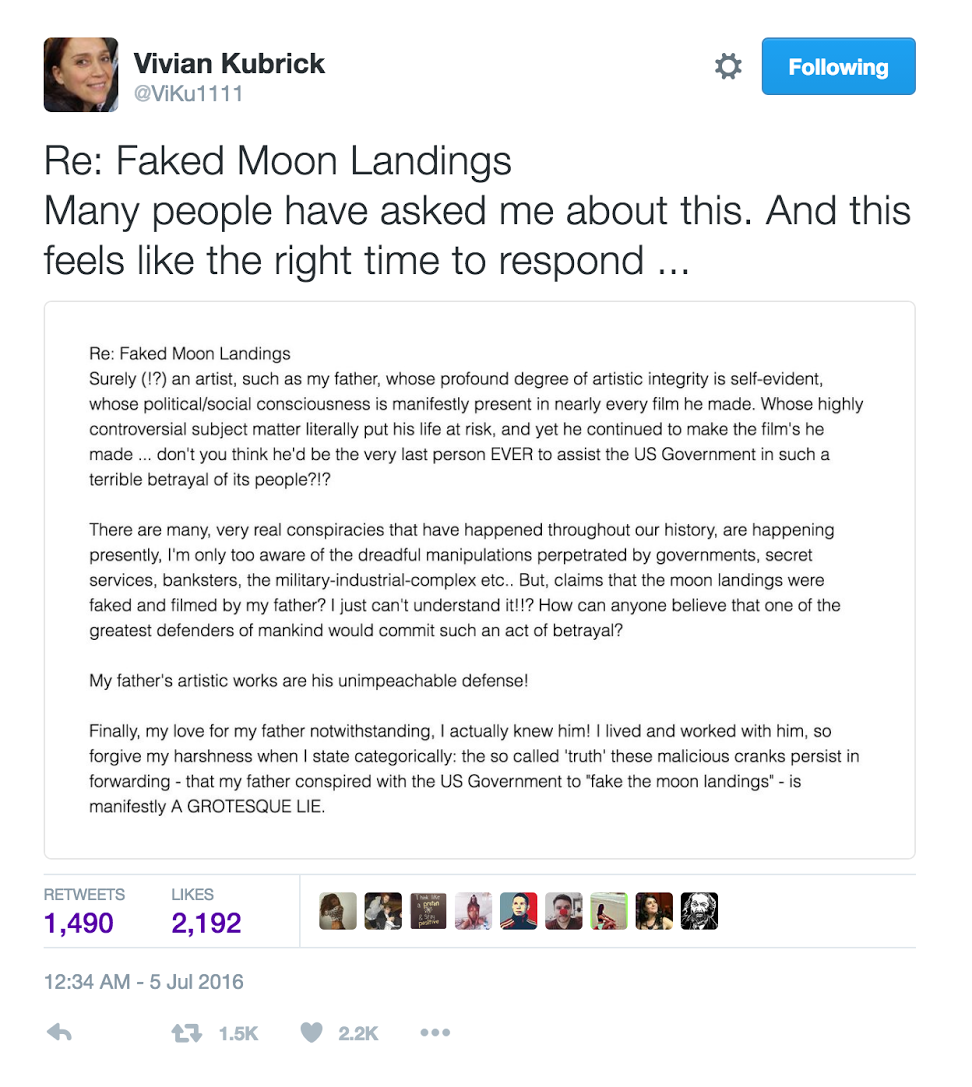
“Vivian Kubrick worked on the set of The Shining with her father where she shot a behind-the-scenes making-of documentary about the film,” adds Variety’s Lamarco McClendon. “Theorists have purported [Stanley] even used the film to admit to shooting the hoax by leaving behind clues. One such clue was Danny Lloyd wearing an Apollo 11 sweater.” The Shining has given rise to a fair few theories, conspiracy and otherwise, of its own, proving that Kubrick fans can get obsessive, watching and re-watching his work while seeking out symbols and patterns, seeing connections and drawing conclusions by building elaborate interpretive structures atop thin evidence. Come to think of it, you’d think they and the moon-landing conspiracy theorists would have a lot to talk about.
Related Content:
Stanley Kubrick Faked the Apollo 11 Moon Landing in 1969, Or So the Conspiracy Theory Goes
“Moon Hoax Not”: Short Film Explains Why It Was Impossible to Fake the Moon Landing
Michio Kaku & Noam Chomsky School Moon Landing and 9/11 Conspiracy Theorists
Based in Seoul, Colin Marshall writes and broadcasts on cities and culture. He’s at work on a book about Los Angeles, A Los Angeles Primer, the video series The City in Cinema, the crowdfunded journalism project Where Is the City of the Future?, and the Los Angeles Review of Books’ Korea Blog. Follow him on Twitter at @colinmarshall or on Facebook.
Read More...In Touching Video, People with Alzheimer’s Tell Us Which Memories They Never Want to Forget
Director Hirokazu Kore-eda’s 1999 film Afterlife tasks its recently deceased characters with choosing a single memory to take with them, as they move into the great unknown.
The subjects of “On Memory,” above, are all very much alive, but they too, have great cause to sift through a lifetime’s worth of memories. All have been diagnosed with Alzheimer’s disease. They range in age from 48 to 70. Two have been living with their diagnoses for six years. The baby of the group received hers just last year.


Those who have no personal connection to Alzheimer’s are likely to have a clearer picture of the disease’s advanced stage than its early presentation. A few minutes with Myriam Marquez, Lon Cole, Frances Smersh, Irene Japha, Nancy Johnson, and Bob Wellington should remedy that.
All six are able to recall and describe the significant events of their youth. At the interviewer’s request, they reflect on the pain of losing beloved parents and the pleasure of first kisses. Their powers of sensory recall bring back their earliest memories, including what the weather was like that day.
The recent past? Much hazier. At present, these individuals’ mild cognitive impairment resemble benign age-related memory slips quite closely. Their diagnoses are what lends urgency to their answers. The prospect of forgetting children and spouse’s names is very real to them.
Knowledge of the interviewees’ diagnoses can’t but help sharpen viewers’ eyes for distinct facial expressions, speech patterns, and individual temperaments. They share a common diagnosis, but for now, there’s no difficulty distinguishing between the six unique personalities, each informed by a wealth of experience.
The video is a step up for viral video producer Cut, creator of such internet sensations as the Truth or Drink series and Grandmas Smoking Weed for the First Time. This video, which directs viewers to the Alzheimer’s Association for more information, deserves an even wider audience.
Related Content:
Daily Meditation Boosts & Revitalizes the Brain and Reduces Stress, Harvard Study Finds
Playing an Instrument Is a Great Workout For Your Brain: New Animation Explains Why
Ayun Halliday is an author, illustrator, and Chief Primatologist of the East Village Inky zine. Follow her @AyunHalliday
Read More...Support Us
We're hoping to rely on loyal readers, rather than erratic ads. Please click the Donate button and support Open Culture. You can use Paypal, Venmo, Patreon, even Crypto! We thank you!

About Us

Open Culture scours the web for the best educational media. We find the free courses and audio books you need, the language lessons & educational videos you want, and plenty of enlightenment in between.
Advertise With Us

FREE UPDATES!
GET OUR DAILY EMAIL
Get the best cultural and educational resources on the web curated for you in a daily email. We never spam. Unsubscribe at any time.
FOLLOW ON SOCIAL MEDIA

Open Culture editor Dan Colman scours the web for the best educational media. He finds the free courses and audio books you need, the language lessons & movies you want, and plenty of enlightenment in between.
Advertise With Us


