This Is What It Sounds Like When 1999 People Sing Prince’s “When Doves Cry”
Earlier this month, 1999 members of Choir!Choir!Choir!–a group that meets weekly and sings their hearts out–showed up at Toronto’s Massey Hall and paid tribute to Prince. In a matter of hours, writes Toronto Life, “choir leaders Nobu Adilman and Daveed Goldman led the crowd through a three-part arrangement of Prince’s “When Doves Cry.” And the result is touching. All proceeds went to the Regent Park School of Music and the Share The Music programme. You can see the group’s earlier tributes to David Bowie here, and many other performances on their YouTube channel.
If you would like to support the mission of Open Culture, consider making a donation to our site. It’s hard to rely 100% on ads, and your contributions will help us continue providing the best free cultural and educational materials to learners everywhere. You can contribute through PayPal, Patreon, and Venmo (@openculture). Thanks!
Read More...Watch the Pioneering Films of Oscar Micheaux, America’s First Great African-American Filmmaker
You may never have heard of Oscar Micheaux, but out of his “impoverished consciousness-raising exploitation potboilers,” writes critic Dave Kehr, “the American black cinema was born.” Kehr wrote that in a brief review of Micheaux’s Murder in Harlem, a “1935 mystery tale involving corpses and mysterious letters and flashbacks and Byzantine plot twists, all of which should undoubtedly prove taxing to Micheaux’s meager technical abilities. It hardly matters though, since Micheaux was his own cinematic institution.”
That movie came in the late-middle period of Micheaux’s career, which produced more than 44 pictures and qualified him as the most prolific black independent filmmaker in American cinema history as well as, in the words of Atlas Obscura’s Stephanie Weber, “a pioneer in almost every aspect of film.” Having started out as a writer, he chose for his first motion picture to adapt The Homesteader, his own novel “about a black homesteader in the Dakotas who falls in love with the daughter of a Scottish widower. In 1919, Micheaux raised the money on his own to film and produce The Homesteader in Chicago, becoming the first African American to make a feature film.”
Not only did Micheaux take on a controversial theme right away by hinting at the possibility of interracial romance (though The Homesteader’s love interest turns out, in a plot twist that must have made more sense at the time, not to actually be white), history has remembered him as standing against not just the dominant social phenomena but the dominant cinematic phenomena of his day: his second film Within Our Gates told the story of a mixed-race schoolteacher whose adoptive father stood up to the family’s white landlord, ostensibly as a response to post-World War I social instability, though some took it as a rebuke to D.W. Griffith’s The Birth of a Nation.
“Given the times, his accomplishments in publishing and film are extraordinary,” says NAACP History, “including being the first African-American to produce a film to be shown in ‘white’ movie theaters. In his motion pictures, he moved away from the ‘Negro’ stereotypes being portrayed in film at the time.” In recent years, critics like Kehr and others have directed a bit of attention back toward Micheaux’s path-breaking body of work, and many future leading lights of black American cinema could no doubt benefit from discovering it themselves. But in his confident treatment of sensational material, his creativity-inducing technical and economic limitations, and his learn-on-the-job understanding of the mechanics of cinema, he also foreshadowed the excitement of all the waves of indie film to come.
You can watch many of Oscar Micheaux’s films free on Youtube or at the Internet Archive. Or find them in our collection, 4,000+ Free Movies Online: Great Classics, Indies, Noir, Westerns, Documentaries & More.
To learn more about Micheaux, read Patrick McGilligan’s book, Oscar Micheaux: The Great and Only: The Life of America’s First Great Black Filmmaker.
via Atlas Obscura
Related Content:
101 Free Silent Films: The Great Classics
Duke Ellington’s Symphony in Black, Starring a 19-Year-old Billie Holiday
Based in Seoul, Colin Marshall writes and broadcasts on cities, language, and style. He’s at work on a book about Los Angeles, A Los Angeles Primer, the video series The City in Cinema, the crowdfunded journalism project Where Is the City of the Future?, and the Los Angeles Review of Books’ Korea Blog. Follow him on Twitter at @colinmarshall or on Facebook.
Read More...John Lydon & Public Image Ltd. Sow Chaos on American Bandstand: The Show’s Best and Worst Moment (1980)
American Bandstand is best remembered these days not for doing the job it set out to do–presenting safe pop stars in the company of a studio audience to move units–but for when it ran headlong into the changing culture around it. Or at least that’s what Open Culture thinks. We’ve seen the beginnings of the Summer of Love with Jefferson Airplane and chipper Dick Clark trying to figure out why hippies wouldn’t cut their hair. We’ve also seen a bemused Clark attempting to interact with David Byrne when the Talking Heads played the show. But nothing really tops the time Public Image Ltd. brought true chaos to the Bandstand.
Dick Clark called it the worst moment in Bandstand history; Lydon, in his autobiography, said the opposite, saying Clark told him it was one of the best performances in the show’s history. Somewhere in between lies the truth–no doubt Clark knew it was great television.
It all took place on May 17, 1980, one full month before John Lydon and Keith Levene’s contentious appearance on Tom Snyder’s program, where Lydon insists that Public Image Ltd. is not a band. “It’s a company,” he shot back in his finest nasal cockney.
PIL was on American Bandstand to promote their album Second Edition, their dark dabbling into dub and post-punk. The first song may be called “Poptones” but there’s nothing poppy about it.
According to Cole Coonce in his book Sex & Travel & Vestiges of Metallic Fragments, Lydon told Clark that he had a cold. “He said that because he wasn’t feeling well he was just going to go up there and take the piss out of me. So I said, ‘Go ahead.’ And he did.’”
Lydon’s account is different, saying the show’s producers cut down “Poptones” and “Careering” (a total of 13 some minutes) down to a manageable length.
“I don’t know where the vocals are going to drop. What are we supposed to do?” Lydon thought.
What PIL did is what was broadcast. Adrift from their own song, Lydon starts “Poptones” sitting on the front of the stage, then grabs the microphone and wanders into the audience. He makes no attempt to lip sync. The audience isn’t sure what to do. Lydon isn’t sure. There’s an element of danger and excitement. Lydon grabs audience members and takes them onto the stage to dance. By the end of the first song the audience has taken over the stage and then Dick Clark has to introduce the band. It doesn’t last long, and “Careering” begins.
The danger of punk and post-punk that evening wasn’t in the performance of the band or of a volatile audience. It was in the breaking down of a television show’s artifice and the separation of band and audience. Check it out.
Some great photos of the show can be viewed over at Flashbak.
Related content:
Never Mind the Bollocks, Here’s … John Lydon in a Butter Commercial?
Johnny Rotten Goes Before TV’s Judge Judy in 1997 … and Wins!
Ted Mills is a freelance writer on the arts who currently hosts the artist interview-based FunkZone Podcast. You can also follow him on Twitter at @tedmills, read his other arts writing at tedmills.com and/or watch his films here.
Read More...Jon Stewart Resurfaces and Breaks Down the 2016 Election: The “Man Baby” v. the “Inauthentic”
It’s a farce of an election, and the only thing that could make it bearable is The Daily Show with Jon Stewart. (Sorry Trevor Noah.) But, alas, Stewart retired from the show earlier this year, leaving us starving for some incisive comic relief.
But here’s a momentary respite.
Two days ago, Stewart appeared on “The Axe Files,” a podcast hosted by David Axelrod, once the Chief Strategist for Barack Obama’s presidential campaigns, and now the Director of the Institute of Politics at the University of Chicago. The podcast features intelligent conversations with key figures in the political world. And they often put a human face on political figures you might otherwise disdain. If you want to feel a little better about American politics, you can listen to archived episodes here.
If you would like to support the mission of Open Culture, consider making a donation to our site. It’s hard to rely 100% on ads, and your contributions will help us continue providing the best free cultural and educational materials to learners everywhere. You can contribute through PayPal, Patreon, and Venmo (@openculture). Thanks!
Read More...Download 144 Beautiful Books of Russian Futurism: Mayakovsky, Malevich, Khlebnikov & More (1910–30)
In the years after World War II, the CIA made use of jazz musicians, abstract expressionist painters, and experimental writers to promote avant-garde American culture as a Cold War weapon. At the time, downward cultural comparisons with Soviet art were highly credible.
Many years of repressive Stalinism and what Isaiah Berlin called “the new orthodoxy” had reduced so much Russian art and literature to didactic, homogenized social realism. But in the years following the first World War and the Russian Revolution, it would not have been possible to accuse the Soviets of cultural backwardness.
The first three decades of the twentieth century produced some of the most innovative art, film, dance, drama, and poetry in Russian history, much of it under the banner of Futurism, the movement begun in Italy in 1909 by F.T. Marinetti. Like the Italian Futurists, these avant-garde Russian artists and poets were, writes Poets.org, “preoccupied with urban imagery, eccentric words, neologisms, and experimental rhymes.” One of the movement’s most inventive members, Velimir Khlebnikov, wrote poetry that ranged from “dense and private neologisms to exotic verseforms written in palindromes.” Most of his poetry “was too impenetrable to reach a popular audience,” and his work included not only experiments with language on the page, but also avant-garde industrial sound recording.
Khlebnikov’s experiments in linguistic sound and form became known as “Zaum,” a word that can be translated as “transreason,” or “beyond sense.” He pioneered his techniques with another major Futurist poet, Aleksei Kruchenykh, who may have been, writes Monoskop, “the most radical poet of Russian Futurism.” The most famous name to emerge from the movement, Vladimir Mayakovsky, embodied Futurism’s confident individualism, his poetics “a mixture of extravagant exaggerations and self-centered and arduous imagery.” Mayakovsky made a name for himself as an actor, painter, poet, filmmaker, and playwright. Even Stalin, who would soon preside over the suppression of the Russian avant-garde, called Mayakovsky after his death in 1930 “the best and most talented poet of the Soviet epoch.”
Monoskop points us toward a sizable online archive of 144 digitally scanned Futurist publications, including major works by Khlebnikov, Kruchenykh, Mayakovsky, and other Futurist poets, writers, and artists. There’s even a critical essay by the imposing Russian painter and founder of the austere school of Suprematism, Kazimir Malevich. All of the texts are in Russian, as is the site that hosts them—the State Public Historical Library of Russia—though if you load it in Google Chrome, you can translate the titles and the accompanying bibliographic information.
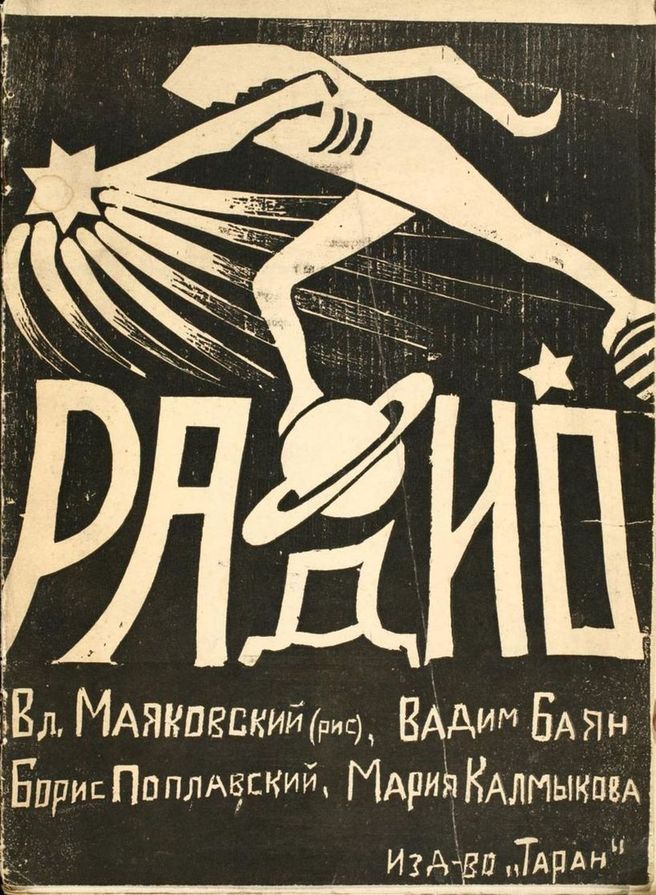
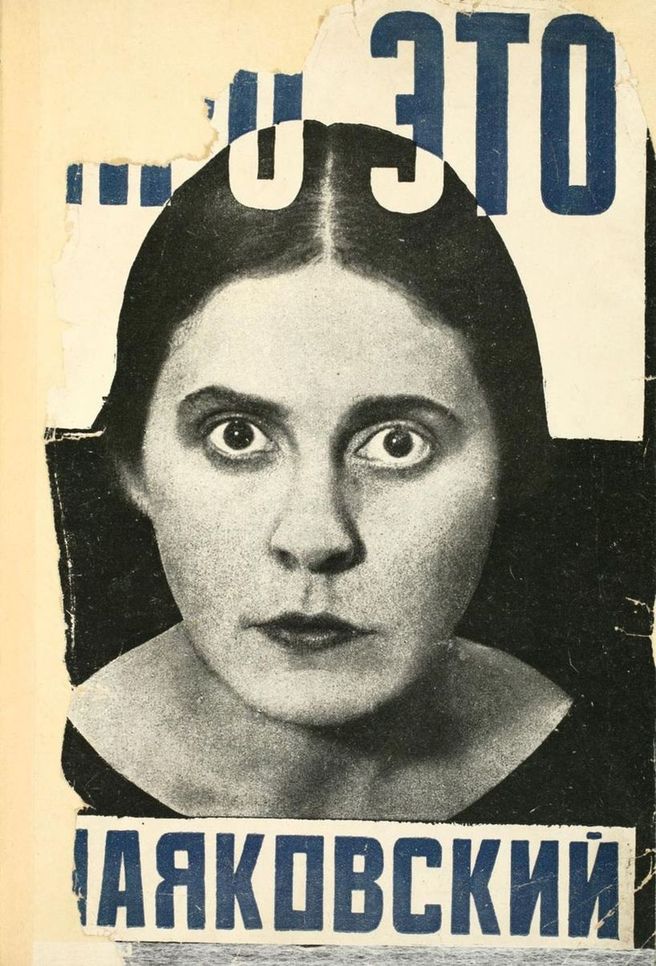
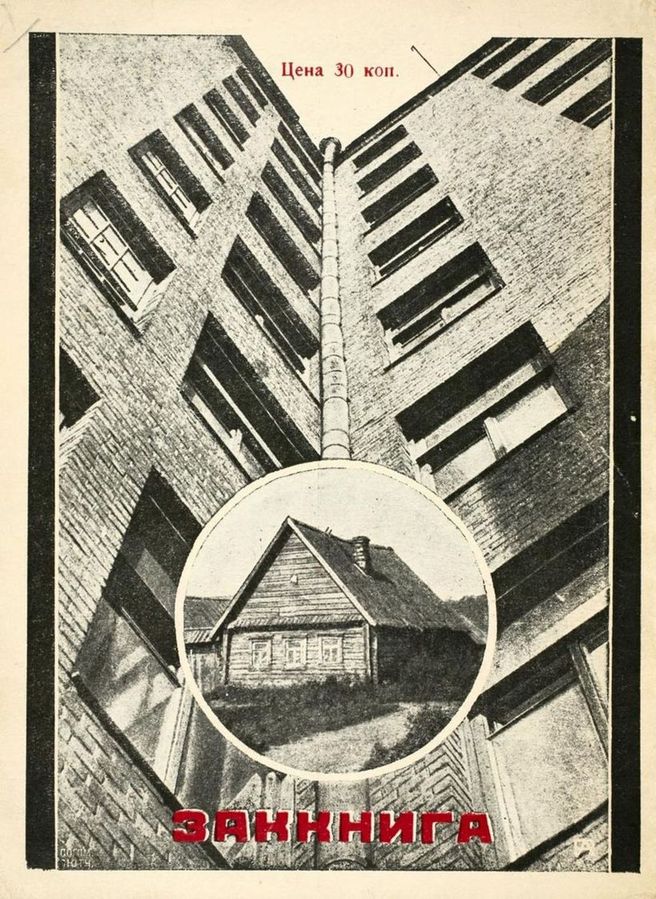
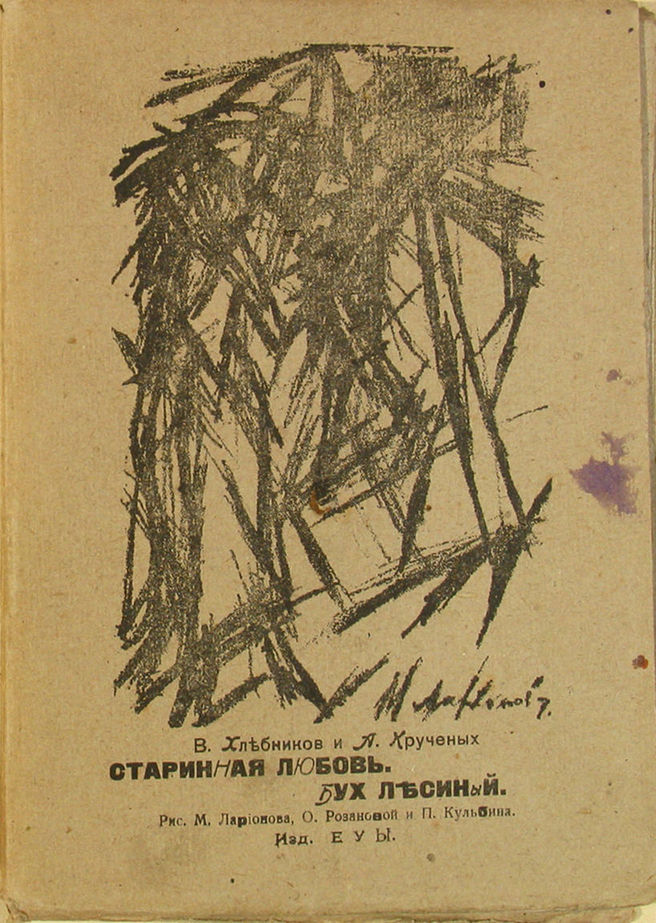
You can also download full pages in high-resolution. Many of the texts include strong visual elements, such as the cover at the top from a multi-author collection titled Radio, featuring Mayakovsky, whose own books include photo montages like the two further up. Just above, see the cover of Khlebnikov and Kruchenykh’s Vintage Love, which includes many more such sketches. And below, the cover of a 1926 book by Kruchenykh called On the Fight Against Hooliganism in Literature.
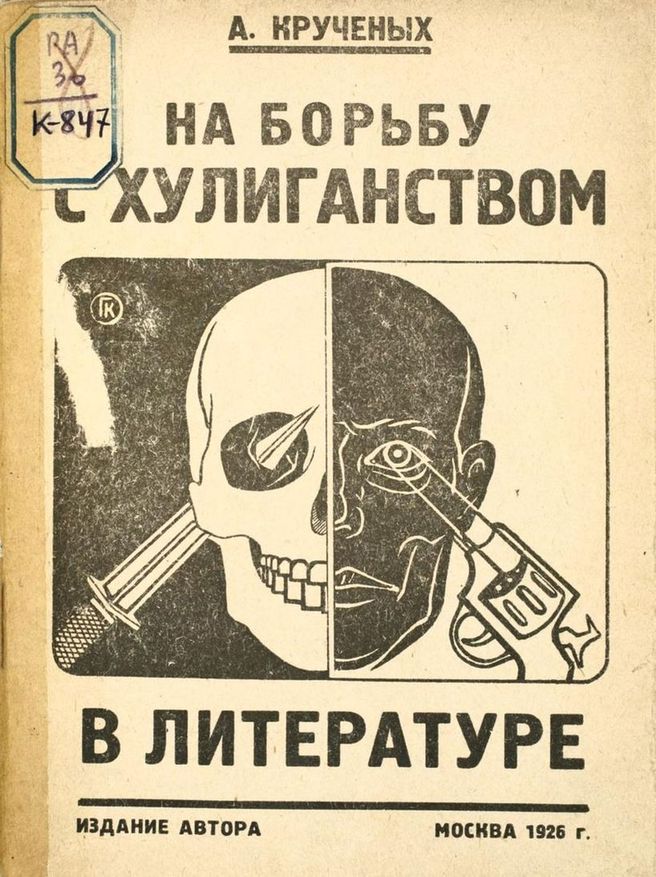
Although “state control was absolute throughout” Soviet history, these artists flourished before Trotsky’s fall in 1928, wrote Isaiah Berlin in his 1945 profile of Russian art; there was “a vast ferment in Soviet thought, which during those early years was genuinely animated by the spirit of revolt against, and challenge to, the arts of the West.” The Party came to view this period as “the last desperate struggle of capitalism” and the Futurists would soon be overthrown, “by the strong, young, materialist, earthbound, proletarian culture”—a culture imposed from above in the mid-30s by the Writers’ Union and the Central Committee.
Thus began the regrettable persecutions and purges of artists and dissidents of all kinds, and the movement toward the Stalinist personality cult and “collective work on Soviet themes by squads of proletarian writers.” But during the first quarter of the century, “a time of storm and stress,” Russian literature and art, Berlin adjudged, “attained its greatest height since its classical age of Pushkin, Lermontov, and Gogol.”
via Monoskop
Related Content:
Hear Russian Futurist Vladimir Mayakovsky Read His Strange & Visceral Poetry
Hear the Experimental Music of the Dada Movement: Avant-Garde Sounds from a Century Ago
Extensive Archive of Avant-Garde & Modernist Magazines (1890–1939) Now Available Online
Josh Jones is a writer and musician based in Durham, NC. Follow him at @jdmagness
Read More...The Wizard of Oz Broken Apart and Put Back Together in Alphabetical Order
WARNING: This film contains extremely fast editing, flashes of light, abrupt changes in image and sound.
Back in 2001, Matt Bucy had the inspiration to do something truly original — take the entire Wizard of Oz, cut it up, and put it back together–this time in alphabetical order. And that’s precisely what he did several years later, in 2004. A coder, Bucy created an app that made it easy to deconstruct the beloved 1939 film. He told Vox:
That [app] spit out a big text file with all the words and their locations in the film, which I then imported into a spreadsheet, sorted in alphabetical and then chronological order, and fed into another little program that took the sorted list and produced the edit. So basically, it was edited in Excel.…
All told, I think it took about seven days spread out over a couple of months. Disassembly was mind-bending in itself. It was literally hard to talk after moving word by word, or syllable by syllable, through the film. English stopped sounding like language, and at times I had to stop because I could not figure out what a word was — I just couldn’t hear it right.
When finally alphabetized, the film, says Bucy, had a surprising energy to it. A certain je ne sais quoi. Yes it’s hard to describe. Maybe you can put your own words to it.
In 2016, Bucy finally made the alphabetized Wizard of Oz available to the rest of world. You can watch it here. And do heed the warning above.
Related Content:
The Complete Wizard of Oz Series, Available as Free eBooks and Free Audio Books
Watch the Earliest Surviving Filmed Version of The Wizard of Oz (1910)
Dark Side of the Rainbow: Pink Floyd Meets The Wizard of Ozin One of the Earliest Mash-Ups
Read More...170 Renowned Academics Talk About Why They Disbelieve, or Believe, in God
Whether we choose to affiliate with any sort of atheist movement or not, many people raised in theistic religions came over time to see God as a literary character in ancient mythologies and historical fictions, as a placeholder for human ignorance, or as a personification of humanity’s greatest fears and desires. The notion that such a personal super-being actually exists has become for many of us, in William James’ terms, a “dead hypothesis.” As physicist Lawrence Krauss puts it in the video above, “there’s absolutely no evidence that we need the supernatural hand of God” to explain the universe. Religions give us fanciful stories, illustrate ethical (and unethical) principles, and enforce tribal loyalties, but they do not describe reality as it is.
We all come to hold our beliefs, or lack thereof, about religious claims for an irreducibly complex variety of reasons that are intellectual as well as moral, political, and emotional. Can we demonstrate, however, that “the more scientifically literate, intellectually honest and objectively sceptical a person is, the more likely they are to disbelieve in anything supernatural, including god”? Such is the thesis of Dr. Jonathan Pararajasignham’s documentary 50 Renowned Academics Speaking About God, which consists of edited clips from interviews with “elite academics and professors at top institutions, many of whom are also Nobel Laureates.” The claim appears on the screen in each of the three videos above and below, framing the interview clips as mounting evidence for the convincing case that disbelief is strongly correlated with, if not necessarily caused by, scientific literacy, intellectual honesty, and skepticism.
Since his first video, Pararajasingham has expanded his series to include 100 more “Renowned Academics Speaking About God.” (See Parts Two and Three of the series above.) On the videos’ Youtube pages, he anticipates a ready objection, writing, “I do not claim that this video demonstrates there is no God. It is not an argument against God in itself, so there is no argument from popularity and authority.” If you’ve already arrived at the conclusion, you’ll find it confirmed many times over by a cast that includes physicists like Krauss, Richard Feynman, and Steven Weinberg, philosophers like A.C. Graying, Bertrand Russell, and John Searle, and far too many more illustrious thinkers to name. (See a complete list on the Youtube pages of each video.) In addition to well-known atheist writers like Daniel Dennett, the series also features academics like anthropologist Pascal Boyer, whose book Religion Explained makes a novel and very persuasive naturalistic argument for why humans have believed in the supernatural for thousands of years.
Believers may counter with their own list of smart people who do believe in God, and who also work in the hard sciences and academic philosophy, including renowned figures like Human Genome Project director Francis Collins and physicist Freeman Dyson. Whether or not they’d wish to claim failed presidential candidate Ben Carson or religious apologists Dinesh D’Souza and Ravi Zacharias as examples of “intellectual honesty and scientific literacy” I couldn’t say, but all of those people and more are included in the video above, 20 Christian Academics Speaking About God, which Pararajasingham produced as a counterpoint to his 50 Academics series. Find the complete list of names for this video, along with links to complete interviews, on Youtube.
Related Content:
Free Online Religion Courses
Richard Feynman on Religion, Science, the Search for Truth & Our Willingness to Live with Doubt
Neil deGrasse Tyson Explains Why He’s Uncomfortable Being Labeled an ‘Atheist’
Josh Jones is a writer and musician based in Durham, NC. Follow him at @jdmagness
Read More...What Are the Most Beautifully & Creatively Shot Films of All Time? Cinematographers Pick Their Favorites
To determine the all-around greatest films of all time, the well-known Sight and Sound Directors Poll surveys filmmakers themselves. By that same logic, then, if you want to know which movies most excel in one particular aspect, you’ll want to poll the people who work on that aspect of cinema: the actors will know which have the best acting, the editors which have the best editing, the sound designers which have the best sound design, the rigging grips which have the best-gripped rigging. And if you want to know the best-shot films of all time, you have only to ask the cinematographers.
In 1998, American Cinematographer polled the American Society of Cinematographers membership for the best-shot films of all time. Kristopher Tapley at Hitflix writes that the “cinematographers were asked for their top picks in two eras: films from 1894–1949 (or the dawn of cinema through the classic era), and then 1950–1997, for a top 50 in each case. Then they followed up 10 years later with another poll focused on the films between 1998 and 2008.”
Here are the 1894–1949 top-ten results and their cinematographers:
- Citizen Kane (Gregg Toland, 1941)
- Gone with the Wind (Ernest Haller, Ray Rennahan, 1939)
- Sunrise (Charles Rosher, Karl Struss, 1927)
- Metropolis (Karl Freund, Günther Rittau, 1927)
- The Wizard of Oz (Harold Rosson, 1939)
- The Magnificent Ambersons (Stanley Cortez, 1942)
- Casablanca (Arthur Edeson, 1942)
- Battleship Potemkin (Eduard Tisse, 1926)
- The Third Man (Robert Krasker, 1950)
- The Birth of a Nation (G.W. Bitzer, 1915)
“The choice of Gregg Toland’s cinematography for Citizen Kane as the best in the first 45 years of motion pictures comes as no surprise,” writes American Cinematographer’s George Turner. “No other movie has been more praised, studied and written about — or more panned, damned and blacklisted.” At the time, “audiences in general were put off by the ‘arty’ photography, overlapping dialogue, unusual cutting and Welles’s penchant for injecting startling and often irritating sound effects. It was years before the ‘newness’ of the Kane style wore off and gained widespread acceptance,” and even absorbed into the mainstream.
And those from 1950–1997:
- Lawrence of Arabia (Freddie Young, 1962)
- The Godfather (Gordon Willis, 1971)
- 2001: A Space Odyssey (Geoffrey Unworth, 1969)
- Days of Heaven (Néstor Almendros, 1978)
- Schindler’s List (Janusz Kaminski, 1993)
- Apocalypse Now (Vittorio Storaro, 1979)
- The Conformist (Vittorio Storaro, 1970)
- Raging Bull (Michael Chapman, 1980)
- Blade Runner (Jordan Cronenweth, 1982)
- Touch of Evil (Russell Metty, 1958)
Turner calls Lawrence of Arabia “perhaps the crowning achievement in the long and illustrious career of director of photography Frederick A. Young,” naming as its most famous single image “the lingering scene in which Omar Sharif, riding a camel, is first seen as a tiny spot in a mirage on the horizon. In the foreground, Lawrence (Peter O’Toole) and an Arab youth are drawing water from a well when they notice the wobbly, distorted shape coming toward them. Shimmering in waves of heat and strangely liquid colors, the rider steadily approaches the well. As he gets closer, he is still indistinct, but the ominous thumping of the camel’s feet can be heard. Sharif finally emerges from the mirage, raises his rifle and shoots the Arab. The long scene carries a strong element of dread and suspense.”
Finally, here are the results from 1998–2008:
- Amélie (Bruno Delbonnel, 2001)
- Children of Men (Emmanuel Lubezki, 2006)
- Saving Private Ryan (Janusz Kaminski, 1998)
- There Will Be Blood (Robert Elswit, 2007)
- No Country for Old Men (Roger Deakins, 2007)
- Fight Club (Jeff Cronenweth, 1999)
- The Dark Knight (Wally Pfister, 2008)
- Road to Perdition (Conrad L. Hall, 2002)
- City of God (Cidade de Deus) (César Charlone, 2003)
- American Beauty (Conrad L. Hall, 1999)
The American Society of Cinematographers quotes Delbonnel on Amélie’s visual victory: “This is real honor for me, especially considering the other movies in this list. These are some of the finest cinematographers, and I’m not sure I deserve to be among them, but I am very happy to be. They are all explorers.” And in that, he sums up why, when we want to know what movies to watch, we should ask the people who make movies: their real competition lies not in simply generating beauty, but in leading the art form into territory unknown.
You can watch several films on the lists–Battleship Potemkin, Sunrise and Metropolis–above. Find more great films in our collection, 4,000+ Free Movies Online: Great Classics, Indies, Noir, Westerns, Documentaries & More.
Related Content:
The 100 Most Memorable Shots in Cinema Over the Past 100 Years
A Mesmerizing Supercut of the First and Final Frames of 55 Movies, Played Side by Side
Free: F. W. Murnau’s Sunrise, the 1927 Masterpiece Voted the 5th Best Movie of All Time
Metropolis: Watch a Restored Version of Fritz Lang’s Masterpiece (1927)
Watch Battleship Potemkin and Other Free Sergei Eisenstein Films
The 10 Greatest Films of All Time According to 358 Filmmakers
Based in Seoul, Colin Marshall writes and broadcasts on cities, language, and style. He’s at work on a book about Los Angeles, A Los Angeles Primer, the video series The City in Cinema, the crowdfunded journalism project Where Is the City of the Future?, and the Los Angeles Review of Books’ Korea Blog. Follow him on Twitter at @colinmarshall or on Facebook.
Read More...A Clever Supercut of Writers Struggling with Writer’s Block in 53 Films: From Barton Fink to The Royal Tenenbaums
Quite patiently, Ben Watts cut apart and stitched together scenes from 53 films (find a complete list here) showing characters suffering through writer’s block. Adaptation, Barton Fink, Shakespeare in Love, The Royal Tenenbaums, and, yes, Throw Momma From the Train–they’re among the films featured in the 4‑minute supercut above. If you give the clip a little time, you’ll see that the supercut has an arc to it. It tells a tale, and has an ending that Hollywood would love.
If you would like to support the mission of Open Culture, consider making a donation to our site. It’s hard to rely 100% on ads, and your contributions will help us continue providing the best free cultural and educational materials to learners everywhere. You can contribute through PayPal, Patreon, and Venmo (@openculture). Thanks!
Related Content:
Watch a 44-Minute Supercut of Every Woody Allen Stammer, From Every Woody Allen Film
A Mesmerizing Supercut of the First and Final Frames of 55 Movies, Played Side by Side
Books in the Films of Wes Anderson: A Supercut for Bibliophiles
Read More...Hear 90+ Episodes of Suspense, the Iconic Golden Age Radio Show Launched by Alfred Hitchcock
America’s “Golden Age of Radio” lasted from the wide household adoption of wireless sets in the 1920s until the onset of the television era in the 1950s, producing a host of long-running dramas, comedies, and science-fiction shows still beloved by radio enthusiasts today. But few had a presence in the zeitgeist like Suspense, which from 1942 to 1962 offered not just guaranteed thrills but high production values as well. In the show’s heyday, that also meant hiring straight from Hollywood, for not just character voices but also high directorial talent.
Suspense’s very first episode came steered by the hand of no less a master of unease than Alfred Hitchcock. “The condition agreed upon for Hitchcock’s appearance,” writes Martin Grams, Jr. in Suspense: Twenty Years of Thrills and Chills, “was that CBS make a pitch to the listening audience about his and [producer Walter] Wanger’s latest film, Foreign Correspondent. To add flavor to the deal, Wanger threw in Edmund Gwenn and Herbert Marshall as part of the package. All three men (including Hitch) would be seen in the upcoming film, which was due for a theatrical release the next month.” Hitchcock wanted to adapt for Suspense’s premiere Marie Belloc Lowndes’ The Lodger, a story he’d previously filmed silent in 1926.
Even if they’ve never heard a single old-time radio broadcast, most people who know of Orson Welles know that the man who made Citizen Kane also made a significant mark on the airwaves. He defined the titular role of the mind-clouding crime-fighter The Shadow when that series premiered in 1937, and the very next year he aired his infamously to0-believable Halloween adaptation of H.G. Wells’ The War of the Worlds. But Welles’ radio work continued even after he launched the film career through which we’ve come to know him today, with productions such as a Suspense version of the play The Hitch-Hiker in 1942.
Welles didn’t just direct the adaptation but also starred in it, which he would do four times on the radio in total. “The Hitch-Hiker was written for Orson Welles in the days when he was one of the master producers and actors in radio,” writes its author Lucille Fletcher. “It was designed to provide a vehicle not only for his famous voice, but for the original techniques of sound which became associated with his radio presentations.” Welles and his Mercury Players “made of this script a haunting study of the supernatural, which can still raise hackles along my own spine.” Both The Hitch-Hiker and The Lodger count as high points in the two-decade run of Suspense, but if you listen to the 90 other episodes free at the Internet Archive (or by streaming the thin playlist above), you’ll feel hackles raised along your own spine in plenty of other ways as well.
Suspense will be added to our collection, 1,000 Free Audio Books: Download Great Books for Free.
Related Content:
Hear 22-Year-Old Orson Welles Star in The Shadow, the Iconic 1930s Super Crimefighter Radio Show
The War of the Worlds: Orson Welles’ 1938 Radio Drama That Petrified a Nation
X Minus One: More Classic 1950s Sci-Fi Radio from Asimov, Heinlein, Bradbury & Dick
Based in Seoul, Colin Marshall writes and broadcasts on cities, language, and style. He’s at work on a book about Los Angeles, A Los Angeles Primer, the video series The City in Cinema, the crowdfunded journalism project Where Is the City of the Future?, and the Los Angeles Review of Books’ Korea Blog. Follow him on Twitter at @colinmarshall or on Facebook.
Read More...Support Us
We're hoping to rely on loyal readers, rather than erratic ads. Please click the Donate button and support Open Culture. You can use Paypal, Venmo, Patreon, even Crypto! We thank you!

About Us

Open Culture scours the web for the best educational media. We find the free courses and audio books you need, the language lessons & educational videos you want, and plenty of enlightenment in between.
Advertise With Us

FREE UPDATES!
GET OUR DAILY EMAIL
Get the best cultural and educational resources on the web curated for you in a daily email. We never spam. Unsubscribe at any time.
FOLLOW ON SOCIAL MEDIA

Open Culture editor Dan Colman scours the web for the best educational media. He finds the free courses and audio books you need, the language lessons & movies you want, and plenty of enlightenment in between.
Advertise With Us

