Jacques Derrida on Seinfeld: “Deconstruction Doesn’t Produce Any Sitcom”
Jacques Derrida could enjoy a good movie like anyone else. In a 2002 interview with TIME, he declared “I have watched The Godfather 10 times. I must watch it whenever it’s on.” Who couldn’t?
Coppola films were one thing. Apparently sitcoms quite another. In another 2002 interview, a journalist asked the French philosopher whether, in so many words, deconstruction shared anything in common with Seinfeld and the ironic/parodic way it looks at the world. This was taking things too far. “Deconstruction, as I understand it,” said Derrida, “doesn’t produce any sitcom. If sitcom is this, and people who watch this think deconstruction is this, the only advice I have to give them is just stop watching sitcom, do your homework, and read.” The cringeworthy scene originally appeared in the documentary, Derrida, directed by Kirby Dick and Amy Ziering Hoffman.
Related Content:
130+ Free Online Philosophy Courses
Read More...Hear James Joyce’s Finnegans Wake Read Unabridged & Set to Music By 17 Different Artists
If you want a guide through James Joyce’s Finnegans Wake—the modernist author’s “wordiest aria,” writes Kirkus Reviews, “and surely the strangest ever sung in any language”—you’d be hard pressed find a better one than novelist Anthony Burgess. Not only did Burgess turn his study of Joyce to very good account in creating his own polyglot language in A Clockwork Orange, but he has “tastefully selected the more readable portions” of Joyce’s final novel in an abridged version, A Shorter Finnegans Wake. No doubt “pedants will object,” writes Kirkus, but if anyone can edit Joyce, it’s Burgess, who has written a thorough introduction to Joyce’s language, a guide to Joyce “for the Ordinary Reader,” and the most comprehensive summary of Joyce’s last novel that I’ve ever encountered—proving that it can be done. Finnegans Wake makes sense!… sort of…
But not, however, as any straightforward story; after all, writes Burgess, “What Joyce is doing… is to make his hero re-live the whole of history in a night’s sleep.” And what Burgess does is show us the complex scaffolding and symbolism of that dream. What he does not do is explain away the music of Joyce’s novel—for it is, after all, not only one long dream, but one long song, the “strangest ever sung.” We can hear Joyce himself sing from the novel’s Anna Livia Plurabelle section in the video at the top (accompanied by subtitles and a very cool animation, I must say). His lilting tenor enthralls, but his is not the only way to sing Finnegans Wake. Indeed, the novel, though very odd and very difficult, is Joyce’s invitation to the world.
And the world has responded (“Here Comes Everybody!”). Last year, Waywords and Meansigns, a Joyce project co-founded by Derek Pyle, brought together artists and musicians from around the globe to sing, read, and set to music the words of Finnegans Wake. Open Culture’s Ted Mills wrote a post describing the “staggering 30+ hours” of Joyce interpretation, and concluded, “Those who read this and feel they’ve missed out on the creativity of tackling Finnegans Wake, don’t worry.” The project was then soliciting contributors for a forthcoming second edition, and now it has arrived. You can hear it in full above, an answer to the question “How many ways are there to read James Joyce’s great and bizarre novel?”
Seventeen different musicians from all around the world, each assigned to render a chapter aurally. The only requirements: the chapter’s words must be audible, unabridged, and more or less in their original order.
We begin with pages 3–29, “The Fall,” read in a rapid deadpan over avant-garde free jazz by Mr. Smolin & Double Naught Spy Car. Next, we have “The Humphriad I: His Agnomen and Reputation,” read by producer David Kahne against a backdrop of minimalist synths, tinkling keyboards, and waves of burbling electronic noise. Perhaps one of my favorite musicians—whose songwriting has always struck me as particularly Joycean—Mike Watt of the Minutemen and fIREHOSE promises to deliver his musical contribution for “Shem the Penman” very soon. In its place is a message from Pyle, who urges you to sign up for the Waywords and Meansigns mailing list for updates. After his message is a brief excerpt from conversation he had with Watt on the bass player’s podcast.
Finnegans Wake, says Watt, “shares with Ulysses the idea of wanting to try and talk about everything.” Joyce, Watt goes on, wanted to “transcend” in his writing the circumstances of his troubled family life, failing eyesight, and financial difficulties; and he was also just “having some fun.” That’s also a good description of the various renderings of Joyce represented in this compilation as these artists try to transcend ordinary ways of reading great literature, and clearly have lots fun in the doing. See the Waywords and Meansigns website for production credits and a complete tracklisting indicating the specific pages, chapters, and sections of each reading.
Related Content:
Hear James Joyce’s Finnegans Wake Read Aloud & Set to Music: 31 Hours of Free Unabridged Audio
Hear Joey Ramone Sing a Piece by John Cage Adapted from James Joyce’s Finnegans Wake
James Joyce Reads ‘Anna Livia Plurabelle’ fromFinnegans Wake
See What Happens When You Run Finnegans Wake Through a Spell Checker
Josh Jones is a writer and musician based in Durham, NC. Follow him at @jdmagness
Read More...Download Marc Andreessen’s Influential Blog (“Pmarca”) as a Free eBook
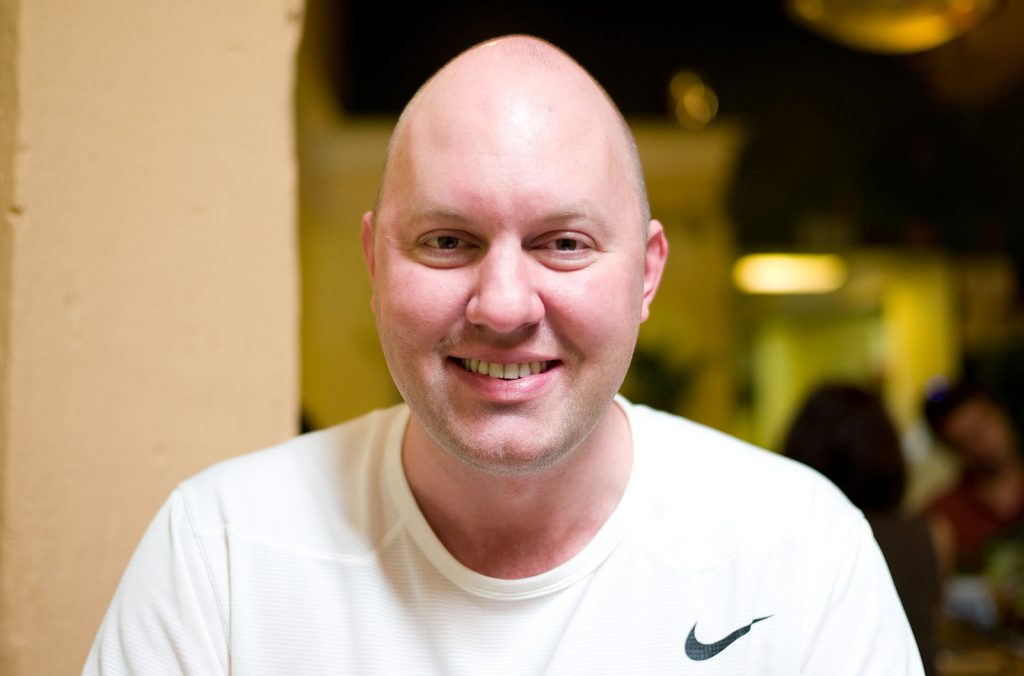
Image by Joi, via Wikimedia Commons
For years Marc Andreessen–the entrepreneur best known for launching Mosaic and later Netscape–ran a popular blog called “Pmarca” (apparently short for “Private Marc Andreessen”) where he dispensed wisdom on startups, business, investing and beyond. If you’ve worked in startups, especially in Silicon Valley, you probably followed “Pmarca” fairly religiously.
Like so many others, Andreessen eventually took down his blog and began “tweetstorming” on Twitter–all while serving on the boards of Facebook, eBay, and HP, and running his now influential VC firm, Andreessen Horowitz. Before “Pmarca” could fade completely into oblivion, fans asked Andreessen to preserve the blog for posterity. And that he did. You can now download an archive of “Pmarca” as a free ebook. Available in three formats (ePub, Mobi, and PDF), the archived version can be read in pretty much the blog’s original format. Start your downloads here.
If you would like to support the mission of Open Culture, consider making a donation to our site. It’s hard to rely 100% on ads, and your contributions will help us continue providing the best free cultural and educational materials to learners everywhere. You can contribute through PayPal, Patreon, and Venmo (@openculture). Thanks!
Related Content:
Peter Thiel’s Stanford Course on Startups: Read the Lecture Notes Free Online
150 Free Online Business Courses
Start Your Startup with Free Stanford Courses and Lectures
Read More...Take a Free Online Course on Making Comic Books, Compliments of the California College of the Arts
Gather round, children and listen to Grandma reminiscin’ ‘bout the days when studying comics meant changing out of your pajamas and showing up at the bursar’s office, check in hand.
Actually, Grandma’s full of it. Graphic novels are enjoying unprecedented popularity and educators are turning to comics to reach reluctant readers, but as of this writing, there still aren’t that many programs for those interested in making a career of this art form.
The California College of the Arts is a notable exception. You can get your MFA in Comics there.
Even better, you need not enroll to sample the 5 week course, Comics: Art in Relationship, led by Comics MFA chair and Eisner Award-nominated author of The Homeless Channel, Matt Silady.
You might write the next Scott Pilgrim.
Or ink the next Fun Home.
At the very least, you’ll learn a thing or two about layout, the relationship of art to text, and using compression to denote the passage of time.
It’s the sort of nitty gritty training that would benefit both veterans and newbies alike.
Ready to sign up? The free course, which starts in February, will require approximately 10 hours per week. The syllabus is below.
Session 1: Defining Comics
Identify key relationships in sample texts & demonstrate the use of various camera angles on a comics page
Session 2: Comics Relationships
Create Text-Image and Image-Image Panels
Session 3: Time And Space
One Second, One Hour, One Day Comics Challenge
Session 4: Layout And Grid Design
Apply multiple panel grids to provided script
Session 5: Thumbnails
Create thumbnail sketches of a multipage scene
Related Content:
Kapow! Stan Lee Is Co-Teaching a Free Comic Book MOOC, and You Can Enroll for Free
Download 15,000+ Free Golden Age Comics from the Digital Comic Museum
1,700 Free Online Courses from Top Universities
Ayun Halliday is an author, illustrator, and Chief Primatologist of the East Village Inky zine. Follow her @AyunHalliday
Read More...Samuel Beckett Play Brought to Life in an Eerie Short Film Starring Alan Rickman & Kristin Scott Thomas
Here at Open Culture, when we think of authors who write work made for the movies, we do, of course, think of names like Dan Brown, J.K. Rowling, and Robert Ludlum — but even more so of names like Samuel Beckett, whose pushing of aesthetic and intellectual boundaries on the stage we welcome now more than ever on the screen. And in a way, his works have undergone more complete film adaptation than have the books of many bestselling mainstream writers, thanks to the 2002 omnibus project Beckett on Film, which rounded up nineteen auteurs to direct films, ranging in length from seven minutes to two hours, of each and every one of his nineteen plays.
Beckett on Film’s roster of directors includes Michael Lindsay-Hogg doing Waiting for Godot, Atom Egoyan doing Krapp’s Last Tape, Neil Jordan doing Not I, the artist Damien Hirst doing Breath, and Anthony Minghella, he of The English Patient and The Talented Mr. Ripley, doing Play, which you can watch above. The sixteen-minute production adapts Beckett’s 1963 one-act, a distinctively purgatorial sort of romantic drama which presents a man (“M”), his wife (“W1”), and his mistress (“W2”), each trapped in an urn, each forced to speak about the details of their triangular relationship when, on stage, the spotlight turns to them. On film, Minghella chooses to swap out the spotlight for the camera itself, which cuts, swings, and shifts focus swiftly between the three, commanding the history of the affair from all three perspectives, each delivered with flat, rapid-fire insistence yet with surprising clarity and feeling as well.
Those qualities naturally owe to Beckett’s mastery of the word, but also to the performances of the three actors, given under absurd circumstances, caked with filth and stuffed into pots: Kristin Scott Thomas as the wife, Juliet Stevenson as the mistress, and the late Alan Rickman as the hiccuping adulterer. Every line they speak distills some aspect of the Beckettian worldview: “Silence and darkness were all I craved,” says Thomas’ W1. “Well, I get a certain amount of both. They being one. Perhaps it is more wickedness to pray for more.” “Things may disimprove,” says Stevenson’s W2. “Adulterers, take warning,” says Rickman’s M, “never admit.” And the ultimate question: “When will all this have been… just play?” But in Beckett’s reality, there’s nothing so “just” about it.
Related Content:
Take a “Breath” and Watch Samuel Beckett’s One-Minute Play
Hear Samuel Beckett’s Avant-Garde Radio Plays: All That Fall, Embers, and More
Samuel Beckett Directs His Absurdist Play Waiting for Godot (1985)
Monsterpiece Theater Presents Waiting for Elmo, Calls BS on Samuel Beckett
Rare Audio: Samuel Beckett Reads Two Poems From His Novel Watt
Based in Seoul, Colin Marshall writes and broadcasts on cities and culture. He’s at work on a book about Los Angeles, A Los Angeles Primer, the video series The City in Cinema, the crowdfunded journalism project Where Is the City of the Future?, and the Los Angeles Review of Books’ Korea Blog. Follow him on Twitter at @colinmarshall or on Facebook.
Read More...85 Compelling Films Starring and/or Directed By Women of Color: A List Created by Director Ava DuVernay & Friends on Twitter

Image by Marie Maye, via Wikimedia Commons
If you follow film news—or really, just news—you’re well aware of the controversy surrounding the current crop of Academy Award nominees. While awards extravaganzas seem like little more than popularity contests, it is curious that neither the acclaimed lead actors nor the directors received nominations for two of the most popular films of the year—Creed and Straight Outta Compton. (See SNL’s satirical take on this.) There’s been no shortage of critical praise for the talent in those films and others, casting doubt on claims that actors, writers, directors, etc. of color simply weren’t up to snuff. The truth is likely more banal: most of the Academy voters are older white men. (“Older and more dude-heavy than just about any place in America,” says The Atlantic, “and whiter than all but seven states.”) No need to allege outright conspiracy when implicit bias operates to exclude people all the time without malicious intent.
Nor do corporate buzzwords like “diversity” carry much weight when it comes to creating a more inclusive industry. “It’s a medicinal word,” says Selma director Ava DuVernay, “that has no emotional resonance… Diversity’s like, ‘Ugh, I have to do diversity.’ ” No one wants to attend a “diversity training” or read a hiring manual about how to “do diversity”; recognizing talent shouldn’t be a forced, procedural matter, but a matter of course. The Academy has vowed to make changes by retiring many inactive members to non-voting emeritus status and—in an Orwellian turn of phrase—“doubling the number of diverse members” by 2020, whatever that means. The aforementioned DuVernay has been sowing seeds of discontent with the status quo for quite some time now, online and in the industry itself with her distribution company AFFRM+Array Releasing, which attempts to counterbalance the racial and gender disparities in the film world.
In a tweet last year, written off the cuff during a writing break, she put out a call to followers to “name three films you like with black, brown, native or Asian women leads” or directors. Indiewire comments that “it seems like common sense that these films exist,” yet “the question proved to be a serious challenge for Twitter.” Eventually, DuVernay and the Twitter denizens came up with a list of 85 titles starring and/or directed by women of color, and you can see them all listed below. If you find yourself watching movie after movie about the same kinds of experiences, maybe consider making your own viewing habits more “diverse” by checking out some of these excellent, and in most cases little-seen movies, including two well-reviewed films from DuVernay herself, 2010’s I Will Follow and 2012’s Middle of Nowhere.
“35 Shots of Rum” by Claire Denis (2008)
“A Different Image” by Alile Sharon Larkin (1982)
“A Girl Walks Home Alone at Night” by Ana Lily Amirpour (2014)
“Advantageous” by Jennifer Phang (2015)
“Ala Modalaindi” by Nandini Bv Reddy (2011)
“All About You” by Christine Swanson (2001)
“Alma’s Rainbow” by Ayoka Chenzira (1994)
“Appropriate Behavior” by Desiree Akhavan (2014)
“B For Boy” by Chika Anadu (2013)
“Bande de Filles/Girlhood” by Céline Sciamma (2014)
“Belle” by Amma Asante (2013)
“Bend it Like Beckham” by Gurinder Chadha (2002)
“Bessie” by Dee Rees (2015)
“Beyond the Lights” by Gina Prince-Bythewood (2014)
“Bhaji on the Beach” by Gurinder Chadha (1993)
“Caramel” by Nadine Labaki (2007)
“Circumstance” by Maryam Keshavarz (2011)
“Civil Brand” by Neema Barnette (2002)
“Compensation” by Zeinabu irene Davis (199)
“Daughters of the Dust” by Julie Dash (1991)
“Double Happiness ” by Mina Shum (1994)
“Down in the Delta” by Maya Angelou (1998)
“Drylongso” by Cauleen Smith (1988)
“Earth” by Deepa Mehta (1998)
“Elza” by Mariette Monpierre (2011)
“Endless Dreams” by Susan Youssef (2009
“Eve’s Bayou” by Kasi Lemmons (1997)
“Fire” by Deepa Mehta (1996)
“Frida” by Julie Taymor (2002)
“Girl in Progress” by Patricia Riggen (2012)
“Girlfight” by Karyn Kusama (2000)
“Habibi Rasak Kharban” by Susan Youssef (2011)
“Hiss Dokhtarha Faryad Nemizanand (Hush! Girls Don’t Scream)” by Pouran Derahkandeh (2013)
“Honeytrap” by Rebecca Johnson (2014)
“I Like It Like That” by Darnell Martin (1994)
“I Will Follow” by Ava DuVernay (2010
“In Between Days” by So-yong Kim (2006)
“Introducing Dorothy Dandridge” by Martha Coolidge (1999)
“It’s a Wonderful Afterlife” by Gurinder Chadha (2010)
“Jumpin Jack Flash” by Penny Marshall (1986)
“Just Another Girl on the IRT” by Leslie Harris (1992)
“Just Wright” by Sanaa Hamri (2010)
“Kama Sutra” by Mira Nair (1996)
“Losing Ground” by Kathleen Collins (1982)
“Love & Basketball” by Gina Prince-Bythewood (2000)
“Luck by Chance” by Zoya Akhtar (2009)
“Mi Vida Loca” by Allison Anders (1993)
“Middle of Nowhere” by Ava DuVernay (2012)
“Mississippi Damned” by Tina Mabry (2009)
“Mississippi Masala” by Mira Nair (1991)
“Mixing Nia” by Alison Swan (1998)
“Monsoon Wedding” by Mira Nair (2001)
“Mosquita y Mari” by Aurora Guerrero (2012)
“Na-moo-eobs-neun san (Treeless Mountain)” by So-yong Kim (2008)
“Night Catches Us” by Tanya Hamilton (2010)
“Pariah” by Dee Rees (2011)
“Picture Bride” by Kayo Hatta (1994)
“Rain” by Maria Govan (2008)
“Real Women Have Curves” by Patricia Cardoso (2002)
“Saving Face” by Alice Wu (2004)
“Second Coming” by Debbie Tucker Green (2014)
“Something Necessary” by Judy Kibinge (2013)
“Something New” by Sanaa Hamri (2006)
“Still the Water” by Naomi Kawase (2014)
“Stranger Inside” by Cheryl Dunye (2001)
“Sugar Cane Alley/Black Shack Alley” by Euzhan Palcy (1983)
“The Kite” by Randa Chahal Sabag (2003)
“The Rich Man’s Wife” by Amy Holden Jones (1996)
“The Secret Life of Bees” by Gina Prince-Bythewood (2008)
“The Silence of the Palace” by Moufida Tlatli (1994)
“The Watermelon Woman” by Cheryl Dunye (1996)
“The Women of Brewster Place” by Donna Deitch (1989)
“Their Eyes Were Watching God” by Darnell Martin (2005)
“Things We Lost in the Fire” by Susanne Bier (2007)
“Wadjda” by Haifaa Al-Mansour (2012)
“Water” by Deepa Mehta (2005)
“Whale Rider” by Niki Caro (2002)
“What’s Cooking?” by Gurinder Chadha (2000)
“Where Do We Go Now?” by Nadine Labaki (2011)
“Whitney” by Angela Bassett (2015)
“Woman Thou Art Loosed: On The 7th Day” by Neema Barnette (2012)
“Xiu Xiu: The Sent-Down Girl” by Joan Chen (1998)
“Yelling to the Sky” by Victoria Mahoney (2011)
“Young and Wild” by Marialy Rivas (2012)
via Indiewire
Related Content:
Spike Lee’s List of 95 Essential Movies – Now with Women Filmmakers
The 10 Greatest Films of All Time According to 358 Filmmakers
725 Free Movies Online: Great Classics, Indies, Noir, Westerns, etc.
Josh Jones is a writer and musician based in Durham, NC. Follow him at @jdmagness
Read More...The Art from David Bowie’s Final Album, Blackstar, is Now Free for Fans to Download and Reuse
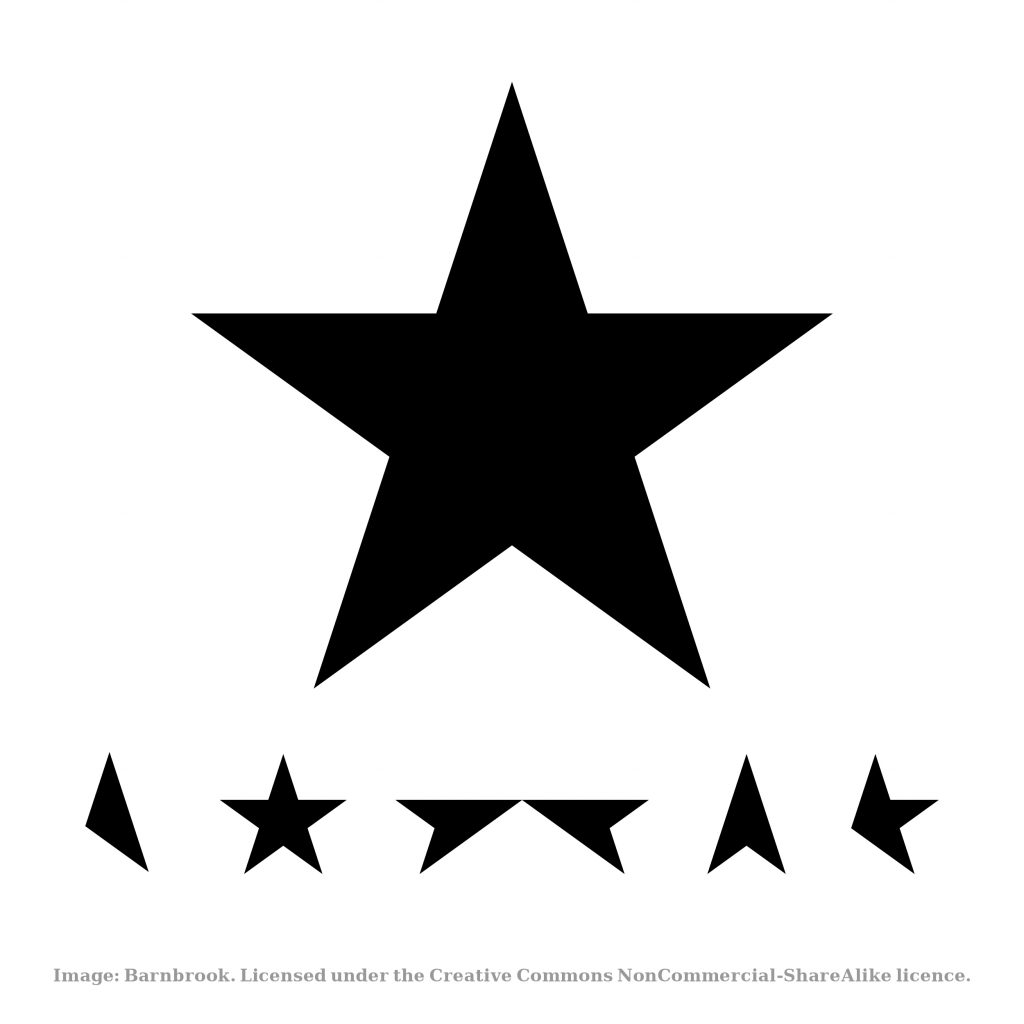
Jonathan Barnbrook, the British graphic designer who created the cover art for several of David Bowie’s more recent albums, had his creative studio issue an announcement on Facebook today, one which will surely please many:
Barnbrook loved working with David Bowie, he was simply one of the most inspirational, kind people we have met. So in the spirit of openness and in remembrance of David we are releasing the artwork elements of his last album ★ (Blackstar) to download here free under a Creative Commons NonCommercial-ShareAlike licence. That means you can make t‑shirts for yourself, use them for tattoos, put them up in your house to remember David by and adapt them too, but we would ask that you do not in any way create or sell commercial products with them or based on them.
Barnbrook was the creative force behind Heathen (2002), Reality (2003) and The Next Day (2013). In this in-depth interview, the designer talks about his approach to creating a visual language for Blackstar, whose design elements can now be freely downloaded here.
If you would like to support the mission of Open Culture, consider making a donation to our site. It’s hard to rely 100% on ads, and your contributions will help us continue providing the best free cultural and educational materials to learners everywhere. You can contribute through PayPal, Patreon, and Venmo (@openculture). Thanks!
Related Content:
Dave: The Best Tribute to David Bowie That You’re Going to See
David Bowie Releases 36 Music Videos of His Classic Songs from the 1970s and 1980s
David Bowie Lists His 25 Favorite LPs in His Record Collection: Stream Most of Them Free Online
Read More...An Animated Introduction to Goethe, Germany’s “Renaissance Man”
We all know the name Goethe — some of us even know the full name, Johann Wolfgang von Goethe. I’ve never lived in the renowned 18th- and 19th-century writer, politician, and cultural polymath’s homeland of Germany, but even when I lived in Los Angeles, I regularly went to my local branch of the Goethe-Institute for German cultural events. Even in Korea, where I live now, Goethe has left a wide if shallow mark: you can see The Sorrows of Young Werther in the form of an elaborate stage musical, for instance, and buy almost all the goods you need in life from the enormous conglomerate named after the young lady on whom Werther concentrates his doomed affections, Lotte.
But why, more than 180 years after Goethe’s death, does his name still come up in so many different contexts? And given that, why do so many of us know so little about his long, varied, colorful, and highly productive life and career? This sounds like a job for the video wing of Alain de Botton’s School of Life, whose short primers continue to bring us up to speed on why the legacies of so many cultural figures (with one section given over to the literary) have endured, or should endure. “Goethe is one of the great minds of European civilisation, though his work is largely unknown outside of the German speaking countries,” says de Botton in their video on Goethe: “He deserves our renewed attention.”
To fill out the details provided in the School of Life’s video, you can read an overview of Goethe’s career (including details on the proper pronunciation of his name) in the accompanying Book of Life entry online. It tells the story of not just Young Werther’s creator, but “one of Europe’s big cultural heroes – comparable to the likes of Shakespeare, Dante and Homer,” skilled in letters, of course, but also in “physiology, geology, botany and optics,” who also spent stretches of his career as “a diplomat, fashion guru, a senior civil servant, a pornographer, the head of a university, a fine artist, an adventurous traveller, the director of a theatre company and the head of a mining company.”
We might call Goethe, insofar as he developed his own mastery, spanning so much of the human experience, a Renaissance man out of time — but one who, in his way, outdid even the actual men of the Renaissance. “We have so much to learn from him,” adds the Book of Life. “We don’t often hear people declaring a wish to be a little more like ‘Goethe.’ But if we did, the world would be a more vibrant and humane place.”
Related Content:
The Death Masks of Great Authors: Dante, Goethe, Tolstoy, Joyce & More
Harry Clarke’s 1926 Illustrations of Goethe’s Faust: Art That Inspired the Psychedelic 60s
Eugène Delacroix Illustrates Goethe’s Faust, “One of the Very Greatest of All Illustrated Books”
Based in Seoul, Colin Marshall writes and broadcasts on cities and culture. He’s at work on a book about Los Angeles, A Los Angeles Primer, the video series The City in Cinema, the crowdfunded journalism project Where Is the City of the Future?, and the Los Angeles Review of Books’ Korea Blog. Follow him on Twitter at @colinmarshall or on Facebook.
Read More...Stephen Hawking & Actor Paul Rudd Play an Epic Game of Quantum Chess, Narrated by Keanu Reeves
The Institute for Quantum Information and Matter (IQIM) at Caltech posted on its YouTube channel today a fun little video called “Anyone Can Quantum”–the “Anyone” probably referring to actor Paul Rudd, who takes on Stephen Hawking in a game of Quantum Chess, narrated by Keanu Reeves. Quantum Chess, a made-up thing, a gimmick, you say? Not so apparently. It’s a thing.
Related Content:
Psychedelic Animation Takes You Inside the Mind of Stephen Hawking
Download the Software That Provides Stephen Hawking’s Voice
Stephen Hawking’s Big Ideas Explained with Simple Animation
Read More...Rare Video Captures 29-Year-Old Luciano Pavarotti in One of His Earliest Recorded Performances (1964)
Sometimes it’s hard to believe that certain entertainers did not arrive fully formed with their famous look already part of the act. It’s still weird to me, for example, to see very early George Carlin, looking like a nephew to the button-down comedy of Bob Newhart. You might get the same shock seeing this very early—possibly the first, but not verified—televised appearance of master tenor Luciano Pavarotti.
In this archived clip from Soviet television, the future opera superstar looks more like comedian Jackie Gleason than the bearded, iconic figure he would become. Those eyebrows are working overtime, though.
The year is 1964, only three years after his professional debut in a regional Italian opera house, where he played the lead, Rodolfo, in a production of La Boheme. It was also a year after his first major accomplishment, supporting and singing with Joan Sutherland on an Australian tour. He was yet to have an American premiere, and was still trying to make a name for himself.
This above clip, a jaunty and confident take on Verdi’s “La Donna e Mobile” from Rigoletto, shows all the youthful promise in his 29-year-old voice. Compare and contrast below his 1982 version from Jean-Pierre Ponnelle’s film version of the opera. It’s sweeter and Pavarotti has less to prove, firmly established in the firmament of singing stars. The song remains the same, but this early glimpse into Pavarotti’s career shows he knew he was going places, but just needed that chance to prove it.
Related content:
Pavarotti Sings with Lou Reed, Sting, James Brown and Other Friends
Ted Mills is a freelance writer on the arts who currently hosts the FunkZone Podcast. You can also follow him on Twitter at @tedmills, read his other arts writing at tedmills.com and/or watch his films here.
Read More...Support Us
We're hoping to rely on loyal readers, rather than erratic ads. Please click the Donate button and support Open Culture. You can use Paypal, Venmo, Patreon, even Crypto! We thank you!

About Us

Open Culture scours the web for the best educational media. We find the free courses and audio books you need, the language lessons & educational videos you want, and plenty of enlightenment in between.
Advertise With Us

FREE UPDATES!
GET OUR DAILY EMAIL
Get the best cultural and educational resources on the web curated for you in a daily email. We never spam. Unsubscribe at any time.
FOLLOW ON SOCIAL MEDIA

Open Culture editor Dan Colman scours the web for the best educational media. He finds the free courses and audio books you need, the language lessons & movies you want, and plenty of enlightenment in between.
Advertise With Us


