Kurt Vonnegut Explains “How to Write With Style”
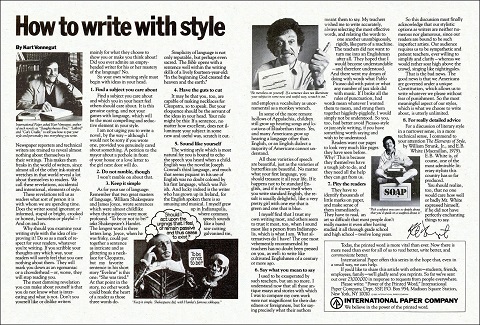
If you feel the need for tips on developing a writing style, you probably don’t look right to the Institute of Electrical and Electronics Engineers’ journal Transactions on Professional Communications. You certainly don’t open such a publication expecting such tips from novelist Kurt Vonnegut, a writer with a style of his own if ever there was one.
But in a 1980 issue, the author of Slaughterhouse-Five, Jailbird, and Cat’s Cradle does indeed appear with advice on “how to put your style and personality into everything you write.” What’s more, he does it in an ad, part of a series from the International Paper Company called “The Power of the Printed Word,” ostensibly meant to address the need, now that “the printed word is more vital than ever,” for “all of us to read better, write better, and communicate better.”
This arguably holds much truer now, given the explosion of textual communication over the internet, than it did in 1980. And so which of Vonnegut’s words of wisdom can still help us convey our words of wisdom? You can read the full PDF of this two-page piece of ad-ucation here, but some excerpted points follow:
- Find a subject you care about. “Find a subject you care about and which you in your heart feel others should care about. It is this genuine caring, and not your games with language, which will be the most compelling and seductive element in your style. I am not urging you to write a novel, by the way — although I would not be sorry if you wrote one, provided you genuinely cared about something. A petition to the mayor about a pothole in front of your house or a love letter to the girl next door will do.”
- Keep it simple. “As for your use of language: Remember that two great masters of language, William Shakespeare and James Joyce, wrote sentences which were almost childlike when their subjects were most profound. ‘To be or not to be?’ asks Shakespeare’s Hamlet. The longest word is three letters long. Joyce, when he was frisky, could put together a sentence as intricate and as glittering as a necklace for Cleopatra, but my favorite sentence in his short story ‘Eveline’ is this one: ‘She was tired.’ At that point in the story, no other words could break the heart of a reader as those three words do.”
- Sound like yourself. “English was Conrad’s third language, and much that seems piquant in his use of English was no doubt colored by his first language, which was Polish. And lucky indeed is the writer who has grown up in Ireland, for the English spoken there is so amusing and musical. I myself grew up in Indianapolis, where common speech sounds like a band saw cutting galvanized tin, and employs a vocabulary as unornamental as a monkey wrench. [ … ] No matter what your first language, you should treasure it all your life. If it happens to not be standard English, and if it shows itself when your write standard English, the result is usually delightful, like a very pretty girl with one eye that is green and one that is blue. I myself find that I trust my own writing most, and others seem to trust it most, too, when I sound most like a person from Indianapolis, which is what I am. What alternatives do I have?”
- Say what you mean. “My teachers wished me to write accurately, always selecting the most effective words, and relating the words to one another unambiguously, rigidly, like parts of a machine. They hoped that I would become understandable — and therefore understood. And there went my dream of doing with words what Pablo Picasso did with paint or what any number of jazz idols did with music. If I broke all the rules of punctuation, had words mean whatever I wanted them to mean, and strung them together higgledy-piggledy, I would simply not be understood. Readers want our pages to look very much like pages they have seen before. Why? This is because they themselves have a tough job to do, and they need all the help they can get from us.”
While easy to remember, Vonnegut’s plainspoken rules could well take an entire career to master. I’ll certainly keep writing on the subjects I care most about — many of them on display right here on Open Culture — keeping it as simple as I can bear, saying what I mean, and sounding like… well, a rootless west-coaster, I suppose, but one question sticks in my mind: which corporation will step up today to turn out writing advice from our most esteemed men and women of letters?
via Biblioklept
Related Content:
Toni Morrison Dispenses Writing Wisdom in 1993 Paris Review Interview
Kurt Vonnegut’s Eight Tips on How to Write a Good Short Story
Stephen King’s Top 20 Rules for Writers
The Best Writing Advice Pico Iyer Ever Received
Colin Marshall hosts and produces Notebook on Cities and Culture and writes essays on cities, language, Asia, and men’s style. He’s at work on a book about Los Angeles, A Los Angeles Primer. Follow him on Twitter at @colinmarshall or on Facebook.
Read More...Watch Pink Floyd’s The Final Cut, A 19 Minute Music Video for Their Last Album With Roger Waters (1983)
The Endless River, Pink Floyd’s unexpected new album, dropped Friday, and unless we credit sly hints dropped by drummer Nick Mason, it’s likely the last we’ll ever hear from them. But one should always clarify, when speaking of the band, exactly which Pink Floyd is under discussion. Is it Pink Floyd 1.0, with madcap singer/guitarist Syd Barrett at the helm? Pink Floyd 2.0—the most enduring combo—featuring Mason, Barrett replacement David Gilmour, bassist Roger Waters, and keyboardist Richard Wright? At another time, Wright was out of the picture, then back in. After 1985, Waters, the band’s primary lyricist, and arguably most visionary member, was gone for good. They would never again make music as soaring and ambitious—if also bombastic—as they did with his overbearing presence.
The title of the last album Waters recorded with the band, 1983’s The Final Cut, presciently announces itself as a coda for Floyd 2.0 (or 2.5? Whatever…). It also alludes to the band’s cinematic reach: whether scoring films, writing them, or making records with the scope and breadth of epic movies. Floyd and film have always formed an organic partnership. Before the quick fix of Youtube, they made feature-length music videos that seemed to emerge fully formed from narrative and concept-rich records. The Final Cut, the album, initially intended to be part of 1982’s rock opera The Wall, took on a life of its own when Waters re-conceived it as a protest against the Falklands War and Margaret Thatcher, as well as a eulogy and vindication for his serviceman father who died in World War II. The Final Cut, the film (above—not to be confused with a 2004 sci-fi flick of the same name), is a nineteen-minute piece that dramatizes four songs from the album: “The Gunner’s Dream,” “The Final Cut,” “Not Now John,” and “The Fletcher Memorial Home.”
The album itself brought the band to an impasse—pushing Waters’ increasingly personal focus to such an extent that, writes Allmusic, it “purposefully alienates all but the most dedicated listener.” That may be so, but if one is willing to indulge it, it’s a very rewarding listen, “more like a novel than a record.” And it makes a fascinating contrast to The Endless River, “a suite of mostly instrumental moods and fragments” reminiscent of the band’s film scores. Taken together, these two documents showcase the enduring strengths of Pink Floyd proper—they were a band who excelled both at telling complex stories and creating deeply felt moods that are, like the title of The Endless River’s closing track, “Louder than Words.”
Related Content:
Watch the Rare Reunions of Pink Floyd: Concerts from 2005, 2010 & 2011
Watch Documentaries on the Making of Pink Floyd’s Dark Side of the Moon and Wish You Were Here
Pink Floyd Plays With Their Brand New Singer & Guitarist David Gilmour on French TV (1968)
Josh Jones is a writer and musician based in Durham, NC. Follow him at @jdmagness
Read More...How to Clean Your Vinyl Records with Wood Glue
During the golden age of vinyl, Ronco sold vacuums to keep your records clean. But there was always a cheaper DIY hack — a hack demonstrated in a video created by a Youtuber who simply goes by “ghettofunk13.” Just pour some wood glue on your record, spread it around carefully as the turntable spins (don’t get it on the center label), and you can apparently get rid of those snaps, crackles, and pops. The video is pretty straightforward. But it’s worth noting the addendum “ghettofunk13” later added in text: “You can use considerably less glue and still get the same effect — it cuts the dry time way down. Just be sure that you get the whole record covered!”
Over on Metafilter, one commenter took “ghettofunk13” to task, saying “The bass is muddy and there’s no clarity and sparkle at the high end.… He should have used de-ionized wood glue from a polycarbonate (NOT polypropylene) bottle, and spread it in the direction of rotation with a hand-polished cedar shake. Amateur.” Just something to consider if you plan to do some DIY record cleaning this weekend. You can get a few more details on the process here. Try at your own risk.
FYI, over at Kottke.org, you can see an excellent microscopic photo of vinyl record grooves. Jason writes, “When you look really closely at record grooves, like at 1000x magnification, you can see the waveforms of the music itself. Sooo cool.”
Related Content:
How Vinyl Records Are Made: A Primer from 1956
A Celebration of Retro Media: Vinyl, Cassettes, VHS, and Polaroid Too
Neil Young on the Travesty of MP3s
World Records: New Photo Exhibit Pays Tribute to the Era of Vinyl Records & Turntables
Read More...53 New York Times Videos Teach Essential Cooking Techniques: From Poaching Eggs to Shucking Oysters
I was blessed to grow up around a grandmother who cooked every meal like she was feeding a dozen famished farmhands. She never spelled out all her various tricks and short cuts … let’s not call them hacks. She just did what she did, and I picked it up by osmosis, using a juice glass for a biscuit cutter and watching for pockmarks in the pancake batter. Endless hours in her kitchen made me a confident chef long before I was in a position to buy my own groceries.
Not everyone is so fortunate, I know.
They get their information from Julia Child, Martha Stewart, some pseudonymous food blogger or possibly my friend, Jesse, whose expertise as a builder extends to things culinary. He once insisted on showing me a more efficient way to cut up mango. My grandmother’s tropical fruit experience maxed out at oranges, so I was on my own in the separating mango flesh from mango bone department. I tried it his way a couple of times, before reverting to my non-way.
There’s undeniable competitiveness amongst those of us who pride ourselves on our cooking abilities. Our skills are our honor. So help me if I went on Top Chef, and some guest judge decreed I was doing something wrong!
For the record, The New York Times endorses Jesse’s mango technique above, in their short instructional video series, Cooking Techniques. There are 53 videos in total.
I can see how such a collection would come in handy for those who didn’t grow up around my grandmother, Jesse, or me.
And speaking of handy, all fledgling chefs are advised to get a firm handle on knife techniques before picking up a notoriously slippery-fleshed fruit and cutting toward their own fingers! Such recklessness would never have passed muster with the editors of the Betty Crocker New Boys and Girls Cookbook. The Times is living on the edge!
Some of the content has a dopey wash-rinse-repeat vibe, abetted by an oddly flavorless narrative voice. (Not everyone has Thug Kitchen’s narrative sparkle. I should be grateful for the personality shining through other Times videos, notably Bill Cunningham’s “On The Street.”)
I’ll eat those words should I ever need to shuck an oyster, another one of those culinary duties that had no place on my Midwestern grandmother’s agenda. Not to say that my kitchen abilities are limned by the culinary standards of 1970s Indiana. I fling around fish sauce and coconuts with Siamese abandon, but oysters always seem so damn daunting. Could owe to early readings of Lewis Carroll.
I don’t know what I was so afraid of. Apparently all it takes is 30 seconds and a dishtowel. (And an oyster knife, but we’ve got drawerfuls of those, the trickle down effect of my husband’s Cape Cod boyhood.)
Ultimately, it’s solid stuff, but though with apologies to our vegetarian readers, there’s more than one way to skin a cat. You can poach eggs a la the Times, or do it my way by adding a tablespoon of vinegar to the poaching water. No fussy pre-poach. Boom! Done!
Similarly stemming greens. My way, gleaned, not from my gran, but a handwritten, illustrated zine earlier this millennium, doesn’t even require a knife! Hold that kale stem side up, using your other hand as an ersatz prong, tearing the leaf from stem to stern.
Good heavens. Is that where that expression came from? Perhaps someone at the Times would know…. See all 53 of their cooking technique videos here.
Related Content:
Science & Cooking: Harvard’s Free Course on Making Cakes, Paella & Other Delicious Food
MIT Teaches You How to Speak Italian & Cook Italian Food All at Once (Free Online Course)
Ayun Halliday is an author, homeschooler, former food blogger and Chief Primatologist of the East Village Inky zine. Follow her @AyunHalliday
Read More...Ricky Gervais Creates Outlandish Comedy with David Bowie
Ricky Gervais’s first brush with fame, at least on the other side of the pond, was as the front man of the ‘80s synch pop band Seona Dancing. If you watch the music video below of the band’s near-hit “Bitter Heart” from 1983, you can see a skinnier, svelter Gervais with over-moussed hair crooning like he was David Bowie. He indeed does sounds a bit like Bowie. He moves like Bowie. And if you squint your eyes, you can almost convince yourself that Gervais even looks like Bowie (or the lead singer of A‑ha).
Seona Dancing folded in 1984 because they ultimately failed to crack the Top 40. So after drifting around the music industry, Gervais turned to comedy. But that didn’t mean that he forgot about Bowie. Before he struck fame and fortune with The Office, he made a one-off show called Golden Years in 1998. He played Clive Meadows, an oblivious, Bowie-obsessed corporate middle manager who prepares for an appearance on the British talent series Stars In Their Eyes by dressing up as the rock star during his Aladdin Sane period, complete with satin pants, red wig and lightning bolt face paint.
Not long after The Office premiered, Gervais got a chance to meet his idol when the BBC invited him to a concert. “David Bowie has been a hero of mine for 25 years,” he told the Daily Mirror. “He is quite special and you meet him and you think he is going to come out of some weird tube and say ‘hello, I’m a space boy’. But he doesn’t, he says ‘hello I’m David’.” Of course, when Gervais was introduced, Bowie had no idea who he was.
Then a few weeks later, Gervais received an email from Bowie, who clearly caught up on his TV viewing. “So I watched that Office. I laughed. What do I do now?”
That sparked a friendship between the two. As Gervais recounted in an interview in GQ Magazine:
I remember, I think, the first time that I knew him when it was his birthday, I sent him an e‑mail that said “57???? Isn’t it about time that you got a proper job? Ricky Gervais, 42, comedian.” He sent back: “I have a proper job. David Bowie, 57, Rock God.”
Their relationship culminated in a guest appearance on Gervais’s HBO series Extras. In the episode, which you can watch above, Gervais plays Andy Millman, an oblivious, desperate movie extra looking to break into the big time. When he annoys Bowie, playing himself, at a posh bar with his self-absorbed whining, the rock star turns to a piano and starts to toss off a damning, but catchy, little ditty on the spot about Gervais called “Little Fat Man.” (Lyrics include: ““Pathetic little fat man / No one’s bloody laughing / The clown that no one laughs at / They all just wish he’d die”)
While making the episode, he and Bowie worked together on making the song:
“Have you got the lyrics?” and he went, “Yeah.” I said, “Can you do something quite retro, like ‘Life on Mars’?” And he went [deadpan], “Oh, of course, yeah, sure. I’ll knock off a quick ‘Life on Mars,’ shall I?”
Related Content:
David Bowie Recalls the Strange Experience of Inventing the Character Ziggy Stardust (1977)
Ricky Gervais Presents “Learn Guitar with David Brent”
“Learn English With Ricky Gervais,” A New Podcast Debuts (NSFW)
Seinfeld, Louis C.K., Chris Rock, and Ricky Gervais Dissect the Craft of Comedy (NSFW)
Jonathan Crow is a Los Angeles-based writer and filmmaker whose work has appeared in Yahoo!, The Hollywood Reporter, and other publications. You can follow him at @jonccrow. And check out his blog Veeptopus, featuring lots of pictures of vice presidents with octopuses on their heads. The Veeptopus store is here.
Read More...Simone de Beauvoir Tells Studs Terkel How She Became an Intellectual and a Feminist (1960)
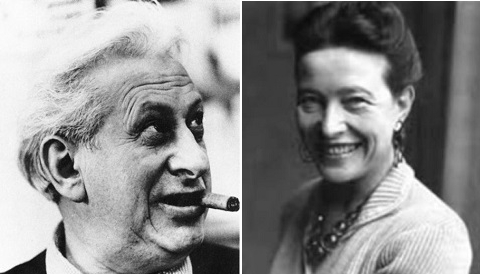
Before Ira Glass, before Terry Gross, before any number of NPR personalities and internet podcasters who these days bring us interview after fascinating interview with the great minds of our time, there was Studs Terkel. In addition to his almost superhuman achievements as an oral historian, film and TV actor, and Pulitzer Prize-winning author, Terkel pioneered the radio interview with his Chicago radio show, which ran for over four decades. “With no written questions,” an NPR eulogy tells us, Terkel would “pick up a riff and improvise.” In 1960, he brought his jazz-like improvisational style to Paris, to the apartment of existentialist philosopher and novelist Simone de Beauvoir.
You can hear their conversation, which spans nearly half-an-hour, just below. De Beauvoir talks about her middle-class upbringing, student days at the Sorbonne, and development as a teacher and writer. She narrates her life history in part because the first book of her three-volume autobiography, Memoirs of a Dutiful Daughter, had just been published, and the second, The Prime of Life, was near completion. Already well-known for her philosophical and political work with her partner Jean-Paul Sartre and fellow existentialists Maurice Merleau-Ponty and Albert Camus, and her groundbreaking feminist study The Second Sex, de Beauvoir was entering a later phase in her career, a very reflective one. Suitably, Terkel opens the interview by observing that “listeners would very much like to know how you got this way.”
“This way” refers to de Beauvoir’s fierce commitments to philosophy, and to feminism. Terkel compares her to transcendentalist and feminist pioneer Margaret Fuller, “of Boston, a century ago,” who “too traveled to various parts of the world and saw what she wanted to see, what she intended to see, the truth.” Accordingly, their conversation turns from personal reminisces to de Beauvoir’s belief that the writer must be “involved,” or—as she clarifies, “committed”—ethically, philosophically, and politically. What this means for her is “not ignoring the rest of the world.” As she puts it, “there is no possible neutrality… you have to commit yourself… and not to just be picked by people, pretending you are picked by nobody.” She goes on, in a vein reminiscent of Howard Zinn’s remark that one “can’t be neutral on a moving train”:
You are always picked one way or another way. You always help this one or this other: the poor against the wealthy or the wealthy against the poor—you have no choice. And if you pretend just to stay and do nothing, even staying and doing nothing means something and it goes to one of the camp or the other.
Intrigued, Terkel asks “I’m doing nothing, this too is a matter of choice, you say?” De Beauvoir explains: “there is only one thing: is to begin to speak yourself, your own way. You have to say ‘I am against it,’ ‘I am for it’ because if you say nothing, your silence is used by the one you are for or against.” It’s a fascinating interview first because de Beauvoir is such an engaging speaker and secondly because Terkel is such an excellent listener.
Related Content:
Simone de Beauvoir Explains “Why I’m a Feminist” in a Rare TV Interview (1975)
Photos of Jean-Paul Sartre & Simone de Beauvoir Hanging with Che Guevara in Cuba (1960)
Josh Jones is a writer and musician based in Durham, NC. Follow him at @jdmagness
Read More...Albert Camus’ Lessons Learned from Playing Goalie: “What I Know Most Surely about Morality and Obligations, I Owe to Football”
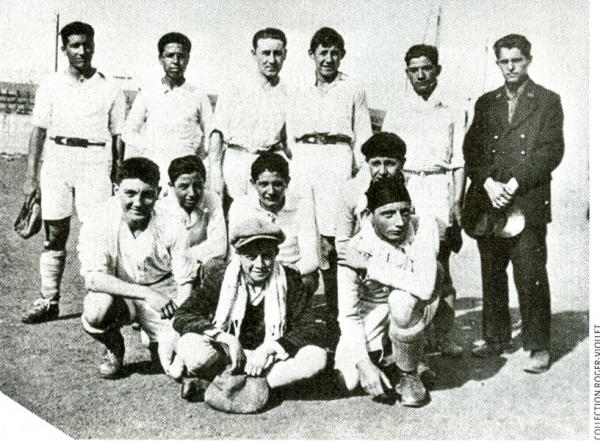
Albert Camus, born 101 years ago today, once said, “After many years in which the world has afforded me many experiences, what I know most surely in the long run about morality and obligations, I owe to football.”
He was referring to his college days when he played goalie for the Racing Universitaire Algerios (RUA) junior team. Camus was a decent player, though not the great player that legend later made him out to be. For Jim White, author of A Matter of Life and Death: A History of Football in 100 Quotations, soccer perhaps taught Camus a few things about selflessness, cooperation, bravery and resilience. That’s a sunny way of looking at things. But perhaps The Telegraph gets at the deeper, darker life lessons Camus took away from soccer:
[T]here is something appropriate about a philosopher like Camus stationing himself between the sticks [that is, in goal]. It is a lonely calling, an individual isolated within a team ethic, one who plays to different constraints. If his team scores, the keeper knows it is nothing to do with him. If the opposition score, however, it is all his fault. Standing sentinel in goal, Camus had plenty of time to reflect on the absurdist nature of his position.
And perhaps the absurdist nature of life itself…
Camus — who appears in the picture above, wearing the dark color jersey in the front row — contracted tuberculosis when he was only 18 years old. His lungs too damaged to continue playing sports, the young man turned to philosophy. When Camus moved from Algeria to France, he learned that philosophy was a rough and tumble game too — something his soccer days prepared him for. He once quipped, “I learned … that a ball never arrives from the direction you expected it. That helped me in later life, especially in mainland France, where nobody plays straight.”
Related Content:
Jorge Luis Borges: “Soccer is Popular Because Stupidity is Popular”
Video: The Day Bob Marley Played a Big Soccer Match in Brazil, 1980
Read More...A Visual Introduction to Soviet Montage Theory: A Revolution in Filmmaking
Between 1908 and 1913, American filmmaker D. W. Griffith made over 400 movies. Over that time, he, along with his fellow Hollywood directors, developed continuity editing. Using such tools as matching eyelines – cutting so that the actors appear to be looking at each other across different shots – and the 180-degree rule – which keeps the actors from switching places on the screen – Griffith and his cohorts created a visual grammar that let audiences forget the film’s artifice and disappear into the story. By the time Griffith released his hugely influential (and hugely racist) masterwork A Birth of A Nation in 1915, the rules of continuity editing had more or less been worked out. This form of storytelling was so successful, and profitable, that it has been used for just about every Hollywood movie that has come out since.
Yet just as these rules were being codified, filmmakers, mostly European, looked for other ways to tell a story. German directors like F. W. Murnau and Robert Wiene experimented with cinematic depictions of the subconscious. French filmmakers like René Clair used camera tricks and odd framing to create works of formal beauty. But it was the filmmakers in the newly formed Soviet Union that really contributed a new way of thinking about film – Soviet Montage. You can watch a video about it above.
When the Bolshevik Revolution washed over the country, the number of films in the USSR dried up. One of the few movies available at VGIK, aka The Moscow Film School, was Griffith’s sprawling Intolerance (watch it online here). Lev Kuleshov, a young teacher there, started to take apart the movie and reorder the images. He discovered that the meaning of a scene was radically changed depending on the order of the shots. This led Kuleshov to try an experiment: he juxtaposed the image of a man with a blank expression with a bowl of soup, a young corpse in a coffin and a pretty girl. You can watch it below.
Invariably, audiences praised the actor for his subtlety of performance. Of course, there was no performance. The connection between the two images was made entirely within the head of the viewer. This realization would forever be commemorated in film schools everywhere as the Kuleshov Effect.
Using the French word for assemble, Kuleshov called this “montage.” At the school, however, there was considerable debate over what montage exactly was. One of Kuleshov’s students, Vsevolod Pudovkin envisioned each shot as a brick, one small part that together with other small parts created a cinematic edifice.
Another student, Sergei Eisenstein, proposed a far more dynamic, and revolutionary, form of montage. Eisenstein saw it “as an idea that arises from the collision of independent shots.” An intellectual well versed in theory, Eisenstein compared montage to Karl Marx’s vision of history where a thesis smashes into its antithesis and together, from that wreckage, forms its synthesis.
Eisenstein’s greatest example of montage, and indeed one of the greatest examples of filmmaking ever, is the Odessa Steps scene from his masterpiece Battleship Potemkin. In it, Czarist soldiers massacre a group of protestors, mostly women and children. You can watch it below.
As you can see, it’s a powerful piece of propaganda. There is no way to come away from this movie and not feel like the Czarists are anything but murderous villains. (Nevermind that the movie is wildly inaccurate, historically speaking.) Shots of a grieving mother juxtaposed with images of bayonet wielding troops result in a surprisingly visceral feeling of injustice.
In his writings, Eisenstein outlined the varying types of montage – five kinds in all. The most important, in his eyes, was intellectual montage – a method of placing images together in a way to evoke intellectual concepts. He was inspired by how Japanese and Chinese can create abstract ideas from concrete pictograms. For example, the Japanese symbol for tree is 木. One character for wall is 囗. Put the two together, 困, and you have the character for trouble, because having a tree in your wall is certainly a huge pain in the ass. You can see an example of intellectual montage in the end of the Odessa steps sequence when a stone lion seemingly rises to his feet.
Eisenstein decided to push this idea to the limit with his follow up, October. The movie is deeply strange to watch now. In one famous sequence, Eisenstein compares White Russian general Alexander Kerensky to a peacock and to a cheap Napoleon figurine. It’s proved to be an interesting intellectual exercise but one that left audiences, both then and now baffled.
And below is another, slightly funnier, certainly more contemporary, example of intellectual montage.
Many of the landmark films mentioned above can be found in our collection, 4,000+ Free Movies Online: Great Classics, Indies, Noir, Westerns, Documentaries & More.
Related Content:
Hitchcock on the Filmmaker’s Essential Tool: The Kuleshov Effect
Watch Battleship Potemkin and Other Free Sergei Eisenstein Films
Jean-Luc Godard’s After-Shave Commercial for Schick
Watch Ten of the Greatest Silent Films of All Time — All Free Online
The Filmmaking of Susan Sontag & Her 50 Favorite Films (1977)
Jonathan Crow is a Los Angeles-based writer and filmmaker whose work has appeared in Yahoo!, The Hollywood Reporter, and other publications. You can follow him at @jonccrow. And check out his blog Veeptopus, featuring lots of pictures of vice presidents with octopuses on their heads. The Veeptopus store is here.
Read More...The Ebola Virus Explained with Animated Video
There’s just one small mention of the Ebola virus on the New York Times homepage right now. And it’s buried halfway down the page — which means that, no longer in panic mode, we can take a cool, calm and collected look at this virus called Ebola.“What does the Ebola virus actually do in your body? Why is it so dangerous and why does it kill so many people?” Those are the questions explored in a new video by Kurzgesagt, a Munich-based design studio that specializes in creating educational and scientific animations. Kurzgesagt, in case you’re wondering, means “in a nutshell” in German. As in, here’s the deal with Ebola in a nutshell.
Follow us on Facebook, Twitter and Google Plus and share intelligent media with your friends. Or better yet, sign up for our daily email and get a daily dose of Open Culture in your inbox.
Related Content:
Free Online Biology Courses
How to Dance Your Dissertation: See the Winning Video in the 2014 “Dance Your PhD” Contest
Salvador Dalí Creates a Chilling Anti-Venereal Disease Poster During World War II
Read More...The Internet Arcade Lets You Play 900 Vintage Video Games in Your Web Browser (Free)

A year ago, Colin Marshall told you all about the Internet Archive’s Historical Software Archive, which lets nostalgic web users play vintage computer games in their web browser — games like Namco’s Pac-Man, or a 1982 version of E.T. the Extra-Terrestrial. The Archive has kept nudging along this project, and last weekend they launched the Internet Arcade, a web-based library of 900 arcade (coin-operated) video games made between the 1970s and 1990s. Dig Dug, Bezerk, Frogger, Tetris, Donkey Kong, Street Fighter II — they are all there.
The games will run in your web browser via a Javascript emulator. Last year, the Internet Archive told us that Firefox was best optimized to run these free games. If you encounter issues with control, sound, or other technical problems, you can read this entry for some common solutions.
If you would like to support the mission of Open Culture, consider making a donation to our site. It’s hard to rely 100% on ads, and your contributions will help us continue providing the best free cultural and educational materials to learners everywhere. You can contribute through PayPal, Patreon, and Venmo (@openculture). Thanks!
Related Content:
Playing a Video Game Could Cut the Risk of Dementia by 48%, Suggests a New Study
Learn to Write Through a Video Game Inspired by the Romantic Poets: Shelley, Byron, Keats
Read More...
Support Us
We're hoping to rely on loyal readers, rather than erratic ads. Please click the Donate button and support Open Culture. You can use Paypal, Venmo, Patreon, even Crypto! We thank you!

About Us

Open Culture scours the web for the best educational media. We find the free courses and audio books you need, the language lessons & educational videos you want, and plenty of enlightenment in between.
Advertise With Us

FREE UPDATES!
GET OUR DAILY EMAIL
Get the best cultural and educational resources on the web curated for you in a daily email. We never spam. Unsubscribe at any time.
FOLLOW ON SOCIAL MEDIA

Open Culture editor Dan Colman scours the web for the best educational media. He finds the free courses and audio books you need, the language lessons & movies you want, and plenty of enlightenment in between.
Advertise With Us

