The Complete Ulysses: Alec Baldwin, Garrison Keillor, Bob Odenkirk & Others Read Joyce’s Opus Aloud
Perhaps you’ve held off on listening to Re:Joyce, Frank Delaney’s line-by-line, episode-by-episode podcast exegesis of James Joyce’s Ulysses, because you want to listen not just to a breakdown of the novel, but to the novel itself. If so, then boy, have we got another ongoing project for you to follow: The Complete Ulysses, which has a mandate to record every word of Ulysses as “the first American production” of the book “using mostly American and Irish-American actors like Alec Baldwin, John Lithgow, Jerry Stiller, Garrison Keillor, Anne Meara, Wallace Shawn, Bob Dishy, Anne Enright, Bob Odenkirk, Pulitzer-Prize-winning poet Paul Muldoon, and Caraid O’Brien as Molly Bloom.” The producers have planned to make available recordings of each chapter as soon as they finish them, “on almost all current and future audio media.” You can browse the so-far completed material here.
“The project began more than 30 years ago,” says The Complete Ulysses’ site, “when [radio station] WBAI broadcast a marathon reading of Ulysses from the Shakespeare & Co. bookstore at 81st and Broadway in New York.” Bookstore owner Larry Josephson “took the idea of a long-form radio reading of Ulysses to Isaiah Sheffer, then Artistic Director of Symphony Space.” This resulted in Bloomsday on Broadway, an 18-hour “live, staged reading of excerpts from Ulysses and other Irish literature and song.” Having then created Radio Bloomsday, a WBAI reading series “featuring live and pre-recorded readings from Ulysses and lots of other things Irish,” Josephson “got the ‘insane’ idea of recording the entire book, which will run about 30 hours.”
Ambitious, yes, but then the same applies to Re:Joyce, and indeed to Ulysses itself, which you can find in our collection of Free eBooks. Joyce has long had a way of inspiring creators to execute their own “insane” ideas, and this one in particular gives his own work a whole new means of expression. Tuning into Radio Bloomsday has, for a few years now, appeared as a mainstay on various press outlets’ “what to do on Bloomsday” lists, but with The Complete Ulysses, you certainly don’t need to wait until June 16 for a Joycean experience; these days, a properly equipped iPod can turn every day into Bloomsday.
If you can’t wait for The Complete Ulysses to be completed, you can always download a reading of Ulysses in its entirety here (in audio format).
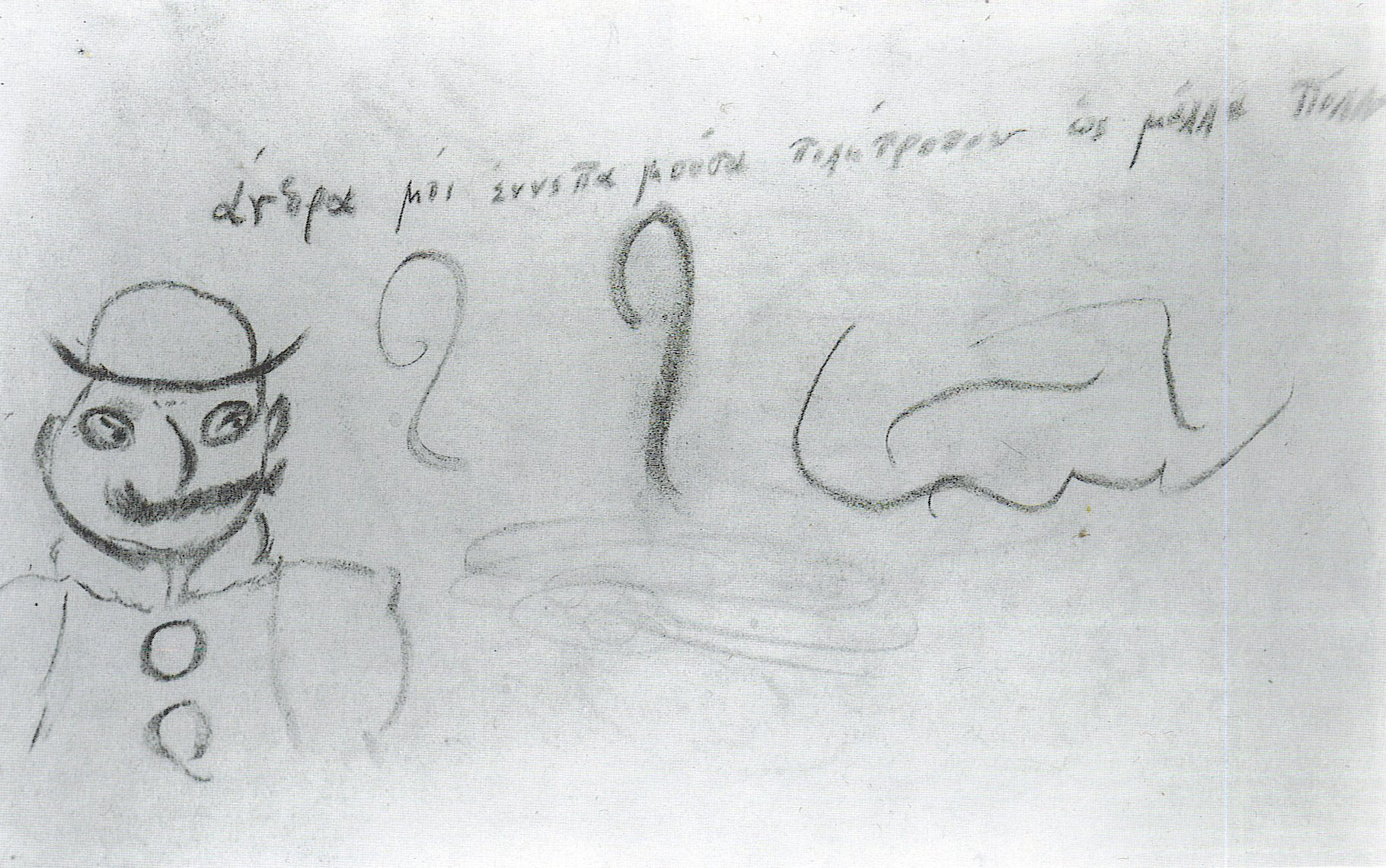
Note: The drawing above is none other than Leopold Bloom, drawn by Joyce himself in 1926, when his eyesight was failing. We have more on that story here.
Related Content:
Everything You Need to Enjoy Reading James Joyce’s Ulysses on Bloomsday
James Joyce’s Ulysses: Download the Free Audio Book
Henri Matisse Illustrates 1935 Edition of James Joyce’s Ulysses
Colin Marshall hosts and produces Notebook on Cities and Culture and writes essays on cities, language, Asia, and men’s style. He’s at work on a book about Los Angeles, A Los Angeles Primer. Follow him on Twitter at @colinmarshall or on Facebook.
Read More...How to Dance Your Dissertation: See the Winning Video in the 2014 “Dance Your PhD” Contest
We’ve seen how modern dance can explain key concepts in statistics (e.g. correlation and sampling error). So why couldn’t dance also illustrate the conclusions of a plant biology doctoral dissertation?
Uma Nagendra, a graduate student at the University of Georgia, has just won the 2014 edition of the “Dance Your Ph.D.” contest. Sponsored by Science and HighWire Press, the contest asks grad students to “explain their Ph.D. research in the most jargon-free medium of all: dance.” (More criteria can be found over at the contest’s tips & tricks page.) According to Science magazine, Nagendra likes to spend “a good deal of her [free] time hanging upside down from a trapeze doing circus aerials.” It’s a creative outlet for her. And it offers a good way, it turns out, to visualize the conclusions of her dissertation exploring “Plant-soil feedbacks after severe tornado damage.”
The “Dance Your Ph.D.” contest allows each contestant to submit a video with a short piece of descriptive text. Here is what Nagendra wrote:
Many of the patterns we see in forests around the world are caused by the relationships that plants have with organisms in the soil. Some very diverse forests can only support as many different tree species as they do because soil-borne diseases prevent any one species from taking over. But what happens when a tornado comes along? Do the plants and soil organisms maintain this diversity-promoting relationship?
My PhD research focuses on how several different species of tree seedlings in the southern Appalachian mountains interact with soil organisms—and how tornadoes might mix things up. I study many different species. As an example, we can look at white pine (Pinus strobus), and the many pathogens that attack the roots of its seedlings.
The dance begins in an undisturbed forest. Because trees live for so long in one place, a mature pine tree accumulates a unique group of fungi around its roots—including pathogens that cause diseases in tree seedlings (in this case, Pythium and Rhizoctonia). White pine seedlings that are very close to a mature tree are more likely to be attacked by these pathogens—causing stunted growth, or even death. The farther away a seedling is from a mature tree, the less likely it is to get infected. These distant seedlings are more likely to survive to maturity. A pattern emerges where the mature pine trees are spaced far apart—leaving room for seedlings of other species to grow, and creating a diverse forest.
In the middle of the dance, we witness the tornado—and how it changes the forest environment. The mature pine tree dies, and the forest floor is no longer shaded. The soil becomes hotter and drier. Without the living mature tree as a host, specialist pathogens are less active, and many die. Because of this, I am predicting that plant-soil relationships in recently tornado-damaged areas may be much weaker. In the last part of the dance, seedlings close to the (killed) mature tree are no longer at greater risk for disease; they grow and survive the same as their more distant siblings. The changing plant-soil relationships after disturbances might be one piece in the puzzle of how diverse ecosystems change over time.
via Explore
Follow us on Facebook, Twitter and Google Plus and share intelligent media with your friends. Or better yet, sign up for our daily email and get a daily dose of Open Culture in your inbox.
Related Content:
Statistics Explained Through Modern Dance: A New Way of Teaching a Tough Subject
The Illustrated Guide to a Ph.D.
Serial Entrepreneur Damon Horowitz Says “Quit Your Tech Job and Get a Ph.D. in the Humanities”
Read More...What Are Literature, Philosophy & History For? Alain de Botton Explains with Monty Python-Style Videos
Once upon a time, questions about the use-value of art were the height of philistinism. “All art is quite useless,” wrote the aesthete Oscar Wilde, presaging the attitudes of modernists to come. Explaining this statement in a letter to a perplexed fan, Wilde opined that art “is not meant to instruct, or to influence action in any way.” But if you ask Alain de Botton, founder of “cultural enterprise” The School of Life, art—or literature specifically—does indeed have a practical purpose. Four to be precise.
In a pitch that might appeal to Dale Carnegie, de Botton argues that literature: 1) Saves you time, 2) Makes you nicer, 3) Cures loneliness, and 4) Prepares you for failure. The format of his video above—“What is Literature For?”—may be formulaic, but the argument may not be so contrary to modernist dicta after all. Indeed, as William Carlos Williams famously wrote, “men die miserably every day / for lack / of what is found” in poetry. How many people perish slowly over wasted time, meanness, loneliness, and broken dreams?
Like de Botton’s short video introductions to philosophers, which we featured in a previous post, “What is Literature For?” comes to us with Monty Python-like animation and pithy narration that makes quick work of a lot of complex ideas. Whether you find this inspiring or insipid will depend largely on how you view de Botton’s broad-brush, populist approach to the humanities in general. In any case, it’s true that people crave, and deserve, more accessible introductions to weighty subjects like literature and philosophy, subjects that—as de Botton says above in “What is Philosophy For?”—can seem “weird, irrelevant, boring.…”
Here, contra Ludwig Wittgenstein’s claims that all philosophy is nothing more than confusion about language, de Botton expounds a very classical idea of the discipline: “Philosophers are people devoted to wisdom,” he says. And what is wisdom for? Its application, unsurprisingly, is also eminently practical. “Being wise,” we’re told, “means attempting to live and die well.” As someone once indoctrinated into the Byzantine cult of academic humanities, I have to say this definition seems to me especially reductive, but it does accord perfectly with The School of Life’s promise of “a variety of programmes and services concerned with how to live wisely and well.”
Lastly, we have de Botton’s explanation above, “What Is History For?” Most people, he claims, find the subject “boring.” Given the enormous popularity of historical drama, documentary film, novels, and popular non-fiction, I’m not sure I follow him here. The problem, it seems, is not so much that we don’t like history, but that we can never reach consensus on what exactly happened and what those happenings mean. This kind of uncertainty tends to make people very uncomfortable.
Unbothered by this problem, de Botton presses on, arguing that history, at its best, provides us with “solutions to the problems of the present.” It does so, he claims, by correcting our “bias toward the present.” He cites the obsessive jackhammering of 24-hour news, which shouts at us from multiple screens at all times. I have to admit, he’s got a point. Without a sense of history, it’s easy to become completely overwhelmed by the incessant chatter of the now. Perhaps more controversially, de Botton goes on to say that history is full of “good ideas.” Watch the video above and see if you find his examples persuasive.
All three of de Botton’s videos are brisk, upbeat, and very optimistic about our capacity to make good use of the humanities to better ourselves. Perhaps some of the more skeptical among us won’t be easily won over by his arguments, but they’re certainly worthy of debate and offer some very positive ways to approach the liberal arts. If you are persuaded, then dive into our collections of free literature, history and philosophy courses highlighted in the section below.
Related Content:
78 Free Online History Courses: From Ancient Greece to The Modern World
55 Free Online Literature Courses: From Dante and Milton to Kerouac and Tolkien
Download 100 Free Online Philosophy Courses & Start Living the Examined Life
Josh Jones is a writer and musician based in Durham, NC. Follow him at @jdmagness
Read More...Download the Complete Sherlock Holmes, Arthur Conan Doyle’s Masterpiece
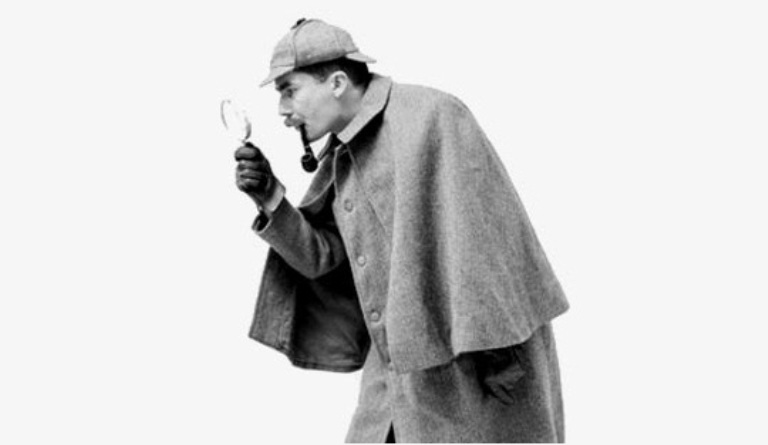
I still remember the thrill I felt when I happened upon a set of the complete Sherlock Holmes stories at an antique store. For a mere ten dollars, I acquired handsomely bound, suitably patina-of-age-bearing editions of each and every one of the sleuth of 221B Baker Street’s adventures that Sir Arthur Conan Doyle ever wrote. In addition to this thrill, I also got a few surprises: first that all of those stories combined — the stories that made Holmes and his assistant Dr. John Watson into household names of nearly 130 years’ standing — fit into two not-especially-large books; second, that Holmes solved his mysteries not just in 56 short stories but four novels as well; and third, that many of those short stories and novels differed intriguingly in tone and content from my expectations. So many modern adaptations — all those television series up to the BBC’s new and expensive-looking Sherlock, the early CD-ROM computer game, Hayao Miyazaki’s steampunk animation Sherlock Hound, Guy Ritchie’s Robert Downey Jr.-showcasing Hollywood films — have convinced us we “know” Sherlock Holmes, which makes it all the more fascinating to investigate, as it were, the original literature.
These days, especially given the recent ruling (just re-affirmed by the Supreme Court) that Conan Doyle’s Sherlock Holmes stories “are no longer covered by United States copyright law and can be freely used by creators without paying any licensing fee to the Conan Doyle estate,” you can download the complete Sherlock Holmes canon in a variety of ebook formats, from PDF to ePub to ASCII to MOBI for Kindle. If you prefer listening to reading, Librivox has made available three different versions of Sherlock Holmes in audiobook form. However you choose technologically to experience the Sherlock Holmes canon, I recommend taking it on chronologically, beginning with the 1887 novel A Study in Scarlet — less a mystery, to my mind, than the scary tale of a murderous Mormon sect — to 1927’s “The Adventure of Shoscombe Old Place,” Holmes’ final Conan Doyle-penned adventure. Somewhere in the middle — in 1893’s “The Final Problem,” to be precise — Holmes’ creator tried to kill the beloved detective off, but the reading public would have none of it. What about Sherlock Holmes stories had got them so hooked that they could successfully demand a resurrection? Now you, too, can find out, without even having to spend the ten dollars, let alone go to the antique store.
Bonus: Below, you can listen to The New Adventures of Sherlock Holmes, an old-time radio show that aired in the US from October 2, 1939 to July 7, 1947.
Related Content:
Sherlock Holmes Is Now in the Public Domain, Declares US Judge
Arthur Conan Doyle Discusses Sherlock Holmes and Psychics in a Rare Filmed Interview (1927)
Arthur Conan Doyle Fills Out the Questionnaire Made Famous By Marcel Proust (1899)
1,000 Free Audio Books: Download Great Books for Free 800 Free eBooks for iPad, Kindle & Other DevicesColin Marshall hosts and produces Notebook on Cities and Culture and writes essays on cities, language, Asia, and men’s style. He’s at work on a book about Los Angeles, A Los Angeles Primer. Follow him on Twitter at @colinmarshall or on Facebook.
Read More...27 More “Essential Films for the Student of Philosophy,” As Suggested By Open Culture Readers
A post of ours last week on philosophical films piqued the interest of many a film-loving, philosophically-inclined reader, and raised an important and perhaps unanswerable question: just what is a “philosophical film”? Does such a creature even exist? Reader Albert Hoffman suggested that “a really great movie always is a philosophical movie, always opens the path to important philosophical questions.” I find that statement hard to dispute, but then find myself also agreeing with another reader, Assyouti, who writes “all bad films can be resources for philosophical discussion.” Why not? What a philosophical film is depends, perhaps, on the definition of words like “philosophical,” “film,” and “is.”
In any case, the originally referenced list of 44 “essential movies for the student of philosophy,” compiled in 2010 by Matt Whitlock for Mubi, laid out some fairly specific criteria, namely that such films “(seem to be) incarnations of classic philosophical thought experiments or movies that have a major philosophical problem as a main theme.” Yet, in addition to films that feature philosophers as characters or participants, this seems to me broad enough to cover an enormous range of movies—from Hitchock’s Vertigo, a favorite of “pervert’s guide” theorist Slavoj Žižek (above), and nearly every film critic everywhere, to (speaking of bad films) Bill and Ted’s Excellent Adventure.
As I mentioned in the previous post, the four years since Whitlock’s list have produced a number of movies that deserve inclusion, several of which were highlighted in the comments. Additionally, readers mentioned several overlooked films that certainly meet the bar. And if we are to loosen up our definitions—and why not—the list expands even further. In that spirit of inclusion, we offer an addendum to Whitlock’s 44, below, with the ever-necessary disclaimer that this new list does not in any way exhaust the subject. We do hope, however, to spark further discussion and, more importantly, introduce interesting, thinky movies for readers to discover. So, without further preamble, here are 27 more “essential movies for the student of philosophy,” in no particular order, as suggested by our always astute Open Culture readers:
- Mindwalk (1990)
- Rosencrantz & Guildenstern Are Dead (1990)
- My Dinner With Andre (1981)
- Steppenwolf (1974)
- Wings of Desire (1987)
- Cocteau’s Orphic Trilogy—Blood of a Poet (1930), Orphee (1950), Testament of Orpheus (1959) [yes, this is three films, but we’ll count them as one for the purposes of this list]
- Possible Worlds (2000)
- The Man Who Fell to Earth (1976)
- The Holy Mountain (1973)
- THX 1138 (1970)
- 99 Francs (2007)
- Un Chien Andalou (1929)
- Enter the Void (2009)
- Stalker (1979) — featured earlier today on OC
- Viva La Muerte (1971)
- I Stand Alone (1998)
- Iris (2001)
- World on a Wire (1973)
- Locke (2013)
- The Widow of Saint-Pierre (2000)
- The Trial (1962)
- Life of Brian (1979)
- Being There (1979)
- Bladerunner (1982)
- Outlandish: Strange Foreign Bodies (2009)
- Is the Man Who Is Tall Happy? (2013) — see the trailer above.
- Thirteen Conversations About One Thing (2001)
As you surely know, the list that pleases everyone has yet to be invented, so if you don’t find your suggestions on this one, please don’t take offense. The exercise has been more than worth the price of the ticket for me—I’ve added quite a few titles to my neverending list of films I absolutely must see before that whole bucket thing. No doubt even the hippest among you has found a surprise or two here to add to yours. And if you’re dying to add number 28, 29, 30, etc. then, please, let us know in the comments below. Or, if you want even more suggestions, check out the titles that were mentioned on our Facebook page.
Related Content:
44 Essential Movies for the Student of Philosophy
Watch The Idea, the First Animated Film to Deal with Big, Philosophical Ideas (1932)
Daniel Dennett and Cornel West Decode the Philosophy of The Matrix in 2004 Film
The Drinking Party, 1965 Film Adapts Plato’s Symposium to Modern Times
Josh Jones is a writer and musician based in Durham, NC. Follow him at @jdmagness
Read More...Hear/Download Kurt Cobain’s Unearthed, Experimental Mixtape, “Montage Of Heck” (1986)
Dangerous Minds has helped unearth Kurt Cobain’s “Montage Of Heck” — a 1986 experimental collage of sounds that Cobain culled from his “wide-ranging collection of LPs, manipulated recordings of the radio, … Nirvana demos,” and other audio sources. Made with a four-track cassette recorder, the 36-minute recording features sounds ripped from recordings by Simon & Garfunkel, The Beatles, Cher, James Brown, John Denver, The Partridge Family, George Michael and Queen. But if you think you’re going to hear an upbeat sampling of pop songs when you click play, you’ve got another thing coming.
Over at Vimeo, you can actually download the audio track, and there you will find one comment that puts the mixtape into some perspective. Owl Berg writes, “It’s no surprise that Kurt collaborated with William Burroughs on The “Priest” They Called Him. They were so obviously on the same wavelength. Here we have evidence of Kurt applying the cut-up technique which comes straight from Burroughs’ writing and tape experiments, with results that are equally funny and frightening and mind-blowing and essential to scrubbing our minds clean of our preconceptions about sound.” You can revisit Burroughs’ and Cobain’s 1992 collaboration by visiting this post in our archive.
Related Content:
The “Priest” They Called Him: A Dark Collaboration Between Kurt Cobain & William S. Burroughs
William S. Burroughs “Sings” R.E.M. and The Doors, Backed by the Original Bands
Patti Smith’s Cover of Nirvana’s “Smells Like Teen Spirit” Strips the Song Down to its Heart
William S. Burroughs on the Art of Cut-up Writing
William S. Burrough’s Avant-Garde Movie ‘The Cut Ups’ (1966)
Read More...28 Important Philosophers List the Books That Influenced Them Most During Their College Days
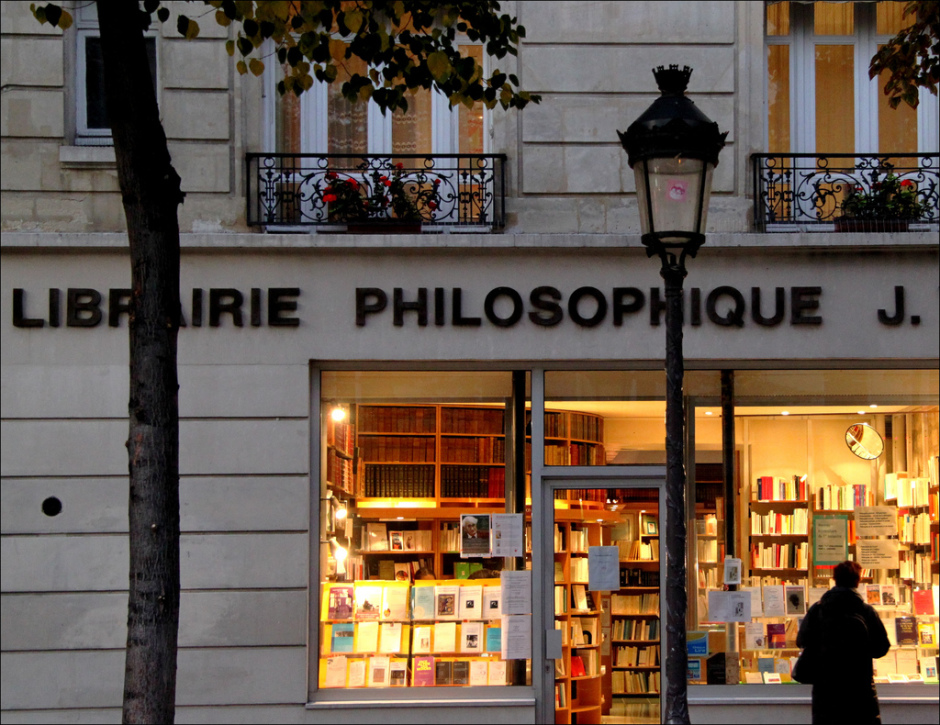
The web site Demasiado Aire recently asked “some of the world’s most important philosophers which three books influenced them the most while undergraduate students.” And, from what we can tell, they got a good response. 28 influential philosophers dutifully jotted their lists, and, for at least the past day, Demasiado Aire has been offline, seemingly overwhelmed by traffic. Thanks to the Internet Archive’s Wayback Machine, we can recover these lists and provide you with a few highlights. We have added links to the texts cited by the philosophers. The free texts have an asterisk (*) next to them.
Charles Taylor (McGill University):
–Phénoménologie de la Perception, Maurice Merleau-Ponty
–The Brothers Karamazov*, Fyodor Dostoevsky
–Jalons pour une théologie du Laïcat, Yves Congar
Daniel Dennett (Tufts University):
“That’s easy:
–Word and Object, Quine.
–The concept of mind*, Gilbert Ryle
–Philosophical Investigations, Ludwig Wittgenstein
“I got to study with Quine and Ryle, but Wittgenstein had died before I encountered his work”.
Alexander Nehamas (Princeton University):
–Apology of Socrates*, Plato
–Nicomachean Ethics*, Aristotle
–Ethics*, Spinoza
“Also, I should point out that Nietzsche’s On the Genealogy of Morality* had a huge effect on me when I was a graduate student and had a formative influence on my philosophical development”.
David Chalmers (Australian National University):
“I was an undergraduate student in mathematics rather than philosophy, but the answer is”:
–Gödel, Escher Bach, Douglas Hofstadter
–The Mind’s I, Douglas Hofstadter & Daniel Dennett
–Reasons and Persons, Derek Parfit
You can view lists by other philosophers, including Alain de Botton, Wendy Brown, Peter Millican, and more here. The image above comes via by MjYj.
If you would like to support the mission of Open Culture, consider making a donation to our site. It’s hard to rely 100% on ads, and your contributions will help us continue providing the best free cultural and educational materials to learners everywhere. You can contribute through PayPal, Patreon, and Venmo (@openculture). Thanks!
Related Content:
44 Essential Movies for the Student of Philosophy
Download 100 Free Philosophy Courses and Start Living the Examined Life
Philosopher Portraits: Famous Philosophers Painted in the Style of Influential Artists
Free Online Philosophy Courses
Read More...Kandinsky, Klee & Other Bauhaus Artists Designed Ingenious Costumes Like You’ve Never Seen Before
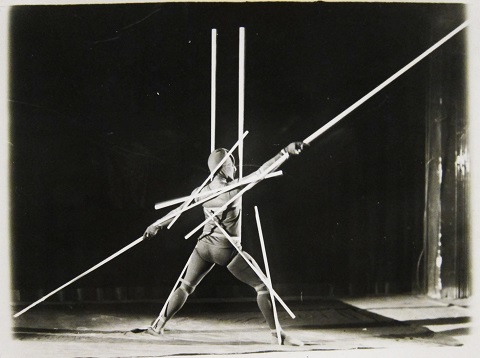
Artists of the Bauhaus school—including founder Walter Gropius, Paul Klee, Wassily Kandinsky, Piet Mondrian and others—broke radically with familiar tradition and made minimalist, abstract, and sometimes shocking statements with their work. We know this history, but you probably haven’t seen these cultural figures physically embody their aesthetic principles as they do in the photographs here, from costume parties the Bauhaus school held throughout the twenties.
As Rachel Doyle at Curbed wrote, “if you thought Bauhaus folk were good at designing coffee tables, just have a look at their costumes—as bewitching and sculptural as any other student project, but with an amazing flamboyance not oft ascribed to the movement.”
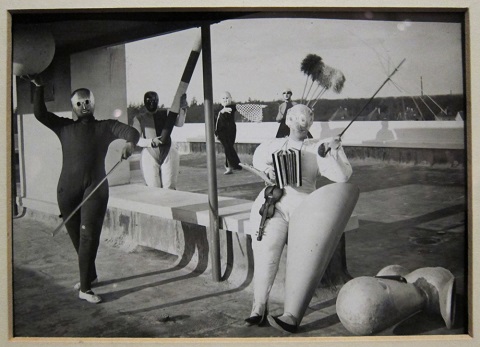
The whimsical costume parties—to which, wrote Hungarian architect Farkas Molnár, artists devoted “the greatest expenditures of energy”—represented further attempts to transcend “medieval conditions” and integrate “today’s scientific and technological advances… into general culture.” So wrote Molnár in a 1925 essay, “Life at the Bauhaus,” where he describes the playfully serious conditions at the school. These parties, he asserts, were superior to “fancy-dress balls” organized by artists in other cities in that “our costumes are truly original. Everyone prepares his or her own. Never a one that has been seen before. Inhuman, or humanoid, but always new.” Everyone participated, it seems, from the newest student to, as Molnár calls them, “the bigwigs”:
Kandinsky prefers to appear decked out as an antenna, Itten as an amorphous monster, Feininger as two right triangles, Moholy-Nagy as a segment transpierced by a cross, Gropius as Le Corbusier, Muche as an apostle of Mazdaznan, Klee as the song of the blue tree. A rather grotesque menagerie…
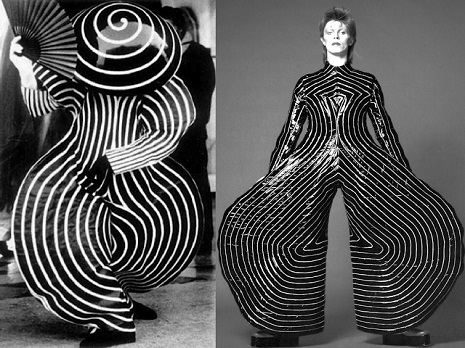
Might that be Kandinsky in the photograph at the top? Just who is this luminous figure? Why did Gropius dress up as Le Corbusier, and what, exactly, does “the song of the blue tree” look like? We can identify at least one of these artists—the bald man in black at the center of the photograph below is Oskar Schlemmer, painter, sculptor, designer, and choreographer. Schlemmer gave Bauhaus costume design its most formal context with the Triadic Ballet, a production, writes Dangerous Minds, that “combined his work in both sculpture and theater to create the internationally acclaimed extravaganza which toured from 1922 to 1929.”
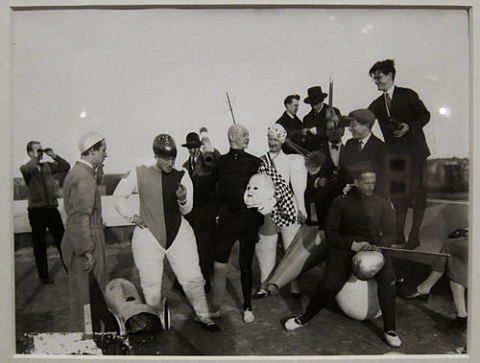
The ballet’s “18 costumes,” writes Curbed, “were designed by matching geometric forms with analogous parts of the human body: a cylinder for the neck, a circle for the heads…. These elaborate costumes [see photo of performers below]… totally upped the ante at the Bauhaus school’s regular costume balls.” Schlemmer “made no secret of the fact that he considered the stylized, artificial movements of marionettes to be aesthetically superior to the naturalistic movements of real humans.” His ballet, Dangerous Minds remarks, may be “the least ‘human’ dance performance ever conceived.”

It may come as no surprise then that the Triadic Ballet influenced some of the hyper-stylized alien costuming of David Bowie’s Ziggy Stardust tour. Perhaps even more than the photographs of revelers from the costume parties, the Triadic Ballet, which has been periodically revived since its 1922 debut, preserves the fascinating innovations Bauhaus artists envisioned for the human form. Just below, watch a 1970 film production recreating many of the original designs, and see more photographs of Bauhaus costumes at The Charnel-House.
Related Content:
Watch an Avant-Garde Bauhaus Ballet in Brilliant Color, First Staged in 1922
The Homemade Hand Puppets of Bauhaus Artist Paul Klee
Time Travel Back to 1926 and Watch Wassily Kandinsky Create an Abstract Composition
Bauhaus, Modernism & Other Design Movements Explained by New Animated Video Series
Josh Jones is a writer and musician based in Durham, NC.
Read More...
Watch Harry Shearer’s Faithful Recreation of Nixon’s Resignation
And now, comedian Harry Shearer.
What role do these gifted performers have in common?
Lear?
Nope. Nixon.
Langella and Sir Anthony resurrected the 37th president within the framework of carefully crafted screenplays. Shearer’s approach is just as actorly, but his material isn’t exactly scripted. Instead, he and Nixon scholar Stanley Kutler pieced it together from unofficial banter on the 3,700 hours of audiotape Nixon secretly recorded while in office, supplementing with notes by those who were there.
The result is Nixon’s The One, a fly-on-the-wall web series in which virtuoso improviser Shearer sticks scrupulously to the script, recreating every pause and awkward chuckle. Compare Shearer’s lead up to Nixon’s televised resignation above, to the real thing, below.
It’s uncomfortable, uncanny, dissociative, and strangely human.
The only false note is Shearer’s glaringly obvious prosthetic nose, though given the professional, period-accurate set, this may have been a deliberate choice. Despite his insistence on authenticity, a biopic is clearly not what creator Shearer had in mind.
He’s been in training for this project for close to half a century, long before the idea itself was hatched. His first turn as Nixon came as a young, make-up free member of the L.A. comedy group, the Credibility Gap.
The next was on Sunday Best, a 1991 mid-season replacement on NBC. “I did a sketch I don’t think ever aired,” he told the Wall Street Journal, “Nixon as a guest on an infomercial demonstrating a magical teeth-whitening preparation.”
Le Show, Shearer’s extremely funny radio show, provided a forum for yet another ridiculous exercise at Tricky Dick’s expense.
The one-time political science major has elected to play it straight with this verbatim, long form labor of love, in order let the weird, unintentional comedy of Richard Nixon shine through. Find all the videos in the Nixon’s the One series here.
Related Content:
Richard Nixon’s Tips For Getting Pandas to Have Sex, Caught on Newly-Revealed Audio Tape (1972)
The Moon Disaster That Wasn’t: Nixon’s Speech In Case Apollo 11 Failed to Return
Nixon and Kissinger: Best of Allies and Rivals
Ayun Halliday is an author, homeschooler, and Chief Primatologist of the East Village Inky zine. She embarrassed her parents on a childhood tour of the Nixon White House uncharacteristically boisterous demands to see Tricky Dick and a queasy stomach that healed itself in time for a visit to a Lafayette Square hot dog vendor. Follow her @AyunHalliday
Read More...Lenny Bruce: Hear the Performances That Got Him Arrested (NSFW)
Lenny Bruce: what comedian today — or countercultural public speaker of any kind — doesn’t name him as an influence? But history has remembered the cutting-edge funnyman of the 1940s, 50s, and 60s as not just an influential figure, but something of a martyr to that quintessentially American cause of free speech. One need only read the story of Bruce’s many legal troubles, a succinct version of which you can find at The Trials of Lenny Bruce Homepage, to understand that the authorities of the mid-20th century interpreted that cause quite differently than we do now. Doug Linder, the author of that piece, describes Bruce’s fall from the peak of his career — a 1959 appearance on national television (introduced by Steve Allen as “the most shocking comedian of our time, a young man who is skyrocketing to fame”), a packed house at Carnegie Hall two years later — to his early death, five years on, after the ravages of bankruptcy, drugs, and courtrooms.
What happened to this promising comedic luminary? All too many comedians flame out due to addiction and financial issues, but Bruce had the considerable burden of running afoul, again and again, of “obscenity” laws: at a San Francisco jazz club, at West Hollywood’s famous Troubadour, at Los Angeles’ Unicorn, in Chicago, and so on. Bruce may have thought himself safe in the comparatively un-Puritan setting of Greenwich Village, but even there, on the fateful night of March 31, 1964, a CIA agent sat in the audience of one of his performances and diligently collected evidence against him. An arrest, arduous, high-profile trial, and conviction followed. Though New York’s highest court would reverse this conviction in 1970, the damage had long since been done, and Bruce himself had died four years earlier.
You can hear the daring material that condemned Bruce above, from the out-of-print album What I Was Arrested For: The Performances that Got Lenny Bruce Busted. (His routine “To Is a Preposition; Come Is a Verb,” which especially ticked off the investigators, appears just above.) Fifty years after the trial, would any of this “obscene, indecent, immoral, and impure drama, play, exhibition, or entertainment,” as the law says, “tend to the corruption of the morals of youth and others”? As All Music Guide’s Sean Carruthers writes of the album, which first came out in 1969 and again in 1975, “It’s amazing what just a few years can accomplish in terms of changing social values — by the time this was re-released, there wasn’t really a whole lot here that would get people too upset.” And so, in perhaps the most telling testament to the ultimate victory of Lenny Bruce, that 20th-century Socrates, the world has become safe for any one of us to publicly utter words like — well, better to hear them straight from the sage of obscenity’s mouth, right?
Related Content:
Lenny Bruce Riffs and Rants on Injustice and Hypocrisy in One of His Final Performances (NSFW)
George Carlin Performs His “Seven Dirty Words” Routine: Historic and Completely NSFW
“Television Taboos”: 1949 Photo Spread Satirizes the Moral Codes of Early Television
Colin Marshall hosts and produces Notebook on Cities and Culture and writes essays on cities, language, Asia, and men’s style. He’s at work on a book about Los Angeles, A Los Angeles Primer. Follow him on Twitter at @colinmarshall or on Facebook.
Read More...Support Us
We're hoping to rely on loyal readers, rather than erratic ads. Please click the Donate button and support Open Culture. You can use Paypal, Venmo, Patreon, even Crypto! We thank you!

About Us

Open Culture scours the web for the best educational media. We find the free courses and audio books you need, the language lessons & educational videos you want, and plenty of enlightenment in between.
Advertise With Us

FREE UPDATES!
GET OUR DAILY EMAIL
Get the best cultural and educational resources on the web curated for you in a daily email. We never spam. Unsubscribe at any time.
FOLLOW ON SOCIAL MEDIA

Open Culture editor Dan Colman scours the web for the best educational media. He finds the free courses and audio books you need, the language lessons & movies you want, and plenty of enlightenment in between.
Advertise With Us