Celebrate The Day of the Dead with The Classic Skeleton Art of José Guadalupe Posada
In Mexico on November 2, mortality is approached with music and laughter.
“On the Day of the Dead, when the spirits come back to us,” explains the Dr. Vigil character in the 1984 film of Malcolm Lowry’s Under the Volcano, “the road from heaven must be made easy, and not slippery with tears.”
The souls of the dead are welcomed back with offerings of food and drink. Skulls and frolicking skeletons, often dressed in full costume, are depicted on alters, food and elsewhere — a playful reminder that all of us, despite our vanities, will one day turn to dust.
The origins of the Day of the Dead and its basic motifs can be traced back 3000 years, to the Aztecs, but the satirical skeletons of its present-day iconography bear the strong influence of one man who died 101 years ago: the printmaker and draughtsman José Guadalupe Posada.
Posada was an obscure newspaper illustrator when he settled in Mexico City in 1888 and began working for a company that published graphic flyers designed to bring the news of the day to a largely illiterate public. Posada’s engravings soon caught on.
“Long drawn to the sensational,” writes Jesse Cordes Selbin at the Henry Ransom Center, “Posada’s interest centered on such fantastic and unsavory aspects of life as murders, robberies, bullfights, political scandals, and illicit love affairs. While his political work alternately satirized President Porfirio Díaz and lauded the populist revolutionary leaders Emiliano Zapata and Francisco Madero, for the most part his prints successfully struck the fine line between hard-hitting and light-hearted, resonating widely throughout Mexico.”
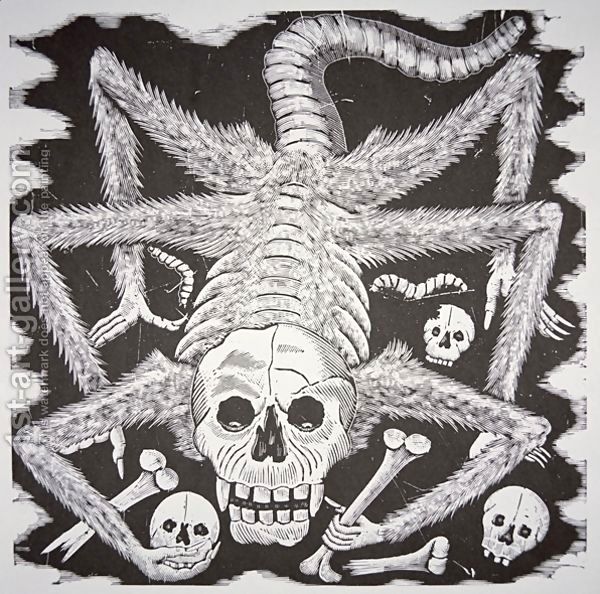
Despite their humble purpose, Posada’s engravings were a major influence on the development of 20th century Mexican art. Octavio Paz described his technique as “a minimum of lines and a maximum of expression.” In his introduction to Mexico: Splendors of Thirty Centuries, Paz writes, “By birthright Posada belongs to a manner that has left its stamp on the twentieth century: Expressionism. Unlike the majority of Expressionist artists, however, Posada never took himself too seriously.”
Others, however, did. The muralists who flourished in post-revolutionary Mexico revered Posada. Diego Rivera and José Clemente Orozco, in particular, praised him as an inspirational figure. In his autobiography, Orozco writes:
Posada used to work in full view, behind the shop windows, and on my way to school and back, four times a day, I would stop and spend a few enchanted minutes in watching him, and sometimes I even ventured to enter the shop and snatch up a bit of the metal shavings that fell from the minimum-coated metal plate as the master’s graver passed over it. This was the push that first set my imagination in motion and impelled me to cover paper with my earliest little figures; this was my awakening to the existence of the art of painting.
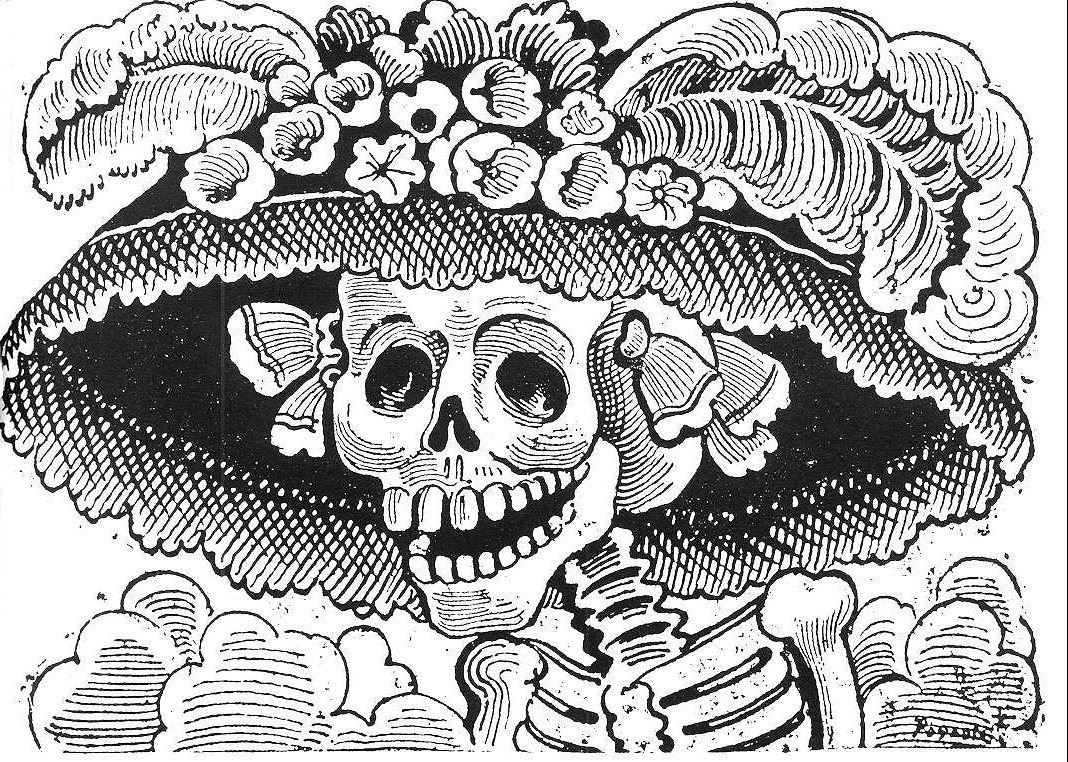
The most influential of Posada’s works were his Calaveras, meaning “skulls,” or, by extension, “skeletons.” Perhaps the most famous work from the series is Calavera Catrina (above), a zinc etching completed in about 1910. It depicts a woman of the social class known as the Catrins (from a Spanish word meaning “over-elegant”), a group who denied their Maya heritage and thought of themselves only as European.
In 1947 Diego Rivera paid homage to Posada by placing him at the center of his panoramic Dream of a Sunday Afternoon in the Alameda Central with a full-length version of the Calavera Catrina on his arm, while Rivera himself, depicted as a young boy, stands on the other side holding her bony hand. For more of Posada’s Calaveras, scroll down.
The Folk Dance Beyond the Grave:
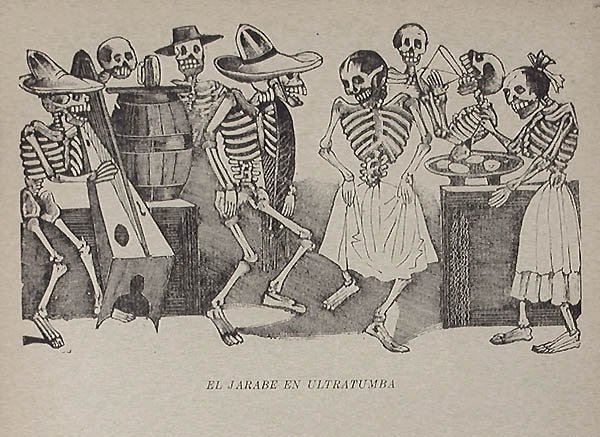
Another zinc etching from around 1910, El Jarabe en ultratumba (“The Folk Dance Beyond the Grave”) depicts a merry group of skeletons eating, drinking, making music and dancing the traditional jarabe. The reproduction is from the posthumous 1930 monograph Las Obras de José Guadalupe Posada, Grabador Mexicano.
Calavera from Oaxaca:
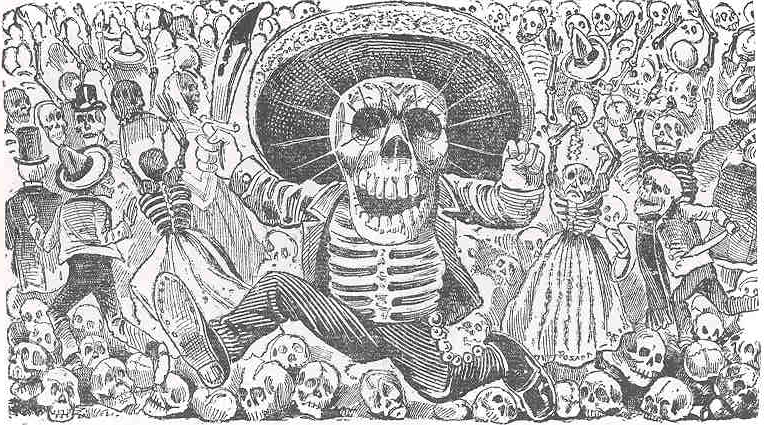
Calavera Oaxaqueña (“Calavera from Oaxaca”) was first published on a broadside in 1910. It shows a proud-looking skeleton dressed as a charro, running past a crowd of skeletons with a blood-stained knife in his hand.
Calavera of Don Quixote:
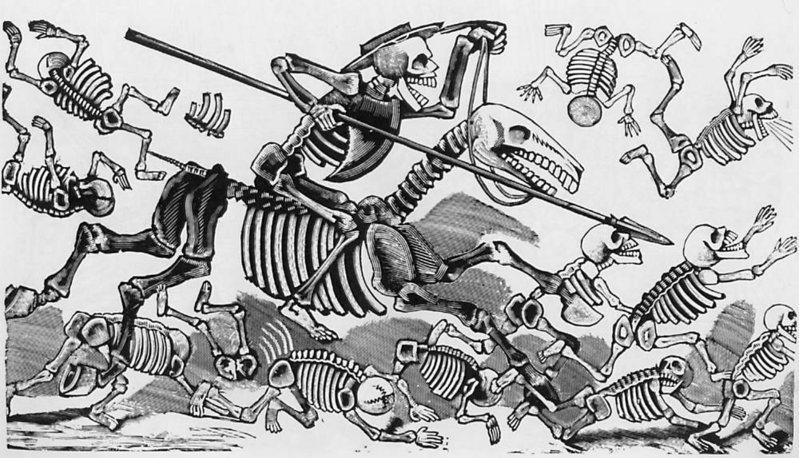
In this etching made sometime between 1910 and Posada’s death in 1913, Don Quixote rides into battle wearing an upside-down barber’s basin he imagines to be the legendary helmet of Mambrino, a solid-gold relic said to make its wearer invulnerable. He vanquishes every foe. “This is the calavera of Don Quixote,” says the caption on the original broadside publication, “the first-class one, the matchless one, the gigantic one.”
Click on the images above to view them in a larger format. You can view more prints by Posada at MoMA and The Public Domain Review.
Related Content:
Charles & Ray Eames’ Short Film on the Mexican Day of the Dead (1957)
Frida Kahlo and Diego Rivera Visit Leon Trotsky in Mexico, 1938
Speaking in Whistles: The Whistled Language of Oaxaca, Mexico
Read More...J.K. Rowling Publishes New Harry Potter Story About the Malevolent Dolores Umbridge

Although J.K. Rowling wrote the final book in the Harry Potter series in 2007, she continues to give Potter fans an occasional fix, publishing short works that add a little more color and detail to the Harry Potter story. Ardent fans know that Rowling wrote a short Prequel in 2008. Also, earlier this year, she began writing new stories about the 2014 Quidditch World Cup Finals for Pottermore, the website for all things Harry Potter. She later followed with a story that takes the form of an article published in The Daily Prophet (“Dumbledore’s Army Reunites at Quidditch World Cup Final”), which gives us the first glimpse of the adult Harry Potter.
Now, on Halloween, we get “The Story of Dolores Jane Umbridge” — a short fictional essay that gives us a more complete personal portrait of the character that readers found so easy to dislike. In the essay [SPOILER ALERT], we learn that Umbridge was, gasp, a half blood, who had demonstrated a certain capacity for wickedness at a young age: “Even at seventeen, Dolores was judgemental, prejudiced and sadistic, although her conscientious attitude, her saccharine manner towards her superiors, and the ruthlessness and stealth with which she took credit for other people’s work soon gained her advancement.”
Rowling then appends some personal comments to the story, explaining the origins of the Umbridge character. She writes:
Once, long ago, I took instruction in a certain skill or subject (I am being vague as vague can be, for reasons that are about to become obvious), and in doing so, came into contact with a teacher or instructor whom I disliked intensely on sight.
The woman in question returned my antipathy with interest. Why we took against each other so instantly, heartily and (on my side, at least) irrationally, I honestly cannot say. What sticks in my mind is her pronounced taste for twee accessories. I particularly recall a tiny little plastic bow slide, pale lemon in colour that she wore in her short curly hair.… [H]er tendency to wear frills where (I felt) frills had no business to be, and to carry undersized handbags, again as though they had been borrowed from a child’s dressing-up box, jarred, I felt, with a personality that I found the reverse of sweet, innocent and ingenuous.
To learn more about the fictional and non-fictional sides of Dolores Umbridge, read Rowling’s new piece here.
Related Content:
How J.K. Rowling Plotted Harry Potter with a Hand-Drawn Spreadsheet
Take Free Online Courses at Hogwarts: Charms, Potions, Defense Against the Dark Arts & More
The Quantum Physics of Harry Potter, Broken Down By a Physicist and a Magician
Read More...Happy Halloween! Louis Armstrong Performs Skeleton in the Closet (1936)
Should you happen to be in the vicinity of Corona, Queens this Halloween afternoon, the Louis Armstrong House Museum will be welcoming trick-or-treaters ’til 6pm. (Fun-sized Snickers be damned! Go anyway, just to see “To Jack Bradley, the ‘Greatest’ Photo Taker,” a collection of candid, private moments captured by the friend Satchmo described as his “white son.”)
If pre-existing engagements prevent you from haunting Corona today, virtual chills await you, above, with “The Skeleton In The Closet,” Armstrong’s show-stopping number from 1936’s Pennies From Heaven. (That masked man on the drums is frequent collaborator Lionel Hampton.)
The vintage Halloween content is a real treat. Gimme ghosts, goblins, and an “old deserted mansion on an old forgotten road” over psycho gore or depressed prefab sexiness any day, not just October 31.
Pennies From Heaven was Armstrong’s first major screen appearance. At the insistence of star Bing Crosby, his turn as a mathematically-challenged bandleader snagged him a main title credit, a first for an African-American actor appearing opposite whites.
The role itself is not a pillar of race advancement, but Ricky Riccardi, the Armstrong House’s Archivist notes that Armstrong remained fond of the work, reenacting an entire scene from memory when he and Crosby appeared as guests on the David Frost Show in 1971.
Riccardi subjects “The Skeleton in the Closet” to a close musical and performance analysis on his Wonderful World of Louis Armstrong blog, a major source of year round goodies for Armstrong fans.
Rattle your bones!
Related Content:
Louis Armstrong Plays Historic Cold War Concerts in East Berlin & Budapest (1965)
Ayun Halliday is an author, homeschooler, and Chief Primatologist of the East Village Inky zine. Follow her @AyunHalliday
Read More...44 Essential Movies for the Student of Philosophy
What comes to mind when you hear the phrase “philosophical film”? The Matrix, most likely, an obvious example of a movie—or franchise—that explores timeless questions: Who are we? What is reality? Are our lives nothing more than elaborate simulations programmed by hyperintelligent supercomputers? Okay, that last one may be of more recent vintage, but it’s closely related to that ancient cave allegory of Plato’s that asks us to consider whether our experiences of the world are nothing more than illusions emanating from a “real” world that lies hidden from view. Another influence on The Matrix is Rene Descartes, whose dualistic separation of consciousness and body receives the maximum of dramatic treatment.
But The Matrix is only one film among a great many that concern themselves with classic problems of philosophy. In a 2010 post for Mubi, Matt Whitlock compiled a list of 44 “Essential Movies for a Student of Philosophy.” Along with The Matrix, other films of the past couple decades get mentions—Richard Linklater’s Waking Life, The Truman Show (“the true home of Plato’s Cave in modern movies”), Eternal Sunshine of the Spotless Mind, I Heart Huckabees, Being John Malkovich, Inception. Also appearing on the list are classics like Akira Kurosawa’s Rashomon and Ingmar Bergman’s The Seventh Seal—which illustrates, Whitlock writes, “The Angst of The Absurd.” All of these films appear under the subheading “Famous thought experiments or discussion of a famous philosophical problem.”
Another category on the list is “Movies featuring a philosopher.” The media-savvy Slavoj Žižek gets two mentions, for 2006’s The Pervert’s Guide to Cinema and 2005’s Žižek! (excerpt above). Since Whitlock compiled the list, Žižek has received yet another feature-length treatment—2012’s The Pervert’s Guide to Ideology. Astra Taylor, director of Žižek!, also included him in 2009’s The Examined Life, alongside Peter Singer, Michael Hardt, Judith Butler, Sunaura Taylor, and Cornel West. After the documentaries, we have “Movies with philosopher as a character,” including Derek Jarman’s Wittgenstein, with Clancy Chassay as the irascible logician, Roberto Rossellini’s 1958 Socrates, starring Jean Sylvere in the title role, and, of course, Bill and Ted’s Excellent Adventure, with Tony Steedman as “So-Crates.”
The final three subcategories in Whitlock’s list are “Movies featuring the ideas of particular philosophers,” “Movies based on Novels written by famous philosophers,” and “Other.” In the last basket, Whitlock places the PBS string-theory documentary The Elegant Universe and Finnish performance artist M.A. Numminen’s bizarre adaptation of Wittgenstein’s Tractatus. Whitlock narrows the field by ruling out “movies that make you think deep crazy stuff” or those with “some new ‘existential twist’ on common topics.” Instead, he sticks to those films “that (seem to be) incarnations of classic philosophical thought experiments or movies that have a major philosophical problem as a main theme… that include topics that a serious student of philosophy needs to understand.”
Like most such lists, this one doesn’t claim to be definitive, and the four years since its compilation have produced several films that might warrant inclusion. Yet another reference from 2010—William G. Smith’s Socrates and Subtitles: A Philosopher’s Guide to 95 Thought-Provoking Movies from Around the World—casts a wider net. But Whitlock’s list seems to me a very useful starting point for thinking about the relationship between philosophy and film. Below, see the first ten films on the list:
Zizek! (2005)
Examined Life (2008)
Derrida (2002)
The Ister (2004)
The Pervert’s Guide To Cinema (2009)
Being In The World (2010)
Bill And Ted’s Excellent Adventure (2001)
When Nietzsche Wept (2007)
The Last Days Of Immanuel Kant (1994)
The Alchemist Of Happiness (2004)
Take a look at his full list here, and by all means, offer your own suggestions for films that fit the criteria in the comments section below.
Related Content:
Wittgenstein: Watch Derek Jarman’s Tribute to the Philosopher, Featuring Tilda Swinton (1993)
Watch The Reality of the Virtual: 74 Minutes of Pure Slavoj Žižek (2004)
Watch The Idea, the First Animated Film to Deal with Big, Philosophical Ideas (1932)
Daniel Dennett and Cornel West Decode the Philosophy of The Matrix in 2004 Film
The Drinking Party, 1965 Film Adapts Plato’s Symposium to Modern Times
Download 100 Free Philosophy Courses and Start Living the Examined Life
Josh Jones is a writer and musician based in Durham, NC. Follow him at @jdmagness
Read More...
Did Bach’s Wife Compose Some of “His” Masterpieces? A New Documentary Says Yes
You may have heard of, or indeed read, Australian conductor Martin Jarvis’ 2011 book Written By Mrs. Bach, which investigates the question of whether Johann Sebastian Bach’s “cello suites were composed by the German musician’s second wife, Anna Magdalena Bach.” Now, the book has become a documentary — adding the no doubt enriching element of sound to the proceedings — whose trailer you can watch above. In it, according to the Washington Post, “a professor of music, a composer and an American expert in document forensics advance the case.”
“Prof Jarvis said he aims to overturn the ‘sexist’ convention that recognised composers were always a ‘sole male creator,’ to finally reinstate Mrs Bach into the history books,” writes the Telegraph’s Hannah Furness. “While Anna is known to have transcribed for Bach in his later years, researchers found the handwriting did not have the ‘slowness or heaviness’ usually attributed to someone who is merely copying, but was likely to have flowed from her own mind,” bolstered by “numerous corrections to scores written in her hand, signalling she is likely to have been composing it as she went along.” A terribly intriguing question, but as with the question of Shakespearean authorship, who held the pen now matters less than what came out of it.
The works under scrutiny here include “Bach’s unaccompanied cello suites, of which there are six — the first of them popularized as the theme of the film Master and Commander: The Far Side of the World”; “the aria that begins and ends perhaps the most famous keyboard work of all time, The Goldberg Variations”; and “a portion of the two-book masterwork originally composed for the harpsichord known as the The Well-Tempered Clavier.” That information comes from the Post, who also offer clips of these pieces. We’ve embedded them here for you to enjoy — and, no matter who wrote them, you certainly will. How often in history, after all, do you encounter both man and wife who can compose for the ages?
Related Content:
All of Bach for Free! New Site Will Put Performances of 1080 Bach Compositions Online
A Big Bach Download: All of Bach’s Organ Works for Free
The Genius of J.S. Bach’s “Crab Canon” Visualized on a Möbius Strip
Video: Glenn Gould Plays the Goldberg Variations by J.S. Bach
Colin Marshall hosts and produces Notebook on Cities and Culture and writes essays on cities, language, Asia, and men’s style. He’s at work on a book about Los Angeles, A Los Angeles Primer. Follow him on Twitter at @colinmarshall or on Facebook.
Read More...Man Hauls a Piano Up a Mountain in Thailand and Plays Beethoven for Injured Elephants
If we’ve featured Jazz for Cows on Open Culture, then why not Classical Music for Elephants? Actually, they’re not just any elephants featured above. They’re old, injured, handicapped, sometimes blind elephants who live in the mountains of Thailand. And the gentleman playing a slow movement from Beethoven’s “Pathétique Sonata” is Paul Barton. On his Youtube channel, Barton mentions that he hauled his piano into the mountains, to Elephantstay — a refuge for the animals. And, emphatically, he tells us that the piano’s keys are made of plastic, not of ivory, seeing that the trade of ivory has caused elephants so much misery.
Barton has a playlist of 23 videos of elephants and his piano playing, the most viral of which was another clip where Barton plays a 12 bar blues on the piano with Peter the Elephant. Peter’s participation was entirely impromptu and completely of his own accord. You can see a photo gallery of Paul and the elephants here, and catch a radio interview with him here.
Follow us on Facebook, Twitter and Google Plus and share intelligent media with your friends. Or better yet, sign up for our daily email and get a daily dose of Open Culture in your inbox.
Read More...Modern Art Was Used As a Torture Technique in Prison Cells During the Spanish Civil War
We’ve all got those friends or family members who consider “modern art” a form of torture. Next time they complain about an exhibition you bring them to, just tell them how relieved they should feel that they didn’t fight in the Spanish Civil War — not just for the obvious reasons; they could have found themselves subject not just to actual torture, but torture directly inspired by modernist aesthetic principles. “A Spanish art historian has found evidence that suggests some Civil War jail cells were built like 3‑D modern art paintings in order to torture prisoners,” reports BBC News. “The cells were built in 1938 for the republican forces fighting General Franco’s Fascist Nationalist army, who eventually won power.” The finding comes from historian Jose Milicua, who discovered references to these modern-art cells among court papers from “the 1939 trial of French anarchist Alphonse Laurencic, a republican, by a Franco-ist military court.”
“During the trial,” the BBC article continues, “Laurencic revealed he was inspired by modern artists, such as surrealist Salvador Dali and Bauhaus artist Wassily Kandinsky” to create the six-foot-by-four-foot cells placed secretly in Barcelona (see a re-creation above), which featured “sloping beds at a 20-degree angle that were almost impossible to sleep on,” “irregularly shaped bricks on the floor that prevented prisoners from walking backwards or forwards,” walls “covered in surrealist patterns designed to make prisoners distressed and confused,” and lighting effects “to make the artwork even more dizzying.” Evidence also indicates that, elsewhere in Spain, Nationalist prisoners “were forced to watch Salvador Dali and Luis Bunuel’s film Un Chien Andalou,” especially an endless loop of its “graphic sequence of an eyeball being cut open” (at the top of the post).

Ironically, those imprisoned in such cells would have wound up there in the name of their fascist cause, which like the Franco-backing Nazi regime in Germany, considered modernism “degenerative.” Presumably, they didn’t leave their imprisonment with any more sympathetic idea of modern art than the one they’d gone in with. “A subcurrent of shock and provocation has always lurked within avant-garde art, which deliberately sets out to challenge bourgeois convention and to elicit a strong response” writes the New York Times’ John Rockwell. “My own experience has been that opponents of new art are much too quick to presume provocation, let alone provocation intended literally to torture. Still, there can be no doubt that outrage was and is a goal of some artists, even if they rarely pushed it to the logical extreme that Laurencic took it.” You can learn more about this unusually artistic form of warfare in this All Things Considered interview with art historian Victoria Combalia. (Listen below.) And do try to suppress those fantasies of throwing your more Philistine acquaintances in there for an hour or two.
Related Content:
Restored Version of Un Chien Andalou: Luis Buñuel & Salvador Dalí’s Surreal Film (1929)
The Nazi’s Philistine Grudge Against Abstract Art and The “Degenerate Art Exhibition” of 1937
How the CIA Secretly Funded Abstract Expressionism During the Cold War
Colin Marshall hosts and produces Notebook on Cities and Culture and writes essays on cities, language, Asia, and men’s style. He’s at work on a book about Los Angeles, A Los Angeles Primer. Follow him on Twitter at @colinmarshall or on Facebook.
Read More...Maya Angelou Tells Studs Terkel How She Learned to Count Cards & Hustle in a New Animated Video
Blank on Blank returns with another one of their visually-distinctive animated videos. This one lets us time travel back to 1970 when Studs Terkel, the great American author, historian, and radio broadcaster, sat down with acclaimed poet Maya Angelou. The interview took place shortly after Angelou published her 1969 autobiography, I Know Why the Caged Bird Sings, and the conversation turns, amusingly, to her childhood years, when she learned how to hustle and count cards from her step father, Daddy Clidell. I bet Bukowski is applauding wherever he is. Blank on Blank made this video in partnership with the Studs Terkel Radio Archive, which we featured on our site late last year.
Related Content:
Maya Angelou Reads “Still I Rise” and “On the Pulse of the Morning”
Studs Terkel Interviews Bob Dylan, Shel Silverstein, Maya Angelou & More in New Audio Trove
Read More...Watch Luis Buñuel’s Surreal Travel Documentary A Land Without Bread (1933)
You don’t get the warm fuzzies from a Luis Buñuel movie. The most famous moment from his first film — Un Chien andalou, co-directed with Salvador Dalí — is a woman getting her eye slashed with a straight razor. While on closer inspection the gutted eye is from a dead donkey, the image still has the power to shock 85 years later. Though the movie was a collaboration, you can discern Buñuel’s vision in this early work — shots of ants coming out of bodily orifices is pure Dalí; the caustic satire against the clergy is pure Buñuel. Dalí’s images are strange and beautiful. Buñuel’s are subversive.
Though Dalí and Buñuel worked together again on the scorchingly anti-Catholic L’Age d’or, their collaboration fell apart in pre-production. Dalí just wanted to tweak those in power. Buñuel, a committed leftist, wanted to undermine the whole bourgeoisie.
Land Without Bread (Las Hurdes: Tierra Sin Pan) is Buñuel’s first movie without Dalí. Though lacking many of the overt surrealist flourishes of his earlier movies – no ocular mutilation here – this 1933 film is much more unsettling. Ostensibly a documentary about the Las Hurdes region located in a remote corner of Spain, the film is in fact a lacerating parody of travel documentaries. Novelist Graham Greene, in a review of the movie for Night and Day magazine, called it “an honest and hideous picture.” You can watch it above.
Las Hurdes is poor but not as comically awful as Buñuel depicts it. He paints the picture of unleavened wretchedness. Disease, deprivation and grinding despair are in just about every frame of the movie. And if the images weren’t miserable enough, Buñuel had no problem with creating a little of his own misery. In one notorious scene, a donkey is stung to death by a swarm of angry bees. Buñuel accomplished this by having the doomed beast slathered with honey and placed next to a couple of downed hives. Another scene sought to illustrate that the mountain passes in Las Hurdes were treacherous by showing a mountain goat tumbling off a craggy slope to certain death. Only the goat wasn’t clumsy, it was wounded. If you look closely at the lower right of the frame in that scene, you can see a puff of smoke from a crewmember’s gun. Buñuel, obviously, was not a member of PETA.
He juxtaposes these grim images with a monotone voice over that heaps disdain and condescension onto its subject. Yet the narration is so heightened, so preposterous, so cruel that you find yourself questioning its veracity. Below is a particularly infamous passage of the movie’s narration.
Dwarfs and morons are very common in the upper Hurdanos mountains. Their families employ them as goat herders if they’re not too dangerous. The terrible impoverishment of this race is due to the lack of hygiene, under nourishment and constant intermarriage. The smallest one of these creatures is 28 years old. Words cannot express the horror of their mirthless grins as they play a sort of hide and go seek.
All this places the viewer into a very uncomfortable position. Buñuel’s portrayal of the locals makes them seem so alien that empathy is all but impossible. All that you are left with is, aside from revulsion, an abstracted form of pity. It’s not all that different from the Oh Dearism you get from watching a news report on a particularly blighted corner of the Third World. The difference is that Buñuel, unlike the news, makes you acutely, uncomfortably aware of your privileged position in relation to the movie’s subject.
Land Without Bread will be added to our collection 4,000+ Free Movies Online: Great Classics, Indies, Noir, Westerns, Documentaries & More.
Related Content:
Two Vintage Films by Salvador Dalí and Luis Buñuel: Un Chien Andalou and L’Age d’Or
The Seashell and the Clergyman: The World’s First Surrealist Film
Read Filmmaker Luis Buñuel’s Recipe for the Perfect Dry Martini, and Then See Him Make One
Jonathan Crow is a Los Angeles-based writer and filmmaker whose work has appeared in Yahoo!, The Hollywood Reporter, and other publications. You can follow him at @jonccrow. And check out his blog Veeptopus, featuring lots of pictures of vice presidents with octopuses on their heads. The Veeptopus store is here.
Read More...Free: Stream Songs from Bob Dylan’s Upcoming Release, The Basement Tapes Complete

As his loyal fans already know, Bob Dylan will release next week a six-CD collection called The Basement Tapes Complete: The Bootleg Series, Vol. 11, which features 139 songs recorded during the late 1960s, when, Dylan, recovering from a motorcycle accident, holed himself up in a basement in Saugerties, NY and began playing music casually with The Band. The story behind the making of The Basement Tapes gets nicely told by Sasha Frere-Jones in the latest edition of The New Yorker, and over at NPR you can now stream a selection of songs from the upcoming Basement Tapes release. Just thought you might want to know.…
Related Content:
Bob Dylan Reads From T.S. Eliot’s Great Modernist Poem The Waste Land
Bob Dylan and The Grateful Dead Rehearse Together in Summer 1987. Listen to 74 Tracks.
The 1969 Bob Dylan-Johnny Cash Sessions: 12 Rare Recordings
Read More...Support Us
We're hoping to rely on loyal readers, rather than erratic ads. Please click the Donate button and support Open Culture. You can use Paypal, Venmo, Patreon, even Crypto! We thank you!

About Us

Open Culture scours the web for the best educational media. We find the free courses and audio books you need, the language lessons & educational videos you want, and plenty of enlightenment in between.
Advertise With Us

FREE UPDATES!
GET OUR DAILY EMAIL
Get the best cultural and educational resources on the web curated for you in a daily email. We never spam. Unsubscribe at any time.
FOLLOW ON SOCIAL MEDIA

Open Culture editor Dan Colman scours the web for the best educational media. He finds the free courses and audio books you need, the language lessons & movies you want, and plenty of enlightenment in between.
Advertise With Us

