Meet “Father Philanthropy”: America’s Most Prolific and Unlikely Master Art Forger
Close your eyes and picture a philanthropist.
Likely you envisioned a fat cat with a designer checkbook. It’s the accepted image, but not every benefactor fits the mold.
Take Mark Landis, a gentle soul who’s spent three decades surprising the staffs of small American museums with artwork presented out of the blue. Not just any artwork, and certainly not the nineteenth-century originals they were represented as—in every case, donor Landis was eventually revealed to be the artist.
In Terri Timely’s documentary glimpse, “Father Philanthropy” (above, with a deleted scene below), Landis obligingly guides viewers through the multi-step process by which his forgeries are created, but he reveals little about his motivation, beyond a desire to honor the memory of his parents (Mother looms large here.)
His fakes don’t add up to a grand conceptual piece, a la artist J. S. G. Boggs’ incredibly detailed, far-more-valuable-than-the-items-they-were-used-to-purchase banknotes. He seems indifferent to the possibility of high profile, if ill gotten, prestige. He is, quite simply a giver. His gifts cost the recipients professional pride and unexpected fees associated with ferreting out the truth, but they seem malice-free. “About all I’ve got is an ability to draw and paint,” he states, “So naturally it led me to give away drawing and paintings.”
via The Atlantic
Related Content
Art for the One Percent: 60 Minutes on the Excess & Hubris of the International Art Market
Art Lovers Rejoice! New Goya and Rembrandt Databases Now Online
Ayun Halliday keeps things real @ayunhalliday
Read More...Hear Tennessee Williams Read Hart Crane’s “The Broken Tower” and “The Hurricane” (1960)
Note: Audio takes about 8 seconds to play…
Many Moons Ago, a poetry teacher of mine introduced me to the term “terminal aesthetic,” meaning a style that could go no further, having burned up all of its resources. It’s a great way to characterize the poet Hart Crane’s ambivalent appraisal of his literary forefather, T.S. Eliot. Crane spent his poetry career trying to remedy what he saw as Eliot’s failure to salvage anything from the modern world but cramped despair in The Waste Land. As Crane put it, Eliot’s masterwork was “so damned dead” and manifested “a refusal to see certain spiritual events and possibilities.” It’s probably safe to say that nearly everyone subjected to Eliot’s portentous verse has felt this way at one time or another. But Crane felt it and persevered; he tried to out-write The Waste Land with his own modernist epic, The Bridge.
The poet’s optimism was totally at odds with his brief, painful life. As David Dudley summed it up recently:
Crane’s short life was a train wreck—a teenage suicide attempt, followed by bitter estrangements from his mother, a Christian Scientist, and his father, a well-to-do Cleveland candy maker who disapproved of his son’s habits. Living as a semi-closeted gay man on the fringes of the cultural limelight in New York and Europe, Crane had affairs with sailors, drank too much, got in fights, and couldn’t hold a job.
Crane’s depression and feelings of failure drove him to suicide in 1932, at age 32: he leapt into the Gulf of Mexico from the steam ship Orizaba (most think; he left no note). His tombstone is inscribed with the words “lost at sea.”
That phrase also captures how so many readers feel when faced with Crane’s rococo verse. With its archaic (some would say pretentious) diction, and obscure allusions nested inside oblique references, the word “difficult” may be an understatement. But Crane’s work has had many champions, among them, Tennessee Williams. As an epigraph to A Streetcar Named Desire, Williams chose these lines from Crane’s “The Broken Tower”:
And so it was I entered the broken world
To trace the visionary company of love, its voice
An instant in the wind (I know not whither hurled)
But not for long to hold each desperate choice.
The exquisite rhythms of Crane’s lines—Shakespearean by way of Eliot—lend themselves so well to reading aloud. Above, then, we have the privilege of hearing Crane’s defender Williams read “The Broken Tower” in his reedy, Southern voice. Follow the text of the poem in the video as Williams reads. Both the audio above and that below—of Williams reading Crane’s hypnotic “The Hurricane”—come from a nearly-impossible-to-find 1960 LP from Caedmon Records. Thanks again, Internet, and thanks to Don Yorty, who posted these videos.
Related Content
The Broken Tower, James Franco’s Docudrama On “Difficult” Poet Hart Crane: A Preview
Marlon Brando Opens Up to Tennessee Williams
British Actors Read Poignant Poetry from World War I
Josh Jones is a writer, editor, and musician based in Washington, DC. Follow him @jdmagness
Read More...Father Guido Sarducci Pitches “The Five Minute University”
If you experienced the heyday of Saturday Night Live, you’ll almost certainly remember Father Guido Sarducci, the chain-smoking, sunglass-wearing priest who worked (rather implausibly) as a rock critic for the Vatican newspaper L’Osservatore Romano. The Sarducci character was the brainchild of Don Novello, a comedian who first began playing with the character in the early 1970s, when he bought a monsignor’s outfit for $7.50 at a thrift shop. Novello took “Sarducci” from the San Francisco nightclubs, to The Smothers Brothers Show, to Saturday Night Live in 1977. The irreverent priest often appeared on the “Weekend Update” segment and even once opened the show. And then, later, Novello brought Sarducci onto the American comedy circuit where he pitched audiences on the “Five Minute University,” a concept you’ll want to consider in case that MOOC thing doesn’t quite work out. Apparently it now has VC funding too.
If you would like to support the mission of Open Culture, consider making a donation to our site. It’s hard to rely 100% on ads, and your contributions will help us continue providing the best free cultural and educational materials to learners everywhere. You can contribute through PayPal, Patreon, and Venmo (@openculture). Thanks!
Related Content:
Pope John Paul II Takes Batting Practice in California, 1987
John Belushi’s Improvised Screen Test for Saturday Night Live (1975)
The Making of The Blues Brothers: When Belushi and Aykroyd Went on a Mission for Comedy & Music
Read More...Join Cartoonist Lynda Barry for a University-Level Course on Doodling and Neuroscience
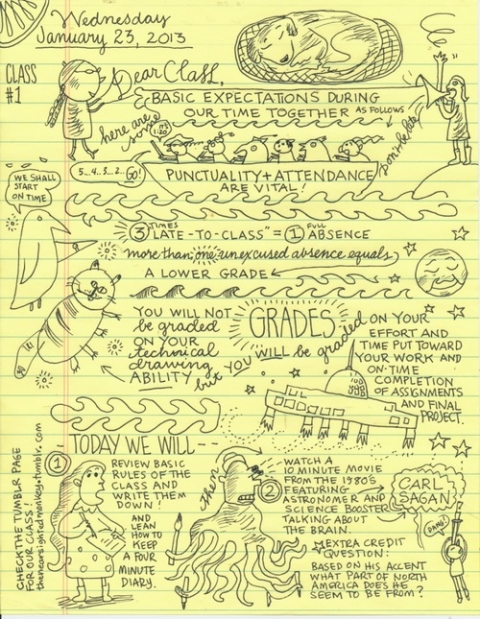
Cartoonist Lynda Barry, who has helped legions of adults grope their way back to the unselfconscious creativity of childhood, is teaching at the university level. Barry’s Unthinkable Mind course is designed to appeal to students of the humanities. Also hardcore science majors, the sort of lab-coated specimens the first group might refer to as “brains.” The instructor describes her University of Wisconsin spring semester offering thus:
A writing and picture-making class with focus on the basic physical structure of the brain with emphasis on hemispheric differences and a particular sort of insight and creative concentration that seems to come about when we are using our hands (the original digital devices) —to help us figure out a problem.
The twenty-one grads and undergrads accepted into Professor Barry’s course have been warned, via the illustrated letter above, handwritten on legal paper, that the workload will be heavy.

You should be warned as well, if you elect to audit this course from home. Enrollment is not necessary. Professor Barry will be posting her weekly assignments and curriculum materials on her tumblr, a forum where her abiding interest in science is as apparent as her devotion to undirected doodling. Your first assignment, posted above, requires a box of crayons, the coloring pages of your choice, downloaded to four types of paper, and a significant chunk of time set aside for brain-related articles and vintage videos starring Cognitive Neuroscientist Michael Gazzaniga and astronomer Carl Sagan. You should also be committed to keeping a four-minute diary and serving as your own guinea pig.
Who’s in?
A big H/T @kirstinbutler
Related Content
Cartoonist Kate Beaton Plays on Literary Classics — The Great Gatsby, Julius Caesar & More
Steven Pinker Explains the Neuroscience of Swearing (NSFW)
Carl Sagan’s Undergrad Reading List: From Plato and Shakespeare, to Huxley and Gide
- Ayun Halliday ‘s most recent book is Peanut.
Read More...Watch John Coltrane and His Great Quintet Play ‘My Favorite Things’ (1961)
Here’s something to get your week started on the right note: John Coltrane in 1961, playing his hypnotic, dervish-like modal arrangement of the popular Rodgers and Hammerstein song, “My Favorite Things.”
The performance was recorded by German public television in Baden-Baden on November 24, 1961–the same year as the release of Coltrane’s breakthrough solo album, also named My Favorite Things. The quintet includes Coltrane on soprano saxophone, Eric Dolphy on flute, McCoy Tyner on piano, Reggie Workman on bass and Elvin Jones on drums. You can see the complete TV broadcast, along with two others, in our November 21 post, “John Coltrane: Three Great European Performances, 1960, 1961 and 1965.”
If you would like to support the mission of Open Culture, consider making a donation to our site. It’s hard to rely 100% on ads, and your contributions will help us continue providing the best free cultural and educational materials to learners everywhere. You can contribute through PayPal, Patreon, and Venmo (@openculture). Thanks!
Related content:
John Coltrane’s ‘Giant Steps’ Animated
John Coltrane’s Naval Reserve Enlistment Mugshot (1945)
Charles Mingus Explains in His Grammy-Winning Essay “What is a Jazz Composer?”
Read More...The Time Neil Young Met Charles Manson, Liked His Music, and Tried to Score Him a Record Deal
Waging Heavy Peace — it’s not your average rock star biography. There’s not much sex and drugs. There’s some rock ’n’ roll. But mostly, there’s a lot of Neil Young being an ordinary guy, hanging out with family and friends, tinkering with toy trains, and refurbishing old cars. It’s a decidedly down-to-earth autobiography, so far as autobiographies go. But it’s not entirely devoid of fantastical stories. Like the time when, during the late 1960s, Young stopped by the Los Angeles home of Dennis Wilson, the drummer of The Beach Boys. There, Wilson was living with three or four girls who had an “intense vibe” and a “detached quality about them.” Young continues:
After a while, a guy showed up, picked up my guitar, and started playing a lot of songs on it. His name was Charlie. He was a friend of the girls and now of Dennis. His songs were off-the-cuff things he made up as he went along, and they were never the same twice in a row. Kind of like Dylan, but different because it was hard to glimpse a true message in them, but the songs were fascinating. He was quite good.
Young then adds:
I asked him if he had a recording contract. He told me he didn’t yet, but he wanted to make records. I told Mo Ostin at Reprise about him, and recommended that Reprise check him out.… Shortly afterward, the Sharon Tate-La Bianca murders happened, and Charlie Manson’s name was known around the world.
After the murders, Manson kind of got a record deal. His recordings were commercially released on the album Lie: The Love and Terror Cult. Above, we have one bizarrely upbeat song from the collection, “Home Is Where You’re Happy.”
Related Content:
Neil Young Reveals the New Killer Gadget That Will Save Music
Neil Young Busking in Glasgow, 1976: The Story Behind the Footage
‘The Needle and the Damage Done’: Neil Young Plays Two Songs on The Johnny Cash Show, 1971
Read More...Jack Kerouac’s Naval Reserve Enlistment Mugshot, 1943
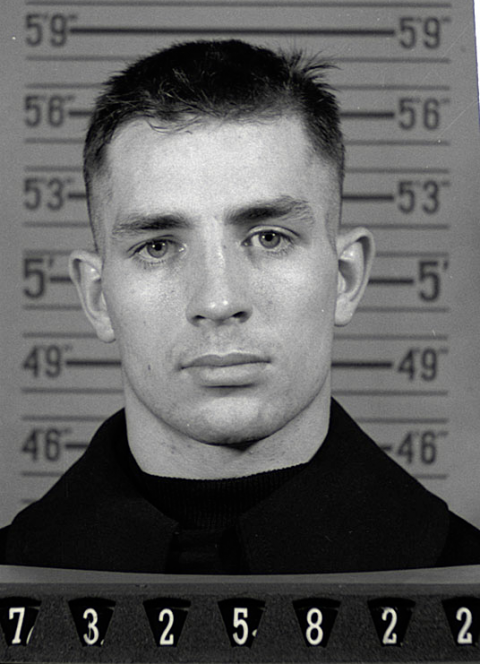
In the summer of 1942, Jack Kerouac followed in the footsteps of Joseph Conrad and Eugene O’Neill and went to sea. After dropping out of Columbia University the previous Fall, the 20-year-old Kerouac signed up for the merchant marine and shipped out aboard the U.S. Army Transport ship Dorchester.
Although World War II had broken out at about the time of his departure from Columbia, Kerouac’s motives for going to sea were more personal than patriotic. “My mother is very worried over my having joined the Merchant Marine,” Kerouac wrote in his journal at the time, “but I need money for college, I need adventure, of a sort (the real adventure of rotting wharves and seagulls, winey waters and ships, ports, cities, and faces & voices); and I want to study more of the earth, not out of books, but from direct experience.”
In October of 1942, after completing a voyage to and from an Army command base in Greenland (which he would later write about in Vanity of Duluoz), Kerouac left the merchant marine and returned to Columbia. That was lucky, because most of the Dorchester’s crew–more than 600 men–died three months later when the ship was torpedoed by a German U‑boat. But the restless Kerouac lasted only a month at Columbia before dropping out again and making plans to return to sea. In December of 1942 he enlisted in the U.S. Naval Reserve. He wanted to join the Naval Air Force, but failed an aptitude test. So on February 26, 1943 he was sent to the Naval Training Station in Newport, Rhode Island. That’s apparently when the photograph above was taken of the young Kerouac with his military haircut. It would have been right around the time of his 21st birthday.
Kerouac lasted only 10 days in boot camp. As Miriam Klieman writes at the National Archives, “The qualities that made On the Road a huge success and Kerouac a powerful storyteller, guide, and literary icon are the same ones that rendered him remarkably unsuitable for the military: independence, creativity, impulsivity, sensuality, and recklessness.” According to files released by the government in 2005, Naval doctors at Newport found Kerouac to be “restless, apathetic, seclusive” and determined that he was mentally unfit for service, writing that “neuropsychiatric examination disclosed auditory hallucinations, ideas of reference and suicide, and a rambling, grandiose, philosophical manner.” He was sent to the Naval Hospital in Bethesda Maryland and eventually discharged.
For more on Kerouac’s brief adventure in the Navy, read Kleiman’s Article, “Hit the Road, Jack! Kerouac Enlisted in the U.S. Navy But was Found ‘Unfit for Service’ ”
Related content:
Jack Kerouac Reads from On the Road, 1959
Jack Kerouac’s 30 Revelations for Writing Modern Prose
Read More...How “Space Oddity” Launched David Bowie to Stardom: Watch the Original Music Video From 1969
It may seem odd to contemplate, but rock titan David Bowie’s rise to fame was a long, frustrating, stop-and-start affair until he burst onto the international scene as Ziggy Stardust (though he had some success with his two prior albums, the excellent The Man Who Sold the World and Hunky Dory). This is partly due to poor management, and partly due to Bowie’s own difficulty in finding a style that fit his ambitions. His first hit, “Space Oddity,” from his second, 1969, album of the same name, promised great things. (That record, originally called, like his first, just David Bowie, was renamed after the song did the Seventies equivalent of viral.) Most people who grew up with Bowie would tell you the song is a watershed moment in their discovery of pop music’s potential. I recall discovering Bowie at a young age through “Space Oddity,” and being given the album on cassette as a birthday present. Like many people, I was a little flummoxed by the record. None of it resembles the single, which isn’t necessarily a bad quality in general, but in this case, it’s hard to know what to make of that strange collection of sometimes comic, Beatles-esque pop fragments (“Don’t Sit Down”), sometimes cool progressive rock (“Janine”), and sometimes almost medieval, Judy Collins-like hippy folk (“Memory of a Free Festival,” “Wild Eyed Boy from Freecloud”). I grew to love it, but the album’s eclecticism didn’t win many over.
Still, nearly everyone knows and loves the album version of “Space Oddity.” But like a great deal of Bowie’s early work, the song exists in an earlier, more tentative version. Initially recorded shortly after his first album, 1967’s David Bowie—which Bowie biographer David Buckley called “the vinyl equivalent of the madwoman in the attic”—the song ended up on an abortive promotional film commissioned by Bowie’s producer, Kenneth Pitt. Called Love You Till Tuesday, after the single from the first album, the film finished shooting in 1969, but didn’t see the light of day until 1984, long after Bowie hit it big.
The film version of “Space Oddity” (first video) differs significantly in sound and vision from the one right above. For one thing, Bowie, who wore a wig for the extent of filming because he’d shorn off his hair to audition for a role, looks decidedly less, well, like a rock star. As “Ground Control,” his Janis Joplin glasses clash oddly with an arty t‑shirt and what looks like a child’s baseball cap perched atop his wig, both emblazoned with “GC.” He stands cross-armed and awkward, lip synching between space sequences. Of the latter, “Major Tom” parts, one YouTube commenter quips, “We have no budget, no props, only baking foil and cornflake packets.… Oh well make the video anyway.” Sums things up pretty well.
Even more so than those who bought Space Oddity after hearing its namesake single, anyone who heard this early version, then went and bought Bowie’s first album would have been thoroughly perplexed. ‘67’s David Bowie is a very strange, though sometimes very intriguing, record, largely influenced by the musical comedy of popular English entertainer Anthony Newley. Watch the film’s title track (and opening sequence), “Love You Till Tuesday” below, with Bowie, in wig and frilly Austin Powers suit, doing some weird Tom Jones thing that just really doesn’t work.
Had Bowie followed this trajectory, instead of finding his voice in the spacerock of his first big single, it’s pretty likely no one would have heard from him again. Lucky for us, the young pop star was nothing if not persistent. And lucky for us, he still is. The 66-year-old Bowie just released his first single in a decade, the contemplative “Where Are We Now?” with an album, The Next Day, coming in March.
Related Content
The Story of Ziggy Stardust: How David Bowie Created the Character that Made Him Famous
David Bowie Celebrates 66th Birthday with First New Song in a Decade, Plus Vintage Videos
David Bowie’s First American Fan Letter And His Evolving Views of the U.S. (1967–1997)
Josh Jones is a freelance writer, editor, and musician based in Washington, DC. Follow him @jdmagness
Read More...Lovers and Philosophers — Jean-Paul Sartre & Simone de Beauvoir Together in 1967
Jean-Paul Sartre and Simone de Beauvoir. They were the intellectual power couple of the 20th century. Some have called Sartre the father of Existentialism. But perhaps it’s more accurate to call him the chief popularizer of the philosophical movement. And Simone de Beauvoir, she wrote The Second Sex, the sprawling 1949 tome that laid the intellectual foundation for second-wave feminism that exploded during the 1960s.
The two philosophers first became an item in October 1929, but it was never a traditional relationship. They neither married nor shared the same living quarters, and they famously had an open relationship. But, as de Beauvoir said, “The comradeship that welded our lives together made a superfluous mockery of any other bond we might have forged for ourselves.”
They were a powerful couple, writes Louis Menand in The New Yorker, “with independent lives, who met in cafés, where they wrote their books and saw their friends at separate tables… but who maintained a kind of soul marriage.” Whatever your personal views, you need to consider this: The relationship worked for Sartre and de Beauvoir for 50 years.
Despite their celebrity, we’ve rarely come across footage of the two philosophers together. So we’re bringing you this — a rare clip from a 1967 documentary filmed at Sartre’s Montparnasse high-rise apartment, overlooking the cemetery where the two philosophers were eventually buried. Somewhat fittingly, we see the two intellectuals, but never in the same frame. You can purchase the complete film for educational use here.
Related Content:
Jean-Paul Sartre Breaks Down the Bad Faith of Intellectuals
Jean-Paul Sartre Writes a Script for John Huston’s Film on Freud (1958)
Sartre, Heidegger, Nietzsche: Three Philosophers in Three Hours
Read More...Gimme Shelter: Watch the Classic Documentary of the Rolling Stones’ Disastrous Concert at Altamont
It’s often remembered as the day the Sixties died. On December 6, 1969, the Rolling Stones and a group of West Coast bands put on a free concert at the Altamont Raceway near San Francisco. The concert was billed as “Woodstock West,” but instead of being another gathering of peace, love and music, it was more like a bad trip.
The event was hastily put together by the Stones to celebrate the end of their American tour, their first with guitarist Mick Taylor. The stage at the venue was unusually low and was situated at the bottom of a hill. To keep the audience of 300,000 people from engulfing the stage, someone had the bright idea of enlisting the Hells Angels motorcycle gang to form a security cordon around the stage in exchange for (essentially) all the beer they could drink.
As the concert descended into chaos, the Hells Angels beat people with pool cues and motorcycle chains. A guitarist and singer for the Jefferson Airplane, Marty Balin, was knocked unconscious. When a man in the audience brandished a pistol during an altercation while the Stones were onstage, he was stabbed and beaten to death by members of the gang.
The whole sorry episode is captured in Gimme Shelter, the classic documentary by the brothers Albert and David Maysles and Charlotte Zwerin. The film was released in 1970 and can be seen above in its entirety. Gimme Shelter contains elements of a typical rock and roll documentary, with footage of the Stones on the road and playing a concert at Madison Square Garden in New York. But the main focus is Altamont. The Maysles brothers hired a large team of cameramen for the event, including filmmaker Robert Elfstrom, Magnum photographer Elliott Erwitt and a young George Lucas.
Gimme Shelter is a fascinating record of the Sixties counterculture as it was falling apart. The last third of the picture is painful to watch but difficult to turn away from. The hubris and naiveté of the time are captured in a scene before the event, when Mick Jagger tells a group of reporters what Altamont is all about: “It’s creating a sort of microcosmic society, which sets an example to the rest of America as to how one can behave in large gatherings.”
Related Content
The Rolling Stones Jam With Their Idol, Muddy Waters
The Rolling Stones at 50: Mick, Keith, Charlie & Ronnie Revisit Their Favorite Songs
Read More...Support Us
We're hoping to rely on loyal readers, rather than erratic ads. Please click the Donate button and support Open Culture. You can use Paypal, Venmo, Patreon, even Crypto! We thank you!

About Us

Open Culture scours the web for the best educational media. We find the free courses and audio books you need, the language lessons & educational videos you want, and plenty of enlightenment in between.
Advertise With Us

FREE UPDATES!
GET OUR DAILY EMAIL
Get the best cultural and educational resources on the web curated for you in a daily email. We never spam. Unsubscribe at any time.
FOLLOW ON SOCIAL MEDIA

Open Culture editor Dan Colman scours the web for the best educational media. He finds the free courses and audio books you need, the language lessons & movies you want, and plenty of enlightenment in between.
Advertise With Us

