Gift Giving Traditions Around the World in a Handy Infographic

This interactive map from Cloud 9 Living offers some potentially helpful tidbits on gift giving traditions around the world. For example, if you’re thinking of giving a clock as a gift in China, think again. It’s considered bad luck. Or, if you head to Russia, remember to give bouquets with an uneven number of flowers. Even-flowered bouquets are for funerals. And, when in Sweden, you can’t go wrong with a bottle of liquor. Click through to see the infographic in larger format.
Read More...David Bowie’s First American Fan Letter And His Evolving Views of the U.S. (1967–1997)
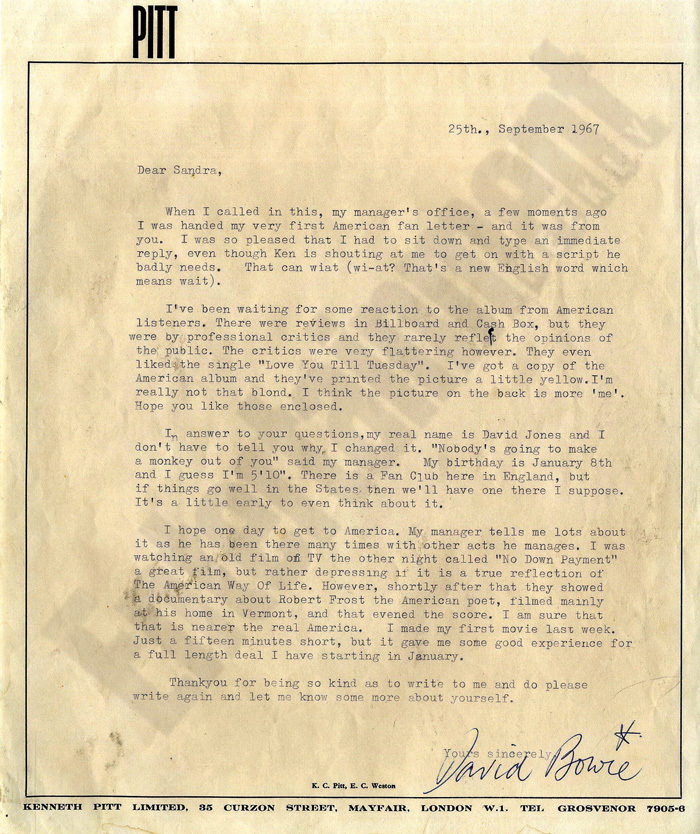
David Bowie’s relationship with America has typified the outsider’s view: an ambivalence ranging from fascination to fear that he expressed in a reply to his first letter from a U.S. fan in 1967 (click to read in large format). The fan, intrepid 14-year-old Sandra Dodd, had gotten her hands on an advance copy of Bowie’s first album and written him to praise his work and offer to start a fan club for him stateside. Bowie’s response is very interesting. We’ve written before about his rise from obscure R&B and folk singer to Ziggy Stardust, which required him to shake off a natural shyness to inhabit his breakout persona. In the letter, the 20-year-old Bowie initially comes off as a naïve, slightly self-involved young pop singer. Then, after answering the usual fan queries—what’s his real name, birthday, height—he turns to the subject of the U.S., a country he had yet to visit. Bowie writes:
I hope one day to get to America. My manager tells me lots about it as he has been there many times with other acts he manages. I was watching an old film on TV the other night called “No Down Payment” a great film, but rather depressing if it is a true reflection of The American Way Of Life. However, shortly after that they showed a documentary about Robert Frost the American poet, filmed mainly at his home in Vermont, and that evened the score. I am sure that that is nearer the real America.
Drawing his impressions from movies, Bowie references two views. The first, Martin Ritt’s 1957 No Down Payment, is full of the banality and melodrama we’ve come to expect from Mad Men, making incisive critiques of mid-50s cultural problems simmering under the surface of the suburbs like alcoholism, racism, and infidelity. As one fan writes, the film depicted what “no one wanted to see… a soiled American Dream,” or what Bowie capitalizes as “The American Way Of Life.”
The other view Bowie takes of the States comes from a film on Robert Frost—most likely 1963’s Robert Frost: A Lover’s Quarrel With the World. Little wonder this film “evened the score” for the lyrical young songwriter, who chooses in his letter to believe it represents the “real America,” a sentiment he would not hold for long.
Flash forward to 1984, and Bowie is an international pop star. Most fans would argue his best work was far behind him, but the 80s saw him break out into more mainstream film roles in The Elephant Man and Labyrinth that kept him at the forefront of American pop culture. His soundtrack work was memorable as well, although the track below “This is Not America,” written with Pat Metheny for The Falcon and the Snowman doesn’t get much attention these days. Bowie’s impressionistic lyrics–which Metheny called “profound and meaningful”–show him in mourning for the country that puzzled his younger self:
A little piece of you
The little peace in me
Will die
For this is not America
Blossom fails to bloom
This season
Promise not to stare
Too long
For this is not a miracle
And again, move forward to 1997, thirty years after Bowie’s letter above, and we find him in a jaundiced mood in “I’m Afraid of Americans” from his album Earthling (the song originally appeared on what may be one of the most cynical films ever made, Showgirls). Bowie explained the genesis of the song in a press release:
I’m Afraid of Americans’ was written by myself and Eno. It’s not as truly hostile about Americans as say “Born in the USA”: it’s merely sardonic. I was traveling in Java when the first McDonalds went up: it was like, “for fuck’s sake.” The invasion by any homogenized culture is so depressing, the erection of another Disney World in, say, Umbria, Italy, more so. It strangles the indigenous culture and narrows expression of life.
The cultural homogenization that so depressed the young Bowie in No Down Payment is now a global phenomenon, and the well-traveled, worldly Bowie seems to harbor few illusions when he sings:
Johnny’s in America
No tricks at the wheel
No one needs anyone
They don’t even just pretend
In the award-winning video, Trent Reznor plays a Travis Bickle-like figure, a menacing creature of alienation and unprovoked, random violence and Bowie a paranoid outsider running from what he perceives as citizens attacking each other on every streetcorner. Stripped of the 50s veneer, it’s a country where people “don’t even pretend”; the violence and misanthropy are now on full display. It’s a view of America that hasn’t dimmed since the mid-nineties. It’s simply moved out of the city and spilled out into the once self-contained suburbs. These three artifacts show Bowie’s evolution in relation to a country that he hoped to find the best in, that nearly always embraced him, and that came to freak him out and piss him off in later years.
via Letters of Note
Josh Jones is a writer and scholar currently completing a dissertation on landscape, literature, and labor.
Read More...Introducing KA Lite: An Offline Version of the Khan Academy That Runs on Almost Anything

Salman Khan’s model for free online education hinges on the micro lecture—brief tutorials on nearly every subject under the sun—delivered through YouTube. Launched in 2006, the Khan Academy now has a library of 3000 videos. That’s not bad, especially for a site with the elevated goal of providing a “free world-class education for anyone anywhere.” With the help of hundreds of volunteers, the site’s content is accessible in 18 languages. But even with all of that effort, Khan doesn’t achieve the global reach that it promises. The fact is that only 35 percent of the world’s population has access to the internet, which puts the idea of online learning behind a virtual firewall for many people.
Enter Khan Academy Lite, otherwise called KA Lite. This new service tries to work around that firewall. Software developer Jamie Alexandre and a team from UCSD developed an offline version of Khan’s learning model that can run on just about anything. Once you download the KA Lite software and install it on a Linux or Windows server, students can start watching Khan videos and exercises on computers/devices as tiny and cheap as the $35 Raspberry Pi. Actually, the whole server can be run on the Raspberry Pi!
You can download the software here and find installation instructions here. Jamie Alexandre offers his own introduction to KA Lite here.
Khan Academy Lite sits nicely alongside the free apps released for the iPhone, iPad, and iPod Touch earlier this year. Be sure to check them out.
Find more K‑12 Resources in our collection of 200 Free Kids Educational Resources: Video Lessons, Apps, Books, Websites & More
Kate Rix writes about digital media and education. Read more of her work at and thenifty.blogspot.com.
Read More...Neil deGrasse Tyson Offers Advice on How to Be Yourself and Achieve Your Own Greatness
Whatever else it is—mordant self-mockery, summation of a life’s work in thought—Friedrich Nietzsche’s last published book, Ecce Homo: How One Becomes What One Is, is a profoundly Romantic text, operating on the premise that an individual who suffers for philosophy, for art, for truth, is heroic, even (or especially) when anti-heroic, brooding, Byronic. Nietzsche states one of the purposes of his strange little book as an imprecation: Hear me! For I am such and such. Above all, do not mistake me for someone else!
Over a century after this work’s publication, a cry of pop culture with its love of simulacra might be: Please mistake me for someone else, especially someone wealthy and famous and prettier than I am! Maybe this ethos reached its zenith with Facebook’s celebrity look-alike day, which inspired a site called myheritage.com to use face recognition technology for users who didn’t look enough like anyone famous to figure out for themselves who they wanted to be. Silly harmless trend, yes, but a little sad too, since it shows how many people suffer from a sense that their identities are dwarfed into insignificance by a famous stranger who slightly resembles them. (Another, more humorous meme, goes something like “Always be yourself, unless you can be Batman. Always be Batman”).
I offer these pop-sociological ruminations as context for the great Neil deGrasse Tyson’s response above to a question he receives quite a bit: “What can I do to be you?” On the one hand, it must be very flattering to be asked this question, even though Tyson seems a pretty modest person. On the other hand, the question is pathetic, I believe, for the reasons I sketched out above. Why be Neil deGrasse Tyson when you can be yourself? Unless you don’t believe you’re worth becoming. Tyson’s answer is also Romantic; he says, “I think the greatest of people in society carve niches that represent a unique expression of their combination of talents.” For Tyson that has meant taking a set of academic and career accomplishments and using them as a platform for expressing a combination of talents that only he has, which is to say that no one can be Neil deGrasse Tyson but Neil deGrasse Tyson. He uses the example of Michael Jordan, who honed his superior talent from natural abilities, for sure, but who also created his own category through a talent for being himself, a combination of personal style, winning personality, leadership qualities, etc.
So what are we to conclude from this? Always be yourself, unless you can be Michael Jordan? Well, I think the gist of Tyson’s short talk is that there is no default or template for what you can become, or as he puts it, “what I do day-to-day is not the fulfillment of some pre-existing job description.” And while “just be yourself” may sound like trite advice to people struggling to find an identity, Tyson sets it out as a task, not a fait accompli. “The task,” he says, “is to find the unique combination of facts that apply to you. Then people will beat a path to your door.” It’s not a task to take on lightly, or in Nietzsche’s hyperbolic words, it is “the heaviest demand ever put on mankind.”
The video above is an excerpt from a longer interview Neil deGrasse Tyson did for Big Think. The full interview is available here.
Josh Jones is a writer and scholar currently completing a dissertation on land, literature, and labor.
Read More...PBS Short Video “Bad Behavior Online” Takes on the Phenomenon of Cyberbullying
Internet trolls are very touchy people. Sometimes their rage is targeted at public figures, institutions, or groups who do and say horrible things (the Westboro Baptist Church comes to mind). More often, the phenomenon of “trolling” is a free-for-all of absurdist online pranks or verbal abuse directed at anyone and everyone. And far too often, online abuse is specifically directed at vulnerable people or victims of tragedy. But, as you’ll see from the comments on the above video from PBS’s Offbook series (if you care to peruse them) almost nothing makes the internet angrier than discussions of trolling itself, since so many people see these conversations as preludes to censorship or nannyish and unconstitutional regulation.
The researchers in the above video don’t, however, make any recommendations for curbing speech. Whitney Phillips, a lecturer at New York University, allows for the potential of trolling to open up dialogues that would otherwise be smothered by taboos. Harvard University’s Andy Sellars makes an important distinction between public speech regulated by the government and that restricted by private entities, like online service providers—an important legal distinction in first amendment cases (he cites the recent fracas over the inflammatory “Innocence of Muslims” video). Sellars points out that, at the moment, the authority for regulating online speech rests with corporations (who, unfortunately, do bow to government pressure, especially abroad). Attempts to regulate the internet by the government have been ham-handed, unpopular, and mostly driven by the profit-motives of the recording and film industries, and Sellars doesn’t address them.
Some attempts at legislation have specifically targeted the cherished culture of online anonymity in order to deal with the ugly phenomenon of cyberbullying. Sellars defends the importance of anonymity, saying it protects victims of real world abuse and oppression from being identified and targeted if they speak out on safe spaces on the internet. Unfortunately, anonymity can also enable what Fordham’s Alice Marwick calls the “online disinhibition effect,” a psychological term for the freedom trolls feel to say abusive things online that they would never say in person.
Marwick discusses this effect in the context of what she calls “aggressive speech acts” but allows that the prevalence of bullying on Facebook, which ties online identities to real names and faces, acts as a counter-example to the theory that anonymity is solely responsible for online abuse. She frames her research as taking a look at our cultural values and “seeing how those play out in technical spaces” and points out that an exclusive focus on cyberbullying ignores the range of other, offline behaviors generally present in—most disturbingly—cases of suicide following online bullying. While the advocacy group Cyberbullying Research Center has adopted the term “cyberbullicide,” defined as “suicide indirectly or directly influenced by experiences with online aggression,” and offers policy suggestions to deal with the problem, Marwick is more circumspect. She calls these cases “complicated” and says that they don’t warrant restricting content but instead improving responses to kids who need help.
Complicated is precisely the word for the tangle of issues relating to internet speech. After watching the balanced, if cursory, discussion above, however, I found the responses of the trolls baffling and lacking all proportion, since no one in the video calls for legislation to limit online speech. But that’s instructive. Trolling is a pervasive hum surrounding almost all popular online content. Sometimes it’s politically pointed, sometimes it’s clever or surreally funny, sometimes it’s just low-level noise, and sometimes it’s a kind of rage-filled adolescent viciousness that is genuinely unsettling and hard to understand.
Josh Jones is a doctoral candidate in English at Fordham University and a co-founder and former managing editor of Guernica / A Magazine of Arts and Politics.
Read More...Watch 125 Korean Feature Films Free Online, Thanks to the Korean Film Archive
If you’ve kept up even casually international viewing habits over the past fifteen years, you’ve watched a Korean movie or two. Maybe you’ve enjoyed the unusual tonal mixture of Bong Joon-ho’s political satire/monster extravaganza The Host, the elaborate grotesqueness of Park Chan-wook’s revenge thriller Oldboy, or the slick Hollywood pastiche of Kang Je-gyu’s North-versus-South heap of spy-versus-spy action Shiri. But look just beyond those high-profile international Korean blockbusters and you’ll find the most vibrant, adventurous cinematic culture active today.
Upon discovering it, I personally got excited enough to move to a Korean neighborhood, study the Korean language, and dig deep for knowledge about the Korean filmmakers whose names even cinephiles rarely bring up outside Asia. You’ll find it rather easier to immerse yourself, now that the Korean Film Archive has come to Youtube. (NOTE: To activate English subtitles, make sure to hit the “CC” button on the lower right of the player.)
The Archive has uploaded many a notable film, including Im Kwon-taek’s Sopyonje, which surprised the country by both rekindling interest in the traditional music of pansori and by breaking box-office records despite playing on only three screens. The Korean Film Archive offers three more films by Im, one of Korean cinema’s most respected elder statesmen, and nine other films from the nineties. You can also watch selections from the eighties, seventies, sixties, fifties and forties, as well as several from other Korean auteurs like the transgressive Kim Ki-young and the prolific Shin Sang-ok. It particularly thrilled me to find The Day the Pig Fell Into a Well, the very first picture from Hong Sangsoo, a director acclaimed by critics worldwide as a comedic formal experimenter, in essence Korea’s Woody Allen. If you don’t know quite what to feel thrilled by here, read Korean film specialist Darcy Paquet’s “Short History of Korean Film,” then listen to my interview with him about his book Korean Cinema: Breaking the Waves. If you love film, you’ll certainly find films to love from Korea.
According to Google, which helped put the collection on YouTube, there are some other highlights you won’t want to miss. They include A Hometown in Heart, made in the early years of Korean Independence, and also A Coachman, the first Korean film to win awards internationally. Many other titles like Aimless Bullet and The Barefooted Young are available in HD.
The films mentioned above will be listed in our collection, 4,000+ Free Movies Online: Great Classics, Indies, Noir, Westerns, Documentaries & More.
Colin Marshall hosts and produces Notebook on Cities and Culture and writes essays on literature, film, cities, Asia, and aesthetics. Follow him on Twitter at @colinmarshall.
Read More...Donald Duck’s Bad Nazi Dream and Four Other Disney Propaganda Cartoons from World War II
During World War II, all hands were on deck, even in Hollywood. Many of America and Britain’s finest filmmakers, from Hitchcock to Frank Capra, were recruited to create propaganda films to support the war effort. And the same went for Walt Disney, who turned his lovable cartoon characters into good patriots.
In 1942, Disney released “Der Fuehrer’s Face,” an anti-Nazi propaganda movie that bolstered support for the war, and eventually won the Academy Award for Best Animated Short Film. Then, a year later, came The Spirit of ’43, which features Donald Duck helping Americans to understand why they need to pay their taxes. Other wartime Disney shorts include Donald Gets Drafted (1942), The Old Army Game (1943), and Commando Duck (1944). They all appear below.
The Spirit of ’43
Donald Gets Drafted
The Old Army Game
Commando Duck
Note: Der Fuehrer’s Face and The Spirit of ’43 appear in the Animation section of our collection of Free Movies Online.
Related Content:
The Story Of Menstruation: Walt Disney’s Sex Ed Film from 1946
How Disney Cartoons Are Made
Disney’s Oscar-Winning Adventures in Music
Read More...A Year of Grateful Dead Tunes Up in a Mashup
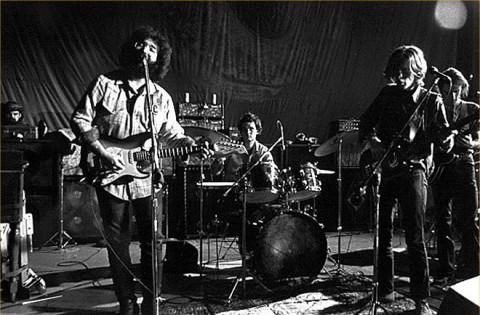
Eventually someone had to do it.
Michael David Murphy created Tuning ’77, a “seamless audio supercut of an entire year of the Grateful Dead tuning their instruments, live on stage.” The mix uses every publicly available recording from 1977, and it’s really all a prelude to this: 8,976 Free Grateful Dead Concert Recordings in the Internet Archive. You can listen to Tuning ’77 here or below. It runs 92 minutes.
via BoingBoing
Read More...James Brown Brings Down the House at the Paris Olympia, 1971
Here’s an amazing film that captures the excitement and raw energy of James Brown in his prime.
The footage was taken on March 8, 1971, during a series of concerts Brown and his band gave at the Olympia theater in Paris. It offers a rare glimpse of the original lineup of the J.B.‘s, the group Brown formed in 1970, about two years after the breakup of the Famous Flames.
The lineup includes William “Bootsy” Collins on bass and his older brother Phelps “Catfish” Collins on lead guitar, both of whom would leave the band a few months later. Famous Flames founder Bobby Byrd, who essentially discovered Brown in 1952, serves as organist, backup singer and master of ceremonies. The rest of the band are: Hearlon “Cheese” Martin on guitar, St. Clair Pinckney on tenor saxophone, Darryl “Hasaan” Jamison and Clayton “Chicken” Gunnells on trumpet, Fred Wesley on trombone, and John “Jabo” Starks and Don Juan “Tiger” Martin on drums.
The film was apparently shot during one performance, even though Brown is introduced twice and wears different clothing. According to reports, Brown took a break between “Sunny” and “It’s a New Day” while Byrd’s wife, Vicki Anderson, sang two songs that were cut from the film. Audio from the concert was released in 1992 as Love Power Peace: Live at the Olympia, Paris 1971. Here’s the set list from the film version, which differs slightly from the LP:
- Introduction
- Brother Rapp
- Ain’t It Funky Now
- Georgia On My Mind
- Sunny
- It’s a New Day
- Bewildered
- Get Up (I Feel Like Being A) Sex Machine
- Try Me
- Papa’s Got A Brand New Bag/I Got You (I Feel Good)/I Got the Feelin’ (medley)
- Give It Up or Turn It a Loose
- It’s a Man’s Man’s Man’s World
- Please, Please, Please
- Get Up (I Feel Like Being A) Sex Machine (reprise)
- Super Bad
- Get Up, Get Into It, Get Involved
- Soul Power
- Get Up, Get Into It, Get Involved (finale)
h/t Ryan Jetten
Related content:
Classic Ray Charles Performance: ‘What’d I Say’ Live in Paris, 1968
The Queen of Soul Conquers Europe: Aretha Franklin in Amsterdam, 1968
Read More...Eraserhead Stories: David Lynch on the Making of His Famously Nightmarish Movie
Not only does the documentary Eraserhead Stories offer as much information as you’ll find anywhere on the making of David Lynch’s first feature film, it has a few Lynchian qualities of its own. For almost an hour and a half, David Lynch sits down behind a microphone and reminisces about the six years his ragtag team spent putting the movie together. But he does it in black-and-white, in front of a curtain, smoking, like something out of an early-1950s television broadcast. The ambient dull roar of an ill wind appears, intermittently and inexplicably, on the soundtrack. Photographs flash by, supporting some of Lynch’s inspiring, arduous, and bizarre recollections. Many of his stories deal with the nuts and bolts of bringing one’s financially impoverished but creatively overflowing early movies into reality. Others involve tubs filled with milk, sets covered in peas, dead cats impregnated with tar, and the ghost of oil tycoon Edward L. Doheny.
Lynch’s fans, and even his detractors — perhaps especially his detractors — will tell you that his films could have come from the mind of no other director. But Eraserhead Stories gives you a clear idea about the kind of dedicated, familial production atmosphere it takes to get an idea successfully out of Lynch’s brain and onto celluloid. On Eraserhead’s intermittently active, often-moving shoot, everyone had to work several jobs: Lynch chucklingly remembers troweling a great deal of plaster alongside star Jack Nance, and he gives collaborator Catherine Coulson a call to talk about all the myriad tasks she handled. Though the unusual visual, aural, and narrative requirements of Eraserhead meant nobody had any easy work, Lynch and his team managed to finish the picture and live every creative filmmaker’s dream: to make a movie which doesn’t compromise, which no viewer forgets, and toward which nobody feels neutral. H/T Biblioklept
Related content:
What David Lynch Can Do With a 100-Year-Old Camera and 52 Seconds of Film
David Lynch’s New ‘Crazy Clown Time’ Video: Intense Psychotic Backyard Craziness (NSFW)
David Lynch’s Surreal Commercials
David Lynch and Interpol Team Up on Short Film
Colin Marshall hosts and produces Notebook on Cities and Culture. Follow him on Twitter at @colinmarshall.
Read More...Support Us
We're hoping to rely on loyal readers, rather than erratic ads. Please click the Donate button and support Open Culture. You can use Paypal, Venmo, Patreon, even Crypto! We thank you!

About Us

Open Culture scours the web for the best educational media. We find the free courses and audio books you need, the language lessons & educational videos you want, and plenty of enlightenment in between.
Advertise With Us

FREE UPDATES!
GET OUR DAILY EMAIL
Get the best cultural and educational resources on the web curated for you in a daily email. We never spam. Unsubscribe at any time.
FOLLOW ON SOCIAL MEDIA

Open Culture editor Dan Colman scours the web for the best educational media. He finds the free courses and audio books you need, the language lessons & movies you want, and plenty of enlightenment in between.
Advertise With Us

