Bob Dylan Shares a Drug-Hazed Taxi Ride with John Lennon (1966)
D.A. Pennebaker’s cinéma vérité documentary Dont Look Back [sic] followed Bob Dylan on his celebrated 1965 tour through England, letting viewers see what happened along the way — the good, the bad and everything between. Today, it’s considered both a classic documentary and a pop-cultural artifact, something Dylan fans can’t afford to miss.
The same can’t be said for Eat the Document, Pennebaker’s follow-up documentary that captured Dylan’s return to the UK in 1966. The premise had promise. Bob Dylan had just gone electric and boos followed him wherever he went. In Manchester, they famously called him “Judas.” That could have made for an intriguing film. But, according to Dylan’s most recent biographer Daniel Mark Epstein, the singer-songwriter was personally unraveling. He had toured to the point of exhaustion, and taken far too many amphetamines. During one moment filmed by Pennebaker, Dylan shared an incoherent taxi ride with John Lennon. Their rambling conversation touched on Johnny Cash, The Mamas & the Papas, Dylan’s homesickness, and how the Thames River supposedly saved Britain from Hitler. And, once we get 20 minutes into the footage, we find Dylan slumped forward in the backseat, seemingly staving off nausea.
Dylan personally edited the film and gave ABC television the option to air it. The network declined, saying it wouldn’t be comprehensible to a mainstream audience. Because the film was never released, it has been passed around in various bootlegged versions. You can watch a 52-minute version on DylanTube.
As a quick footnote, it’s worth mentioning that, according to Epstein’s biography, Lennon later told Rolling Stone magazine that he and Dylan were doing “junk” (aka heroin) that day, and that Lennon thought Dylan was close to OD’ing. It’s all discussed in The Ballad of Bob Dylan: A Portrait.
Related Content:
The 1969 Bob Dylan-Johnny Cash Sessions: Twelve Rare Recordings
Bob Dylan and The Grateful Dead Rehearse Together in Summer 1987. Listen to 74 Tracks.
John Lennon’s Victorian Circus Poster Lovingly Remade by Artists and Engravers
Read More...Jean-Paul Sartre Writes a Script for John Huston’s Film on Freud (1958)
In 1958, legendary director John Huston decided to make a film about the life of Sigmund Freud. Having met Jean-Paul Sarte in 1952 during the filming of Moulin Rouge, Huston felt the philosopher would be the ideal person to script the Freud film, since Sartre knew Freud’s work so well and since Huston surmised that he would have “an objective and logical approach.” Despite Sartre’s obvious talents, this still seems like an odd choice on its face, given the specific demands of screenwriting versus philosophical or literary work. But Sartre had some experience writing for the screen by that time—like most literary screenwriters, he’d mostly done it for the money and disavowed most of this work in hindsight–and he loved the movies and respected Huston. The director and the existentialist philosopher also had very similar views of their biographical subject:
Ironically both Sartre and Huston considered themselves anti-Freud for largely the same reason: Sartre because as a Communist he believed the role of the psychoanalyst was limited and of little social importance. For his part Huston felt that psychoanalysis was an indulgence for bored house wives and the problem children of the rich while the “movers and shakers”’ were too busy for it and those that most needed it couldn’t afford it.
Huston and Sartre’s treatment of Freud promised to be critical, but the partnership soon soured due to Sartre’s inability to keep his script at feature length. First, he delivered a modest 95-page treatment. This, however, became a 300-page draft in 1959 that Huston calculated would produce an unacceptable five-hour-long film (see an image from Sartre’s draft screenplay below, and click it to read it in a larger format).

When Huston and Sartre met in person in Galway to find a way to cut the screenplay down to a reasonable length, their working relationship was less than cordial. In Huston’s recollection, Sartre never stopped talking long enough for anyone else to get a word in. The director also remembered that Sartre was “as ugly as a human being can be.” Sartre’s remembrance is hardly more flattering of Huston, if somewhat more comic; he described the director in a letter to his wife Simone de Beauvoir as a pretentious, thoughtless character.…
…in moments of childish vanity, when he puts on a red dinner jacket or rides a horse (not very well) or counts his paintings or tells workmen what to do. Impossible to hold his attention five minutes: he can no longer work, he runs away from thinking.
After their Galway meeting, during which Huston tried and failed to hypnotize Sartre, the philosopher attempted another revision, but this time, he sent Huston an even longer draft, for an eight-hour film. At this point, Huston gave up on Sartre and salvaged what he could, eventually enlisting the help of German screenwriter Wolfgang Reinhardt to finish the script. Huston finally made his Freud film, released in 1962 as Freud: The Secret Passion, with Montgomery Clift as the doctor (see the trailer for the film above).
Unsurprisingly, Sartre had his name removed from the final film. For a fuller account of the meeting of Huston and Sartre, see the second chapter of Elizabeth Roudinesco’s Philosophy in Turbulent Times, where you’ll find other fascinating details like Sartre’s desire to cast Marilyn Monroe as Anna O and Huston’s bemusement at Sartre’s dental hygiene.
Josh Jones is a doctoral candidate in English at Fordham University and a co-founder and former managing editor of Guernica / A Magazine of Arts and Politics.
Read More...
Bowling for Columbine: It’s Online and 10 Years Later the School Massacres Continue. Have You Had Enough?!
http://youtu.be/9jGtAcDefHg?t=50s
In April 1999, Eric Harris and Dylan Klebold murdered 12 students and one teacher in Columbine, Colorado, while injuring 21 others. Michael Moore documented the tragedy in his 2002 film, Bowling for Columbine, which sits on YouTube, available for everyone to see. It’s heartbreaking to think that a decade later, students are no safer at their schools. If anything, gun control has slackened during the intervening years (thanks partly to the Supreme Court) and mass murders have become more commonplace, if not a monthly occurrence. 12 were killed and 52 injured in Aurora, CO in July. 10 killed in a Sikh temple shooting in Wisconsin this August. Five gunned down at Accent Signage Systems in Minnesota in October. Two shot dead at a mall in Portland, Oregon earlier this week. And now 20 youngsters and seven adults killed at an elementary school today in Connecticut.
We’ve reached the point where it has become an exceptional American pathology. Indeed, we’ve had 27 mass murders since Columbine, with the worst two taking place in schools — Virginia Tech and Sandy Hook Elementary. We also have exponentially more gun-related deaths than any other country in the developed world. I sincerely hope this isn’t another instance where we breathlessly express outrage for a week, then turn back to the Kardashians, until the next shooting happens in February at best. Public spaces should be safe, schools all the more so. It’s time for the apathy and the fear of lobbies to end, and for our leaders to finally lead. What might a practical action plan look like? Let’s turn to Nicholas Kristof’s plan outlined in The New York Times. You can also donate to the Brady Campaign to Prevent Gun Violence.
Below, I have posted President Obama’s moving speech made last night in Newtown, CT. It worth watching and reflecting on.
Read More...
What Makes Us Tick? Free Stanford Biology Course by Robert Sapolsky Offers Answers
First thing you need to know: Before doing anything else, you should simply click “play” and start watching the video above. It doesn’t take long for Robert Sapolsky, one of Stanford’s finest teachers, to pull you right into his course. Better to watch him than listen to me.
Second thing to know: Sapolsky is a MacArthur Fellow, a world renowned neurobiologist, and an adept science writer best known for his book, Why Zebras Don’t Get Ulcers. Much of his research focuses on the interplay between the mind and body (how biology affects the mind, and the mind, the body), and that relationship lies at the heart of this course called “Human Behavioral Biology.”
Now the third: Human Behavioral Biology is available on YouTube and iTunes for free. The course, consisting of 25 videos spanning 36 hours, is otherwise listed in the Biology section of our big list of Free Online Courses (now 575 courses in total).
Ok, stop reading and just watch.…
Related Content:
Robert Sapolsky Breaks Down Depression
Dopamine Jackpot! Robert Sapolsky on the Science of Pleasure
Read More...National Geographic Gives Us Intimate Moments with a Leopard Seal
Too bad there are no leopard seals on National Geographic’s payroll. Photographer Paul Nicklen’s intimate portraits of the one who took particular interest in him on a recent Antarctic expedition are delightful. Imagine how great it would be to have some reverse angle reaction shots of Nicklen as his new friend attempts to serve him a succession of live, dead, and mutilated penguins.
He may have turned up his nose at his subject’s cuisine, but Nicklen brings something else to the table, namely four days’ worth of up close and personal shots of an animal doing something other than going about its business. Without anthropomorphizing its intentions over much, this creature went out of its way to acclimate its strange guest to his new surroundings, sticking around when lesser hosts would have abandoned him alongside the buffet. Pretty cool when you consider that Nicklen’s entire head could — and briefly did — fit inside its massive, sharp fanged jaws.
Related Content:
Mariachi Band Serenades Beluga Whale at Mystic Aquarium
The Wild Kingdom: Brought to You by Mutual of Omaha (It’s on YouTube)
Filming a Sprinting Cheetah at 1,200 Frames Per Second
- Ayun Halliday’s encounters with species other than her own are a feature of her memoir, No Touch Monkey! And Other Travel Lessons Learned Too Late
Read More...Miles Davis and His ‘Second Great Quintet,’ Filmed Live in Europe, 1967
In the mid 1960s Miles Davis responded to the form-breaking influence of free jazz by surrounding himself with a group of brilliant young musicians and encouraging them to push him in new directions.
The group was Davis’s last with all acoustic instruments, and came to be known as his “second great quintet.” It featured Davis on trumpet, Wayne Shorter on saxophone, Herbie Hancock on piano, Ron Carter on bass and Tony Williams on drums. Between 1964 and 1968 the quintet recorded a string of innovative albums, including E.S.P., Sorcerer and the transitional Miles in the Sky, in which Hancock introduces the electric Fender Rhodes piano.
For Guardian jazz critic John Fordham, the second great quintet was Davis’s best group ever. “Their solos were fresh and original, and their individual styles fused with a spontaneous fluency that was simply astonishing,” writes Fordham in a 2010 article. “The quintet’s method came to be dubbed ‘time, no changes’ because of their emphasis on strong rhythmic grooves without the dictatorial patterns of song-form chords. At times they veered close to free-improvisation, but the pieces were as thrilling and hypnotically sensuous as anything the band’s open-minded leader had recorded before.”
You can hear for yourself in these two concerts, shown back-to-back, recorded for television during the quintet’s 1967 tour of Europe. The first concert was recorded on October 31, 1967 at the Konserthuset in Stockholm, Sweden. Here’s the set list:
- Agitation (Miles Davis)
- Footprints (Wayne Shorter)
- ‘Round Midnight (Thelonius Monk)
- Gingerbread Boy (Jimmy Heath)
- Theme (Miles Davis)
The next concert was recorded one week later, on November 7, 1967, at the Stadhalle in Karlsruhe, Germany:
- Agitation (Miles Davis)
- Footprints (Wayne Shorter)
- I Fall in Love Too Easily (Sammy Cahn/Jule Styne)
- Walkin’ (Richard Carpenter)
- Gingerbread Boy (Jimmy Heath)
- Theme (Miles Davis)
Related content:
The Miles Davis Story, the Definitive Film Biography of a Jazz Legend
‘The Sound of Miles Davis’: Classic 1959 Performance with John Coltrane
Mashup Duet: Miles Davis Improvising on LCD Soundsystem
Read More...Chowda!: Three Centuries of Recipes Reveal the Rise of New England’s Finest Culinary Export
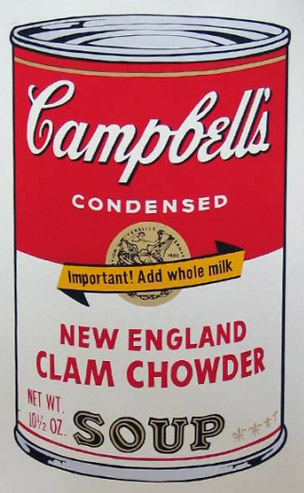
Say chowder out loud: chowder. The word sounds like food. Not an appetizer either. An entree in a small crock topped with broken crackers.
As with so many things related to food, chowder is a storied dish. It hails from New England and northeastern Canada, its first written reference dating back to 1732 when a journalist recalls dining on a “fine chowdered cod.”
There are as many types of chowder as there are soup, though a true chowder is more like a stew than a soup. Some purists would rather eat slugs than a chowder with tomatoes in it or whose name references New York. But all chowders must feature the following: broth, salt pork, biscuit and seafood.
Aside from that, all bets are off. Chow down.
Of course a regional dish with this long a history and which leaves this much room for interpretation deserves a history of its own, and so the good people at the University of Massachusetts, Amherst created the New England Chowder Compendium, a collection of recipes and ephemera exploring how chowder rose to become a staple of New England cookery.
Culled from cookbooks held by the university’s Beatrice McIntosh Cookery Collection, the compendium chronicles chowder recipes from the 1700s to the 1970s, through lean times and fat, through recipes heavy with cream and without.
And so, as readers click through featured chowder recipes from the 1920s on through to the 1940s, they’re sure to notice the ways ingredients vary. Use evaporated milk and a little water, if cream is not available. Housewives were wise in the 1940s to be thrifty while making fresh stock from knuckles: Save that fat that rose to the top and sell it to your meat dealer.
Chowder may be one of the poster food for people who are making do. Don’t have fresh seafood? Canned tuna will do. Lima beans soaked overnight can substitute for clams.
As with most handwritten recipes, the handwriting and illustrations are part of the fun. One radical suggests adding a dash of paprika. This recipe, for the Kingston Yacht Club, may have fed the entire membership (three gallons of clams?!)
The archivists include a nice primer, tracing the development of chowder (the word comes from French for “cauldron”).
One recipe that doesn’t sound so good: diet chowder from the 1970s.
Kate Rix writes about digital media and education. Read more of her work at and at thenifty.blogspot.com.
Read More...Writers’ Houses Gives You a Virtual Tour of Famous Authors’ Homes
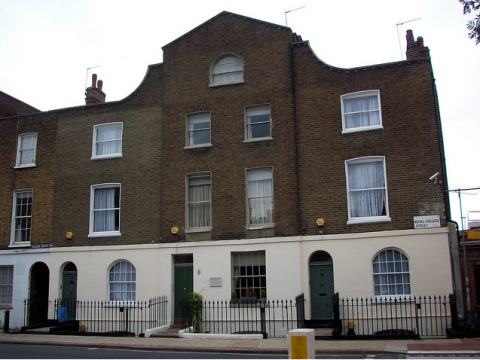 I’ve always been somewhat amused by the accounts of Paul Verlaine and Arthur Rimbaud’s brief bohemian affair. The older, married, and internally tortured Catholic Verlaine’s pining for the self-destructive and precocious young Rimbaud always presents a ridiculous picture in prose. But it’s a picture that takes on much clearer contours when, for the first time, I get to see the house they occupied on 8 Royal College Street (above). The image of the house, with its forbidding brick façade, gives their really pretty unpleasant story a gravitas that literary history can’t approach. Whether seen in person or in a photograph, the effect of viewing any revered author’s home is similar: histories once subject to biographers’ caprice take on the irrefutable weight of physical reality. And while I’d love to have the luxury of a pilgrimage to all my literary heroes’ homes, I’m content with the next best thing: an internet tour in pictures. That’s exactly what one gets at the Writers’ Houses site, which has collected dozens of images of famous writers’ homes, sourced mainly from user photos.
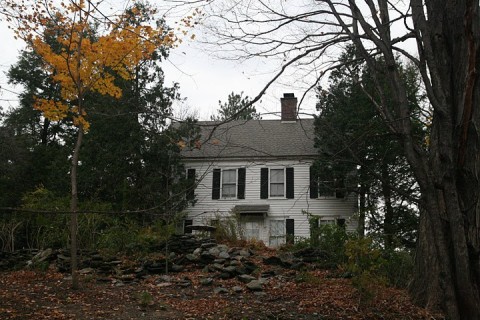
And so homebodies like myself can read their favorite Edna St. Vincent Millay sonnets while gazing at her Austerlitz, NY home “Steepletop” (below, a bit more modest than I’d imagined):
Likewise, I can read Flannery O’Connor’s grotesque little stories and be continually amazed that she did not emerge from some Medieval cloister in a fiery Southern wild but from the bright, rambling farmhouse called “Andalusia” (below).

And while I can only connect Thomas Hardy’s country gothic novels and bleak poetry with the terminal despair of a man who never leaves his firelit study in some sturdy, formal estate, his little cottage (below) is really kind of cheery and resembles something out of Peter Jackson’s Shire (though Hardy’s “Max Gate” home in Dorchester is exactly what I picture him in).

The Writers’ Houses site allows you to browse by author, state, and city, with a separate category for “international houses.” Its main page is a regular blog with a wealth of current information on writers’ homes, replete with links to other sites and sources. For lovers of travel and architectural and literary history, this is not to be missed.
via Kottke
Josh Jones is a doctoral candidate in English at Fordham University and a co-founder and former managing editor of Guernica / A Magazine of Arts and Politics.
Read More...Enthusiastic Futurist Jason Silva Waxes Theoretical About the Immersive Power of Cinema
No one will ever accuse Jason Silva of lacking in enthusiasm. The self-professed “filmmaker, futurist, epiphany addict” is in love, head over heels, with technology, and it’s a love infectious, as he shows us above in his short monologue, Attention: The Immersive Power of Cinema. Inspired by Diana Slattery’s essay “Virtual Reality and Hallucination,” Silva extracts a theory of cinema as a “rhetorical technology, a shrine to immersion.” His ideas are also built around a narrative and linguistic concept known as “deictic shift theory,” from deixis or “self-orientation.” For Silva, the deictic shift occurs when the “viewer assumes a viewpoint in the story,” and, in total immersion, “enters the dream as dream.” He speculates that at this point, the “pre-frontal lobe dims, and there’s a loss of ego,” such that “cinema is akin to godliness.” Hogwash, you say? Perhaps, but it’s entertaining hogwash, and if one takes the time to process the ideas embedded in Silva’s manic, form-is-content presentation, it’s even persuasive. But poor Beethoven. Fur Elise doesn’t deserve another beating.
Josh Jones is a doctoral candidate in English at Fordham University and a co-founder and former managing editor of Guernica / A Magazine of Arts and Politics.
Read More...Kickstart the Restoration of the Very First William S. Burroughs Documentary
If you’re into William S. Burroughs, maybe you’ve watched all the Burroughs-related material we’ve featured here on Open Culture, like his 1981 Saturday Night Live appearance or the 1991 documentary Commissioner of Sewers. But another documentary on Burroughs exists — the earliest one of all — and we can’t show it to you. Nobody can show Burroughs: The Movie to you, or at least they can’t show it to you in any crisp, clear, accessible form. Sure you could pay between 25 and 90 dollars for a VHS copy on Amazon, but that money might be more productively put toward restoring the original film. As you can see in the video above, such a restoration is in the works, provided the restorers can raise the $20,000 they need to do it on Kickstarter by the end of this month.
Aaron Brookner, nephew of Burroughs: The Movie’s director Howard Brookner, found a print of the film in good condition, but now needs the funding to remaster it cleanly into a modern digital form. Begun in 1979 and debuted on the BBC in 1983, the documentary includes interviews not just with Burroughs but with Allen Ginsberg, Brion Gysin, Francis Bacon, Herbert Hunke, Patti Smith, Terry Southern, and Lauren Hutton. Howard Brookner, who died in 1989, made it as his New York University film school thesis, and to operate the camera and record the sound he enlisted two soon-to-be famous classmates, Tom DiCillo and Jim Jarmusch. As of this writing, Aaron Brookner has received $9,425 in pledges, nearly half of his goal. Burroughs enthusiasts interested in chipping in — backing premiums include limited-edition DVDs, never-before-heard audio recordings, and Burroughs: The Movie photobooks — should visit the project’s Kickstarter page.
Related content:
William S. Burroughs Reads His First Novel, Junky
William S. Burroughs on the Art of Cut-up Writing
Beat Writer William S. Burroughs on Saturday Night Live, 1981
Colin Marshall hosts and produces Notebook on Cities and Culture. Follow him on Twitter at @colinmarshall.
Read More...Support Us
We're hoping to rely on loyal readers, rather than erratic ads. Please click the Donate button and support Open Culture. You can use Paypal, Venmo, Patreon, even Crypto! We thank you!

About Us

Open Culture scours the web for the best educational media. We find the free courses and audio books you need, the language lessons & educational videos you want, and plenty of enlightenment in between.
Advertise With Us

FREE UPDATES!
GET OUR DAILY EMAIL
Get the best cultural and educational resources on the web curated for you in a daily email. We never spam. Unsubscribe at any time.
FOLLOW ON SOCIAL MEDIA

Open Culture editor Dan Colman scours the web for the best educational media. He finds the free courses and audio books you need, the language lessons & movies you want, and plenty of enlightenment in between.
Advertise With Us


