The Physics of Guinness Beer Demystified
Over the years the physicists behind the YouTube channel Sixty Symbols have answered some big questions — like what happens if you stick your hand inside the Large Hadron Collider? Or do physicists believe in God? But now these fine scientists from The University of Nottingham have brought physics to a level that I can personally appreciate. They’ve hit the streets of Dublin to demystify what goes into the finest of Irish libations, the perfect glass of Guinness Beer. Their inquiry starts with the most obvious question: What creates that thick beige froth that sits elegantly atop the dark brown stout? It sounds like a mundane question. Until you realize it’s not. The dynamics of Guinness foam can be explained partly by work done by the Irish physicist Lord Kelvin (1824–1907) long ago. But other aspects of Guinness foam are still being hotly contested by physicists today. Take for example this paper, Waves in Guinness, published in 2008 in the journal Physics of Fluids. Now we’ll let Sixty Symbols explain the rest.…
If you would like to support the mission of Open Culture, consider making a donation to our site. It’s hard to rely 100% on ads, and your contributions will help us continue providing the best free cultural and educational materials to learners everywhere. You can contribute through PayPal, Patreon, and Venmo (@openculture). Thanks!
Related Content:
The Physics of Coffee Rings Finally Explained
Free Online Courses Online about Physics from Great Universities
Physics from Hell: How Dante’s Inferno Inspired Galileo’s Physics
Read More...The Wonder, Thrill & Meaning of Seeing Earth from Space. Astronauts Reflect on The Big Blue Marble
On December 7, 1972, the Apollo 17 crew took a photograph of earth that became known as “The Blue Marble” because of the whorling clouds above the continents. Not the first image of the earth from space, it remains one of the most arresting. To commemorate the fortieth anniversary of “The Blue Marble,” Planetary Collective, a group of visual artists, philosophers, and scientists, released the short film Overview (above) at a screening at Harvard this past Friday. Overview takes its title from author Frank White’s phrase for the perspective of the earth as seen from space: “The Overview Effect.” White’s book of the same name uses interviews and writings from thirty astronauts and cosmonauts to build a theory about the psychology of planetary perspectives.
The film is a prelude to a feature-length documentary called Continuum, and it introduces many of that project’s themes: the interdependence of everyone on earth, the necessity of adopting a planetary perspective, and the meeting of certain religious experiences with the sciences. Through a selection of interviews with five astronauts and philosophers associated with think tank The Overview Institute, one gets a thrilling and vicarious experience of what it’s like to see Bucky Fuller’s “Spaceship Earth.” Across all of the responses emerge the central themes of Earth’s unity, and its fragility: we’re all in this together, or else, the film concludes.
Especially interesting is the interview with Apollo astronaut Edgar Mitchell; he comes to see his experience in mystical terms, as a kind of intense meditative state known in Sanskrit as savikalpa Samadhi, a union with the divine. Dr. Mitchell’s attempts to integrate scientific practice and human consciousness parallel those of Planetary Collective and The Overview Institute, all of whom seek in their own ways to help the human race achieve a shift in perspective similar to what the astronauts experienced, a shift so well articulated by Carl Sagan in his Cosmos documentary series and his 1994 book Pale Blue Dot. Inspired by another iconic image of the earth from space, Voyager 1’s photo from 4 billion miles out, Sagan’s musings took a mystical turn, but never left the ground of sound scientific reasoning. His “Pale Blue Dot” has become a metaphor for a similar perspective as White’s “overview effect,” albeit one considerably more detached. Watch Sagan’s words brought to life below by animation studio ORDER.
via @kirstinbutler
Josh Jones is a doctoral candidate in English at Fordham University and a co-founder and former managing editor of Guernica / A Magazine of Arts and Politics.
Read More...20 Animations of Classic Literary Works: From Plato and Dostoevsky, to Kafka, Hemingway & Bradbury
Yesterday we featured Piotr Dumala’s 2000 animation of Fyodor Dostoyevsky’s classic novel, Crime and Punishment, and it reminded us of many other literary works that have been wonderfully re-imagined by animators — many that we’ve featured here over the years. Rather than leaving these wondrous works buried in the archives, we’re bringing them back and putting them all on display. And what better place to start than with a foundational text — Plato’s Republic. We were tempted to show you a claymation version of the seminal philosophical work (watch here), but we decided to go instead with Orson Welles’ 1973 narration of The Cave Allegory, which features the surreal artistic work of Dick Oden.
Staying with the Greeks for another moment … This one may have Sophocles and Aeschylus spinning in their graves. Or, who knows, perhaps they would have enjoyed this bizarre twist on the Oedipus myth. Running eight minutes, Jason Wishnow’s 2004 film features vegetables in the starring roles. One of the first stop-motion films shot with a digital still camera, Oedipus took two years to make with a volunteer staff of 100. The film has since been screened at 70+ film festivals and was eventually acquired by the Sundance Channel. Separate videos show you the behind-the-scenes making of the film, plus the storyboards used during production.
Eight years before Piotr Dumala tackled Dostoyevsky’s Crime and Punishment, Dumala produced a short animated film based on The Diaries of Franz Kafka. Once again, you can see his method, known as “destructive animation,” in action. It’s well worth the 16 minutes. Or you can spend time with this 2007 Japanese animation of Kafka’s cryptic tale of “A Country Doctor.” And if you’re still hankering for animated Kafka, don’t miss Orson Welles’ Narration of the Parable, “Before the Law”. The film was made by Alexander Alexeieff and Claire Parker, who using a technique called pinscreen animation, created a longer film adaptation of Nikolai Gogol’s story, “The Nose.” You can view it here.
The animated sequence above is from the 1974 film adaptation of Herman Hesse’s 1927 novel Steppenwolf. In this scene, the Harry Haller character played by Max von Sydow reads from the “Tractate on the Steppenwolf.” The visual imagery was created by Czech artist Jaroslav Bradác.
In 1999, Aleksandr Petrov won the Academy Award for Short Film (among other awards) for a film that follows the plot line of Ernest Hemingway’s classic novella, The Old Man and the Sea (1952). As noted here, Petrov’s technique involves painting pastels on glass, and he and his son painted a total of 29,000 images for this work. (For another remarkable display of their talents, also watch his adaptation of Dostoevsky’s “The Dream of a Ridiculous Man”.) The Old Man and the Sea is permanently listed in our collection of Oscar Winning Films Available Online and our collection of 700 Free Movies Online.
Italo Calvino, one of Italy’s finest postwar writers, published Italian Folktales in 1956, a series of 200 fairy tales based sometimes loosely, sometimes more strictly, on stories from a great folk tradition. Upon the collection’s publication, The New York Times named Italian Folktales one of the ten best books of the year. And more than a half century later, the stories continue to delight. Case in point: in 2007, John Turturro, the star of numerous Coen brothers and Spike Lee films, began working on Fiabe italiane, a play adapted from Calvino’s collection of fables. The animated video above features Turturro reading “The False Grandmother,” Calvino’s reworking of Little Red Riding Hood. Kevin Ruelle illustrated the clip, which was produced as part of Flypmedia’s more extensive coverage of Turturro’s adaptation. You can find another animation of a Calvino story (The Distance of the Moon) on YouTube here.
Emily Dickinson’s poetry is widely celebrated for its beauty and originality. To celebrate her birthday (it just passed us by earlier this week) we bring you this little film of her poem, “I Started Early–Took My Dog,” from the “Poetry Everywhere” series by PBS and the Poetry Foundation. The poem is animated by Maria Vasilkovsky and read by actress Blair Brown.
E.B. White, beloved author of Charlotte’s Web, Stuart Little, and the classic English writing guide The Elements of Style, died in 1985. Not long before his death, he agreed to narrate an adaptation of “The Family That Dwelt Apart,” a touching story he wrote for The New Yorker. The 1983 film was animated by the Canadian director Yvon Malette, and it received an Oscar nomination.
Shel Silverstein wrote The Giving Tree in 1964, a widely loved children’s book now translated into more than 30 languages. It’s a story about the human condition, about giving and receiving, using and getting used, neediness and greediness, although many finer points of the story are open to interpretation. Today, we’re rewinding the videotape to 1973, when Silverstein’s little book was turned into a 10 minute animated film. Silverstein narrates the story himself and also plays the harmonica.
During the Cold War, one American was held in high regard in the Soviet Union, and that was Ray Bradbury. A handful of Soviet animators demonstrated their esteem for the author by adapting his short stories. Vladimir Samsonov directed Bradbury’s Here There Be Tygers, which you can see above. And here you can see another adaptation of “There Will Come Soft Rains.”
The online bookseller Good Books created an animated mash-up of the spirits of Franz Kafka and Hunter S. Thompson. Under a bucket hat, behind aviator sunglasses, and deep into an altered mental state, our narrator feels the sudden, urgent need for a copy of Kafka’s Metamorphosis. Unwilling to make the purchase in “the great river of mediocrity,” he instead makes the buy from “a bunch of rose-tinted, willfully delusional Pollyannas giving away all the money they make — every guilt-ridden cent.” The animation, created by a studio called Buck, should easily meet the aesthetic demands of any viewer in their own altered state or looking to get into one.
39 Degrees North, a Beijing motion graphics studio, started developing an unconventional Christmas card last year. And once they got going, there was no turning back. Above, we have the end result – an animated version of an uber dark Christmas poem (read text here) written by Neil Gaiman, the bestselling author of sci-fi and fantasy short stories. The poem was published in Gaiman’s collection, Smoke and Mirrors.
This collaboration between filmmaker Spike Jonze and handbag designer Olympia Le-Tan doesn’t bring a particular literary tale to life. Rather this stop motion film uses 3,000 pieces of cut felt to show famous books springing into motion in the iconic Parisian bookstore, Shakespeare and Company. It’s called Mourir Auprès de Toi.
Are there impressive literary animations that didn’t make our list? Please let us know in the comments below. We’d love to know about them.
Read More...Ghosts of History: Dutch Artist Eerily Superimposes Modern Street Scenes on World War II Photos
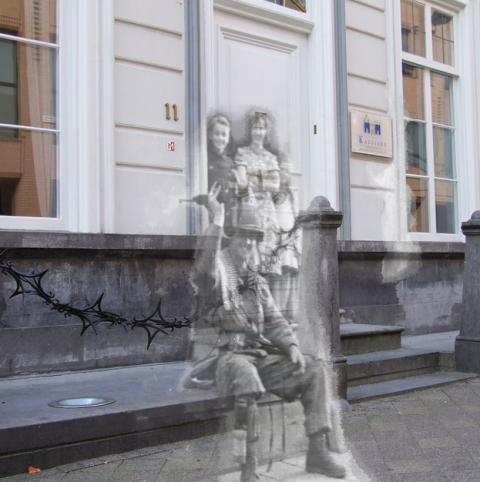
We all have our fascinations. Some of us are enamored of a particular historical era. If I had to pick a time period I’d want to visit, I’d say the 1930s—after the Depression, before World War II—a “tweener” decade if there ever was one.
Jo Hedwig Teeuwisse takes her interest in the 1930s to extraordinary lengths. She wears vintage clothing and attends 1930s-theme parties. She is also a historical consultant and expert on daily life from 1930–1945.
Teeuwisse lives in The Hague but once, while visiting Amsterdam, she stumbled upon a treasure on the street. It was a box filled with old photographic negatives. Some had identifying notes but most did not. A history nut, Teeuwisse went to work immediately trying to sort out where the shots were taken and, if possible, the identities of people in the retro photos.
The results are an impressive and amazing archive Teeuwisse calls Ghosts of History. More than simply figuring out which building is featured in a picture, Teeuwisse created photo mash-ups by combining elements of a vintage image with an image of her own taken in the same place today.
We see members of the underground press marching down a main Amsterdam thoroughfare in June, 1945 alongside shoppers and tourists strolling down the same street today.
In a powerful juxtaposition of then and now, three Dutch scouts risk their lives crossing Amsterdam’s Dam Square in the aftermath of a Nazi attack just two days after Germany surrendered. Note the hats left behind by people who had fled for their lives, and the contemporary students walking nonchalantly on.
This image shows the same scene, but with the Nazi recruitment office sign prominent in the background.
What is so potent about Teeuwisse’s work is that it is so quiet. She doesn’t have to point out irony because it is so immediately evident: Those same cobbles that so many have trod on the way to Madame Tussaud’s Wax Museum are scuffed by the boots of soldiers, famished victims of war austerity and ordinary working people on their way to the factory.
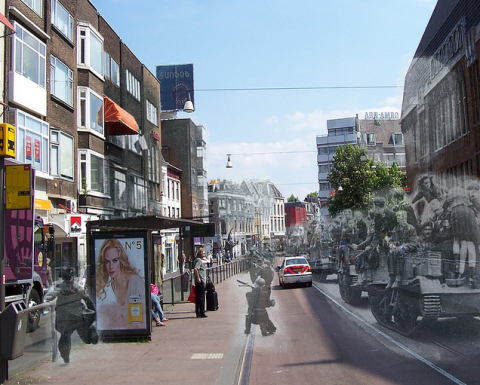
Some make it more plain than others that history is all around us all the time.
There are still many World War II images from that box that remain unidentified. Teeuwisse loaded them all up to her flickr site. Take a look. Maybe you’ll find a familiar face from your own past.
Kate Rix writes about digital media and education. Read more of her work at and thenifty.blogspot.com.
Read More...Europa Film Treasures Digitally Preserves 194 Films From 1890s to 1970s
At the heart of Martin Scorsese’s visually stunning Hugo lies the painful loss of so many Georges Melies masterpieces. Not long before Hugo’s release, Fritz Lang’s 1927 futurist-Christian-socialist parable Metropolis saw re-release as “The Complete Metropolis,” with 25 additional minutes restored from a film canister found rotting in a Buenos Aires closet. Both these fictionalized and real restorations provide high-profile examples of the fragile state of so much classic cinema prior to digital projects like Europa Film Treasures.
An online film museum, Europa is open to all, thanks to several public and private donors and a network of over 30 European film archives (laid out in this nifty interactive map). It “houses” 194 films from the late 19th century to the 70s, each accompanied by an “explanatory booklet.” Contemporary musicians have composed original scores for many of the silent films, and there is even an interactive workshop where users can create soundtracks of their own or test their knowledge of filmmaking techniques.
As the dramatic promotional teaser above says, Europa is a “constellation,” a hugely diverse range of films, some famous, most totally obscure and from “relatively unknown film industries.” Visiting Treasures for the first time can be a little daunting because of the sheer number of genres, periods, and countries of origin. So to give you an entryway, here are a few random nodes in the archival constellation of Europa:
- From Deutsche Kinemathek comes “Supertramp Portrait 1970,” featuring a small quartet called Daddy (later Supertramp) in their first filmed performance at hip Munich spot the PN Club. The band does a seriously jazzy ten-minute rendition of “All Along the Watchtower.”
- From Filmoteca Espanola comes “Barcelona en tranvia” (Barcelona by Tram), from 1908. The title says it all; in this short film, a camera mounted on a city tram records a bustling, turn-of-the century scene where bicycles are overtaking horses. Titles announce the street names as the tram twists and turns through the metropolis while pedestrians and running children gawk and wave at the camera. The arpeggio-rich piano score by Antonia Coppola lends pathos and a wistful air.
- 1967’s experimental film “A Kind of Seeing”—from the Scottish Screen Archive—juxtaposes a gloomy church-organ score against slow-moving shots of Technicolor Scottish flora and other “rural tableau,” offering a meditation on “the dynamic between the visual and the aural.”
- Opening with a title card that promises “ten minutes of medieval hocus pocus,” the 1933 silent “L’Apprenti sorcier” (The Sorcerer’s Apprentice), gives us dancer Jean Weidt’s agonized interpretation of the Goethe tale, performed, we are told, as an expressionist act of protest against the rise of the Third Reich. This one comes via the Archives Francaises du Film.
- Finally, an American classic—also rediscovered by the Archives Francaises du Film—1917’s “Bucking Broadway,” by John Ford. A feature-length adventure, the film follows the journey of Wyoming cowboy Cheyenne Harry to the Big Apple to rescue his fiancé, who’s been kidnapped by horsetraders. The sepia-toned adventure stars one of silent film’s first superstars, dashing Harry Carey.
That should get you started. Have fun, and don’t blame us if you end up on a long, meandering tour of obscure and rediscovered cinematic treasures that takes up the rest of your day.
via @ubuweb
Josh Jones is a doctoral candidate in English at Fordham University and a co-founder and former managing editor of Guernica / A Magazine of Arts and Politics.
Read More...Watch PBS’ American Masters Documentaries (Including Scorsese’s Homage to Kazan) Free Online
Each new American Masters broadcast, when it debuts on television, tends to receive a hero’s welcome. The potential for heroism on the part of a biographical documentary may, of course, seem limited, but their astuteness and attention to detail does put them on a level above. Produced by New York City’s Thirteen/WNET and distributed by the Public Broadcasting Service, the show has for 26 years told the life stories of creators of all types, American-born and otherwise, who have made an impact on U.S. culture. Last month, we featured Woody Allen answering thirteen unusual questions from Robert B. Weide, director of the series’ recent Woody Allen: A Documentary. That episode stirred up quite a flurry of admiration, as did the more recent Inventing David Geffen, a portrait of the entertainment industry titan directed by American Masters creator Susan Lacy — which you can watch free at PBS.org.
And that’s not the only one. Any self-respecting fan of American cinema will want to watch the program above, A Letter to Elia. It showcases a quality often cited as one of American Masters’ great strengths: its matches of subject and documentarian. In this case, we get the life of Elia Kazan, director of classic pictures like On the Waterfront and East of Eden, as described by Martin Scorsese, director of such promising candidates for classic status as Taxi Driver and Raging Bull. The documentary examines not only Kazan’s life and work but Scorsese’s relationship to it, and from there, any young artist’s relationship to art itself. PBS has also made freely available their broadcasts on Johnny Carson, Jeff Bridges, Charles and Ray Eames, and quite a few others besides. If the culture of a country as vast and young as the United States of America remains difficult to pin down, it certainly isn’t for American Masters’ lack of trying.
Various episodes have been added to our collection of 500 Free Movies Online.
Related content:
Alfred Stieglitz: The Eloquent Eye, a Revealing Look at “The Father of Modern Photography”
Einstein Documentary Offers A Revealing Portrait of the Great 20th Century Scientist
Colin Marshall hosts and produces Notebook on Cities and Culture. Follow him on Twitter at @colinmarshall.
Read More...Dostoyevsky’s Crime and Punishment Presented in a Beautifully Animated Short Film
In this darkly poetic animation, the Polish filmmaker Piotr Dumala offers a highly personal interpretation of Fyodor Dostoyevsky’s classic novel, Crime and Punishment. “My film is like a dream,” Dumala said in 2007. “It is as if someone has read Crime and Punishment and then had a dream about it.”
Dumala’s version takes place only at night. The story is told expressionistically, without dialogue and with an altered flow of time. The complex and multi-layered novel is pared down to a few central characters and events: In the Russian city of Saint Petersburg, a young man named Raskolnikov lies in his dark room brooding over a bloody crime.
He murders an old woman with whom he had pawned his watch. When her younger sister comes home unexpectedly, he murders her too. He confesses to a saintly young woman named Sonya. The sinister eavesdropper Svidrigailov knows of Raskolnikov’s love for Sonya, and of his sins. In the end Svidrigailov takes a pistol and “goes to America” by killing himself.
Dumala completed his half-hour film of Crime and Punishment (Zbrodnia i Kara) in 2000, after three years of work. He has a unique method: He takes a white plaster panel and coats the surface with glue. He then paints over it with a dark color and lets it dry. He uses a knife and sandpaper to engrave his image, creating a hatching effect that gives it a feeling of texture. To add darkness to a light area, he adds more paint with a brush.
It’s a form of “destructive animation.” Each image exists only long enough to be photographed and then painted over to create a sense of movement. It’s a process that sometimes makes Dumala sad. “I think sometimes when I do a drawing in my film, I want to keep it,” he told Melissa Chimovitz of Animation World Network in 1997, “but I must destroy it because this is the technique I use. I must destroy every frame to put in its place another one, the next one, to have movement. This way, sometimes I think it is too much suffering, to destroy all the time what I am doing.”
If you appreciate Dumala’s take on Dostoyevsky, you won’t want to miss his 1992 treatment of Franz Kafka.
Dumala’s films are housed in our list of Free Movies Online. Dostoyevsky’s Crime and Punishment appears in our Free Audio Books and Free eBooks collections.
Looking for free, professionally-read audio books from Audible.com? Here’s a great, no-strings-attached deal. If you start a 30 day free trial with Audible.com, you can download two free audio books of your choice. Get more details on the offer here.
If you would like to support the mission of Open Culture, consider making a donation to our site. It’s hard to rely 100% on ads, and your contributions will help us continue providing the best free cultural and educational materials to learners everywhere. You can contribute through PayPal, Patreon, and Venmo (@openculture). Thanks!
Related content:
Albert Camus Talks About Adapting Dostoyevsky for the Theatre, 1959
Kafka’s Nightmare Tale, ‘A Country Doctor,’ Told in Award-Winning Japanese Animation
Read More...John Hodgman Presents a Survival Guide for the Coming Apocalypse
How can we all survive the apocalypse predicted by the Mayan calendar and make it to the other side of December 21? John Hodgman (you know him from The Daily Show and Apple TV ads) has it all figured out. Hopefully it’s not too much of a spoiler to say load up on mayo and urine while you still have time.… h/t Devour
Catch us on Facebook and Twitter and spread quality culture through your social world!
Read More...Toni Morrison Dispenses Sound Writing Advice: Tips You Can Apply to Your Own Work
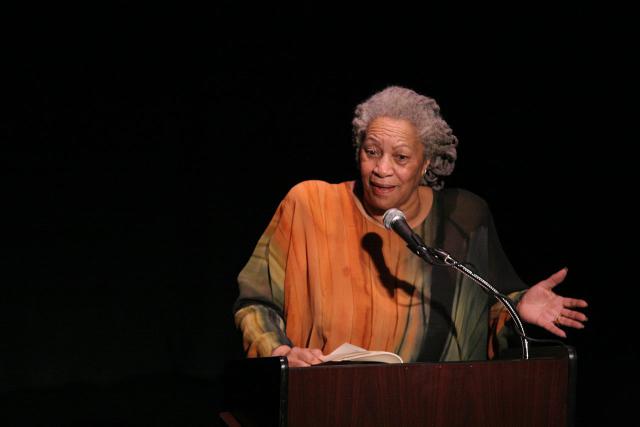
Image by Angela Radulescu via Wikimedia Commons
It is sometimes the case that a favorite writer isn’t terribly interesting when it comes to talking shop. This has never been so with the self-revealing Toni Morrison, whose public appearances and interviews often duplicate the experience of reading one of her novels—her voice draws you in, and before you know it, you’re part of a world all her own that she has given you the privilege of joining for a short time.
This is the experience of reading her interview with Elissa Schappell in the Paris Review. Morrison discourses on subjects ranging from her personal routine and history, to her identity as a writer and a woman, to the larger history of slavery and the black lives she writes about. Woven through it all are observations about her art that may or may not be of any use to budding writers, but which will certainly make lovers of Morrison read her work a little differently. Some of her observations are below:
- Write when you know you’re at your best. For her, this happened to be the early morning, pre-dawn hours, before her children woke up, since she worked full-time and feels she is “not very bright or very witty or very inventive after the sun goes down.” Morrison describes her morning ritual this way:
I always get and make a cup of coffee while it is still dark—it must be dark—and then I drink the coffee and watch the light come.
- “There’s a line between revising and fretting” It’s important for a writer to know when they are “fretting,” because if something isn’t working, “it needs to be scrapped,” although in answer to whether she goes back over published work and wishes she had fretted more, Morrison answers, “a lot. Everything.”
- A good editor is “like a priest or a psychiatrist.” Morrison worked as an editor for Random House for 20 years before she published her first novel. She observes the relationship between writer and editor by saying that getting the wrong one means that “you are better off alone.” One of the marks of a good editor? She doesn’t “love you or your work,” therefore offers criticism, not compliments.
- Don’t write with an audience in mind, write for the characters. Knowing how to read your own work—with the critical distance of a good reader—makes you a “better writer and editor.” For Morrison, this means writing not with an audience in mind, but with the characters to go to for advice, to tell you “if the rendition of their lives is authentic or not.”
- Control your characters. Despite the ever-present and clichéd demand to “write what you know,” Morrison studiously tries to avoid taking character traits from people she knows. As she puts it: “making a little life for oneself by scavenging other people’s lives is a big question, and it does have moral and ethical implications.” And as for keeping control of her characters, Morrison says “They have nothing on their minds but themselves and aren’t interested in anything but themselves. So you can’t let them write your book for you.”
- Plot is like melody; it doesn’t need to be complicated. Morrison sums up her approach to plot in Jazz and The Bluest Eye by saying “I put the whole plot on the first page.” Rather than constructing intricate plots with hidden twists, she prefers to think of the plot in musical terms as a “melody,” where the satisfaction lies in recognizing it and then hearing the “echoes and shades and turns and pivots” around it.
- Style, like jazz, involves endless practice and restraint. Speaking of Jazz, Morrison tells she has always thought of herself like a jazz musician, “someone who practices and practices and practices in order to able to invent and to make his art look effortless and graceful.” A large part of her “jazz” style, she says, is “an exercise in restraint, in holding back.”
- Be yourself, but be aware of tradition. Of the diversity of African-American jazz musicians and singers, Morrison says “I would like to write like that. I would like to write novels that were unmistakably mine, but nevertheless fit first into African American traditions and second of all, this whole thing called literature.”
Most readers of Morrison’s work would argue that’s exactly what she’s done her whole career. Read the entire interview here and be sure to visit the complete archive of Paris Review interviews online.
If you would like to support the mission of Open Culture, consider making a donation to our site. It’s hard to rely 100% on ads, and your contributions will help us continue providing the best free cultural and educational materials to learners everywhere. You can contribute through PayPal, Patreon, and Venmo (@openculture). Thanks!
Related Content:
Writing Tips by Henry Miller, Elmore Leonard, Margaret Atwood, Neil Gaiman & George Orwell
Seven Tips From Ernest Hemingway on How to Write Fiction
Josh Jones is a doctoral candidate in English at Fordham University and a co-founder and former managing editor of Guernica / A Magazine of Arts and Politics.
Read More...Nate Silver (Sporting a Cookie Monster T‑Shirt) Talks Serious Stats with Conan O’Brien
Even if you hate or fear statistics, you’ve surely become more than aware in recent months of one particular statistician: Nate Silver. The young professional number-cruncher has made the news in a big way for a legitimately impressive statistical feat: predicting the winner of all fifty states and the District of Columbia in this year’s United States presidential election. He came nearly as close back in 2008’s election, predicting the winner in 49 states. In between those coups, Time named Silver one of the world’s hundred most influential people, and the New York Times has given their official imprimatur by hosting his blog FiveThirtyEight. Now he’s received what some would consider an even higher honor: an invitation to sit down with Conan O’Brien for the better part of an hour on Serious Jibber-Jabber.
“Elections are probably the most dramatic moments in the history of our country,” O’Brien says to Silver. “These’s a danger,” he then deadpans, “that you’re taking the fun out of it.” We jumped on O’Brien’s new long-form interview web series last month, featuring his conversations with presidential historian Edmund Morris and “comedy mastermind” Judd Apatow. Silver, the program’s third guest, perfectly continues its short but strong tradition of personalities who bring both zeitgeist relevance and intellectual substance. The choice also taps into a well of public curiosity — a great many of us know of Nate Silver without quite understanding why we do — and finds a reserve of goofiness to match O’Brien’s own. (If you doubt this, behold Silver’s Cookie Monster t‑shirt.) So think hard when you watch this conversation about political echo chambers, media fragmentation, data’s relationship to instinct, and mathematical modeling. But do feel free to laugh at the jokes.
Related content:
Conan O’Brien Plays Charlie Rose, Talks Presidential History with Edmund Morris
Celebrity Statistician Nate Silver Fields Questions from Data Wizards at Google
Colin Marshall hosts and produces Notebook on Cities and Culture. Follow him on Twitter at @colinmarshall.
Read More...Support Us
We're hoping to rely on loyal readers, rather than erratic ads. Please click the Donate button and support Open Culture. You can use Paypal, Venmo, Patreon, even Crypto! We thank you!

About Us

Open Culture scours the web for the best educational media. We find the free courses and audio books you need, the language lessons & educational videos you want, and plenty of enlightenment in between.
Advertise With Us

FREE UPDATES!
GET OUR DAILY EMAIL
Get the best cultural and educational resources on the web curated for you in a daily email. We never spam. Unsubscribe at any time.
FOLLOW ON SOCIAL MEDIA

Open Culture editor Dan Colman scours the web for the best educational media. He finds the free courses and audio books you need, the language lessons & movies you want, and plenty of enlightenment in between.
Advertise With Us


