“The Value of Culture” Revealed in a New BBC Radio Series by Melvyn Bragg
 Your presence here indicates that you have an interest in culture. But what, exactly is culture? I’ve long addressed that perhaps too-broad question with a simple working definition: if Melvyn Bragg broadcasts about it, it’s probably culture. You may remember the English writer, presenter, and House of Lords member from our posts on his documentaries on Jackson Pollock and Francis Bacon, or from the mention of his long-running BBC Radio 4 program In Our Time. But while that show certainly has covered scientific topics — evolutionary psychology, genetic mutation, the neutrino — Bragg and his panels of experts spend even more airtime discussing subjects claimed by the humanities. Some of its most interesting moments happen at the crossover, with scientific angles on the humanistic and vice versa; “Goethe and the Science of the Enlightenment” comes to mind, to name but one example. Where conversations like those can arise, I daresay we have culture at its most robust.
But I merely circle around the issue. Bragg’s five-part Radio 4 series The Value of the Culture deals with the question of culture’s nature head-on. Need we call culture anything more specific than the body of things that mankind makes? Does culture work as a force for good? What does culture look like from an anthropological perspective? Must works reach a certain standard, or display certain qualities, to count as culture? What does the gap between the sciences and the humanities mean for culture? How did “mass culture” come about, as opposed to “high culture”? And what does all this say about the culture we have today? Assembling his typically impressive range of luminaries from across the British intellectual landscape, Bragg asks these questions and many more besides, using as a point of departure ninetheenth-century poet, critic, and school inspector Matthew Arnold’s description of culture as “the best which has been thought and said” which provides life its “sweetness and light.” But much has changed in how we regard culture since the nineteenth century, and here we have just the program to get us thinking harder than ever about it.
All episodes of The Value of Culture: Culture and Anarchy (above), Culture and the Anthropologists, Two Cultures, Mass Culture, What’s the Value of Culture Today?
Related content:
Watch Portrait of an Artist: Jackson Pollock, the 1987 Documentary Narrated by Melvyn Bragg
Francis Bacon on the South Bank Show: A Singular Profile of the Singular Painter
Colin Marshall hosts and produces Notebook on Cities and Culture and writes essays on literature, film, cities, Asia, and aesthetics. Follow him on Twitter at @colinmarshall.
Read More...Watch Portrait of an Artist: Jackson Pollock, the 1987 Documentary Narrated by Melvyn Bragg
Jackson Pollock painted with the kind of visceral immediacy that frees you from having to know much about his ideas, his methods, or his life. But spend enough time gazing at his canvases and you’ll surely start to get curious. If you’ve seen Melvyn Bragg talk to Francis Bacon in studio, gallery, café, and bar on the South Bank Show’s profile of the painter, you know how expertly he can open up an artist’s world. Two years after that International Emmy-winning program, the broadcaster, writer, and House of Lords Member applied his talents to a perhaps even less understood painter in Portrait of an Artist: Jackson Pollock. Where Bragg appeared as a participatory presence in The South Bank Show — to the extent, at one drink-sodden point, of getting tipsy himself — here he sticks to narration. His relegation to the soundtrack perhaps reflects a certain cultural distance: to an American, Bragg seems about as English a host as they come, and to the rest of the world, Pollock seems about as American a painter as they come — in his work as well as his life.
The Library Media Project describes Pollock as a “ ‘cowboy’ from Wyoming” instrumental in forging the American art movement, Abstract Expressionism. They describe his life in the smallest nutshell: “His famous ‘drip’ paintings earned him both notoriety and abuse and the pressures of new-found celebrity compounded his lifelong struggle with alcoholism, a fight he lost when he died in a car crash at the age of 44,” In its 50 Bragg-narrated minutes, Portrait of an Artist: Jackson Pollock goes into far greater detail, using existing radio conversations with Pollock, photographer Hans Namuth’s film of Pollock at work, and interviews with critics, curators, Pollock’s colleagues, his friends, his widow, and his mistress. Where a biopic like Ed Harris’ Pollock plunges straight into the artist’s brash conduct and volatile mixture of work and life, this documentary steps slightly back, examining Pollock’s paintings and the Hemingwayesque existence that gave rise to them in a cooler — not to say more English — light. Make them a double feature, if you can.
Portrait of an Artist: Jackson Pollock will be added to the Documentary section of our collection of 500 Free Movies Online.
Related content:
Jackson Pollock: Lights, Camera, Paint! (1951)
MoMA Puts Pollock, Rothko & de Kooning on Your iPad
Francis Bacon on the South Bank Show: A Singular Profile of the Singular Painter
Colin Marshall hosts and produces Notebook on Cities and Culture and writes essays on literature, film, cities, Asia, and aesthetics. Follow him on Twitter at @colinmarshall.
Read More...Kids (and Less Savvy Marketers) Imagine the Internet in 1995
In 1995, a group of 5th grade kids in Helena, Montana got together and made a PSA for the Internet (above). And, man, were they hip, with their techno music and their “by the time I’m in college, the internet will be your telephone, television, and workplace.” In the annals of overblown predictions and technological hubris, mid-nineties internet-fever will go down as the ultimate exception. These kids even anticipated the cute cat mania that would infect the internet forever. Of course, none of them could have foreseen the Twitter revolution, the Facebook decline, rubbable gifs, or spherical panoramic views of Mars, but that’s just quibbling.
It really is astonishing to look back a mere seventeen years at what a primitive technology the internet was. Of course it wasn’t necessarily evident at the time that the online world would indeed become our “telephone, television, and workplace,” and some naysayers, like astronomer and hacker-catcher Clifford Stoll, called BS on the hype. In a 1995 Newsweek article titled “The Internet? Bah!,” Stoll wrote:
The truth is no online database will replace your daily newspaper, no CD-ROM can take the place of a competent teacher and no computer network will change the way government works.
In 2010, Stoll was forced to retract, commenting on Boing Boing coverage of his sourpuss skepticism with:
“Of my many mistakes, flubs, and howlers, few have been as public as my 1995 howler.
But who could blame him? This was the age of such clunky Web services as AOL, which promises much in a 95 ad below, but ultimately delivered little.
Not all web advertising in 1995 looks so dated and silly. AOL’s competitor Prodigy, which fared even worse, certainly had a better ad agency. Their 95 ad below, featuring Barry White, is a romp.
All of this reflection warrants more wisdom from a chastened Clifford Stoll, who in a 2006 TED talk says: “If you really want to know about the future, don’t ask a technologist, a scientist, a physicist. No! Don’t ask somebody who’s writing code. No, if you want to know what society’s going to be like in 20 years, ask a kindergarten teacher.”
via Prefix
Josh Jones is a doctoral candidate in English at Fordham University and a co-founder and former managing editor of Guernica / A Magazine of Arts and Politics.
Headbanging Anthropologist Takes Us Through the World of Heavy Metal in 2005 Documentary
Don’t worry; I don’t know anything about metal either. As least, I didn’t know anything about it before I watched Metal: A Headbanger’s Journey, a 2005 documentary on this vast yet much-derided musical subculture that you can watch on YouTube. Sam Dunn, an anthropologist, bassist, and unapologetic metalhead, uses the film to ask many question about his favorite music: what exactly is metal? How do metal players get it to sound so evil? Why does one person give himself over completely to the metal lifestyle, while another barely notices its existence at all? What feeling do the most die-hard fans get from metal, and how do they get addicted to it? Why does metal’s mostly straight male audience thrill to the sight of metal’s mostly straight male performers strutting around in tight leather? How did metal grow so many subgenres — black metal, glam metal, power metal, death metal? Does Satan really have anything to do with metal, or does it all come down to a big piece of Halloween-ish theater? And how come northern Europeans take metal so deadly seriously?
In pursuit of the answers, Dunn travels the world interviewing metalists of every stripe, from Rob Zombie to Alice Cooper to Rush bassist Geddy Lee to Twisted Sister frontman Dee Snider to Iron Maiden’s multitalented Rob Dickinson to a pair of masked men from Slipknot. He even talks twice to the late Ronnie James Dio, the singer who supposedly popularized the now-universal sign of the horns metal hand gesture. Seeking context for these first-hand accounts, Dunn talks to academic sociologists and musicologists as well as the mile-a-minute cultural essayist Chuck Klosterman. Following his anthropological instinct, he also puts in a great deal of time with fellow metalheads of myriad ages and nationalities (though they usually come from the same range of grimly dull childhoods). Dunn’s disarming personality and undying enthusiasm for the material offer a way into this seemingly contradictory musical culture of virtuosity and brutality, whose creators sing in death grows yet speak eloquently, whose hardened outsider followers somehow find in it a fount of community, friendship and belonging.
via Metafilter
Colin Marshall hosts and produces Notebook on Cities and Culture. Follow him on Twitter at @colinmarshall.
Read More...A Paul Simon Feelin’-Very-Groovy Moment
Playing in Toronto last week, Paul Simon did something, well, awesome. A fan asks him to play “Duncan,” his 1972 classic, and lets him know that she learned to play guitar to that song. So Simon agrees. And, even better, he invites her on stage to take over guitar and vocals. Nervous, almost hyperventilating, she hesitantly gets going, as does the crowd. From there, a big feelin’ groovy moment unfolds, and it just gets better as it goes along. Kudos to NPR’s All Songs Considered for making this great find …
Related Content:
13,500 Sing “Hey Jude” in Trafalgar Square
Paul Simon’s Christmas Gets Animated in April
Read More...Bernard-Henri Lévy on the Streets of Tehran
Bernard-Henri Lévy, one of France’s leading intellectuals (you can tell by the way he buttons his shirt) pays dramatic homage to the uprising in Iran. The rhythm of the speech is vaguely MLK’esque. But the content is distinctly French intello. (Somehow Michel Foucault gets worked into an analysis of what’s happening on the streets of Tehran.)
via TELOS
Read More...Martin Scorsese Creates a List of 39 Essential Foreign Films for a Young Filmmaker
As a young man, filmmaker Colin Levy got an opportunity of a lifetime. He got a one-on-one meeting with Martin Scorsese. After spending much of his time in high school making a five-minute short, Levy won the national YoungArts award — and, with it, the chance to chat with the guy who directed Goodfellas, Taxi Driver and Raging Bull.
After getting a personal tour of Scorsese’s office and editing bays by none other than legendary editor Thelma Schoonmaker, Levy met the man himself. “It was a defining moment in my path as a filmmaker,” he later wrote on his blog.
Martin Scorsese was intimidating, to say the least. But very jovial, very talkative, and he took me seriously. (Or convinced me, at least.) I pretty much kept my mouth shut. Every 30 seconds he would mention an actor, producer, director or film title I had never heard of before. I was stunned just to be in his presence. He liked my film, he said. “How did you do the little creatures?” I tried to explain how I figured out the basics of 3D animation. His eyes lit up and he started talking about the digital effects in The Aviator.
The juxtaposition of scales was overpowering. I felt like I was in a movie. Why he spent so much time with me I do not know, but it was amazing just to be in his presence. A few weeks afterwards I labored over a thank-you card, in which I expressed the overwhelming impression I had gotten that I don’t know enough about anything. I specially don’t know enough about film history and foreign cinema. I asked if he had any suggestions for where to start.
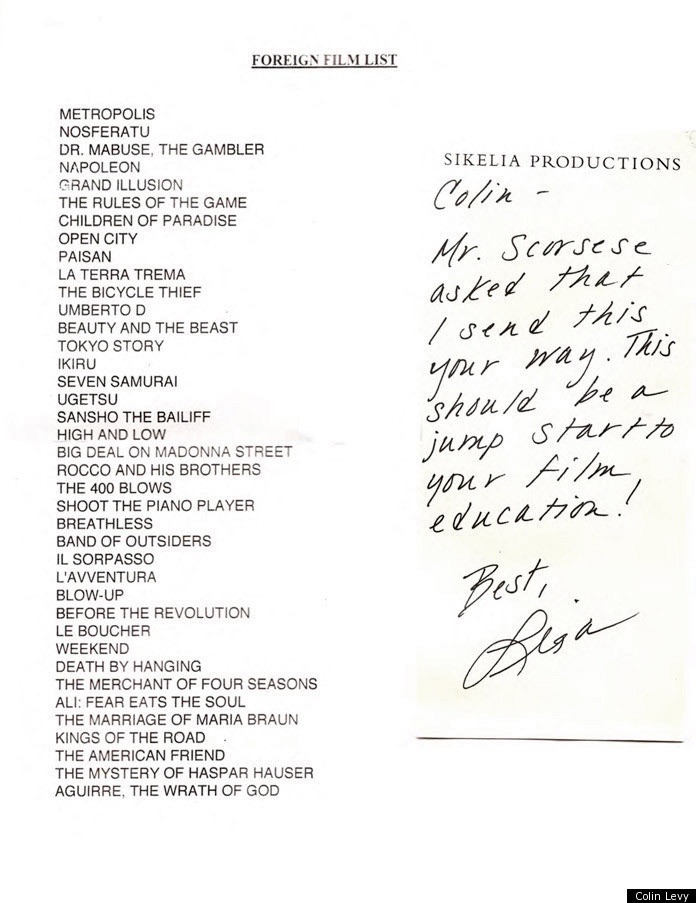
A couple of weeks later, Scorsese’s assistant sent him a handful of books and 39 foreign movies personally picked by the filmmaker. “Mr. Scorsese asked that I send this your way,” his assistant wrote to Colin. “This should be a jump start to your film education!”
Scorsese’s selections – which you can see above – are a fascinating insight into what influenced the filmmaker. Several movies are perennial film school classics: Italian neorealist masterpieces like The Bicycle Thief and Umberto D pop up on the list along with groundbreaking French New Wave works like The 400 Blows and Breathless. More unexpected are surprisingly strong showings of both Japanese post-war movies and New German cinema. Both Akira Kurosawa and Rainer Werner Fassbinder get three films each. And while there are some rather eccentric, unexpected inclusions in the list–Rocco and His Brothers? Il Sorpasso? Death by Hanging? – there are also some pretty striking omissions; big name art house figures like Ingmar Bergman, Robert Bresson and most surprisingly Federico Fellini didn’t make the cut. In any case, as Scorsese’s assistant writes, this list is a great place to start for anyone looking to learn more about foreign film.
Note: An earlier version of this post appeared on our site in 2014.
Related Content:
Martin Scorsese Create a List of 38 Essential Films About American Democracy
4,000+ Free Movies Online: Great Classics, Indies, Noir, Westerns, Documentaries & More
Martin Scorsese Makes a List of 85 Films Every Aspiring Filmmaker Needs to See
Jonathan Crow is a writer and filmmaker whose work has appeared in Yahoo!, The Hollywood Reporter, and other publications.
Read More...Doctor Who’s Tom Baker Plays Douglas Adams’ Digital “Agent” in the AI-Predicting Hyperland (1990)
Cast your mind, if you will, back to the year 2020. It now feels like a different time, what with the spreading COVID-19 pandemic and the heated sociopolitical battles being waged online, and indeed in the (socially distanced) streets. That spring, we featured here on Open Culture an amusing retro-technological diversion called Hyperland. First broadcast on BBC2, the program stars The Hitchhiker’s Guide to the Galaxy author Douglas Adams as himself and Doctor Who’s Tom Baker as his agent. “You want fifteen percent?” the former asks the latter when they first meet in a vast wasteland of flickering television sets. Not at all: “I’m here to do your every slightest bidding,” Baker explains, “to fetch and carry for you, to work tirelessly and selflessly on your behalf, always ready, always willing, no job too small or too menial.”
Today, we can hardly share in Adams’ bewilderment, familiar as we are with the notion of what Baker calls a “software agent,” an “artificial and completely customizable personality” with “instant access to every piece of information stored digitally anywhere in the world: any picture or film, any sound, any book, any statistic, any fact, any connection between anything you care to think of.” We must remind ourselves that Hyperland was produced in 1990, when these lines would have struck all but the most computer-savvy and forward-looking viewers as sheer science fiction. Even three decades thereafter, they still sounded more or less like an elevated version of ordinary late-twentieth-century techno-optimism. Here in 2026, Baker’s services are close to being considered a basic necessity, at least in Silicon Valley and its global provinces.
Not so very long ago, Hyperland looked startlingly prescient about the rise of the World Wide Web, which would soon let its users seek out their own desired pieces of information and media, actively moving through links between them, in a manner unlike the passive viewing experience of television (with which it would, as no one then knew, one day converge). This was an unfamiliar idea to most people in 1990; hence the variety of clear and entertaining ways in which the program breaks down its technological basis, pulling up clips from its onscreen “database” like an interview with Ted Nelson, who coined the term hypertext. Like multimedia, that word may carry a whiff of antiquity today, but it was once on the lips of practically every technologist in popular culture — in a manner reminiscent of the lexicon that has sprung from new developments in artificial intelligence over the past few years.
At times, Baker’s character now looks almost realistic, as when Adams asks him to knock off the obsequiousness, or when he pulls up Kurt Vonnegut’s theory of story form before Adams fully gets the question out. Yet Hyperland devotes little time to AI per se. The program appeared in the wake of the eighties’ AI boom, when “expert systems” promised to solve problems in industry, medicine, and other sectors, but many of the field’s larger ambitions went unrealized. There followed a long “AI winter” in research and development, in whose climate Baker-as-“agent” would have been a means of humanizing an abstract-seeming concept of organizing and navigating information. Not that all his enthusiastically proffered services draw unqualified enthusiasm from Adams, who possessed a rare combination of Californian technophilia and British skepticism. His fascination with humanity’s digital future is ours — and so is his wariness.
Related Content:
Play The Hitchhiker’s Guide to the Galaxy Video Game Free Online, Designed by Douglas Adams in 1984
Pioneering Sci-Fi Author William Gibson Predicts in 1997 How the Internet Will Change Our World
Sci-Fi Author J.G. Ballard Predicts the Rise of Social Media (1977)
Based in Seoul, Colin Marshall writes and broadcasts on cities, language, and culture. He’s the author of the newsletter Books on Cities as well as the books 한국 요약 금지 (No Summarizing Korea) and Korean Newtro. Follow him on the social network formerly known as Twitter at @colinmarshall.
Watch “The Midnight Parasites,” a Surreal Japanese Animation Set in the World of Hieronymus Bosch’s The Garden of Earthly Delights (1972)
Hieronymus Bosch’s bizarre paintings might have looked perfectly ordinary to his contemporaries, argues Stanley Meisler in “The World of Bosch.” Modern viewers may find this very hard to believe. We approach Bosch through layers of Freudian interpretation and Surrealist appreciation. We cannot help “regarding the scores of bizarre monsters”—allegories for sins and punishments far more legible in 15th-century Netherlands—“as a kind of dark and cruel comic relief.”
While Bosch might have intended his work as serious sermonizing, it is impossible for us to inhabit the medieval consciousness of his time and place. There’s just no getting around the fact that Bosch is really weird—weirder even (or more imaginatively allegorical) than nearly any other artist of his time. In some very important ways, he belongs to a 20th-century aesthetic of post-Freudian dream logic as much as he belonged to peculiar medieval visions of heaven and hell.
Bosch “described terrible, unbearable holocausts crushing mankind for its sins,” writes Meisler, visions that seemed both stranger and more familiar in the wake of so many man-made holocausts whose absurdities defy reason. What modern horrors does famed Japanese animator Yōji Kuri invoke in his psychedelic 1972 film “The Midnight Parasites,” above, a surrealist short set in the world of Bosch?
Dangerous Minds’ Paul Gallagher describes the plot, such as it is:
Here Kuri imagines what would life might be like if we all lived in Bosch’s painting “Garden of Earthly Delights.” It’s a basically shit and death or rather a cycle of life where blue figures live and die; eat shit and shit gold; are skewered, and devoured; are regurgitated and reborn to carry on the cycle once again.
Kuri’s satirical vision, in films long favored by countercultural audiences, has “bite,” writes Animation World Network’s Chris Robinson: “he helped lift Japanese animation out of decades of cozy narrative cartoons into a new era of graphic and conceptual experimentation. His films mock and shock, attacking technology, population expansion, monotony of modern society… Witnessing the surrender of Japan during WW2, the devastation of his country followed by the quick rise of Western inspired materialist culture and rampant consumption, Kuri, like many of his colleagues at the time, questioned the state and direction of his society and world.”
His creative appropriation of Bosch, “dark, dirty, oddly beautiful, with a groovy soundtrack,” Gallagher writes, may not, as Meisler worries of many modern takes, get Bosch wrong at all. Though the Dutch artist’s symbolism may never be comprehensible—or anything less than hallucinatory—to us moderns, Kuri’s half-playful reimagining uses Boschian figures for some serious moralizing, showing us a hell world governed by grave lapses and cruelties Bosch could never have imagined.
Note: An earlier version of this post appeared on our site in 2018.
Related Content:
The Meaning of Hieronymus Bosch’s The Garden of Earthly Delights Explained
Josh Jones is a writer and musician based in Durham, NC.
Read More...Why Cleopatra, Lawrence of Arabia, Ben-Hur & Other Hollywood Classics Still Look So Good
Cleopatra cost Twentieth Century Fox $44 million, by the studio’s own estimate. That may sound like the budget of one of those genre pictures that winds up going straight to streaming, but if we convert those 1963 dollars into current ones, it comes out to $480 million. The most expensive film ever made up to that point, it remained an industry symbol of near-parodically troubled production and grotesque cost inflation for decades. Like The Wizard of Oz, it failed to recoup its investment during its initial theatrical run, eventually turning a profit thanks only to re-releases and television rights sales. And yet, these six decades later, the investment seems to have proven sound, at least according to the video above from YouTube channel Wolfcrow, “Why Cleopatra Still Looks Like a Trillion Bucks.”
Unlike some infamously expensive movies, Cleopatra doesn’t leave you wondering where all the money went. Wolfcrow creator Sareesh Sudhakaran points out some of the myriad ways it manifests onscreen, from the 70-foot-long giant sphinx to the full-scale Alexandria harbor built on the coast to the Roman Forum set designed to be three times larger than the actual Roman Forum to the 65 or so outfits Elizabeth Taylor wears in the title role (to say nothing of the 26,000 other costumes made for all the other characters). Even the matte paintings and optical camera tricks still look convincing. The film’s production designers knew that nothing could be done by half measures, given that the 65mm Todd-AO stock used for filming would expose any flimsiness on the big screen.
Just as unforgiving was the ultra-wide aspect ratio used for the 1959 version of Ben-Hur, which necessitated painstaking labor on everything that went before the camera, but also a new approach to the composition of the shots themselves. Even those of us who’ve never seen the movie can call to mind images of its climactic chariot race, a sequence that earned its cultural impact the hard way.
It took five months to film on the largest set ever built at that time, with 1,500 extras in its stands. A few years later, Lawrence of Arabia took Hollywood grandeur up to the level of sublimity with its real desert landscapes. David Lean “was obsessed with scale and detail,” Sudhakaran explains. “He wanted the desert to be more than just a backdrop. He wanted it to be a character in the story,” which required meticulous planning of all the ways its natural light could possibly be used to dramatic effect.
Though Sudhakaran clearly has an interest in spectacles from the golden age of the Hollywood historical epics, he’s also made videos on lastingly impressive movies from other times and genres. When was the last time you sat down to enjoy the satirical urban techno-dystopia RoboCop, the comic-strip noir fantasia of Dick Tracy, or the flamboyant de-familiarized twenty-third century of The Fifth Element — or better yet, saw them properly screened at a revival house? When they came out, those films met with varying degrees of box-office success and critical praise, if not regarded as the absolute peak of cinematic sophistication. In our time, their ambition and craft look nothing short of astonishing, especially when we remember that they built their worlds in physical reality with real human beings, mostly analog techniques, and a whole lot of labor and imagination. Could even a trillion dollars buy the same results today?
Related Content:
The Scene That Reveals the Beauty of Classic Hollywood Cinema
Why Movies Don’t Feel Real Anymore: A Close Look at Changing Filmmaking Techniques
The Greatest Cut in Film History: Watch the “Match Cut” Immortalized by Lawrence of Arabia
Based in Seoul, Colin Marshall writes and broadcasts on cities, language, and culture. He’s the author of the newsletter Books on Cities as well as the books 한국 요약 금지 (No Summarizing Korea) and Korean Newtro. Follow him on the social network formerly known as Twitter at @colinmarshall.
Read More...Support Us
We're hoping to rely on loyal readers, rather than erratic ads. Please click the Donate button and support Open Culture. You can use Paypal, Venmo, Patreon, even Crypto! We thank you!

About Us

Open Culture scours the web for the best educational media. We find the free courses and audio books you need, the language lessons & educational videos you want, and plenty of enlightenment in between.
Advertise With Us

FREE UPDATES!
GET OUR DAILY EMAIL
Get the best cultural and educational resources on the web curated for you in a daily email. We never spam. Unsubscribe at any time.
FOLLOW ON SOCIAL MEDIA

Open Culture editor Dan Colman scours the web for the best educational media. He finds the free courses and audio books you need, the language lessons & movies you want, and plenty of enlightenment in between.
Advertise With Us

