Irish Navy Builds Ships Named After Samuel Beckett & James Joyce

It’s how things go around here. You do some research on Samuel Beckett’s plays (see post from earlier today) and you discover there’s a naval ship dedicated to the Irish playwright. Launched in November 2013 and commissioned in May 2014, LÉ Samuel Beckett (P61) patrols Irish waters, allowing the Irish navy to conduct search and rescue operations, undertake vessel boardings, and also protect fisheries. According to an Irish site, the ship “represents an updated and lengthened version of the original RÓISÍN Class OPVs… She is built to the highest international standards in terms of safety, equipment fit, technological innovation and crew comfort.” The cost, 56 million euros.
Of course, the Irish haven’t forgotten their other great literary son. LÉ James Joyce (P62) will be launched in May 2015. And guess what, LÉ Seamus Heaney may soon be on the horizon.
Does anyone know of another nation that honors its artists in such a way?
Read More...Heavy Metal: BBC Film Explores the Music, Personalities & Great Clothing That Hit the Stage in the 1980s
In 1982, John Michael Osbourne was playing a show at the Veterans Memorial Auditorium, in Des Moines, Iowa. During the set, a fan tossed a bat onstage. Having drunkenly bitten off a dove’s head some months earlier, Osbourne obeyed his instincts and decapitated the bat in similar fashion. With a single bite, Osbourne, known as Ozzy to his legion fans, had become the most notorious example of metal’s dangerous, ungodly ways.
Those wary of metal’s loud sounds and louder hair will likely be surprised by what they find in the BBC documentary, Heavy Metal (1989), above. Interspersed amidst headbanging performances by Metallica, Motorhead, and Slayer, Heavy Metal includes several entertaining interviews, including an arrestingly sedate Osbourne together with Geezer Butler, Black Sabbath’s bassist and lyricist, who discuss launching their careers in a blues band. How does Osbourne justify the grim, confronting nature of Black Sabbath’s lyrics?
“It’s heavy metal, so you’ve got to put a heavy lyric to it. I suppose writing about the darker forces and about the darker sides of, whatever, fits the music. You would hardly write about a love song to that… kind of heaviness.”
In contrast with their brash, outsized personas, most interviewees are surprisingly demure. Axl Rose’s boasts of Guns N Roses’ musical integrity aside, Black Sabbath, Napalm Death, and Iron Maiden all prove disappointing ambassadors of satan-worship, providing lucid commentary on the state of metal, the differences between its American and English varieties, and codpieces. Iron Maiden’s Bruce Dickinson, whose non-musical pursuits include beer brewing, piloting commercial aircraft, penning novels, and Olympic-level fencing, distinguishes himself as the most thoughtful and engaging of the bunch.
For an entertaining look at the state of metal in 1989, watch the full documentary here. It’s also listed in our collection of Free Documentaries, part of our collection of 635 Free Movies Online.
Ilia Blinderman is a Montreal-based culture and science writer. Follow him at @iliablinderman.
Related Content:
Headbanging Anthropologist Takes Us Through the World of Heavy Metal in 2005 Documentary
Horror Legend Christopher Lee Presents a Heavy Metal Version of The Little Drummer Boy
Orson Welles Records Two Songs with the 1980s Heavy-Metal Band Manowar
Read More...
Horror Legend Christopher Lee Presents a Heavy Metal Version of The Little Drummer Boy
Every year, around this time, I give thanks that I no longer work retail. Sore feet and rude customers go with the territory, but December (nay, November) brings with it a terrifying onslaught of Little Drummer Boys. I know folks who can’t abide Grandma Got Run Over By a Reindeer, or the Singing Dogs’ Jingle Bells, but as far as I’m concerned, nothing hastens a psychotic break faster than a few dozen pa rum pa pum pum pum rum pa pum pum pum rum pa pum pum pums.
It seems horror legend Christopher Lee, familiar to younger fans as Star Wars’ Count Dooku, feels my pain..and relishes it. It’s a cliche for an aging actor to release an album of seasonal chestnuts, but the 91-year-old Lee’s A Heavy Metal Christmas is a thing apart. His take on The Little Drummer Boy is the sonic equivalent of Rosemary’s Baby.
I can’t say that I prefer Lee’s to any other version — they’re all tortuous in my book- but I’m at peace with admiring it in the abstract. A stunt? Maybe, but he seems wholly sincere in his video greeting below, wishing us all a very happy Christmas and “for the sake of the world and those people in it” a safe New Year.
Ayun Halliday reveals the true meaning of of Xmas here. Follow her @AyunHalliday
Related Content:
Edgar Allan Poe’s “The Raven,” Read by Christopher Walken, Vincent Price, and Christopher Lee
Orson Welles Records Two Songs with the 1980s Heavy-Metal Band Manowar
Read More...Orson Welles Records Two Songs with the 1980s Heavy-Metal Band Manowar
Heavy metal music enjoyed the pleasures of excess in the 1980s, an era when, if you believe certain biographers, writer-actor-auteur Orson Welles did the very same. Though some describe the life of the man who made Citizen Kane as having by then fallen into a final period of great decadence, he still managed to leave his mark on a number of unusual projects. Many of my generation fondly remember his performance as the man-made planet Unicron, eater of worlds, in 1986’s Transformers: The Movie, but those slightly older may have first encountered Welles’ late work on Battle Hymns, the debut album by sword-and-sorcery-minded metal (technically, “epic metal”) band Manowar, for whose track “Dark Avenger,” below, he provided suitably epic narration: “And they placed in his hands a sword made for him called Vengeance, forged in brimstone and tempered by the woeful tears of the Unavenged.” Who but Welles (or maybe Christopher Lee) could sell a line like that?
Five years later, Manowar would return to the Welles well for their fifth album Fighting the World, whose track “Defender,” below, features a posthumous appearance originally recorded as a demo during the Battle Hymns sessions. Fighting the World, incidentally, appeared as the first ever digitally recorded and mixed heavy metal album, an achievement unshyly declared on the band’s web site.
There you’ll also learn that Manowar not only included fantasy imagery in both their lyrics and on their covers before their colleagues did, but that they also designed and built their own speaker cabinets and guitars first, recorded songs in 16 languages first, and collaborated with “Germany’s bestselling fantasy author, Wolfgang Hohlbein” first. They also declare themselves “the loudest band in the world (a record they have broken on three separate occasions),” but give a place of even higher honor on the list to their distinction as “the only band ever to record with Orson Welles” — epic metal, metal, or otherwise.
Related Content:
Freedom River: A Parable Narrated by Orson Welles
Fourteen-Year-Old Girl’s Blistering Heavy Metal Performance of Vivaldi
A Bluegrass Version of Metallica’s Heavy Metal Hit, “Enter Sandman”
The Physics of Mosh Pits at Heavy Metal Concerts (Explained by Cornell Grad Students)
Orson Welles Reads Coleridge’s “The Rime of the Ancient Mariner” in a 1977 Experimental Film
Colin Marshall hosts and produces Notebook on Cities and Culture and writes essays on cities, Asia, film, literature, and aesthetics. He’s at work on a book about Los Angeles, A Los Angeles Primer. Follow him on Twitter at @colinmarshall or on his brand new Facebook page.
Read More...A Bluegrass Version of Metallica’s Heavy Metal Hit, “Enter Sandman”
On the strength of its hit single Enter Sandman, Metallica’s eponymous 1991 album eventually went platinum, and the band became one of the biggest heavy metal acts around. Since then, the influence of “Enter Sandman” has rippled out into the larger culture. Since 1999, Mariano Rivera, surely the greatest relief pitcher in the history of baseball, has ritually made his entrance to the game with “Enter Sandman” providing the soundtrack. (Perhaps a strange pick for a mild-mannered, deeply religious man. But somehow it works.) And the song has been covered umpteen times — by other metal bands (most notably Motörhead) but also by Weird Al Yankovic, Pat Boone, and the bluegrass band called Iron Horse.
Formed over a decade ago in the recording capital of Muscle Shoals, Alabama, Iron Horse features Tony Robertson on mandolin, Vance Henry on guitar, Ricky Rogers on bass, and Anthony Richardson on banjo. And, together, they’ve taken some risks along the way.
In 2003, they released Fade to Bluegrass: Tribute to Metallica, a collection of ten Metallica songs done in bluegrass fashion — “or at least as bluegrass as it’s possible for Metallica songs to be.” Speaking about the album on their website, they write:
Metallica’s thundering drums, heart-pounding guitars and anguished vocals tell the story of people lost in the hustle of modern society. Bluegrass music sings the tale of people stuck between heaven and hell, the farm and the city and love and hate. In many ways Metallica and bluegrass are brothers, one raised in the urban jungle and the other in the country. So what happens when these two estranged siblings get together? Fade to Bluegrass: Tribute to Metallica has the answer. Banjo and mandolin replace electric guitars and high lonesome harmonies soar in place of growling vocals to create a surprising and moving tribute. Performed with passion and skill by Alabama bluegrass band Iron Horse, and featuring classics such as “Unforgiven,” “Enter Sandman” and “Fade to Black,” Fade to Bluegrass: Tribute to Metallica is a family reunion between brothers heavy metal and bluegrass.
You can watch Iron Horse perform “Enter Sandman” above. And below you can see that Metallica’s lead guitarist Kirk Hammett approves:
via Devour
Related Content:
Steve Martin on the Legendary Bluegrass Musician Earl Scruggs
Pickin’ & Trimmin’ in a Down-Home North Carolina Barbershop: Award-Winning Short Film
Steve Martin Writes Song for Hymn-Deprived Atheists
Read More...14-Year-Old Girl’s Blistering Heavy Metal Performance of Vivaldi
She is 14 years old, and apparently French. Not much else is known about this precocious young guitarist who goes by the name “Tina S” on her YouTube channel.
Tina became an Internet sensation in late May, when she posted an astonishing cover version of “Eruption,” from Van Halen’s debut album. Eddie Van Halen’s son Wolfgang was so impressed he tweeted, “I need to meet this girl!!!”
Writing as “@Tina_Guitare,” the young musician replied, “I need to meet you too! Haha :))” Talk show host Ellen DeGeneres also went on Twitter and said, “This girl is incredible. If you know where she is, I want her on my show immediately.” There was no reply to that one — at least not on Twitter.
Now Tina is back with a new video, made by her teacher Renaud Louis-Servais, in which she rips through a cover of “Vivaldi Tribute,” Patrick Rondat’s speed metal adaptation of the climactic “Presto” (very fast) movement of the Baroque composer Antonio Vivaldi’s “Summer” concerto from The Four Seasons. It’s an amazing performance for a 14-year-old, although you should also see her playing classical guitar when she was nine.
If you would like to support the mission of Open Culture, consider making a donation to our site. It’s hard to rely 100% on ads, and your contributions will help us continue providing the best free cultural and educational materials to learners everywhere. You can contribute through PayPal, Patreon, and Venmo (@openculture). Thanks!
Read More...Virginia Woolf and Friends Dress Up as “Abyssinian Princes” and Fool the British Royal Navy (1910)

Click image for larger version
On February 7th, 1910, Virginia Woolf (then Virginia Stephen) and five of her Bloomsbury companions—painter Duncan Grant, Woolf’s brother Adrian, Anthony Buxton, Guy Ridley, and Horace de Vere Cole—boarded the pride of the British Royal Navy, the HMS Dreadnought, dressed in blackface and outlandish stage costumes. (In the photo above, from left to right.) In what became known as “The Dreadnought Hoax,” the six convinced the Dreadnought’s officers that they were the “Emperor of Abyssinia” (now Ethiopia) and his entourage, and they were received with high honors.
The hoax, masterminded by Cole, began when he sent a telegram to the ship telling the crew to expect a visit from some North African dignitaries. Once on board, the group spoke in accented Latin (quoting the Aeneid) and gibberish. Woolf kept quiet so as to disguise her gender. One of the officers on the ship was a cousin of Virginia and Adrian, but he failed to recognize them. It wasn’t a flawless performance on either side: at one point, Buxton sneezed and almost lost his mustache, and the Navy, unable to find an Abyssinian flag, flew the flag of Zanzibar instead.
The “princes” asked for prayer mats, presented the officers with fake military honors, and exclaimed “bunga, bunga!” each time they were shown some marvel of the ship. The Dreadnought was then, in the words of Woolf’s nephew and biographer, Quentin Bell, “the flagship of the Home Fleet, the most formidable, the most modern, and the most secret man o’ war then afloat.” (This incident is said to be the origin of the ludicrous phrase “bunga, bunga,” most associated with the exploits of the recently convicted Silvio Berlusconi.) The next day, Cole anonymously sent the photograph at the top to The Daily Mirror, revealing the hoax. According to Woolf scholar Mairead Case—who sees the incident as a precursor to Woolf’s gender-bending novel Orlando—the Mirror described the “Abyssinians” thus:
All the princes wore vari-coloured silk sashes as turbans, set off with diamond aigrettes, white gibbah tunics, over which were cast rich flowing robes and round their necks were suspended gold chains and jeweled necklaces … They also all wore patent leather boots which, Oriental fashion, tapered to a point, the ends projecting fully six inches beyond the toes. White gloves covered the princes’ hands, and over the gloved fingers, they wore gold wedding rings – heavy, plain circlets, which looked very impressive.
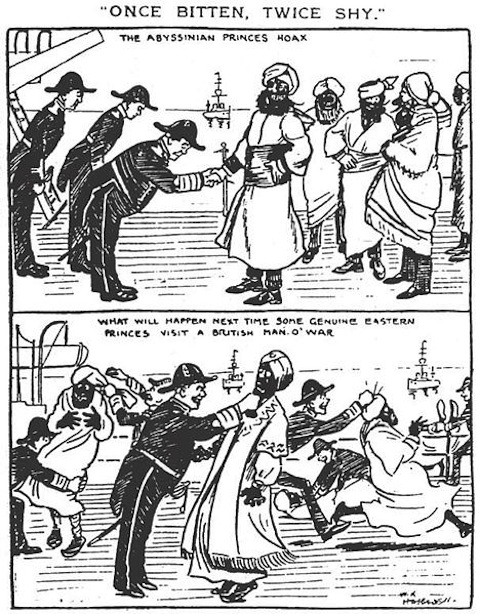
In a recently discovered letter, Cole wrote to a friend that the hoax was “glorious” and “shriekingly funny.” The group intended to mock what they saw as an outmoded Victorian imperialism, and they succeeded, at least in the popular press. The Mirror published the cartoon above and the Royal Navy was a laughingstock for weeks afterward. None of this pseudo-racist pranksterism (which reflected just as badly on the officers) struck the actual Emperor of Ethiopia—Menelik II—as particularly funny. When he visited England later that year, he was taunted in the streets by children shouting “Bunga! Bunga!” and denied permission to inspect the navy’s fleet for fear that his visit might cause further embarrassment.
Related Content:
F. Scott Fitzgerald in Drag (1916)
Josh Jones is a writer and musician based in Washington, DC. Follow him at @jdmagness
Read More...Teacher Wears Same Groovy Outfit In Yearbook Photo 40 Years Straight
In 1973, Dale Irby, a teacher at Prestonwood Elementary in Dallas, decided to wear a polyester shirt and coffee-colored sweater for school-picture day. Without realizing it, he wore the same outfit the following year. According to the Dallas News, Dale’s wife noticed the emerging trend and dared him to do it a third year. And then they figured, ‘Why stop?’ The tradition continued 40 years in total, until Dale and his outfit retired this year.
via Mashable
Read More...Chinese Artist Ai Weiwei Releases a “Heavy Metal” Song & Video Recalling His Harsh Imprisonment
Burly Chinese artist and dissident Ai Weiwei has never lost his sense of humor, even when facing harsh repression from his government. But while the idea of 55-year old Ai recording a heavy metal record might seem like a stunt, the source material for his first single, “Dumbass” (above), is anything but funny. The furiously angry, expletive-filled song is inspired by Ai’s harsh treatment during his 81-day imprisonment in 2011. He’s calling the musical project “a kind of self-therapy” and will release six tracks on June 22—the second anniversary of his release—as an album called The Divine Comedy.
Ai sings (or howls, growls, and bellows) in Chinese. As you can see from the grim images in the video above—with the artist re-enacting and re-imagining his experiences in detention—the memories of his incarceration are still raw and painful. While he’s called his music “heavy metal,” The Guardian points out that “it’s not exactly Metallica” (unless you count that Lou Reed collaboration). Ai himself says of his sound:
After I said it would be heavy metal I ran back to check what heavy metal would be like. Then I thought, oh my god, it’s quite different…. So it’s Chinese heavy metal, or maybe Caochangdi [where his studio is based] heavy metal.
Call it what you want: Chinese heavy metal, practical joke, avant garde performance piece… it’s still likely to get Ai in even further trouble with Chinese authorities. As he explained to the New York Times, however, he “wanted to do something impossible…. I wanted to show young people here we can all sing…. It’s our voice.”
Related Content:
Who’s Afraid of Ai Weiwei: A Short Documentary
Ai Weiwei’s Parody of ‘Gangnam Style’
Josh Jones is a writer and musician based in Washington, DC. Follow him at @jdmagness
Read More...The Physics of Mosh Pits at Heavy Metal Concerts (Explained by Cornell Grad Students)
Speaking at the American Physical Society last month, Matthew Bierbaum, a Cornell grad student, presented a talk called “Collective Motion at Heavy Metal Concerts,” where he made the case that physics is everywhere, even in a mosh pit at a heavy metal show. Along with three other Cornell researchers, Bierbaum has analyzed and modeled the collective motions of moshers in various YouTube concert videos (like the one below) and discovered that “dancers collide with each other randomly and at a distribution of speeds that resembles particles in a two-dimensional gas,” writes Lauren Wolfe in Chemical & Engineering News.
To try and understand what’s happening in mosh pits, the researchers used a flocking-based simulation that helps “model living beings as simple particles, reducing complex behavioral dynamics to a few basic rules,” says Itai Cohen, the head of the research team. From this study, the Cornell team hopes to learn more about how seemingly chaotic crowds behave, and how smarter exit routes and evacuation strategies can be designed.
You can learn more about their research by perusing the team’s published paper “Collective Motion of Moshers at Heavy Metal Concerts” or by watching Bierbaum’s aforementioned presentation in the grainy video below below.
If you would like to support the mission of Open Culture, consider making a donation to our site. It’s hard to rely 100% on ads, and your contributions will help us continue providing the best free cultural and educational materials to learners everywhere. You can contribute through PayPal, Patreon, and Venmo (@openculture). Thanks!
Related Content:
The Physics of Coffee Rings Finally Explained
Physics from Hell: How Dante’s Inferno Inspired Galileo’s Physics
Michio Kaku Explains the Physics Behind Absolutely Everything
Read More...Support Us
We're hoping to rely on loyal readers, rather than erratic ads. Please click the Donate button and support Open Culture. You can use Paypal, Venmo, Patreon, even Crypto! We thank you!

About Us

Open Culture scours the web for the best educational media. We find the free courses and audio books you need, the language lessons & educational videos you want, and plenty of enlightenment in between.
Advertise With Us

FREE UPDATES!
GET OUR DAILY EMAIL
Get the best cultural and educational resources on the web curated for you in a daily email. We never spam. Unsubscribe at any time.
FOLLOW ON SOCIAL MEDIA

Open Culture editor Dan Colman scours the web for the best educational media. He finds the free courses and audio books you need, the language lessons & movies you want, and plenty of enlightenment in between.
Advertise With Us

