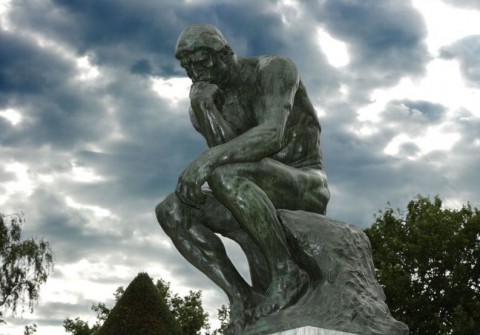
Once beauty, now farce. h/t @opedr
Related Content:
Getz and Gilberto Perform ‘The Girl from Ipanema’
Once beauty, now farce. h/t @opedr
Related Content:
Getz and Gilberto Perform ‘The Girl from Ipanema’
The Mercedes-Benz Museum in Stuttgart, Germany, is a remarkable structure. Designed by Ben van Berkel and Caroline Bos of the Dutch firm UN Studio, the building received rave reviews when it opened in May of 2006. Influenced by Frank Lloyd Wright’s Guggenheim Museum in New York, the building was described as “jet-age baroque” by The Guardian architecture critic Jonathan Glancey. “It twists and turns with breathtaking complexity,” Glancey wrote in 2006, “clever as a conjuring trick.”
The architects needed a bit of magic to bring the museum’s open plan into compliance with fire codes. Like in the Guggenheim, the interior is one continuously unfolding space that spirals around a central atrium. As a consequence there could be no fire doors to contain smoke if a blaze broke out in one section of the building. To solve the problem, UN Studio hired the engineering firm Imtech to design a system that would draw smoke away from all areas of the museum, allowing people to escape.
The result is the world’s largest man-made air vortex, a 112-foot-high tornado that automatically activates in the event of a fire, drawing smoke into the center of the atrium and moving it upward through an axial fan in the ceiling. An array of 144 outlets in the surrounding walls emit powerful jets of air to generate a central region of low pressure, just like in a real tornado. Imtech engineers perfected the design using computational fluid dynamic (CDF) simulations and laboratory models. The firm has created similar systems for airports in several German cities, including Düsseldorf and Hamburg. You can watch the tornado at the Mercedes-Benz Museum in action above.
Related Content:
Infinity. It’s a puzzling concept. Is it real, or a mathematical fiction?
Aristotle believed infinity could only be potential, never actual. To speak of an actual infinity, he argued, is to fall into logical contradiction: “The infinite turns out to be the contrary of what it is said to be,” Aristotle wrote in the Physics. “It is not what has nothing outside it that is infinite, but what always has something outside it.”
Aristotle’s logic rested on common sense: the belief that the whole is always greater than the part. But in the late 19th Century, Georg Cantor and Richard Dedekind turned common sense upside down by demonstrating that the part can be equal to the whole. Cantor went on to show that there are many orders of infinity–indeed, an infinity of infinities.
But what relation does the Platonic realm of pure mathematics have to the physical world? Physics is an empirical science, but that hasn’t stopped theorists from imagining the mind-boggling consequences of an infinite universe. To Infinity and Beyond, a one-hour BBC Horizon special featuring interviews with leading mathematicians and physicists, is an entertaining exploration of a subject which, by definition, you won’t be able to wrap your mind around.
Related Content:
Dangerous Knowledge: 4 Brilliant Mathematicians & Their Drift to Insanity
Futurist Arthur C. Clarke on Mandelbrot’s Fractals
Mathematics in Movies: Harvard Prof Curates 150+ Scenes
3,000,000 tourists move through Venice each year. The flood starts during the spring and peaks in summer, then recedes during the cooler months, giving the local residents a little peace. True, the city, made up of 124 islands, 183 canals and 438 bridges, is radiant during the summer. (Just watch below.) But the “Queen of the Adriatic” takes on a different beauty in the winter, something that a tourist, who simply goes by FKY, captures in an artful video above. Enjoy, and if you want to know more about the architectural wonders of this 1500-year-old city, don’t miss How Venice Works.
Two weeks ago, we mentioned that Stanford will be rolling out seven new courses in its experiment with online learning. Fast forward to today, and yet another seven courses have been added to the winter lineup, bringing the total to 14.
Immediately below, you’ll find the latest additions. All of these courses feature interactive video clips; short quizzes that provide instant feedback; the ability to pose high value questions to Stanford instructors; and feedback on your overall performance in the class.
Courses start in January and February. Enroll today for free. And, if something doesn’t pique your interest below, don’t miss our big list of 400 Free Online Courses.
Newly added:
Technology Entrepreneurship
Making Green Buildings
Anatomy
Information Theory
Design and Analysis of Algorithms I
The Lean Launchpad
Cryptography
Originally mentioned:
Computer Science 101
Software Engineering for SaaS
Human Computer Intereaction
Natural Language Processing
Game Theory
Probabilistic Graphical Models
Machine Learning
More Free Courses from Top Universities
Yale Rolls Out 10 New Courses – All Free
MIT Introduces Complete Courses to OpenCourseWare Project
Harvard Presents Free Courses with the Open Learning Initiative
Next up: a lovely film about a lonely desk toy that longs for adventure. Observing the space around him, a robot finds a toy car and heads off on a road trip across the United States, guided only by Google Maps Street View. We start on the Brooklyn Bridge and finish on the Pacific Coast Highway in California. Parts of the video look like sequences from a Pixar film, they are so well made. In reality, the film was produced, animated, filmed, lit, edited and graded by one person: Tom Jenkins.
A great treat to start the week.
via Flowing Data
Eugene Buchko is a blogger and photographer living in Atlanta, GA. He maintains a photoblog, Erudite Expressions, and writes about what he reads on his reading blog.
During the past two years, the films of Andrei Tarkovsky have quietly come online, giving viewers the chance to encounter the Soviet director’s great body of work. If you’re not familiar with Tarkovsky, it’s worth mentioning that Ingmar Bergman considered him his favorite director, and Akira Kurosawa once said, “Every cut from his films is a marvelous image in itself.” The list of available films now includes:
(Note: If you access the films via YouTube, be sure to click “CC” at the bottom of the videos to access the subtitles.)
You can thank Mosfilm, the oldest film studio in Russia, if not Europe, for bringing these films to the web. If you head to Mosfilm’s YouTube Channel, you can watch more than 50 Russian classics, including Sergei Bondarchuk’s 1969 adaptation of Tolstoy’s War & Peace, a film that Roger Ebert called “the definitive epic of all time.” In a concession to Western capitalism, each film is preceded by a short commercial, proving yet again that there’s no such thing as a truly free lunch.
Finally, don’t miss our collection of 1100 Free Movies Online, which features six films by Sergei Eisenstein, Russia’s pioneering filmmaker and film theorist: Strike, Battleship Potemkin, Romance Sentimentale, October: Ten Days That Shook the World, Old and New and Alexander Nevsky. They’re all there.
Related Content:
Ingmar Bergman Visits Dick Cavett, 1971
The Kurosawa Digital Archive
Random thoughts: Has the White House (save last summer’s earthquake) ever been rocked this hard? And has a rock ‘n roll crowd ever been this restrained? Let’s face it, the rebelliousness of rock and the formality of high government make for a funny fit. But that doesn’t take anything away from Grohl’s little gig, and don’t miss my favorite performance from that night: Elvis Costello singing Penny Lane with a member of the United States Marine band on the piccolo trumpet.
Related Content:
The Beatles’ Rooftop Concert: The Last Gig
The Beatles: Why Music Matters in Two Animated Minutes
Jimmy Page Tells the Story of Kashmir
Terry Gilliam has never tried to hide his feelings about Hollywood. “It’s an abominable place,” he told The New York Times in 2005. “If there was an Old Testamental God, he would do his job and wipe the place out. The only bad thing is that some really good restaurants would go up as well.”
One thing that bothers Gilliam about Hollywood is the pressure it exerts on filmmakers to resolve their stories into happy endings. In this interesting clip from an interview he did a few years ago with Turner Classic Movies, Gilliam makes his point by comparing the work of Steven Spielberg–perhaps the quintessential Hollywood director–with that of Stanley Kubrick, who, like Gilliam, steered clear of Hollywood and lived a life of exile in England. Kubrick refused to pander to our desire for emotional reassurance. “The great filmmakers,” says Gilliam, “make you go home and think about it.”
If you would like to sign up for Open Culture’s free email newsletter, please find it here. It’s a great way to see our new posts, all bundled in one email, each day.
If you would like to support the mission of Open Culture, consider making a donation to our site. It’s hard to rely 100% on ads, and your contributions will help us continue providing the best free cultural and educational materials to learners everywhere. You can contribute through PayPal, Patreon, and Venmo (@openculture). Thanks!
Related Content:
Terry Gilliam (Monty Python) Shows You How to Make Your Own Cutout Animation
Stanley Kubrick’s List of Top 10 Films (The First and Only List He Ever Created)
The Best Animated Films of All Time, According to Terry Gilliam
In 1961, John F. Kennedy asked a lot of the U.S. space program when he declared: “I believe that this nation should commit itself to achieving the goal, before this decade is out, of landing a man on the Moon and returning him safely to the Earth.” NASA hit that ambitious target with a few months to spare. On July 20, 1969, the Apollo 11 landed on the moon and Neil Armstrong and Buzz Aldrin took their famous first steps on the desolate lunar surface. The original video is grainy, hard to see. But the photos taken during the mission are anything but. To celebrate the 40th anniversary of the moon landing (back in 2009), the folks at SpaceRip stitched together a collection of high resolution photos from the Apollo 11 mission, then set the slideshow to Chopin’s Trois nouvelles études, 2nd in A flat major. You can find this clip housed in our collection of Great Science Videos.
Related Content:
Touring the Earth from Space (in HD)
The Best of NASA Space Shuttle Videos (1981–2010)
Fast forward to the 47 second mark if you want to cut straight to the action.
Werner Herzog moved to the United States in the mid 1990s. He tried living in San Francisco, but found it “too chic and leisurely.” He gave thought to New York, but realized it is “only a place to go [to] if you’re into finances.” Looking for “a place of cultural substance,” he ended up in Los Angeles. The city is “raw, uncouth and bizarre,” but it’s a place of substance,” he concluded.
By 2006, Herzog discovered that L.A. also has a little danger going for it. During an interview with BBC critic Mark Kermode, the filmmaker took a shot from an unknown gunman armed with an air rifle. No matter. Kermode and Herzog quickly relocated and continued the interview. The unflappable Herzog shrugged off the shooting, simply saying “It was not a significant bullet. I am not afraid.”
If you would like to sign up for Open Culture’s free email newsletter, please find it here. It’s a great way to see our new posts, all bundled in one email, each day.
If you would like to support the mission of Open Culture, consider making a donation to our site. It’s hard to rely 100% on ads, and your contributions will help us continue providing the best free cultural and educational materials to learners everywhere. You can contribute through PayPal, Patreon, and Venmo (@openculture). Thanks!
Related Content:
Werner Herzog: Movies Won’t Change the World
Werner Herzog Reads “Go the F**k to Sleep” in NYC (NSFW)
Werner Herzog Loses a Bet to Errol Morris, and Eats His Shoe (Literally)