What if you took great works of art, stacked them side by side, and had them tell a story? You’d have a decidedly artful video … and a great teaser for the new artCircles iPad app that brings you collections of images curated by well-known figures including Yves Behar (named one of the “World’s 7 Most Important People in Design”) and John Maeda (president of Rhode Island School of Design). The app is free on iTunes, and if you pick up the new iPad with retina display, you can see where the device really excels. Or at least that was my experience when I gave it a spin.
And while we’re on the topic, here’s another free app worth checking out: “The Life of Art.” Produced by the Getty Museum in LA, the “Life of Art” gives users a chance to understand how objects end up in a museum in the first place. Photography, animations, video, and 360 degree rotations narrate the artistic lives of these objects. Find the app here. H/T Kottke
If you’ve listened to the past decade’s conversations about food, you’ll have noticed that eating, always a pursuit, has suddenly become a subject as well. One flank of this movement of enthusiasts has taken up Michael Pollan, a professor at UC Berkeley’s journalism school, as its leading light. Whether they agree or disagree with his principles, intellectually engaged eaters who don’t have at least a basic familiarity with Pollan’s books such as The Omnivore’s Dilemma and In Defense of Food can hardly consider themselves conversant in the food questions and controversies of the day.
Both Pollan’s potential boosters and detractors alike can get themselves up to speed with his latest volume, Food Rules: An Eater’s Manual, which boils down his culinary weltanschauung into a series of simple sentences, including “Eat foods made from ingredients that you can picture in their raw state or growing in nature,” “Pay more, eat less,” and, “The whiter the bread, the sooner you’ll be dead.” Pollan also takes positions on entirely gnarlier issues, such as the efficiency (or lack thereof) of agribusiness, and that’s when animators like Marija Jacimovic and Benoit Detalle provide their enlivening services. In the two-minute video above, Jacimovic and Detalle use pieces of actual food to illustrate Pollan’s critique of large-scale food production.
Note: Are you a writer interested in educational technology and open educational resources? And, do you want to write for Open Culture? Then drop us a line.
As the sun’s 11-year cycle of magnetic storms moves closer to peak intensity sometime early next year, people who live at higher latitudes can expect to see colorful auroras lighting up the night sky. But what would it be like to look down at the auroras, or to move through them? In these striking images from NASA, we find out. Astronaut Don Pettit has been orbiting the Earth since December, as a Flight Engineer for International Space Station Expedition 30, and while up there he’s been taking advantage of the increased solar activity by filming some of the fireworks in the Earth’s magnetosphere. “We can actually fly into the auroras,” Pettit says in this NASA ScienceCast. “It’s like being shrunk down and put inside of a neon sign.” To learn more, you can read the article at NASA Science News, and to watch other episodes in the series, visit the ScienceCasts home page. Find more excellent clips in our collection of Great Science Videos.
Bill Murray, surely both America’s most and least approachable movie star, seems for almost everything yet unavailable for almost anything. Rarely granting interviews, limiting himself (mostly) to roles he actually cares about, and famously working without an agent, he tends to pop up in places you wouldn’t expect him to. Well, aside from Wes Anderson films, where he’s remained a consistent presence since 1998’s Rushmore — but remember how startling it felt to see the star of Groundhog Day turn up in such a relatively small-scale, low-concept, genreless production in the first place? More recently, his extended cameo in Ruben Fleischer’s Zombieland has become, in the fullness of time, that picture’s very raison d’être. Not long before that, he appeared in a selection at the 2008 Sundance Film Festival: it wasn’t the latest feature from a Wes Anderson or a Sofia Coppola or a Jim Jarmusch, and in fact not a feature at all, but Peter Karinen and Brian Sacca’s short FCU: Fact Checkers Unit.
Karinen and Sacca star as two lowly fact-checkers at Dictum, a publication solidly in the tradition the United Kingdom calls “lads’ mags.” (“SEX WORK OUTS,” insists one cover blurb.) Faced with a draft of an article on celebrity sleeping tips that recommends drinking a glass of warm milk before bed, “like Bill Murray,” the fellows kneel before a shrine to Alex Trebek — their personal god of facts — don their Fact Checkers Unit windbreakers, and go looking for Murray’s house. Sensing their stumbling presence, Murray finds our heroes huddled in the bathtub almost immediately after they’ve broken in. True to his reputation, Murray has not been easy to find, but true to his public persona, he proves placidly willing and able to hang out when found. After an evening of M*A*S*H, martinis, checkers, and lounge singing, the FCU boys discover the truth about Bill Murray and milk. I won’t, er, spoil it.
I can’t help but admire this casting coup; Karinen and Sacca must have gone through just as much hassle as the FCU did to find Bill Murray. (That, or they happened to know him through some coincidental connection none of us could ever replicate.) Even more impressive, in its way, is how they seemingly crafted the structure of FCU: Fact Checkers Unit to accommodate whichever hard-to-come-by celebrity they could have managed to come by. Perhaps a bigger fan than I knows of some deep, long-established connections between Bill Murray, lad’s mags, M*A*S*H, and warm milk, but nothing stops me from imagining the Kevin Spacey version. In fact, I’d like to see the Kevin Spacey version. Insert a new celebrity each week while holding all else equal, and the concept could become an avant-garde web series.
You can find this film listed in our collection of Free Movies Online.
It’s not hard to jump online and learn about Albert Einstein’s intellectual contributions. Thanks to Yale, you can get a 60 minute primer on Einstein’s theoretical work. It’s called Einstein for the Masses. Or you can embark upon a longer, 10-lecture exploration of Einstein’s groundbreaking ideas (iTunes – YouTube) with Leonard Susskind, a Stanford professor known for his own groundbreaking work on String Theory.
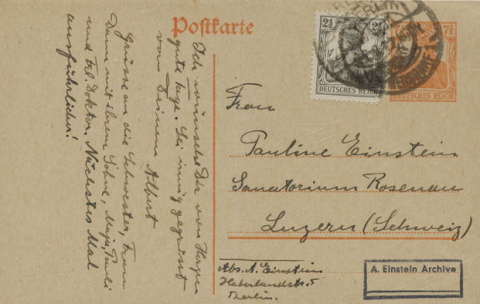
And then there’s this: Starting this week, the Hebrew University of Jerusalem is bringing online an extensive archive of papers and letters belonging to the great humanist and scientist. The collection currently features 2,000 documents and will eventually surpass 80,000. And it all gives a rounded view of Einstein’s life and work. The documents shed light on his personal relationship with his mother, wife and many mistresses; his views on the Arab-Israeli conflict; and his work on physics itself. A quick way to sample the archive is to enter this gallery, where, among other things, you’ll find Einstein’s manuscript introducing his famous equation, e=mc2.
We’ve always had the desire to leave our earth-bound bodies and take flight with the birds. We achieved the miracle of flight over a century ago. But only recently did we create a robot that can mechanically reproduce the beauty of birds in flight. And now we’ve taken the next step, actually joining birds high in the air. Above you can watch ParaHawking in action, a fusion between falconry and paragliding that lets you interact with birds of prey in their own environment. It all takes place in Nepal. And it’s all part of an effort to conserve Asia’s threatened vulture population. Learn more about these conservation efforts and ParaHawking itself at, of course, Parahawking.com.
And if you want to see what happens when a paraglider (not affiliated with this project) accidentally runs into an eagle, watch below:
Eons ago, we brought you Tom Waits reading Charles Bukowski’s poem “The Laughing Heart” in his ever so distinctive gravelly voice. Today, we’re heading to the other end of the rock audio spectrum. We’re bringing you Bono — short, of course, for the Latin “Bonovox,” or “Good Voice” — reading two poems by Bukowski, the poet once called the “laureate of American lowlife” by Pico Iyer. That’s because Bukowski made the ordinary lives of poor Americans and their many travails the subject of his poetry.
First up comes “Roll the Dice,” a poem from the collection, What Matters Most is How Well You Walk Through the Fire (1999). Next, “The Crunch,” published in Love is a Dog From Hell (1977). Both Bono readings originally appeared in the 2003 Bukowski documentary Born Into This. You can find the film listed in our collection of Free Movies Online (in the Documentary section), and also more Bukowski readings in our big list of Free Audio Books.
If you would like to support the mission of Open Culture, consider making a donation to our site. It’s hard to rely 100% on ads, and your contributions will help us continue providing the best free cultural and educational materials to learners everywhere. You can contribute through PayPal, Patreon, and Venmo (@openculture). Thanks!
Earlier this month, we posted a pair of Wes Anderson-directed television commercials advertising the Hyundai Azera. While I understood that, at one time, a known auteur using his cinematic powers to pitch sensible sedans would have raised hackles, I didn’t realize that it could still spark a lively debate today. Seeing as Open Culture has already featured commercials by the likes of David Lynch, Frederico Fellini, Ingmar Bergman, and Jean-Luc Godard — and I couldn’t resist linking to Errol Morris’ when discussing El Wingador — I assumed any issues surrounding this sort of business had already been settled. On Twitter, the New Yorker’s Richard Brody, author of a hefty tome on Godard, seemed to corroborate this conclusion: “Bergman made commercials, so did Godard; the more distinctive the artist, the less the artist need worry about it.” “Also,” the Chicago Sun-Times’ Jim Emerson tweeted, “the, concept of “sellout” no longer exists.”
From all the ensuing back-and-forth between critics and cinephiles emerged Brody’s New Yorker blog post, “Wes Anderson: Classics and Commercials.” Pointing out that “so many great paintings were made for popes and kings and patrons, and great buildings sponsored by tycoons and corporations,” Brody finds that “the better and stronger and more distinctive the artist, the more likely it is that anything he or she does will bear the artist’s mark and embody the artist’s essence. Those who are most endangered by the making of commercials (of whatever sort in whatever medium) are those whose abilities are more fragile, more precarious, more incipient, less developed.” But a dissenting voice appears in the comment section: “The reason that Godard and Anderson can make commercials that feel more like short films is not so much because their talents are more developed; it’s because their reputation is more secure. [ … ] It would be better to regard these commercials as short films financed by a company’s patronage (with a few strings attached) than as commercials proper.”
An even more forceful objection comes from Chris Michael in the Guardian: “Is it worth remaining sceptical about art made in the direct service of a sales pitch? I think it is. Does it cheapen your talent to consistently sell its actual goals to the highest bidder? I think it does. When the goal or persuasive intent does not ‘resonate with audience in meaningful way’, but rather ’employ style to conflate love for artist with love for product’, there’s a genuine, full-frontal, non-imaginary assault on the integrity of the art’s meaning. Better to ask: What meaning? What art? Taking it further, can a car ad ever be art?” When Slate’s Forrest Wickman entered the fray, he hauled a Darren Aronofsky-directed Kohl’s spot in with him to demonstrate that “that there is such a thing as selling out,” comparing it unfavorably with Anderson’s ads as “nothing more than a second-rate ripoff, a cheap copy of ads and music videos past.”
Michael remains unimpressed: “Aronofsky really sold out least: by not prostituting his style and delivery, by not wrapping anything of himself around a dull car or department store, by just doing the job for the money like a professional. That, I can respect.” Responding, Brody holds fast in defense of Anderson’s ads, one of which he calls “a feat of astonishing psychological complexity. “These little films, which happen to be commercials for a car,” he writes, “share not only the style but also the content, the theme, and the emotional and personal concerns, of Anderson’s feature films. Yes, they’re short. Yes, there’s a difference between what can be developed in two hours and what can be developed in thirty seconds—it’s the difference between a poem and a novel, between a song and an opera.” Has Wes Anderson sold out? Is selling out still be possible? As in everything, dear reader, the task of weighing the evidence and making the decision falls ultimately to you.
“Nobody’s dreaming about tomorrow anymore,” says astrophysicist Neil deGrasse Tyson in this compelling little video on the decline of the American space program. “After we stopped going to the moon, it all ended. We stopped dreaming.” The video was put together by Evan Schurr with material from various sources. In it, Tyson asks us to imagine the possibilities for tomorrow if NASA’s budget were increased to just one penny for every tax dollar. It’s a point he raised earlier this month before a U.S. Senate committee (read the full testimony here), when he said:
The 2008 bank bailout of $750 billion was greater than all the money NASA had received in its half-century history; two years’ U.S. military spending exceeds it as well. Right now, NASA’s annual budget is half a penny on your tax dollar. For twice that–a penny on a dollar–we can transform the country from a sullen, dispirited nation, weary of economic struggle, to one where it has reclaimed its 20th century birthright to dream of tomorrow.
We're hoping to rely on loyal readers, rather than erratic ads. Please click the Donate button and support Open Culture. You can use Paypal, Venmo, Patreon, even Crypto! We thank you!
Open Culture scours the web for the best educational media. We find the free courses and audio books you need, the language lessons & educational videos you want, and plenty of enlightenment in between.