Sophocles and Aeschylus may be spinning in their graves. Or, who knows, they may be taking some delight in this bizarre twist on the Oedipus myth. Running eight minutes, Jason Wishnow’s 2004 film puts vegetables in the starring roles. One of the first stop-motion films shot with a digital still camera, Oedipus took two years to make with a volunteer staff of 100. But the hard work paid off. The film has since been screened at 70+ film festivals and was eventually acquired by the Sundance Channel. Separate videos show you the behind-the-scenes making of the film, plus the storyboards used during production.
Steve Duncan is an urban historian and photographer whose mission is to “peel back the layers of a city to see what’s underneath” – to piece together the complex cities we inhabit. In this fascinating video, we follow Duncan as he explores the underbelly of New York City. Andrew Wonder, using a Canon 5D Mark II and the Canon 24mm f/1.4L lens, documents the adventure. The sensory experiences must be extraordinary, as Alan Feuer (who accompanied Steve and Andrew on one of their trips) writes in the New York Times:
The sounds down here are even more impressive than the sights and smells: the Niagara-like crash of water spilling in from side drains; the rumble of the subway; the guh-DUNK! of cars hitting manhole covers overhead, like two jabs on a heavy bag.
For more, I highly recommend reading the NPR story, “Into the Tunnels.” Also worth seeing are Duncan’s photos of New York City bridges and the underground rivers of London. The video above has a run time of 28 minutes.
Follow us on Facebook and Twitter and share intelligent media with your friends. Or better yet, sign up for our daily email and get a daily dose of Open Culture in your inbox. And if you want to make sure that our posts definitely appear in your Facebook newsfeed, just follow these simple steps.
Last week, MIT OpenCourseWare officially released its LectureHall iPhone app. Put simply, the free app gives you mobile access to MIT video lectures. It even lets you download lectures straight to your phone (handy for times when you may not have connectivity). Another plus: the LectureHall iPhone app adds a social dimension to the learning experience. Facebook integration, discussion forums, ratings & reviews of individual videos – they’re all layered in. And, just in case you’re wondering, an Android version of the LectureHall app is in the works.
Now a quick plug: Feel free to download our Free iPhone app, which includes free audio books, online courses, foreign language lessons, and intelligent podcasts. Or, better yet, simply visit Open Culture with your smart phone and get lots of smart media wherever you go…
On James Dean’s 80th birthday, this film probably deserves its own little mention. The James Dean Story, a 79 minute documentary chronicling the life and times of Jimmy Dean, came out two years after the young actor’s death in 1955. Most notably, the film was directed by Robert Altman, a young director who would eventually make MASH, Nashville, The Player, Gosford Park, etc. It’s also catalogued in our collection, 4,000+ Free Movies Online: Great Classics, Indies, Noir, Westerns, Documentaries & More.
If you would like to support the mission of Open Culture, consider making a donation to our site. It’s hard to rely 100% on ads, and your contributions will help us continue providing the best free cultural and educational materials to learners everywhere. You can contribute through PayPal, Patreon, and Venmo (@openculture). Thanks!
James Dean starred in only three major films – Rebel Without a Cause, East of Eden, and Giant – before perishing in a car accident on Route 466, near Cholame, California in September 1955. (A free documentary covers that.) A star died at 24. Meanwhile, a legend forever embodying youth was born.
PS Today is also Jules Verne’s 183rd birthday. If you’re looking for his classics – Around the World in 80 Days or 20,000 Leagues Under the Sea – you can find them in our Free Audio Books and Free eBooks collections.
When Sir Arthur Conan Doyle first conceived of Sherlock Holmes in 1887, he probably didn’t anticipate that the “consulting detective” would become the world’s favorite fictional investigative logician and eventually infiltrate everything from academic curricula to Hollywood. Just last year, the BBC produced a fantastic three-part modernization of the classic, which according to many critics eclipsed Guy Ritchie’s effects-driven blockbuster of the same name, released several months earlier.
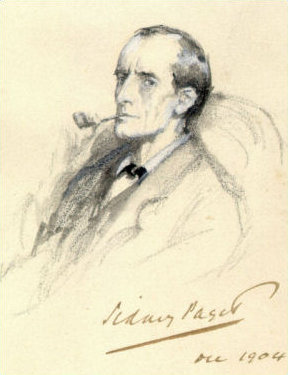
So massive and wide-reaching is the cult of Holmes that Stanford dedicated an entire project to the study of Sherlock Holmes. Discovering Sherlock Holmes features 12 of the greatest stories of the Sherlock Holmes canon from The Strand Magazine, where Sherlock first made his appearance, downloadable as free annotated, illustrated PDF’s. A historical essay on Holmes’ epoch contextualizes the stories and features rare vintage artwork by Sidney Paget, the original Sherlock illustrator.
Note: You can also find The Adventures of Sherlock Holmes in Open Culture’s collections of Free Audio Books and Free eBooks. Plus, the Free Movies collection houses three vintage Sherlock Holmes films — Dressed to Kill (1941), Sherlock Holmes and the Secret Weapon (1943) and Terror by Night (1946).
Maria Popova is the founder and editor in chief of Brain Pickings, a curated inventory of cross-disciplinary interestingness. She writes for Wired UK, GOOD Magazine and DesignObserver, and spends a great deal of time on Twitter.
Here we have the first aerial footage of an uncontacted tribe living in the Brazilian Amazon – a people living entirely apart from civilization as we know it. The short clip, filmed for the BBC show Human Planet, follows Jose Carlos Meirelles, who works on behalf of the Brazilian government to safeguard the country’s indigenous people. The livelihood of these indigenous peoples is constantly threatened by illegal mining and logging. And it’s Meirelles’s mission to protect this population by publicizing their existence. This footage was filmed at 1 KM distance with a long telephoto lens to minimize disturbance. To learn more about this and other uncontacted tribes, visit http://www.uncontactedtribes.org.
A quick fyi for TED heads in our audience: Right here, you can find an online spreadsheet that lists 875 TEDTalks, with handy links to each individual video. This evolving Google doc will give you access to more than 265 hours of “riveting talks by remarkable people.” Because the page is updated on a regular basis, you’ll definitely want to bookmark it and keep tabs on the new additions.
On a related note, TED has also just rolled out TEDBooks, a new digital book series that delivers powerful ideas in 20,000 words or less. That’s about 1/3 the length of a traditional book. TEDBooks are currently being sold for $2.99 through Amazon as “Kindle Singles.” You can learn more about the initiative on TED’s blog or via BrainPickings, or simply visit Amazon to preview the first three books in the series:
What would it look like if our great directors took creative control over the Super Bowl broadcast? Slate imagines it, showing you how Quentin Tarantino, David Lynch, Wes Anderson, Werner Herzog and Jean-Luc Godard would put their cinematic stamp on the broadcast. The clip gets better as it moves along…
Enjoy the big game. And, if movies are more your thing, don’t forget to visit our big list of 340 Free Movies Online. Films by some of the great directors mentioned above appear on the list.
What to do after the Apocalypse? This little public information film was made (wink, wink) by the “Australian Board of Civil Defence” during the early 1980s. Found somewhere in an old university archive, the film, now newly dusted off, is being shown for the first time. Note: It’s a tad unsafe for work…
If you would like to support the mission of Open Culture, consider making a donation to our site. It’s hard to rely 100% on ads, and your contributions will help us continue providing the best free cultural and educational materials to learners everywhere. You can contribute through PayPal, Patreon, and Venmo (@openculture). Thanks!
We're hoping to rely on loyal readers, rather than erratic ads. Please click the Donate button and support Open Culture. You can use Paypal, Venmo, Patreon, even Crypto! We thank you!
Open Culture scours the web for the best educational media. We find the free courses and audio books you need, the language lessons & educational videos you want, and plenty of enlightenment in between.
 When Sir Arthur Conan Doyle first conceived of Sherlock Holmes in 1887, he probably didn’t anticipate that the “consulting detective” would become the world’s favorite fictional investigative logician and eventually infiltrate everything from academic curricula to Hollywood. Just last year, the BBC produced a fantastic



